Showing posts with label Haganah. Show all posts

21 February 2026

What the Jewish Left Doesn’t Need is Advice that It has No Responsibility for What Zionism and Israel Has Done In Their Name

 A Reply to Shaul Magid’s Argument for Jewish Indifference to Genocide and an Evasion of Responsibility

Shaul Magid is a rabbi, Visiting Professor of Modern Jewish Studies at Harvard Divinity School, and Distinguished Fellow in Jewish Studies at Dartmouth College. Magid is also an opponent of Jewish anti-Zionism which he argues is irrelevant. Jews opposed to Zionism should turn in on themselves and ignore what is happening in their name.

In his article What Does the Jewish Left Want?, which is reprinted by Jewish Voice for Liberation, Magid argues that the Jewish left should ‘no longer focus on opposition to a state that many in the Jewish Left no longer support.’ In my response below I explain that if it doesn’t focus primarily on Zionism and the Israeli state, then this Jewish left is not only not a genuine left but it has no real purpose.

Shaul Magid

At a time when US and Western Imperialism is using Jewish people as its human shield, its moral alibi for support of the genocide in Gaza, to pretend that solidarity with the Palestinians and opposition to Zionism should be deprioritised is to do exactly what the Zionists want us to do.

It is to argue that Jews should become the bystanders to the slaughter in Gaza. Raul Hilberg excoriated, in Perpetrators, Victims and Bystanders, the ‘dull awareness’ and passive indifference of those who looked on as the Jews were exterminated in the holocaust, be they individuals or the Allied countries.

Hilberg spoke of the ‘human wall’ that bystanders had erected, of indifference and social isolation. What Magid is arguing is that Jews on the left should adopt a similar approach today. It is profoundly immoral.

Magid argued, in opposition to Jewish Voice for Peace’s statement adopting an explicitly anti-Zionist position, that they had ignored

a series of real “Zionist” possibilities where “justice and equality” were paramount.

What Magid really wants is to have his cake and eat it. His article is an exercise in self-indulgence. The real question is whether Jewish intellectuals have the courage and honesty to call Zionism out for what it is. Clearly Magid doesn’t possess that courage. Magid says

Many Jews who define themselves as anti-Zionist do not think the state of Israel should cease to exist. Rather, they contest Zionist hegemony.

If that is the case then they are not anti-Zionists and that is Magid’s problem.

For Magid the internal battle within the Jewish community takes precedence over genocide and ethnic cleansing. Is it any wonder that Palestinians get tired of this Jewish preciousness at a time when Palestinian children are being starved to death in the name of Zionism’s Jewish redemption?

If you are an anti-Zionist then Israel as a Jewish state must disappear. Not the people but the state. Israel must become normalised, like any other state. It must be a state of its own citizens, regardless of ethnicity or religion.

Magid accepts that Jewish anti-Zionists reject the idea that ‘Zionism is a requirement for legitimate Jewish identity in the twenty-first century.’’ But then he indulges in a semantic frivolity when he makes:

 ‘an important distinction... between Zionism and Israel. Israel is a country; Zionism is an ideology.’

No.  Zionism is the ideology of the Israeli state. It dictates the imperatives of Zionism, such as ethnic cleansing, Jewish racial purity, Jewish settlement at the Palestinians’ expense. This is a distinction without a difference.

What Magid demonstrates is that he rejects the special characteristic of Zionism as a settler colonial ideology whose aim was to achieve as pure a Jewish state as possible. In the words of Israel’s opposition leader, Yair Lapid:

“My principle says maximum Jews on maximum land with maximum security and with minimum Palestinians”

Quite amazingly Magid goes on to say, without so much as a flicker of awareness, that:

Like most countries Israel will choose how to govern according to will of its citizens, in Israel’s case, mostly, but not exclusively, its Jewish citizens (as those living under occupation have no political agency in the national polity), how to treat its minorities, how to deal with questions of justice and domination.

The whole point of anti-Zionism is that Israel is not like most countries. It is sui generis. Actually most countries don’t govern according to the will of their citizens but their elites and the capitalist ruling class. But let this pass. Magid is not a socialist.

In Israel’s case it pays no heed whatsoever to its Palestinian citizens. In Netanyahu’s words, ‘Israel is a state of its Jewish citizens not all of them’. That is why, being a Jewish state, it continues to dispossess what it calls Arab Israelis from their homes, in particular the destruction of the unrecognised villages of the Bedouin of the Negev such as Umm al-Hiran and Ras Jraba. Has Magid never heard of the policy of Judaisation of the Galilee and Negev, the Koenig Memorandum and Prawer Plan?

Does Magid think that there’s nothing of special interest in the fact that those living under occupation have no civil or political rights despite it being made clear that the West Bank will always remain part of Israel? Has he lost the ability to spell or even recognise the word Apartheid?

Magid quotes Joel Swanson’s assertion that

Historically, Zionism has never been one single concept. It has been a family of arguments, ... To say ‘Zionism’ without adjectives is already to erase its internal diversity.’

Here we really come to the crux of the argument. Shaul Magid’s illusion that there is a nice as well as a nasty Zionism. It is part of a ‘family’ that somehow along the way as it lost its focus or direction.

So let us spell it out for Shaul Magid who is blind to Zionism’s  racist reality. Zionism is what Zionism does. Zionism does not exist in the minds of a fragrant Jewish American Princess who still believes in fairy tales but in the settler attacks on Palestinian villages in the West Bank or the Death to the Arabs riots in Jerusalem each year.

Is there any difference between Herzog and Netanyahu, between Labour and Revisionist Zionism or did they merely argue about the means of achieving and maintaining a Jewish Supremacist state beholden to the West as an armed watchdog?

Magid clings to a Zionism that never existed. In fact cultural and socialist Zionism long ago disappeared in their own contradictions. Socialism is universal. Zionism is particularist. I realised that when I was 16 but Magid has yet to achieve political adolescence.

Magid points to a recent poll in which only a third of American Jews identify as Zionist whereas 88% support the concept of Israel as a Jewish and democratic state. Clearly there is confusion among American Jews as Israel has proven beyond doubt that it cannot be both Jewish and democratic. Always it is forced to take the former path and jettison the latter, as the Jewish Nation State Law has proved.

The reality is that this was always a dishonest slogan of the hypocritical Zionist ‘left’. When confronted with a choice Zionism always preferred the Jewish to the democratic. In the words of Ahmed Tibi, an Arab member of the Knesset, Israel is Democratic for Jews and Jewish for Arabs.

It is this which has allowed Jewish neo-Nazis to become the third largest bloc in the Knesset and for Itamar Ben Gvir to become Police Minister in Israel. It is this which has led to Israeli Police acting like SS storm troopers against Israel’s Palestinian citizens. Israel is a state where torture is the norm (for Palestinians).

Yes there is massive confusion among American Jews but rather than offering clarity Magid seeks to take advantage of that confusion with his ridiculous essay.

Magid says that ‘Zionism served as an escape mechanism for Jews trying to escape a Europe collapsing around them.’ No that is absolutely not true. Haganah sent Feivel Polkes to Nazi Germany to persuade the Gestapo not to allow Jewish emigration to any place but Palestine. In exchange he offered to collaborate with them.

As a result Professor Franz Six, a senior SS official and head of Department II in the SD Main Office, who was sentenced to 20 years imprisonment for war crimes in April 1948 wrote:

Pressure is being exerted on the Reich Deputation of the Jews in Germany in order to compel Jews emigrating from Germany to head only to Palestine and not to any other country.” [The Secret Contacts, Zionism and Nazi Germany, 1933-1941, Journal of Palestine Studies, Vol. 5 3/4 Spring/Summer 1976]

Ha’avara, the trade agreement between Nazi Germany and the Zionist movement, agreed in August 1933, not only broke the world-wide Jewish Boycott of Nazi Germany but it worsened the position for Jews trying to escape to other countries.

The Zionist movement consistently opposed rescue to any country bar Palestine. Magid fails to understand what has been called ‘cruel Zionism.’  See my book Zionism During the Holocaust (to purchase it contact me at tonygreenstein104@gmail.com).

Magid cites Yehiam Weitz’s article, “The Positions of David Ben Gurion and Yitzhak Tabenkin Vis-A-Viz the Holocaust of European Jewry” but has failed to understand it. Weitz cites Ben-Gurion on the Jewish refugee problem thus:

‘Both during the 1930s ... and during the second half of the 1940s, after the war's end - his position on this question was determined and indisputable; Ben-Gurion definitively and often crudely opposed ameliorating the position of Jewish groups by means other than their transfer to Palestine. He felt that any 'solution of the national problem outside of Eretz Israel, or ... solving the individual's distress by ignoring the national problem ... [means] undermining the foundations of Zionism and acting  as a temptation  which  every  Zionist  must  learn to  withstand completely.'

When it came to priorities Zionism and building the Jewish state came first. Weitz quotes Ben-Gurion’s notorious statement in the wake of Kristallnacht that if:

'it would be possible to save all the [Jewish] children in Germany by transferring them to England and only half of them by transferring them to Eretz Israel, I would choose the second possibility, because before us is not only the account of these children but the historical account of the Jewish people.’

In other words the interests of building the ‘Jewish’ state took precedence over saving Jewish children from Germany. Magid could also have mentioned Boas Evron’S, Jewish State or Israeli Nation and the fierce opposition to the Evian Conference, called by Eisenhower to solve the Jewish refugee question. Of course it did no such thing but the Zionist leadership were nonetheless frightened.

What Magid didn't mention was the identification with Israel of the far and even neo-Nazi right

Evron quotes the minutes of a meeting of the Jewish Agency Executive of 26 June 1938. Ben-Gurion was unremittingly hostile as he declared that

No rationalizations can turn the conference from a harmful to a useful one. What can and should be done is to limit the damage as far as possible.

A Russia member of the Zionist Executive Menachem Ussishkin was even more forthright

He hoped to hear in Evian that Eretz Israel remains the main venue for Jewish emigration. All other emigration countries do not interest him… The greatest danger is that attempts will be made to find other territories for Jewish emigration. [my emphasis]

These positions are quite clear in the essay he referred to yet Magid scrupulously refrains from mentioning the attitude of the Zionists to saving the Jewish refugees.

Magid asks Can the Jewish Left move beyond Zionism and anti-Zionism?’ and queries whether it can ‘no longer focus on opposition to a state that many in the Jewish Left no longer support?’

Thus missing out the whole point of why Jews on the left make opposition to Israel and Zionism a central focus of their work. Of course Magid knows the reason but refrains from spelling it out. Everything Israel does is in the name of the mythical ‘Jewish people’ and Jews. It is after all a self-proclaimed Jewish state.

It is therefore incumbent upon Jewish socialists and those who are genuinely on the Jewish left to say ‘Not in My Name’. The fact that Magid resiles from this suggests that his membership of the Jewish left is ephemeral.

Of course the Jewish left can do many other things but when being Jewish is one of the primary justifications given for imperialism’s support for Israel’s genocide and ethnic cleansing it is rank hypocrisy and cowardice not to make that a priority. If the Jewish left cannot focus on Zionism and its claim to represent Jews then it has no relevance.

Magid says that One of the fundamental differences between liberal Zionism and Jewish anti-Zionism is the exceptionalism that underlies the case of Israel’. That is of course true.  Liberal Zionists can, in theory, hold progressive positions on domestic American affairs but for Palestine there is an exception (Progressive Except Palestine). But that is increasingly untenable.

What Magid seems to be doing is providing a new way for this exceptionalism to operate by suggesting that Jews on the left simply avoid the issue altogether.

Why would Jews seek to avoid the one area where they have a contribution to make? Does he find it too uncomfortable? The difference between Magid and a self-declared Zionist is that he doesn’t openly defend the Apartheid state whereas ‘liberal’ Zionism does. Instead he makes excuses for it.

Jewish identity post-war has been forged in the crucible of Zionism. Jewish identity has changed for many a substitute religion. Without an alternative explicitly anti-Zionist Jewish identity Jewish identity become at best a self-indulgence and at worst an identity with genocide and racism.

Magid quotes Adi Ophir in his support:  to become non-Zionist one first must become anti-Zionist.” I wonder if Magid ever thought this through? How about saying that to become a non-racist one must first become an anti-racist. Perhaps our goal is to abstain from confronting racism? This is meaningless nonsense, verbal masturbation.

The fact is that for Jews non-Zionism is, at best, a half-way house to anti-Zionism. Of course being an anti-Zionist also means taking a position against US imperialism and its use of Jews as its moral alibi.

As a final flourish Magid says that

The land between the river and the sea remains the Jewish homeland and the Palestinian homeland. But the domination of one over the other will never yield the flourishing of either.

In this Magid could not be more wrong. He equates the oppressed with their oppressors. Palestine is the home of the Palestinians. It is not a Jewish homeland. My home is where I live, Britain. The United States is the home of millions of Jews. Israel is a settler colonial state that calls itself Jewish only in the racial and ethnic sense. Israel is a state of Jewish Supremacy where Jews, not Palestinians, exercise domination.

The eventual choice that Israeli Jews face is between becoming Jewish Palestinians or leaving. That was the choice that White South Africans faced and we should not make any exception for the Zionist settlers whose crimes far exceed those of White South Africans.

Tony Greenstein

12 September 2022

Why does the ‘only democratic state in the Middle East’ (Israel) sends Defence Ministry Agents to Archives in order to brow-beat them into hiding historical documents?

For nearly 20 years Israeli Arabs lived under military rule – not because they were a Fifth Column but to prevent them returning to the land that had stolen been from them
Haganah terrorists expelling Palestinian refugees from Haifa


Israel is a state that has been built on myths – whether it is that ‘god’ gave the settlers the land of the Palestinians or the fiction that in 1948, the Palestinians miraculously ran away on the orders of the Arab states in order that a Jewish state could be created. As Ilan Pappe, Benny Morris and other historians have demonstrated, the Palestinians left because they were forced to do so.
I have previously covered the topic of the desperate efforts of the Israeli state to prevent the truth emerging. This has taken the form of reclassifying documents that have been released to historians, presumably on the assumption that they were not copied and therefore any one quoting from them can’t prove that what they said is true.
At the end of this article in Ha’aretz, Adam Raz quotes the cynical comments of Yehiel Horev, the former director of the Malmab, the secretive Defence Ministry unit which is dedicated to rewriting the history of the Israeli military’s deeds. In an interview he made his purposes crystal clear:
“When the state imposes confidentiality, the published work is weakened… If someone writes that the horse is black, if the horse isn’t outside the barn, you can’t prove that it’s really black.”

Of course all nations based their identity on myths such as the tales of King Arthur and his knights. Israel’s national myths are not just about ancient tales of kings but about recent events where the evidence is crystal clear.  Myths that are national lies with the sole purpose of legitimising the theft of land.
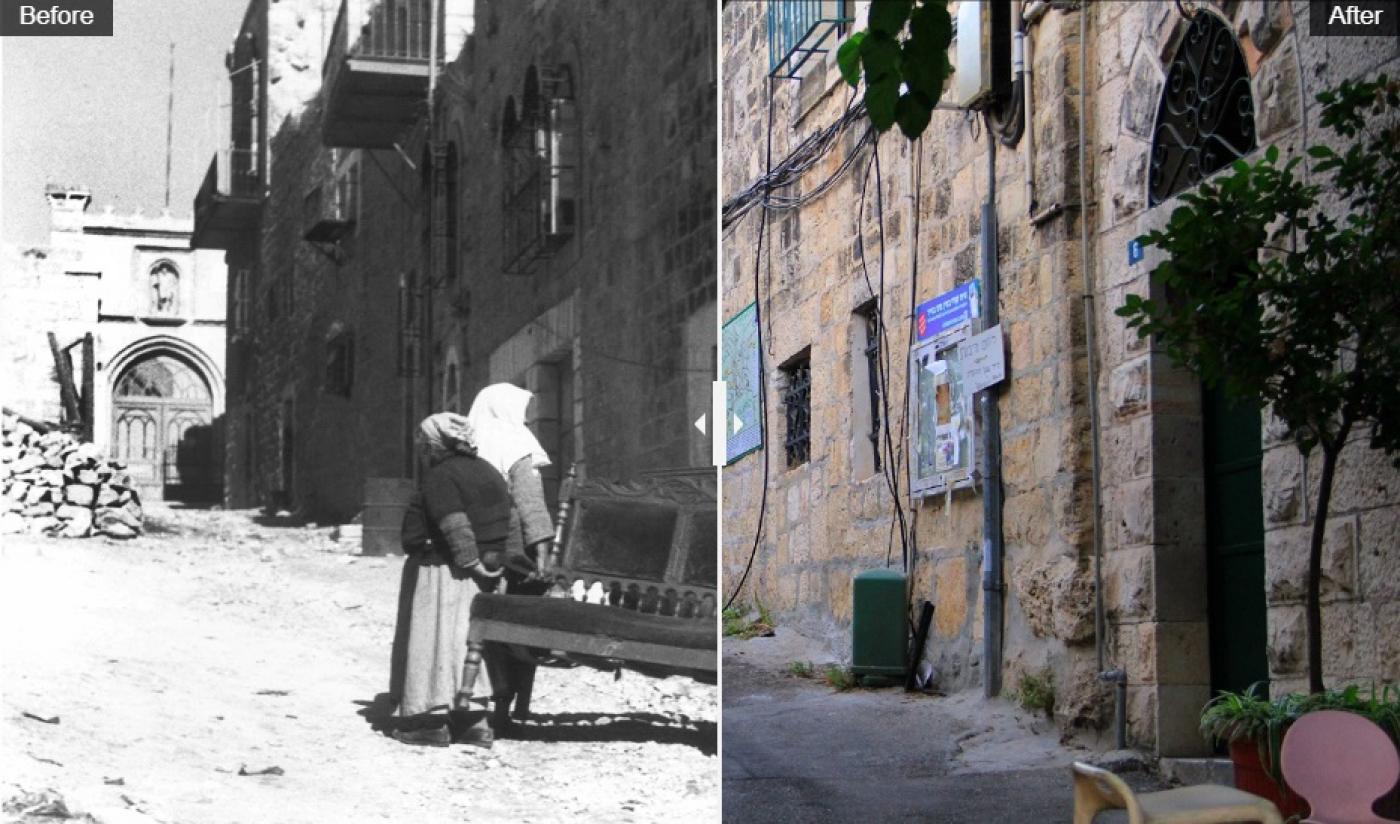
Before and after - the Palestinian Al Hambra cinema in 1937 and today a Church of Scientology centre
From 1949 to 1966 Israel’s Arab population was kept under military government. They could not leave their villages without permission. As is the case with everything in Israel the excuse was that the Arabs were a fifth column, a security threat.
We now know, as the article by Adam Raz explains, that this was never true and was not believed by the military establishment either. The purpose of military rule was in order to prevent Israel’s Arabs, who had often been displaced by the fighting from their villages, from returning to their land.
A law, the Absentee Property Law was passed in 1950 with the specific purpose of defining the property of persons who were expelled, fled or left the country after 29 November 1947 as well as their property (land, houses, bank accounts etc.), as “absentees”.

Property belonging to absentees was placed under the control of the Custodian for Absentees’ Property. The Absentees’ Property Law 1950 was the main legal instrument used by Israel to take possession of the land belonging to the internal and external Palestinian refugees.
Zionists loot a sofa from a Palestinian house (left) and today (right)
An Orwellian category Present-Absentees was created. You could be present in Israel, having not been expelled, and still be absent.  Even if you left your house in 1948 because of the fighting or you were forced out by the Haganah you were still counted as an Internally Displaced Person. Of course Israeli Jews who were forced to leave their homes faced no such prohibition.
It is estimated today that 1 in 4 Israeli Palestinians are Internally Displaced Persons. That lies at the root of inequality in Israel, an inequality emphasised by the Jewish Nation State Law that made ‘Jewish settlement’ into a national virtue.
Palestinians are not permitted to live in the homes they formerly lived in, even if they were in the same area, the property still exists, and they can show that they own it. [Tom Segev, 1949: The First Israelis, pp. 68-91].
However it was one thing to pass a racist law but it was another thing to implement that law. Israeli Palestinians desired nothing more than to return to where they were living but for Zionism, all wings of the Zionist movement including the ‘left’  Mapam, it was an article of faith that no Palestinian should ever return to their home even if they only moved a mile away for safety.
Thus it was that military rule was instituted over Israel’s Palestinian population.  By forbidding them to leave their villages without permission it made it that much easier to prevent unauthorised access to their previous homes. This was necessary because although Zionist settlers moved into their former villages this took time, not least because at that time there weren’t enough Zionist settlers.
Thus Israel was born in a fit of ethnic cleansing and today the job of Malmad and the Ministry of Defence is to keep documents of the time secret and hidden and to perpetuate the myth that the Palestinian refugees left of their own accord.
We should bear this in mind when Israel's racist Ambassador to London, Tzipi Hotoveli, states that the Nakba and the forcible expulsion and dispossession of the Palestinians in 1948 was an 'Arab lie'. It is a Zionist lie that there was no expulsion and the fact that that lie is written into Israeli law makes no difference whatsoever.
Tony Greenstein
A document unsealed after 60 years reveals the Israeli government’s secret intentions behind the imposition of a military government on the country’s Arab citizens in 1948: not to enhance security but to ensure Jewish control of the land
Top of Form
Bottom of Form
Top of Form
Bottom of Form
Jan 31, 2020 11:50 AM
Arabs awaiting a security check in Kfar Qasem, during the War of Independence.GPO

Israel’s defense establishment has for years endeavored to conceal historical documentation in various archives around the country, as was revealed in an article in Haaretz last July.
That article, which followed up on a study by the Akevot Institute for Israeli-Palestinian Conflict Research, noted that for closed to 20 years, the staff at Malmab – the Defense Ministry’s secretive security department (the name is a Hebrew acronym for “director of security of the defense establishment”) – had been visiting public and private archives and forcing their directors to mothball documents relating to Israeli history, with special emphasis on the Arab-Israeli conflict. This was done without legal authority. The article sparked a furor, and dozens of researchers and historians urged the defense minister at the time, Benjamin Netanyahu, to halt the clandestine illegal activity. Their appeal received no response.
When the state imposes confidentiality, the published work is weakened… If someone writes that the horse is black, if the horse isn’t outside the barn, you can’t prove that it’s really black.
What sort of documents did Malmab order the directors to hide away in their archives’ safes? The many and varied examples include: thick files kept by the military government under which Israel’s Arab citizens lived for 18 years; testimony about the looting and destruction of Arab villages during the Independence War; cabinet ministers’ comments on the Arab refugee situation, following that war; evidence of acts of expulsion and testimony about camps set up for captives; information about Israel’s nuclear project; documents relating to various foreign policy issues; and even a letter sent by the poet and Holocaust survivor Abba Kovner about his own anti-Arab sentiments.
It’s not clear whether Malmab has reduced its activity in the archives since the article was published. However, it can be said that during the past six months, files earlier ordered closed by Malmab have been reopened, adding to our knowledge of the history of the two peoples who share this land. Though none are earth-shattering in historical significance, these are important documents that shed light on significant aspects of various events.
One such document is a secret codicil to a report drawn up by the government-appointed Ratner Committee in early 1956. The document, restored from oblivion in a safe at the Yad Yaari Research and Documentation Center at Givat Haviva, is titled, “Security Settlement and the Land Question.”
The importance of the information included in the codicil can be seen within the context of the history of the military government imposed on Israel’s Arabs in 1948, just months after independence, and abolished only in 1966. There were about 156,000 Arabs in Israel at the war’s end. Following the armistice agreement with Jordan (April 1949) and the annexation of the Triangle – a concentration of Arab locales in central Israel – 27 villages, from Kafr Qasem in the south to Umm al-Fahm in the north, also fell under the jurisdiction of the military government.
Administratively, the latter was divided into three regions: north, center (Triangle) and Negev. Sixty percent of Israel’s Arab citizens lived in Galilee, 20 percent in the Triangle and the rest in the Negev and in various so-called mixed cities, such as Haifa and Acre. In practice, about 85 percent of all Arab citizens were under the rule of the military government, subject to night-time curfews and regulations requiring them to obtain a travel permit before leaving their area of residence.
Related Articles
Bottom of Form
The military government was based on the Defense (Emergency) Regulations, promulgated in 1945 by British mandatory authorities, and invoked by Israel to facilitate supervision of the movement and settlement of its Arab citizens, and to prevent their return to the areas captured by Jewish forces in the Independence War. The Jewish public was told that the purpose of the military government was to deter hostile actions against the state by its Arab citizens. In practice, however, it only exacerbated the enmity between the two peoples.

The secret addendum. Described the military government as a tool in the struggle against Arab "trespassers.
The military government, an ugly episode in Israeli history, was the subject of severe criticism at the time, not least by certain members of the Jewish community. Various parties on both the left and the right – Ahdut Ha’avodah, Mapam, the Communist Party and Herut (precursor of Likud) – objected, each for its own reasons, to its imposition. One reason for the opposition was that, as early as the early 1950s, the Shin Bet security service had concluded that the country’s Arab citizens did not pose any sort of security risk.

Opinion was also divided in Mapai, the ruling party (precursor of Labor). The state committee that was headed by Prof. Yohanan Ratner, a retired general and architect, was the second body appointed to consider whether the military government was necessary. The first, convened by Prime Minister David Ben-Gurion, in 1949, had decided to leave the status quo in place. In February 1956, the three members of the Ratner Committee reached the unanimous conclusion that “the military government has been reduced as much as it can be, and there is no place for a further reduction.” That this was probably a foregone conclusion is attested to by a remark made in public by a member of that panel, Daniel Auster (mayor of Jerusalem until 1950): “Of 200,000 Arabs and other minorities now residing in Israel, we did not find one who is loyal to the state.”
Secret action
A few years later, in the early 1960s, when pressure mounted to abolish the military government, Ben-Gurion explained that it was still essential in order to prevent an insurrection by the country’s Arabs. The state’s existence depends on the presence of the military government, he maintained, although he did not mention the opposition to it of the security establishment. However, it gradually became clear that what truly interested the advocates of the government was not security but control over land. That had been facilitated by Article 125 of the Defense (Emergency) Regulations (1945), under which a military commander can issue an order to close “any area or place.”
In a closed meeting of the Mapai leadership, in 1962, Ben-Gurion stated that without article 125, “we would not have been able to do what we did” in the Negev and Galilee. “Northern Galilee is Judenrein [empty of Jews],” he warned. 
“We will find ourselves in that situation for many years if we do not prevent – by means of Article 125, by administrative force and military force – entry into forbidden areas. And in the eyes of the Arabs these forbidden areas are theirs. Because the land of Ayalon [Valley] is Arab land.”
Despite the inherent logic of this argument, few testimonies exist about the military government’s latent nationalist motivations. For one thing, there was a tacit understanding, rarely violated, that this was not a subject for public discussion. The secret appendix to the Ratner Committee’s report, found in the Yaari Archives and in the State Archives, and being published here for the first time, is highly illuminating about the true motives that guided the country’s leaders.
According to the panel, the army alone could not safeguard state lands: only Jewish settlement – “security settlement,” as it was called – could do that in the long run. It was thus essential to establish Jewish settlements in the three geographical zones overseen by the military government. Such a process, however, would be lengthy, the committee members agreed, and in the meantime Arab citizens uprooted in the war wanted to return to their homes – something that could not be prevented through legislation. In the view of the codicil’s framers, “The laxness [by the Arabs] in seizing these areas is due mainly to the fact these areas were closed by the military government or under its supervision.” They added that only “the vigilance of the military government’s representatives largely prevented more serious lawlessness in regard to land seizure.” In other words, it was that government that prevented the Arabs from returning to their lands.
The report’s authors also objected to a decision made by Pinhas Lavon, a senior Mapai figure who opposed the military government and who replaced Ben-Gurion as defence minister in early 1954 (but resigned a year later during the so-called Lavon affair, which involved a covert operation in Egypt that went wrong). Lavon cancelled the prior decision to divide Galilee into 46 separate, closed areas in which Arabs needed a permit to move from one to another. A division into three or four zones would be enough, to his mind, and would ease life for Arab citizens. The committee members were adamantly against this, arguing that it had led to excessively free movement by the Arabs, because of which “the takeover of the state’s lands increased.”
The Ratner Committee exceeded the official mandate it received upon its appointment in late 1955. Its secret codicil also includes detailed recommendations for amending property laws, particularly an Ottoman statute from 1858. The latter stipulated that anyone, Jew or Arab, who resided on land for 10 years consecutively was entitled to retain it permanently. Now, eight years after Israel’s founding, the committee was worried that within two years, much land would be lost and transferred to Arab citizens. Its recommendation, then, was to abolish the time frame in regard to remaining on these lands.
The text of the secret codicil shows unequivocally that a major task of the military government was to act as a means to control the state’s lands until their permanent status could be regularised and until, with state support, Jewish settlement could begin in formerly Arab areas. Hence, one of the committee’s conclusions: 
“Until the stabilisation of security settlement in the few reserve areas that can still be settled, it is essential to maintain the military government in these places and to strengthen its apparatus… so that the military government can ensure, directly and indirectly, that the lands are not lost to the state.”
The panel described the military government as a tool in the struggle against Arab “trespassers,” and added that without the military government, “many more areas are liable to be lost to the state.” In a reprimand to the state, the committee noted that the military government was suffering from “known laxness… as a result of the criticism being levelled at it.”
Published in part at the time (without the secret section), the Ratner Committee’s recommendations provoked considerable public and governmental criticism. Ben-Gurion, who received a copy of the report in February 1956, blocked discussion of it for months because of disagreements within the government. The Sinai War, which erupted in October 1956, meant that it stayed off the agenda for an even longer period. Ultimately, the report was never submitted to the government for approval, but nevertheless served as the basis for policy in the coming years. In 1958, another committee, headed by Justice Minister Pinhas Rosen, suggested far-reaching changes in the military government, effectively proposing its almost total abolition. Not surprisingly, the cabinet held lengthy discussions in 1959 about whether to publish the recommendations of the Rosen committee.
Why did the state continue to conceal a report that was written more than six decades ago? The explanation might lie in a cabinet session in July 1959, in which Education Minister Zalman Aranne stated that “among the conclusions are some that are political.” In other words, security had nothing to do with it. He added, “The thing must be done, but not revealed, such as Judaizing Galilee, for example.
Perhaps it’s appropriate here to recall the words of Yehiel Horev, the former director of the Malmab, who admitted in an interview to Haaretz last July that the defense establishment is simply trying to hamper historians.
“When the state imposes confidentiality, the published work is weakened… If someone writes that the horse is black, if the horse isn’t outside the barn, you can’t prove that it’s really black.”
Adam Raz, a historian, is a researcher at the Akevot Institute for Israeli-Palestinian Conflict Research and author of the book “Kafr Qasem Massacre: A Political Biography,” published in both Hebrew and Arabic.

5 September 2022

What is remarkable about Zionism’s claim to the ‘Promised Land’ is how careless they are about preserving its history

The irony of Zionism’s colonisation of Palestine is that it’s the Palestinians who are descended from the original Hebrew tribes


When I listen to spokespersons for the settlers, people like Daniella Weiss who claim that God gave the Jews the Land of Israel, that they are merely ‘returning’ home, I can’t help wondering why it is that the Zionist settlers are so careless about preserving its heritage.

The biblical landscape of the West Bank has been all but destroyed by the hideously ugly hilltop settlements that they have built. I often wonder what these Americanised Judeo-Nazi settlers would do if they ever encountered an ancient Hebrew tribesman from whom they claim descent.  Probably he’d be shot on sight as a ‘terrorist’.

Despite the claims of Zionism’s fascistic rulers, the original Zionist settlers accepted that the Palestinians were the original occupants of what they call the Holy Land. Both David Ben Gurion, Israel’s first Prime Minister and Yitzhak Ben-Zvi, Israel’s second President, acknowledged that if anyone is descended from the ancient Hebrew tribesmen it was the Palestinians.  Indeed many Jewish customs persisted throughout the centuries in Palestinian homes such as lighting candles on a Friday night.

According to Israeli historian Tsvi Misinai

nearly 90 percent of all Palestinians are descended from the Jews. ‘And what's more, about half of them know it,’ he says. Not only that, many Palestinians retain Jewish customs, including mourning rituals, lighting Shabbat or memorial candles and even wearing tefillin.

That is the irony of the Zionist claim to be ‘returning’ to Palestine. It is the Palestinians who have a greater claim to be the descendants of the ancient Hebrews. Most Israeli Jews are simply European settler colonists whose ancestors at some stage converted to Judaism. This is another reason why the Zionist colonisation of Palestine was always a political and racial, not religious, phenomenon. See also Clinging to ancient traditions, the last Samaritans keep the faith

The article below from Ha’aretz describes the deliberate Zionist destruction and vandalism in the ancient town of Tiberias. Tiberias was the one of four holy cities for Jews in Palestine – the others being Safed, Jerusalem and Hebron. The architecture, which went back centuries, was in many cases deliberately destroyed to erase the traces of its Arab inhabitants. Zionism represented the intrusion of the West, with all its gaudy and cheap Americanised culture, into the Orient.

A similar phenomenon occurred when Ibn Saud and the Wahabi army took over Arabia. Over 98% of the Kingdom’s historical and religious sites have been destroyed since 1985, estimates the Islamic Heritage Research Foundation in London. “It’s as if they wanted to wipe out history,” says Ali Al-Ahmed, of the Institute for Gulf Affairs in Washington. See Saudi Arabia Bulldozes Over Its Heritage and Never-ending destruction of historical sites in Mecca and Medina, cradle of Islam

The Zionist  destruction of the biblical heritage of Palestine was perpetrated by the Haganah, the Israeli army and the kibbutzim, who deliberately destroyed the ancient Palestinian villages so as to erase all trace of the previous occupants.  So ashamed are the Zionists of what they did that they still refuse to release files from Haganah’s archives from 1948. The Zionists know that contrary to the lies of people like Israeli Ambassador Tzipi Hotoveli, the Nakba is no lie.

International forces overseeing the evacuation of Iraq al-Manshiyya, near today's Kiryat Gat, in March, 1949.Credit: Collection of Benno Rothenberg/Israel State Archives 

For over a decade Israeli Defense Ministry teams have scoured local archives and removed troves of historic documents to conceal proof of the Nakba. See Burying the Nakba: How Israel Systematically Hides Evidence of 1948 Expulsion of Arabs and Secret Israeli unit hiding documents to undermine history of Nakba: Report

One day when the Israeli state is dismantled we will see the Zionist lies for what they are but the fact that Israel is reclassifying files that previously were released demonstrates that the leaders of Israel know in their hearts that their state is an illegitimate one.

Tony Greenstein
How Israel Destroyed Old Tiberias

Sitting on the shores of the Sea of Galilee, old Tiberias is full of winding streets and ancient monuments – most of which are currently in a shockingly derelict state.

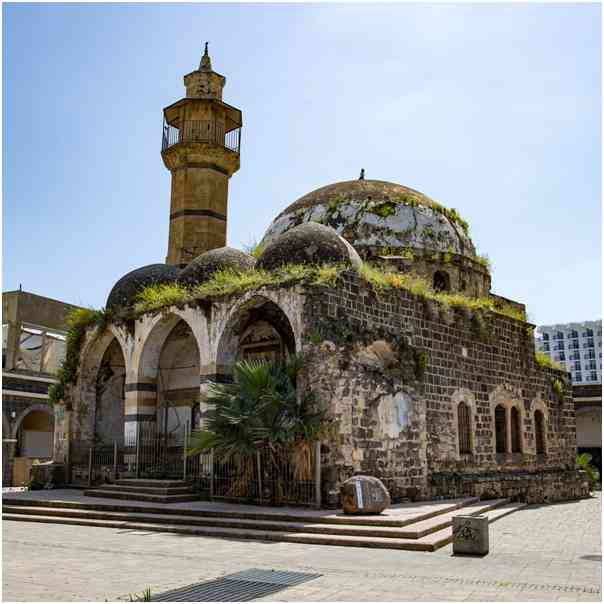
The Omari Mosque in Tiberias, built in the 18th century by Zahir al-Umar.Credit: Gil EliahuMoshe Gilad

Moshe Gilad

May. 18, 2022 2:12 PM

Tiberias was once a small city. Walking the length of the Old City from north to south takes less than a half hour. This week, we took a leisurely stroll from the Zahir al-Umar Fortress to the Greek Orthodox Church on the shore. It’s a short distance, only a few hundred meters, but the sights are astounding.

An illustration of Zahir al-Umar, who was the autonomous Arab ruler of northern Palestine in the mid-18th century.Credit: Ziad Zaydany


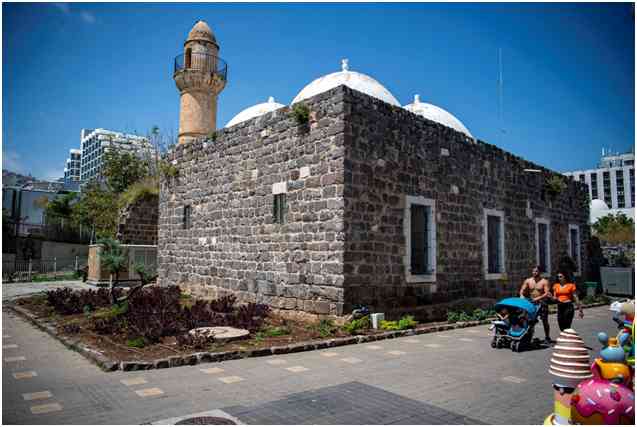
Professor Mustafa Abbasi, a historian, pointed out the buildings that have survived in this part of the city. We saw the fortress; the administrative building built by the Ottomans known as the saraya; the building that once housed the Tiberias Hotel; the Franciscan Church; the guard towers on the remnants of the ancient city wall, the dilapidated Omari Mosque built by Zahir al-Umar (whose  name is sometimes spelled Daher al-Omar) in the 18th century and the sealed-off Al-Bahr Mosque. We saw the Etz Hahayim Synagogue built by Rabbi Hayyim Abulafia, and drank coffee on the boardwalk. We turned down two offers to sail on the lake in a boat. We bought hats at one of the shops on Hagalil Street. Abbasi chose a khaki-colored cap. Mine had two yellow pineapples on it.

The bottom line of the tour that we did: The sights are lovely and awful at the same time. Tiberias is a beautiful city that sits on the shore of a beautiful lake, but it also very neglected and unattractive. The remnants of the Old City are large structures built of black basalt, things of real beauty, but only a few remain and some are in terrible condition. The city wall was nearly completely destroyed by the combined damage of earthquakes, severe flooding in 1934, the war of 1948 and events since then. Amazing assets of the city are either, at best, totally neglected or, at worst, deliberately wrecked.

The building that was once the Hotel Tiberias. Credit: Gil Eliahu

All this happened on our watch. Just 74 years ago, Israeli sappers blew up entire historic quarters of the city that were home to both Arabs and Jews. A city rich in historical and cultural heritage was almost totally wiped off the face of the earth.

No new, attractive city center was built in its place. The streets in the center of the Old City all look terrible now. Some are appallingly rundown. Zahir al-Umar's Omari Mosque looks like a ruin being used as a dump in the heart of the city. Many shops on the main streets stand empty. An entire building on Hagalil Street is burned-out and covered with soot. Several buildings appear to be abandoned. In other streets, there are stores and coffee shops that bear the signs of poverty and neglect. The boardwalk named for Yigal Allon has been fixed up a bit, but it still not very inviting. It’s quite disheartening to see a city that is such an important center of tourism for the Galilee area look this way.

Prof. Abbasi, who has extensively researched the history of the Galilee area and teaches at Tel Hai Academic College, recently published a book in Hebrew titled “Tiberias and its Arab Inhabitants during the British Mandate Period, 1918-1948.” The book is a detailed academic historical study, but I found myself reading several chapters with bated breath. The story of Tiberias is presented from a different vantage point, one with which I was not familiar. Abbasi tells the tale of a mixed Arab and Jewish city that could serve as a model of coexistence. He also traces the story of this city’s destruction.

Some 300 years ago, Zahir al-Umar, then the Ottoman ruler of the Galilee, invited Rabbi Hayyim Abulafia, convincing him to travel from Izmir and settle on the banks of the Sea of Galilee. The rabbi finally relented, arriving with 40 adherents in 1740, and the governor assisted him in constructing the Jewish Quarter in the heart of the Old City. The quarter was surrounded by Muslim ones, and the relations between the neighbors, according to Abbasi, were excellent. This tranquil coexistence characterized Tiberias for over 200 years. The Jewish leadership, headed by the Abulafia and Alhadif families, large and prestigious Sephardi families, lived in good relations with the Arab residents, headed by the al-Tabari family, whose members served as qadis and muftis and held much property.

The walls of the Old City in Tiberias.Credit: Gil Eliahu

Thanks to the local leadership, peace was maintained during the 1929 riots that washed over the rest of the country. Twenty years later, the situation was different. Moderating influences had weakened. The Jewish mayor, Zaki Alhadif, was murdered in 1938. In Kiryat Shmuel, near the city, 19 Jews were murdered that year. The moderating forces on each side disappeared. The extremists and the militants dictated the tone.

On April 18th, 1948, after several days of battle between the Haganah underground militia and Arab forces, the British removed the Arabs of Tiberias by bus. Before that, the Old City had been home to 6,000 Jews and 5.000 Arabs. (Today, the city is home to 50,000 people, all Jews.) Tiberias, long sacred to Christians and Jews, received a sanctified status from Muslims, as well. The holiest Muslim compound in the city, almost unmentioned in advertising for the city, according to Abbasi, is a shrine to Sitt Sakina, a descendant of the Prophet Mohammed. This tomb is known today as the Tomb of Rachel, wife of Rabbi Akiva, and is located at the southern end of town.

Part of the Greek Orthodox monastery in Tiberias.Credit: Gil Eliahu

According to Abbasi’s book, Tiberias had become a symbol of Arab and Jewish coexistence for hundreds of years. The warm relations ended in a grand collapse, at the height of which the Arabs of Tiberias and the Jews of the Old City were forced to leave their homes. The British moved the Arabs to Nazareth and Jordan, and the Old City’s Jews were moved to other neighborhoods. The residents of Tiberias were the first Arab urban community to be removed in its entirety, and reearch shows that this happened partly because Jewish decision-making shifted out of the city, to the Haganah national headquarters.

This is how Abbasi describes this astonishing sequence of events:

“Immediately after [the removal], there began a systematic and intentional demolition of the holy Old City, which was razed to the ground. […] Such destruction was common and carried out in hundreds of Arab villages and towns, but it was very surprising in Tiberias, which was considered a sacred Jewish city, and many of its homes were owned by Jews. […] The interesting part about the destruction, in addition to the loss of valuable historical, archeological, and religious riches, was the stubborn struggle by Jews from the Old City to receive compensation. Jews who against all expectations, found themselves sharing the suffering of their Arab neighbors.”

Women walk by the Greek Orthodox Church on the shore of the Sea of Galilee, in Tiberias. Credit: Gil Eliyahu

Old Tiberias was destroyed in three stages. First, in April 1948, a few buildings were destroyed in the fighting. In June of that year, the military blew up a few more buildings, and in January 1949 massive demolition of Old City houses began.

Half the properties in the Old City were Jewish-owned, yet the authorities destroyed its ancient area almost completely, showing no regard for its holiness or history of coexistence. According to Abbasi, the demolitions were not random, but part of an overall approach toward Arab villages and towns in order to prevent the return of the Arab residents.

While the government made no formal decision to destroy the city, it provided the military and municipal authorities with the means to do so, and never tried to prevent the destruction. Government institutions displayed contempt toward the Jews of the Old City, who belonged to what was called “the old yishuv.” This contempt was expressed not only in the destruction of their homes, but also the confiscation of the land and the demand that they pay rent for their temporary abodes in empty Arab homes.

Abbasi’s conclusion is that Tiberias, to the decision-makers, was a city with an Eastern landscape or appearance. He says proponents of the destruction repeatedly described it in a similar way:

“In its appearance and narrow alleys it was, to them, a manifestation of the old, degenerate, and corrupt. This attitude was common to many in those days, and is particularly vivid in the description by senior Jewish National Fund figure Yosef Weitz. The Arab and Muslim ‘Eastern landscape’ was to them not only a danger to national security, but also an object of repugnance. To them, it symbolized the backwardness of the East, and therefore they didn’t hesitate to destroy it, even at the cost of hurting Jews.”

The former Hotel Tiberias, which was built by German Templers.Credit: Gil Eliyahu

Remains of the citadel at Tiberias which Zahir al-Umar built early in his rule. Credit: Gil Eliyahu

A street in Tiberias' Old City. Credit: Gil Eliahu

What we see in today’s today is a direct result of the destruction that took place 74 years ago. There are places in Tiberias that look slated for immediate demolition, and others where perhaps it would have been better to just not build anything. Much of what had been built simply looks bad, and that includes some of the new hotels.

History will connect us

Abbasi is one of the most optimistic people I have ever met. He believes in peace and the brotherhood of nations. He believes in the sanctity of life and a good future. When I suggest that the city was ruined by crooks, he looks at me softly and smiles patiently.

“I believe that history needs to be enlisted for compromises and not wars,” he says. “We enlisted history to exhaust and kill each other. I was born in a home that believed in the brotherhood of nations. My family ran a Sufi order in Safed, and the chief rabbis of Safed were friends of my grandfather and helped him stay in the country. History should connect the two peoples. I don’t omit the difficult points, but the question is how you present them. Tiberias and its people need to make hopeful voices heard. Let us provide hope without giving up describing what happened.”

Part of the fortress built by Zahir al-Umar around Tiberias. Credit: Gil Eliyahu

According to Abbasi, his book is unique in telling the story of the Arabs of Tiberias, who have been absent or presented as component with no weight or impact in other studies. Their absence, he says, is a perversion of history and denies answers to those seeking to delve deeper into the city’s history. In the final chapter of his book, he writes: “The main contribution of this book is that, despite its focus on the British Mandate period, it also discusses the Arab population of Tiberias since the renewal of the city in the early 18th century.”

In a conference held via Zoom to mark the publication of Abbasi’s book a few weeks ago, historian Prof. Aviva Halamish of the Open University said that historically, Tiberias’ situation was different from that of other mixed cities in the country. This was because of a number of factors: a relatively peripheral location, the Sephardic Jewish majority, Jews and Arabs living side by side in the Old City, the fact that most Jewish immigrants who arrived in the city weren’t Zionist, and mostly the fact that Arabic was the dominant language in the city, common to both Jews and Arabs. Nationalism, says Halamish, was more muted, and so relations between Arabs and Jews were closer and more relaxed.

A postcard with a photo of Tiberias taken in 1917. The Hotel Tiberias can be seen in the center. Credit: Unknown author

In 2007, journalist Dalia Karpel created a fascinating documentary film, “The Diaries of Yossef Nachmani.” The film centers on the days of conquest and destruction in Tiberias through the eyes of Nachmani, an alum of Hashomer, the paramilitary self-defense organization active in the 1910s, and the director of the Jewish National Fund office in Tiberias, who worked a great deal with the Arab population.

The film paints a captivating depiction of the change in Nachmani’s beliefs. At first, he was a proponent of dialogue and reconciliation with the Arab population, and supported having it remain in the city. He wrote lines in his diary such as: “We are widening the abyss and arousing hate. The hotheads’ urges must be restrained.” Soon after, in a total turnaround, Nachmani avidly supported the destruction of the Old City to prevent the return of the Arabs. To add to the already bizarre situation, his son, Shimon Nachmani, was one of the explosives technicians who, on military orders, blew up the Old City homes.

No one left to care for the people

A couple walks by the Sea Mosque in Tiberias.Credit: Gil Eliyahu

“I study on the micro level,” Abbasi says of his research. “From a collection of details I build a macro, and thus produce a different story than generalizations, and an overall model of history. Generalizations are the easy way to write history. I don’t set boundaries in advance. The material sets the boundaries and leads me to the story. The study of Tiberias and its Arab population is an example of a case of micro-historical research of our country.

"The history here [in the city] is written from the bottom up, through the daily life of the urban population in all its components, from the elite to the commoners, who were the overwhelming majority in the city, and in our case mostly Arabs. There were fishermen among them, farmers, builders, workers at the nearby hot springs, water vendors, women who worked in the tourism industry, drivers and coach owners, and even immigrants who came from Syria, stayed in the city and worked odd jobs. Without understanding the social

processes and the interactions between them and the local elite, it is hard to understand the city’s history.”

Abbasi says the heroes of the city, who fought tooth and nail to maintain coexistence, were Mayor Alhadif and the Al-Tabari family. Alhadif’s family came to Tiberias in the 18th century along with with Rabbi Abulafia and his disciples. Alhadif served as mayor from 1928 until his murder in 1938. When the supporters of coexistence vanished from the stage, there was no one left to care for the people.

How can Tiberias’ future be better?

The Etz Hahaim Synagogue in Tiberias.Credit: Gil Eliahu

“Tiberias can be the jewel of the Galilee. The leaders of the city need to change their thinking and connect with the Arab population in the Galilee. Tiberias flourished when it was better connected to the region, both within the Galilee and beyond the border. It was a city convoys passed through en route to Damascus. Golani Interchange was actually part of Tiberias and served as the most important junction in the country since the dawn of time.

“We should remember that Tiberias depended in the past on connections with Syria and Jordan. Until 1948, five buses left from here to Jordan every day. If there is a ‘warm’ peace with Jordan and peace with Syria, Tiberias will not remain a peripheral city.

“The Night of Bridge” – June 16, 1946, when Israeli paramilitary forces blew up the bridges connecting Mandatory Palestine with the neighboring countries – “was the night economic ties with the East were destroyed. Tiberias is a city at the edge of the East. If you’re not connected to the East, you have no economy. You can’t live in the East and revile everything Eastern.

Prof. Mustafa Abbasi.Credit: Gil Eliahu

“For a historian like me, who knows both sides well, it breaks my heart. I’m connected to the country and the religion. I have deep roots here. But when I see both sides harming each other, I feel bad. It surprises me that it is the intellectuals on both sides who either stay on the sidelines, or join the most extreme statements.

“Once there is a high dose of religiosity and nationalism, it’s lethal. National and religious zeal is destructive. We have turned nationalism into the holiest thing. To me, humanity is the center of the world, and not the nation…

 “I am optimistic because humanity is a smart creature. I believe, based on a connection to Sufism, that every human being has a divine spark. You cannot be a Sufi and hate others. The goal is to turn this into a way of life. My grandfather sat with clerics from all denominations in Safed and Jish and respected them. At prayer time, everyone went to pray to their own prophet and came and sat back down, to talk and be happy. I ask today, how did we get to such levels of hate? Our lack of familiarity has turned us into monsters. To stop that, we need dialogue and discourse.”


The remnants of a ruined stone tower in Tiberias.Credit: Gil Eliahu 

What is the conclusion of your book about Tiberias?

“The writing of the book lasted for three years, and what kept me strong during that time was that despite the tragic end of Tiberias, it shows the ability of its leaders to live together for 200 years and overcome crises. The local leaders were heroes because they fought against the odds. The extremists may have won eventually, but Tiberias proved that we can live together. Since the Arabs were thrown out of the city, everyone has suffered.”

Requests for the comment of the Tiberias municipal authorities to the above and as to its plans for the Old City received no reply.