According to
the National Crime Agency It’s a Crime to Send Money to a Palestinian Kindergarten
but Not A Crime to Fund Settlements Built on Stolen Land
On 2 June
Santander froze not only my personal accounts but the accounts of a registered
charity, the Brighton Trust, for the crime of sending money to a Palestinian kindergarten,
the Al Tafawk Centre in Jenin.
The most obvious culprit is the National Crime Agency which is a law unto itself. The key personnel leading the NCA are Graeme Biggar, itsDirector General who works alongside Rob Jones: Director General (Operations), James Babbage: Director General (Threats), Wendy Clark: Director General (Capabilities) and Steve Rodhouse: Director General (Strategic Projects).
British
State sanctions silencing dissent with Tony Greenstein on The World Today.
I received,
after 9 days, a letter from Tracey Flynn, Senior Complaints Manager which said
precisely nothing as to why they had frozen the accounts. If this is part of a criminal
investigation it is surprising that no one has sought to interview me in connection
with any alleged criminal offences. The assumption must therefore be that this
is a pure case of harassment, probably relating to my impending trial at
Kingston Crown Court on 18 August under s.12(1) Terrorism
Act 2000 for inviting support for a proscribed organisation, viz. Hamas.
The Jewish activist Tony Greenstein, whose opposition to the Gaza genocide will see him on trial in August for "supporting terrorism", is now being hounded – like other prominent Palestine solidarity activists – with a freeze on his bank accounts.
Nonetheless
I haven’t been idle. On Sunday I gave an interview
on the Crispin Flintoff Show and on Monday I gave an extended interview with
the World Today, an
Australian broadcaster.
US issues sanctions against UN investigator probing abuses in Gaza • FRANCE 24 English
s.12 of the Terrorism Act 2000
It is clear that
the Starmer Junta and their Police State Operatives are using legislation designed
for the purpose of tackling serious crime in order to undermine Palestinian protest
organisations and activists.
As imperialism
goes on the rampage in the Middle East with its war on Iran, which as most people
know is based on a series of lies, so dissent at home must be squashed.
Later today the
four defendants who were convicted of criminal damage at the Filton 6 trial
will know if they are going to be sentenced as ‘terrorists’ by the Intelligence
Agencies former barrister Injustice Jeremy Johnson. Trials are being turned
into rubber stamps as judges seek to exclude any context for the actions of
those before them.
The harassment I
am experiencing must be seen in this light. Despite professing support for a
two-state solution in Palestine Starmer, Cooper and Mahmood are doing their
best to stop any and every support for those living under Israel’s vicious
military rule in the West Bank, to say nothing of the genocide in Gaza.
My Rental Payment Failed Because of Santander's Misinformation
Absolutely.
The same Cooper who outlaws Palestine Action would surely have done the same to the Suffragettes if she had been around in the years leading up to WW1. https://t.co/ZB4XiwMWbNpic.twitter.com/pbuJUMjURT
We are seeing a
full spectrum attack on our democratic rights and that was the reason Palestine
Action was banned last summer though it didn’t turn out quite as Yvette Cooper,
the ‘fragrant’ and hypocritical feminist who turned
up in the colours of the suffragettes, purple in the House of Commons the
very day of the banning, presumably oblivious to the fact that the Suffragettes
bombed and burnt their way across Britain in support of universal suffrage.
In the meantime it
will be useful if people contact Santander by email at these addresses to let
their views be known
You could
also ask Graeme Biggar of the National Crime Agency for an explanation as to why
he uses money laundering legislation to attack Palestine solidarity groups and
activists. He can be contact at the following email addresses:
Those Who Deny the Holocaust in Gaza are No Different to those Who Deny
the Nazi Holocaust
The truth
about the British Empire and slavery: Mehdi Hasan and Nigel Biggar | Head to
Head
I first came across Tory Peer and author of In Defence of War, the Revd. Lord
Biggar, when a friend, Adam Waterhouse, sent me a link to an article he had written.
Adam’s article was in response to an article Biggar had written, Israel’s acts are not
‘genocidal.’ Biggar had been replying to an article by the Archbishop of York,
Stephen Cottrell which spoke of Israel’s actions in Gaza as ‘genocidal acts’.
The Archbishop had visited the West Bank and he was quoted
as saying that after his visit the previous week “It gives me no joy whatsoever to use these words,” but that he had
been left wondering, “What other words do
you use” to describe the situation in the West Bank?
What’s
happening in the West Bank is not what happened in South Africa, but
you’re left thinking: what other language do I use to describe such a two-tier
system, where one group of people is so persistently and systematically denied
their human rights
and having to live a parallel life? What is happening is deliberate and
systematic, persistent, and intentional, and its impact is devastating.
You may wonder why Nigel Biggar even felt the need to
respond to the Archbishop’s mild words. We have the horrors of Gaza: the
starvation of children, the bombing of hospitals and schools, the Flour Massacre and the shooting of people collecting food, the mass murder
of innocent civilians and the genocidal statements of Israeli leaders, to say
nothing of the open apartheid in the West Bank, yet the only thing that aroused the ire of our Professor of Morality was the description of what is happening in Gaza 'Genocide'.
Israeli officials' rhetoric fuelling Gaza genocide through
dehumanisation and incitement: B’Tselem
One can only assume that Biggar was doing his best
to prevent any expression of solidarity by the Church of England with the Palestinians
of Gaza. Not that there had been much anyway. Until he resigned for his role
in covering up child abuse in the Church of England, Archbishop of Canterbury
Justin Welby had not only refused to condemn the genocide but had all
but supported it.
Biggar is not a
historian but an academic engaged in historical revisionism and moral
relativism. He is no different from those who downplay the magnitude of the
Nazi holocaust.
Although Biggar
dresses up his arguments in the clothes of moral theology his mission is
political, the rehabilitation of the reputation of the British Empire and its
offspring, Israel.
That is why he defends
the actions of Israel and minimises the genocide in Gaza. In this he is given
enthusiastic support
by the same Tory press which turned a blind eye to Hitler's anti-Semitism in the 30s.
Zionism was the
product of the late colonial era. He could hardly exculpate British colonialism
whilst condemning its bastard child, Israel. That is the impulse which drives Biggar
and he is not averse to resorting to every verbal and rhetorical trick in
pursuit of that goal even if he plays fast and loose with facts.
The reason why I have penned an Open Letter to
Biggar is two fold. Firstly Adam Waterhouse was too polite by half when
tackling as devious and dishonest a character as Biggar. Politeness is not one
of my faults!
Secondly there are many questions that Adam did not ask
concerning Biggar’s motive in writing his turgid essay.
You are the Regius Professor Emeritus of Moral and Pastoral
Theology. It is a grand title for such an immoral, (or is
it amoral?) man. You are the
King’s Professor no less.
I puzzle over what kind of morality and theology leads
a person to deny that a genocide is taking place when the evidence to the
contrary is so overwhelming?
You state,
in the Church Times of 28 November 2025, that Israel’s acts are not ‘genocidal’ in response to the
Archbishop of York’s declaration
that Israel is committing ‘genocidal acts’.
Israel bombs
school in Gaza killing children and parents under the pretext that they were
Hamas
By the most conservative estimate, when your
article appeared, 70,100 people had
been murdered by Israel in Gaza yet you reduce it to 44,000. Why?
According to a
study published in The Lancet, some
83,000 had died by January 2025. If this is true then over 118,000 had died by
the time your article appeared.
According to Stuart Casey Maslen, head of the
Geneva Academy of International Humanitarian Law and Human Rights, Gaza’s
population had
declined by more than 10%, which would suggest roughly 200,000 people had
died by February 2026.
In your article
you do your best to minimise the number of dead. Morally you are no different
from deniers of the Nazi holocaust who also did their best to minimise the number of those killed. You say that ‘the large number of civilian casualties alone — maybe around 44,000 —
is not sufficient evidence’ of genocide. Is this what the morality of
pastoral Christian theology amounts to?
The definition
of genocide owes nothing to numbers. The death of 8,000 at Srbenica was held
to be a genocide. ‘Genocide’ refers to the intent to destroy, in whole or
in part, a national, ethnic, racial, or religious group. The question is
whether Israel had the necessary intent and did it commit any of the acts that
constitute genocide, viz.
ØKilling
members of or Causing serious bodily or mental harm to members of the group
ØDeliberately
inflicting on the group conditions of life calculated to bring about its
physical destruction, in whole or in part
ØImposing
measures intended to prevent births within the group
ØForcibly
transferring children of the group to another group
Apart from
the last category it is clear that the acts of the Israeli state are clearly
acts of genocide. It is also clear that you have no expertise in genocide,
history or any relevant academic discipline.
Raz Segal, an Israeli and Associate Professor of Holocaust
and Genocide Studies does have that expertise. Segal wrote:
Israelis
are explicit and unashamed about their genocidal intent because they have
imagined and prosecuted a war against people who they see as colonised
“savages”.
A survey by
Professor Tamir Sorek of Pennsylvania State University showed that 82% of Israeli
Jews supported the expulsion of the Palestinians of Gaza and 47% agreed that
when conquering an enemy city, the Israel Defense
Forces should act as the Israelites did in Jericho under Joshua's command –
killing all its inhabitants.
56% supported the expulsion of
Palestinian citizens of Israel. The statements of intent to commit genocide by Israel's leaders are too many to count.
You question
why Archbishop Cottrell ‘thinks that his view should carry
weight’ when he ‘is an expert neither in the ethics of war nor in Middle
Eastern affairs’. But this applies even more so to you, the author of a book In Defence of War?
You
also criticise
the Genocide Convention because it ‘fails to distinguish the morally different
ways in which a people can be “destroyed”.’ For most people there is nothing
moral in destroying a people.
You compare
the Allies killing of thousands of French and Italian civilians in the fight
against the Nazis with Israel’s ‘war against Hamas’. But there is no comparison.
Hamas is a resistance organisation waging a guerrilla war against the world’s fourth
most powerful army. The Nazis had an army consisting of armed soldiers complete with tanks and aircraft. So too does Israel. It is the IDF not
Hamas which is comparable to the Nazis.
It is also noticeable
that you avoid mentioning the word ‘Palestinians’. To you they are ‘Arabs’.
This too is part of a genocidal mentality whereby indigenous people are invisible.
What is clear
is that your morality is not politically neutral. You say that
THERE is no doubt that Hamas intended to kill
indiscriminately on 7 October 2023, because we know that they deliberately
hunted down the old, the young, and the infant.’
Hamas mass rape a ‘hoax’ and ‘fake news’, says University of Sydney
professor
But
there is doubt. Israel has waged a war of atrocity propaganda. The first lies
were the 40
beheaded babies hoax. Then there was the mass rape hoax. Hamas’
principal aim was to capture Israeli hostages in order to exchange them for
Palestinian hostages.
Whereas
you attributed to Hamas the worst of motives, you went out of your way to
excuse the actions of the Israeli army. You wrote that:
In contrast, the fact that the Israeli military
have targeted buildings where they know civilians are present is no proof that
they intend to kill them; for it may be that their intended targets are Hamas
sites, to which, tragically, civilians are located dangerously close.
So
when Israel bombs and attacks hospitals it is because they are Hamas sites? And
ambulances? Universities? What about schools?
How about reservoirs
and water treatment plants? Was Hamas hiding out in them too? How about the
Trades Union Centre?
Are bakeries and kindergartens also Hamas bases.
I
know that you are an expert in moral theology, but that begs the question of whether moral theology is a genuine academic discipline or an invented and imagined subject. It is entirely subjective and without any means of independent verification.
Everything you have said could justify any and everything
that the Nazis did. Your morality seems to depend on which side you take. Are there any universal principles that can be distilled from your writings?
You
say that ‘the Nazi death camps are the
paradigm of genocide’. But are they? One of the main characteristics of
Genocide is that there is no paradigm except perhaps the presence of
colonialism/imperialism/nationalism.
The
death of between 12 and 15 million
Africans as a result of slavery might also be considered paradigmatic but your
main concern when it comes to colonial slavery is to oppose reparations by indulging in whatabouttery in your
book The
Tyranny of Imagined Guilt.
‘Whataboutery seems to me a very fragile ethical
edifice upon which to build an anti-reparative argument.
It
seems that ethics have no place in your moral theology. Lester writes
that you
accuse(s) reparations activists of “the
reckless, dismissive brushing aside of concerns about the truth.” One wonders
if he was looking in the mirror.
For
you there seems to be only one genocide, the Jewish holocaust. Contrary to Zionist
propaganda it was no more unique than any other genocide.
Was
the Genocide
in the Congo where amputations and the skinning alive of the 10 million Africans were perpetrated, less cruel or paradigmatic?
Was
the Herero/Nama
genocide in SW Africa to be disregarded when it was based on the same
principles of racial supremacy and even involved some of the same actors who
perpetrated the Nazi holocaust, such as Eugen Fischer?
The
Nazi genocide of Jews has become an imperialist narrative, shorn of its
political and social roots, as the main rationale
for everything that Israel does. It is no surprise that you do not deploy your ‘moral’
arguments against reparations for slavery against the reparations
that were paid by the Germans to Israel.
I can only
assume that the real reason for your anguish is that as a Christian
Zionist you are prepared to justify any atrocity and any war crime that Israel
commits because without the ‘return’ of the Jews to the Holy Land Christ will
not be returning. In other words the ends justify the means.
When I saw
you in the debate
hosted by Mehdi Hassan you brought to mind Percy Shelley’s Masque of Anarchy,
written in the wake of the massacre at Peterloo in 1819:
I met Murder on
the way—
He had a mask
like Castlereagh -
Very smooth he
looked, yet grim;
Seven
blood-hounds followed him.
You are also the author
of Colonialism: A
Moral Reckoning, which attempts to provide a defence
of the British Empire. In your own words it is ‘Empire
Without Apology’.
Although you conceded in
the debate hosted by Mehdi Hassan that the Empire contained ‘‘elements
of racism’ you see the Empire as not having been ‘essentially racist’. On balance
it was a force for good.
It is no surprise that you were ennobled by Kemi Badenoch
who like most Black people in the Tory Party goes out of her way to prove that
she’s politically White. Badenoch is the Black Face of White Supremacism. It is
no surprise that she has been called
a coconut
by Black anti-racists.
Kenan Malik, in his review
of your book describes how, in 1919, the architect of British support for
Zionism, Foreign Secretary, Arthur James Balfour,
dismissed the idea that the new League of Nations
should adopt a statement about equality, insisting it unimaginable “that a man from central Africa could be
regarded as the equal of a European or an American”
This is the racism that led
to Britain’s support of Zionism.
Your real function as
an academic was to provide the religious and ideological underpinnings for the
new imperialism that we are seeing play out in the wars in the Middle East today.
Your academic discipline, Moral Theology, is little more than a religious
justification of imperialism and its work. It is political chicanery dressed up
in academic jargon.
Virtually every human rights organisation in the world
recognises that what has occurred in Gaza is genocide. Organisations as
disparate as Amnesty
International, Human
Rights Watch, Israel’s B’tselem
and the UN’s own Commission of Inquiry. The Association of Genocide Scholars voted
by 86% to describe what was happening in Gaza as a genocide.
Perhaps you would like to inform people just what your own
qualifications are that enables you to contradict not only every human rights
organisation but the testimony of doctors like Dr Mark Perlmutter. In an interview
Perlmutter described how, when volunteering at the European
hospital of Khan Younis in southern Gaza he "saw
two children that were shot twice". He added: "No child gets shot twice by mistake."
Virtually every
doctor who has volunteered in Gaza has the same story. Israel is using children
as target practice. Does this not tell you something about what has happened in
Gaza or does your allegiance to the Tory Party and mammon preclude this?
It seems to me that a
far better title for you to use would be the Professor of an Immoral Theology,
not forgetting the Regius bit of course!
For the
past six years I have raised funds for the Al Tafawk Centre in Jenin. Twice
previously the Israeli military have wrecked the inside of the Centre, formerly
in Jenin Refugee Camp. In January this year the refugee camp itself was
destroyed and the centre with it.
The first
time was in July 2021 and the
second time was in November
2023 when they smashed large holes in the exterior walls. The
existence of Palestinian civil society organisations is deemed a threat to
Zionism, its belief in a purely Jewish state and the ethnic cleansing of the
West Bank.
Since then
the repression has grown even worse. When the Jenin refugee camp was destroyed
it was with the greatest difficulty that the Centre managed to re-establish
itself in Jenin City.
Since the
beginning of the year the Israeli military has done its best to impede the
progress and development of the Centre. This gives the lie to Zionists like
Starmer and Nandy who pretend that opposition to Zionist colonisation stems
from ‘anti-Semitism’ rather than the daily oppression that Palestinians face
trying to live a normal life.
Below is a
report from Karen, a former volunteer with the Centre who spoke to Mona, the
manager of the Centre.
Palestinians
are living, not under a democracy as Israel’s propagandists like to pretend,
but a fully blow military police state which surveils and controls every aspect
of Palestinian lives.
You cannot
travel even a short distance without encountering check points whose whole
purpose is to harass the local population and make normal living impossible.
Imagine in
this country members of the police force, still less the army, entering a
children’s centre and telling them what hours they can open. This is the Orwellian
state of affairs in the West Bank.
Why?Because Israel’s goal is the ethnic cleansing
of the West Bank and to accomplish that they must make Palestinian lives as
difficult as possible.
Below I
have copied two articles from Ha'aretz on
the reign of terror in the occupied territories. These are pogroms no different
from those that the Jews of Czarist Russia fled from.
Tony
Greenstein
Karen’s Report 26th October 2025
There is
some very sad news today.
At around
7pm yesterday evening the soldiers smashed down the door of Al Tafawk and
approximately 35 soldiers entered and surrounded the building.
21 children
were sleeping - five sharing a mattress - as they had nowhere else to stay.
Mona and the women were ordered to gather in the room with the children and had
their phones taken from them.
Mona asked
why the soldiers were doing this but was told to shut up. She didn’t and as a
result she was hit on the shoulder with a gun and slapped so hard across her
face that her mouth bled. They laughed at her as she asked them not to touch
the children or her mother. Once they had searched the room, they asked where
the men were - Mona’s two brothers were in another room.
Some of the
children staying last night were as young as one or two years old and didn’t
understand what was going on. Mona said she thought that they believed it was
like a movie and she tried to turn the situation into a game. The soldiers
didn’t physically harm the children, but did push them away if they got too
close.
One of the
older children vomited. Mona asked if she could give him a drink of water, but
she was told to remain where she was.
Mona used
the word “monsters” to describe the soldiers - as she lay on the floor, they
kicked her with heavy boots. Not even animals are treated this badly, she said.
Meanwhile
they had proceeded once more to beat her brother - Mona cannot understand how
his body can take it, he has been beaten so many times. They beat her second
brother too.
Once the
soldiers had finished searching and beating, the family and children were told
they had 20 minutes to collect their belongings and leave the building. In
spite of Mona’s efforts to convince them to allow them to stay, the leader said
that he didn’t argue…he gave the orders. And he was ordering them to leave.
This, along
with the landlord, they duly did, having no other choice and they spent the
night sleeping outside the Center. The soldiers remained inside.
Mona was
informed by the leader that the Kindergarten can still operate between the
hours of 8am and 12noon, but the building must then be vacated by everyone.
When Mona remonstrated with him, telling him that her family and the children
had nowhere else to stay, he told her he didn’t care. The building would be
checked by soldiers at 12noon and she will be held responsible if they find
anybody in there.
This
morning, the soldiers were still surrounding the building and although Mona
asked them to be less conspicuous as the children arrived, they refused to
move. So the children came as they do every day to enjoy a precious few hours
to play and be fed -business as usual.
Mona does not
understand why they are allowing the Kindergarten to remain open, yet they are
not allowed to stay overnight. She and her family have adhered to all the rules
the soldiers have imposed, no lights or noise at night, no open curtains or
windows.
We finished
the call this morning with Mona clearly very upset and feeling weak. This
afternoon, she and her family will search for somewhere to stay tonight.
A masked Israeli marauder using a slingshot to attack harvesters
in the village of Beita, earlier this month. For many growers, the economic
incentive for completing the harvest has almost evaporated, while the mortal
danger they face during the harvest just keeps mounting. Credit: Jaafar Ashtiyeh/AFP
Israeli settler
militias, backed by soldiers, are laying waste to Palestinian communities –
beating residents, torching crops, smashing cars, slaughtering animals.
Jonathan Pollak, who accompanies Palestinian farmers during the olive harvest,
recounts what he's witnessed – and how he nearly paid for it with his life
Southern trees bear
strange fruit, Blood on the leaves and blood at the root, Black bodies swinging in the Southern breeze, Strange fruit hanging from the poplar trees. Pastoral scene of the gallant South, The bulging eyes and twisted mouth, The scent of magnolias, sweet and fresh, Then the sudden smell of burning flesh. Here is a fruit for the crows to pluck, For the rain to gather, for the wind to suck, For the sun to rot, for the trees to drop, Here is a strange and bitter crop.
– "Strange Fruit," by Abel Meeropol
The
past two years have been a period of unrestrained Israeli violence. In the Gaza Strip
that violence swelled to truly monstrous proportions,
but in the West Bank, too, Palestinians have suffered their share.
Every
place and the type of violence meted to it. Here in the West Bank, Israeli
violence is carried out in concert by all forces present – whether those of the
army, police, Border Police, Shin Bet security service, Israel Prisons Service
or settlement security coordinators, and of course, Israeli civilians. And
often, these civilians carry sticks, metal pipes and stones, while others are
armed with firearms.
Militias operating outside of the law but within its embrace.
At
times, it is the civilians who take the lead, with the official security
apparatuses trailing behind them, providing cover. Sometimes it's the other way
around. The result, however, is always the same. In recent months, and more
aggressively in recent weeks, since the start of the olive harvest, Israeli
violence – orchestrated and organized – in the West Bank is setting new
records. Such was the detrimental violence in Duma, Silwad, Nur Shams,
Mu'arrajat, Kafr Malik and Mughayyir a-Deir, before the harvest even began.
This is the fate of the Palestinian rural communities left to their own devices
in the face of the Israeli strongholds on the frontier.
Mohammed
al-Shalabi ran for his life, not yet knowing he was running toward his death,
when a mob of Israelis in a gray pickup, some of them armed, pursued him and 10
others. His body was found hours later – shot in the back and marked by brutal
violence.
Such
was also the case for Saif a-Din Musallet, who was attacked, succeeded in
fleeing for a time, and then collapsed and eventually died. He lay there
unconscious and dying for hours, along with a friend who was unable to
extricate him, with bands of Israeli soldiers and civilians filling the hills,
still hunting for prey. Those were the harshest results of the pogrom at Jabal al-Baten,
east of Ramallah, on July 11, 2025.
At
those moments I didn't yet know they were dead, but the fear of death I did
know. A few hours earlier, a swarm of Israelis invaded al-Baten, and a group of
young Palestinians from the nearby villages of Sinjil and al-Mazra'a
ash-Sharqiya set out to block them. At first the Palestinians had the upper
hand, and the intruders were pushed back a little. But within a short time,
Israeli reinforcements arrived in the form of a gray pickup carrying a number
of armed men.
Israeli civilians attacking
farmers, their land and vehicles during the attack on Beita, on October 10.
Twenty people were wounded, one by live fire. Jaafar
Ashtiyeh/AFP
The
pickup sped toward the Palestinians and hit one of them. Shortly after, as I
was helping one of the young men carry the injured person, we started to run
for our lives, as the days leading to this one had made what would happen to
anyone who didn't manage to escape in such situations abundantly clear.
And
in fact, we did not succeed. A group of masked Israelis, armed with black
police truncheons, caught up to us. The truncheons were lifted and brought down
to serve blows, over and over, on the face, on the ribs, on the back, and again
on the face. There was also kicking and punching, pell-mell, as the dust rose
from the earth. Long moments of wild, relentless violence. With faces rendered
purple and swollen like a balloon, we were also unsurprisingly the ones
arrested by the soldiers when they showed up.
A
group of Israelis, armed with police truncheons, caught up to us. The
truncheons were lifted and brought down to serve blows, on the face, on the
ribs, on the back, and again on the face. Long moments of wild, relentless
violence.
While
we sat there, waiting to be taken to a police station, the pickup collected a
few of the Israelis frolicking around the army and police jeeps, and sped in
the direction of Sinjil, toward an ambulance and a civilian car whose occupants
were observing the goings-on from a nearby hill. In retrospect, that was
actually the start of the lynching, with all the variables of the equation of
Israeli violence present: the official armed forces, the privatized ones – each
in their place, playing their part.
As
the hours passed, a search party set out in the pursuit of Mohammed. They did
not know whether he was still alive, but Border Police troops, playing their
part, prevented them from getting to the side of the hill, where his body lay
lifeless and still; for their part, the pogromists went wherever they pleased.
Even hours later, when I was interrogated at the police station, I didn't know
what had happened, because the officers didn't find it fit to ask me for
details about the events that led to the murder that had just occurred. It was
only later when I was released that I learned about their death – two young men
whose difference from me is the difference between the blue of an Israeli ID
and the green of the Palestinian card.
The
olive picking season was not always one attack following another, nor was it a
succession of summer pogroms. Originally, the harvest was far more than an
economic anchor. It was a staple of Palestinian cultural life: the family,
including women and children, gathering in a natural setting; the folk songs;
the cooking of qalayet bandora (a dish made with onions, tomatoes and hot
peppers) over an open fire, in the shade of the trees. The assault on the olive
harvest and its transformation into an affair marked by vigilance and looming
disaster, goes beyond the concrete world. It's not just a matter of pushing
Palestinians out of their lands, the concrete part of ethnic
cleansing. This assault is geared to subvert the emotional
attachment to the land and toward cultural erasure, to the disappearance of
identity. It's not by chance that this description is reminiscent of clauses in
international law that address annihilation.
The
assault in which Mohammed and Saif were killed marked another horrific moment –
a particularly horrific one – in a long series of pogroms. I tried – and did
not manage – to recall how many funerals I've attended in the past several
months, even before the start of the harvest, the hunting season of the
apparatus of Israeli violence. And as though the violence isn't enough, in
recent years it's been compounded by the climate collapse. Olive trees produce
an abundant crop one year, followed by a year with a meager crop. This year is
a meager one, aggravated by the paucity of rain last winter. The heat waves
last spring dealt yet another blow: They dried out the trees and as a result
many of the buds of the fruit fell off.
Entire
groves lay almost entirely barren of fruit – and that's even before we account
for the mass uprooting of trees. For many farmers, the economic incentive to
harvest has almost evaporated, while the mortal danger they face during the
harvest just keeps mounting.
Palestinian farmers and activists
harvesting olives near the village of Turmus Ayya this month. A broad coalition
has mobilized to support the farmers. Hazem Bader /
AFP
Nevertheless,
and despite the persecution of the Palestinian activists and notwithstanding
the threat of incarceration in Israeli detention pens, the Zeitoun 2025
campaign got underway. It is a broad coalition, ranging from the Palestinian
far left to the various factions of Fatah, set to organize around the harvest
and to support the farmers. In the past few months Palestinian activists mapped
risk areas by level of danger, harvesters' needs and vulnerabilities. Still,
even the most stubborn of activists had to acknowledge the limited
possibilities in light of the grim reality.
The
night the harvest began, dozens of soldiers raided the home of Rabia Abu Naim,
a key activist and one of the coordinators of the Zeitoun 2025 campaign, and
placed him in administrative detention – a code name for incarceration without
trial. Rabia is from al-Mughayyir, east of Ramallah, a hotspot of the worst of
the violence of both Israeli militias and military forces. It was there that
Mohammed and Saif were killed, and also where the sons of Sinjil, Deir Jarir,
Kafr Malik and Silwad fell.
In
al-Mughayyir the army recently uprooted 8,500 trees, and groups of Israelis who
descended from the hills at night completed the work by savaging hundreds of
trees on the other side of the village.
Some
may be tempted to think the situation isn't as bad as all that, that there is
violence on both sides, that the army isn't just standing idly by or taking an
active part, that the police are indeed investigating the incidents, and that
there are secret, justified reasons for Rabia's administrative detention. Fine.
Those readers are invited to continue to tell themselves stories about fairies
and witches, and continue reading what follows.
If
in the run-up to the olive harvest there was a steady trickle of assaults, on
its first day, exactly two weeks ago, there were torrential rains.
In
Jurish harvesters were attacked by Israelis with clubs and were prevented from
getting to the groves on their lands. Harvesters from Akraba, in the same area,
northeast of Nablus, were similarly attacked. In Duma, the village in which the
Dawabsheh
family was murdered in 2015, it was actually soldiers who
prevented harvesters from accessing their lands, claiming that entry into those
areas requires security coordination.
In
Khirbet Yanun olives picked by the landowners were stolen, and they were
expelled from their lands by a group of Israelis. In the village of Deir Istiya
another group of Israelis abused Palestinians who were harvesting olives near a
road, but the attempt to drive them away wasn't successful. In the village of Kafr
Thulth, Israelis attacked Palestinian harvesters and shepherds, and slaughtered
a number of goats.
Rabia Abu Naim photographed by a
soldier. On the eve of the olive harvest, the army raided his home and placed
him under administrative detention.: Avishay Mohar
In
addition, Israelis who arrived from the hills fired live ammunition at farmers
from Far'ata who were harvesting olives on their lands; soldiers backed up the
assailants and did not intervene. Moreover, soldiers and civilians alike later
raided the village itself. In Kobar, the hometown of incarcerated Palestinian
leader Marwan Barghouti, soldiers actually arrested harvesters who were working
in their own groves. This is an incredibly partial list.
The
peak of the scourge on that same day was in the town of Beita, south of Nablus
– home to almost 20,000 people, which is known for its longtime tradition of
resistance to Israeli rule. On that same Friday, October 10, about 150
harvesters set out together to harvest olives near a new settler outpost that
was established in the area, whose members have since attacked the villagers in
a series of incidents involving shooting, beatings, arson and the smashing of
car windshields and windows.
The
large concentration of harvesters apparently did not deter the assailants – and
perhaps even encouraged them. A combined force of soldiers and civilians
carried out a large-scale attack on the farmers and on their supporters. It
began in the early morning, when a single family that arrived in the groves was
attacked; three of its sons were wounded so badly they had to be taken to a
hospital, leaving behind splotches of blood staining the dust.
It's
not just a matter of pushing Palestinians out of their lands, as part of ethnic
cleansing. This assault subverts the emotional attachment to the land and leads
to cultural erasure, to the disappearance of identity.
In
the hours that followed, the groves were inundated by landowners, on one hand,
and by Israeli assailants, on the other. The violence of the Israeli civilians
– who smashed and shattered using clubs and stones, and also opened fire – was
supplemented by the soldiers who resorted to beatings, tear-gas and stun
grenades. The people of Beita clung to their lands, but at a steep price: 20
wounded, including one young man who was hit by live fire.
Among
the wounded was also a solidarity activist, who was attacked with sticks and
stones, and was evacuated suffering from arm and rib fractures – and also three
journalists: Jaafar Ashtiya, whose car was set ablaze and was wounded; Wahaj
Bani Moufleh, whose leg was broken when a tear-gas projectile was shot at him; and
Sajah al-Alami. Ashtiya's car wasn't the only one torched in the groves. Eight
vehicles were set on fire that day, and an ambulance owned by the town of Beita
was turned on its side; fortunately, a few young residents were able to get to
it before the mob could torch it.
The
flood of attacks continued on the days that followed, with dozens of incidents,
one after another. In Burqa, near Ramallah, olive harvesters were attacked by
soldiers and civilians who descended from the direction of the outpost of Givat
Asaf, fired live ammunition, stole equipment and fruit that had been picked and
prevented the landowners from accessing their lands without a permit.
In
al-Mughayyir 150 trees were felled by a gang that descended from the hill under
the cover of night and of the military siege of that community. In Khirbet
Yanun locals discovered stumps of trees, and in Lubban al-Sharqiya, outside
Nablus, and Turmus Ayya, near Ramallah, harvested olives were stolen from their
owners. Again, in Burqa, some 300 trees were cut down and 12 dunams (3 acres)
of farmland were rendered unfit for use.
In
Burin, Israelis who descended from the Givat Ronen outpost attacked the
harvesters and activists who accompanied them – in plain sight of soldiers
deployed in the vicinity. In Duma, Israelis shot at workers building a dirt
access road to groves in coordination with the military government's Civil
Administration. In the village of Naama, armed Israelis attacked the farmers
and made off with the fruit they had picked.
Soldiers block Palestinians from
the village of Kobar, near Ramallah, on their way to harvest olives. Residents
working their own land were detained by the IDF.
For
its part, the IDF is participating in the struggle being waged against the
harvesters in a variety of ways. Sometimes troops accompany the assailants,
sometimes the army turns a blind eye to incidents, and sometimes it attacks.
Its soldiers also find creative ways to degrade the farmers' staying power. For
example, on October 16 the army determined that the village of Burin would
become a "closed military zone." This would seem to be standard
practice: preventing access to villages' lands on the pretext of averting
"friction."
This
time, however, the military didn't even bother with the deception. The area
declared closed did not encompass farmland, but the entire built-up area of
Burin. And just like that, 32 pro-Palestinian activists who had come to support
the harvesters were arrested and expelled for the simple reason that they were
sat in someone's living room at his invitation.
Last
Friday, October 17, groups of Israelis attacked harvesters at several sites and
over several hours in the town of Silwad, east of Ramallah. The invaders also
vandalized an ambulance. Nearby in the same area, a family was attacked and
their tractor and car were stolen. Another group of harvesters who ascended a
hill in Silwad in order to pick olives on their lands, near an Israeli outpost
farm, discovered that ancient trees had been chopped down. An Israeli shepherd
who encountered them called reinforcements, and again a telltale gray pickup
appeared, from which an armed Israeli and some youth descended, declaring that
the area was a closed military zone. A little later a military force showed up
at the site and expelled the landowners and their guests – but not the
interlopers, who in the meantime tried to steal sacks of olives and attacked
people physically. I was there.
Shortly
afterward a car of young Israelis suddenly appeared, in hot pursuit of the car
I was riding in, speeding along a narrow, winding road on the edge of a cliff.
Our driver sped up as well, and images of the pogrom in Jabal al-Baten ran
through my mind. Fortunately, we succeeded in safely reaching the village
without allowing the pursuers to overtake us.
So
there you have it: Scores, indeed hundreds of incidents, big and small, one
after the other. As these words are being written, masked men armed with clubs
bludgeoned an elderly woman on the head in Turmus Ayya; she is suffering from
intracranial bleeding and is hospitalized in Ramallah. Two activists were also
pummeled; one of them needed stitches in his head. Five cars were torched in
the attack; others were vandalized and smashed.
This
is still only the beginning of the olive harvest, not even half of it has
passed. The attacks will no doubt continue until it ends, and will not wind
down afterward as well. But this is not only a story of violence and dispossession.
It's also a story of the Palestinian steadfastness, their clinging to their
land and their refusal to give in or give up. Rabia, the coordinator of the
Zeitoun 2025 campaign who was placed in administrative detention, had monitored
many incidents involving the uprooting of trees before the harvest season
began, warning that at this rate there would be nothing left to pick. "But
if the olive trees in the village become extinct," he declared, "we
will harvest the oak trees. And if no acorns are left on them, we will harvest
the leaves."
Bahjat and Alia al-Hallaq, with their
children Sila and Wajdi, holding the memorial poster for Muhammad, this week.
Eyewitnesses said that after the shooter fired his deadly bullet, he raised his
arms in a gesture of apparent joy. Credit:
Alex Levac
Eyewitnesses
say Muhammad al-Halaq stood with his arms folded, posing no threat, when a
single, deadly shot was fired. The soldiers later appeared to celebrate. The
IDF said the incident is under review
A large banner, bearing the image of a boy in a
brightly colored sweat suit, covers the bed. A new blue backpack lies at the
head of the bed, a white garment at its foot. A woman is standing there,
sobbing, her gaze fixated on the image of her son. There is not a dry eye
around her.
The bed belongs to Muhammad al-Hallaq, a 9-year-old
who was in fourth grade. He received the backpack the day he was killed. The
white garment is the festive outfit he wore in the local mosque during the
Friday prayers. The tearful woman next to the bed is Alia, his mother, an
impressive woman of 33, the mother of four, including the dead boy.
An Israel Defense Forces soldier shot and killed the
boy last Thursday, October 16, as he stood quietly, at a distance from the
force. In a video taken by a passerby he's seen for an instant on the edge of
the frame, a little boy standing in the street, wearing a blue T-shirt shirt,
seconds before his death.
The soldiers fired dozens of rounds into the air,
scaring off children who were playing soccer on the basketball court of the
local girls' school nearby. Terrified, the children scattered. Muhammad also
fled to the street and stood next to a stone wall, arms folded on his chest.
Apparently he thought there was no reason to keep running: The soldiers were
far away, the street was quiet.
But one of the soldiers decided to teach the boy a
lesson. According to the testimony of eyewitnesses Haaretz spoke to, the
soldier knelt, aimed and fired a single shot. The bullet struck Muhammad in the
right hip and exited from the left hip after ravaging major blood vessels and
organs. Muhammad didn't stand a chance. He managed to take a step or two,
collapsed and tried to crawl on the ground, until he stopped moving.
About an hour and a half later he was pronounced
dead at the hospital. He was the third child of the al-Hallaqs, an impoverished
family living in the remote village of al-Rihiya, south of Hebron.
Al-Rihiya. What's allowed in Gaza
is allowed here, too: killing for the sake of killing. Credit: Alex Levac
The IDF had no reason to raid the village, still
less to kill a child. This is yet another case of the incursion of the war in Gaza
into the West Bank.
What's allowed there is allowed here, too: killing for the sake of killing,
even of young children for whose blood Satan has not yet devised revenge, as
the poet wrote.
To Haaretz's query as to whether the soldier who
killed the boy had been detained for questioning, the IDF Spokesperson's Unit
offered its usual response. The one generic sentence – "The event is known
and is under examination by the Military Advocate General's unit" – was
apparently sufficient to acknowledge the army's moral imperative with respect
to the killing of an innocent child. In another year or two the case will be
closed on grounds of lack of public interest.
And the soldier – what will happen to him? Will he
remember the angelic youngster he killed in cold blood? Will he remember him when
he is the father of a child of the same age? Will the dead boy appear in his
dreams? His nightmares? Does he have any notion of the disaster he has
inflicted on this hardscrabble family? Or maybe he's already forgotten the
whole thing. The fact is he wasn't even interrogated. Killing a little boy like
this is of no consequence to the IDF and perhaps not to the soldier who pulled
the trigger either.
Eyewitnesses told us that after the soldier fired he
raised his arms in a gesture of apparent joy; his buddies joined in the gaiety.
Then they fired tear-gas grenades at some of the locals who tried to save the
boy, before leaving a few minutes later.
About 7,000 people live in al-Rihiya. The route to
the village is tortuous thanks to the abundance of abandoned checkpoints that
have sprung up in the two years since the outbreak of the war in Gaza Strip.
One must find one's way through the labyrinthine streets of the Al-Fawar
refugee camp, which is also almost completely sealed off from the world.
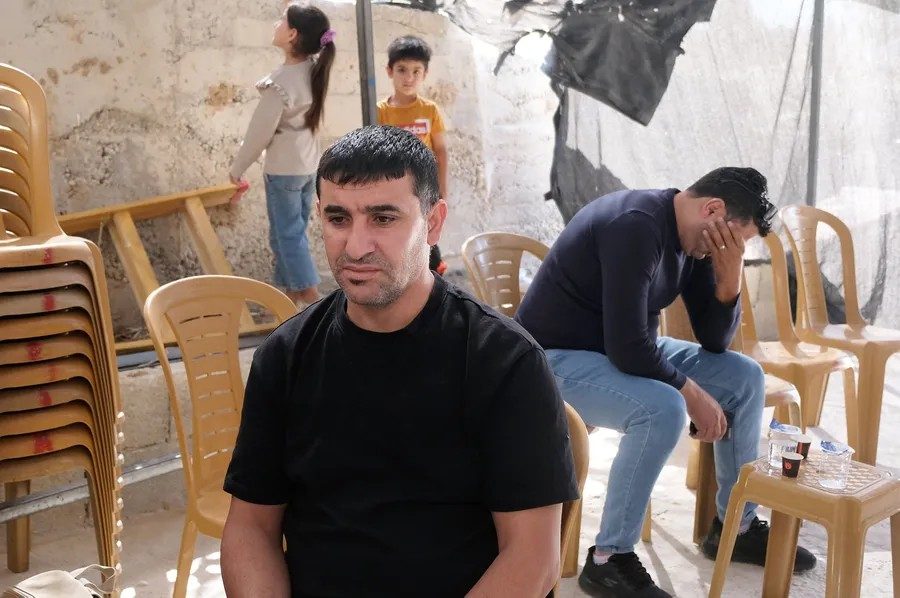
The parents are sitting in the mourning tent erected
next to their home. The father, Bahjat, 38, worked for years in construction
projects in Israel; now he's employed at a supermarket in a refugee camp near
Ramallah. The distance from home, and the myriad checkpoints, compel him to
spend the week in the camp and to come home only on weekends.
On the day his son was killed, Bahjat told us when
we visited this week, he was also at work. The panicky, nightmarish journey to
reach his son, after he was originally told that the boy had been wounded, took
three hours. In an al-Rihiya WhatsApp group he saw a clip of Muhammad being
carried by his uncle to the latter's car, bleeding from the hip, his head
dangling. He knew the boy's fate was sealed. Three hours passed before he saw
the body: He had been forced to wait more than an hour at the so-called
container checkpoint that slices the West Bank in two, as soldiers
lethargically checked car after car, as usual.
Muhammad's father, Bahjat, at the
mourning tent. It took him three frantic hours to reach his son's body after
hearing he'd been wounded. Credit: Alex Levac
That morning Muhammad left home escorting his little
sister Sila, a 6-year-old who is in first grade, to the girls school which is
next to his school. At the end of the day he collected her as usual and the two
went home. Proudly he showed off the new backpack and pencil case he and his
classmates received as gifts from UNICEF, the United Nations Children's Fund,
whose logo is emblazoned on them.
Muhammad's mother shows them to us. His notebooks
and textbooks are still inside, including the arithmetic notebook, in which
comments in red were written by the teacher on what would be the last day of
his life. In his pencil case are pens and pencils, and also a vial of perfume
that he would use after putting on his festive white clothes for Friday prayers
in the mosque. Alia strokes the little bottle, as though unwilling to part from
it.
After Muhammad finished lunch on Thursday, a few of
his friends came over and together they went to the girls school, which is
about 1.5 kilometers (almost a mile) from his home; they play soccer on the
basketball court there almost every day after school. It was about 2:30 P.M.
when Muhammad left, never to return. At the same time, his mother went to the
nearby city of Yatta with her father to do some shopping.
‘And the soldier – will he remember the
angelic youngster he killed in cold blood? Will he remember him when he is the
father of a child of the same age? Does he have any notion of the disaster he
has inflicted on this hardscrabble family? Or maybe he's already forgotten the
whole thing.’
At about 5 P.M. two IDF jeeps suddenly swept into
the village. The kids were still on the basketball court. The soldiers fired
shots into the air to disperse the local residents and make them go home, the
way you chase away stray dogs. It's become routine: The army invades this
village three times a week on average, usually at night. This time its troops
showed up in daylight.
The streets emptied out. The kids playing soccer
also scattered. Muhammad fled the schoolyard together with them and stood near
the wall. The soldiers were in the valley below, some 250 meters away. They
shouted and fired into the air. Immediately afterward one of them apparently
knelt and shot Muhammad.
The soldiers then fired four tear-gas grenades at
passersby, leaving Muhammad to bleed for three-four minutes before it was
possible to evacuate him.
One of the boy's uncles, who lives nearby and saw
what had happened, rushed out into the street and, together with his son, and
carried Muhammad to the uncle's car. A video shows the uncle bundling his
nephew, who seems to be lifeless, into the car. This week the uncle – he is
afraid to have his name published – related that he found a pulse in the
child's neck, albeit weak. He wanted to evacuate the boy to the government
hospital in Yatta as fast as possible, but saw the same two jeeps he'd seen in
al-Rihiya driving slowly in front of him. He was afraid the soldiers would
delay him and might also abduct Muhammad, so he chose a bypass road that
doubled the time of the trip: 30 minutes instead of 15.
Another cousin, Aiham, 19, told us that he saw the
moment at which Muhammad was hit, from the roof of his house. He related that
the soldiers raised their arms in what looked to him like a gesture of triumph
or joy. Other eyewitnesses confirmed this to Manal al-Jabari, the Hebron-area
field researcher for B'Tselem – The Israeli Information Center for Human Rights
in the Occupied Territories. They also told her that the security camera
installed on a street that overlooks the site of the shooting had been removed
sometime later by soldiers.
Muhammed's mother, Alia, next to
his bed. She thought there was still hope. Credit:
Alex Levac
When the uncle arrived at Abu Hasan Qassem Hospital
in Yatta, he thought his nephew's heart had stopped beating. The physicians
tried to resuscitate Muhammad and rushed him to the operating room, but it was
too late. That evening, a Shin Bet security service agent called the uncle to
warn him and his family against organizing demonstrations during the funeral.
After Muhammad was shot, his father's brother called
Bahjat to say his son had been wounded; when he looked at the village's
WhatsApp group he realized that the boy was in critical condition. He remembers
going into a state of shock. Residents of the Palestinian town of Idna
volunteered to drive him home. At the end of the excruciatingly journey he
arrived at the hospital at 8:30 P.M.
Alia was shopping in Yatta with her father when the
events transpired, and when he got a phone call, she had a fearful feeling.
When her father put the phone in his pocket, her anxiety grew. A relative was
asking, "What's happening in your neighborhood. Has someone been wounded?"
Switching to her own phone, she saw the video of her dying son being placed in
his uncle's car.
The medical team at the hospital wouldn't let Alia
and her father into Muhammad's room and tried to calm her down, saying that he
had suffered a light wound. When they asked the family for blood donations, she
thought there was still hope. It was only after some time that the physicians
informed her that the bullet had ruptured major blood vessels and that her
Muhammad was dead. He had once told his mother that he wanted to be a
cardiologist when he grew up.
He was buried the same night in the village
cemetery.
Now Alia is weeping, in her son's bedroom; her
teenage son Wajdi is mournful. All she wants now is for the soldier who shot
and killed her son to be given the punishment he deserves. Her children aren't
sleeping anymore in their beds, next to Muhammad's. They're afraid.