Showing posts with label capitalism. Show all posts
Showing posts with label capitalism. Show all posts
24 November 2024
When the amoral, sociopath Keir Starmer denies that there is a Genocide in Gaza he is no different to those who deny the Nazi Holocaust
This summary is not available. Please
click here to view the post.

8 December 2022
Abram Leon, 26, leader of Hashomer Hatzair and then the Fourth International in Belgium, was Murdered in Auschwitz
Leon Explained in The Jewish Question – A Marxist Interpretation Why Anti-Semitism Arose and Where it Came From

As readers of my book will know, during
the Second World War the Zionist movement was a Quisling movement that
collaborated with the Nazis and went out of its way to obstruct rescue of
Jewish refugees whose destination wasn’t Palestine.
By way of contrast Abram Leon, leader of the
Fourth International in Belgium, died resisting the Nazis. Where, as in the
Warsaw Ghetto, Zionists fought alongside Jewish anti-Zionists against the Nazis
they did so not because they were Zionists but despite their Zionism.

Jewish Partisans Captured in Warsaw Ghetto
After the Warsaw Ghetto Uprising there
was panic in Palestine. Dina Porat, Chief Historian
at Israel’s Yad Vashem Propaganda Museum wrote that Melech Neustadt of the
Jewish Agency Executive:
repeatedly
implored the youth movement leaders in Palestine to save those still alive –
even against their will – by issuing a directive that they were to leave
immediately by whatever ways possible... The issue was whether or not the
Yishuv was morally justified in instructing these comrades to abandon their
communities, save themselves, and thereby stop the armed uprisings.... the
numerous revolts in the summer of 1943 would ultimately deprive the Yishuv of
the cream of Europe’s potential pioneering force... among the major youth
movements in Palestine. Neustadt’s views prevailed and attempts to extricate
the activists failed. They refused to leave. [Porat,
The Blue and the Yellow Stars of David, p. 241]

A
Zionist emissary arrived in Bedzin, a Nazi ghetto in Poland, in July 1943 after
the Warsaw Uprising to persuade Frumka Plotnicka to leave. She replied that ‘I have a responsibility for my brethren...
I have lived with them and I will die with them.’ The Zionist fighters,
such as Antek Zuckerman and Zivia Lubetkin, refused on principle to leave. One
can only admire the bravery and commitment of these young fighters who, given
the choice between the fight against the Nazis in the Diaspora and the Arabs in
Palestine, committed what in Zionist eyes, was a mortal sin. They chose the Diaspora.
One of the Palestinian emissaries, Yudke Hellman, described how in October and December 1939 he witnessed the return of Plotnicka and Lubetkin to German-occupied Poland and how he had tried and failed to persuade them to leave for Palestine. Frumka stood up and announced that her decision to return to Warsaw was final. [Yechiam Weitz, The Yishuv’s Response to the Holocaust, pp. 218-19].

Hayka Klinger, another fighter in Warsaw, who arrived in Palestine in March 1944,
told the Histadrut Executive that ‘we
received an order not to organize any more defence.’ [Porat p. 242]
Klinger observed that
‘Without a people, a people’s
avant-garde is of no value. If rescue it is, then the entire people must be
rescued. If it is to be annihilation, then the avante-garde too shall be
annihilated.’ [Edith Zertal, Israel’s Holocaust and the Politics
of Nationhood, p. 33]
Never
was the ethical and moral distinction between the Jewish diaspora and
Palestine’s Zionist leaders clearer.
The Zionist leaders
saw the risings in the ghettos as ‘a kind
of betrayal of the overriding principle of the homeland.’ [Zertal
p.34] Yet despite opposing the uprisings at the time, the ghetto
fighters were ‘retrospectively
conscripted’ into the Zionist terror groups. ‘We fought here and they fought there’ according to Palmach
commander Yitzhak Sadeh. [Zertal p.26]
Except that the Jewish partisans fought against the fascists whereas the
Zionist militias fought with fascists.

This is why John Rose of the SWP
was wrong when he argued that Zionism was not an obstacle to fighting against
fascism. Rose wrote:
It’s true that when Hitler came to power some
Zionist leaders stupidly thought that they could do a deal with him that would
enable some German Jews to go to Palestine.
The Zionist attitude to the Nazis
had nothing to do with ‘stupidity’ nor was Ha'avara, their trade deal with the
Nazis, about enabling some Jews to go
to Palestine. However I digress.
Abram Leon was born in Warsaw in
1918 and died in Auschwitz in 1944. Leon had been the leader of Hashomer Hatzair
(Young Guard), a left-wing Zionist youth group, from 1936 till 1940 when he and
20 comrades broke from Zionism and joined the underground Trotskyist organisation. He was arrested
by the Nazis in June 1944 and tortured before being sent to Auschwitz where he
died in September 1944.

Leon died at the age of 26 but not
before he had written The Jewish Question – A
Marxist Interpretation, which was written whilst leading the resistance
to the Nazis. It is a remarkable work, not least because of the conditions
under which it was produced.
Leon’s thesis in a nutshell was
that unlike the myths spread by the Zionists and Orthodox Jewry, that the Jews
survived because of their religion, the exact opposite was the case. He
reversed the relationship. The religion survived because of the Jews. It was
the specific social and economic role that Jews played in society, reflected as
it was in their religion, which kept the religion going.
It was Karl Marx who had written
in On the Jewish Question that:
Judaism has survived, not in spite of history but because of it. (p.92)
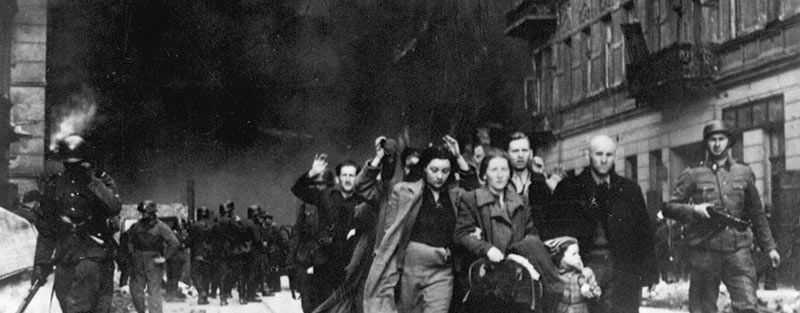
Captured Jewish Partisans in Warsaw
Indeed where Jews did not have a
specific socio-economic role as with the Jewish farmers in Sicily, they
assimilated to the surrounding population.
Zionism has rewritten the history
of the Jews and hence the history of anti-Semitism. Zionism, with its claim to
Palestine, consists of a series of myths designed to appeal to the simplest of
minds.

How many times did we hear
during the attacks on Corbyn that anti-Semitism was a ‘virus’, a pathological
and incurable condition. As one of the first Zionists, Leon Pinsker wrote
in Autoemancipation:
‘Judeophobia is then a mental disease, and as a
mental disease it is hereditary, and having been inherited for 2,000 years, it
is incurable.
Pinsker was a doctor so he used the
term ‘Judeophobia’ rather than anti-Semitism. But if a disease is incurable
then there is no point in fighting it.
At best one seeks pain relief or palliatives.
Theodor Herzl, the founder of
Political Zionism, was of the belief that the cause of anti-Semitism was the
Jews themselves. Their fault was living in other peoples’ countries. The
solution was therefore colonisation. In the Jewish State he wrote:
“The unfortunate Jews are now carrying the seeds of
anti-Semitism into England; they have already introduced it into America.”
Leon demolishes this and other
Zionist myths and shows how, as Jews fulfilled certain roles in society – money lenders, tax stewards,
usurers, traders, skilled craftsmen –anti-Semitism itself changed. Religious
anti-Semitism expressed class antagonism
to the role Jews played in feudal society and was expressed as religious
antagonism.
Leon’s great achievement was to
situate the Jews in history. Instead of the Zionist myth of the expulsion of
the Jews from Palestine in the wake of the destruction of the Second Temple,
for which there is zero evidence, he showed how it was the Jews themselves who
emigrated because Palestine was incapable of feeding its inhabitants.
In this the Palestinian Jews were
not unique. Many people such as the Phoenicians and Armenians had followed
similar paths.
Some 4 million Jews left Palestine
in the first two centuries AD. Some 1 million of them were
to be found in Alexandria alone, one of the great Hellenized cities in the
Mediterranean. Like many people before them, the Jews became great traders and
it was through trade and commerce that Jews survived.
Leon’s explanation of the Jews as a
‘people-class’ explained their survival. In the feudal era, a society based on
production for use not exchange, groups who carried out particular
socio-economic roles were seen as being different ethnically from the native
population.
The Zionist idea of ‘eternal
anti-Semitism’ is a way of avoiding difficult questions such as why the Jews survived and why there was
persecution. It is really a reflection of the anti-Semitic stereotype of the ‘eternal
wandering Jew’ which became a film under the
Nazis.
Anti-Semitism constituted the class
antagonism of different layers of feudal society towards the economic role that
Jews played.

Thousands of Jews died in peasant
revolts, be it at York,
Norwich or at the hands of Chmielniki
and the Cossacks in Poland from 1648 to 1657. However this was a peasants
revolt against the role of Jews as Arendators,
officials who leased land from the nobles and whose demands on the peasants
were extremely exacting.
Many of those who died were Jews but contrary to popular
history it wasn’t just Jews who suffered. As Anna
Reid wrote
in Borderland: A Journey Through the History of Ukraine:
Wherever they found the szlachta, royal
officials or Jews, they [Cossacks] killed them all, sparing neither women nor
children. They pillaged the estates of the Jews and nobles, burned churches and
killed their priests, leaving nothing whole....
But whereas anti-Semitism in feudal
times came from the peasants and mendicant religious orders, with the Jews as
in Poland, protected by the nobility and King, under capitalism anti-Semitism
came from the State and the ruling classes. The best example until the Nazis
was under the Czar whose Ministers deliberately instigated pogroms, creating
the Black Hundreds
for this purpose.
To the Zionists anti-Semitism was
the property of all non-Jews regardless of class. Anti-Semitism existed because
the Jews existed. As A B Yehoshua explained, the Jews were guests who used
other peoples’ countries like hotels. [Jewish Chronicle, 22.12.89.
‘Diaspora a cancer’]
As
Hannah Arendt observed
If it is true that mankind has
insisted on murdering Jews for more than two thousand years, then Jew-killing
is a normal, and even human, occupation and Jew-hatred is justified beyond the
need of argument. [The Origins of
Totalitarianism, p. 7] The
Origins of Totalitarianism, p. 7,
Leon’s book went almost unnoticed
until it was resurrected by French Marxist Maxime Rodinson in 1968 at the
height of the Paris riots.
Leon’s main argument was that the
Jews formed a ‘People Class’ – that they performed specific tasks in pre-capitalist
society that bound them together as both a people and a class. Under feudalism
this was very common. Not just the Jews but the Gypsies, Scots, Armenians and
Chinese of South Asia, who were even called the Jews of Asia, also formed
castes that attracted popular ire.
Where the Jews lost a distinctive
socio-economic role they assimilated to the majority. To the Zionists
anti-Semitism was common to all non-Jews. As Leon wrote (p.247)
Zionism
transposes modern anti-Semitism to all of history and saves itself the trouble
of studying the various forms of anti-Semitism and their evolution.[1]
In what is a short book, Leon gave
a panoramic overview of the Jews historically. The book explains that the ‘Jewish
Question’ was dying out in Western Europe with the advent of capitalism. The
Jews no longer had any specific socio-economic role. They were assimilating to
the majority population with the advent of Emancipation. It was only
anti-Semitism in Russia and Eastern Europe, resulting in waves of migration by
Jews westwards, that kept the Jewish Question alive.
Zionism was implacably opposed to Jewish Emancipation because
they saw, correctly, that granting equal rights to Jews meant that they were no
longer forced by the state to maintain a separate existence. In Israel today
the fascist Lehava calls
miscegenation , inter-racial sex, a holocaust. Israeli minister Rafi Peretz labeled
intermarriage between American Jews and non-Jews as being “like a second Holocaust.”
Leon had but a very short life but
in that very short time-span he produced
one of the Marxist classics which cuts through the mystification of
Zionism in its treatment of both Jewish history and anti-Semitism .
I began by saying that Leon had
started out as a Zionist in Hashomer Hatzair. In Palestine this was a political
party which later became Mapam. Their strand of ‘Marxist’ Zionism had been
founded by Ber Borochov,
who was expelled from the Russian Social Democratic Party in 1901 for Zionism.
Borochov held that Jews could not
take part in the class struggle in the diaspora because they had no
relationship to the means of production. Their conditions of production meant
that they were outside the class struggle. According to Borochov social
structure of the Jews resembled an ‘inverted pyramid’ – too many rich Jews and
not enough poor or working class Jews.
It was only in Palestine where Jews
could form their own society that it was possible for class struggle to break
out. Borochov, who ended up supporting WW1 was wrong. It was precisely at this
time, the end of the 19th and beginning of the 20th
centuries that Jews were becoming part of the proletariat.
Marxist Zionism was always a cult
that used sophistry to explain away colonialism. If Borochov is to be taken at
his word then Socialist Zionists having allied with the bourgeois Zionists in
order to create a Jewish State would then wage class war against them! The
problem with this was that it was more likely to become part of the bourgeoisie
in such a state.
We can see where this bankrupt
theory has ended up. In the last Knesset Meretz, which was the descendant of
Mapam, found itself in alliance with the far-Right Yisrael Beteinu and Yamina.
In the 2020 elections Meretz, has been eliminated from the Knesset altogether. In
1949 in Israel’s first elections it obtained 19 seats.
The beauty of Leon’s book is that
it at once provides an overview of Jewish history since ancient times and
explains how and why anti-Semitism has persisted, albeit in different forms. It demystifies anti-Semitism.
As Leon remarked in the section on Zionism
and the belief in 2,000 years of exile:
In reality just so long as Judaism was incorporated
in the feudal system, the “dream of Zion” was nothing but a dream and did not
correspond to any real interest of Judaism. The Jewish tavern owner or “farmer”
of sixteenth-century Poland thought as little of “returning” to Palestine as
does the Jewish millionaire in America today. Jewish religious Messianism was
no whit different from the Messianism belonging to other religions. Jewish
pilgrims who went to Palestine met Catholic, Orthodox, and Moslem pilgrims.
Besides it was not so much the “return to Palestine” which constituted the
foundation of this Messianism as the belief in the rebuilding of the temple of
Jerusalem.
We should not forget that Leon was
writing at the height of the Nazi persecution, a persecution which claimed him
in that death factory, Auschwitz. He wrote that one of the “ironies of history”
was that
when the Jew was unassimilable, at a time when he
really represented “capital,” he was indispensable to society. There could be
no question of destroying him. At the present time, capitalist society, on the
edge of the abyss, tries to save itself by resurrecting the Jew and the hatred
of the Jews. But it is precisely because the Jews do not play the role which is
attributed to them that anti-Semitic persecution can take on such an amplitude.
Jewish capitalism is a myth; that is why it is so easily vanquished. But in
vanquishing its “negative,” racism at the same time destroys the foundations
for its own existence....
The irony of history wills that the most radical
anti-Semitic ideology in all history should triumph precisely in the period
when Judaism is on the road of economic and social assimilation. But like all
“ironies of history” this seeming paradox is very understandable. At the time
Tony Greenstein
[1] Abram Leon, The
Jewish Question - A Marxist Interpretation, p. 247.
14 November 2021
Telling Simple Truths – We Will Never Stop Global Warming and Climate Change as Long as We have CAPITALISM
A few brief thoughts - COP26: Glasgow in the eye of the climate storm

Instead of writing a blog I have instead decided to publish an article from a friend's blog. The argument is very simple.
Capitalism is, by its very nature, incapable of preventing climate
change. Anyone who says they are a Green
but not a Socialist is lying – not least to themselves.
At the heart of how capitalism works is the blind production of capital.
The central driving force of capitalism is profit not human need. Everything else is subordinate to it. And in order to protect capital against those
who would take it away and use it collectively for the benefit of humanity you
have to wage wars.
Capitalism is based on economic competition not co-operation. And
sometimes this isn't economic but military. The drive to gain markets and
resources is ceaseless. All the time new pretexts are dreamed up such as in Bush and Blair’s ‘war
for democracy’ in Iraq.

COP26: Glasgow in the eye of
the climate storm
As the eyes of the world fall on Glasgow for the COP26 summit, its significance cannot be overstated. COP26 has been billed as the last chance saloon for us to save the planet by delivering on the promises adopted in the 2016 Paris Agreement which present a tangible route for each country to meet their ‘nationally determined contributions’ (NDCs: agreed timetables for emissions reductions). The NDCs give each country a realistic and equitable path to reach its target, with less developed nations recognised as having a more difficult path to net-zero emissions. These NDCs are due to be updated this year to keep countries on track to meet the Paris targets, with some yet to submit their new proposals. This will be crucial in holding countries to account for the pledges they’ve made.
It is the first of COP26’s four goals that is overarching: to “secure global net zero by mid-century and keep 1.5 degrees within reach” [1]. Reaching ‘net-zero’ emissions means adding no more greenhouse gases to the atmosphere than we remove. But this terminology and the legislation which backs it up can often be manipulated by big polluting companies who instead of reducing their carbon dioxide emissions, try to offset them by planting trees. This has been characterised as ‘greenwashing’, with the effectiveness of tree planting as an immediate solution under scrutiny. Activists cite the potential for wildfires and the time trees take to grow before they can become effective carbon capturers as major concerns [2]. By comparison, leaving fossil fuels in the ground gives a far greater certainty for the quantity of emissions reductions. Because of the urgency of the climate crisis, the central focus of world governments needs to be on emissions reductions and forcing these companies to transition to green energy- not just allowing for inadequate and unverifiable offsets.
It is important to consider what a world 1.5°C or 2°C hotter (in comparison to the period 1850-1900) would look like to know what we are fighting against. This year the Intergovernmental Panel on Climate Change (IPCC), the leading UN authority on climate science, published its sixth assessment report which gave a stark and frightening analysis. They predict that a world 1.5°C warmer would face increased precipitation, more extreme heat, droughts, higher sea levels, extinction of species and habitats and much more. But this has been common knowledge for decades- the crucial findings of the report are about how much worse the effects will be if a 2°C increase is allowed to occur. The IPCC predict that the additional 0.5°C rise would cause sea levels to rise by an extra 0.1 metres, putting 10 million more people at risk, coral reefs to decline by over 99% (as opposed to 70-90% at 1.5°C) and double the number of people to experience climate change-induced water stress. These are just a few of the many tangible effects that another 0.5°C of warming would cause and should serve as motivation for the world to act in the most ambitious manner possible.
The analysis of pathways to the 1.5°C target, however, makes for sobering reading. Limiting temperature rises to the more ambitious target will require CO2 emissions to decline by 45% by 2030 in comparison to 2010 levels and reach net zero by 2050. By comparison, the 2°C target require reductions of 25% by 2030 and net-zero by 2070. The report makes clear that pathways to 1.5°C require “rapid and far-reaching transitions in energy, land, urban and infrastructure and industrial systems”. To keep to this target, by 2050 renewables should supply at least 70% of electricity, CO2 from industry should be at least 65% lower and an additional $830 billion per year spent on energy-related investments. As of 2020 only 29% of electricity generation was from renewables, showing the scale of the task ahead.
A common theme across all the projected pathways is a dependence on carbon dioxide removal (CDR); in particular bioenergy with carbon capture and storage (BECCS) technologies. These technologies would be necessary to keep to temperature targets only in the cases where emissions don’t drop by enough or we overshoot targets and try to bring the temperature back down. But such technologies are in their early stages, with only five BECCS facilities in operation as of 2019 capturing 1.5 million tonnes per year of CO2; a miniscule amount in comparison to the 11 gigatonnes needed by 2050 in the most BECCS dependent pathway [4]. It is not just the limitations in upscaling BECCS, but the impact other carbon capture methods could have on land, energy, water and nutrients that make the feasibility of CDR a huge challenge. And the jury’s still out on the effectiveness of CDR in reducing temperatures after they’ve peaked, meaning that the NDCs need to rely on what we can do now rather than on future technology with no guarantees.
For the world to change in the manner needed requires huge political will power, which is so far lacking. The current national climate pledges put the world on track for a 2.7°C temperature rise by 2100, a far cry from the 1.5°C goal of Paris [5]. The Emissions Gap Report 2021 found that the figure could be reduced to 2.2°C if pledges were implemented effectively, but that most national climate plans focus on delaying action till after 2030. This is why it is absolutely crucial for world leaders to act now, rather than fob the public off with dubious promises on ‘net-zero’ aimed primarily at appeasing the fossil fuel industry. The new NDCs are predicted to only reduce predicted emissions in 2030 by 7.5% in comparison to the previous NDCs, when a 55% reduction is needed for the 1.5°C target. One potential solution to limit temperatures in this crucial eight year window is to focus on reducing methane emissions, the second largest contributor to global warming. Methane can warm the planet 80 times more than CO2 and stays in the atmosphere for a far shorter period, meaning that cuts to methane will have a far quicker effect. Stringent cuts to methane may therefore buy the planet a little extra time to cut CO2, which will only be possible with clearly defined rules and transparent processes to track progress.
It is clear that climate change will disproportionately affect the poor and those living in the tropics, which is why it is particularly important for the developed nations- those with the necessary resources and technology- to take the lead. But so far only ten G20 members are predicted to meet their previous NDCs (let alone their new ones) with the USA the most prominent of those predicted to fall behind. These countries are guilty of duplicity; using vague long term targets to pretend to the public that they care, whilst doing little to back it up with concrete policy. In a similar way, our media have made much of the USA’s pledged promise of $11.4 billion per year in climate finance contributions. Whilst this could end up being another empty promise- Barack Obama promised $3 billion, but only delivered $1 billion per year- it is also a drop in the ocean for what a country like the USA can afford. By comparison the total cost of the Iraq War was estimated to be $1.9 trillion. More recently the USA signed the AUKUS deal with the UK and Australia which will build submarines at a cost of $3.45 billion each, meaning three submarines will cost as much as their annual contribution to the Green Climate Fund. Once again it shows the mixed-up priorities of Western leaders. To paraphrase Tony Benn, there is always enough money to kill people but never enough to help people.

The spotlight of the Western media has however predominantly fallen on China, which is viewed as the determining factor for whether COP26 is a success or failure. There is some merit to this, with China producing an estimated 27% of global greenhouse gas emissions, but when measuring by emissions per capita, the USA are more than twice as polluting. This measure is a better indicator of how ambitious a country’s path to net-zero can be, as well as being fairer and showing who holds the greatest historic responsibility for a warming planet. China’s COP26 pledge not to build any more coal-fired power stations abroad has far greater significance than current pledges on climate finance, but it should be viewed only as a good first step. This pledge is in keeping with their current investment projects in ‘belt and road’ initiative countries, with 57% of China’s energy investment going to renewables in 2020- a jump from only 38% in 2019- but it crucially makes no reference to coal power inside China [6]. It is also clear that their headline policy of ‘peaking emissions by 2030’ must be brought forward if we are to have a chance of keeping warming under the targets.
The build-up to COP26 has been long, with promises under scrutiny like never before and a groundswell of anger and frustration from populations across the world coming to the fore. If we are to avert climate disaster, people must continue to mobilise to put pressure on their leaders to act now whilst we still have the chance. No matter how bad things get- indeed we are already feeling the effects of climate change- we must continue to fight for a green and sustainable world, staving off every fraction of a degree rise that we can. In such bleak times it is easy to be defeatist, but instead we must be realist, preparing for the worst but fighting for something far better. Glasgow’s COP26 conference is indeed of huge importance in getting the world to turn the corner, but it should just be the beginning. The fight to save our planet from the monstrous greed of capitalism; from those as Noam Chomsky said, “are willing to sacrifice the literal existence of organised human life… so they can put a few more dollars in highly overstuffed pockets” must be continued at all costs.
[1] https://ukcop26.org/cop26-goals/
[3] https://www.ipcc.ch/sr15/chapter/spm/
[4] https://en.wikipedia.org/wiki/Bioenergy_with_carbon_capture_and_storage
[5] https://www.unep.org/resources/emissions-gap-report-2021
[6] https://www.theguardian.com/commentisfree/2021/oct/27/china-climate-pledges-cop26-emissions
See also Capitalism is killing the planet – it’s time to stop buying into our own destruction George Monbiot
Subscribe to:
Posts (Atom)