Showing posts with label Hashomer Hatzair. Show all posts

8 December 2022

Abram Leon, 26, leader of Hashomer Hatzair and then the Fourth International in Belgium, was Murdered in Auschwitz

Leon Explained in The Jewish Question – A Marxist Interpretation Why Anti-Semitism Arose and Where it Came From


As readers of my book will know, during the Second World War the Zionist movement was a Quisling movement that collaborated with the Nazis and went out of its way to obstruct rescue of Jewish refugees whose destination wasn’t Palestine.

By way of contrast Abram Leon, leader of the Fourth International in Belgium, died resisting the Nazis. Where, as in the Warsaw Ghetto, Zionists fought alongside Jewish anti-Zionists against the Nazis they did so not because they were Zionists but despite their Zionism.

Jewish Partisans Captured in Warsaw Ghetto

After the Warsaw Ghetto Uprising there was panic in Palestine. Dina Porat, Chief Historian at Israel’s Yad Vashem Propaganda Museum wrote that Melech Neustadt of the Jewish Agency Executive:

repeatedly implored the youth movement leaders in Palestine to save those still alive – even against their will – by issuing a directive that they were to leave immediately by whatever ways possible... The issue was whether or not the Yishuv was morally justified in instructing these comrades to abandon their communities, save themselves, and thereby stop the armed uprisings.... the numerous revolts in the summer of 1943 would ultimately deprive the Yishuv of the cream of Europe’s potential pioneering force... among the major youth movements in Palestine. Neustadt’s views prevailed and attempts to extricate the activists failed. They refused to leave. [Porat, The Blue and the Yellow Stars of David, p. 241]

A Zionist emissary arrived in Bedzin, a Nazi ghetto in Poland, in July 1943 after the Warsaw Uprising to persuade Frumka Plotnicka to leave. She replied that ‘I have a responsibility for my brethren... I have lived with them and I will die with them.’ The Zionist fighters, such as Antek Zuckerman and Zivia Lubetkin, refused on principle to leave. One can only admire the bravery and commitment of these young fighters who, given the choice between the fight against the Nazis in the Diaspora and the Arabs in Palestine, committed what in Zionist eyes, was a mortal sin. They chose the Diaspora.

One of the Palestinian emissaries, Yudke Hellman, described how in October and December 1939 he witnessed the return of Plotnicka and Lubetkin to German-occupied Poland and how he had tried and failed to persuade them to leave for Palestine. Frumka stood up and announced that her decision to return to Warsaw was final. [Yechiam Weitz, The Yishuv’s Response to the Holocaust, pp. 218-19].

Hayka Klinger, another fighter in Warsaw, who arrived in Palestine in March 1944, told the Histadrut Executive that ‘we received an order not to organize any more defence.’ [Porat p. 242] Klinger observed that

‘Without a people, a people’s avant-garde is of no value. If rescue it is, then the entire people must be rescued. If it is to be annihilation, then the avante-garde too shall be annihilated.[Edith Zertal, Israel’s Holocaust and the Politics of Nationhood, p. 33]

Never was the ethical and moral distinction between the Jewish diaspora and Palestine’s Zionist leaders clearer.

The Zionist leaders saw the risings in the ghettos as ‘a kind of betrayal of the overriding principle of the homeland.’ [Zertal p.34] Yet despite opposing the uprisings at the time, the ghetto fighters were ‘retrospectively conscripted’ into the Zionist terror groups. ‘We fought here and they fought there’ according to Palmach commander Yitzhak Sadeh. [Zertal p.26] Except that the Jewish partisans fought against the fascists whereas the Zionist militias fought with fascists.

This is why John Rose of the SWP was wrong when he argued that Zionism was not an obstacle to fighting against fascism. Rose wrote:

It’s true that when Hitler came to power some Zionist leaders stupidly thought that they could do a deal with him that would enable some German Jews to go to Palestine.

The Zionist attitude to the Nazis had nothing to do with ‘stupidity’ nor was Ha'avara, their trade deal with the Nazis, about enabling some Jews to go to Palestine. However I digress.

Abram Leon was born in Warsaw in 1918 and died in Auschwitz in 1944. Leon had been the leader of Hashomer Hatzair (Young Guard), a left-wing Zionist youth group, from 1936 till 1940 when he and 20 comrades broke from Zionism and joined the underground Trotskyist  organisation. He was arrested by the Nazis in June 1944 and tortured before being sent to Auschwitz where he died in September 1944.

Leon died at the age of 26 but not before he had written The Jewish Question – A Marxist Interpretation, which was written whilst leading the resistance to the Nazis. It is a remarkable work, not least because of the conditions under which it was produced.

Leon’s thesis in a nutshell was that unlike the myths spread by the Zionists and Orthodox Jewry, that the Jews survived because of their religion, the exact opposite was the case. He reversed the relationship. The religion survived because of the Jews. It was the specific social and economic role that Jews played in society, reflected as it was in their religion, which kept the religion going.

It was Karl Marx who had written in On the Jewish Question that:

Judaism has survived, not in spite of  history but because of it. (p.92)
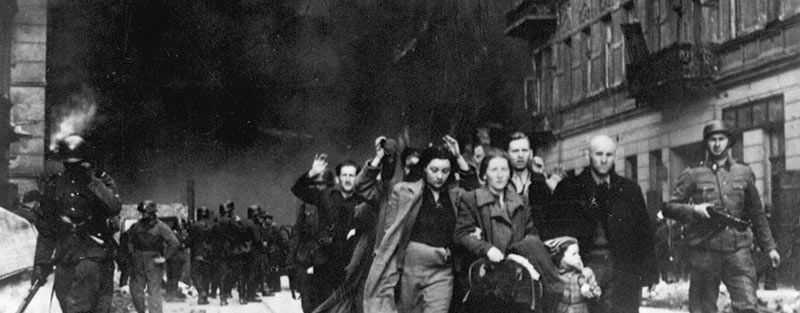
Captured Jewish Partisans in Warsaw

Indeed where Jews did not have a specific socio-economic role as with the Jewish farmers in Sicily, they assimilated to the surrounding population.

Zionism has rewritten the history of the Jews and hence the history of anti-Semitism. Zionism, with its claim to Palestine, consists of a series of myths designed to appeal to the simplest of minds.

How many times did we hear during the attacks on Corbyn that anti-Semitism was a ‘virus’, a pathological and incurable condition. As one of the first Zionists, Leon Pinsker wrote in Autoemancipation:

‘Judeophobia is then a mental disease, and as a mental disease it is hereditary, and having been inherited for 2,000 years, it is incurable.

Pinsker was a doctor so he used the term ‘Judeophobia’ rather than anti-Semitism. But if a disease is incurable then there is no point in fighting it.  At best one seeks pain relief or palliatives.

Theodor Herzl, the founder of Political Zionism, was of the belief that the cause of anti-Semitism was the Jews themselves. Their fault was living in other peoples’ countries. The solution was therefore colonisation. In the Jewish State he wrote:

“The unfortunate Jews are now carrying the seeds of anti-Semitism into England; they have already introduced it into America.”

Leon demolishes this and other Zionist myths and shows how, as Jews fulfilled certain roles in  society – money lenders, tax stewards, usurers, traders, skilled craftsmen –anti-Semitism itself changed. Religious anti-Semitism expressed  class antagonism to the role Jews played in feudal society and was expressed as religious antagonism.

Leon’s great achievement was to situate the Jews in history. Instead of the Zionist myth of the expulsion of the Jews from Palestine in the wake of the destruction of the Second Temple, for which there is zero evidence, he showed how it was the Jews themselves who emigrated because Palestine was incapable of feeding its inhabitants.

In this the Palestinian Jews were not unique. Many people such as the Phoenicians and Armenians had followed similar paths.

Some 4 million Jews left Palestine in the first two centuries AD. Some 1 million of them were to be found in Alexandria alone, one of the great Hellenized cities in the Mediterranean. Like many people before them, the Jews became great traders and it was through trade and commerce that Jews survived.

Leon’s explanation of the Jews as a ‘people-class’ explained their survival. In the feudal era, a society based on production for use not exchange, groups who carried out particular socio-economic roles were seen as being different ethnically from the native population.

The Zionist idea of ‘eternal anti-Semitism’ is a way of avoiding difficult questions such as why the Jews survived and why there was persecution. It is really a reflection of the anti-Semitic stereotype of the ‘eternal wandering Jew’ which became a film under the Nazis.

Anti-Semitism constituted the class antagonism of different layers of feudal society towards the economic role that Jews played.

Thousands of Jews died in peasant revolts, be it at York, Norwich or at the hands of Chmielniki and the Cossacks in Poland from 1648 to 1657. However this was a peasants revolt against the role of Jews as Arendators, officials who leased land from the nobles and whose demands on the peasants were extremely exacting. 

Many of those who died were Jews but contrary to popular history it wasn’t just Jews who suffered. As Anna Reid wrote in Borderland: A Journey Through the History of Ukraine:

Wherever they found the szlachta, royal officials or Jews, they [Cossacks] killed them all, sparing neither women nor children. They pillaged the estates of the Jews and nobles, burned churches and killed their priests, leaving nothing whole....

But whereas anti-Semitism in feudal times came from the peasants and mendicant religious orders, with the Jews as in Poland, protected by the nobility and King, under capitalism anti-Semitism came from the State and the ruling classes. The best example until the Nazis was under the Czar whose Ministers deliberately instigated pogroms, creating the Black Hundreds for this purpose.

To the Zionists anti-Semitism was the property of all non-Jews regardless of class. Anti-Semitism existed because the Jews existed. As A B Yehoshua explained, the Jews were guests who used other peoples’ countries like hotels. [Jewish Chronicle, 22.12.89. ‘Diaspora a cancer’]

As Hannah Arendt observed

If it is true that mankind has insisted on murdering Jews for more than two thousand years, then Jew-killing is a normal, and even human, occupation and Jew-hatred is justified beyond the need of argument. [The Origins of Totalitarianism, p. 7] The Origins of Totalitarianism, p. 7,

Leon’s book went almost unnoticed until it was resurrected by French Marxist Maxime Rodinson in 1968 at the height of the Paris riots.

Leon’s main argument was that the Jews formed a ‘People Class’ – that they performed specific tasks in pre-capitalist society that bound them together as both a people and a class. Under feudalism this was very common. Not just the Jews but the Gypsies, Scots, Armenians and Chinese of South Asia, who were even called the Jews of Asia, also formed castes that attracted popular ire.

Where the Jews lost a distinctive socio-economic role they assimilated to the majority. To the Zionists anti-Semitism was common to all non-Jews. As Leon wrote (p.247)

Zionism transposes modern anti-Semitism to all of history and saves itself the trouble of studying the various forms of anti-Semitism and their evolution.[1]

In what is a short book, Leon gave a panoramic overview of the Jews historically. The book explains that the ‘Jewish Question’ was dying out in Western Europe with the advent of capitalism. The Jews no longer had any specific socio-economic role. They were assimilating to the majority population with the advent of Emancipation. It was only anti-Semitism in Russia and Eastern Europe, resulting in waves of migration by Jews westwards, that kept the Jewish Question alive.

Zionism was implacably opposed to Jewish Emancipation because they saw, correctly, that granting equal rights to Jews meant that they were no longer forced by the state to maintain a separate existence. In Israel today the fascist Lehava calls miscegenation , inter-racial sex, a holocaust. Israeli minister Rafi Peretz labeled intermarriage between American Jews and non-Jews as being “like a second Holocaust.”

Leon had but a very short life but in that very short time-span he produced  one of the Marxist classics which cuts through the mystification of Zionism in its treatment of both Jewish history and anti-Semitism .

I began by saying that Leon had started out as a Zionist in Hashomer Hatzair. In Palestine this was a political party which later became Mapam. Their strand of ‘Marxist’ Zionism had been founded by Ber Borochov, who was expelled from the Russian Social Democratic Party in 1901 for Zionism.

Borochov held that Jews could not take part in the class struggle in the diaspora because they had no relationship to the means of production. Their conditions of production meant that they were outside the class struggle. According to Borochov social structure of the Jews resembled an ‘inverted pyramid’ – too many rich Jews and not enough poor or working class  Jews.

It was only in Palestine where Jews could form their own society that it was possible for class struggle to break out. Borochov, who ended up supporting WW1 was wrong. It was precisely at this time, the end of the 19th and beginning of the 20th centuries that Jews were becoming part of the proletariat.

Marxist Zionism was always a cult that used sophistry to explain away colonialism. If Borochov is to be taken at his word then Socialist Zionists having allied with the bourgeois Zionists in order to create a Jewish State would then wage class war against them! The problem with this was that it was more likely to become part of the bourgeoisie in such a state.

We can see where this bankrupt theory has ended up. In the last Knesset Meretz, which was the descendant of Mapam, found itself in alliance with the far-Right Yisrael Beteinu and Yamina. In the 2020 elections Meretz, has been eliminated from the Knesset altogether. In 1949 in Israel’s first elections it obtained 19 seats.

The beauty of Leon’s book is that it at once provides an overview of Jewish history since ancient times and explains how and why anti-Semitism has persisted, albeit in different forms.  It demystifies anti-Semitism.

As Leon remarked in the section on Zionism and the belief in  2,000 years of exile:

In reality just so long as Judaism was incorporated in the feudal system, the “dream of Zion” was nothing but a dream and did not correspond to any real interest of Judaism. The Jewish tavern owner or “farmer” of sixteenth-century Poland thought as little of “returning” to Palestine as does the Jewish millionaire in America today. Jewish religious Messianism was no whit different from the Messianism belonging to other religions. Jewish pilgrims who went to Palestine met Catholic, Orthodox, and Moslem pilgrims. Besides it was not so much the “return to Palestine” which constituted the foundation of this Messianism as the belief in the rebuilding of the temple of Jerusalem.

We should not forget that Leon was writing at the height of the Nazi persecution, a persecution which claimed him in that death factory, Auschwitz. He wrote that one of the “ironies of history” was that

when the Jew was unassimilable, at a time when he really represented “capital,” he was indispensable to society. There could be no question of destroying him. At the present time, capitalist society, on the edge of the abyss, tries to save itself by resurrecting the Jew and the hatred of the Jews. But it is precisely because the Jews do not play the role which is attributed to them that anti-Semitic persecution can take on such an amplitude. Jewish capitalism is a myth; that is why it is so easily vanquished. But in vanquishing its “negative,” racism at the same time destroys the foundations for its own existence....

The irony of history wills that the most radical anti-Semitic ideology in all history should triumph precisely in the period when Judaism is on the road of economic and social assimilation. But like all “ironies of history” this seeming paradox is very understandable. At the time

Tony Greenstein


[1]                                 Abram Leon, The Jewish Question - A Marxist Interpretation, p. 247.

10 July 2020

How Zionist colonisation subverted even the best intentioned of people in the cause of a Jewish exclusivist project


Review: Wrestling with Zionism– Jewish Voices of Dissent, Daphna Levit, 
Olive Branch Press, Interlink Publishing Company, 2020


Daphna Levit grew up as a secular Zionist who worshipped just one god, the Land of Israel (Eretz Yisrael). She was a good example of those early Zionists who based their claim to Palestine on the god they denied. Even the ‘Marxist’ Zionists of Ber Borochov’s Hashomer Hatzair (Mapam) supported the colonisation of Palestine.
This book is appropriately named. When you are born into a Zionist family (or grow up in Israel) you have to wrestle with the unconscious racism, biases and assumptions that are part of every day life.
I grew up in an Orthodox Jewish family and it was taken for granted that you couldn’t trust an Arab, that they would stab you in the back when you weren’t looking. That Arabs never meant what they said. For most Jews and certainly for most Zionist Jews in Britain, Arabs and Muslims are not real living human beings but cardboard cut outs.
According to the CAA this idiot is typical of British Muslims
This is why I laugh when I read that ‘anti-Semitism’ is rife within the Muslim community. For example the Campaign Against Anti-Semitism pamphlet British Muslims and antiSemitism which states that
‘It is clear that many British Muslims reserve a special hatred for British Jews’ yet the CAA is still taken serious by British politicians and it was also taken seriously by the EHRC which accepted its complaint against the Labour Party for ‘anti-Semitism’. I wonder when someone is going to do a survey on hostility to Arabs and Muslims in the Jewish community.
Daphna grew up in the 1950s and 1960s never questioning the Zionist narrative. It all seemed so simple. God gave us the land and the Arabs tried to drive us into the sea. Despite us pleading for them to stay in 1948 (Haifa’s Mayor is always given as the example, forgetting that Haganah was shelling the Arabs of Haifa at the same time and broadcasting from loudspeakers that they should flee whilst there was time) the ingrates had received orders from their leaders in Damascus and Cairo to vacate the land whilst the Arab armies could invade. When this task was completed they could return.
Martin Buber
Understandably the early Israelis were reluctant to take back the refugees since they could never be sure that they wouldn’t pull the same trick again. Oh and Israel desired nothing more than peace but the Arabs simply wouldn’t talk to them forcing Israel to attack them! Repeatedly!
It never occurred to me as a child to ask simple questions such as, how could the Zionists create their Jewish state when the majority of inhabitants were Palestinian. Nor did I hear of two researchers, Walid Khalidi and Erskine Childers, who independently in 1961 examined the BBC and CIA transcripts of the Arab radio broadcasts of the time. Not only were there no such Arab orders but to the contrary the Palestinians were told not to flee. You can see the original article by Childers here and a debate The Spectator Correspondence.
One of the great skills of Zionist ideologues is to ignore the evidence, however compelling, and rely on assertion. Read the discussion on Childer’s article and the attempts by Jon Kimche to defend the indefensible whilst continually changing ground. Life back then was simple. Even grown ups believed in fairy tales!
I have no hesitation in recommending this short book as a good introduction to the history of Zionism through the potted histories of some of its key figures. There is a wide selection of people, from the founder of Political Zionism Theodor Herzl to dissident Zionists such as Yeshayahu Leibowitz and Uri Avnery.
There are a few mistakes in the text. Leon Pinsker’s Autoemancipation was written in 1882 not 1884 and it was motivated by the 1881 pogrom in Odessa, in the wake of the assassination of Czar Alexander III not the 1871 pogrom. On page 34 it states that On May 14, 1948, the United Nations resolved to partition Palestine’. In fact that was the day Israel attained independence.
It is easy to quibble over Daphna’s choice of who to include. Personally I would have included Herzl’s deputy, Max Nordau, a believer in social Darwinism who wrote a book Degeneration’. It was an argument that Hitler frequently made. Nordau argued that degenerate art reflected and caused a degenerate society. He attacked Oscar Wilde’s dress sense as the ‘pathological aberration of a racial instinct’. Influenced by the criminologist Lombroso who believed that criminality was an inherited disease.
I would also have included Arthur Ruppin, the Director of the Palestine Office from 1908 and the key figure of Palestinian Zionism in the pre-state period. [see here and here] He was responsible for the establishment of the kvutza and the collective Labour Zionist settlements and the marriage of bourgeois Zionist capital with labour Zionism. He was a social Darwinist who put his ideas into practice in respect of the Yemenite Jews brought to Palestine to do the heavy work for the ‘socialist’ kibbutzniks. They died off like flies and Ruppin’s behaviour towards them was Nazi-like, refusing them medical help and sufficient wages for food.
Levit, like many historians of Zionism, over estimates the influence of Cultural Zionism and Ahad Ha’am in particular. Ha’am warned in his essay ‘Truth from Eretz Yisrael’ in 1891 of the Jewish settlers’ “"hostility and cruelty” and of their ‘pride’ in beating them. Ahad Ha’am had, however, virtually no influence on the development of Zionism apart from his involvement in the founding of the Hebrew University, Jerusalem.
Indeed thousands of words are wasted on Zionist ‘peace groups’ of the period such as Brit Shalom and Ihud. These groups are usually quoted as examples of how Zionism was heterogeneous.  In fact these groups were tiny.  Even worse they incorporated those whose only reason for participation was in order to persuade the Arabs that they should surrender peacefully and abandon their opposition to Zionist settlement.
Haim Kalvarisky
Ruppin was the founder of Brit Shalom but he was an imperialist.  He even spent a comfortable two hours with the leading racial scientist in Germany in July 1933, Professor Hans Gunther, exchanging ideas about racial anthropology! This meeting was excised from Ruppin’s Diaries by Alex Bein. Haim Kalvarisky, the successor to Haim Arlosoroff as Political Director of the Jewish Agency was also a member of Brit Shalom.

Judah Magnes
David Ben Gurion and Chaim Weizmann are surprising omissions and I would have chosen Judah Magnes over Martin Buber as a representative of the peace wing of Zionism . One particularly noticeable omission is the lack of any figure from the Zionist Right such as Ze’ev Jabotinsky, whose clear articulation of Zionism as colonialism was a contrast to the dishonest polemics of the ‘socialist’ Zionists who pretended that, but for their feudal leaders, the Arabs would consent to being seduced by sweet talk and honeyed promises.  In The Iron Wall he wrote:

Ze'ev Jabotinsky
‘Every reader has some idea of the early history of other countries which have been settled. I suggest that he recall all known instances. If he should attempt to seek but one instance of a country settled with the consent of those born there he will not succeed.
This is similar to Ben Gurion’s riposte to Martin Buber, the advocate of bi-nationalism, when he inquired whether he had ‘come to Palestine with the consent of the Arabs or against their wishes’. 
However this is Daphna’s book not mine! There is a very impressive representative of what might be called the ‘other Israel’. People such as Tanya Reinhardt and Tikva Honig-Parnass.
However Daphna is still in thrall to some of the myths of Zionism. My major criticisms of the book is that Levit does not analyse Zionism as a settler colonial movement but in terms of its own self-serving justifications such as providing a refuge for Jews. In fact the motives for Ben Gurion and the Zionist leaders was to recreate the mythical warrior state of the Jewish people in the image of the Macabees. Zionism was always, first and foremost, a project to resurrect the Jewish racial state.  It was never about providing a refuge for Jews. What later was called ‘refugeeism’ i.e. saving Jews in whatever place could be found was implacably opposed by the Zionists.
In a memo of 17 December 1938 to the Jewish Agency Ben Gurion made the policy of the Zionist movementabsolutely clear:
‘if the Jews are faced with a choice between the refugee problem and rescuing Jews from concentration camps on the one hand, and aid for the national museum in Palestine on the other, the Jewish sense of pity will prevail and our people's entire strength will be directed at aid for the refugees in the various countries. Zionism will vanish from the agenda and indeed not only world public opinion in England and America but also from Jewish public opinion. We are risking Zionism's very existence if we allow the refugee problem to be separated from the Palestine problem.’
Colonialism always provides its own justifications. No colonial power described its mission as one of exploitation and plunder.  All of them had a noble mission. For Britain it was the White Man’s Burden for Zionism it was seeking a refuge for Jews in a Land Without a People for a People Without a Land.
Zionism was never a movement to save Jews. It was a movement to save the Jewish people as a mythical racial entity. One favourite myth, which Levit repeats uncritically is her assertion that:
Most of the early Zionist leaders were ardent socialists and nationalists... their secular/ political Zionist hope was to create a ... Jewish homeland for a community that would discard much of its religious identity. a modernistic amalgamation of nationalism, socialism, enlightened Western culture, and some as yet undefined ethnic Jewish identity.’
Leaving aside the amalgamation of nationalism and socialism, which is like saying you can amalgamate life and death, a poison with its antidote, love and hate, the myth that the early Zionists were ‘ardent socialists’ is just that. A myth. At the first Zionist Congress the all-male participants were attired in formal dress and white tie. No workers they.
Zionism arose as a reaction to anti-Semitism that rejected socialism and any attempt to ameliorate the condition of Jews in the diaspora. That was what made Zionism different from the many different Jewish reactions to anti-Semitism and the transition from feudalism to capitalism.
The Black Hundreds - Czarist organised pogromists
Barely 4 months after the 1903 Kishinev pogrom when nearly a 100 Jews were murdered and others were raped and injured, a pogrom which caused infamy throughout the world, Herzl met with the person responsible for setting up the Black Hundreds, the group that perpetrated the massacre, Czarist Minister Vyacheslav von Plehve, to secure the legalisation of the Zionist movement in Russia, which he achieved.
‘‘Help me to reach land sooner and the revolt will end” he pleaded ‘And so will the defection to the Socialists.’
In an interview with  Lucien Wolfe in The Times of 6 February 1904 Plehve explained that Zionism was ‘an antidote to socialist doctrines.’ Similarly Winston Churchill, a noted anti-Semite and Zionist, wrote an influential essay Zionism v Bolshevism - A Struggle for the Soul of the Jewish People. .in which this apostle of imperialism placed his hopes in Zionism as the saviour of the Jewish people from Marxism and socialism.
In a letter to Baroness Suttner in 1899 Herzl explained that
‘we are everywhere engaged in battles with the revolutionaries and are actually turning the young students as well as the Jewish workingmen away from socialism and nihilism by unfolding before them a pure and national ideal.’
Ben Gurion wrote of his battles with the anti-Zionist Bund the main adversary in his home town of Plonsk in northern Poland. In Tom Segev’s recent A State at  Any Cost: The Life of Ben Gurion Segev describes how
A Bund publication wrote that Ben Gurion began to shout during one of the debates (between Poale Zion and the Bund). “We have weapons and we will kill you all like dogs.” It called him a hooligan. “And I beat the Bund” Ben Gurion boasted. “I ejected the Bund from Plonsk.” The short boy who had never been happy... was now a thuggish Labour boss in a small town.’
Simon Petliura - Ukrainian nationalist responsible for 100,000 Jewish deaths - Jabotinsky formed an alliance with him against the Bolsheviks
Zionism was always a reactionary movement. Socialist Zionism grew up as an attempt to retain the support of Jewish workers who were more interested in more immediate questions such as anti-Semitism and wages and conditions than the fight for Palestine.
Herzl also went out of his way to win over the Orthodox rabbis, albeit with no success. He even failed with the Chief Rabbi of his own Vienna, Morris Gudeman. See The Rabbis’ Intifada – An Unbroken Chain of Jewish anti-Zionism and Solidarity It is therefore untrue to say that ‘He would have been surprised, if not shocked, to learn that many of the staunchest defenders of Zionism do so in the name of religion.’
Herzl was well aware that Zionism could only succeed if it could harness the Jewish religion to the Zionist chariot. In Altneuland he talked of keeping rabbis out of politics because he understood what happens when religion and a state are married – messianic racism. Of course when you make a pact with the devil you need a very long spoon!
Hannah Arendt
Daphna Levit is a student of Hannah Arendt and her portrait of Hannah, a refugee from Nazi Germany who was an early Zionist activist is well worth reading as an essay on its own. Levit is an expert on Hanna Arendt, the greatest political philosopher of the 20th century. I share her fascination, even with Arendt’s many errors!
Levit describes the famous debate with Gershom Scholem, the Zionist professor of mysticism, when, after her publication of Eichmann in Jerusalem, wrote to her accusing her of having no love for the Jewish people. Her response was withering:
‘You are quite right—I am not moved by any “love” of this sort, and for two reasons: I have never in my life “loved” any people or collective... I indeed love “only” my friends and the only kind of love I know of and believe in is the love of persons. Secondly this “love of the Jews” would appear to me, since I am myself Jewish as something rather suspect.... I do not love the Jews, nor do I believe in them: I merely belong to them.’
Scholem demonstrated in his question the racist waters in which Zionism breeds. Arendt had written a series of articles for the New Yorker on the Eichmann Trial and the subtitle of the book was ‘The Banality of Evil’. The terrifying thing about Eichmann she wrote was that he was surprisingly normal. He didn’t have horns.
Ze'ev Sternhell
Arendt was also scornful of what Salo Baron called the ‘lachrymose version’ of Jewish history. The idea of 2,000 years of unending Jewish persecution. The idea of the Jew as perpetual victim and never the actor, which is itself an anti-Semitic stereotype, was one Arendt rejected.
Arendt was scornful of those who believed that the whole world was against us.  This was a Zionist siege mentality typical of settler colonialism. She foresaw that the Holocaust would become the new Jewish religion and used to justify any Israeli aggression.
Yeshayahu Leibowitz was the Orthodox religious scholar and Professor, a latter day Prophet, who foresaw that the Israelis would end up worshipping the Land of Israel much as the ancient Israelites worshipped Baal and the false idols. Levit quotes Leibowitz that
“He who empties the Jewish people of its religious content turns the concepts of chosen and holy into expressions of racist chauvinism.’
Sternhell's comparison between Israel and Nazi Germany caused great affront to the racists who inhabit Israel
Leibowitz claimed that Israel could not be considered a democracy as long as it ruled over two million people deprived of any legal or human rights. Like the late Ze’ev Sternhell, Uri Avnery and Noam Chomsky, Leibowitz saw the 1967 war as one of conquest which ‘changed the very foundation of its existence.’ Unfortunately this was wishful thinking.
I get the feeling that Daphna has some sympathy with this view, that 1967 changed the course of Israeli history. The expulsions of 1948 and onwards betrayed Israel’s settler colonial nature. To create a Jewish state in a land where the majority of the population was not Jewish ethnic cleansing was inevitable.  In my view this subject is the central reason for Netanyahu’s desire to annex the West Bank.
The conquest of the West Bank/Gaza simply gave expression to that. However throughout the 1950s and 1960s, when Israel’s Arab population was under Military Rule, Israel was seeking any pretext to expand its borders. The 1956 Suez War was a false start.  1967 established Israel as the strategic watchdog of the West. Israel also engaged in ethnic cleansing of the Bedouin of the Negev throughout the 1950s.
The decay of Israeli ‘democracy’, the rise of the nakedly chauvinist Right who have no regard for the tender feelings of liberal Zionists such as Peter Beinart has been a terrible shock for Israel’s liberal supporters. The fact that Netanyahu doesn’t care and openly aligns himself with Donald Trump is indicative of the fact that ideology and practice is coming into line in Israel.  There is no longer a need to pretend that the Kibbutzim are an oasis of socialism rather than seeing them for what they are – racially exclusive Jewish settlements.
As Chomsky wrote
“There seems to be no room in Israel for those who try to square a universalist point of view, be it liberal or socialist, with the racist definition of Zionism.”
The problem is that Zionism is racist by definition.  There isn’t a non-racist Zionism. Levit cites Chomsky being refused entry to from Israel because of his opinions. He suggested that his interrogators ‘“try to find any government in the world that likes anything I say,” Israel is quite unique in the western world in barring visitors, including Jewish anti-Zionists, because of their opinions.
Professor Ze’ev Sternhell, a child survivor of the Holocaust, who has only just passed away, justified Zionism by the need for Jews to find a refuge.
‘By being the only place in the world to which European Jews could actually escape in the 1930s and 1940s, Palestine gave legitimacy to the establishment of the State of Israel beyond any historical rights to the land.’
Except it wasn’t the only place that Jews could escape to despite the attempts of the Zionist movement to close down alternative places of refuge such as Saint Domingo.
Palestine took less than 15% of the total number of Jewish refugees from Germany. Zionist opposition to lowering the immigration barriers in America and other countries and their sabotage of the attempt to seek other havens resulted in the death of thousands.
Sternhell who was a target of a fascist settler bomb in 2014, was a world authority on fascism. He wrote the defining book on the history of Labour Zionism, the Founding Myths of Israel. In it he traced the development of Labour Zionism proving that it was never socialist.  Instead it mobilised the Jewish working class for national goals.  It owed more to nationalist socialism than socialism. Ben Gurion coined the slogan ‘from class to nation’.
Daphna Levitt recalls that ‘Sternhell points out that many of the early leaders of the Zionist Revolution loathed the diaspora and its “weakling Jews.” which is correct but this also points to a fundamental weakness of the book’s analysis of Zionism. Zionism was, above all, a reaction to anti-Semitism which accepted the rightfulness of anti-Semitism.
Indeed Zionism justified anti-Semitism. As Jacob Klatzkin, the editor of Die Welt (1909-11) and co-founder of the Encyclopedia Judaica explained:
‘If we do not admit the rightfulness of anti-Semitism we deny the rightfulness of our own nationalism... Instead of establishing societies for defence against the anti-Semites who want to reduce our rights, we should establish societies for defence against our friends, who desire to defend our rights.’ [The Meaning of Jewish History, by Jacob Bernard Agus, David Daiches, Commentary, April 1964]
According to ‘left’ Zionist A B Yehoshua Jews were a ‘cancer connected to the main tissue of the Jewish people” who use other peoples’ countries like hotels.’ [Jewish Chronicle 22 December 1989, ‘Diaspora a cancer’]
This was why the myth that Herzl was driven by the Dreyfus Affair into becoming a Zionist is wrong. Herzl fell out with the one member of the Zionist Actions Committee, Bernard Lazarre, who was the original anti-Dreyfussard. As Herzl wrote in his Diaries:
In Paris... I achieved a freer attitude towards anti-Semitism, which I now began to understand historically and to pardon. Above all, I recognise the emptiness and futility of trying to 'combat' anti-Semitism.’ [Diaries p.6]
Uri Avnery was a ‘Canaanite’ who wanted an Israeli nation that included the Palestinians but was separate from diaspora Jewry.  Zionism however was founded to wind up the diaspora not exclude it. Israel was to be a state of Jews everywhere not its citizens.
Avnery, Sternhell and Chomsky failed to understand that a Jewish state, in a settler colonial context, could not be other than racist.
Levit includes many of the foremost Israeli activists such as Tikva Honig-Parnass, who was Parliamentary Secretary of Mapam before joining the anti-Zionist Matzpen. Tikva recalls an incident in the 1948 War when she was fighting in Palmach when she encountered two Jewish American volunteers in the army who came from a mission shouting that they met on their way back to the base Palestinian women and children starving to death and begging to go back to their villages. They added angrily that, “if this new state cannot take care of its Palestinian inhabitants, then it has no right to exist.”
Tikva, who was then member of the ‘Marxist’ Mapam wrote to her parents that ‘I’m sick and tired of these American ‘philanthropists.’” The idea of that concern for the Palestinian refugees was a form of philanthropy says everything about Zionism’s racist ideology. Instead of all human beings  being treated equally, Zionism treats kindness to non-Jews as a form of unwarranted generosity. Such feelings merited an especial scorn from the racists of Labour Zionism. At that time she was contemptuous of those who showed any concern towards the indigenous population.
Daphna describes the pivotal moment in the crystallisation of the anti-Zionist group Matzpen who put an advert in Ha’aretz 3 months after the 1967 war stating that
Conquest brings in its wake foreign rule’ which ‘brings in its wake resistance... oppression (and) ... terrorism and counterterrorism... (it) will turn us into a nation of murderers and murder victims. Let us leave the Occupied Territories now.’
This did not make them too popular!
Levit describes the rise of the new historians, Benny Morris, Ilan Pappe, Avi Shlaim, Simha Flapan and Tom Segev in some detail. With the opening up of the archives they began to deconstruct the founding myths of Israel. These same files are now being reclassified by Israel’s security police Shin Bet. History to Zionism is a weapon in the war. It has no merit in its own right.  There are no truths, everything is relative. Zionism is the ultimate form of post-modernism.
Simha Flapan’s 1987 book The Birth of Israel: Myths and Realities was groundbreaking. He was the first to destroy the myth that Israel had been invaded by all the Arab armies on gaining independence in 1948. On the contrary the Zionists had negotiated a deal with King Abdullah of Jordan to prevent a Palestinian state. The other Arab armies sought to prevent Abdullah triumphing.
Benny Morris’s book Birth 1987 of the Palestinian Refugee Problem and then his subsequently Birth of the Palestinian Refugee Problem Revisited demolished the idea that the Palestinian exodus had been voluntary. Yet increasingly Morris’s historical researches were at variance with his political opinions which, after 2000, were at variance with his research.  He became a supporter of transfer and criticised Ben Gurion for not having finished the job.
Levit gives us a potted history of how the State of Israel has sought to manipulate and distort its own history in a way no bourgeois democracy would contemplate. This in itself is the sign of a proto fascist society.
Shlomo Sand
Daphna focuses on Shlomo Sand, Professor of History at the University of Tel Aviv whose The Invention of the Land of Israel deconstructs the myth that for 2,000 years all that Jews longed for was a Jewish state. Debunking the story of the Exodus and doubting the existence of King David whilst showing there was no Roman expulsion of Jews in the aftermath of the fall of the first temple. 
In Israel there is History and Jewish History and the two are distinct subjects. Universalism has been excluded from Israeli academia as universities have functioned as an ideological transmission belt for Zionism.
Tom Segev, a journalist on Ha’aretz, wrote the seminal Seventh Million about the German Jewish immigrants to Israel and the record of Zionism during the war years and after.  Daphna quotes Elie Wiesel, a survivor of Auschwitz, in his review of the book, The Land that Broke Its Promise that:
Just as the new Israelis were creating an image of a heroic, athletic, defiant Jew, they did not want to come face to face with a weak and pitiful survivor and did not want to claim him as their own. They wanted heroes, not the embarrassing reminder of Jews being proverbially “led like lambs to the slaughter.... (Segev)
the Jewish leaders of Palestine never made the rescue of European Jews into an overwhelming national priority... Zionist leader Itzhak Gruenbaum, a future Minister of the Interior in David Ben-Gurion’s first cabinet, considered creating new settlements more urgent than saving Jews from being sent to Treblinka and Birkenau.
Levit quotes Uri Avnery as saying that instead of Zionism being dispensed with once the State of Israel was created it had continued. 
‘When one builds a house, one needs scaffolding. When the building is finished, the scaffolding is removed.... Thus “Zionism” continued to exist after its aim had already been achieved. The scaffolding became superfluous, indeed obstructive …’ 
Avnery failed to understand that Zionism was a settler colonial movement whose aim, a Jewish state as racially pure as possible, was an ongoing and never ending process. 1948 was only a staging point on the road to a Jewish Reich. The ‘ingathering of the exiles’ was its aim. Its purpose was the rebirth of a new Jewish Warrior Race and State. Far from dismantling the scaffolding Zionism was busy consolidating its previous work.  The seizure of Arab land had only just begun.  The Zionist institutions such as the JNF were used by the Israeli state to subcontract racism to para state organisations.
The final chapter of Levit’s book is devoted to two brave Ha’aretz journalists, Gideon Levy and Amira Hass and Ilan Pappe, whose support for BDS resulted in his being driven from Haifa University into exile. Levitt recalls a particularly disturbing case in which Israeli academia showed that its loyalty is to the settler state.
Electronic Intifada reported on the demonstration at Tantura
At the University of Haifa a student named Teddy Katz presented his MA thesis to the university in 1998. It described Tantura village in 1948 where there was a very large massacre. The veterans of the army unit who perpetrated the massacre sued for libel. Although Katz, was pressurised into not contesting the writ, he later sought to withdraw this but the court refused. Pappé was not Katz’s supervisor but, he became prominent in defending him after the court proceedings led to a suspension of Katz’s degree in 2000. In an interview Pappé explained his intervention:
‘No one came to his aid. Why should they? He’s a master’s student. They’re professors. What do they care? After I sat here and transcribed the tapes... two or three colleagues changed their mind and helped. But they didn’t endanger their careers. I knew that when I went to help Katz, I would get it in return. But I didn’t know how much … Teddy Katz suffered a stroke because of this university. He almost died. And a master’s degree student shouldn’t almost die because of a university.’
A shocking incident and it is the answer to those who say we should not boycott Israeli academia. Levit pays tribute to the few brave lawyers who represented the Palestinians including the late Felicia Langer, who closed her office because justice in Israeli courts was impossible, Lea Tsemel, Avigdor Lieberman and Gaby Laski.
In the epilogue Daphna describes a horrific incident in the casual cruelty of an Occupation that British Zionists, such as David Feldman, Keir Starmer and the Jewish Labour Movement do their best to defend via accusations of ‘anti-Semitism’. It is:
‘incident (that) forever will haunt me. At a border checkpoint a  terrified, wide-eyed little boy was desperately clinging to his mother’s hand. He was bleeding profusely through a towel wrapped round his head. His mother was screaming uncontrollably, her face distorted with emotion ... In her free hand she held an unrecognizable red blob, her son’s dismembered ear. She was frantically trying to get into an ambulance with him, but wasn’t permitted to; only the patient was allowed in the vehicle. She was told to walk or find other transportation to cross the checkpoint to the hospital. After a storm of frantic gestures and pleas, a ride was found, and the boy and his mother were driven  together to the hospital in a car belonging to an Israeli demonstrator at the crossing.’ This incident is but one of many where Israeli soldiers and checkpoints are used to delay and obstruct ambulances and Palestinian patients have died as a result of this callous cruelty.
Daphna asks
Can this incident be included among the legends of heroic battle against the insidious enemies of the Jewish state, a battle for which every Jewish-born Israeli is trained? Or should it simply be erased, to help maintain the purity of the myth?
It is a good question.
At the end of her book is a list of individuals whom she wants to pay tribute to including Jeff Halper, Haim Henegbi, Adam Keller, Moshe Machover, Akiva Orr, Idith Zertal and Beate Zilversmidt. The tragedy is that these individuals, brave though each one is, represent a sliver of Israel’s Jewish population.
There is a lot that Daphna Levit has compacted into 200 pages. It is an excellent introduction to the history of Zionism even though it seems as if Daphna is still wrestling with Zionism.
Tony Greenstein


[1]               Diaries, p.6.