Showing posts with label anti-Semitic attacks. Show all posts

30 September 2017

Anti-Semitism - Moral Panics

The Anti-Semitic Attack that wasn’t


I'm happy to run this story about a serious assault on a Jewish man, but the question is whether it was anti-semitic or not.  It would appear that what was a drug related attack has been elevated, for entirely cynical reasons into being an anti-Semitic attack.  We should remember that whilst all anti-Semitic attacks are made on Jews, not all attacks on Jews are anti-Semitic.

tony greenstein

Guest Post:  Gavin Lewis
Gavin Lewis is a freelance British mixed-race writer and academic. He has published in Britain, Australia and the United States on film, media, politics, cultural theory, race and representation. He has taught critical theory, film and cultural studies at a number of British universities.

Coverage of the Moshe Fuerste assault reveals deep-seated media prejudice.


In the aftermath of global condemnation of Israel’s 2014 bombing of Gaza’s civilians, including hundreds of children, the UK media and that of the broader Western world became swept up in a moral panic suggesting that the world’s ‘real’ victims were in fact affluent, middle-class, white ethnic Western Jews. Apparently anti-Semitism was to be the ‘real’ prioritised problem, and it was claimed to be rife. However, in the UK, even in the face of media under-reporting, the extent of racism experienced by Black Britons and Muslims is evident, because we know the names of those who experience crippling attack, and who die at the hands of racists and disproportionately at the hands of the police: Dr Sarandev Bhambra, Mohammad Saleem Chaudry, Mark Duggan and Jermaine Baker have been some of the many victims of these various experiences. We even know the places of Muslim worship subjected to arson, such as the Finsbury Park and Bishopbriggs mosques. By comparison, where were the equivalent white ethnic Jewish victims of anti-Semitism? Even in the case of the much-trumpeted fist fight that occurred at Stamford Hill synagogue—which got considerable, disproportionate media coverage—the local rabbi, Maurice Davis, excluded anti-Semitism as a cause. Finally, filling a gap in the dominant ideological narrative, there was one incident that the media could invoke by reference to a real name, which therefore was privileged with elevated coverage, despite obvious undermining contradictions in the reportage.

‘This was not an anti-Semitic attack’, a family friend of Fuerst’s was reported as saying. ‘They might have said something about him being Jewish—but it all started because of drugs. He smokes a lot of weed.’

Reporting the incident

While out in a group of four teenage Jewish friends, Moshe Fuerst was involved in an incident during which he suffered a ‘bleed on the brain’ (media accounts of his injury vary from ‘serious head injury’ to ‘fractured skull’). The Guardian chose to headline the story ‘suspected antisemitic attack’. However, the Jewish Chronicle (JC), which was the Guardian’s cited source, initially reported Fuerst’s father’s assertions that this had actually been drug-related violence; it later took down its original online report entirely, and instead ran with an anti-Semitism claim. Israel’s Haaretz, though, ran the original JC story, which is still available: ‘This was not an anti-Semitic attack’, a family friend of Fuerst’s was reported as saying. ‘They might have said something about him being Jewish—but it all started because of drugs. He smokes a lot of weed.’ Fuerst’s father, Rabbi Michael Fuerst, told the JC in an exclusive interview that he would not be surprised if the attack on Saturday night came after a disagreement over cannabis. ‘He is on the fringes of society and that is what kids on the fringe do’, Rabbi Fuerst said. ‘He was not involved in hard drugs—he’s not any different to any other middle classes’.

At trial, ‘Judge Prowse said that “throwaway remarks that were anti-Semitic were made”, but ruled the victims weren’t attacked because they were Jewish, saying they were simply “in the wrong place at the wrong time”’. Ian Rushton, deputy chief crown prosecutor at the Crown Prosecution Service for the North West, said:

We considered very carefully what each of the victims reported the two attackers saying during the incident, and we have studied the available CCTV. None of the victims reported that racist or religiously abusive language was used by the offenders and there is no clear evidence from the statement or CCTV to prove to the court that they demonstrated or were motivated by racial or religious hostility.

This material was never used to update the Guardian’s original story page, which to this day continues to label the attack as anti-Semitic violence


Despite the fact that anti-Semitism as a motivation for the attack was unsubstantiated by any official source, the paper referred to the two accused as ‘the hate attackers’.

.


In a broader context, the evolving coverage that occurred during the course of this story was considerably worse. The Manchester Evening News (MEN) is the newspaper of the city where the incident took place. The MEN has a practice of covering criticism of Israel pejoratively, as anti-Semitism—there is a very small hard core of wealthy Zionist activism in Manchester, apparently with significant advertising budgets to spend or withhold. The paper has previously smeared Muslims protesting Israel’s bombing of Gaza by likening them to Nazis (as if people of colour weren’t also persecuted by the Nazis). The credibility of these smears unashamedly rested entirely on the utterings of local councillor Richard Leese, who in 2010 spent twenty hours in a cell and received a police caution for assaulting his sixteen-year-old stepdaughter. The paper ran more than eight variants of the Moshe Fuerst story, of which some, perhaps reflecting the sensationalist tone of its coverage, it subsequently felt obliged to either take down or update. In its coverage the paper explicitly labelled the attack anti-Semitic or emphasised the Jewish identity of the teenagers, so as to give that impression. This overt and definitive media reporting tends to be rarer in the cases of Black Britons who have suffered a racist attack, where the label ‘racism’ is often withheld until it has been ‘legitimised’ by the police or a court. In almost all coverage, and heightening the sensationalist tone, a substantially blown-up photo of Moshe Fuerst’s shaved, stitched and operated-on head was used. The Guardian employed a similar tactic of ‘splashing’ the photo.

Moshe Fuerst

One report, which later disappeared from the news site but is still available via the website of one of the MEN’s local sister papers, The Bury Times, claimed that it was a case of young teenagers ‘set upon by a gang of men’—by inference many fully grown adults victimising a smaller number of teenagers. Like several other news outlets, Israel’s National News revised the figure down to a ‘gang of three men’. The MEN conceded that it was actually a ‘gang of three youths’—so, not adults. By the time the case went to trial, it turned out—as the MEN had to further concede—to be two youths in a confrontation with, er, a ‘gang?’ of four Jewish youths. Despite the fact that anti-Semitism as a motivation for the attack was unsubstantiated by any official source, the paper referred to the two accused youths as ‘the hate attackers’. The extent of some of these hyped claims is still evident, and they have been repeated in the Israeli media, for example in The Times of Israel: ‘Fuerst’s father Michael said the attack was carried out by a gang of “non-Jewish boys who were drunk” and who took “great joy, I’m sure, from the fact that they were beating up a Jewish kid”’. However, it’s not just that the numbers and ages of the people involved in this confrontation were manipulated, or even that loaded assumptions about the assailants’ motivations coloured the story, but also that in this coverage the media use of the word ‘gang’ is coming though a particular class- and race-based ideological prism, and therefore it has been unevenly applied. North Manchester has some affluent sections, home in part to the city’s historic Jewish communities. When middle-class Jewish teenagers congregate in these areas they are referred to as a ‘group’. By contrast, working-class kids from poorer and former blue-collar neighbourhoods that border these areas, such as Middleton and Salford, are described as gathering in ‘gangs’, as are, in particular, Black teenagers from the poorer parts of South Manchester, known as Moss Side. None of the media coverage that prioritised an anti-Semitic motivation in its reporting investigated or even considered the option that this was perhaps simply lower-middle-class youths fighting with rich kids.

None of the media coverage that prioritised an anti-Semitic motivation in its reporting investigated or even considered the option that this was perhaps simply lower-middle-class youths fighting with rich kids.
Much of the MEN’s coverage not only gave the impression that this was without question an anti-Semitic attack but also that it was attempted murder. ‘I believe these men killed my son and the NHS brought him back to life’ (Michael Fuerst). ‘(W)hy…come up to him while he is lying on the ground unconscious, kick him in the head, and potentially kill him?’ The impression is also given by the MEN that the extent of Moshe Fuerst’s vulnerabilities and potentially critical health status was instantly evident to those involved in the violent confrontation, thereby justifying the attempted-murder inferences. Here the MEN writes, suggesting an immediate consequence, ‘He suffered a bleed to the brain. He was intubated at North Manchester General Hospital and then put in an ambulance and taken to the neurosurgery specialist centre at Salford Royal. As soon as he arrived there he was operated on. At Crumpsall (North Manchester General) he was already slipping into a coma’. Actually, as the JC reported—perhaps unaware of the MEN narratives—it was apparently a day or so later that Moshe Fuerst’s health crashed and his condition became apparent: ‘The 17-year-old was taken to hospital and initially discharged. He returned to Salford Royal Hospital on Sunday after he complained of headaches, and vomited and collapsed’. But the MEN reporting reinforced national tabloid coverage in papers like the Daily Mail and Daily Mirror, which consequently followed a similar tone: using the language ‘anti-semitic attack’ and the inference of attempted murder, and, like the Guardian, splashing the post-operative photo of the teenage victim. It’s worth reiterating that the youths were convicted of assault: no attempted-murder or hate-crime charge was made. By the time the case came to trial, in reference to the assailants and in contradiction of the implied media narrative that they’d kicked the victim into a coma and casually sauntered off, Judge Prowse said, ‘They genuinely had no idea of the severity of the incident that they had been involved in’.
The other issue in the reporting is the manner in which the potential gangs, class, drugs and/or alcohol-related aspects of this case were underexplored and under-represented in favour of an anti-Semitism narrative. Significantly, the JC initially wrote that ‘the two groups clashed after shouting at each other’ (accounts suggest that this took place from opposite platforms at a tram stop). The JC’s subsequent reports were revised, apparently so as not to give the impression that the Jewish teenagers had been doing any of the baiting and ‘shouting’. But the pictures of the two youths who were eventually convicted of the assault are quite telling in that, in contradiction of the anti-Semitism narrative, both young men appear to be performing gang signs with their hands, perhaps indicative of a more basic, tribal youth conflict?
Moshe Fuerste’s assailants, Joseph Kelly, left, and Zach Birch, right. Source: Manchester Evening News.
None of this—even the legal decision—categorically rules out any anti-Semitic motive in this attack, but a number of questions arise. Why, given the weight of evidence and testimony, did the coverage veer off in the direction of an anti-Semitism narrative when so many other factors were worthy of consideration? Why did the corporate media manipulate material in this way, particularly as the coverage occurred just after the first anniversary of Israel’s bombing of the children of Gaza? If there is a homogenous ‘anti-Semitic’ narrative being encouraged, it does not appear to be a genuine expression of the diverse grassroots reality of Jewish-British experience, sentiments or communal allegiances. In May 2016 the Daily Mirror (also part of the MEN’s Trinity Mirror news stable) splashed the headline ‘Jewish cemetery vandalised by yobs in “sickening” anti-Semitic attack’. Yet buried at the very bottom of the page was the following statement: ‘Stephen Wilson, administrator of the North Manchester Jewish Cemetaries Trust, said he reported the vandalism to the police after being alerted by the cemetery’s ground staff. He said he was “dismayed” by the attacks but was not convinced the motive was antisemitism. “It’s my guess—locals come over the wall, you always find drink cans (beer) over here, they’ve been in that frame of mind and they’ve done it for the sheer hell and fun of it”’. Mr Wilson’s dismissal of an anti-Semitic motive to the vandalism in Manchester replicates Rabbi Maurice Davis’s position—‘everybody gets on and we haven’t had any experience of anti-Semitism’—on the fight that occurred at the entrance to Stamford Hill synagogue hundreds of miles away in London. Both incidents, though, were headlined as anti-Semitic.

Four consecutive Al Jazeera investigations plus ongoing commentaries have revealed that the Israeli embassy has been attempting to provoke its sympathisers to intervene in and manipulate British political and media culture. Could this current moral panic, its tone and potential misrepresentation of Jewish-British experience, be a reflection of this?

It appears that at one point, apparently in support of an interpretation of the Moshe Fuerst incident as an anti-Semitic attack, claims were made that ‘a Jewish Kippah skullcap worn by one of the boys appeared to have been spat at after it fell to the ground during the incident. However, police said the victim “couldn’t be sure” about this happening in a formal statement which was presented to the Crown Prosecution Service to make a charging decision’. Greater Manchester Police ‘said the allegation surrounding the Kippah cap was fully investigated, but the victim was “unsure” as to whether it was spat on’. The police later said:

On September 21, two weeks after the attack, one of the victims attended a police station to report that he believed his Kippah may have been spat upon on the floor during the attack. Further enquiries were carried out by officers to investigate and the circumstances were discussed with the victim. On September 30, the victim made a formal statement to the police regarding this matter, in which he was unsure if the offender spat towards his Kippah.

To summarise: in support of an anti-Semitism narrative, and as an apparent afterthought two weeks after the incident, these claims were made, then withdrawn, then made again, unsubstantiated, at trial. No DNA evidence was ever produced in support of the claims.

As noted above, this coverage and its continuous self-contradictory, flip-flopping claims, occurred just a few months after the first anniversary of Israel’s bombing of Gaza’s children, which in many quarters received much less coverage than the assault on Moshe Fuerste. To put this incident in broader socio-historical context, at almost any time in postwar Britain, regardless of the injuries he sustained, if Moshe Fuerst had been Black, he may well have been treated as a suspect, even prosecuted—unjustifiably or not—for an offence such as ‘affray’. One infamous historical example illustrating this institutional prejudice is the 1993 racist murder of Black teenager Stephen Lawrence, where not only did the authorities initially refuse to prosecute the killers but also the police put the dead victim’s parents, Neville and Doreen Lawrence, under surveillance after they publicly complained to the media about continuing police inaction.

More recent incidents echo Britain’s ‘all darkies look and are the same’ racist past. Bristol police tasered an elderly Black Briton, Judah Adunbi, directly in the face because the officers involved couldn’t tell the difference between him and another Afro-Caribbean man who was the genuine suspect. This generic ‘Black labelling’ resulting in a ‘police stop’ was something Adunbi had suffered before. He had merely been attempting to enter his own home, and the police were apparently oblivious to or unable to recognise the fact that he had been their own race-relations adviser to the local Independent Advisory Group. An innocent, unarmed Brazilian, Jean Charles de Menezes, was publicly shot dead because he was presumed to be Middle Eastern—as if that would have made it all right. Retired top-flight professional footballer Dalian Atkinson was killed by repeated police taser assaults. Complaints of racism—on an incident-by-incident and thematic basis—are given far less column space, and often the term ‘racism’ may not even be used. These inconsistent degrees of coverage have certainly never reached equivalent anti-Semitism moral-panic reportage levels, even—as in case of the killing of Mark Duggan—when the original incident provoked rioting. In contrast to the relatively free use of the term anti-Semitism, the word racism was hard to find in news coverage of the original de Menezes killing or in commentary on the extraordinarily surprising subsequent promotion of Police Commander Cressida Dick, the officer in charge of the operation in which he was killed, to police commissioner.

Given how heavily the anti-Semitism narrative was pushed in reporting the Moshe Fuerst assault, it’s worth going back to original coverage, including family testimony, that featured in the JC: ‘The rabbi [the boy’s father, Michael Fuerst] questioned whether antisemitism had been the key driving force behind the attack. “They were not neo-Nazis out looking for Jewish boys to beat up. They were drunk kids. I imagine they knew they were all Jewish—one of the boys was wearing a yarmulke”’.
One of the defining characteristics of ongoing racial oppression is that it is underpinned by a history of slavery, colonial genocide, institutional power, the leverage of the cultural-media apparatus, and white racial, economic and class privilege. This is what differentiates it from simple prejudice that individuals such as redheads experience. By comparison to the Black experience of racism, rather than being oppressed by institutional practices, the mobilisations of current anti-Semitism moral panics—particularly as and where they support the Israel lobby and aspects of white privilege—appear to be benefiting from these entrenched power dynamics. Even now there are numerous easily accessible webpages on news sites—including that of the Guardian—where the constructed narrative of the Moshe Fuerst incident includes the headlines and descriptions ‘anti-semitic attack’, and this plays into a broader, largely incident-free moral panic about anti-Semitism. By comparison, racist incidents against Black and Muslim Britons require a far greater degree of substantiation. The death toll experienced by the Palestinians is downplayed and/or—in the tradition of nineteenth-century racist, ‘civilising-the-savage’ narratives—is treated as a justifiable developmental inevitability of white Western progress. Similarly, the oppression of Black and indigenous Jews in Israel is made invisible by the corporate media. And, disgracefully, the reported reality of Israel practising apartheid and ethnic cleansing is treated as debatable, even when it is supported by the testimony of Nobel Peace Prize winners Nelson Mandela and Archbishop Desmond Tutu. But perhaps, given the racist double standards on the comparative value of human life upon which the current moral panic is structured, the hypocrites in the corporate media regard Mandela and Tutu as only Black Noble Prize winners.

5 September 2017

Are anti-Semitic attacks at a record high or is it the Israel lobby up to their old tricks?

Hyping up Fears of Anti-Semitism is part of a strategy designed to make Jews feel unsafe

Below is a guest post by  Alan Maddison on what I've termed the fake anti-Semitism campaign.  In the Labour Party the Zionist/pro-Israel lobby has deliberately manufactured a media consensus that there is anti-Semitism in order that those who oppose Israeli Apartheid can be smeared with the label anti-Semitism.  All the figures and statistics show that anti-Semitism is and we should be grateful that it is, at a historically low level.

The Media reports “Anti-Semitic attacks at a record high” – but what does this really mean for British Jews? 

by Dr Alan Maddison

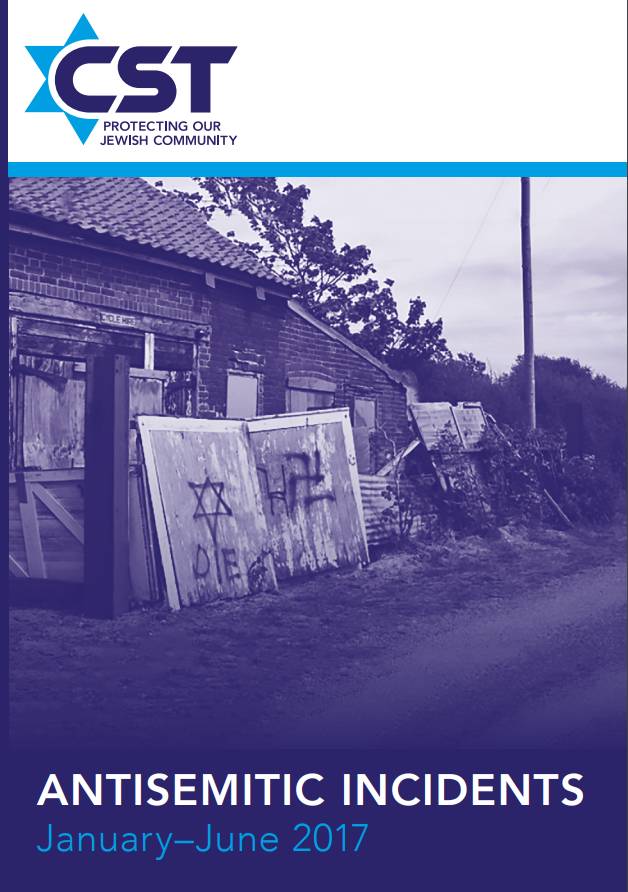
Following the recent publication of the latest Community Security Trust (CST) report into 767 anti-Semitic incidents for the 6 months to June 2017, an increase of 30% over the same period last year, we have seen many articles in the media (July 2017) with quotes such as, 
Anti-Semitic attacks at a record high…….rising hatred and anger”
Then Gideon Falter, chairman of the 'charity' CampaignAgainst Anti-Semitism (CAA), made a scathing attack in the media on the Police and the Crown Prosecution Services. He accused them of betraying British Jews by failing to crack down on anti-Semitic crime and having low prosecution rates. Mr Falter went on to say, 
 “ British Jews continue to endure intolerable levels of hate crime …….there is a very real danger of Jews emigrating”
Such media articles and statements must be very worrying for British Jews to read, especially given the rise of Far Right neo-Nazi movements and Islamist terrorism, the main perpetrators of anti-Semitic attacks in the UK.

Whilst not wishing to under-play the real threats to British Jews, I think it might reassure them to give broader context to these rather ‘anxiogenic’ articles, and to tell them their home is here in the UK and they should stay. 

Are British Jews now especially at risk for hate crime attacks in the UK?

Anti-Semitism: From Prejudice to hate crimes

Surveys (Pew Research, YouGov) indicate prejudice against Jews does exist, but seems to be restricted to a small minority of people (7-8%), with the majority of UK citizens appreciating their Jewish neighbours and the contribution they have made to our society. Up to 6-8 times more prejudice was recorded against Muslims and Roma Gypsies respectively than for Jews.

Of course prejudice, though deplorable, is not hatred, and rarely leads to a hate crime offence. The police have not yet released data to March 2017, but their latest figures for reported hate crimes for the 12 months to March 2016 in England and Wales are shown below, together with CST data for anti-Semitic incidents.

The 924 anti-Semitic incidents published by the CST represented around 1.5% of the 62 518 reported hate crimes. This is illustrated above with estimates of the breakdown for other victim groups for comparison.

It is true that 1.5% seems a low share for anti-Semitism, but the Jewish population is only around 267,000, compared, for instance, with an Asian population of 4.37 million. To appreciate the relative risk for British Jews becoming a victim of a hate crime we need to look at the pro-rata data and these are shown below per 100 000 of each victim population. 
                                
For an anti-Semitic incident the relative risk is slightly less than for a racist attack for all forms of hate crime offences, but higher than for other groups. What seems surprising in the above illustration is that violent assaults (with or without injury) represented about 30-40% for most victim groups, yet only 8% of those anti-Semitic incidents reported by the CST.  So an Asian or Black person probably has a relative risk of a Hate Crime assault four times greater than a Jewish person.

In addition, over a quarter of hate crime assaults reported to the police involved injury, for anti-Semitism the CST reported only 4.6% for this period, at least using GBH as a criterion. 

It is possible that, given these assault data, attacks on British Jews may be less frequent and less violent than those on Asian or Black people. Another explanation is that the CST has succeeded in its mission to encourage reporting of the less serious incidents, those incidents less likely to motivate victims to report to the police. The CST also seems to have greater resources than other victim groups to identify social media abuse. This could mean that by reporting such less severe forms of abuse, the 924 anti-Semitic incidents reported by the CST are “inflated” in relation to police reports for other hate crimes by a factor of around four.

From both prejudice and hate crime data, it does seem that British Jews are NOT at greater risk, indeed BAME victim populations are four times more likely to be assaulted. 
   
Are the CAA allegations of “Police and CPS betrayal” justified?

 Gideon Falter, chairman of the CAA, reviewed recent information from their own records and other sources. He reported that according to his data compilation, 1078 anti-Semitic offences registered in 2016, but there were only 89 charges (8.3%) and 15 prosecutions.

The Crown Prosecution Service (CPS) responded to this accusation by saying it was wrong to claim it does not take anti-Semitic crime seriously,  “ Last year we prosecuted more hate crimes than ever before – more than 15 000 cases.”  The CPS said they did not recognise the statistics contained in the CAA report.

In fact, records show that the CPS did indeed prosecute 15 442 out of a total of those 62 518 hate crime cases reported over 12 months to March 2016, as they say, a prosecution rate of 24.7%. 

Police also report the breakdown for prosecutions and convictions for the main strands (motivations) of Hate Crimes as shown below. As police do not report national figures for further sub-groups within each strand, such as those motivated by Islamophobia or anti-Semitism, I have inserted the CAA anti-Semitism data for the full year of 2016 in italics.

The average total hate crime prosecution rate (24.7%) is three times more than that which the CAA claims for the anti-Semitic hate crimes (8.3%), based on their own data. In addition, the CAA estimate of conviction rate for anti-Semitic hate crimes (16.8%) is very low compared with the 83% average.

These “betrayal” allegations from Mr Falter are very serious indeed, and must be worrying for British Jews, and other citizens who expect the police and CPS to do their job effectively and without bias.

It seems unlikely that over 40 police forces and the CPS would deliberately discriminate against British Jewish victims of hate crimes. Indeed most reports of any prejudice involved the past treatment of BAME individuals who make up most of the hate crime motivated by the Race category. This now has a prosecution rate of 25% and a high conviction rate.

The CPS says they do not recognise the CAA figures, so it could be simply that the Mr Falter’s allegations are based upon unreliable data. However, the CST did report only 22 successful prosecutions out of 1 309 for 2016, this represents 1.7% which is very low compared with the 20.5% conviction rate for total hate crimes reported to the police.

In the absence of more detailed police data it seems likely that the prosecution and conviction rates of anti-Semitic incidents are low. So how do we explain this?

The police record that in general the main reasons for failure to prosecute involve evidential difficulties (26%) and no suspect being identified (48%). Reporting an offence as a hate crime requires no evidence of motivation, just a claimed perception of the victim. But charges and prosecution DO need convincing evidence to be provided. Why should this be more of a problem for alleged anti-Semitic offences?  Well there are three possible reasons besides police and CPS “ betrayal”.

Firstly most hate crimes are reported directly to the police by the victim. But for anti-Semitic offences, many are passed on by the CST who in their recent report says only 38% come from the victim. In fact, the CST accepts anonymous reporting too. These processes would certainly make it harder for police to gather adequate prosecution evidence.

Secondly, the CST encourages reporting of less serious offences which is evidenced by the fact that only 8-10% of their incidents involve assault, yet for all hate crime victim group strands this is around 33%.  In one London Met Police report they stated that, “non-violent offences present less evidential opportunities.” It is therefore probably harder for police to gather adequate evidence for more minor incidents such as graffiti or social media abuse.
The fact that there were four times more violent assaults reported for other hate crime victims than Jewish victims could explain why their prosecution rate is three times that for anti-Semitic incidents.

Thirdly, the CST seems to use the IHEA definition of anti-Semitism and says they encourage the CPS to prosecute anti-Zionist or anti-Israel comments used in an accusatory or abusive manner. The validity of this has been challenged from a legal perspective. It is still lawful to voice legitimate criticism of the Zionist movement policies and those of the Israeli Government. Such freedom of speech may contribute to lower prosecution/conviction rates for anti-Semitic incidents.

It therefore seems that Mr Falter is NOT justified in his public accusations of  “Police and CPS betrayal of British Jews”. 

We need to place anti-Semitic attacks in a broader perspective.

Not all assaults are a result of hate crimes. In fact the general population was exposed, over the same period, to 745 528 general assaults (402 316 of them inflicting injury). Of these assaults only 21 950 (2.2%) were reported as a Hate Crime.

Below we illustrate the calculation of relative risk of being a victim of a general assault, or an assault motivated by either racism or anti-Semitism for each victim group.

These figures are based upon Police and CST reports for 2016 and estimates of population sizes, largely from census data. 

Based upon data from England and Wales above, each year all British residents share an average risk of 13.5/1000 for being the victim of a reported assault. This is 34 times greater than the risk of a British Jew being the victim to an anti-Semitic assault (0.4/ 1000).

We have also illustrated above, as seen earlier, that the Jewish community is exposed to only one quarter the risk for hate crime assaults compared with the predominantly BAME community.

In other words, if according to Mr Falter, British Jews ‘endure intolerable levels of hate crime”, how must the BAME, EU immigrant and other communities at risk for racist attacks feel when their individual risk for assault is four times greater? What about the rest of us? Should we all emigrate when we carry a pro rata assault risk 34 times that of a Jewish person for an anti-Semitic assault, and an even higher risk of injury? In fact, based on CST assault data, a Jewish person also shares with the rest of us, a 34 times greater probability of being the victim a general assault than they do for one motivated by anti-Semitism. 

Conclusion

I have attempted to provide a broader perspective for the relative risks regarding anti-Semitic attacks for British Jews, and alternative explanations for apparently low prosecution and conviction rates.

The allegations and remarks of Mr Falter do not seem justified. He has not presented convincing evidence that the police and CPS have betrayed British Jews. He is no stranger to unfounded claims such as these. Under his chairmanship, the CAA has devoted much of its time to attacking Jeremy Corbyn and the Labour Party with claims of rampant anti-Semitism. Yet in the Home Affairs Select Committee report into anti-Semitism  (October 2016) they state that there is no evidence to support this. Such alarmist and unjustified accusations against important British institutions, like the Police, CPS and main Opposition Party, are divisive and undermine the genuine fight against anti-Semitism.

We should remember that every week, in addition to TWO anti-Semitic assault cases, the police and CPS have to deal with 14 000 criminal assaults including over 8 000 with injury. Police resources are being cut, so it is understandable that some less serious offences, especially with poor evidence, may receive a lower priority, whether these are related to anti-Semitism or not.

In addition, the evidence does not support the idea that British Jews should emigrate to avoid “enduring intolerable levels of hate crime” because the individual hate crime risk for them is relatively low, and more importantly probably 34 times lower than for a general assault.

This is not to deny that hate crimes, however infrequent, are dreadful and lead to fear and anxiety of becoming a future victim oneself, or having a member of one’s family attacked. No British Jew, nor anyone indeed, should have to live in such fear. The rise of the Far Right neo Nazis in the USA may embolden those in the UK too. But we must fight anti-Semitism together, unrelentingly, using education, prevention measures and the application of the law. British Jews have excellent public, political and media support and should have confidence that the police and CPS are doing a good job on their behalf.

The vast majority of British people, including myself, appreciate our Jewish neighbours and want them to stay in the country we have shared as our home, often for generations.

The fight against ant-Semitism, Racism and all hate crimes, especially at this worrying time, requires bringing our communities together, not frightening British Jews to emigrate to Israel. 

                                                                                 Dr Alan Maddison, 20th August 2017