Showing posts with label Yesh Din. Show all posts

6 March 2023

Two Shocking Films - Israeli Troops Escort Masked Jewish Settlers Who Attack Palestinian Homes -

 But later they fire tear gas at Palestinians trying to defend themselves – this is worse than Apartheid in South Africa

Israeli settler in the West Bank village of Burin, on Friday.Credit: Yesh Din

This film is taken by human rights group Yesh Din and was printed today in Ha’aretz in an article below. It demonstrates beyond doubt that the Israeli military have one purpose and one purpose alone in the West Bank – to defend the settlers and to further the colonisation of the land.

That is why armed resistance by the Palestinians is perfectly justifiable and why the settlers are also legitimate military targets. The Quisling Palestinian Authority should be dismantled. It serves no purpose other than to act as the enforcer of the Israeli Occupation Authorities.

Tony Greenstein


Israeli Soldiers Seen Standing by as Settlers Throw Rocks at Palestinian Houses in West Bank Town

In a video documenting the incident, the rioters are seen vandalizing trees and throwing stones, as soldiers stand by without trying to stop or detain them. According to Israeli NGO Yesh Din which published the video, three Palestinian houses were damaged

Hagar Shezaf        Mar 4, 2023 8:11 am IST 

Israeli settlers were documented throwing stones at Palestinian houses in the West Bank village of Burin on Friday, as IDF soldiers were present and stood by.

In a video published by Israeli human rights organization Yesh Din, the rioters, some of them masked, are seen throwing stones and destroying trees belonging to Palestinians – while Israeli soldiers stand by without trying to stop or detain them.

According to Yesh Din, three houses in the village were damaged by the stones. Soldiers were later seen firing tear gas into the area, and several local residents were injured by inhaling the gas, according to the organization.

The army says it is investigating why the soldiers did not act immediately, adding that after a military force that arrived in the village responded with crowd-control measures, order was restored.

The village of Burin is located near the settlement of Yitzhar and the Giv'at Ronen outpost, as well as the Palestinian town of Hawara. According to evidence, during the settlers' rampage in Hawara earlier this week, riots also took place in Burin, resulting in damages to several houses in the village.

Security establishment officials estimated that approximately 400 settlers took part in the riots in Hawara, which broke out after the murder of brothers Hillel and Yigal Yaniv by a Palestinian assailant. During the riots, a Palestinian man was shot dead and dozens were injured. The attackers caused extensive damage to property, set cars and buildings on fire and slaughtered sheep.

Central Command chief Maj. Gen. Yehuda Fuchs called the incident "a pogrom carried out by lawbreakers" and admitted that the army was not properly prepared to prevent it. "This is a disgraceful event by lawbreakers who acted not in accordance with the values on which I was raised, not in accordance with the values of the State of Israel and also not in accordance with the values of Judaism," Fuchs said.

On Friday morning, the army prevented hundreds of left-wing activists who came to Hawara to express support for residents from entering the town, and threw stun grenades at them. The IDF declared the area a "closed military zone" and prevented the buses with which the Israelis arrived from moving forward. The activists then walked towards the town while demonstrating, and at least four were detained when they tried to cross the army blockade. One of the activists said he was beaten by soldiers. A soldier was also seen confronting former Knesset speaker and Jewish Agency chairman Avrum Burg, knocking him to the ground.

‘I couldn’t see if my brother’s murderer was a soldier or settler’

Footage obtained by +972 shows Sameh Aqtesh was shot dead during a settler attack accompanied by the Israeli army on the night of the Huwara pogrom.

By Oren Ziv and Yuval Abraham March 5, 2023

Last Sunday night, when Israeli settlers launched a pogrom on the West Bank town of Huwara, a Palestinian man, Sameh Aqtesh, was fatally shot during a simultaneous settler attack in the nearby village Za’atara. And according to an analysis of 14 videos by Palestinian residents obtained by +972 and Local Call, Israeli soldiers — as in Huwara — were escorting the settlers during the shooting of Aqtesh.

According to the testimonies and videos, the incident began on Feb. 26 at around 7 p.m., when masked settlers came down to Za’atara from Tapuach Junction, a major traffic artery nearby, and began attacking homes in the village. Palestinian residents reacted by throwing stones at the attackers, forcing the settlers to retreat.

An hour and a half later, the settlers returned to the village — this time with soldiers backing them up. In a video recorded moments after Aqtesh’s shooting, taken on Sunday at 8:44 p.m., at least three soldiers, two military jeeps, and what appears to be a police vehicle are seen accompanying a group of around 40 settlers.

Footage of Samer Aqtesh’s killing:

“The settlers came twice,” said Abed Aqtesh, Sameh’s older brother.

“The first time, they came alone and we managed to drive them away. The second time they came back with soldiers and with the settlement security coordinator. There were about 50 settlers; they threw stones at us, and had jerry cans full of gasoline. We threw stones at them.”

In the video recording of the moment of the shooting, one of the Palestinian residents is heard saying, “Don’t be afraid,” while some of the settlers shine flashlights and laser pointers in what appears to be an attempt to blind the residents. Then two more shots are heard, and one of the residents is heard saying: “It’s in the air.” Five more shots are fired. The Palestinian residents are heard saying: “They are shooting at us — ambulance.” This was likely the moment Aqtesh was hit.

At the end of the video, two more shots are heard as well as another call for help. Throughout the video, no Palestinian residents are seen throwing stones or confronting the settlers or the soldiers. After the shooting, the video shows a settler throwing stones again.

“They started shooting live fire. They didn’t throw gas, stun grenades, or rubber bullets, — it was immediate live fire,” Abed continued. “Everything was dark. I didn’t see if the person who murdered my brother was a soldier or a settler.”

2 September 2017

Israel Passes the 'Regularisation' Law - its like having a law to compensate the burglar who enters your home

Pity the Poor, Distressed Zionist Land Thief


Imagine a law in Britain which is specifically designed to legalise squatting on other peoples’ land.  Not only would this be impossible, in fact the opposite occurred under the last government.  The actions of the homeless have increasingly been criminalised, even when they take over empty housing that rich people have decided to keep empty for reasons of making a profit.

The settlement of Amona
Settlers like Education Minister, Naftali Bennett were not homeless.  Bennett came as a rich businessman from Brooklyn, New York.  He and thousands of others are ideological squatters.  They believe they are fulfilling god’s commandments to steal the land of others.  Unlike in Britain they are backed by the force of the State.

Jewish settlers have squatted in their thousands on private Palestinian land [i.e. land which the State has not confiscated under one pretext or another] to which they have no entitlement. 

Attorney General Avichai Mandelblit attends a ceremony in Jerusalem, June 13, 2017. (Yonatan Sindel/Flash90)
Instead of evicting them, as would happen if Palestinians in Israel did the same, the Knesset recently passed a ‘Regularisation Law’ which regularised the position of the land thieves.  It retrospectively legalised the theft of private Palestinian land in the West Bank.  Even the Attorney General, Avichai Mendelblit, a member of Likud, refused to support it describing it as unconstitutional but Netanyahu and his far-Right government proceeded regardless.  After all this is what settler colonialism has always done.

The Jewish settlers believe that god gave them the land, on the basis that their ancestors, completely mythical creatures, apparently lived there a few thousand years ago.  Imagine if the whole world were ordered on this basis!  In reality the settlers are doing no more than colonists have always done in places like Southern Africa.  Using the Bible to justify their expropriation of the land of the indigenous people.

See also the excellent article by Gideon Levy Oh Merciful God, Show Some [Mercy] to Victims

Tony Greenstein


The Israeli settlement of Almon in the occupied West Bank. Credit Ahmad Gharabli/Agence France-Presse — Getty Images        


Israel to High Court: Law Seizing Palestinian Land Is Humane Response to 'Distress' of Thousands of Settlers

Private lawyer representing the state says expropriation of Palestinian lands in West Bank is constitutional under both Israeli and international law

Yotam Berger 22.08.2017 12:17 Updated: 12:18 PM

The unauthorized outpost of Mitzpeh Kramim. Israel says the expropriation law would help residents there with construction. Michal Fattal
The state on Monday asked the High Court of Justice to reject legal challenges to a controversial law that would allow for the retroactive expropriation of land owned by Palestinians in West Bank settlements. It called the law “a humane, proportional and reasonable response to the genuine distress of Israeli residents.”

In seeking to persuade the court to reject the legal challenges – filed by Palestinian and Israeli human rights organizations – the state argued that the “practical alternative” to the law is the maintenance of the existing situation, which the state said is disruptive to the lives of “hundreds of families” in settlements, including families who built homes based on representations by government authorities that it was permissible.

The state added that the law is constitutional under Israeli law and also meets the requirements of international law.
Amona settlers building
Subject to specific provisions, the law allows Jewish settlers to remain in homes built on privately owned Palestinian land, even though it does not grant them ownership of the land. It also denies the Palestinian owners the right to claim the land or take possession of it “until there is a diplomatic resolution of the status of the territories.”

The state’s response was prepared by Harel Arnon, a private lawyer retained by the government after Attorney General Avichai Mendelblit refused to represent it, saying the legislation was not constitutional. Prior to its passage, he also tried to halt the legislative process.

Implementation of the law had been informally suspended following the legal challenge. However, at Mendelblit’s request, the court made the suspension official on Monday through a court order. This will remain in effect until the court makes its ruling.
Bennett shakes hands with Zeev Elkin
 The law also provides a mechanism for compensating Palestinians whose lands are seized: A landowner can receive an annual usage payment of 125 percent of the land’s value as determined by an assessment committee, or an alternate plot of land if this is possible – whichever the Palestinian landowner chooses.

The state said the law addressed “a reality in which the owners of the land are not benefiting from their rights, particularly a reality that time after time has been polarizing and tearing Israeli society apart, and severely harming public trust and institutions of government.”

The state called the current situation “a national problem.”

It also noted a number of cases in which it said residents would benefit from the law if it is found constitutional, including construction at the unauthorized outpost of Mitzpeh Kramim and a number of buildings in the settlement of Ofra.
Demolition of Amona
The state’s response included data from the Israeli Civil Administration in the West Bank, detailing the numbers of orders issued against illegal settlement construction on privately owned Palestinian land.

It said that between 2012 and 2016, orders were issued against 285 illegally built structures; between 2007 and 2011, orders were issued in connection with 251 structures; and between 2002 and 2006, more than 450 orders were issued. Between 1992 and 1996, however, the figure was only 20.

In conclusion, the state said that although there are many issues that prompted the legal challenges to the law requiring thorough consideration, ultimately the petitioners are making “much ado about nothing.”

The law, the state said, does not run counter to any precedent or legal principle, and instead is meant to deal with a unique and complex situation that at times has led to demolitions that benefited no one – a situation that places hundreds of families under “a cloud of uncertainty.”

In response, the organizations Yesh Din, Peace Now and the Association for Civil Rights in Israel – which are some of the petitioners in the case – responded: “The State of Israel, in its response today, is trying to present the land expropriation law as addressing a national problem, when in practice it involves continued government support for a criminal enterprise that has continued for decades.

“The government is minimizing the continuing harm to the rights of the Palestinian landowners, and at the same time is trying to present the Israeli citizens who are taking part in the looting of West Bank Palestinians as people who have been harmed and who require ‘compensation’ for their part in the looting,” they added. “We hope the court rejects the state’s arguments out of hand, strikes down this unconstitutional and immoral law, and sends a loud and clear message: No more.”

Yotam Berger

Haaretz Correspondent

https://ssl.gstatic.com/ui/v1/icons/mail/images/cleardot.gif

State says outpost legalization law protects Palestinians

Responding to petition from left-wing NGOs, government insists preventing additional outpost evacuations is in Israel’s ‘national interest’

In its official response Thursday to a High Court of Justice petition against a new law to legalize wildcat West Bank outposts, the state argued that the legislation, if implemented, would benefit Palestinians.

Private attorney Harel Arnon crafted the response on behalf of the state after Attorney General Avichai Mandelblit refused to defend the legislation. In his 156-page response, Arnon wrote that the law will ensure just compensation for Palestinian landowners who would otherwise receive the death penalty from the Palestinian Authority for selling their land to Jews.

“The law even improves the situation of landowners, who will receive significant compensation for the use of their land — an option denied to them without the law,” Arnon wrote on behalf of the state.
The response also rejected claims that the legislation violates Israeli and international law. Arnon argued that it was in Israel’s “national interest” to prevent the evacuation of the some 4,000 homes that the law would legalize retroactively.


Defense Ministry dismantling Amona outpost in the central West Bank on February 6, 2017. (Courtesy Amona Council)

“The Regulation Law balances the obligation of the government towards thousands of citizens who have relied in good faith on government action and a minor infringement of property rights, with increased compensation to the landowners,” the state concluded.

Passed over six months ago, the Regulation Law allows the Israeli government to expropriate private Palestinian land where illegal outpost homes have been built ex post facto, provided that the outposts were “built in good faith” or had government support.

In return, the legislation states, the Palestinian landowners will be compensated financially or with other land.

The passage of the bill, originally meant to save the since-razed outpost of Amona, was roundly condemned by a slew of activists and political figures in Israel and abroad.

Its legality was immediately challenged in a High Court petition from left-wing NGOs Peace Now, Yesh Din and ACRI (Association for Civil Rights in Israel) on behalf of 27 Palestinian local councils and 13 Israeli civil society organizations.

Regardless of the petition, the law was supposed to have gone into effect last week. However, at the behest of Mandelblit, the High Court ruled Thursday to freeze its implementation for two months.


Jewish Home chair Naftali Bennett (R) shakes hands with Minister for Jerusalem Affiars Zeev Elkin after a vote on the so-called Regulation Bill, a controversial bill that seeks to legitimize illegal West Bank outposts, December 7, 2016. (Hadas Parush/Flash90)

Consequently, no additional land will be expropriated even if it fits the above conditions. At the same time, outposts found to have been built in good faith or with government backing will not be demolished until a final decision is made.

Justice Minister Ayelet Shaked echoed state’s response to the High Court petition in a Monday statement praising the legislation. “The law offers a counter to the racism of the Palestinian Authority, which places the death penalty on those who sell land to Jews,” she said

But the left-wing NGOs behind the High Court challenge said the government’s response was an attempt to cover for a “criminal enterprise.”

“The Israeli government’s response seeks to present the expropriation law as a solution for a national problem, while the real problem is the state’s involvement in illegal settlement activity for the past five decades,” they said in a joint statement.

The court is now set to hear a response from the Knesset’s legal adviser in mid-September, followed by what is expected to be an unprecedented challenge to the law from Mandelblit himself in October.
In the months leading up to the February 6 Knesset vote on the Regulation Law, Mandelblit warned that the legislation bypassed standard land regulation procedures in the West Bank and that it legalized Israeli settlements built on private Palestinian land in breach of local and international law.
Mandelblit also cautioned that the legislation openly curtailed property rights of Palestinians in the West Bank in a way that contravenes the protections granted to occupied populations under the Fourth Geneva Convention.

When the Knesset passed the law anyway, Mandelblit officially notified the High Court that he would not defend the legislation if it was challenged. Arnon was subsequently chosen to represent the state in Mandeblit’s stead.

In May, Haaretz revealed that Arnon’s own home in the Elazar settlement is being built illegally on land that had been designated strictly for military purposes.


These illegal structures could be legalized under Israel's contentious 'land-grab' law, whose validity is now being determined by the High Court of Justice

Yotam Berger Aug 23, 2017 9:01 AM 

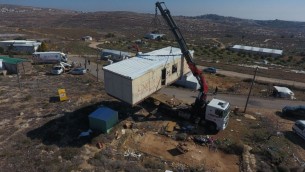
Settlers build in the illegal West Bank outpost of Amona, since evacuated by Israel. Emil Salman

There are 3,455 residential and public buildings built on private Palestinian lands in the West Bank, according to Civil Administration data. These illegal structures could be legalized under the expropriation law, whose validity is now being determined by the High Court of Justice in response to Palestinian petitions against the law.

Extensive details on the scope of illegal structures on private Palestinian land were revealed in an appendix to the state’s response to the petitions.

The law allows the state to expropriate Palestinian lands on which settlements or outposts were built “in good faith or at the state’s instruction,” and deny its owners the right to use those lands until there is a diplomatic resolution of the status of the territories. The measure provides a mechanism for compensating Palestinians whose lands are seized.

According to the Civil Administration, the 3,455 structures fall into three categories. The first includes 1,285 structures that are clearly private land. These are structures built during the past 20 years on land that was never defined as state land and all have had demolition orders issued against them. The second category comprises 1,048 structures that were built on private land that had earlier been erroneously designated state land. The third category contains 1,122 structures that were built more than 20 years ago, during a period when planning laws were barely enforced in the West Bank.
The structures on clearly private land are within the jurisdictions or adjacent to the jurisdictions of 74 settlements throughout the West Bank. Of these, 874 are in outposts – small, illegal satellites of larger settlements. One example would be the Tzur Shalem outpost near Karmei Tzur in the Etzion Bloc. Amona, which was evacuated in February, was another example. The other 411 are individual structures that were built on enclaves of private land within various legal settlements that were planned in accordance with Israeli law.

Israel just passed the land-grabbing law. What is it all about?

Of the 1,285 structures built on clearly private land, 543 are built on what the Civil Administration calls “regularized private land,” meaning lands whose owners are known and whose ownership is formally registered. The other homes are built on lands recognized as private after aerial photos proved that these lands had been cultivated over the years, but there is no definitive registry of who was cultivating them. Cultivating land establishes ownership in the West Bank in accordance with the Ottoman-era laws that still prevail there.

According to Dr. Ronit Levine-Schnur, an expert on property rights at the Interdisciplinary Center, Herzliya, “Regularized land is land for which there is clear land registration, whether performed under Jordanian rule or during the Mandate period. The land at Amona was regularized land. In these cases there is no doubt about the rights because the registration invalidates any competing right and there’s no such thing as a statue of limitations on registered land. Non-regularized land can be unregistered but known to be privately owned, or registered but in a registry that doesn’t have the same strong evidentiary power.”

The second category includes structures built on lands that had been erroneously declared state land. Because the original declarations of state land were based on obsolete surveying technology, when the technology improved, errors were discovered and lands were removed from the state land listings. As a result, 1,048 structures suddenly found themselves outside the “blue line” that demarcates state lands. Of these, 799 structures are in areas that had a valid master plan and were thus planned and built based on the earlier declarations. Of this subcategory, 303 buildings are in the ultra-Orthodox city of Modi’in Ilit.

The third category of structures were built on private lands, with the Civil Administration admitting that in most cases the owners of the lands are known. These structures, however, were built more than 20 years ago, during a period when there was almost no oversight regarding construction on private Palestinian land. Until 1998, the policy was to conduct virtually no enforcement actions in the settlements. Of these 1,122 structures, 480 are in Ofra, 193 are in Beit El, and 146 are in Elon Moreh. Dozens of other such homes were built in Eli, Shavei Shomron, Psagot, Ma’aleh Michmash and Hermesh.

All told, of the 3,455 structures built on private Palestinian land in the West Bank, 1,576 (around 45 percent) were built on regularized private land and the rest on private land whose owners are not confirmed. This number includes residential structures and public buildings, mobile and permanent alike, but doesn’t include other types of structures like storage rooms, fences, roads and infrastructures that were built on private land.

The Civil Administration data is similar to the numbers that appeared in a recent Peace Now report, which estimated that the expropriation law could legalize up to 4,000 housing units in the settlements and outposts. Outposts that could be legalized included Avigail, Ahuzat Shalhevet, Beit El East, Bat Ayin West, Jebal Artis, Hill 725, Givat Assaf and more. The report noted that numerous homes could also be legalized in Oranit, Asfar, Beit El, Givat Ze’ev, Gitit, Har Gilo and others.

The Civil Administration appendix also details how many demolition orders were issued against illegal structures in the settlements. Between 2012 and 2016 there were 285 orders issued; between 2007 and 2011 – 251; from 2002 to 2006 – 451; between 1997 and 2001 – 278 orders and between 1992 and 1996 only 20 demolition orders were issued.

Yotam Berger

Haaretz Correspondent

26 January 2016

The Attack on Israel’s Human Rights Organisations by the State

When Israeli Jewish Opponents of the 

Occupation are Targeted for attack the 

Israeli Labour Party Offers its Support


Ezra Nawi - arrested Human Rights Worker
The article below in Israel’s 972 Magazine illustrates graphically the attack on Israeli human rights organisations and groups which oppose the Occupation and highlight its casual brutality.
Ezra Nawi has been detained, without access to a lawyer, on a trumped up charge as a result of the ‘revelations’ of the far-right Ad Kan group that he had threatened to report what was a bogus land deal to the Palestinian police.

Another Israeli far-right NGO Im Tirzu makes it clear that it is unconcerned if its campaign against left-wing NGOs and civil liberties groups results in physical attacks on those running those organisations.

Having attacked Palestinians in Israel and run an Occupation for nearly 50 years, it is clear that the next target is Israeli Jews who speak out against Zionist violence and injustice. 

B’Tselem field worker Nasser Nawajah was as I previously described, arrested and produced in the Jerusalem criminal courts and when the courts ordered him to be freed, immediately transferred to the Military courts on the West Bank, which are courts in name only.
Ezra Nawi - Ta'ayush and gay activist in South Hebron Hills
The Israeli anti-occupation Left and human rights NGO’s are under severe attack by the Israeli state.  Breaking the Silence, an organisation of soldiers with a conscience, is a particular target.  BtS documents and publicises the war crimes of the Israeli military by documenting the stories of Israeli soldiers themselves concerning the brutality and the mass murder, in Gaza in particular.  BtS is a target of those who, instead of preventing Israel’s war crimes prefer to attack an organisation which publicises them.  It is a classic case of shooting the messenger rather than dealing with the message. 

In this attack we see that the virulent nationalism of Zionism now targets the democratic rights even of Israeli Jews.

Tony Greenstein

Published January 23, 2016
There is a campaign being carried out against anyone actively opposing the occupation in Israel, and it doesn’t matter if you’re an activist in the field, a human rights attorney or a former soldier talking about what you were ordered to do.

Ta’ayush member Ezra Nawi is brought to a Jerusalem court on January 20, 2016. Nawi, an Israeli Jew active opposing the occupation, was arrested after a right-wing organization put him in the crosshairs of a hidden-camera ‘sting operation.’ (Oren Ziv/Activestills.org)
“Activists from the shady organization, “Ta’ayush,” who we tracked from within and outside, behind closed doors and during clashes on Saturdays, are going to fall one by one. Don’t worry friends. We will finish off Ezra Nawi and move on to Guy Butavia… and many others.”

That message was published and quickly spread on Facebook following the arrest of Ezra Nawi, and before the arrest of Guy Butavia, another activist in Ta’ayush, and B’Tselem field worker Nasser Nawajah. The three were arrested after a right-wing group, “Ad Kan,” gave allegedly incriminating materials to the police and primetime investigative news show, “Uvda.”
A month earlier, far-right group Im Tirzu marked other anti-occupation activists as targets: B’Tselem Executive-Director Haggai El-Ad; executive director of the Public Committee Against Torture in Israel, Yishai Menuchin; a prominent member of Breaking the Silence; and an attorney who protects Palestinians in Israeli courts on behalf of Hamoked — Center for the Defense of the Individual. This week it was revealed that right-wing group “Regavim” hired a private investigator to track human rights attorney Michael Sfard and Israeli human rights organization Yesh Din. There is a connection between each of these, of course.
By Haggai Matar | January 22, 2016
The past few days have seen politicians and pundits comparing the “extreme left” to the “extreme right,” between the Ta’yush activists to the suspects in the Duma murders. Alon Dian wrote brilliantly about the mainstream’s tendency to create this kind of symmetry — replacing principled, moral judgment with statistics. But there is a different, more fundamental point that does not get the attention it deserves. In the case of Duma, the police went and looked for the perpetrators only after the crime was committed. The same goes for all the recent hate crimes by right-wing extremists, which were investigated by the state (the vast majority of so-called “price tag attacks” end with no indictment).
A group of Ta’ayush activists walk toward a Palestinian hamlet in the South Hebron Hills on Saturday, January 17, 2016. The activists’ presence is often enough to prevent settlers from targeting Palestinians and to deter the army from kicking them off their land. (Photo by Oren Ziv/Activestills.org)
But in the case of the Ta’ayush activists, the process was reversed: “Ad Kan” did not go to the South Hebron Hills to investigate the harassment of land sellers. They went in search of ways to bring down Ta’ayush. To infiltrate the organization and get dirt on as many activists as possible. Like in the case of Michael Sfard and Breaking the Silence: first the Right found its target, and only then did it start looking for crimes. To the chagrin of Regavim, the materials it found and published about Sfard did not lead to the same storm that the Uvda report or recent articles on Breaking the Silence did. But the principle is identical.
The criminals from the South Hebron Hills
A member of Ta’ayush speaks to Israeli army officers during a direct action in solidarity with Palestinian residents of the South Hebron Hills, January 17, 2016. (Oren Ziv/Activestills.org)


This is the fundamental issue. This is the reason left-wing activists feel it is open season on them. Because the targeting of activists has become personal, using their names and images. Because the goal is to find something — anything — to eliminate them, at all costs. If not through police investigations, then by tarnishing their public images, like in the case of former Ambassador to South Africa Alon Libel. Perhaps a recent article on him in Yedioth Ahronoth, in which he was secretly filmed giving a lecture to Breaking the Silence activists, will bring about a change in the law and Libel will find himself in prison. If not, then maybe someone will decide to wait outside his home and beat him up. When the head of Im Tirzu was asked about the possibility that his contemptible campaign could actually bring physical harm to the heads of these organizations, he shrugged and said that it “would be their responsibility.” Things have never been clearer.

A prominent right-wing journalist with whom I used to work often said, in an entirely different context, that “once you enter the system’s pipeline, someone will find something about you.” That is why in a state governed by law, the police investigates crimes rather than people. At this moment, the logic in Israel is the exact opposite — the Right is investigating people. The media, the police, and the pathetic politicians of the Israeli center are following in its wake. Before the land seller case, the Samaria and Judea Police Division tried to pin on Nawi a series of traffic violations. Only the fact that were able to make an even better case stick saved us from reading op-eds about how “the Left is protecting a traffic violator.”
The reason these people were targeted is crystal clear. There is not much in common between Ta’ayush and Michael Sfard, or between Breaking the Silence and Ezra Nawi, aside from the fact that they all struggle against the occupation.
They say Breaking the Silence is hated in Israel because they speak about the occupation abroad, and that B’Tselem is hated because they receive donations from foreign countries. Nonsense. Ta’ayush does not speak abroad. In fact, they aren’t even an NGO, but rather an informal organization made up of people who every Friday and Saturday head to the South Hebron Hills — in the hottest days of summer and in the freezing winter — to stand up to settlers from illegal outposts and the army that backs them. This is a boring, difficult task, which often includes accompanying Palestinian shepherds and farmers — so that they are not attacked by settlers — planting trees, or cleaning out water wells that have been either sealed shut or destroyed.
A decade and a half ago, when I served as a soldier in South Hebron Hills, the army still accompanied Palestinian children in order to prevent settler harassment. But the truth is that even back then, this was the wildest, ugliest place in the country. One of the settlers, who immigrated from apartheid South Africa, advised us to treat the Palestinians the way they used to treat blacks in his native land. Another settler, who lived in a cave in the West Bank, used to march his small herd of sheep directly into Palestinian fields, and when they tried to keep the animals away from their crops, the man would call the army because, well, the Palestinians were harassing Jews.

The reality of the Israeli Wild West did not interest the either the public or the media back then. It doesn’t interest them today. Uvda never bothered to go to the occupied territories to talk about the difficult reality farmers face there on a daily basis. The only people who cared were the activists in Ta’ayush, who do everything they can to stand up to much larger, far more organized forces. And now they are paying the price for it. Just like Michael Sfard, who argued before the High Court of Justice — and won — that the land belonging to the villagers of Bil’in was stolen for the sake of building a new neighborhood for Jews, all using deceptive claims of “security needs.” Just like B’Tselem’s field worker Nasser Nawaj’ah, who sat in jail following Uvda’s report while bulldozers demolished a protest tent against land expropriation in his home village of Susya. First they ignore the story, then they target those who speak about it, then they look for dirt, and then they demand the rest of the Left condemn the wrongdoers, lest everyone be considered a criminal.
The fact that Ta’ayush’s activities focus on Israel/Palestine, rather than abroad, hasn’t helped them much. Michael Sfard’s appeals to Israeli courts, rather than The Hague, were what led the Right to persecute him. The fact that Breaking the Silence does not reveal the names of the soldiers who give testimony, so that they do not face prosecution around the world or even in Israel, did not help. They are all fighting the occupation — that is their real crime. Instead of going to speak on television panels about the need for a “political horizon,” they tried to do something about the reality here. The occupation is the ruler, and it eliminates its opponents. Not because they are strong or threaten it, but because there really is no other way. Because the project of control in the occupied territories is in crisis, and we need to place the blame on someone.
The Right’s vision
It is no coincidence, of course, that Ad Kan’s campaign is backed by the publicly funded Samaria Settler Council, and that Regavim — which spends huge sums on tracking human rights organizations — is also backed by state-funded local councils in the West Bank. Ta’ayush, on the other hand, is run entirely by volunteers. Now it seems that the only people who actually received money for their trips to South Hebron Hills were Ad Kan’s moles, possibly funded by Israeli taxpayers.
The state and the Right are joining hands because the occupation is the state. Guy Butavia discovered in his interrogation that the questions he was asked by the police were passed on by Ad Kan. Israeli police in the West Bank, a division of the Israel National Police that is totally incompetent when it comes to solving recurring attacks against Palestinians — and which closes investigations into people who attack left-wing activists in broad daylight and in front of the cameras — suddenly acted with maximum efficiency in response to the Uvda investigation. Ezra Nawi was arrested at the airport despite the fact that there was no order preventing him from leaving the country. Why? How? Who cares. The arrestees were prevented from meeting with their attorneys, as if we were dealing with a “ticking bomb.” Not only were these blatantly political arrests, the most basic rights of the detainees were suspended.
Something dawned on human rights organizations and anti-occupation activists this week. It seems clear to all that a new campaign has begun. Much of the public is apathetic toward the Ta’ayush arrests, as goes for all political persecution. In history classes we used to ask ourselves how the “silent majority” and the “good people” allowed for such horrible things to happen. Now the answer is clear: if someone is being persecuted, there was probably a good reason, and the majority of people continue living their lives, because that is what people do. The weakness of Israel’s left-wing parties is far less clear to me. They are still playing the old game of trying to wedge themselves into the mainstream while the reality has changed completely.
It must be repeated: the Right has no solution for the current situation. The Palestinians will continue to resist the occupation, even if all the human rights organizations are shut down. Even if Israel manages to silence the Palestinians for a month, a year, or five. Those who view Arab citizens of Israel as enemies will turn them into enemies. Those who view Israelis who oppose the occupation as traitors won’t stop there. The only vision the Right is presenting is a civil war between Jews and Arabs, and between Jews and Jews. The only thing preventing that from happening is Israel’s sheer military strength. But desperation will also find a way to break through even that. With every day that passes, the price of changing direction only rises, and those who are able to step on the brakes prefer to sit on the fence.
This article was first published in Hebrew on Local Call. Read it here.