Showing posts with label Jerusalem Magistrates Court. Show all posts

26 October 2022

I am being Stalked by a Sad Sick Zionist on this Blog - If anyone knows how to Block someone on Blogspot please let me know!

 ALSO - A Roundup of Life in the ‘Only Democracy in the Middle East’ and the attack of 4 Border Police Thugs on a 16 Year Old Palestinian Boy

It’s not clear where Shadi bled from, but later that morning, after his arrest, the stains and drops remained everywhere.Credit: Alex Levac

Readers of this blog may know that about 6 months ago I was forced to moderate comments, not because I want to prevent people who I disagree with posting but because a foul mouthed Zionist, who is clearly psychologically disturbed, who began posting a series of vile posts in which he carries on an imaginary conversation with me.

The latest comment of his takes pleasure in the murder of 5 Palestinian youth in Nablus this week by the Israeli Occupation Forces. I post a number of his comments to demonstrate the depths of sickness of some Zionist minds.

It is clear that this freak, lacking anyone to converse with, has taken refuge in an imaginary conversation with me. The chore of deleting his idiotic comments, in addition to having to sift out genuine comments from the abusive, mean that I would like, if possible to be able to block the nutter through his ISP.

It has been suggested that he might be Paul Besser, former Intelligence Officer (despite being anything but intelligent) for the  neo-Nazi Britain First. Jonathan Hoffman, the former Zionist Federation Vice-President is a friend of him and he operates in the netherworld of Zionist supporters of the EDL and Tommy Robinson.

Nutter’s comments do though given an insight into the sickness that infects so many Zionist minds. He protests the killing of civilians in the Ukraine and Iran but rejoices over the murder of civilians by Israel or ‘the Jews’ as this racist would have it. He also adopts the persona of other activists like Asa Winstanley in an effort to fool me.

Not being technically minded I thought I’d make the problem public.

My apologies for not having posted a blog in the past week. There are two reasons for this.  Firstly I am engaged in the final preparations for the issue of my book Zionism During the Holocaust and secondly I am working on a long blog on Al Jazeera’s Labour Files which has necessitated me watching all four episodes again and taking notes.


A few of the Zionist Nutter's Posts That I Deleted

A Roundup of Life in the ‘Only Democracy in the Middle East’

Israeli and Palestinian flags waved at demonstrations at Ben-Gurion University in the southern city of Be'er Sheva, in May.Credit: Eliyahu Hershkovitz 

There are so many stories about the iniquities of the world’s only apartheid state that it is sometimes hard to know where to start. A good place might be the contempt that Israeli universities have for freedom of speech when it comes to Palestinian students.

Watan Madi, a member of the Communist  Party of Israel, Hadash, has been found guilty of the heinous crime of quoting the word ‘Martyr’ from a poem by Mahmoud Darwish, the Palestinian national poet. The idea that Palestinians have martyrs as opposed to being terrorists is something that Israeli universities have difficulties understanding.

So when someone complains about the Academic Boycott you can tell them that as long as Israeli universities are complicit in Israeli apartheid and its military occupation so long will they be the target of Boycott. The complaint against Watan was made by Im Tirzu, a group which even the Jerusalem District court found to be fascist. See:

Student Convicted of Disobeying Campus Authorities Over Mahmoud Darwish Quote

The exterior of ruruHaus, one of the venues hosting documenta fifteen in Kassel, Germany, June 16, 2022. (Baummapper/CC BY-SA 3.0 DE)


Uniting behind Palestinians, German art festival hits back at antisemitism charges

There is also a good article in Israel’s +972 Magazine about a pushback against attempts in Germany to ban Palestinian artists from an art festival documenta fifteen.

One of the ironies of politics in Germany today is that it is the neo-Nazis who are the most ardent supporters of Zionism. The German state itself, is eager to offload its guilt over the Holocaust onto the Palestinians by painting the victims of Israeli ethnic cleansing as no better than Nazis.

Perhaps someone can remind German politicians that when Hitler was in power the policy of the Nazis was to single out the Zionist movement, which represented no more than 2% of German Jews, for favourable treatment. So the present day demonisation of Palestinians by the German state and their support for Zionist attacks on Palestinians are really no different from the policy of Hitler!

Curators and artists at the renowned documenta fifteen exhibition faced a torrent of denunciations, including from German officials, for hosting Palestinian collectives and exhibits on Palestine solidarity.

By Hebh Jamal October 24, 2022

For months prior to opening day, documenta fifteen — the 15th edition of one of the world’s largest art festivals — had been the subject of a major smear campaign by the German media. Held from June 18 until Sept. 25 in Kassel, Germany, the festival’s organizers were accused of antisemitism, primarily relating to issues around Palestine-Israel, leading many artists involved to believe the quinquennial exhibition was doomed from the very start.

Art on display at documenta fifteen, Kassel, Germany, June 17, 2022. (Birte Fritsch/CC BY 2.0)

Documenta fifteen was the first edition of the event to be curated mostly by artists from the Global South. Ruangrupa, a Jakarta-based artists’ collective, was selected to curate this year’s exhibits, and chose to do so based on the core values of lumbung — the Indonesian term for a communal rice barn — placing a strong emphasis on collectivity, communal resource-sharing, and sustainability.

While Palestine-Israel played a marginal role in the months-long exhibition, Ruangrupa faced a torrent of criticism, including from German political officials, for showcasing allegedly antisemitic collectives, as well as pressure to shut down an exhibit by Palestinian artists.

Read on

Protestor holding a sign against the far-right party Alternative for Germany (AfD) in Berlin. June 9, 2018. (Hossam el-Hamalawy/Flickr)

Bloodstains and Destruction at This Palestinian Home Tell the Whole Story 

I am also copying an article from Gideon Levy and Alex Levac in Ha’aretz. The home of a Palestinian living in East Jerusalem was raided by 4 thugs from the Border Police. They wanted to arrest a 16 year old boy, Shadi Khoury who was living with his parents.

The boy asked them to leave while he got dressed and this was the cue for a vicious assault on him by 4 grown adults equipped with batons etc.

The Police, when contacted by Ha’aretz of course had their lies already prepared:

The suspect was arrested on suspicion of his involvement in a serious violent event in which Jewish vehicles were attacked and stoned in Beit Hanina last week. During his arrest, [which was backed] by a court order, he attacked the police officers with his fists and by kicking, and he pushed, went wild and tried actively to prevent the execution of the arrest.

And if you believe that then I’m a Martian.  Note the term ‘Jewish vehicles’. It’s the first time that vehicles have been know to adopt a religion!

The Jerusalem Magistrates Court, which regularly frees on bail Jewish terrorists accused of attacking Palestinians bought this Police story wholesale and continued to remand Shadi in custody.

https://youtu.be/JG8uoO3P5xc

Jeremy Corbyn, in one of his more idiotic statements, praised the separation of the judiciary from the legislature in Israel. The reality is that there is no separation. Israeli courts have always been a rubber stamp for Zionist land theft and the military repression of the Palestinians.

Israel’s thuggish Border Police raided the East Jerusalem neighborhood of Beit Hanina to arrest Shadi Khoury. When the 16-year-old refused to disrobe in their presence, he was beaten in front of his parents, then taken away. No one told the parents – who both run local cultural institutions – why their son was arrested

Shadi Khoury's mother, Raina. He began screaming as he was beaten. His mother tried intervening: "He’s a boy, give him two minutes to get dressed." Nothing helped. Credit: Alex Levac

Gideon Levy and Alex Levac

Blotches of blood streak the spacious, elegant mansion. Wherever the police dragged their victim, he left behind a narrow trail of drops of blood, drop after drop, as though to mark the path of the arrest and the beatings. The boy screamed; the neighbors heard his shouts and were terrified.

Beit Hanina is an affluent and relatively quiet neighborhood, and it’s not every day that violent events like this occur there. The youth involved, Shadi Khoury, lives with his parents and older brother in a family compound on a street that bears the name of one of the family’s forebears, Yusuf Khoury, the engineer who founded the street and this handsome group of homes on the northern slopes of Jerusalem.

Everything is stained with blood. The rug in his room, the marble floor in the corridor, the stairs, the yard, the garden and the street, even a paper ticket on his table is bloodied.

When we arrived, a few hours after Shadi’s brutal arrest, this past Tuesday, the blood hadn’t yet dried and the family was distraught. Shadi Khoury, 16, an 11th-grader at the Quakers Friends School in Ramallah, was forcibly taken into custody, barefoot and in his pyjamas. When the police ordered him to get dressed, he refused to disrobe in front of them and requested them to leave him momentarily in his room, whose windows are barred. In response, the officers started to beat him savagely – four hooligans in black, hunched over a terrified youth and pounding him with their fists, on his head, his face, his chest. All while his parents watched, appalled, unable to come to the aid of their son. Imagine if it was your children.

Early Tuesday morning, I got a phone call from Lora Khoury, a 91-year-old woman who reads Haaretz and occasionally calls to comment, but who this time was overcome with emotion. Her neighbors’ son – they are her relatives – had been arrested before dawn, and she heard his screaming in her home, a luxurious structure a few houses away from theirs.

“They come to make an arrest, so why do they hit people? What kind of army and what kind of police did you create for yourselves?” she asked in her excellent English. When we arrived, this elegant woman was waiting for us at the entrance to her house and she led us to Shadi’s home. This is an attractive compound of several stone homes owned by the extended Khoury family and other families, amid well-tended gardens and paths, shaded by pine and olive trees. The wealth and the stylishness are apparent, but understated.

The way to Shadi’s room is dotted with his blood, and the room itself is in a state of chaos following the violent police search. Everything is scattered on the floor in this teenager’s room – clothes, books, among them textbooks about film, history and literature; the posters have been ripped from the walls. The raiders hurled the standing fan and mattress onto the floor, and then jumped on the wooden bed frame until it broke, according to the parents who were present. 

In the living room is a large library, the furniture is European in design, refined. A framed, American-style wedding photo stands on a chest; it was taken at the wedding of Shadi’s sister, Zeina, in the Catholic church in Jericho, three years ago. Shadi is standing on the right, in a black suit and a bow tie. He’s the youngest child of Rania, the director of the Gideon Levy and Alex Levac in Ha’aretz Jerusalem Magistrates Court, Jeremy Corbyn, Beit Hanina Yusuf Khoury, Quakers Friends School in Ramallah Lora Khoury, Jericho, Yabous Cultural Center in East Jerusalem, and Suhail, a composer and musician and the general director of the Edward Said National Conservatory of Music, also in East Jerusalem (it also has another four branches). The couple have three other children: another son, Yusuf, 18, who this year began architecture studies at Bir Zeit University; and two daughters – Rand, 21, a musician who is a veterinary student in Hungary; and Zeina, a musician who is the director of the Palestine Youth Orchestra and is holding her newborn baby when we visit.

On Monday this week, Shadi went to sleep around 11 P.M. “He has school,” his mother says. “Had school,” a relative corrects her. Everyone in this house, whether elderly or young, speaks fluent English.

At 5:45 A.M. on Tuesday the family awoke to pounding on the door and incessant ringing of the doorbell. Together with their German shepherd, the parents, in their pajamas and groggy with sleep, opened the door, with Shadi and Yusuf standing behind them. The callers were six black-clad, armed police officers, who ordered them to remove the dog. They had smashed the parking barrier on their way into the compound and had tried to get to the main entrance of the house, but it is accessible only with an entry code, so they came in from the back, entering the stairwell.

“Who is Shadi?” they asked. “You? Yalla, you’re under detention.”

They told the family to take them to Shadi’s room, into which the men in black now squeezed, along with the teenager and his parents. Suhail asked to see an arrest warrant; they showed him a document in Hebrew, which he can’t read. “And do you have a search warrant?” he asked. One of the officers in black replied, “We have a warrant for everything.” The parents tried to argue that the 16-year-old had the rights of a minor, to which the reply was, “We know the law. Don’t teach us.’

They demanded Shadi’s cell phone, he said he would give it to them but wouldn’t unlock it. They then ordered Shadi to get dressed in order to be taken into custody, but before putting on his underwear he had to take off his pajamas. He refused to undress in their presence. The officers began shouting, before knocking Shadi to the floor, at which point four of them began to pummel him. Four against one.

Shadi's trashed room.Credit: Alex Levac

“Don’t worry,” they told Shadi’s mother, “we’ll strip him in the interrogation, he doesn’t need clothes.”

Shadi started to scream, they went on beating him. His mother tried to intervene: “He’s a boy, give him two minutes to get dressed.” Nothing helped.

He was dragged outside, in his bare feet. On the street were Border Police vehicles and other officers. Shadi hands were bound behind his back, and he was blindfolded with a rag – standard procedure. He went on screaming. His parents are certain the officers went on hitting him in the vehicle.

It’s not clear where he bled from, but later that morning the stains and drops remained everywhere. The force left with their booty. They told the parents that they were taking him to the detention facility in the Russian Compound, in downtown Jerusalem. Suhail left immediately in the wake of his son; Rania was afraid to go outside – she doesn’t have a residency permit in her city.

On July 22, 2020, units of the Israel Defense Forces had invaded the two cultural institutions that Suhail and Rania manage, confiscated equipment and shut them down. That was preceded by the arrest of the two parents in their home – the same house they raided this week to detain their son. The couple were released after being questioned about the cultural centers they run and their sources of financing, but Rania’s temporary-residency permit, which she received within the framework of a family unification request, was revoked, and since then she has been waging a legal struggle to remain in her home.

Rania was born in Bethlehem, and since 1998 she has been living in Jerusalem with her husband and children, on a temporary permit. She appealed the cancellation of the permit through the Hamoked Center for the Defense of the Individual, and her expulsion was suspended until the conclusion of legal proceedings. Now she’s reluctant even to go into the street, fearing she will be expelled. She can’t visit her family in Bethlehem, because she might not be allowed back in, and they can’t visit her, because they don’t have entry permits for Jerusalem. After the interrogation and the shuttering of the institutions – they have since reopened – Suhail wrote an article and posted it in the social media with the headline, “We love Beethoven.”
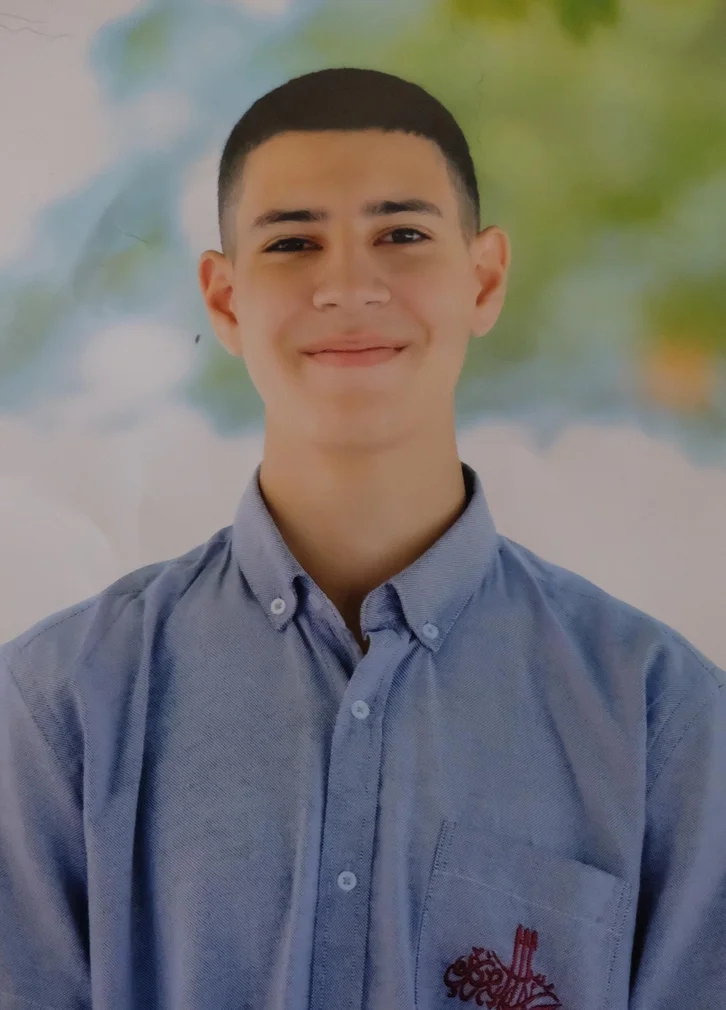
 

Shadi Khoury.Credit: Courtesy of the family

After Shadi was taken into custody, the men in black uniforms returned to his room and started to poke around and to dump everything on the floor, breaking the bed frame. “That’s the story of our life,” says 91-year-old Lora, who has seen everything.

A police spokesperson this week stated in response to a query from Haaretz:

“This is what a distorted description of reality looks like. The suspect was arrested on suspicion of his involvement in a serious violent event in which Jewish vehicles were attacked and stoned in Beit Hanina last week. During his arrest, [which was backed] by a court order, he attacked the police officers with his fists and by kicking, and he pushed, went wild and tried actively to prevent the execution of the arrest.

“The members of his family who were in the house at the time also tried to thwart execution of the arrest. As a result of the suspect’s grave and unacceptable behavior, the police officers were compelled to use force in order to subdue him, stop the attack on them and complete the execution of the arrest. Following his arrest he was taken for questioning by the police, and he will be brought to court for a remand and for the full course of the law to be taken against him.”

One’s heart goes out to the naïve and innocent guys in black from the Israel Police. A boy of 16 “attacked” them, they say – and his father, the composer, and his mother, who runs a cultural center, also joined in. And maybe Lora, the elderly neighbor and relative, also took part in the wild attack on the keepers of the law. A brief acquaintance with the occupants of this house is sufficient to grasp how ludicrous the claims of the police are.

Around dusk on Tuesday, Shadi was ordered remanded for 48 hours. All that day his father stood on the street, outside “Room No. 4,” the notorious interrogation facility in the Russian Compound in downtown Jerusalem, to which Shadi was taken.

When asked on Thursday for an update on her son’s situation, Raina Khoury reported that her husband and the other children had had been in court that day when Shadi’s detention was extended through Sunday, a decision his lawyer is appealing. “I’ll keep you posted,” she said.

26 January 2016

The Attack on Israel’s Human Rights Organisations by the State

When Israeli Jewish Opponents of the 

Occupation are Targeted for attack the 

Israeli Labour Party Offers its Support


Ezra Nawi - arrested Human Rights Worker
The article below in Israel’s 972 Magazine illustrates graphically the attack on Israeli human rights organisations and groups which oppose the Occupation and highlight its casual brutality.
Ezra Nawi has been detained, without access to a lawyer, on a trumped up charge as a result of the ‘revelations’ of the far-right Ad Kan group that he had threatened to report what was a bogus land deal to the Palestinian police.

Another Israeli far-right NGO Im Tirzu makes it clear that it is unconcerned if its campaign against left-wing NGOs and civil liberties groups results in physical attacks on those running those organisations.

Having attacked Palestinians in Israel and run an Occupation for nearly 50 years, it is clear that the next target is Israeli Jews who speak out against Zionist violence and injustice. 

B’Tselem field worker Nasser Nawajah was as I previously described, arrested and produced in the Jerusalem criminal courts and when the courts ordered him to be freed, immediately transferred to the Military courts on the West Bank, which are courts in name only.
Ezra Nawi - Ta'ayush and gay activist in South Hebron Hills
The Israeli anti-occupation Left and human rights NGO’s are under severe attack by the Israeli state.  Breaking the Silence, an organisation of soldiers with a conscience, is a particular target.  BtS documents and publicises the war crimes of the Israeli military by documenting the stories of Israeli soldiers themselves concerning the brutality and the mass murder, in Gaza in particular.  BtS is a target of those who, instead of preventing Israel’s war crimes prefer to attack an organisation which publicises them.  It is a classic case of shooting the messenger rather than dealing with the message. 

In this attack we see that the virulent nationalism of Zionism now targets the democratic rights even of Israeli Jews.

Tony Greenstein

Published January 23, 2016
There is a campaign being carried out against anyone actively opposing the occupation in Israel, and it doesn’t matter if you’re an activist in the field, a human rights attorney or a former soldier talking about what you were ordered to do.

Ta’ayush member Ezra Nawi is brought to a Jerusalem court on January 20, 2016. Nawi, an Israeli Jew active opposing the occupation, was arrested after a right-wing organization put him in the crosshairs of a hidden-camera ‘sting operation.’ (Oren Ziv/Activestills.org)
“Activists from the shady organization, “Ta’ayush,” who we tracked from within and outside, behind closed doors and during clashes on Saturdays, are going to fall one by one. Don’t worry friends. We will finish off Ezra Nawi and move on to Guy Butavia… and many others.”

That message was published and quickly spread on Facebook following the arrest of Ezra Nawi, and before the arrest of Guy Butavia, another activist in Ta’ayush, and B’Tselem field worker Nasser Nawajah. The three were arrested after a right-wing group, “Ad Kan,” gave allegedly incriminating materials to the police and primetime investigative news show, “Uvda.”
A month earlier, far-right group Im Tirzu marked other anti-occupation activists as targets: B’Tselem Executive-Director Haggai El-Ad; executive director of the Public Committee Against Torture in Israel, Yishai Menuchin; a prominent member of Breaking the Silence; and an attorney who protects Palestinians in Israeli courts on behalf of Hamoked — Center for the Defense of the Individual. This week it was revealed that right-wing group “Regavim” hired a private investigator to track human rights attorney Michael Sfard and Israeli human rights organization Yesh Din. There is a connection between each of these, of course.
By Haggai Matar | January 22, 2016
The past few days have seen politicians and pundits comparing the “extreme left” to the “extreme right,” between the Ta’yush activists to the suspects in the Duma murders. Alon Dian wrote brilliantly about the mainstream’s tendency to create this kind of symmetry — replacing principled, moral judgment with statistics. But there is a different, more fundamental point that does not get the attention it deserves. In the case of Duma, the police went and looked for the perpetrators only after the crime was committed. The same goes for all the recent hate crimes by right-wing extremists, which were investigated by the state (the vast majority of so-called “price tag attacks” end with no indictment).
A group of Ta’ayush activists walk toward a Palestinian hamlet in the South Hebron Hills on Saturday, January 17, 2016. The activists’ presence is often enough to prevent settlers from targeting Palestinians and to deter the army from kicking them off their land. (Photo by Oren Ziv/Activestills.org)
But in the case of the Ta’ayush activists, the process was reversed: “Ad Kan” did not go to the South Hebron Hills to investigate the harassment of land sellers. They went in search of ways to bring down Ta’ayush. To infiltrate the organization and get dirt on as many activists as possible. Like in the case of Michael Sfard and Breaking the Silence: first the Right found its target, and only then did it start looking for crimes. To the chagrin of Regavim, the materials it found and published about Sfard did not lead to the same storm that the Uvda report or recent articles on Breaking the Silence did. But the principle is identical.
The criminals from the South Hebron Hills
A member of Ta’ayush speaks to Israeli army officers during a direct action in solidarity with Palestinian residents of the South Hebron Hills, January 17, 2016. (Oren Ziv/Activestills.org)


This is the fundamental issue. This is the reason left-wing activists feel it is open season on them. Because the targeting of activists has become personal, using their names and images. Because the goal is to find something — anything — to eliminate them, at all costs. If not through police investigations, then by tarnishing their public images, like in the case of former Ambassador to South Africa Alon Libel. Perhaps a recent article on him in Yedioth Ahronoth, in which he was secretly filmed giving a lecture to Breaking the Silence activists, will bring about a change in the law and Libel will find himself in prison. If not, then maybe someone will decide to wait outside his home and beat him up. When the head of Im Tirzu was asked about the possibility that his contemptible campaign could actually bring physical harm to the heads of these organizations, he shrugged and said that it “would be their responsibility.” Things have never been clearer.

A prominent right-wing journalist with whom I used to work often said, in an entirely different context, that “once you enter the system’s pipeline, someone will find something about you.” That is why in a state governed by law, the police investigates crimes rather than people. At this moment, the logic in Israel is the exact opposite — the Right is investigating people. The media, the police, and the pathetic politicians of the Israeli center are following in its wake. Before the land seller case, the Samaria and Judea Police Division tried to pin on Nawi a series of traffic violations. Only the fact that were able to make an even better case stick saved us from reading op-eds about how “the Left is protecting a traffic violator.
The reason these people were targeted is crystal clear. There is not much in common between Ta’ayush and Michael Sfard, or between Breaking the Silence and Ezra Nawi, aside from the fact that they all struggle against the occupation.
They say Breaking the Silence is hated in Israel because they speak about the occupation abroad, and that B’Tselem is hated because they receive donations from foreign countries. Nonsense. Ta’ayush does not speak abroad. In fact, they aren’t even an NGO, but rather an informal organization made up of people who every Friday and Saturday head to the South Hebron Hills — in the hottest days of summer and in the freezing winter — to stand up to settlers from illegal outposts and the army that backs them. This is a boring, difficult task, which often includes accompanying Palestinian shepherds and farmers — so that they are not attacked by settlers — planting trees, or cleaning out water wells that have been either sealed shut or destroyed.
A decade and a half ago, when I served as a soldier in South Hebron Hills, the army still accompanied Palestinian children in order to prevent settler harassment. But the truth is that even back then, this was the wildest, ugliest place in the country. One of the settlers, who immigrated from apartheid South Africa, advised us to treat the Palestinians the way they used to treat blacks in his native land. Another settler, who lived in a cave in the West Bank, used to march his small herd of sheep directly into Palestinian fields, and when they tried to keep the animals away from their crops, the man would call the army because, well, the Palestinians were harassing Jews.

The reality of the Israeli Wild West did not interest the either the public or the media back then. It doesn’t interest them today. Uvda never bothered to go to the occupied territories to talk about the difficult reality farmers face there on a daily basis. The only people who cared were the activists in Ta’ayush, who do everything they can to stand up to much larger, far more organized forces. And now they are paying the price for it. Just like Michael Sfard, who argued before the High Court of Justice — and won — that the land belonging to the villagers of Bil’in was stolen for the sake of building a new neighborhood for Jews, all using deceptive claims of “security needs.” Just like B’Tselem’s field worker Nasser Nawaj’ah, who sat in jail following Uvda’s report while bulldozers demolished a protest tent against land expropriation in his home village of Susya. First they ignore the story, then they target those who speak about it, then they look for dirt, and then they demand the rest of the Left condemn the wrongdoers, lest everyone be considered a criminal.
The fact that Ta’ayush’s activities focus on Israel/Palestine, rather than abroad, hasn’t helped them much. Michael Sfard’s appeals to Israeli courts, rather than The Hague, were what led the Right to persecute him. The fact that Breaking the Silence does not reveal the names of the soldiers who give testimony, so that they do not face prosecution around the world or even in Israel, did not help. They are all fighting the occupation — that is their real crime. Instead of going to speak on television panels about the need for a “political horizon,” they tried to do something about the reality here. The occupation is the ruler, and it eliminates its opponents. Not because they are strong or threaten it, but because there really is no other way. Because the project of control in the occupied territories is in crisis, and we need to place the blame on someone.
The Right’s vision
It is no coincidence, of course, that Ad Kan’s campaign is backed by the publicly funded Samaria Settler Council, and that Regavim — which spends huge sums on tracking human rights organizations — is also backed by state-funded local councils in the West Bank. Ta’ayush, on the other hand, is run entirely by volunteers. Now it seems that the only people who actually received money for their trips to South Hebron Hills were Ad Kan’s moles, possibly funded by Israeli taxpayers.
The state and the Right are joining hands because the occupation is the state. Guy Butavia discovered in his interrogation that the questions he was asked by the police were passed on by Ad Kan. Israeli police in the West Bank, a division of the Israel National Police that is totally incompetent when it comes to solving recurring attacks against Palestinians — and which closes investigations into people who attack left-wing activists in broad daylight and in front of the cameras — suddenly acted with maximum efficiency in response to the Uvda investigation. Ezra Nawi was arrested at the airport despite the fact that there was no order preventing him from leaving the country. Why? How? Who cares. The arrestees were prevented from meeting with their attorneys, as if we were dealing with a “ticking bomb.” Not only were these blatantly political arrests, the most basic rights of the detainees were suspended.
Something dawned on human rights organizations and anti-occupation activists this week. It seems clear to all that a new campaign has begun. Much of the public is apathetic toward the Ta’ayush arrests, as goes for all political persecution. In history classes we used to ask ourselves how the “silent majority” and the “good people” allowed for such horrible things to happen. Now the answer is clear: if someone is being persecuted, there was probably a good reason, and the majority of people continue living their lives, because that is what people do. The weakness of Israel’s left-wing parties is far less clear to me. They are still playing the old game of trying to wedge themselves into the mainstream while the reality has changed completely.
It must be repeated: the Right has no solution for the current situation. The Palestinians will continue to resist the occupation, even if all the human rights organizations are shut down. Even if Israel manages to silence the Palestinians for a month, a year, or five. Those who view Arab citizens of Israel as enemies will turn them into enemies. Those who view Israelis who oppose the occupation as traitors won’t stop there. The only vision the Right is presenting is a civil war between Jews and Arabs, and between Jews and Jews. The only thing preventing that from happening is Israel’s sheer military strength. But desperation will also find a way to break through even that. With every day that passes, the price of changing direction only rises, and those who are able to step on the brakes prefer to sit on the fence.
This article was first published in Hebrew on Local Call. Read it here. 

30 October 2015

A Day in the Life of Jerusalem's Magistrates Court

The Folly of Israeli Apartheid Knows No Boundaries


Police arrest International at Nabi Saleh protest
A post by Miko Peled, an Israeli anti-Zionist, on a day in the life of the Jerusalem Magistrates Court. As one can seen, lying in court is a ritual that Israeli police and military engage in as a matter of course.  Almost certainly Miko will be convicted because the word of a military liar is valued more highly than a civilian demonstrator.  As the magistrate makes clear, he cannot understand why the Nasser el-Din, the Arab collaborator is lying because acceptance of the good intentions and the role of the army is part of the normal state of affairs in Israel.  It is the foundation stone of society and therefore Mick Peled, in denying the allegations is challenging the Zionist political status quo.

By   Miko Peled

October 25, 2015
Brave Zionist soldier detains boy with broken arm
The aim of the resistance is to free Palestine and to give Palestinians the rights they deserve, says Miko Peled.

The courtroom in Jerusalem was small with whitewashed walls and a few simple, uncomfortable wooden benches. The air conditioner didn’t work well, so the room was either too cold or not cool enough. The atmosphere was very causal. No one announced or stood when the judge entered. The prosecution and the defense council were too busy with their papers, and the defendants—me among them—were caught by surprise as the door to his chambers opened and the judge entered and sat in his chair.
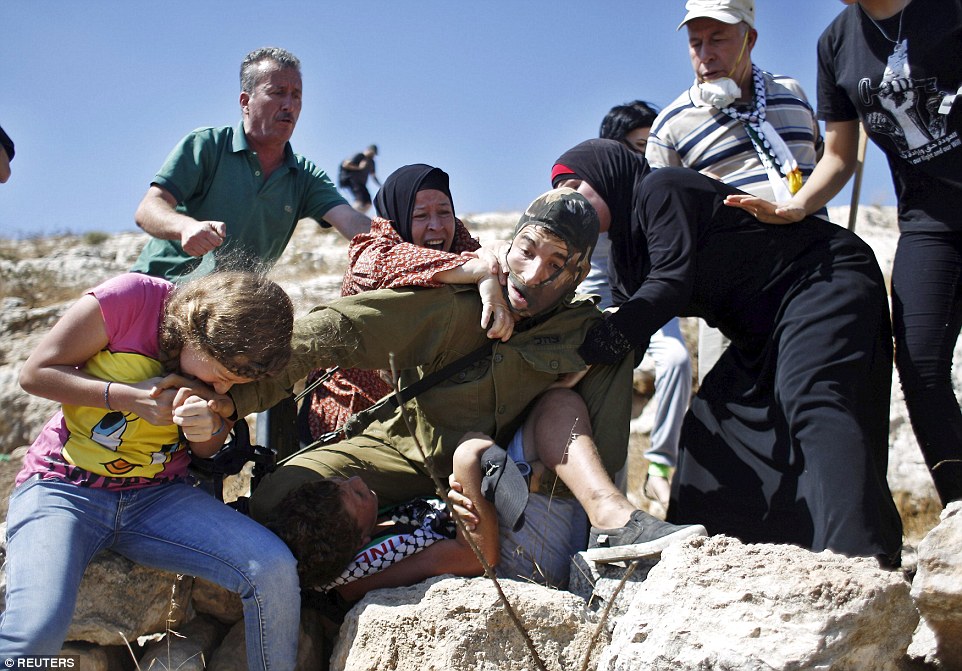
Brave Zionist soldier being attacked by cowardly Palestinian girl and women - Israeli 'culture' Minister said soldier should have shot his attackers to avoid 'Jewish humiliation'
Under the circumstances, the whole thing seemed a waste of time. There I was, along with two other defendants, charged with participating in disturbances in a protest in the village of Nabi Saleh in the West Bank in 2012. Considering that during the month of October, armed Israeli vigilantes and soldiers have been killing and injuring young Palestinians wholesale and getting away with it, our trial seemed beyond petty—it was stupid.
Jerusalem District Court
The main witness for the prosecution was Yousef Nasser el-Din, a Palestinian Druze collaborator who serves as an officer in the Israeli Border Guards, or “Magav.” He is tall and fit-looking, with handsome features. He came wearing the distinctive olive green uniform of the Border Guards and he was carrying a loaded pistol on his belt.
Peaceful demonstration at Nabi Saleh
Officer Nasser el-Din told the judge about the “Tsambar” hill where we were gathered. I had never heard this term prior to the trial; it is a Hebrew acronym that stands for “burning tires.” According to him, we stood on that hill, which the name suggests is used to roll burning tires down onto the main road, and onto advancing soldiers. The mob was calling out slogans in Arabic that were meant to incite for violence. “I understand and speak the Arabic language,” he reminded the court.
Protesting outside the courts of injustice
By the time it was my turn to testify, my attorney, Gabi Laski, looked like she was suffering from hypothermia. Someone asked to lower the air conditioner and the judge apologized, pointed the remote toward the air-conditioner and turned it off.
Tariq abu Kheideir, boy of 16 beaten by Israeli police - his brother was burned alive by settlers
“What do you say to these accusations of mob-like disturbances that the previous witness described?” Ms. Laski challenged me.

“I am afraid the time allotted for this hearing will not allow me to recount all the lies told by Officer Nasser el-Din,” I replied.
Tariq abu Kheideir led into court, having been badly beaten by police
When I was done answering, the judge, Ohad Gordon, looked at me closely. I was standing behind the small lectern that served as a witness stand, just a few feet from him. He leaned over, his face almost too young for his salt-and-pepper hair.
soldiers attacking haim schwarczenberg
“I want to make something very clear,” he said. “On the one hand, we are hearing descriptions of an unruly riot, stones hurled at the security forces and incitement for violence. You are describing a completely pastoral environment, people marching peacefully and then the army, for no apparent reason, shooting. You see, there is a problem here.”
Tariq abu Kheideir led into court
I looked back at the judge, who seemed to me to be sincere.

“Your honor, you described it exactly as it is,” I said. “People marching peacefully and then the army, for no apparent reason, shooting; not only the place and the time we are discussing, but at every place and at every time, every Friday in the various villages in the West Bank. The attempt to paint the Palestinian popular resistance as a violent mob is deceitful, it is dishonest, it is a lie. People from around the world come to these villages to participate because the popular resistance is committed to nonviolence just as it is committed to resistance and freedom. Palestinian villages have become the international ‘Meccas’ for nonviolent activists. Again I say, your honor, you could not have described it better.”
Police tear gas demonstration at Nabi Saleh
The officer-collaborator, Nasser El-Din, also described the goals of the popular resistance in terms that are congruent with general Israeli thinking.

“The villagers are protesting because of a dispute surrounding who owns the rights to the spring at the foot of the village,” he said.

Free Palestine

The Israeli town of Halamish, where some of the most vicious fanatic Israelis live, has taken much of Nabi Saleh land, including the small spring. But Officer Nasser El-Din is a fool if he thinks Palestinians in Nabi Saleh or any other village are putting their lives on the line for a spring, or a well or even a settlement here or there.

The resistance is here to free Palestine and to give Palestinians the rights they deserve. And it will not end until this is achieved.

It is the same folly that leads Israeli security officials to think that more soldiers, more police, more checkpoints and walls will keep Israelis safe from the consequences of the occupation. If every inch of every street of every city and town were lined with soldiers, Israelis would still not be safe.
It is also the same folly that leads Israeli lawmakers to think they can legislate against the resistance. Legislating against the Boycott, Divestment and Sanctions (BDS) movement, legislating against stone throwing, legislating to loosen the shoot-to-kill guidelines, legislating to keep Palestine supporters out of the country. One wonders what they may think of next.

But the fact remains that you cannot legislate to end the resistance any more than you can legislate to legalize the crimes of Israel. Killing Palestinians in cold blood is a crime even if it is legal in Israel. The Palestinian resistance is legal and moral even if Israel calls it illegal.

But if there is one thing unique about Israel, it is that it’s stupid. Israeli governments always deal with small irrelevant issues that are devoid of context and avoid the real problems. Much like my trial, where they tried to place my co-defendants and I in the midst of an angry mob by showing a video where two young boys throw rocks at an advancing infantry platoon. Where, in fact, we were in the midst of a peaceful protest until the army came and all hell broke loose. But that is neither important nor relevant.

What is relevant and important is to end the siege on Gaza immediately and without conditions; to release all Palestinian prisoners immediately and unconditionally; and to dismantle the military apparatus that has been maintaining the apartheid regime in Palestine for close to 70 years.
Back to my court hearing, the young prosecutor, his black hair cropped short, seemed at a loss. He kept scratching his head until finally he looked at me and asked: “Why would the army attack, just like that with no reason?”

“That’s an excellent question,” I replied. “I suggest you ask the army.”

A final hearing and verdict will take place in a few months