Showing posts with label Warsaw Ghetto Uprising. Show all posts

8 December 2022

Abram Leon, 26, leader of Hashomer Hatzair and then the Fourth International in Belgium, was Murdered in Auschwitz

Leon Explained in The Jewish Question – A Marxist Interpretation Why Anti-Semitism Arose and Where it Came From


As readers of my book will know, during the Second World War the Zionist movement was a Quisling movement that collaborated with the Nazis and went out of its way to obstruct rescue of Jewish refugees whose destination wasn’t Palestine.

By way of contrast Abram Leon, leader of the Fourth International in Belgium, died resisting the Nazis. Where, as in the Warsaw Ghetto, Zionists fought alongside Jewish anti-Zionists against the Nazis they did so not because they were Zionists but despite their Zionism.

Jewish Partisans Captured in Warsaw Ghetto

After the Warsaw Ghetto Uprising there was panic in Palestine. Dina Porat, Chief Historian at Israel’s Yad Vashem Propaganda Museum wrote that Melech Neustadt of the Jewish Agency Executive:

repeatedly implored the youth movement leaders in Palestine to save those still alive – even against their will – by issuing a directive that they were to leave immediately by whatever ways possible... The issue was whether or not the Yishuv was morally justified in instructing these comrades to abandon their communities, save themselves, and thereby stop the armed uprisings.... the numerous revolts in the summer of 1943 would ultimately deprive the Yishuv of the cream of Europe’s potential pioneering force... among the major youth movements in Palestine. Neustadt’s views prevailed and attempts to extricate the activists failed. They refused to leave. [Porat, The Blue and the Yellow Stars of David, p. 241]

A Zionist emissary arrived in Bedzin, a Nazi ghetto in Poland, in July 1943 after the Warsaw Uprising to persuade Frumka Plotnicka to leave. She replied that ‘I have a responsibility for my brethren... I have lived with them and I will die with them.’ The Zionist fighters, such as Antek Zuckerman and Zivia Lubetkin, refused on principle to leave. One can only admire the bravery and commitment of these young fighters who, given the choice between the fight against the Nazis in the Diaspora and the Arabs in Palestine, committed what in Zionist eyes, was a mortal sin. They chose the Diaspora.

One of the Palestinian emissaries, Yudke Hellman, described how in October and December 1939 he witnessed the return of Plotnicka and Lubetkin to German-occupied Poland and how he had tried and failed to persuade them to leave for Palestine. Frumka stood up and announced that her decision to return to Warsaw was final. [Yechiam Weitz, The Yishuv’s Response to the Holocaust, pp. 218-19].

Hayka Klinger, another fighter in Warsaw, who arrived in Palestine in March 1944, told the Histadrut Executive that ‘we received an order not to organize any more defence.’ [Porat p. 242] Klinger observed that

‘Without a people, a people’s avant-garde is of no value. If rescue it is, then the entire people must be rescued. If it is to be annihilation, then the avante-garde too shall be annihilated.[Edith Zertal, Israel’s Holocaust and the Politics of Nationhood, p. 33]

Never was the ethical and moral distinction between the Jewish diaspora and Palestine’s Zionist leaders clearer.

The Zionist leaders saw the risings in the ghettos as ‘a kind of betrayal of the overriding principle of the homeland.’ [Zertal p.34] Yet despite opposing the uprisings at the time, the ghetto fighters were ‘retrospectively conscripted’ into the Zionist terror groups. ‘We fought here and they fought there’ according to Palmach commander Yitzhak Sadeh. [Zertal p.26] Except that the Jewish partisans fought against the fascists whereas the Zionist militias fought with fascists.

This is why John Rose of the SWP was wrong when he argued that Zionism was not an obstacle to fighting against fascism. Rose wrote:

It’s true that when Hitler came to power some Zionist leaders stupidly thought that they could do a deal with him that would enable some German Jews to go to Palestine.

The Zionist attitude to the Nazis had nothing to do with ‘stupidity’ nor was Ha'avara, their trade deal with the Nazis, about enabling some Jews to go to Palestine. However I digress.

Abram Leon was born in Warsaw in 1918 and died in Auschwitz in 1944. Leon had been the leader of Hashomer Hatzair (Young Guard), a left-wing Zionist youth group, from 1936 till 1940 when he and 20 comrades broke from Zionism and joined the underground Trotskyist  organisation. He was arrested by the Nazis in June 1944 and tortured before being sent to Auschwitz where he died in September 1944.

Leon died at the age of 26 but not before he had written The Jewish Question – A Marxist Interpretation, which was written whilst leading the resistance to the Nazis. It is a remarkable work, not least because of the conditions under which it was produced.

Leon’s thesis in a nutshell was that unlike the myths spread by the Zionists and Orthodox Jewry, that the Jews survived because of their religion, the exact opposite was the case. He reversed the relationship. The religion survived because of the Jews. It was the specific social and economic role that Jews played in society, reflected as it was in their religion, which kept the religion going.

It was Karl Marx who had written in On the Jewish Question that:

Judaism has survived, not in spite of  history but because of it. (p.92)
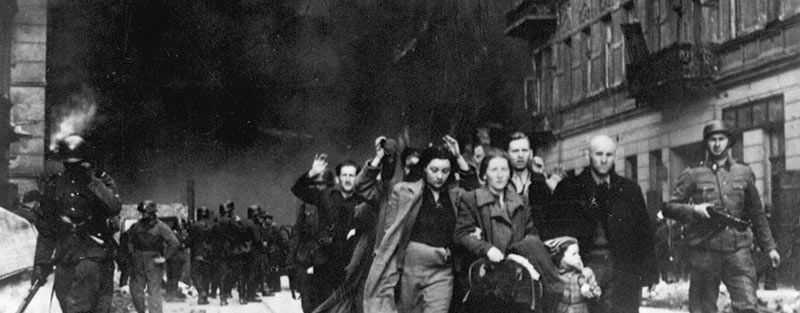
Captured Jewish Partisans in Warsaw

Indeed where Jews did not have a specific socio-economic role as with the Jewish farmers in Sicily, they assimilated to the surrounding population.

Zionism has rewritten the history of the Jews and hence the history of anti-Semitism. Zionism, with its claim to Palestine, consists of a series of myths designed to appeal to the simplest of minds.

How many times did we hear during the attacks on Corbyn that anti-Semitism was a ‘virus’, a pathological and incurable condition. As one of the first Zionists, Leon Pinsker wrote in Autoemancipation:

‘Judeophobia is then a mental disease, and as a mental disease it is hereditary, and having been inherited for 2,000 years, it is incurable.

Pinsker was a doctor so he used the term ‘Judeophobia’ rather than anti-Semitism. But if a disease is incurable then there is no point in fighting it.  At best one seeks pain relief or palliatives.

Theodor Herzl, the founder of Political Zionism, was of the belief that the cause of anti-Semitism was the Jews themselves. Their fault was living in other peoples’ countries. The solution was therefore colonisation. In the Jewish State he wrote:

“The unfortunate Jews are now carrying the seeds of anti-Semitism into England; they have already introduced it into America.”

Leon demolishes this and other Zionist myths and shows how, as Jews fulfilled certain roles in  society – money lenders, tax stewards, usurers, traders, skilled craftsmen –anti-Semitism itself changed. Religious anti-Semitism expressed  class antagonism to the role Jews played in feudal society and was expressed as religious antagonism.

Leon’s great achievement was to situate the Jews in history. Instead of the Zionist myth of the expulsion of the Jews from Palestine in the wake of the destruction of the Second Temple, for which there is zero evidence, he showed how it was the Jews themselves who emigrated because Palestine was incapable of feeding its inhabitants.

In this the Palestinian Jews were not unique. Many people such as the Phoenicians and Armenians had followed similar paths.

Some 4 million Jews left Palestine in the first two centuries AD. Some 1 million of them were to be found in Alexandria alone, one of the great Hellenized cities in the Mediterranean. Like many people before them, the Jews became great traders and it was through trade and commerce that Jews survived.

Leon’s explanation of the Jews as a ‘people-class’ explained their survival. In the feudal era, a society based on production for use not exchange, groups who carried out particular socio-economic roles were seen as being different ethnically from the native population.

The Zionist idea of ‘eternal anti-Semitism’ is a way of avoiding difficult questions such as why the Jews survived and why there was persecution. It is really a reflection of the anti-Semitic stereotype of the ‘eternal wandering Jew’ which became a film under the Nazis.

Anti-Semitism constituted the class antagonism of different layers of feudal society towards the economic role that Jews played.

Thousands of Jews died in peasant revolts, be it at York, Norwich or at the hands of Chmielniki and the Cossacks in Poland from 1648 to 1657. However this was a peasants revolt against the role of Jews as Arendators, officials who leased land from the nobles and whose demands on the peasants were extremely exacting. 

Many of those who died were Jews but contrary to popular history it wasn’t just Jews who suffered. As Anna Reid wrote in Borderland: A Journey Through the History of Ukraine:

Wherever they found the szlachta, royal officials or Jews, they [Cossacks] killed them all, sparing neither women nor children. They pillaged the estates of the Jews and nobles, burned churches and killed their priests, leaving nothing whole....

But whereas anti-Semitism in feudal times came from the peasants and mendicant religious orders, with the Jews as in Poland, protected by the nobility and King, under capitalism anti-Semitism came from the State and the ruling classes. The best example until the Nazis was under the Czar whose Ministers deliberately instigated pogroms, creating the Black Hundreds for this purpose.

To the Zionists anti-Semitism was the property of all non-Jews regardless of class. Anti-Semitism existed because the Jews existed. As A B Yehoshua explained, the Jews were guests who used other peoples’ countries like hotels. [Jewish Chronicle, 22.12.89. ‘Diaspora a cancer’]

As Hannah Arendt observed

If it is true that mankind has insisted on murdering Jews for more than two thousand years, then Jew-killing is a normal, and even human, occupation and Jew-hatred is justified beyond the need of argument. [The Origins of Totalitarianism, p. 7] The Origins of Totalitarianism, p. 7,

Leon’s book went almost unnoticed until it was resurrected by French Marxist Maxime Rodinson in 1968 at the height of the Paris riots.

Leon’s main argument was that the Jews formed a ‘People Class’ – that they performed specific tasks in pre-capitalist society that bound them together as both a people and a class. Under feudalism this was very common. Not just the Jews but the Gypsies, Scots, Armenians and Chinese of South Asia, who were even called the Jews of Asia, also formed castes that attracted popular ire.

Where the Jews lost a distinctive socio-economic role they assimilated to the majority. To the Zionists anti-Semitism was common to all non-Jews. As Leon wrote (p.247)

Zionism transposes modern anti-Semitism to all of history and saves itself the trouble of studying the various forms of anti-Semitism and their evolution.[1]

In what is a short book, Leon gave a panoramic overview of the Jews historically. The book explains that the ‘Jewish Question’ was dying out in Western Europe with the advent of capitalism. The Jews no longer had any specific socio-economic role. They were assimilating to the majority population with the advent of Emancipation. It was only anti-Semitism in Russia and Eastern Europe, resulting in waves of migration by Jews westwards, that kept the Jewish Question alive.

Zionism was implacably opposed to Jewish Emancipation because they saw, correctly, that granting equal rights to Jews meant that they were no longer forced by the state to maintain a separate existence. In Israel today the fascist Lehava calls miscegenation , inter-racial sex, a holocaust. Israeli minister Rafi Peretz labeled intermarriage between American Jews and non-Jews as being “like a second Holocaust.”

Leon had but a very short life but in that very short time-span he produced  one of the Marxist classics which cuts through the mystification of Zionism in its treatment of both Jewish history and anti-Semitism .

I began by saying that Leon had started out as a Zionist in Hashomer Hatzair. In Palestine this was a political party which later became Mapam. Their strand of ‘Marxist’ Zionism had been founded by Ber Borochov, who was expelled from the Russian Social Democratic Party in 1901 for Zionism.

Borochov held that Jews could not take part in the class struggle in the diaspora because they had no relationship to the means of production. Their conditions of production meant that they were outside the class struggle. According to Borochov social structure of the Jews resembled an ‘inverted pyramid’ – too many rich Jews and not enough poor or working class  Jews.

It was only in Palestine where Jews could form their own society that it was possible for class struggle to break out. Borochov, who ended up supporting WW1 was wrong. It was precisely at this time, the end of the 19th and beginning of the 20th centuries that Jews were becoming part of the proletariat.

Marxist Zionism was always a cult that used sophistry to explain away colonialism. If Borochov is to be taken at his word then Socialist Zionists having allied with the bourgeois Zionists in order to create a Jewish State would then wage class war against them! The problem with this was that it was more likely to become part of the bourgeoisie in such a state.

We can see where this bankrupt theory has ended up. In the last Knesset Meretz, which was the descendant of Mapam, found itself in alliance with the far-Right Yisrael Beteinu and Yamina. In the 2020 elections Meretz, has been eliminated from the Knesset altogether. In 1949 in Israel’s first elections it obtained 19 seats.

The beauty of Leon’s book is that it at once provides an overview of Jewish history since ancient times and explains how and why anti-Semitism has persisted, albeit in different forms.  It demystifies anti-Semitism.

As Leon remarked in the section on Zionism and the belief in  2,000 years of exile:

In reality just so long as Judaism was incorporated in the feudal system, the “dream of Zion” was nothing but a dream and did not correspond to any real interest of Judaism. The Jewish tavern owner or “farmer” of sixteenth-century Poland thought as little of “returning” to Palestine as does the Jewish millionaire in America today. Jewish religious Messianism was no whit different from the Messianism belonging to other religions. Jewish pilgrims who went to Palestine met Catholic, Orthodox, and Moslem pilgrims. Besides it was not so much the “return to Palestine” which constituted the foundation of this Messianism as the belief in the rebuilding of the temple of Jerusalem.

We should not forget that Leon was writing at the height of the Nazi persecution, a persecution which claimed him in that death factory, Auschwitz. He wrote that one of the “ironies of history” was that

when the Jew was unassimilable, at a time when he really represented “capital,” he was indispensable to society. There could be no question of destroying him. At the present time, capitalist society, on the edge of the abyss, tries to save itself by resurrecting the Jew and the hatred of the Jews. But it is precisely because the Jews do not play the role which is attributed to them that anti-Semitic persecution can take on such an amplitude. Jewish capitalism is a myth; that is why it is so easily vanquished. But in vanquishing its “negative,” racism at the same time destroys the foundations for its own existence....

The irony of history wills that the most radical anti-Semitic ideology in all history should triumph precisely in the period when Judaism is on the road of economic and social assimilation. But like all “ironies of history” this seeming paradox is very understandable. At the time

Tony Greenstein


[1]                                 Abram Leon, The Jewish Question - A Marxist Interpretation, p. 247.

23 April 2018

The 75th Anniversary of the Warsaw Ghetto Uprising Passed Unnoticed – It is not on the Zionist Calendar

Remembering the Warsaw Ghetto Uprising


Jews captured during the Warsaw ghetto being marched to a collecting point for deportation. (Credit: United States Holocaust Memorial Museum, courtesy of National Archives and Records Administration, College Park)
Last week was the 75th anniversary of the Warsaw Ghetto Uprising.  You would have been forgiven for having missed it.  The anniversary of the founding of the Israeli state, which was also on 19th April this year, took precedence in the mass media and the Zionist press.  Given the choice between a tale of Jewish heroism against impossible odds, fighting fascism and racism or tales of heroic Israelis massacring Palestinian civilians and creating ¾ million Palestinian refugees, there was no choice.

Earlier in the year we had Holocaust Memorial Day, a saccharine event whose primary purpose is to depoliticise the Holocaust, the how and why it happened.  No uncomfortable comparisons between New Labour and Theresa May’s ‘climate of extreme hostility’ to immigrants and the failure to rescue Europe’s Jews.  No searing questions about how much of the Establishment and their rabid press supported Hitler up and until the invasion of Poland.  Even fewer questions about the role of the Zionist movement during the Holocaust.
Poland stands at attention for those slain (Photo: Reuters)

The Warsaw Ghetto Uprising was however commemorated in Poland.  There were the government's own commemorations led by the President Andrzej Duda but hundreds attended independent commemorations, refusing to attend those organised by a government which, earlier in the year, passed legislation making it a criminal offence to accuse Poles of having collaborated with the Nazi occupation (which many did).
 Israeli leaders stayed away because they preferred to celebrate the Palestinian Naqba (catastrophe) to attending the commemoration of the Warsaw Ghetto uprisings.
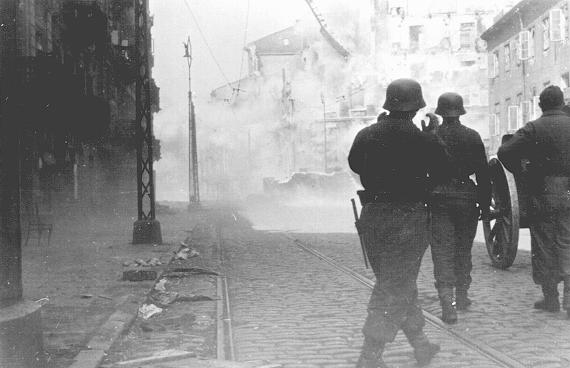
German soldiers direct artillery against a pocket of resistance during the Warsaw ghetto uprising. Warsaw, Poland, April 19-May 16, 1943. — US Holocaust Memorial Museum
It is not hard to see why the Zionist movement and their court servants – the John Manns, Joan Ryans, Ruth Smeeths and Luciana Bergers, should have little to say about the Uprising.  For a start it was led by an anti-Zionist Jewish socialist party the Bund, [the wrong sort of Jews!] who had the loyalty of the overwhelming majority of Polish Jews.  Secondly fighting anti-Semitism has always been deprecated in Zionist circles (unless it is the type of ‘anti-Semitism’ that is anti-Zionism).  Zionism was established on the basis of not fighting anti-Semitism because anti-Semitism was inherent in the non-Jew, it was futile.  Antisemitism was deemed by the Zionist movement to be the product of Jewish ‘homelessness’.  In the words of the founder of Political Zionism, Theodor Herzl, who wrote this  at the time of the Dreyfuss Affair:
Theodor Herzl - founder of Political Zionism - tolerant of anti-semitism
Theodor Herzl
‘In Paris... I achieved a freer attitude towards anti-Semitism, which I now began to understand historically and to pardon. Above all, I recognise the emptiness and futility of trying to 'combat' anti-Semitism.' [Diaries, p.6]

Poles laying flowers on the monument to the fallen heroes

The Warsaw Ghetto was ignored and forgotten by the Zionist leaders in Palestine. Zionist leader Yitzhak (Antek) Zuckerman asked why no-one left Geneva, Istanbul or Sweden, ‘if only to serve as a ‘gesture, a sign, a hand extended as a token of sharing our fate’?’ Only the Bund and the AK sent emissaries into the ghetto. Other movements in Europe sent their emissaries from one ghetto to the next  [Dinah Porat, p. 228, The Blue and Yellow Stars of David]. To the Zionist movement in Palestine, the fate of the Warsaw Ghetto was irrelevant.  Their sole objective was achieving a Jewish state. The young Zionists who fought first had to rebel against their own Zionist parties. Zionism was irrelevant. Marek Edelman, the last Commander of the Uprising and a member of the Bund describes how:
‘We joined hands with all Jewish Zionist underground organizations. Our comrades lived and worked with the others just as members of a close family. A mutual aim united us. During this entire period of over half a year, there were no quarrels or struggles, which are common among adherents of different ideologies. All overworked themselves in organising the mutual defence of our dignity.’[Edelman, The Ghetto Fights, pp. 110-111. Citing Second report of the Jewish workers underground movement, 15.11.43].

Jews that were captured during the Warsaw Ghetto uprising, about to be searched for weapons before being moved to Treblinka. (Credit: United States Holocaust Memorial Museum, courtesy of National Archives and Records Administration, College Park)

Marek Edelman described how ‘the cornered partisans defended themselves bitterly and succeeded, by truly superhuman efforts, in repulsing the attacks’ as well as capturing two German machine guns and burning a tank. [Edelman, p.76].
The role of the Bund and Edelman in the Warsaw Ghetto Revolt has been airbrushed out of history by Zionist holocaust historians. The Revolt has become another Zionist foundational myth. [The last Bundist, Moshe Arens,] Today Zionism uses the Revolt for propaganda purposes, suggesting that the Resistance was solely composed of young Zionist fighters.
There was another reason for Zionist hostility to Edelman. Edelman had written an open letter to the Palestinians asking them to stop the bloodshed and enter into peace negotiations. The letter caused outrage in Israel because Edelman did not mention the word “terrorism.” Israeli leaders were particularly incensed by its title: Letter to Palestinian partisans’.
Ha'aretz, 9.8.02.
Smoke from the Treblinka uprising, as seen from a railroad worker. (Credit: UtCon Collection/Alamy)
Mr Edelman … wrote in a spirit of solidarity from a fellow resistance fighter, as a former leader of a Jewish uprising not dissimilar in desperation to the Palestinian uprising in the occupied territories. He addressed his letter to “commanders of the Palestinian military, paramilitary and partisan operations – to all the soldiers of the Palestinian fighting organisations. This set up a howl of rage in the Zionist press, who reminded their readers that Mr Edelman, despite his heroism in the 1940s, is a former supporter of the anti-Zionist socialist Bund, and can therefore not be trusted.’ [Palestine's partisans, Paul Foot, Guardian, Wednesday August 21, 2002,]

What was particularly irksome was that Edelman had consciously compared the structures of the resistance movement in Warsaw to that of the Palestinians.’  [The Last Bundist].

When Edelman died, the President of Poland attended his funeral in Warsaw on 9th October 2009 and there was a fifteen-gun salute. Because of his support for the Palestinians, not even the lowliest clerk in the Israeli Embassy attended. [Zionism Boycotts the Funeral of Marek Edelman, 15.10.09.] Moshe Arens, the former Likud Foreign Minister, interviewed Edelman as part of his research into the history of the Revisionist National Military Army ZZW, which fought separately in Warsaw: ‘I knew his views on Israeli politics, and did not discuss the situation in the Middle East, but as we parted I said “You must make peace with the Arabs.” Edelman received Poland's highest honor, and the French Legion of Honor medal but ‘he died not having received the recognition from Israel that he so richly deserved.’  
see also

The Revisionist Zionists made up the leadership and ranks of the Jewish police and the leadership of ZOB had contempt for them. The ZZW obtained their arms via their Polish fascist friends. Stiff resistance to the Nazi invasion of the Ghetto came from the Revisionists, who were based at 7-9 Muranowska Square and the corner of Muranowska and Nalewki streets. For two days the Polish and Jewish Star of David flags flew, visible to thousands of Poles on the Aryan side.  [S Beit Zvi, p.353, Post-Ugandan Zionism on Trial, A Study of the Factors That Caused the Mistakes Made by the Zionist Movement During the Holocaust, 1991, Zahala, Tel Aviv]

Some five to six thousand Jews are estimated to have escaped from the ghetto to the ‘Aryan’ side of Warsaw and to have remained hidden till the end of 1943.  In Palestine there was panic that the revolts ‘would ultimately deprive the Yishuv of the cream of Europe’s potential pioneering force.’ Melech Neustadt wanted the youth movements in Palestine to instruct their comrades ‘to abandon their communities, save themselves, and thereby stop the armed uprisings.’ The Zionist youth in Europe, such as Antek Zuckerman and Zivia Lubetkin refused on principle to leave. Hayka Klinger, who arrived in Palestine in March 1944, told the Histadrut Executive that ‘we received an order not to organize any more defence.’ [i] The Zionist leadership sought to extricate the leaders of the ghetto fighters as they were more valuable in Palestine than in leading the resistance in the ghettos. Klinger told Histadrut that ‘Without a people, a people’s avant-garde is of no value. If rescue it is, then the entire people must be rescued. If it is to be annihilation, then the avante-garde too shall be annihilated.’ [Zertal, The Politics of Nationhood, p.33

The Zionist leaders saw the subsequent risings in other ghettos as ‘a kind of betrayal of the overriding principle of the homeland.’ [Zertal, p.44] Yet despite this Ben Gurion later claimed that the heroism of the ghetto fighters owed its inspiration to the Zionist fight in Palestine. The ghetto fighters were ‘retrospectively conscripted’ into the Zionist terror groups. ‘We fought here and they fought there’ according to Palmach commander Yitzhak Sadeh.[Zertal, pp. 25-26]. The resistance of the Jewish ghetto fighters became intertwined with the heroic myth of the Zionist fight for Palestine.  See The anti-Zionist Bund led the Jewish Resistance in Poland whilst the Zionist Movement abandoned the Jews

The article below contains a number of mistakes and is slanted towards a Zionist version of events.  Nonetheless it is an interesting description of the events of 75 years ago.  I also recommend you read Marek Edelman's account of the Ghetto Uprising, The Ghetto Fights.
Tony Greenstein
On this day in 1943, a band of Jewish resistance fighters launched an armed insurrection against the Nazis. They were proud socialists and internationalists.
Jewish resistance fighters during the Warsaw Ghetto Uprising. WWII War Crimes Records

On the eve of Passover 1943 — the nineteenth of April — a group of several hundred poorly armed young Jews began the Warsaw Ghetto Uprising, one of the first insurrections against Nazism.
For a small group of fighters, realizing — in the lyrical words of one militant — that “dying with arms is more beautiful than without,” an isolated group of Jewish militants resisted for twenty-nine days against a much larger foe, motivated by a desire to kill as many fascists as they could before they themselves were killed. The uprising, etched into the collective memory of postwar Jewry, remains emotive and emboldening.

That their heroism was a crucial part of the war is disputed by nobody today. But less known is the extent to which the uprising, far from being a spontaneous one of the masses, was the product of planning and preparation from a relatively small — incredibly young — group of Jewish radicals.

The Ghetto
Within a few weeks of the Nazi consolidation of Poland, Governor Hans Frank ordered four hundred thousand Warsaw Jews to enter a ghetto. By November 1940, around five hundred thousand Jews from across Poland had been sealed behind its walls, severed from the outside world and plunged into social isolation. Surrounded by a ten-foot-high barrier, the creation of the ghetto meant the relocation of approximately 30 percent of Warsaw’s population into 2.6 percent of the city, the designated area being no more than two and a half miles long and having previously housed fewer than 160,000 people.

In the ghetto, Jews were forced to live in chronic hunger and poverty. Many families inhabited single rooms, and the dire lack of food meant that roughly one hundred thousand people survived on no more than a single bowl of soup per day. The sanitation system collapsed, and disease became rampant. By March 1942 onwards, five thousand people died each month from disease and malnutrition.

The situation was dire — and yet, the initial response of the Jewish community leadership was one of inaction. Following the creation of the Judenrat (Jewish Council) — a collaborationist organization established with Nazi approval to allow easier implementation of anti-Jewish policies — some inhabitants fell into a false sense of security. An attitude permeated the ghetto, proffered through the lens of Jewish history, that Nazism was just another form of persecution that the Jewish people must suffer and outlast.

Others — such as the Hashomer Hatzair militant Shmuel Braslaw — began to recognize a jealous respect for the Germans among the ghetto’s residents. “Our young people learn to doff their caps when encountering Germans,” wrote Braslaw in an internal document, “smiling smiles of servitude and obedience . . . but deep in their hearts burns a dream: to be like [the Germans] — handsome, strong and self-confident. To be able to kick, beat and insult, unpunished. To despise others, as the Germans despise Jews today.”

Against this demoralization, circles of defiance could be found in the self-organization of the left-wing of the Jewish community. Communists, Socialist-Zionists of varying descriptions, and social democrats organized themselves into sections in the ghetto, aiming to transform the misery into meaningful political organization. All parties — the Bund, a social-democratic mass organization that had enjoyed huge pre-war popularity; the Marxist-Zionist youth group Hashomer Hatzair; the left-wing Zionist party Left Poale Zion; and the Communist Party dedicated themselves to this strategy, organizing cells that sought to revive collectivist attitudes among an emotionally crippled and disaffected Jewish youth.

In dark times, the cell structures of youth organizations provided a social and psychological anchor against hunger and depression. “The day I was able to re-establish contact with my group,” wrote the Young Communist militant

Dora Goldkorn, “was one of the happiest days in my hard, tragic ghetto life.” In the project to develop a resistance leadership among the youth, keeping spirits high was crucial; acts of friendship such as the sharing of food were as important as distributing anti-Nazi literature.
By 1942, the various youth organizations felt confident enough to consider the formation of an “Anti-Fascist Bloc.” On the insistence of the Communists, a manifesto was drafted that sought to unite the Jewish left in the Warsaw Ghetto, with the hope of generalizing this political unity across other ghettos.

Calling for a “national front” against the occupation, for the unity of all progressive forces on the basis of common demands and for armed antifascism, the manifesto echoed the pre-war Popular Fronts in its organizational methodology.

The Left Poale Zion enthusiastically joined, as did the Hashomer Hatzair — who re-emphasized their fidelity to the Soviet Union, despite the Kremlin’s opposition to Zionism. The Bund, however, were less reliable, due to their historic anticommunism and rejection of specifically Jewish armed action; a party that resolutely stated Poland was the home for Polish Jews, many Bundists refused avenues other than Polish-Jewish unity of action.

The paper of the Anti-Fascist Bloc, Der Ruf, reached publication twice. Its contents overwhelmingly focused on applauding Soviet resistance and urging the ghetto inhabitants to hold out for imminent liberation at the hands of the Red Army.

The bloc’s fighting squads contained militants belonging to all varieties of labor movement groups, but the lynchpin of the organization was Pinkus Kartin. A stalwart of communism in prewar Poland and a veteran of the International Brigades to Spain, Kartin was a leader both politically and militarily. To the historian Israel Gutman, who himself was active with Hashomer Hatzair in his youth, Kartin “undoubtedly impressed” the underground’s young and inexperienced cadre.

It was the arrest and murder of Kartin in June 1943 that signaled the end for the Anti-Fascist Bloc. His arrest triggered an intense repression against the prominent Young Communists, who saw their numbers decimated and were driven into hiding. It is for this reason that when the Jewish Fighting Organization (ZOB) was founded several months later, the Communists were absent at first — although their political line was upheld and applied by those such as Abraham Fiszelson, a Left Poale Zion leader who had been Kartin’s right-hand man and had befriended him in Spain.

During this period, figures from the right-wing of the Jewish community formed a rival group, the Jewish Military Union (ZZW). Led by the right-wing Zionist group Betar and funded by high society, the ZZW relied upon ex-army officers who could fight orthodox warfare with the Nazis using regular army discipline — unlike the ZOB, which considered itself the armed expression of the Jewish workers’ movement. Furthermore, the ZZW’s connections to Polish nationalists, the antisemitic Polish government-in-exile and the right-wing Revisionist-Zionist movement provoked suspicion among the ZOB leadership.

By contrast, in the eyes of Israel Gutman, the typical ZOB volunteers were “young men in their twenties, Zionists, Communists, socialists — idealists with no battle experience, no military training.” While the propaganda of the ZZW was staunchly nationalistic, the ZOB’s propaganda and literature encouraged antiracist internationalism, offered intellectual positions on the world situation, and debated the labor movement.

Despite the darkness of their times, members of the ZOB belonged to a political tradition that desired a better world, and sought to create it through their struggle.
 The Resistance
The ZOB set as its aim an anti-Nazi insurrection. However, it recognized that paramount to achieving this was the strengthening of the organization’s position in the wider community — it was decided that it had to involve the intimidation and execution of Jewish collaborators with the occupiers.
For ZOB militants, collaborators represented an auxiliary wing of fascism that was instrumental in facilitating the deportation of Polish Jewry. To demonstrate that this stance would not be accepted in the ghetto, ZOB militants chose to execute Jewish policeman Jacob Lejkin. For his “dedication” in deporting Jews to Auschwitz, Lejkin was shot, and his example triggered widespread panic in the collaborating establishment. This was followed by the execution of Alfred Nossig in February 1943. Józef SzeryÅ„ski, the former head of the ghetto police, committed suicide to avoid his own fate.
These acts ensured ZOB’s centrality in the resistance movement, and also encouraged resistance from beyond their ranks. They aimed to prove that challenging collaboration was both possible and a moral duty — and within a short period of time had won many ghetto inhabitants to this position.
As the months progressed, the specter of death became ever-present. Between June and September 1942, three hundred thousand Jews had been deported or murdered, a destruction of the Polish Jewish community. In these desperate circumstances, people lost everyone and many young people began to dispense with anxieties about protecting their families and commit instead to militant political activity. Simply put, the more Jews were murdered in the ghettos, the less personal obligations were felt by survivors, and the more the feeling of responsibility for causing further anguish from Nazi reprisals receded.
Contempt was shown for the self-determined martyrdom of Adam Czerniakow, the Judenrat leader who committed suicide in July 1942. For young Jewish socialists such as the prominent Bundist Marek Edelman, Czerniakow had “made his death his own private business,” a symbol of privilege in contrast to Edelman and his working-class comrades awaiting their turn on the deportation lists. For them, he said, the overwhelming sentiment in these times was that political leadership necessitated that “one should die with a bang.”
The Uprising
In many senses, the hopes of the Left in calling for a common struggle against Nazi barbarity had outlived its constituency: the Jewish community was in the process of being exterminated. What now mattered was the initiative young leftists took upon themselves — and the majority favored an uprising.
On the morning of Monday, January 18, six months after the first mass deportations of Warsaw Jews (which reduced the number of ghetto inhabitants from four hundred thousand to approximately seventy to eighty thousand), ZOB militants emerged from the crowds of deportees to attack German soldiers, killing several. A series of attacks followed over four days, where militants infiltrated lines of slave laborers marching towards the Umschlagplatz [Deportation of Jews], stepped out of rank at a given signal, and assassinated their German guards. Though scores of ZOB fighters fell, the confusion created by the fighting allowed some to flee — and demonstrated to others that Nazi bodies could also fall in the ghetto.
By April 1943, there was a general awareness that the ghetto was to be entirely liquidated. A general armed revolt was scheduled to happen at the next Nazi provocation. On April 19, five thousand soldiers led by SS general Jürgen Stroop entered the ghetto to remove the final inhabitants; in response, approximately 220 ZOB volunteers began their attack, located in ersatz positions in cellars, apartments, and rooftops, each armed with a single pistol and several Molotov cocktails.
The revolt caused chaos, catching the Nazis off guard and killing many Wehrmacht and SS soldiers. In response, the humiliated German army, suffering losses at the hands of prisoners they thought long defeated, initiated a policy of systematically burning out the fighters. To paraphrase one ZOB militant, it was the flames — not the fascists — whom the fighters lost out to. Vicious hand-to-hand combat raged for days, and by late April coordinated warfare by the ZOB collapsed, the conflict now largely consisting of the Germans burning small groups of armed Jews out of bunker hideouts created to evade capture.
According to accounts, both the red flag and the blue-and-white flag of the Zionist movement were raised over ZOB-seized buildings. The youngest fighter killed had been a Bundist activist aged thirteen. Though clearly inexperienced as a fighting force, an anonymously authored Bund internal document that reached London in June 1943 stressed the “exemplary” political unity and “fraternity” between leftist groups in combat. The unswerving dedication to which the young fighters of the ZOB clung to their dreams of socialism was exemplified most movingly in a May Day rally held amid the ghetto’s ruins.
Participating in the rally, Marek Edelman reflected that
The entire world, we knew, was celebrating May Day on that day and everywhere forceful, meaningful words were being spoken. But never yet had the Internationale been sung in conditions so different, so tragic, in a place where an entire nation had been and was still perishing. The words and the song echoed from the charred ruins and were, at that particular time, an indication that socialist youth [were] still fighting in the ghetto, and that even in the face of death they were not abandoning their ideals.
Leading militants of the ZOB committed mass suicide on May 8, surrounded by the German army at their base on Mila 18. By mid-May, the ghetto had been razed, and the Great Synagogue of Warsaw personally blown up by General Stroop on May 16 to celebrate the end of Jewish resistance. A mere forty ZOB combatants had escaped onto the “Aryan” side of Warsaw, where scores more fell before war’s end in the subsequent city-wide uprising of 1944.
 The Lesson
In our times, war criminal George W. Bush can pay comfortable tribute to the fighters of the Warsaw Ghetto Uprising. So can fellow humanitarians David Cameron and Barack Obama, who both offered speeches dripping with moralism about the heroism of the revolt. Their platitudes are the product of the historical reduction of the event over time — something which is likely to increase as more witnesses to the Holocaust leave us, often with unrecorded testimony.
More dangerous still are active attempts to erase the politics that produced such heroic resistance. Just this week, the University of Vilnius in Lithuania announced that it would honor Jewish students murdered in the Holocaust — as long as they had not participated in left-wing political activity or anti-Nazi militancy.
Against this attack on history, the Left’s task is to defend the fighters of the ZOB from the condescension of official patronage or the dark possibilities of state demonization. We can only do this by restating what so many of these people were — young militants, committed to left-wing ideals, brimming with enthusiasm for a better world, pushed to oblivion alongside their community.
Jews by birth and communal affiliation, they also engaged in the struggle as internationalists, a determined part of a worldwide struggle against fascism and capitalism. As weakened as they were, their attitude — that to submit meant death, that resistance even in the face of impossible odds was a moral imperative — inspired imprisoned Spanish Republicans, French communist peasants, their fellow Poles watching from behind the ghetto walls, and their fellow Jews languishing in the concentration camps.
Their story is a reminder of the Holocaust’s brutality and hopelessness, but also a shining example of those who in the worst of circumstances — in the words of the partisan poet Hirsh Glik — could never say that they have reached the final road.