It was Guardian ‘journalists’ who, from the safety of their expense accounts, sneered & jeered whilst intelligence asset Luke Harding invented lies aimed at keeping Assange locked up

Last
Tuesday Julian Assange was freed after 12 years of wrongful imprisonment after
agreeing a ‘plea deal’ with the US government over espionage charges when the
only significant US witness admitted
under oath that he had been lying the whole time.

When Assange was set free from
Belmarsh for the ‘crime’ of having revealed American war crimes, I wondered
what angle I should take. I decided that Guardian
hypocrisy was a good approach after I read The
Guardian view on the WikiLeaks plea deal: good for Julian Assange, not
journalism. If
hypocrisy is the tribute that vice pays to virtue then Editor Katherine Viner
must have overdosed on the stuff.
At last Julian Assange is Free
I then came across Jonathan Cook’s excellent It
was the media, led by the Guardian, that kept Julian Assange behind bars.
Cook
wrote
about how David Leigh and Luke Harding, who worked with Assange on behalf of
the Guardian, had become extremely
hostile to him for not agreeing to their writing his. Instead they

‘repeatedly
betrayed confidences and manoeuvred against Wikileaks rather the cooperating
with it. Assange was particularly incensed to discover that the paper had broken the terms of its written
contract with Wikileaks by secretly sharing confidential documents with
outsiders, including the NYT.

When lawyers for the US yet again quote from a book by the Guardian's David Leigh in a desperate bid to bolster their flimsy case against Julian Assange, investigative journalist Nicky Hager replies: 'I would not regard that [book] as a reliable source' https://t.co/uPk8wVX5RF
— Jonathan Cook (@Jonathan_K_Cook) September 20, 2020
In giving evidence at the
Old Bailey, a senior investigative journalist, Nicky Hager, described the
pair’s 2011 book WikiLeaks:
Inside
Julian Assange's War on Secrecy as “not a reliable source”. Hostility to Asssange extended to
virtually all the Guardian’s ‘journalists’.

Deepa Driver interview with BBC on
Assange’s Release
It was Luke Harding and Dan Collyns
who wrote the article Manafort
held secret talks with Assange (Guardian 27.11.18). This was a fabrication,
planted by the intelligence services which alleged that Assange was in league
with Donald Trump. Manafort had been Trump’s campaign manager. No evidence was
provided for the allegation that they had had 3 visits. The security cameras
didn’t catch sight of Manafort and the Embassy visitors’ book was not signed by
him. This was Harding’s revenge, courtesy of MI5/6.

Assange's lawyers are noting the long-known fact that Guardian journalists made the unredacted cables accessible through incompetence – they published the file's password. The point is: If anyone should be in the dock (and no one should be!), it would be the Guardian, not Assange https://t.co/4fQlUEXLTP
— Jonathan Cook (@Jonathan_K_Cook) February 25, 2020
At
the centre of the US case against Assange was information in Leigh and
Harding’s book that ‘Assange was
recklessly indifferent to the safety of US informants named in leaked files
published by Wikileaks.’ In fact this was the opposite of the truth.

‘Assange was meticulous about redacting
names in the documents. It was they – the journalists, including Leigh – who
were pressuring Assange to publish without taking full precautions....
But to bolster its feeble claim against
Assange – that he was reckless about redactions – the US has hoped to
demonstrate that in September 2011, long after publication of the Iraq and
Afghan diaries, Wikileaks did indeed release a trove of documents – official US
cables – that Assange failed to redact....
In fact, the story behind
the September 2011 release by Wikileaks of those unredacted documents is
entirely different from the story the court and public is being told. The Guardian has conspired in keeping quiet
about the real version of events for one simple reason – because it, the Guardian, was the cause of that release.
The February
2011 Guardian book the US keeps
citing contained something in addition to the highly contentious and disputed
claim from Leigh that Assange had a reckless attitude to redacting names. The
book also disclosed a password – one Assange had given to Leigh on strict
conditions it be kept secret – to the file containing the 250,000 encrypted
cables. The Guardian book let the cat out of the bag. Once it gave away
Assange’s password, the Old Bailey hearings have heard, there was no going
back.
.jpg)
Demonstration Outside the Guardian's Offices 2020
It is this that
explains why, for over a decade Guardian’s
writers and columnists have attacked the very person who the Guardian had
teamed up with, to produce its scoops. Instead of campaigning against the
extradition proceedings against Assange the Guardian
kept quiet. ‘Left’ journalists like George Monbiot refused to cover the case. In
2020 we held a demonstration
outside the Guardian’s offices near
King’s Cross to protest at its silence during the extradition hearings.

It
is therefore a chutzpah (defined as when a boy who has killed both his parents
asks the court for mercy because he’s an orphan!) when, after Assange’s
release, in its leading
article the Guardian wrote that
‘Julian Assange should never have been
charged with espionage by the US. The release
of the WikiLeaks founder from custody in the UK is good news... This
is no
triumph for press freedom. Mr Assange’s plea has prevented the
setting of a frightening judicial
precedent for journalists, avoiding a decision that might bind
future courts. Nonetheless, this is the first
conviction for basic journalistic efforts under the 1917 act.
Using
espionage charges was always a bad and cynical move. ... Alarmingly, the
Espionage Act allows no
public interest defence, preventing defendants from discussing the
material leaked, why they shared it, and why they believe the public should
know about it. ... It is possible that future administrations could take this
case as encouragement to pursue the press under the Espionage Act. ... The
political solution to this lengthy saga is welcome, ... But the threat to press
freedom has not ended. Its defence cannot rest either.
That Assange has
finally gained his freedom is no thanks to the Guardian which lied and deceived throughout his 14 year ordeal.

Just a few of the poisonous articles in the Guardian - all based on trivial, malicious and unfounded allegations

The stench of hypocrisy
emanating from the Guardian’s offices
is overwhelming. The Guardian, which
benefitted from scoop
after scoop
after scoop
after scoop
after scoop
as a result of Wikileaks revelations, turned on the person who enabled those
front page stories, with a tale of treachery and deceit that would put Judas to
shame.
Deepa Driver
Speaks on the Injustices of our ‘Justice System’ vs Julian
Assange
But when the United
States and its masters of the dark arts hit on the idea of framing Assange for
rape in Sweden, knowing full well that such an allegation would inevitably
cause people to question whether they should be supporting him, the Guardian and the rest of the liberal rat
pack ran as fast as their little legs could carry them.

Unlike liberals and
identity politics feminists, the Deep State is not stupid. It knows very well
how to sow the seeds of division among its opponents. Sexual crimes and #metoo
rank highest of all in the list of accusations to wreak havoc in the ranks of
Assange’s supporters.

The same has happened
over Israel’s genocide in Gaza. Israeli
propagandists have worked hard to conjure up tales of ‘rape’ by the Palestinian
resistance despite a total lack of evidence. The weaponisation of rape has a
long history and Black and Jewish people have both been its victims as they
were portrayed as sexual predators in the Deep South and Nazi Germany. The case
of the Scottsboro
Boys, 9 Blacks who were falsely accused of rape and nearly executed in
Alabama, stands out as an example of racialised lynch mob justice.

Nils Melzer, the UN
Rapporteur, in The
Trial of Julian Assange demolished the accusations of rape showing that it
was the Police and a corrupt Swedish prosecutor who formulated these charges
despite a lack of evidence. The women concerned hadn’t made allegations of
rape. That was the Swedish state on behalf of the United States.
The
Guardian was assiduous in playing up
the rape allegations. In February 2016, in response to a UN Report that Assange
was the victim of arbitrary detention, the Guardian
published a leading article Julian Assange: no victim of arbitrary
detention. It said:
It is true
that he has never been charged, as his lawyers have argued. But that is because
Swedish legal procedure requires an interview to take place before any decision
to prosecute: since Mr Assange left Sweden in 2010 before he could be
questioned and has resolutely refused to return, no such interview has taken
place.

But that was a lie. As
Nils Melzer pointed out, Assange delayed his departure from Sweden in order
that prosecutors could question him. They refused to do so. He had already been
questioned by police. The Guardian
and its contributors made a special effort to run with the rape allegations in
order to cover up its own malfeasance.

But that did not stop feminists
and liberals using these accusations to target Assange on behalf of US imperialism.
The Guardian’s ‘journalists’, not
least its female journalists, were the worst.

Marina
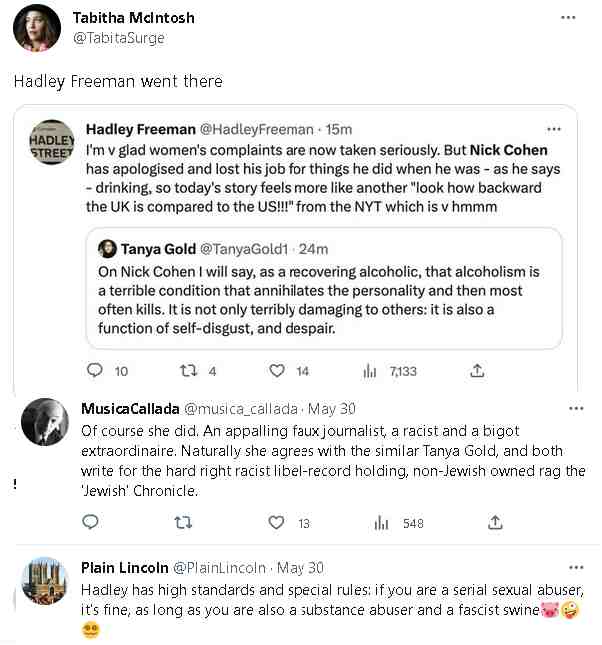
Hyde, the Guardian’s empty head, was the nastiest and snidest of the lot. Hadley
Freeman, on loan from the Jewish
Chronicle, penned a puerile
attempt at wit. Suzanna
Moore a poisonous transphobe and Hanna Jane
Parkinson joined in the baying mob.

The Guardian’s male ‘journalists’
lacked the viciousness and bitchiness of their female colleagues but they made
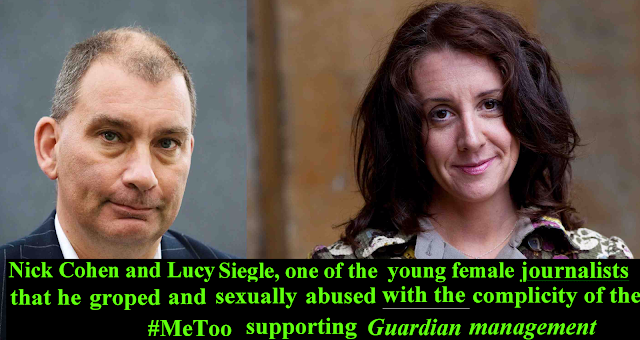
up for it. None more so than Nick Cohen, whose years
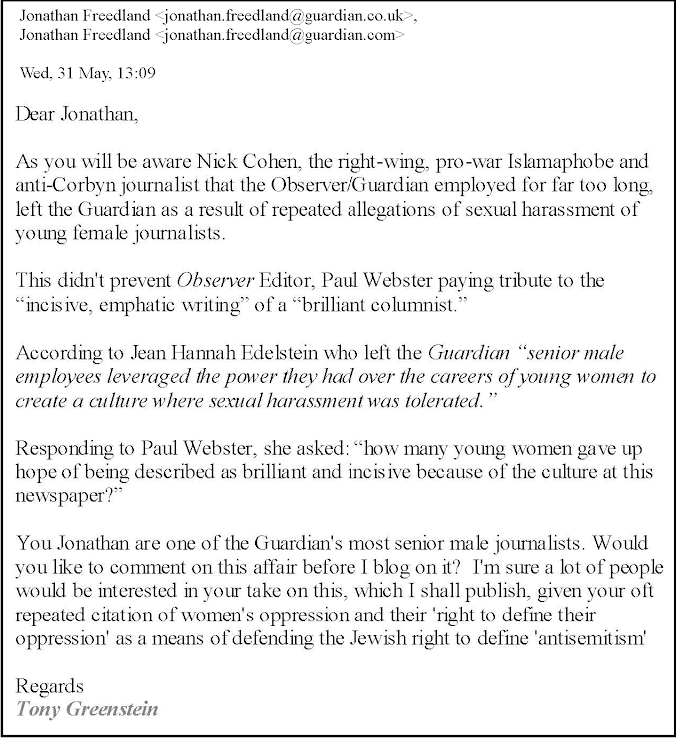
of sexual abuse, was covered up by Jonathan Freedland and other senior
editors.

Cohen’s abuse was the
subject of an article
in the NYT. The Guardian prided
itself on #metoo but when it came to it, it too covered up gross and persistent
sexual assault bordering on rape. As Martha Gill put it in the Observer #MeToo
men want to be forgiven, but what of the careers of their casualties? I’m
sure all the young journalists who were forced to give up internships or jobs
at the Guardian because of Cohen have been handsomely compensated-not.

None
of this prevented
Cohen from attacking Assange though!
Some
of Assange's supporters say that the women have no right to put allegations of
sexual abuse before a competent court. Instead, they denounce them as
"feminazis" in language so extreme that the women's lawyer said his
clients were "the victims of a crime, but they are looked upon as the
perpetrators". ... Activists, who
claim they are the enemies of patriarchy, dismiss allegations of sexual abuse
as a CIA conspiracy.

Cohen wasn’t the only
righteous hypocrite on the Guardian. Marina Hyde was convinced
that Assange was ‘a man hiding in an
embassy to avoid a rape investigation’. Nothing to do with the CIA wanting
to bump him off. The talentless Hyde had an obsession with Assange, remarking
in another turgid
article that ‘the higher he has gone
in his “quest for justice”, the smaller he has looked.’

But
when it comes to getting it badly wrong, no one was quite as skilled as Cohen.
In another paranoid article
Cohen wrote that:

Greenwald
and the rest of Assange's supporters do not tell us how the Americans could
prosecute the incontinent leaker. American democracy is guilty of many crimes
and corruptions. But the First Amendment to the US constitution is the finest
defence of freedom of speech yet written. The American Civil Liberties Union
thinks it would be unconstitutional for a judge to punish Assange.

And
yet Assange was prosecuted. Under the Espionage Act. The Americans were
determined to exclude his protections under that same First Amendment (because
he wasn’t a citizen). Cohen to be fair was not the only one to get it wrong.
James Ball, wrote
in 2018 that
The
only barrier to Julian Assange leaving Ecuador’s embassy is pride. The
WikiLeaks founder is unlikely to face prosecution in the US, charges in Sweden
have been dropped – and for the embassy, he’s lost his value as an icon

David Crouch attacked
Assange over breach of privacy with an article
about how he had defied Swedish prosecutors by releasing a statement. Having
been interviewed by Sweden’s prosecutors Assange was perfectly entitled to
release his version of events.
In 2019 Jessica Elgot,
another transfer from the Jewish
Chronicle reported
on a letter from MPs that urged that priority be given to rape claims that were
by then dead. Quite conveniently that saved them from defending someone who had
revealed the US’s dirty secrets.

None
of these people have apologised for their squalid attacks, despite having got
it wrong about the US intention to extradite Assange. If the Guardian had any principles it would
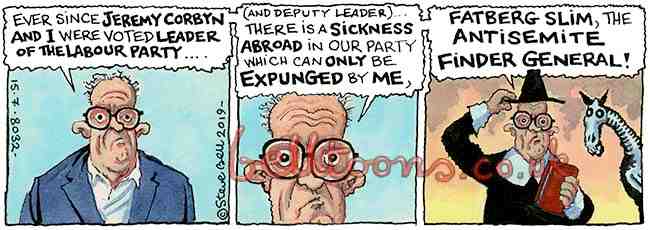
have fired the lot. As I said on the demonstration outside the Guardian, it had only one good
journalist, its cartoonist Steve Bell, and he was fired!
Declassified Clip on Starmer's Role When at the CPS on the Framing of
Julian Assange
All of this pales in comparison with Starmer’s role as head of the Crown Prosecution Service. The CPS urged the Swedes not to drop their extradition request when the lack of evidence was plain. ‘Don’t you dare get fold feet’ was the message sent by the CPS to them.
The CPS has admitted
to destroying key emails related to the Assange case, mostly covering the
period when Starmer was in charge, while the CPS lawyer overseeing the case
advised the Swedes in 2010 or 2011 not to visit London to interview Assange.

Now is a
good time to remember that when Starmer was (a deeply
unpopular) Director of Public Prosecutions and Assange was fighting
attempts to extradite him to Sweden, as a staging post for extradition to the
US, Starmer flew at least three times to the US in connection with the Assange
case. He was accompanied by security officials. The CPS destroyed all records
of Starmer’s discussions – as it did
with records showing what he knew about serial rapist Jimmy Savile:
This was
not Starmer’s only example of grovelling to the US on extradition. When the US
wanted autistic hacker Gary McKinnon after he had hacked its servers looking
for information on UFOs, Starmer told the Americans he would ‘do everything’ to ensure the extradition
went ahead – and flew
in fury to bow and scrape to Washington after the then Home
Secretary Theresa May quashed it.

Starmer
has been described as
a ‘long-time servant of the British
security state’ and has relentlessly backed moves to protect state agents
from crimes such as rape and murder. He attacked
environmental and human rights protesters, supported immunity for
soldiers who murdered civilians in Northern Ireland and refused
to oppose laws allowing the state to persecute journalists. Not once
did he speak out against the relentless US pursuit of Assange, despite
the collapse
of the US case when its main witness
admitted lying.
If Starmer is elected
as Prime Minister we can expect a continuation of the Tory policy of
criminalising protest. There isn’t a piece of paper between him and the Tories.
See Video:
Starmer met US agencies about Assange extradition – CPS destroyed all records

An
important article
in the London Review of Books by Patrick Cockburn, one of the few genuine
journalists left, described how:
Melzer describes an investigation
that was politicised from the moment on 20 August 2010 when two women, then
known only as AA and SW, went to a police
station in Stockholm ‘to inquire whether
Mr Assange could be compelled to take an HIV test’. Within
hours, ‘the Swedish prosecution ordered
the arrest of Mr Assange and informed the tabloid newspaper Expressen that he was suspected of
having raped two women.’
Over the next nine years, as the
investigation was repeatedly closed by one prosecutor only to be reopened by
another, Sweden regularly indicated that it wanted to question Assange, but in
practice showed little desire to do so or to bring the investigation to a
conclusion. The main effect of the stop-go judicial proceedings was to keep the
controversy over what Assange did in Stockholm in 2010 on the boil. The Swedish
government finally replied to Melzer’s letter in November only to say that it
had ‘no further observation to make’;
the following day the investigation was formally closed.

None of this is likely to change
the way Assange is seen. In keeping with past experience, almost no mainstream
news outlet paid any attention to Melzer’s questions about the conduct of the
case. The world’s biggest newspapers, which had published the WikiLeaks
disclosures on their front pages in 2010, distanced themselves from Assange
very shortly afterwards, often declaring that he was a difficult person to deal
with or was slapdash in his handling of the US government cables and
reports. He was accused of being a ‘narcissist’, as if that were something more
than a character flaw, or as if his character flaws – whatever they were – had
any bearing on the information that had been revealed.
Given the gravity of the issues at stake, the silence of journalists about Assange’s detention in Belmarsh following Ecuador’s revoking of his asylum status is striking. Here was evidence of a radical shift in US security policy, towards the position taken by countries like Turkey and Egypt, which have sought to criminalise criticism of the state and to conflate the publication of news it doesn’t want the public to hear with terrorism or espionage. ... as Glenn Greenwald has pointed out in the Intercept, Western media have ‘largely ignored what is, by far, the single greatest attack on press freedoms by the US government in the last decade at least: the prosecution and attempted extradition of Julian Assange for alleged crimes arising out of WikiLeaks’s ... publication – in conjunction with the world’s largest newspapers – of the Iraq and Afghanistan war logs and US diplomatic cables’. They couldn’t jail the editor of the New York Times so they pursued Assange instead.

The fact that Assange has evaded charges of sexual violence and skipped bail should be opposed by the Labour Party. I'm sure it is, I'd like to hear it. https://t.co/17vv19pNA7
— Jess Phillips (@jessphillips) April 11, 2019

Tribute
needs to be paid to Stella Assange, who I had the privilege of meeting during the
Future of the Left events
at the 2022 Labour Party conference in Liverpool where I spoke. Stella has been
a dogged campaigner. John Pilger was a staunch supporter as was Yanis
Varoufakis but with very few exceptions Labour MPs like Jess Philips, who ran with the
rape allegations, have been silent or hostile.
I have a few
observations. The thrust of the US charges related to Wikileaks having
endangered their agents and operatives. Although Assange took care not to
reveal their names I have to confess that I couldn’t care less what happened to
them. I remember when ex-CIA agent Phil
Agee, deliberately went out of his way to expose them in his book Inside the
Company, which is still a
good read. Agee was deported by Home Secretary Merlyn Rees in 1977

The CIA has
been responsible, through the coups it has engineered in Chile, Indonesia, Iran
etc. for the deaths of over a million people in Indonesia alone. If there are a
few less CIA thugs roaming the streets then that makes far more people safe. US
foreign policy is designed to make all except the elites unsafe.
I also want
to comment on the judicial proceedings. Yet again our judges, who never let it
be forgot are the 'most socially exclusive groups of
all the professions’
according to the report, Elitist Britain by the Social
Mobility Commission and the Sutton Trust. It shows that 65% of senior judges
were educated at an independent school & 75% attended Oxford or Cambridge. [Law
Gazette, 25.6.19.]

The inquities in this case are
staggering. There is firstly the conflict of interests. The Westminster Chief
Magistrate Lady Emma Arbuthnot who made key rulings against Assange is married
to Lord James Arbuthnot,
a former Defence Minister and Chair of the Defence Select Committee. Arbuthnot
was also an advisor to the Islamaphobic Henry Jackson Society.
The Lord Chief Justice who was responsible
for rejecting Assange’s first appeal, Ian Burnett, was a long-standing
friend of Alan Duncan, the Minister at the Foreign Office who was responsible
for the campaign against Ecuador for
harbouring Assange. He later described
Assange in parliament as a ‘miserable
worm’.

But it’s not just these obvious
conflicts of interest. Running through these proceedings is the assumption that
the United States has the right to prosecute non-citizens for ‘offences’
committed outside its territorial jurisdiction. Of course in reality the evil
empire considers that its reach extends everywhere but at no point did this
point even enter the heads of the judiciary.
Secondly Article 4 of
the Extradition
Treaty of 2007 between the US and Britain explicitly excludes political
offences. It reads:
Extradition shall not be
granted if the offense for which extradition is requested is a political
offense.
However
the judges are well paid to ensure that their duty to the security state
always outweighs their duty to justice and naturally they found a form of weasel
words to get around this.
It might be thought that revealing
details of war crimes committed by the United States was in itself a compelling
reason for rejecting the extradition request however that would be to
underestimate the morality of Britain’s judiciary. Crimes by the state are
never crimes unless there is a political advantage to making them so. The fact
that committing war crimes is illegal under the International Criminal
Court Act 2001 is no bar to making revelation of them an offence.
Then there is the small matter of the
CIA listening
in to privileged conversations between Assange and his lawyers. The judges
didn’t rule on this they simply ignored it altogether.
Then there was the attempt
of the CIA to assassinate Assange. Naturally the judges didn’t think this had
any bearing on the extradition proceedings. After all that’s the CIA’s job. So
how can one party trying to kill another be of any relevance?
So all in all Britain’s judiciary
completely disgraced themselves but that too is not the first time.
We can thank Australia’s electorate
that they turfed
out the previous administration under Scott Morrison and elected a Labour government
under Anthony Albanese that campaigned vociferously for Assange’s release.
Whatever the sins of the Australian Labour Party, and they are many, one can be
thankful that Albanese is not Keir Starmer otherwise Assange would still be in
Belmarsh.