Showing posts with label Nasser. Show all posts

1 May 2019

How to Create Anti-Semitism in 2 easy steps


First you say that Zionism is the same as being Jewish, then, when people criticise Israel you cry ‘anti-Semitism’
What is remarkable about the false anti-Semitism campaign waged by Labour’s racist Deputy Leader Tom Watson and child abuse supporter Margaret Hodge is how often they get away with it. 
[There was a time when Jewish Chronicle then Daily Express Editor Stephen Pollard wrote about Hodge that ‘It’s difficult to imagine a more blatant, shameful and utterly contemptible piece of two-faced hypocrisy than the behaviour of Margaret Hodge‘. It was true then and it’s true now!


Jeremy Corbyn became Labour leader because of a desire to see fundamental change. However the people who supported him were political novices who were unprepared for the backlash that followed.
It was not easy for the Right to attack Corbyn who won as the anti-Austerity candidate. Arguing, as did the Dark Prince Peter Mandelson that he was “intensely relaxed about people becoming filthy rich” whilst people were using food banks or sleeping on the streets did not convince many people. Liz Kendal tried it in 2015 and flopped with 4.5%.
‘Anti-Semitism’ was a much more useful weapon, almost custom made. It had an aura of moral righteousness about it. Fighting ‘anti-Semitism’ could make even the worst reactionary feel good. It is, as I once wrote in an essay for Return No. 5, ‘The False Anti-Semitism of the Right’.
Fighting for lower taxes for the rich is far less morally uplifting than opposing racism against those who suffered from attempted extermination. Even if it means getting into bed with racists!
The Daily Mail, which during the 1930’s supported Hitler abroad and Sir Oswald Moseley’s British Union of Fascists at home in addition to campaigning against the admission of Jewish refugees from the Nazis, began the fake anti-Semitism campaign with a story alleging Jeremy Corbyn had worked with a holocaust denier Paul Eisen.
There is a good tradition for this kind of thing.  When British imperialism conquered India it did it so in the name of fighting Suttee, a Hindu custom of burning widows on the pyre of their husbands. It didn’t mention bleeding India dry of its wealth and resources or blasting people from the barrels of cannons.
That is why it is disappointing that Richard Burgon MP, one of the better members of Corbyn’s Shadow Cabinet should first deny and then distance himself from his perfectly reasonable view that Zionism is a threat to peace.
Zionism based its whole project on the  slogan that Palestine was a ‘land without a people for a people without a land’. The slogan had first been coined by a Christian Restorationist, Alexander Keith.
The main accusation against Burgon should have been that it was a statement of the obvious. Saying Zionism is a threat to peace is like saying that dogs bark or fish swim. Why should be want to deny it?
The JLM demonstrate that their concern is Zionism not anti-Semitism
It is irrelevant whether or not Burgon remembered saying that Zionism is a threat to peace. Obviously he must have believed it and why not? Israel has, since it was founded, based its whole existence on creating enemies. First it was Gamel Abdul Nasser of Egypt, then the PLO, then Hezbollah and now Iran. The Israeli state could not justify its existence without an enemy. 
Recently the enemy has become the 40,000 Black refugees within its borders whose only crime is to be Black and not Jewish. The term used by Netanyahu is ‘infiltrators’ which the Israeli Labour Party’s Avi Gabbay repeated. Infiltrators conjures up another enemy of Israel, the Palestinian refugees who ‘infiltrated’ back into Palestine after their expulsion in 1948. Hundreds if not thousands of them were murdered by the Israeli army in the 1950’s. Calling refugees ‘infiltrators’ is an attempt to equate them with ‘terrorists’.
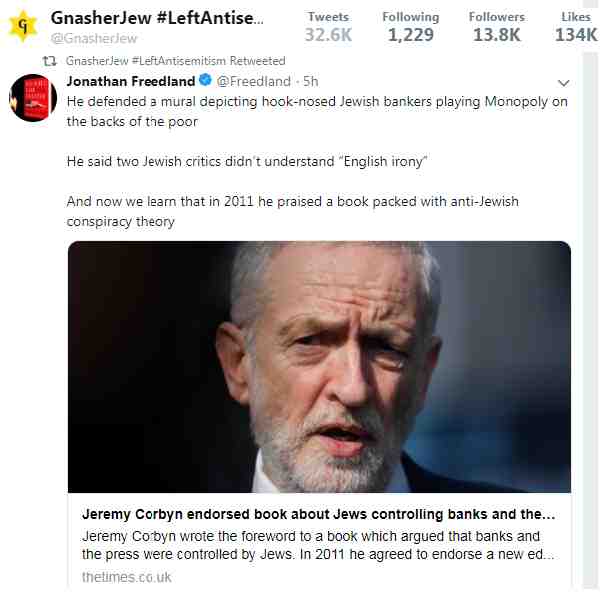
The lies of Jonathan Freedland - the famous mural had no 'hooked-nose' Jewish bankers in it and 4 of the bankers were non-Jewish
But it’s not only within the Middle East that Israel has been a threat to peace. It has consistently supported the most repressive and genocidal regimes abroad. It actively aided the genocide in Guatemala where up to 200,000 Mayan Indians were slaughtered. It supported the death squad regime in El Salvador. Shipped weapons to the Nicaraguan Contras when the US Congress cut them off.  It supported Pinochet in Chile (Israel’s Supreme Court recently refused to allow the files to be opened on ‘national security’ grounds).  It armed the neo-Nazi Junta of Argentina between 1976-1983 when it murdered up to 3,000 Jews and of course more recently it armed the Burmese regime as it committed genocide. Israel was also of course the main arms supplier to the Apartheid regime in South Africa, including nuclear weapons.
Tom Watson defended 'poor Phil' who campaigned on this racist leaflet from Phil Woolas in 2010 - the High Court removed Woolas from the Commons for lies in a campaign that aimed to 'make white folk angry'
Colin Shindler described in the Jewish Chronicle how
Despite a US arms embargo, Israel trained personnel and provided equipment which could be used against Pinochet’s opponents. In 1989 Eitan Kalinsky and his wife were sent as Israeli emissaries to teach at the Jewish school in Santiago. They attended the now public protests against Pinochet’s regime and were amazed to note that the riot-control vehicles had been manufactured by Beit Alfa, a left-wing Hashomer Hatzair kibbutz.
Kibbutz Artzi was the kibbutz federation of the so-called Marxist Zionist Mapam party!
So the question is why Burgon didn’t proudly admit that he called Israel a threat to world peace and defy his accusers to do their worst? After all Israel is an openly apartheid state which for half a century has maintained a military dictatorship in the Occupied Territories.
The reason is Zionist Political Terrorism. The fake anti-Semitism campaign run by the Israeli Embassy, as Al Jazeera documented, has successfully intimidated otherwise decent politicians like Richard Burgon into denying their own private views.
The JLM have successfully demonised Ken Livingstone, Chris Williamson, Jackie Walker, Marc Wadsworth, Chris Williamson and others, myself. Included. Unfortunately, instead of Momentum standing up to them, Jon Lansman and Owen Jones have gave gone along with the McCarthyites.

When Burgon first stated Zionism was a threat to peace, Joan Ryan MP wrote an open letter on 16th August 2016 to him. I replied with another Open Letter four days later! This was a dead issue deliberately resurrected by the JLM in order to continue with its campaign of intimidation and vilification.

If Burgon had had the guts to stand up to the JLM and Katz and call these petty racists out, as Moshe Machover for example did, then Katz would have been reduced to the insignificant straw man that he is.

The arguments used by Katz of the Jewish Labour Movement to attack Burgon are interesting and show the dishonesty of the Zionists.  Katz stated that ‘the vast majority of British Jews identify as Zionists’ and that Burgon was therefore ‘insulting a core part of their identity.’
Leaving aside how you can ‘insult’ an identity as opposed to agreeing or disagreeing with it, his basic premise is untrue. In British Jews Attitudes to Israel conducted in 2015 just 59%, down from 71% five years previously, defined themselves as Zionists. 31% of British Jews said they were not Zionists. 59% is not ‘overwhelming’.
However even if an overwhelming majority of British Jews supported Zionism what would that say?  That the majority of British Jews were racists?  Stupid? Ignorant?  Choose your adjective. However if Zionism is racist, as it clearly is, then the views of British Jews are irrelevant.  Truth is more important.
Racism is about dehumanisation. Racism defines people as inferior according to arbitrary attributes such as ‘race’, colour or religion. It is not about challenging a political identity.
Salman Rushdie
When 40 years ago Salman Rushie published Satanic Verses the vast majority of Muslims considered it an insult to their identity as Muslims. Copies of the book were publicly burned and a fatwa was put on the head of Salman Rushdie by Ayatollah Khomeini.  Many of us on the Left had no hesitation in supporting Rushdie’s right to publish his book unharmed. Were we racist because we were opposed to a core element of some Muslim’s identity?  Of course not.
If some Africans believe that FGM is part of their identity is it racist to oppose it?  Zionism is just as much of a threat to Palestinians and FGM is.  If some Jews identify as Zionists that paints them as incorrigible racists who identify with the historic oppressors of Jews.
The right to criticise religion is a fundamental part of any free society.  Likewise the right to call an ideology, Zionism, racist or a threat to peace is called freedom of speech. It is irrelevant whether Zionism is the core part of the identity of many Jews. So what? It is also the core identity of Evangelical Christians and opposition to Zionism is the core identity of many anti-Zionist Jews. 
Eric Pickles defended the Tory link-up with anti-Semitic and racist parties in the European parliament
The tragedy is that under the baleful influence of the Zionist Jon Lansman, fake leftist Owen Jones and others such as Shadow Foreign Minister Emily Thornberry, supported by cowardly trade union leaders such as Dave Prentis, the Labour Party has adopted the IHRA definition of ‘anti-Semitism’ which conflates criticism of Israel and Zionism with anti-Semitism.  That is why out and out racists like Tory Eric Pickles have signed up to a definition of anti-Semitism that provides an ideological underpinning for British foreign policy. 
What the present campaign of equating anti-Semitism with anti-Zionism is doing is to identify British Jews with Zionist atrocities. All the things that the Israeli state does is equated with British Jews. That is why supporting Zionism is the best way to support anti-Semitism.
The fake anti-Semitism allegations have been much in evidence in the local elections. In Brighton the only Black woman council candidate, Alex Braithwaite has been suspended from Brighton Labour Party.  It is too late for her name to be taken off the ballot paper and we hope that in two days time she will nonetheless be elected to the council.
Another Labour Party member, Amanda Bishop, foolishly believed that Alex’s removal was as a result of the actions of local Jews, since what was done was in the name of the Sussex Jewish Representative Council and she made a suggestion on Facebook, more in jest, that we should march to the local synagogue!  She too has been suspended although Amanda too has a long and good record as an anti-racist in the days of Apartheid. The fake anti-Semitism campaign is being used by racists to attack anti-racists.
The only effect of the fake anti-Semitism campaign is to INCREASE anti-Semitism.  And that too will be welcome to Zionism because without anti-Semitism there is no Zionism or emigration to Israel.
Tony Greenstein

25 March 2018

The Growing Divorce Between American Jewish Youth and Israel


This is one of the most positive stories yet to come out of America and indeed the Jewish community as a whole.  Before 1945 the majority of Jews world wide rejected Zionism.  The reasons were quite simple.  Most Jews assert that they are part of the nations amongst whom they live.  Zionism posits that they are members of another nation- the Jewish nation.  Since you can’t be a member of 2 nations at the same time, what this means in practice is that Zionism alienate people from the nations amongst whom they live.

It was the Holocaust, the failure to defeat fascism, which led to support for Zionism and the Israeli state.  It seems as if Zionism had been right all along when it said that anti-Semitism is inherent in the non-Jew, that it could not be fought.  Germany was a terrible example of the truth of this.
However in the 72 years of its existence Israel has been in a permanent state of emergency, an artificial war-like nation that is always seeking an excuse to make war on somebody somewhere.  Israel is a state in search of enemies and where it has none it does its best to invent them.
So in its time we have had Gamel Abden Nasser, the President of Egypt called the Hitler on the Nile, Arafat/Ahmedinajad and anyone else Zionism doesn’t like has been called a new Hitler.  Hamas are genocidal Jewish baby eating monsters as are Hezbollah.  At the same time Israel has dropped the verbal attachment to collectivism as it has adopted neo-liberalism with an enthusiasm not matched anywhere in the world.

Combine all this with the Occupation, the daily human rights abuses, Ahed Tamimi, the racist laws and house demolitions and it is not easy to be a supporter of Israel and yet demand equality at home.
When you find that those in society who are most anti-Semitic, like neo-Nazi Richard Spencer of the alt-Right, Steve Bannon, Le Pen, Geert Wilders, Nick Griffin of the BNP, Pastor John Hagee and assorted racists and fascists all love Israel whilst, at the same not liking Jews then it begins to occur to young Jews that Israel is not all that it is cracked up to be.  In addition a Jewish state suggests that Jews don’t belong in America.
It is therefore not surprising that in this survey of the Bay Area district in California, only 11% of Jews between 18 and 34 were ‘very attached to Israel’.  Even better only 40% of young American Jews are ‘comfortable with the idea of a Jewish state.’

 It is becoming ever clearer that it isn’t Jews but racist non-Jews who most love Israel.  In Fire & Fury it describes how Jared Kushner felt Steve Bannon’s support for Israel was a cover for his anti-Semitism.  Today the normal response from anti-Semites is that they love Israel.

Tony Greenstein

Young Jews Are Actually Winning The Generational War Over Israel

By Batya Ungar-Sargon, The Forward, February 13, 2018
Ever since the late 1960s, Israel has been a defining feature of American Jewish identity. But for the first time in fifty years, this is changing.

Wedge issues have been alienating liberal Jews from Prime Minister Benjamin Netanyahu’s hawkish, pro-Orthodox, pro-settlement platform, issues like prayer accommodations for Reform and Conservative Jews at the Western Wall and the treatment of the Palestinians in the West Bank and Gaza.
Now, a new study joins mounting evidence that young American Jews are abandoning Israel. And unless this trend is somehow reversed, American Jews in their newfound ambivalence towards Israel will lose a key part of who they are, or at least, who they have been for the past half century.
The study, conducted by Steven Cohen and Jack Ukeles, was commissioned by the Jewish Community Federation of San Francisco, the Peninsula, Marin, and Sonoma Counties. In it, over 3,000 respondents from the Bay Area took an online survey in which they were asked questions about Jewish life.

This is what Cohen and Ukeles found: Only 11% of Jews age 18-34 said they were “very attached to Israel,” as opposed to 25% of those 50 and older. Only 37% of American Jews age 18-34 said the Jewish state was “very important,” compared to 61% of American Jews 50-64 and 68% of American Jews 65 and older.

More shockingly, only 40% of American Jews age 18-34 said they were “comfortable with the idea of a Jewish state,” compared to 64% of American Jews 50-64 and 73% of American Jews 65 and older. And only 30% of American Jews age 18-34 said that they sympathized more with Israel than with the Palestinians when it came to the Israeli-Palestinian conflict, compared to 47% of American Jews 50-64 and 56% of American Jews 65 and older.

A Portrait of Bay Area Jewish Life and Communities

Now, California is the most liberal state in the union, and the Bay Area is its most liberal area, and Jews are the most liberal of America’s ethnic groups, all of which is to say, the data might not be completely representative of the larger Jewish community. But the findings are compatible with a recent Stanford study, which found that Jewish college students don’t want to engage in debates or conflict around Israel, and resist being labeled as pro-Israel either by Israel advocates or by those critical of Israel.

These results were also consistent with the Pew Research Center’s survey of American Jewish life from 2013, as well as with a Pew study that came out last month, which found a deep political polarization and generational divide among Americans generally on the subject of Israel. A full 79% of Republicans say they sympathize more with Israel than the Palestinians, compared to just 27% of Democrats. And while 56% of Americans 50 and over sympathized more with Israel than with the Palestinians, only 32% of 18-29 year olds did.

Just as it’s dividing Americans, Israel is dividing American Jews. The Bay Area study’s researchers concluded that there are four main predictors for feeling a connection to Israel: age, politics, your level of Jewish engagement more generally, and affluence. “People who are conservative, older, more Jewishly engaged or wealthier feel more attached to Israel than people who are liberal, younger, less Jewishly engaged and less affluent,” Steven Cohen, one of the researchers, told me. “All these factors are interrelated.”
Which brings us to young Jews. “What we’re seeing in comparing younger with older Jews is that younger Jews are moving towards a more neutral position regarding Israel,” explained Cohen.
The reason for this is twofold, says Cohen. The first stems from the fact that American Jews are defining their identity in more personal and less collective terms. “They are more spiritual and less ethnic,” he explained. “And Israel falls in the ethnic compartment.”

The second reason younger Jews are less invested in Israel has to do with Israel itself. “Israeli policies are far more appealing to political conservatives and more alienating to political liberals,” said Cohen. “American Jewry outside Orthodoxy remains overwhelmingly liberal and overwhelmingly associated with the Democratic Party.”

But Jews stand to lose a lot more than non-Jewish Democrats when they lose their ability to proudly identify with Israel. The Israeli policies which appeal to conservatives and alienate liberals are actually costing American Jews a core piece of their identity. When young Jews stop identifying with Israel or caring about it, this reinforces a lack of engagement with their Jewish identity overall. Which means that losing our connection to Israel is catastrophically, existentially dangerous for the Jewish diaspora community.
“Israel’s policies are depriving American Jewry of a major pillar of inspiration and mobility,” Cohen said.
Others are worried, too.
“It’s a huge concern,” said Jason Isaacson, Associate Executive Director for Policy of the American Jewish Committee. It’s why AJC puts an emphasis on contrasting Israel with what Isaacson called Israel’s “more autocratic neighbors” and stresses Israel’s “hunger for peace with the Palestinian people whose leadership has resisted the course of the negotiations.”

But Isaacson admits that it’s a case that’s becoming increasingly difficult to make, thanks to the inherent tension between some of Israel’s actions and the liberal values that matter to American Jews – especially young Jews. “Obviously the actions of the government on matters relating to the Palestinians color this,” Isaacson said.
Then you have the Israeli government’s embrace of the Trump administration, which is hardly popular among liberal youngsters. “All this is part of this mix, so cutting through that and introducing the reality of Israel and the reality of Israel’s situation is a challenge,” Isaacson said.

And it’s not just young Jews. Based on polls the AJC regularly conducts, Isaacson says that the mainstream American Jewish community is “uncomfortable with the occupation.” “It’s not in our nature and it’s not the destiny of the Jewish people to occupy another people,” Isaacson said.
But the days when American Jews will support Israel in spite of illiberal policies are coming to an end. Other data strongly suggests that that when American Jews perceive a tension between Israel and leading an ethical life, they will choose their ethics.

Take, for example, the poll that found that American Jews ranked remembering the Holocaust, leading an ethical and moral life, being intellectually curious, and working for justice and inequality as more important to their Jewish identity than Israel. The same poll found that as important as Israel to being Jewish is having a good sense of humor (Israelis disagreed – strongly).

In other words, for huge amounts of Jews, their core beliefs about what is ethical and just — beliefs which preclude the occupation of the Palestinians — are more definitive of who they are as Jews than the nationalism represented by the fact of a Jewish state.
Indeed, nationalism has been tainted by the rise of white supremacists in the US, and its stain is spreading through President Donald Trump to everything he touches – which now includes Israel. And while there is still a minority willing to support Israel on its own terms, the younger generation and the majority of Jews no longer fit into that category.

And yet, we know from the past that American Jews want an Israel they can identify with — fiercely. What’s more, they need it to survive in America as Jews, as Cohen pointed out. Absent the strong ties of community and religion, Israel has provided a source of inspiration that kept Jews connected to each other even in the Diaspora.

Values-driven millennials wont endorse something that doesn’t fit within their belief system. If moneyed American Jews want to strengthen Jewish continuity, they should stop spending money trying to convince American Jews that they aren’t seeing what they say they are seeing when they look at Israel, and start convincing Israeli leaders to pursue policies that American Jews can be proud of.

In fact, this does seem to be happening. Recently, Jonathan Greenblatt of the Anti-Defamation League criticized Netanyahu’s efforts to deport African refugees on the ground that it seems racist. “African refugees, who seem like the Dreamers in the US — young people who by dint of their parents’ decisions have grown up in this country — who speak fluent Hebrew, when you start physically picking them up and sending them over the border back to South Sudan or Rwanda all the while, while you don’t do the same to Ukrainians or Eastern Europeans who overstay their visas, guys, this is not going to end well,” Greenblatt said.
And the AJC’s Isaacson told me he, too, speaks to Israeli officials and leaders about the ways in which they are alienating young Jews. He sees his work as cutting both ways. “It’s hasbara, but it’s not just hasbara,” Isaacson said, referring to Israeli government propaganda presented in a positive light. “It’s action. It’s policies. And obviously these are issues that we discuss intensively and continuously with our friends and brethren in Israel.”

Young American Jews are having an effect on the American Jewish leadership. By refusing to endorse Israel’s shortcomings, they are pushing their leaders to demand change.
It’s a good thing. Our future as Jews – even in the Diaspora – depends on it.

Batya Ungar-Sargon is the opinion editor of the Forward.

10 January 2016

Israel and Saudi Arabia - The Roots of a Special Relationship

This is an important and well-researched article.  It shows beyond doubt how the Saudi regime, which ousted its rivals in Arabia in the period 1921-1925, worked closely with British imperialism.  Ibn Saud was unleashed as a weapon of the British against those Arab rulers who refused to accept the Zionist colonisation of Palestine.  In other words, the corrupt Ibn Saud clan were quislings and traitors from the start.  Their barbarous and medieval practices, which involved stoning, flogging and mass executions, were justified by the Wahhabi faith in the same way that religion justifies repression in many countries.  Just as today Phillip Hammond justifies the 47 executions by the Saudis as the inevitable consequence of Sharia Law, thus demonstrating his own ignorance as well as the priorities and concerns of present day British imperialism.

 Tony Greenstein
Abdel Aziz Ibn Saud with Sir Percy Cox
Israel and Saudi Arabia have worked for years together.  Another example is in Lebanon where the Saudis supported the Phalangists against the leftist Lebanese National Movement.  In this they also worked with the Israelis.  The instance of co-operation with Israel in Yemen in the 1950’s when Nasser supported the Republicans is well known.

Today Israel and Saudi Arabia work hand in glove in opposing Iran and supporting the ‘moderate’ terrorists in Syria.

Tony Greenstein


Churchill and Ibn Saud in Egypt 1945
The covert alliance between the Kingdom of Saudi Arabia and the Zionist entity of Israel should be no surprise to any student of British imperialism. The problem is the study of British imperialism has very few students. Indeed, one can peruse any undergraduate or post-graduate British university prospectus and rarely find a module in a Politics degree on the British Empire let alone a dedicated degree or Masters degree. Of course if the European led imperialist carnage in the four years between 1914 – 1918 tickles your cerebral cells then it’s not too difficult to find an appropriate institution to teach this subject, but if you would like to delve into how and why the British Empire waged war on mankind for almost four hundred years you’re practically on your own in this endeavour. One must admit, that from the British establishment’s perspective, this is a formidable and remarkable achievement.
Ibn Saud
In late 2014, according to the American journal, “Foreign Affairs”, the Saudi petroleum Minister, Ali al-Naimi is reported to have said “His Majesty King Abdullah has always been a model for good relations between Saudi Arabia and other states and the Jewish state is no exception.” Recently, Abdullah’s successor, King Salman expressed similar concerns to those of Israel’s to the growing agreement between the United States and Iran over the latter’s nuclear programme. This led some to report that Israel and KSA presented a “united front” in their opposition to the nuclear deal. This was not the first time the Zionists and Saudis have found themselves in the same corner in dealing with a perceived common foe. In North Yemen in the 1960’s, the Saudis were financing a British imperialist led mercenary army campaign against revolutionary republicans who had assumed authority after overthrowing the authoritarian, Imam. Gamal Abdul-Nasser’s Egypt militarily backed the republicans, while the British induced the Saudis to finance and arm the remaining remnants of the Imam’s supporters. Furthermore, the British organised the Israelis to drop arms for the British proxies in North Yemen, 14 times. The British, in effect, militarily but covertly, brought the Zionists and Saudis together in 1960’s North Yemen against their common foe.

However, one must go back to the 1920’s to fully appreciate the origins of this informal and indirect alliance between Saudi Arabia and the Zionist entity. The defeat of the Ottoman Empire by British imperialism in World War One, left three distinct authorities in the Arabian peninsula: Sharif of Hijaz: Hussain bin Ali of Hijaz (in the west), Ibn Rashid of Ha’il (in the north) and Emir Ibn Saud of Najd (in the east) and his religiously fanatical followers, the Wahhabis.
Fahd bin Abdul Aziz Al Saud & fellow tyrant
Ibn Saud had entered the war early in January 1915 on the side of the British, but was quickly defeated and his British handler, William Shakespear was killed by the Ottoman Empire’s ally Ibn Rashid. This defeat greatly hampered Ibn Saud’s utility to the Empire and left him militarily hamstrung for a year.[1] The Sharif contributed the most to the Ottoman Empire’s defeat by switching allegiances and leading the so-called ‘Arab Revolt’ in June 1916 which removed the Turkish presence from Arabia. He was convinced to totally alter his position because the British had strongly led him to believe, via correspondence with Henry McMahon, the British High Commissioner in Egypt, that a unified Arab country from Gaza to the Persian Gulf will be established with the defeat of the Turks. The letters exchanged between Sharif Hussain and Henry McMahon are known as the McMahon-Hussain Correspondence.
The Saud clan circa 1911
Understandably, the Sharif as soon as the war ended wanted to hold the British to their war time promises, or what he perceived to be their war time promises, as expressed in the aforementioned correspondence. The British, on the other hand, wanted the Sharif to accept the Empire’s new reality which was a division of the Arab world between them and the French (Sykes-Picot agreement) and the implementation of the Balfour Declaration, which guaranteed ‘a national home for the Jewish people’ in Palestine by colonisation with European Jews. This new reality was contained in the British written, Anglo-Hijaz Treaty, which the Sharif was profoundly averse to signing.[2] After all, the revolt of 1916 against the Turks was dubbed the ‘Arab Revolt’ not the ‘Hijazi Revolt’.
Ibn Saud with President Roosevelt
Actually, the Sharif let it be known that he will never sell out Palestine to the Empire’s Balfour Declaration; he will never acquiescence to the establishment of Zionism in Palestine or accept the new random borders drawn across Arabia by British and French imperialists. For their part the British began referring to him as an ‘obstructionist’, a ‘nuisance’ and of having a ‘recalcitrant’ attitude.
The British let it be known to the Sharif that they were prepared to take drastic measures to bring about his approval of the new reality regardless of the service that he had rendered them during the War. After the Cairo Conference in March 1921, where the new Colonial Secretary Winston Churchill met with all the British operatives in the Middle East, T.E. Lawrence (i.e. of Arabia) was dispatched to meet the Sharif to bribe and bully him to accept Britain’s Zionist colonial project in Palestine. Initially, Lawrence and the Empire offered 80,000 rupees.[3] The Sharif rejected it outright. Lawrence then offered him an annual payment of £100,000.[4] The Sharif refused to compromise and sell Palestine to British Zionism.
TE Lawrence of Arabia - who helped implement a Zionist agenda with the Arab revolt
When financial bribery failed to persuade the Sharif, Lawrence threatened him with an Ibn Saud takeover. Lawrence claimed that “politically and militarily, the survival of Hijaz as a viable independent Hashemite kingdom was wholly dependent on the political will of Britain, who had the means to protect and maintain his rule in the region.” [5] In between negotiating with the Sharif, Lawrence made the time to visit other leaders in the Arabian peninsula and informed them that they if they don’t tow the British line and avoid entering into an alliance with the Sharif, the Empire will unleash Ibn Saud and his Wahhabis who after all is at Britain’s ‘beck and call’.[6]

Simultaneously, after the Conference, Churchill travelled to Jerusalem and met with the Sharif’s son, Abdullah, who had been made the ruler, “Emir”, of a new territory called “Transjordan.” Churchill informed Abdullah that he should persuade “his father to accept the Palestine mandate and sign a treaty to such effect,” if not “the British would unleash Ibn Saud against Hijaz.”[7] In the meantime the British were planning to unleash Ibn Saud on the ruler of Ha’il, Ibn Rashid.

Ibn Rashid had rejected all overtures from the British Empire made to him via Ibn Saud, to be another of its puppets.[8] More so, Ibn Rashid expanded his territory north to the new mandated Palestinian border as well as to the borders of Iraq in the summer of 1920. The British became concerned that an alliance maybe brewing between Ibn Rashid who controlled the northern part of the peninsula and the Sharif who controlled the western part. More so, the Empire wanted the land routes between the Palestinian ports on the Mediterranean Sea and the Persian Gulf under the rule of a friendly party. At the Cairo Conference, Churchill agreed with an imperial officer, Sir Percy Cox that “Ibn Saud should be ‘given the opportunity to occupy Hail.’”[9] By the end of 1920, the British were showering Ibn Saud with “a monthly ‘grant’ of £10,000 in gold, on top of his monthly subsidy. He also received abundant arms supplies, totalling more than 10,000 rifles, in addition to the critical siege and four field guns” with British-Indian instructors.[10] Finally, in September 1921, the British unleashed Ibn Saud on Ha’il which officially surrendered in November 1921. It was after this victory the British bestowed a new title on Ibn Saud. He was no longer to be “Emir of Najd and Chief of its Tribes” but “Sultan of Najd and its Dependencies”. Ha’il had dissolved into a dependency of the Empire’s Sultan of Najd.

If the Empire thought that the Sharif, with Ibn Saud now on his border and armed to the teeth by the British, would finally become more amenable to the division of Arabia and the British Zionist colonial project in Palestine they were short lived. A new round of talks between Abdulla’s son, acting on behalf of his father in Transjordan and the Empire resulted in a draft treaty accepting Zionism. When it was delivered to the Sharif with an accompanying letter from his son requesting that he “accept reality”, he didn’t even bother to read the treaty and instead composed a draft treaty himself rejecting the new divisions of Arabia as well as the Balfour Declaration and sent it to London to be ratified![11]

Ever since 1919 the British had gradually decreased Hussain’s subsidy to the extent that by the early 1920’s they had suspended it, while at the same time continued subsidising Ibn Saud right through the early 1920’s.[12] After a further three rounds of negotiations in Amman and London, it dawned on the Empire that Hussain will never relinquish Palestine to Great Britain’s Zionist project or accept the new divisions in Arab lands.[13]In March 1923, the British informed Ibn Saud that it will cease his subsidy but not without awarding him an advance ‘grant’ of £50,000 upfront, which amounted to a year’s subsidy.[14]

In March 1924, a year after the British awarded the ‘grant’ to Ibn Saud, the Empire announced that it had terminated all discussions with Sharif Hussain to reach an agreement.[15] Within weeks the forces of Ibn Saud and his Wahhabi followers began to administer what the British foreign secretary, Lord Curzon called the “final kick” to Sharif Hussain and attacked Hijazi territory.[16] By September 1924, Ibn Saud had overrun the summer capital of Sharif Hussain, Ta’if. The Empire then wrote to Sharif’s sons, who had been awarded kingdoms in Iraq and Transjordan not to provide any assistance to their besieged father or in diplomatic terms they were informed “to give no countenance to interference in the Hedjaz”.[17] In Ta’if, Ibn Saud’s Wahhabis committed their customary massacres, slaughtering women and children as well as going into mosques and killing traditional Islamic scholars.[18] They captured the holiest place in Islam, Mecca, in mid-October 1924. Sharif Hussain was forced to abdicate and went to exile to the Hijazi port of Akaba. He was replaced as monarch by his son Ali who made Jeddah his governmental base. As Ibn Saud moved to lay siege to the rest of Hijaz, the British found the time to begin incorporating the northern Hijazi port of Akaba into Transjordan. Fearing that Sharif Hussain may use Akaba as a base to rally Arabs against the Empire’s Ibn Saud, the Empire let it be known that in no uncertain terms that he must leave Akaba or Ibn Saud will attack the port. For his part, Sharif Hussain responded that he had,

“never acknowledged the mandates on Arab countries and still protest against the British Government which has made Palestine a national home for the Jews.”[19]

Sharif Hussain was forced out of Akaba, a port he had liberated from the Ottoman Empire during the ‘Arab Revolt’, on the 18th June 1925 on HMS Cornflower.

Ibn Saud had begun his siege of Jeddah in January 1925 and the city finally surrendered in December 1925 bringing to an end over 1000 years of rule by the Prophet Muhammad’s descendants. The British officially recognised Ibn Saud as the new King of Hijaz in February 1926 with other European powers following suit within weeks. The new unified Wahhabi state was rebranded by the Empire in 1932 as the “Kingdom of Saudi Arabia” (KSA). A certain George Rendel, an officer working at the Middle East desk at the Foreign Office in London, claimed credit for the new name.
On the propaganda level, the British served the Wahhabi takeover of Hijaz on three fronts. Firstly, they portrayed and argued that Ibn Saud’s invasion of Hijaz was motivated by religious fanaticism rather than by British imperialism’s geo-political considerations.[20] This deception is propounded to this day, most recently in Adam Curtis’s acclaimed BBC “Bitter Lake” documentary, whereby he states that the “fierce intolerant vision of wahhabism” drove the “Bedouins” to create Saudi Arabia.[21] Secondly, the British portrayed Ibn Saud’s Wahhabi fanatics as a benign and misunderstood force who only wanted to bring Islam back to its purest form.[22] To this day, these Islamist jihadis are portrayed in the most benign manner when their armed insurrections is supported by Britain and the West such as 1980’s Afghanistan or in today’s Syria, where they are referred to in the western media as “moderate rebels.” Thirdly, British historians portray Ibn Saud as an independent force and not as a British instrument used to horn away anyone perceived to be surplus to imperial requirements. For example, Professor Eugene Rogan’s recent study on the history on Arabs claims that “Ibn Saud had no interest in fighting” the Ottoman Empire. This is far from accurate as Ibn Saud joined the war in 1915. He further disingenuously claims that Ibn Saud was only interested in advancing “his own objectives” which fortuitously always dovetailed with those of the British Empire.[23]

In conclusion, one of the most overlooked aspects of the Balfour Declaration is the British Empire’s commitment to “use their best endeavours to facilitate” the creation of “a national home for the Jewish people”. Obviously, many nations in the world today were created by the Empire but what makes Saudi Arabia’s borders distinctive is that its northern and north-eastern borders are the product of the Empire facilitating the creation of Israel. At the very least the dissolution of the two Arab sheikhdoms of Ha’il and Hijaz by Ibn Saud’s Wahhabis is based in their leaders’ rejection to facilitate the British Empire’s Zionist project in Palestine.

Therefore, it is very clear that the British Empire’s drive to impose Zionism in Palestine is embedded in the geographical DNA of contemporary Saudi Arabia. There is further irony in the fact that the two holiest sites in Islam are today governed by the Saudi clan and Wahhabi teachings because the Empire was laying the foundations for Zionism in Palestine in the 1920s. Contemporaneously, it is no surprise that both Israel and Saudi Arabia are keen in militarily intervening on the side of “moderate rebels” i.e. jihadis, in the current war on Syria, a country which covertly and overtly rejects the Zionist colonisation of Palestine.

As the United States, the ‘successor’ to the British Empire in defending western interests in the Middle East, is perceived to be growing more hesitant in engaging militarily in the Middle East, there is an inevitability that the two nations rooted in the Empire’s Balfour Declaration, Israel and Saudi Arabia, would develop a more overt alliance to defend their common interests.

Notes
[1] Gary Troeller, “The Birth of Saudi Arabia” (London: Frank Cass, 1976) pg.91.
[2] Askar H. al-Enazy, “ The Creation of Saudi Arabia: Ibn Saud and British Imperial Policy, 1914-1927” (London: Routledge, 2010), pg. 105-106.
[3] ibid., pg. 109.
[4] ibid., pg.111.
[5] ibid.
[6] ibid.
[7] ibid., pg 107.
[8] ibid., pg. 45-46 and pg.101-102.
[9] ibid., pg.104.
[10] ibid.
[11] ibid., pg. 113.
[12] ibid., pg.110 and Troeller, op. cit., pg.166.
[13] al-Enazy op cit., pg.112-125.
[14] al-Enazy, op. cit., pg.120.
[15] ibid., pg.129.
[16] ibid., pg. 106 and Troeller op. cit., 152.
[17] al-Enazy, op. cit., pg. 136 and Troeller op. cit., pg.219.
[18] David Howarth, “The Desert King: The Life of Ibn Saud” (London: Quartet Books, 1980), pg. 133 and Randall Baker, “King Husain and the Kingdom of Hejaz” (Cambridge: The Oleander Press, 1979), pg.201-202.
[19] Quoted in al-Enazy op. cit., pg. 144.
[20] ibid., pg. 138 and Troeller op. cit., pg. 216.
[21]In the original full length BBC iPlayer version this segment begins towards the end at 2 hrs 12 minutes 24 seconds.
[22] al-Enazy op. cit., pg. 153.
[23] Eugene Rogan, “The Arabs: A History”, (London: Penguin Books, 2009), pg.220.