Showing posts with label Israeli Arabs. Show all posts

9 February 2021

EVERYDAY ZIONIST RACISM: The Israeli Policeman’s Lot is Not a Happy One as Plod is Caught Out Only Giving Arabs a Traffic Ticket

 Israel's Palestinians citizens are told ‘You are not Israelis you are Arabs’ as they are prevented from having a picnic in a ‘Jewish’ area


It was with the best of intentions that an Israeli Policeman boarded a bus from Modi’in in the West Bank to Tel Aviv to check on little things like the (Palestinian) labourer’s permits to be in Israel. Because just like in South Africa Palestinians need permits and passes to be outside their Bantustan.

However this particular plod was an especially caring person which is, as you can imagine, quite unusual in Israel. He was particularly concerned for the safety of the Palestinian passengers who were not wearing their seat belts. So concerned that he handed out 250 Shekel fines all round.

Now there are certain people who are carping that he ignored the 6 or so Jewish passengers on the same bus but I am mystified.  Clearly this policeman was more concerned for the safety of the Palestinians than Israeli Jews! Is that racism?  Sure they probably can’t afford about £60 in fines from their meagre wages but that’s better than being killed or injured.

If anything he should be accused of anti-Semitism for not caring equally for the Jewish passengers!

The second article is a little reminder that Israel is a Jewish Supremacist state even in respect of Palestinian citizens of Israel. Zionist propagandists usually use the fact that Israeli Arabs can vote as proof that Israel is a democracy. But a democracy doesn’t distinguish between its citizens.  It treats them equally or attempts to do so.

Here was an Israeli Arab family having a picnic but they made the mistake of holding their picnic in the Occupied West Bank.  The nearby Jewish settlers took exception. To them an Arab is an Arab, regardless of where they come from. And they don’t like Arabs. So they summoned the Israeli army who, of course, agreed with them.

In their ‘logic’ the West Bank is Jewish not Palestinian land.  Israeli Palestinians have no more right to be there than Palestinians who live there. And it is the function of the IDF to keep it that way.

Of one thing we can be sure.  Neither the racist Israeli Policeman nor the soldiers will be punished after the ‘investigation’.

Tony Greenstein

Israeli Police Fine Only Arab Passengers for Not Wearing Seat Belts on Public Bus

Passengers say officer conducting inspection was deliberately discriminating and didn't check Jewish passengers at all, while police deny their claims

A policeman conducting a routine inspection of a public bus in central Israel fined only Arab passengers for not wearing seat belts while not checking Jewish ones, according to several passengers.

Witnesses who were on the bus from Modi'in to Tel Aviv told Haaretz that it was a case of deliberate discrimination, while police denied racial profiling had taken place.

The bus in question, operated by the Kavim bus company, stopped on Sunday morning at morning near a major interchange on Route 443 for what the police described as “enforcement of traffic laws and coronavirus regulations.” Most of the passengers were Palestinians from the West Bank with permits to work in Israel who had gotten on the bus at the Maccabim border checkpoint. The driver of the bus, Mahmoud Mujahid, said he estimated that six of the 29 passengers on the bus were Jewish.

According to several passengers, the policeman approached the Arab passengers and spent about half an hour checking their documents. After all of them had presented permits showing that they were allowed to enter Israel, almost all received 250 shekel ($76) citations for not wearing seatbelts, a violation of the law that is thought to be enforced very rarely. None of the Jews were reportedly checked or fined. The driver, who is Arab, was also not fined.

Arab passengers expressed outrage at the citations and threw them on the floor of the bus, prompting the policeman to say that they would be receive another fine, for 700 shekels ($213) if they did so. In a video of the incident, the driver can be heard saying, “The Israel Police are abusing laborers. [The policeman] is treating them like animals. These are human beings on their way to make a living.”

Mujahid, the driver, a resident of the East Jerusalem neighborhood of Kafr Aqab, said he was initially warned that he too would be fined, but that the policeman later reconsidered. He said that when he objected to the citations given to the passengers, he was told that if he didn’t proceed onward on his route, he would be fined for obstructing traffic.

“I’ve never heard of a seat belt fine on public transportation,” he said. “Even police officers who get on the bus don’t buckle up.”

One of the Jewish passengers claimed that it was clear to her that the policeman was harassing the Arab passengers. “None of the passengers were buckled at all,” she told Haaretz. “We thought it was an inspection for permits,” she said, referring to permits issued to West Bank Palestinians allowing them to enter Israel. “He didn’t even look at us [Jewish passengers]. It wasn’t pleasant. I didn’t dare open my mouth. It was clear that it was deliberate, explicit, disgusting and racist. It was obvious. It’s something that isn’t done. Everyone was in shock. The driver begged, ‘Why are you doing this to them?”

The police said in response: “In an inspection of dozens of vehicles and buses, several of them were found to have passengers who were not buckled as required. Some of the passengers and drivers who were the subject of the enforcement were Jews and some were Arab, and contrary to what was claimed, the citations were issued only for violations that were identified and without any relation to the person’s origin or religion.”

“This is something out of Alabama in the 1960s,” said Knesset member Ahmad Tibi, chairman of the Ta’al party, part of the Joint List electoral alliance of majority Arab parties.

“It’s humiliating, racist conduct and a blatantly discriminatory use of means of enforcement for arbitrary and racist [purposes]. I demand that the police commissioner investigate the incident, cancel the citations and put the police officers on trial.”

“This is something out of Alabama in the 1960s,”Ahmad Tibi

Israeli settlers harass an Arab Israeli family having a picnic outside the village of Jibya in the West Bank on February 6, 2020. (Screen capture/YouTube)


'You're Not Israelis, You're Arabs': Settlers and Soldiers Expel Family Having a Picnic

The Arab family, all Israeli citizens, was picnicking at a site near Ramallah, not far from an outpost, when settlers harassed them and called the army

Israeli soldiers ejected an Israeli Arab family from a site near Kafr Jibiya in the Ramallah area of the West Bank on Saturday, where the family was having a picnic. The soldiers arrived on the scene after Israelis from a nearby Jewish settlement outpost called them to the site.

In two video clips of the incident, the settlers are first seen approaching the family and telling them to leave, although the site is not within the confines of any West Bank Jewish settlement. When the family refused, one of the settlers took their belongings and threw beverages from their cups onto their campfire. The settlers continued saying - "You're not Israelis, you're Arabs, we did you a favour when we let you stay," and then called the army.

The family filmed a soldier who arrived on the scene, who told them that they had to leave. “I don’t want to use too much force. You’re not allowed here,” the soldier is heard saying.

The mother of the family told the soldier it was public space. And in an apparent attempt to say that as Israeli citizens, they are entitled to be present at the site in the West Bank just as they could picnic in the Carmel Mountains within Israel proper, she asked, “Isn’t an Israeli allowed to be in the Carmel Mountains?”

 “You’re in the Carmel Mountains? ”You’re not allowed to be here. Please leave. Come on,” the soldier replied.

There is an unauthorized settlement outpost near the site called Zvi’s Farm, which was partially built on state land and partially on privately owned land.

The Israeli army said it was aware of the incident and will "look into the combatants' conduct."

see also

‘You’re not Israelis, you’re Arabs’: Settlers oust family picnicking in W. Bank


14 July 2020

Using Arabs as Window Dressing for Israeli Apartheid is Standard Hasbara (propaganda)


As Uncle Tom Diplomat Ishmael Khalidi discovered, being a Collaborator does not make you immune from being beaten up by Israeli Security 

You have to sympathise. Ishmael Khalidi is Israel’s first Bedouin diplomat.  Studying by candlelight in his tent (because most Bedouin villages being ‘unrecognised’ don’t get supplied with electricity or water) he nonetheless passed his exams and graduated. He even served in the notoriously racist killer squad, the Border Police.
Then someone in the Foreign Office talent spotted Ishmael. Clearly here was someone who would be able to present Israeli ‘democracy’ to gullible  audiences in America and speak out about BDS.  Who better than an Israeli Arab to tell White Americans that sanctions would hurt the Palestinians more than anyone and to put over the lie that Israel is the land of equal opportunity.  After all it is their concern for Palestinians which leads Israel to oppose BDS!
Ishmael Khalidi - beaten up by Israeli security goons
Sure enough he was posted to London and San Francisco.  Not, of course as Ambassador but senior enough to be someone who could be held up as an example of how Arabs are not discriminated against in Israel.
None of that stopped 4 security guards in Jerusalem pulling him to the ground, kneeling on his neck until he was shouting ‘I can’t breathe’. After all, in the eyes of these goons, once an Arab always an Arab.
Israel Hayom, a right-wing pro-Netanyahu free sheet funded by billionaire Sheldon Adelson report that ‘Khaldi rejected any comparisons to George Floyd, the black American man whose death at the hands of Minneapolis police has sparked protests around the world. He also said he understands that Israeli security guards have a job to do.’
The security guards claimed that Khalidi had refused to show his ID and Israeli police spokesman, Micky Rosenfeld, backed this up. The security establishment are, of course, all pulling together.
No doubt the waste of space that is Labour’s new leader, Sir Starmer, will think this is all an ‘anti-Semitic conspiracy theory’.
Below is an article by Jonathan  Cook in Mondoweiss.
Jonathan Cook 23 June 2020
An Israeli diplomat filed a complaint last week with police after he was pulled to the ground in Jerusalem by four security guards, who knelt on his neck for five minutes as he cried out: “I can’t breathe.”
There are obvious echoes of the treatment of George Floyd, an African-American killed by police in Minneapolis last month. His death triggered mass protests against police brutality and reinvigorated the Black Lives Matter movement. The incident in Jerusalem, by contrast, attracted only minor attention – even in Israel.
An assault by Israeli security officials on a diplomat sounds like an aberration – a peculiar case of mistaken identity – quite unlike an established pattern of police violence against poor black communities in the US. But that impression would be wrong.
The man attacked in Jerusalem was no ordinary Israeli diplomat. He was Bedouin, from Israel’s large Palestinian minority. One fifth of the population, this minority enjoys a very inferior form of Israeli citizenship.
Ishmael Khaldi’s exceptional success in becoming a diplomat, as well as his all-too-familiar experience as a Palestinian of abuse at the hands of the security services, exemplify the paradoxes of what amounts to Israel’s hybrid version of apartheid.
Khaldi and another 1.8 million Palestinian citizens are descended from the few Palestinians who survived a wave of expulsions in 1948 as a Jewish state was declared on the ruins of their homeland.
Israel continues to view these Palestinians – its non-Jewish citizens – as a subversive element that needs to be controlled and subdued through measures reminiscent of the old South Africa. But at the same time, Israel is desperate to portray itself as a western-style democracy.
So strangely, the Palestinian minority has found itself treated both as second-class citizens and as an unwilling shop-window dummy on which Israel can hang its pretensions of fairness and equality. That has resulted in two contradictory faces.
On one side, Israel segregates Jewish and Palestinian citizens, confining the latter to a handful of tightly ghettoized communities on a tiny fraction of the country’s territory. To prevent mixing and miscegenation, it strictly separates schools for Jewish and Palestinian children. The policy has been so successful that inter-marriage is all but non-existent. In a rare survey, the Central Bureau of Statistics found 19 such marriages took place in 2011.  
The economy is largely segregated too.
Most Palestinian citizens are barred from Israel’s security industries and anything related to the occupation. State utilities, from the ports to the water, telecoms and electricity industries, are largely free of Palestinian citizens.
Job opportunities are concentrated instead in low-paying service industries and casual labour. Two thirds of Palestinian children in Israel live below the poverty line, compared to one fifth of Jewish children.
This ugly face is carefully hidden from outsiders.
On the other side, Israel loudly celebrates the right of Palestinian citizens to vote – an easy concession given that Israel engineered an overwhelming Jewish majority in 1948 by forcing most Palestinians into exile. It trumpets exceptional “Arab success stories”, glossing over the deeper truths they contain.
During the Covid-19 pandemic, Israel has been excitedly promoting the fact that one fifth of its doctors are Palestinian citizens – matching their proportion of the population. But in truth, the health sector is the one major sphere of life in Israel where segregation is not the norm. The brightest Palestinian students gravitate towards medicine because at least there the obstacles to success can be surmounted.
Compare that to higher education, where Palestinian citizens fill much less than one per cent of senior academic posts. The first Muslim judge, Khaled Kaboub, was appointed to the Supreme Court only two years ago – 70 years after Israel’s founding. Gamal Hakroosh became Israel’s first Muslim deputy police commissioner as recently as 2016; his role was restricted, of course, to handling policing in Palestinian communities.
Khaldi, the diplomat assaulted in Jerusalem, fits this mould. Raised in the village of Khawaled in the Galilee, his family was denied water, electricity and building permits. His home was a tent, where he studied by gaslight. Many tens of thousands of Palestinian citizens live in similar conditions.
Undoubtedly, the talented Khaldi overcame many hurdles to win a coveted place at university. He then served in the paramilitary border police, notorious for abusing Palestinians in the occupied territories.
He was marked out early on as a reliable advocate for Israel by an unusual combination of traits: his intelligence and determination; a steely refusal to be ground down by racism and discrimination; a pliable ethical code that condoned the oppression of fellow Palestinians; and blind deference to a Jewish state whose very definition excluded him.
Israel’s Foreign Ministry put him on a fast track, soon sending him to San Francisco and London. There his job was to fight the international campaign to boycott Israel, modelled on a similar one targeting apartheid South Africa, citing his own story as proof that in Israel anyone can succeed.
But in reality, Khaldi is an exception, and one cynically exploited to disprove the rule. Maybe that point occurred to him as he was being choked inside Jerusalem’s central bus station after he questioned a guard’s behaviour.
After all, everyone in Israel understands that Palestinian citizens – even the odd professor or legislator – are racially profiled and treated as an enemy. Stories of their physical or verbal abuse are unremarkable. Khaldi’s assault stands out only because he has proved himself such a compliant servant of a system designed to marginalise the community he belongs to.
This month, however, Israeli Prime Minister Benjamin Netanyahu himself chose to tear off the prettified, diplomatic mask represented by Khaldi. He appointed a new ambassador to the UK.
Tzipi Hotovely, a Jewish supremacist and Islamophobe, supports Israel’s annexation of the entire West Bank and the takeover of Al Aqsa mosque in Jerusalem. She is part of a new wave of entirely undiplomatic envoys being sent to foreign capitals.
Hotovely cares much less about Israel’s image than about making all the “Land of Israel”, including the occupied Palestinian territories, exclusively Jewish.
Her appointment signals progress of a kind. Diplomats such as herself may finally help people abroad understand why Khaldi, her obliging fellow diplomat, is being assaulted back home.


19 May 2020

Why does the ‘only democratic state in the Middle East’ (Israel) sends Defence Ministry Agents to Archives in order to brow-beat them into hiding historical documents?


For nearly 20 years Israeli Arabs lived under military rule – not because they were a Fifth Column but to prevent them returning to the land that had stolen been from them

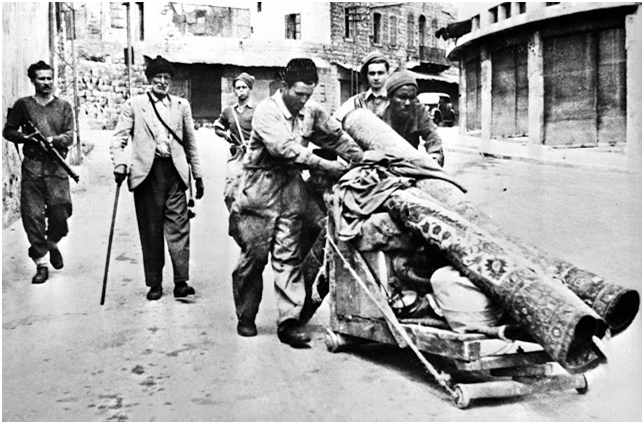
Haganah terrorists expelling Palestinian refugees from Haifa
Israel is a state that has been built on myths – whether it is that ‘god’ gave the settlers the land of the Palestinians or the fiction that in 1948, the Palestinians miraculously ran away on the orders of the Arab states in order that a Jewish state could be created. As Ilan Pappe, Benny Morris and other historians have demonstrated, the Palestinians left because they were forced to do so.

I have previously covered the topic of the desperate efforts of the Israeli state to prevent the truth emerging. This has taken the form of reclassifying documents that have been released to historians, presumably on the assumption that they were not copied and therefore any one quoting from them can’t prove that what they said is true.
At the end of this article in Ha’aretz, Adam Raz quotes the cynical comments of Yehiel Horev, the former director of the Malmab, the secretive Defence Ministry unit which is dedicated to rewriting the history of the Israeli military’s deeds. In an interview he made his purposes crystal clear:
“When the state imposes confidentiality, the published work is weakened… If someone writes that the horse is black, if the horse isn’t outside the barn, you can’t prove that it’s really black.”
Of course all nations based their identity on myths such as the tales of King Arthur and his knights. Israel’s national myths are not just about ancient tales of kings but about recent events where the evidence is crystal clear.  Myths that are national lies with the sole purpose of legitimising the theft of land.
Before and after - the Palestinian Al Hambra cinema in 1937 and today a Church of Scientology centre

From 1949 to 1966 Israel’s Arab population was kept under military government. They could not leave their villages without permission. As is the case with everything in Israel the excuse was that the Arabs were a fifth column, a security threat.
We now know, as the article by Adam Raz explains, that this was never true and was not believed by the military establishment either. The purpose of military rule was in order to prevent Israel’s Arabs, who had often been displaced by the fighting from their villages, from returning to their land.
A law, the Absentee Property Law was passed in 1950 with the specific purpose of defining the property of persons who were expelled, fled or left the country after 29 November 1947 as well as their property (land, houses, bank accounts etc.), as “absentees”.
Property belonging to absentees was placed under the control of the Custodian for Absentees’ Property. The Absentees’ Property Law 1950 was the main legal instrument used by Israel to take possession of the land belonging to the internal and external Palestinian refugees.
Zionists loot a sofa from a Palestinian house (left) and today (right)

An Orwellian category Present-Absentees was created. You could be present in Israel, having not been expelled, and still be absent.  Even if you left your house in 1948 because of the fighting or you were forced out by the Haganah you are still counted as an Internally Displaced Person. Of course Israeli Jews who were forced to leave their homes face no such prohibition.
It is estimated today that 1 in 4 Israeli Palestinians are Internally Displaced Persons. That lies at the root of inequality in Israel, an inequality emphasised by the Jewish Nation State Law that made ‘Jewish settlement’ into a national virtue.
IDPs are not permitted to live in the homes they formerly lived in, even if they were in the same area, the property still exists, and they can show that they own it. [Tom Segev, 1949: The First Israelis, pp. 68-91].
However it was one thing to pass a racist law but it was another thing to implement that law. Israeli Palestinians desired nothing more than to return to where they were living but for Zionism, all wings of the Zionist movement including the ‘left’ Mapam, it was an article of faith that no Palestinian should ever return to their home even if they only moved a mile away for safety.
Thus it was that military rule was instituted over Israel’s Palestinian population.  By forbidding them to leave their villages without permission it made it that much easier to prevent unauthorised access to their previous homes. This was necessary because although Zionist settlers moved into their former villages this took time, not least because at that time there weren’t enough Zionist settlers.
Thus Israel was born in a fit of ethnic cleansing and today the job of Malmad and the Ministry of Defence is to keep documents of the time secret and hidden and to perpetuate the myth that the Palestinian refugees left of their own accord.
Tony Greenstein
A document unsealed after 60 years reveals the Israeli government’s secret intentions behind the imposition of a military government on the country’s Arab citizens in 1948: not to enhance security but to ensure Jewish control of the land
Jan 31, 2020 11:50 AM

Arabs awaiting a security check in Kfar Qasem, during the War of Independence.GPO


Israel’s defense establishment has for years endeavored to conceal historical documentation in various archives around the country, as was revealed in an article in Haaretz last July.
That article, which followed up on a study by the Akevot Institute for Israeli-Palestinian Conflict Research, noted that for closed to 20 years, the staff at Malmab – the Defense Ministry’s secretive security department (the name is a Hebrew acronym for “director of security of the defense establishment”) – had been visiting public and private archives and forcing their directors to mothball documents relating to Israeli history, with special emphasis on the Arab-Israeli conflict. This was done without legal authority. The article sparked a furor, and dozens of researchers and historians urged the defense minister at the time, Benjamin Netanyahu, to halt the clandestine illegal activity. Their appeal received no response.
When the state imposes confidentiality, the published work is weakened… If someone writes that the horse is black, if the horse isn’t outside the barn, you can’t prove that it’s really black.
What sort of documents did Malmab order the directors to hide away in their archives’ safes? The many and varied examples include: thick files kept by the military government under which Israel’s Arab citizens lived for 18 years; testimony about the looting and destruction of Arab villages during the Independence War; cabinet ministers’ comments on the Arab refugee situation, following that war; evidence of acts of expulsion and testimony about camps set up for captives; information about Israel’s nuclear project; documents relating to various foreign policy issues; and even a letter sent by the poet and Holocaust survivor Abba Kovner about his own anti-Arab sentiments.
It’s not clear whether Malmab has reduced its activity in the archives since the article was published. However, it can be said that during the past six months, files earlier ordered closed by Malmab have been reopened, adding to our knowledge of the history of the two peoples who share this land. Though none are earth-shattering in historical significance, these are important documents that shed light on significant aspects of various events.
One such document is a secret codicil to a report drawn up by the government-appointed Ratner Committee in early 1956. The document, restored from oblivion in a safe at the Yad Yaari Research and Documentation Center at Givat Haviva, is titled, “Security Settlement and the Land Question.”
The importance of the information included in the codicil can be seen within the context of the history of the military government imposed on Israel’s Arabs in 1948, just months after independence, and abolished only in 1966. There were about 156,000 Arabs in Israel at the war’s end. Following the armistice agreement with Jordan (April 1949) and the annexation of the Triangle – a concentration of Arab locales in central Israel – 27 villages, from Kafr Qasem in the south to Umm al-Fahm in the north, also fell under the jurisdiction of the military government.
Administratively, the latter was divided into three regions: north, center (Triangle) and Negev. Sixty percent of Israel’s Arab citizens lived in Galilee, 20 percent in the Triangle and the rest in the Negev and in various so-called mixed cities, such as Haifa and Acre. In practice, about 85 percent of all Arab citizens were under the rule of the military government, subject to night-time curfews and regulations requiring them to obtain a travel permit before leaving their area of residence.
Related Articles
The military government was based on the Defense (Emergency) Regulations, promulgated in 1945 by British mandatory authorities, and invoked by Israel to facilitate supervision of the movement and settlement of its Arab citizens, and to prevent their return to the areas captured by Jewish forces in the Independence War. The Jewish public was told that the purpose of the military government was to deter hostile actions against the state by its Arab citizens. In practice, however, it only exacerbated the enmity between the two peoples.
The secret addendum. Described the military government as a tool in the struggle against Arab "trespassers.

The military government, an ugly episode in Israeli history, was the subject of severe criticism at the time, not least by certain members of the Jewish community. Various parties on both the left and the right – Ahdut Ha’avodah, Mapam, the Communist Party and Herut (precursor of Likud) – objected, each for its own reasons, to its imposition. One reason for the opposition was that, as early as the early 1950s, the Shin Bet security service had concluded that the country’s Arab citizens did not pose any sort of security risk.
Opinion was also divided in Mapai, the ruling party (precursor of Labor). The state committee that was headed by Prof. Yohanan Ratner, a retired general and architect, was the second body appointed to consider whether the military government was necessary. The first, convened by Prime Minister David Ben-Gurion, in 1949, had decided to leave the status quo in place. In February 1956, the three members of the Ratner Committee reached the unanimous conclusion that
“the military government has been reduced as much as it can be, and there is no place for a further reduction.”
That this was probably a foregone conclusion is attested to by a remark made in public by a member of that panel, Daniel Auster (mayor of Jerusalem until 1950):
“Of 200,000 Arabs and other minorities now residing in Israel, we did not find one who is loyal to the state.”
Secret action
A few years later, in the early 1960s, when pressure mounted to abolish the military government, Ben-Gurion explained that it was still essential in order to prevent an insurrection by the country’s Arabs. The state’s existence depends on the presence of the military government, he maintained, although he did not mention the opposition to it of the security establishment. However, it gradually became clear that what truly interested the advocates of the government was not security but control over land. That had been facilitated by Article 125 of the Defense (Emergency) Regulations (1945), under which a military commander can issue an order to close “any area or place.”
In a closed meeting of the Mapai leadership, in 1962, Ben-Gurion stated that without article 125, “we would not have been able to do what we did” in the Negev and Galilee. “Northern Galilee is Judenrein [empty of Jews],” he warned.
“We will find ourselves in that situation for many years if we do not prevent – by means of Article 125, by administrative force and military force – entry into forbidden areas. And in the eyes of the Arabs these forbidden areas are theirs. Because the land of Ayalon [Valley] is Arab land.”
Despite the inherent logic of this argument, few testimonies exist about the military government’s latent nationalist motivations. For one thing, there was a tacit understanding, rarely violated, that this was not a subject for public discussion. The secret appendix to the Ratner Committee’s report, found in the Yaari Archives and in the State Archives, and being published here for the first time, is highly illuminating about the true motives that guided the country’s leaders.
According to the panel, the army alone could not safeguard state lands: only Jewish settlement – “security settlement,” as it was called – could do that in the long run. It was thus essential to establish Jewish settlements in the three geographical zones overseen by the military government. Such a process, however, would be lengthy, the committee members agreed, and in the meantime Arab citizens uprooted in the war wanted to return to their homes – something that could not be prevented through legislation. In the view of the codicil’s framers,
 “The laxness [by the Arabs] in seizing these areas is due mainly to the fact these areas were closed by the military government or under its supervision.”
They added that only
“the vigilance of the military government’s representatives largely prevented more serious lawlessness in regard to land seizure.”
In other words, it was that government that prevented the Arabs from returning to their lands.
The report’s authors also objected to a decision made by Pinhas Lavon, a senior Mapai figure who opposed the military government and who replaced Ben-Gurion as defence minister in early 1954 (but resigned a year later during the so-called Lavon affair, which involved a covert operation in Egypt that went wrong). Lavon cancelled the prior decision to divide Galilee into 46 separate, closed areas in which Arabs needed a permit to move from one to another. A division into three or four zones would be enough, to his mind, and would ease life for Arab citizens. The committee members were adamantly against this, arguing that it had led to excessively free movement by the Arabs, because of which “the takeover of the state’s lands increased.”
The Ratner Committee exceeded the official mandate it received upon its appointment in late 1955. Its secret codicil also includes detailed recommendations for amending property laws, particularly an Ottoman statute from 1858. The latter stipulated that anyone, Jew or Arab, who resided on land for 10 years consecutively, was entitled to retain it permanently. Now, eight years after Israel’s founding, the committee was worried that within two years, much land would be lost and transferred to Arab citizens. Its recommendation, then, was to abolish the time frame in regard to remaining on these lands.
The text of the secret codicil shows unequivocally that a major task of the military government was to act as a means to control the state’s lands until their permanent status could be regularised and until, with state support, Jewish settlement could begin in formerly Arab areas. Hence, one of the committee’s conclusions:
“Until the stabilisation of security settlement in the few reserve areas that can still be settled, it is essential to maintain the military government in these places and to strengthen its apparatus… so that the military government can ensure, directly and indirectly, that the lands are not lost to the state.”
The panel described the military government as a tool in the struggle against Arab “trespassers,” and added that without the military government, “many more areas are liable to be lost to the state.” In a reprimand to the state, the committee noted that the military government was suffering from “known laxness… as a result of the criticism being levelled at it.”
Published in part at the time (without the secret section), the Ratner Committee’s recommendations provoked considerable public and governmental criticism. Ben-Gurion, who received a copy of the report in February 1956, blocked discussion of it for months because of disagreements within the government. The Sinai War, which erupted in October 1956, meant that it stayed off the agenda for an even longer period. Ultimately, the report was never submitted to the government for approval, but nevertheless served as the basis for policy in the coming years. In 1958, another committee, headed by Justice Minister Pinhas Rosen, suggested far-reaching changes in the military government, effectively proposing its almost total abolition. Not surprisingly, the cabinet held lengthy discussions in 1959 about whether to publish the recommendations of the Rosen committee.
Why did the state continue to conceal a report that was written more than six decades ago? The explanation might lie in a cabinet session in July 1959, in which Education Minister Zalman Aranne stated that “among the conclusions are some that are political.” In other words, security had nothing to do with it. He added,
 “The thing must be done, but not revealed, such as Judaizing Galilee, for example.”
Perhaps it’s appropriate here to recall the words of Yehiel Horev, the former director of the Malmab, who admitted in an interview to Haaretz last July that the defense establishment is simply trying to hamper historians.
“When the state imposes confidentiality, the published work is weakened… If someone writes that the horse is black, if the horse isn’t outside the barn, you can’t prove that it’s really black.”
Adam Raz, a historian, is a researcher at the Akevot Institute for Israeli-Palestinian Conflict Research and author of the book “Kafr Qasem Massacre: A Political Biography,” published in both Hebrew and Arabic.

18 April 2017

Land Apartheid in Israel - Knesset Votes for New Bill to Demolish Arab Homes and Villages

Israeli Arabs are 20% of the population yet they occupy 2½%  of the land

Israeli policemen stand guard as bulldozers demolish homes in the unrecognized Bedouin village of Umm al-Hiran in the Negev desert, on January 18, 2017. (AFP Photo/Menahem Kahana)
You might think that a new Bill to prevent building contrary to the planning laws of Israel might be uncontroversial.  After all you can’t have everyone building where they want to.  It is a principle that should be uncontroversial.  However in Israel it represents another attack on Israel’s Palestinians.
As Ha’aretz notes, some 97% of house demolitions in Israel are of Arab houses.  In the occupied territories settlers can build where they want and when they want, whereas unauthorised Palestinian buildings are regularly demolished.

The backdrop to this is the fact that 20% of Israel’s population, its Arab citizens live in just 2.5% of the land.  It is the same percentage as pertained in 1948 after the expulsion of ¾ million Palestinians.  At that time the Arab population was 150,000.  Now it is 1.5 million  Not one new Arab town has been established.  Israeli planners regularly, almost as a matter of course, deny Arabs the right to construct new buildings or even build extensions to their houses.

That is why there is a massive crisis in the Arab housing sector which the State is helping to intensify.  This Bill heralds another racist attack on Israel’s 20% Arab minority under the guise of enforcing the law.
Bedouins cry following the destruction of houses on January 18, 2017 in the Bedouin village of Umm al-Hiran. (AFP/ MENAHEM KAHANA)
Couple this with racist legislation such as the Access to Communities Act which allows hundreds of existing Jewish villages and settlements to deny access to Arabs on ‘social’ grounds and then you see how Israel reinforces discrimination against its Arab citizens.

In addition half the existing Arab villages are ‘unrecognised’.  Like Umm al Hiran which was recently demolished, they live under the threat that police bulldozers will come in and demolish peoples’ homes and all their possessions.  There isn’t one Jewish village or town in Israel which is ‘unrecognised’.  Being ‘unrecognised’ means having no running water, sewerage facilities or electricity.  Literally may Israel’s Palestinian citizens live in the dark age compared to Israel’s Jews. 
This is what Apartheid in the Israeli state means in practice.

Tony Greenstein

Editorial: Construction, Not Destruction

 While Israeli Arabs constitute 20 percent of the population, Arab communities’ jurisdictions occupy just 2.5 percent of the state’s land area, and the process of approving new construction in Arab towns takes decades.

Haaretz Editorial Apr 04, 2017 3:26 AM

A demolished building in Kalansua, January 10, 2017. Moti Milrod
The Knesset will be convening tomorrow for a special recess session to hold the final votes on a bill that would boost enforcement and penalties for building without a permit. The bill increases the maximum sentence for building violations to three years, does not distinguish between building violations committed for profit and those committed for lack of an alternative, and limits the role that judgment and court intervention can play while enhancing the authority of the Finance Ministry unit that enforces construction laws. This favors the administrative track over a system of checks and balances.

The bill, initiated by the Justice Ministry, doesn’t explicitly say that it’s aimed at the Arab public in Israel, but it’s clear to all that its consequences will primarily affect Arab communities. Between 2012 and 2014, 97 percent of the administrative demolition orders were issued against structures in these communities. Moreover, the bill is being promoted by a government that is pleased to pass discriminatory legislation like the muezzin law, the expropriation law, the impeachment law and the cultural loyalty law.
Arab Joint List leader MK Ayman Odeh was injured during a protest against house demolitions in the Negev town of Umm al-Hiran on January 18, 2017. Here he is holding the sponge-tipped bullet that he said injured him. (Courtesy/Arab Joint List) 
No one disputes that illegal construction must be dealt with, that all Israeli citizens are meant to obey the law and that the bill is worded in a totally professional manner. However, the bill should not be passed at this stage because it deals solely with enforcement, without providing a solution for the essential problem – a housing crisis in Arab communities – and without recognizing plans being put into place.

Moreover, in the past the government has established that the funding for implementation of this law will be taken from the budget designated for the development of Arab communities. This looks suspiciously as if the bill is aimed at intensifying the abuse of the Arab population and continuing the government’s incitement policy against it.

Yaqoub Mousa Abu al-Qia’an - Arab schoolteacher murdered by Israeli police at Umm al Hiran(Courtesy)
If the Justice Ministry was really interested in solving the problem of illegal construction, it would implement those master plans for Arab communities that have already been approved, expedite the approval of those that have yet to be approved, increase the number of planning committees dealing with these communities, and only afterward declare an enforcement crackdown.

While Israeli Arabs constitute 20 percent of the population, Arab communities’ jurisdictions occupy just 2.5 percent of the state’s land area, and the process of approving new construction in Arab towns takes decades. The combination of these things and the lack of any workable alternatives cause a housing crunch and expand the scope of illegal construction. This bill does not seek to solve the problem, but merely to make life more difficult for an already distressed population.

The above article is Haaretz's lead editorial, as published in the Hebrew and English newspapers in Israel.

Israel wants to build a Jewish only town in place of a Bedouin village [Anadolu]


Police Raid Arab-Israeli Neighborhood, Injure Residents

(Jerusalem) - Israel should immediately cease the discriminatory demolition of homes belonging to Palestinian citizens of Israel, Human Rights Watch said today. Israel should ensure equal treatment in planning and zoning procedures for its non-Jewish citizens, and carry out demolitions only as a last resort along with compensation or alternative housing arrangements.

A daughter of Yaqoub Mousa Abu Al-Qia’an, who police say killed an officer on January 18th in Umm il-Hiran, stands among the rubble of her home. Police had destroyed her home that morning. (Credit: Dov Lieber / Times of Israel)
"Israeli authorities allow buildings that will benefit Jewish citizens while demolishing Arab houses next door," said Sarah Leah Whitson, Middle East director at Human Rights Watch. "That obviously discriminates against non-Jewish Israelis, but officials haven't given any justification for this clear difference in treatment between citizens."

On December 13, 2010, Israel Land Administration inspectors and Israeli police demolished six homes belonging to Palestinian citizens of Israel in the Abu Tuk neighborhood of Lod, a city near Tel Aviv, displacing 67 members of the extended Abu Eid family, 27 of them children. On March 2, 2011, Israeli police entered the same neighborhood and destroyed the bases for two prefabricated homes the family had planned to erect there; displaced family members are currently staying with neighbors or living in tents. Israeli authorities say the homes lack building permits, but repeatedly refused to grant such permits; they argue that the land is zoned as "agricultural" rather than "residential" but have refused to re-classify the land as residential.

Arab Israelis hold protest banners against the demolition of homes in the unrecognized Bedouin village of Umm al-Hiran, January 19, 2016. (Courtesy)
However, Israeli authorities recently rezoned land adjacent to the demolished site from agricultural to residential land, and are planning a housing development there for Israeli security service personnel. Plans for a Jewish religious college have been approved on another nearby site.

Thirty percent of the 70,000 residents of Lod are Palestinian Arabs, according to Israeli government statistics. While official figures are not readily available, more than 70 percent of Palestinian Arab homes in Lod and the nearby city of Ramle have no legal status, according to a project on Israeli cities with mixed populations run by Shatil, an Israeli nongovernmental group.

Hundreds of homes in Lod are under immediate demolition orders, virtually all of them in Palestinian Arab neighborhoods, according to the Shatil project. In addition, approximately 1,600 housing units in Lod are currently designated as "illegal," and thus subject to demolition orders, because they lack proper building permits, according to a government statement.

According to residents who are Palestinian Arab citizens of Israel, however, planning authorities repeatedly rejected their applications for permits. Israeli planning authorities by contrast recently approved plans for a seven-hectare campus for a Jewish religious college immediately beside the demolished area.

Israelis attend a protest against the recent demolition of Bedouin homes in the village of Umm al-Hiran outside the Prime Minister’s office in Jerusalem on January 18, 2017. (Yonatan Sindel/FLASH90)
Israeli officials have explained that Arab-Israeli homes have been destroyed on the basis that they lacked permits, but that raises the issue of who is being granted permits. Human Rights Watch is not aware that Israeli officials have justified why Arab-Israelis have a harder time obtaining building permits or access to residential planning solutions in general.

Approximately 500 police officers arrived in the Abu Tuk neighborhood at 8 a.m. on a rainy December 13 and evicted the residents of six buildings before demolishing them. The independent Palestinian Ma'an news agency described one case in which armed police broke down a door and "pointed their rifles" at a brother and sister aged 11 and 12 and told them, "Don't move," before forcing them outside. Other residents told Human Rights Watch that the police did not allow them to save their possessions before demolishing their homes.

The families, after salvaging some belongings from the rubble, pitched five tents that they bought with donations, and placed a sign over their plot that read, "Abu Eid Refugee Camp." For three months, male members of the family, about 30 people, have been living in five tents on the ruins of their former houses, while the women have been staying with neighbors.

The families had been planning to erect two small, prefabricated homes, but on March 2, around 200 police destroyed the homes' bases and clashed with residents, injuring several. Kawser Abu Eid, a 39-year-old mother of five whose home was one of the six demolished in December, told Human Rights Watch that three of her children were home during the March demolitions, and that her 12-year-old son was hospitalized with a leg injury. A female neighbor's arm was broken when she tried to protect the boy, witnesses told Human Rights Watch. A police spokesperson told Human Rights Watch that no police forces were injured.

Police arrested four members of the Abu Eid family and one neighbor for resisting the evictions. They were released the next day under conditions of house arrest. Israeli civil society workers who were following the case told Human Rights Watch that they were not sure how the authorities would enforce the house arrest order, since the residents' homes had already been destroyed.

According to residents, the family complained about the December demolitions to Brigadier General (res.) Ilan Harari, who until February 2011 served as the head of Lod's municipality, and who agreed to write to the Welfare Ministry, the Housing Ministry, and the Israel Land Administration requesting assistance for the families. Human Rights Watch does not know whether the letters were sent. To date, the residents say, they have received no assistance.

"My kids have no home; they can't study under these conditions," Kawser Abu Eid said. "The head of the municipality promised to care for us months ago, but nothing has happened."

Israeli planning authorities have approved residential and educational building projects intended to benefit primarily Jewish Israelis on sites next to the demolished homes. In 2008 Israeli authorities began rezoning agricultural land for residential construction in the next-door Jewish neighborhood of Ganei Aviv, according to the Israel Land Administration. An October 2010 government decision urges other government agencies to complete plans for the neighborhood within six months, and directs that the land be allocated for housing for Israeli military and other security service personnel.
Directly beside the demolished homes, Israeli authorities have approved plans for a 7-hectare yeshiva (religious college) that will, according to the Lod Municipality website, "bring thousands of religious students and families to Lod." Harari said that this college will bring in "high-quality residents." On October 7, Minister of Interior Eli Yishai told Israeli media that "the thing that will help the city of Lod will be bringing another 50,000 Jews there. That's what will save and keep the city, I don't have another solution." The 50-million shekel project will be located on land previously designated as a "public open space." The Lod city council unanimously approved the allocation of the land to the yeshiva, the Lod Municipality stated.

"When it comes to housing rights in Lod, Israeli officials seem to have one rule for Palestinian citizens, another for Jewish citizens," said Whitson. "That kind of discrimination has been rejected the world over."

Members of the Abu Eid family told Human Rights Watch that they had been living in the houses in Lod since the 1950s, after Israeli authorities evicted them from their original homes in the Hula Valley region in northern Israel.

The Abu Eid family had been leasing land in Lod from the state of Israel, which controls 93 percent of the country's land and in most cases does not sell land but leases lots for 49 or 98 years. The land in question was zoned as an agricultural rather than residential area, a designation that restricted the permissible size and density of homes. Human Rights Watch has documented that Jewish towns and neighborhoods in the Lod area were also originally zoned for agricultural use, but authorities rezoned that land to allow residential construction.

Israeli planning authorities denied the Palestinian residents' repeated requests to re-zone the area to permit residential building. As a result, the structures that residents built lacked permits and were deemed "illegal." The Israel Land Administration first issued an eviction order against the homes in 2002. In 2010 the family lost a prolonged legal struggle when the Ramle Magistrate's Court rejected their appeal against the demolition orders, finding that the homes were built illegally on agricultural land.

In addition to the Abu Eid family, another 45 Arab-Israelis with homes in the same area received notices that authorities would bulldoze their houses by the end of 2010. Authorities demolished two Arab homes in the same neighborhood in October.

Israeli law requires the owners of demolished homes to pay the municipality for the cost of the demolition or face a criminal sentence, including imprisonment. Faced with this threat, some Palestinian Arab residents in Lod have demolished their own homes.

In October 2010 the government passed a large "emergency assistance" plan meant to "strengthen and develop the city of Lod," according to the prime minister's office. A quarter of the funds for that plan, 40 million shekels (US$11 million), will be used to create an "eviction authority" for "enforcement regarding illegal construction" for the next two years, with the possibility of an additional 10 million shekels in case of need. By contrast, the decision allocated only 3 million shekels (US $830,000) for projects that "advance" the Palestinian Arab community in the city, and even this part of the plan does not mention new building projects. The plan does indicate that authorities will re-zone an Arab neighborhood of Lod, Pardes Snir, from agricultural to residential, and construct housing units there, but notes that many existing Arab-owned buildings will first have to be demolished.

Throughout Israel, tens of thousands of Palestinian Arab homes lack required permits and are at risk of demolition. Israeli authorities demolished 165 houses belonging to Palestinian citizens of Israel across the country in 2009, according to the Arab Center for Alternative Planning, an Israeli nongovernmental organization. Human Rights Watch has reported on discriminatory planning procedures in the unrecognized Arab-Israeli community of Dahmash, near Lod.