The ‘Liberal’ Establishment –
from the Guardian to Liberty - has averted its eyes as the Police
Raid & Arrest Dissident Journalists & Palestine Solidarity Activists
Natalie Strecker, a pacifist based in Jersey,
is the latest activist to be arrested by the Police on their favourite pretext,
supporting a proscribed organisation contrary to s.12(1A) of the Terrorism Act
2000. It’s called the ‘rule of law’.
The Jersey Post has more courage and integrity than the 'liberal' Guardian when it comes to Police attacks on activists
Since October 7 the Police have been very busy
trying to take out key Palestine solidarity activists. Electronic Intifada journalist Asa Winstanley had his house raided
and his electronic devices stolen by the Police a few weeks ago. Asa wasn’t
actually arrested but this gives a clue to the Police’s motivation. Stopping
the publication of alternative news. They prefer the ‘reliable’ media to be our
sole source of news – from the BBC to
the Guardian to the Daily Mail.
Sarah Wilkinson Interview
Sarah Wilkinson was also arrested recently by
Police thugs in balaclavas, who stole her passport, without even telling her,
whilst making it a condition of bail that she surrender it. They stole her
money, overturned her grandmother’s urn of ashes, hid her bank cards and trashed
her house. She was forbidden to even use a phone until the police were forced
to withdraw the bail conditions.
Palestine Action, a direct action group
committed to putting Elbit and other suppliers of arms to Israel have been the
victim of extreme repression with the Filton 10 being held until their trial in
a year’s time for doing what the Police should be doing, which is stopping the
activities of those contributing towards genocide in Palestine.
Only today
we hear that another 10 Palestine Action activists have been arrested.
But there is one law that the Police have ignored
- the International
Criminal Court Act 2001 - which makes being party to and aiding in the
commission of war crimes and genocide a criminal act. We can’t imagine why they
are not interested in enforcing this Act!
Sections 52 and 53 make it quite clear that genocide
and acts ancilliary to genocide, whether committed in this country or abroad,
will be treated as committed in this country.
Proceedings will only be initiated by the Attorney
General but I’m sure Richard Hermer wouldn’t want to be seen to be endorsing acts ancilliary
to genocide by his colleagues, such as supplying spare parts for aircraft that
bomb civilians!
I’ve been arrested twice in the past 12
months. Firstly on December 20 2023 when my flat was raided and all my
electronic devices were stolen. The second time was at the picket of notorious
racist, Israeli Ambassador
Tzipi Hotoveli’s residence when I compared Israel’s actions in Gaza to
those of the Nazis. My ‘offence’ was ‘racially aggravated harassment’ of a
Zionist, Richard Millett, the sole Zionist counter-demonstrator, who has called
holocaust survivor Stephen Kapos ‘scum’ for opposing Israel’s genocide.
There are no known examples of the Police
arresting Zionist demonstrators for violence, genocidal speech or racism.
Police harassment is strictly in one direction only.
I was recently informed that I was not being
charged, making my arrest and detention unlawful. A couple of weeks after my
arrest 79 year-old Israeli ProfessorHaim Bresheeth, who is suffering from cancer, was arrested at the same
spot and held all night in a cold cell inHolborn police station. He too has been told that he is not going to be
charged. Another unlawful arrest and detention.
Richard Medhurst, another journalist, was
stopped at an airport, detained, arrested and held in abysmal conditions and
again all his electronic devices were stolen.
Others arrested under the same pretexts
include Richard Barnard, an activist in Palestine Action.
Thomas
Bingham, former Master of the Rolls, Lord Chief Justice and Senior Law
Lord, was described
as ‘the greatest jurist of our time’ by
Lord Hope of Craighead. Bingham formulated 8 rules of law in his book The
rule of law. A number of them are applicable to the present, cavalier
disregard of the law by the Police in their attempt to ride roughshod over our
rights and to suppress political dissent.
The most important for our purposes is the
eighth rule – which states that
The rule of law requires compliance by the
state with its obligations in international law as in national law.
Britain is party to the Genocide
Convention which therefore makes it part of British law but for the police
it is a no-go area.They are not
interested in enforcing provisions of international law that have been
incorporated in domestic law. Bear in mind the third of Bingham’s rules of law:
‘The laws of the land should apply equally to all’. It is clear that
there is one law for activists and another for government politicians and war criminals
like Starmer and Lammy.
Article 2 (a)-(d) of the Genocide Convention makes
it crystal clear that Israel’s behaviour in Gaza is a classic example of
genocide. Only the fifth provision, the forcible transfer of children out of
the area is inapplicable, because Israel prefers to kill Palestinian children
to transferring them out of harms way.
The fifth provision also makes it clear that
genocide can take place without anyone being killed so our idiot of a Foreign
Secretary, David Lammy’s assertion, that not enough people have been killed for
it to be a genocide, is simply wrong. Starmer’s denial of a genocide is more
sinister. He knows full well that what is happening in Gaza is a genocide.Starmer is no different from a neo-Nazi holocaust
denier.
It is no surprise that the Guardian has failed to cover the
continued series of raids that have taken place. What is more surprising is
that Liberty, the old National Council
for Civil Liberties, has not responded to our invitation to provide a speaker.
It is as if all the erstwhile liberals have hauled up the White Flag and surrendered
to the security state.
(1)The law must be accessible and so far as
possible intelligible, clear and predictable.
(2) Questions
of legal right and liability should ordinarily be resolved by application of
the law and not the exercise of discretion.
(3) The laws of the land should apply equally
to all, save to the extent that objective differences justify differentiation.
(4) Ministers
and public officers at all levels must exercise the powers conferred on them in
good faith, fairly, for the purpose for which the powers were conferred,
without exceeding the limits of such powers and not unreasonably.
(5) The law must afford adequate protection of
fundamental human rights.
(6) Means
must be provided for resolving, without prohibitive cost or inordinate delay,
bona fide civil disputes which the parties themselves are unable to resolve.
(7)
The adjudicative procedures provided by the state should be fair.
(8) The rule of law requires compliance by the
state with its obligations in international law as in national law.
In the
parliamentary debate in the House of Lords’s Constitution Committee, former
Attorney-General 2010-14, Dominic
Grieve KC, said the rule of law encompasses:
“the system of rules that we have
in our country to ensure that the decisions we make and the way the Executive
and, ultimately, individuals, organisations and institutions behave are subject
to the law—both our own domestic law and international law—and that the
processes by which the law can be applied work.48
David Gauke,
Lord Chancellor 2018–19 stated that the rule of law means:
“the … sense that the law applies
equally to everyone, that no one is above the law and, in particular, that the
Government must comply with the law.”49
Lord Keen of
Elie KC, Advocate General for Scotland 2015–20 s said:
“that all institutions and parties
should be equal before the law and subject to the law, that the law should be
publicly available, and they should be capable of ascertaining what their
rights and obligations are thereunder … It extends not just to domestic law but
to the sphere of international law.”50
It is clear that the actions of the Police and
the refusal of the present Attorney General Lord Richard Hermer KC
to take any action in regard to the enforcement of Britain’s legal obligations to
oppose genocide make a mockery of the Attorney General’s position as an
independent legal adviser to the government.
This is not surprising since Hermer was
appointed by Starmer to advise the government
on compliance with the law.It’s not
often that a poacher appoints the gamekeeper! The same contradictions occurred
in 2003 when the then Attorney General, Lord Goldsmith, completely
changed his position on the legality of the invasion of Iraq under
political pressure.
Richard Hermer has also bucked under the
pressure and is now openly condoning the refusal of the government to ban arms
sales to Israel even though they are contributing to the ongoing genocide.
One thing is for sure. We are not going to be cowed
by this Police State repression whilst genocide in going on in Gaza. We
understand full well the role that the Police have in backing Starmer’s policy of
giving 100% support to Genocide Joe Biden and Killer Kamala. That is why we are
holding a meeting on the arrests this Friday.Please come along.
We should not forget that Democratic Rights were
Won in the Teeth of Opposition by a Reactionary Judiciary
Contempt For Justice
Today in Britain we
have an unpopular Government and an almost equally unpopular Opposition, both
of which agree on the need to curtail democratic rights and direct action. As
environmental disaster beckons, we have a government intent on ramping up carbon
emissions by approving
of new oil fields in the North Sea.
Their answer to direct
action protests is not to change course but to attack the right to protest. The
judiciary, which likes to think of itself as independent, has joined forces
with the Executive.
As groups like Extinction Rebellion, Climate Action and Just Stop Oil take direct action in response to the climate crisis,
the government, in hock as it is to the oil industry, has resorted to
repression.
This legislation was preceded
by the Overseas Operations
Bill which made it much
harder to prosecute British personnel for serious crimes –
including torture – overseas as well as the Covert Human Intelligence Sources
(Criminal Conduct) Bill (Spycops
Bill) which was even
more abhorrent. It granted a host of state agencies
the power to commit grave crimes with legal immunity. This is a giant leap forward
to a police state yet British judges have remained silent.
There was a time, in
the 1990s and 2000s when a succession of liberal judges presided over the
Supreme Court and as Lord Chief Justice such as Thomas Bingham, described
as ‘the greatest jurist of our time’,
Lord
Taylor who presided over theHillsborough DisasterInquiry
and uncovered Police malfeasance, Lord Steyn, Baroness
Haleand Stephen
Sedley. It is perhaps no accident that Taylor, Sedley and Steyn were
Jewish.
Today we have seen a
return to a reactionary judiciary under Lord
Reed, President of the Supreme Court and the execrable LordBurnett who presided
over the Assange hearing.
IfBurnett had any integrity he would have
recused himself from the Assange case since he is a close friend of former
Minister Alan Duncan, who described
Assange as a “miserable little worm”.
Assange is a litmus
test for the judiciary. He has been imprisoned for four years, without charge because
of an extradition request from the United States. His only offence being to reveal
multiple war crimes.
The Supreme Court’s shameful
decision on Shamima Begum, which was contrary to international law on
statelessness was one indication of the new ‘security minded’court.In another decision, where two mothers challenged the government’s
decision to restrict tax credits and universal credit to two children, Reed
went out of his way to attack those bringing the action.
Nicholas Reed Langen lamented
the “trend towards deference.” This
is the political backcloth to the attack of government and judges on the right
to protest. This increasing judicial reaction occurred as juries have been
returning what the Right see as authorities are ‘perverse verdicts’ of‘not guilty’ against direct action protesters.
The Establishment was
outraged by a Bristol jury which acquitted
those who dumped the statue of Edward
Colston, a mass murderer and slave trader, into Bristol harbour. The
government sought ‘clarification’ from the Court of Appeal as to whether
defendants could cite human rights in their defence in a case of criminal
damage.
One wonders whether
the judges would have approved of a statue of Hitler being erected in Golder’s
Green yet the Court of Appeal found
that human rights defences should only be considered by courts in
protest-related cases if the damage is ‘minor’ and ‘low-value’. It thus put a
threshold on when people can enact their human rights.
The affront to Black
British citizens never crossed the minds of these miserable judicial wretches
who knew the price of everything and the value of nothing. The courts have
always prioritised the needs of property over people. It was another
reactionary judge Lord Denning who ruled
in LB Southwark v Williams that
“necessity
would open a door which no man could shut…If hunger were once allowed to be an
excuse for stealing the plea would be an excuse for all sorts of wrong doing.
The courts must take a firm stand.”
The ruling by the Court of Appeal found expression in the
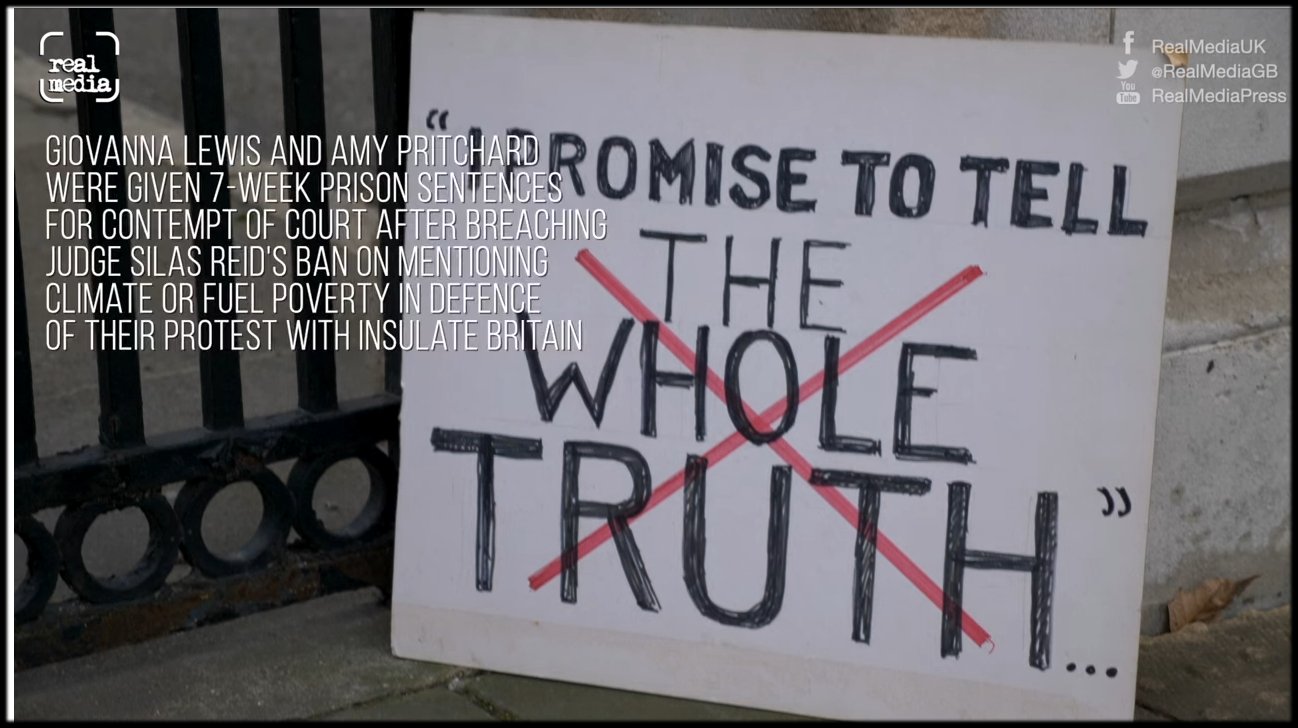
decision of Judge Silas Reid in climate change cases to gaol for contempt
defendants who mentioned why they took direct action. This has meant that
people are unable to put forward any defence and is clearly contrary to Article 6 of the European Convention of Human Rights:
In
the determination of his civil rights and obligations or of any criminal charge against him, everyone is entitled
to a fair and public hearing within a reasonable time by an
independent and impartial tribunal established by law.
It is also contrary to Article 50
of the EU Charter of Fundamental Rights,
the right not to be tried or punished twice in criminal proceedings for the
same offence.
It is or should be obvious
to all except the most narrow minded judge that if you can’t say why you are
innocent the trial must be unfair. None of this is surprising since the history
of British justice is a history of conflict between protest and a reactionary judiciary.
In Fascist
Judges Craig Murray described how in Irmtrud Wojak’s biography of Fritz Bauer, a concentration camp
survivor who became the most important prosecutor of the Nazis in Germany,
Bauer detailed how the Nazis didn’t have to find their own judges. Most of the
German legal establishment had simply adapted themselves to applying Nazi laws.
It was
one of the scandals of the post-war Federal Republic of Germany that judges who
had served the Nazis so well continued in post. Does anyone seriously believe
that if a fascist regime arose in Britain that the judges would defend our
rights? Craig wrote how
The current
legal establishment will adapt themselves to the legal framework of whatever
sort is ordained by the rulers. Anybody expecting judges to defend liberties is
likely to be sorely disappointed. They will happily remove the ability of
juries to defend liberty too.
Judge Silas Reid – a model fascist judge
Silas Reid would have no difficulty in becoming a model Nazi judge, dispatching
a British Sophie Scholl to the guillotine or gallows.
Sent to prison by Silas Reid for trying to
"tell the whole truth"
David Nixon
In October 2021, David Nixon took part in an Insulate Britain roadblock whose aim was
to arouse the public and media to the need to insulate homes, to tackle fuel poverty
and reduce carbon emissions.
Six previous trials
of people involved in similar actions had ended in two acquittals, two guilty
verdicts, and two deferred (in one of these the Judge asked the prosecution whether it was in the public interest
to continue).
Protesters are being
tried for the ‘archaic’common
law offence of causing a public nuisance. Silas Reid told the defendants at
Inner London Crown Court that while they might genuinely believe that they had
been performing a public good and not a public nuisance jurors should not take
their motivations into account.
Appearing at Inner
London Crown Court with three others, Nixon was warned by Silas not to mention
climate or fuel poverty during the trial. In response to an accusation that
8,500 people had had their bus journeys disrupted Nixon told the jury that
coincidentally 8,500 people had died that same year as a result of fuel
poverty.
Silas
Reid cleared the court and demanded Nixon apologise. As Reid
directed the jury to leave the court, Nixon continued:
That’s before moving on to
climate change. Posters around the court building are saying that we are on a
highway to climate hell with our foot on the accelerator.
“You’ve not been able to hear these truths because this court has not
allowed me to say them. Our safety is at risk, our society is at risk.
“I have only one apology: that Insulate Britain did not get our demand
met.”
When he refused to apologise on the grounds that his duty was to
‘tell the whole truth’ he was sentenced to an eight-week
prison sentence for contempt of court. Reid has been accused of “stripping away” protesters’ legal
defences following the sentencing of Nixon because he defied Reid’s instruction
not to cite the climate crisis as motivation for his participation in the same
Bishopsgate roadblock in 2021.
After the jury returned, Reid
told them to disregard Nixon’s statements. Reid told jurors:
This is not a trial about climate change, fuel poverty, etc. Matters
relating to that are not relevant to your deliberations, no matter how much Mr
Nixon wants them to be.
While the jury went out to
consider their verdict, Nixon admitted contempt and declined two offers from
Reid to apologise, telling Silas Reid: “I
wish I could but I don’t think it would be genuine.”
The jury returned to court and
found the four protesters guilty. Nixon was standing trial alongside Kai
Bartlett, Alyson Lee and Christian Murray-Leslie. Reid said he would sentence
them at a later hearing.
On four occasions, defendants
have defied Silas’s instruction in their closing speeches to the jury. Those
trials were immediately halted, juries sent out, and the defendant removed to a
cell for ‘contempt of court’. In three cases, Judge Reid has then gone on to
sentence the defendant to several weeks in prison. Perhaps because of the
concerns expressed, he decided to take no further action in the last case. Barrister
Paul Powlesland said:
"Judge Reid jailing David
for speaking the truth to a jury in his defence is an outrageous threat to some
of our oldest and most precious liberties…. If you are on a jury trying a
peaceful climate protester, the judge may be preventing them from mentioning
the climate crisis in their defence. Remember that you have an absolute right
to acquit them on your conscience.
"Such an
acquittal cannot be appealed and you will never be asked to explain or
justify it…. Citizens pushing back on judges is what has kept the right to jury
trial alive over the centuries."
Several leading lawyers protested
outside the court during one of the contempt of court hearings. In
an interview Powlesland reminded us about the 17th century Bushel’s
case, where a judge locked up the jury without food and water for two days
to try and force a guilty verdict, but which ended up setting a legal precedent
– the right for a jury to acquit on their conscience. The case is celebrated by a
plaque inside the Old Bailey (where it is visible to court users, including
jurors).
"The British
courts have lost the plot. Infuriated by the habit of juries acquitting climate
protestors, a new policy has been adopted in which the judge bans climate
protestors from referring to climate change during their trial, and when the
defendant honours their oath to tell the whole truth and explains to the jury
why they did what they did, the judge holds them in contempt of court for
defying their gagging order."
Amy Pritchard & Giovanna Lewis
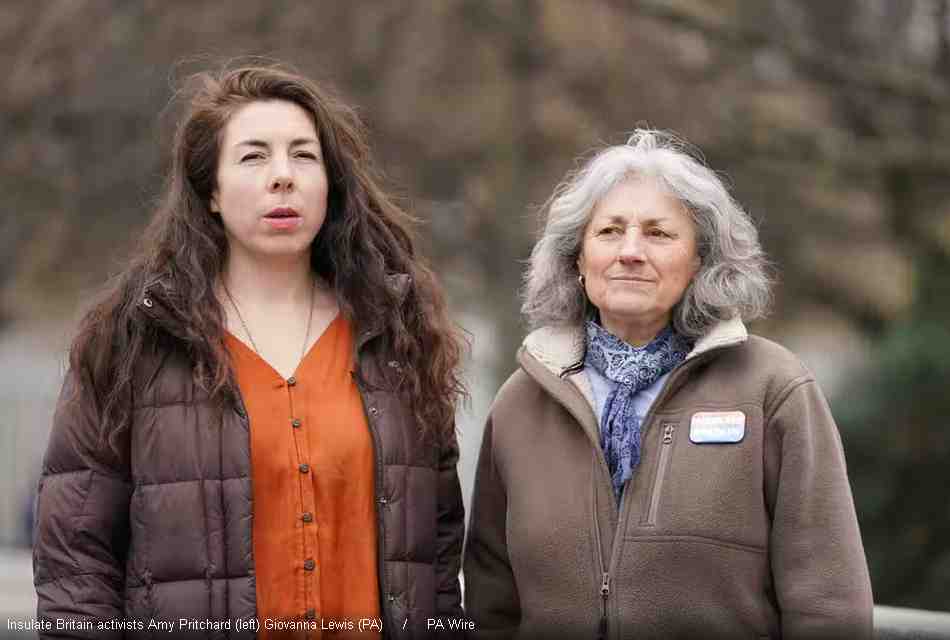
Giovanna
Lewis, 65, from Dorset; Amy Pritchard, 37, from London; and Paul Sheeky, 46,
from Warrington, were accused of blocking a major junction in central London on
25 October 2021 at around 8am. All three denied the charges.
The jury
heard that 25 arrests had been made that morning as protesters lay in the road
while others glued themselves to the ground, bringing rush hour traffic on
Upper Thames Street and Bishopsgate to a standstill that lasted hours.
In his
opening address Reid warned that the defendants had hoped being able to talk
about climate and ecological crises as motivation for their actions would “touch people’s hearts” and bring
morality to proceedings. Reid said:
“It seems to
me that the desires of the defendants to speak about the motivations of their
actions is that they believe that the jury will look at the case in a moral way
rather than in a legal way. That would be wholly wrong.”
This latest crackdown followed a ruling
by the Attorney General after the Home Secretary’s appeal against the acquittal of the Colston
Four (who toppled the Bristol statue). The Attorney General’s ruling, along
with the earlier Ziegler ruling, restrict the defences available to someone
accused of protest-related charges such as criminal damage or public nuisance,
ruling out any balancing exercise relating to human rights or any defence of
‘necessity’ (attempting to prevent a greater evil).
Although there is some leeway for
judges to decide how much a jury can hear from defendants, protest trials often
begin with legal arguments where the prosecution ask the judge to rule out all
such defences at the start of the trial,
while defence lawyers argue the jury should hear them. The judge can also direct
the jury at the end of the trial to ignore elements that are deemed irrelevant
in law.
Real Mediareported the five-week trial of Burning Pink activists
during which evidence of the extent of the climate crisis was heard. All
but two out of 20 charges against 12 people ended in acquittal.
A group calling themselves Fair
Justice Project have been posting notices in the streets near the Old
Bailey displaying legal information about the right for jurors to acquit on
their conscience.
On the morning of 27th
March, retired social worker, Trudi Warner, used similar wording on a banner
and stood for half an hour on the pavement of the road leading to the juror’s
entrance at the court.
When she returned to court later
that week, she was ambushed by police and arrested for contempt of court. Held
in a cell for the rest of the day, she appeared before the British version of Roland Freisler,
President of the Nazi People’s Court, at 5pm and told she must appear at the
Old Bailey on 4th April for contempt proceedings (“contempt in the face of
the court attempting to influence the jury”).
After hearing from her solicitor,
Mr Justice Cavanagh gave his decision that:
“It is not the case in any trial that
jurors can acquit by their conscience if by that it is meant they can disregard
evidence and directions given by the judge and decide on their own beliefs
whether a defendant is guilty of a criminal offence. To do so would be a breach
of their jury oath and cause injustices.”
Cavanagh’s ruling is a clear
attempt to roll back the rights of a jury and is indicative of the period we
are living in. A jury can acquit for any
reason whatsoever. They are not accountable for their decision to anyone. It
is clearly stated on the plaque that adorns the Old Bailey, celebrating the
decision in Bushell’s
that
Chief Justice Vaughan delivered
the opinion of the Court which established “The Right of Juries” to give their
Verdict according to their Opinions.
Either Cavanagh is an ignorant
bigot or he is determined to overturn a celebrated decision of over 500 years
standing in theJudges’ attempt to bow
the knee to the present Tory Government. (see below)
Cavanagh ruled that the case
should be referred to the Attorney General. In the meantime, appeals have been
lodged in relation to several of Reid’s Insulate Britain trials and
several trials scheduled for after Easter have been deferred until those
appeals are decided.
A woman who attended in support,
was arrested at the Old Bailey for allegedly “attempting to pervert the course of justice” in connection with
putting up a poster near Inner London Court. If anything it is Cavanagh and
Silas Reid who are guilty of attempting to pervert the course of justice.
Bushel’s case sets a so-far
inalienable right in law. So the question is, where can it be legal to
display a banner celebrating this case, and more importantly, where and why
could it NOT be legal to display this tenet of British law?
Four Insulate Britain protesters
appeared at Inner London Crown Court before Judge Silas Reid ahead of their
sentencing next week.
Insulate Britain campaigners (left to right) Stephen
Pritchard, Roman Paluch-Machnik, Ruth Cook and Oliver Rock, outside Inner
London Crown Court ahead of their sentencing for road blockages protests
(Jordan Pettitt/PA) / PA Wire
Another road-blocking protester
who could face jail confronted Silas Reid over
the decision to ban him from mentioning his climate-related motivations to a
jury. Stephen Pritchard used his speech ahead of his sentencing to condemn the
order made by Silas Reid:
I think that your rulings were amoral; I believe also they were
irrational given the situation that we’re in
The Buddhist and former parish
councillor appeared at Inner London Crown Court alongside former probation
officer Ruth Cook, 71, gardener Roman Paluch-Machnik, 29, and carpenter Oliver
Rock, 42.
All four were convicted by a jury
of causing a nuisance to the public by obstructing the highway after they
stopped traffic at Junction 3 of the M4 on October 1 2021. Insulate Britain said they are the first protesters to be convicted
of causing a public nuisance – a common law offence which carries a maximum
penalty of life imprisonment.
Silas Reid had ruled that they
should not mention their climate motivations during their trial, but asked them
to “concentrate as much as possible on
motivation” in their speeches ahead of sentencing. He told them:
“Blocking the road in the way you did, if it was done for no reason, is
a serious matter and would result in a prison sentence.”
Addressing Reid, Pritchard said:
“People’s lives are being lost.
The only possible way I could imagine stopping peaceful civil resistance in
this context is for you to tell me that this country has stopped pumping
greenhouse gases into the air.
“I’m well aware of what prison is
like, having been to prison. It’s not a very nice place. But I feel like I’m
already a prisoner of my conscience.”
Cook said she had spent decades “upholding the law” but resorted to
disruptive protests so she could “look
her grandchildren in the eye”.
Speaking about Silas Reid’s
imposition of limits to their defence, the grandmother from Frome gestured to
the jury bench and said:
I’m really aware of those empty
seats. I am going to say things now that I wish they would have been able to
hear, so that they weren’t discussing traffic data and listening to boring
statistics about traffic, but knew why we did what we did.
Cook, who is also a Quaker, said
her work delivering aid in Africa on behalf of Oxfam and the Refugee
Council and seeing climate refugees on the continent
“changed me fundamentally. I saw the impact that the climate emergency
was having on their lives
The defendants also mentioned the
impact the campaign had had on their friend Xavier Gonzalez-Trimmer, who killed
himself after spending time in prison over an Insulate Britain protest. Pritchard
said:
“He was a brave, gentle and caring human being who could see the future
we were facing and was desperate to do something about it, and now he’s dead.”
Paluch-Machnik used his speech to
highlight the impact of climate change, adding: “This isnt a belief system of mine, this is a measurable process.” The
four will return to the same court for sentencing by Silas Reid.
The Rights of A Jury and Bushel’s Case 1670
Prior
to Bushell’s Case, for nearly four centuries, jurors had been subject to
coercion, fines and imprisonment if they disregarded the wishes of the judge.
The jury was not independent as it is today, but more a ventriloquism act, “the judge with thirteen voices” any time
the judge wished to determine the verdict. The grandfather authority for the
coercion probably was a case in 19 Edward III (1346), which suggested that
jurors "might be dragged about in
carts at the tail of the [Circuit] Justices from assize-town to assize-town
until they could make up their minds". [The
Four Jurors in Bushell's Case, Wilmer G. Mason, American Bar Association
Journal, JUNE 1965]
In August 1670, William Penn, who
went on to found Pennsylvania, and William Mead were charged with “unlawfully and tumultuously” assembling
to preach and speak during a Quaker worship session on London’s Gracechurch
Street. The jury found them not guilty. The outraged judges, the Mayor and
Recorder of London, refused to accept the decision and told the jurors to keep
deliberating. The jury was sent back with the warning that
“you shall not be dismissed until we have a decision that the court will
accept; and you shall be imprisoned up, without meat, drink, fire, or smoke….
With God’s aid, we’ll get a decision, or you’ll starve to death.”
The jury returned two days later,
finding both defendants not guilty. For contempt of court, the judge fined them.
One of the jurors, Edward Bushel, refused to pay the fine required for his
release. Instead, he petitioned the Court of Common Pleas for a writ of habeas
corpus, contesting the legality of his detention. He was released two months
later after the court approved the writ.
The case of Bushel resulted in a
landmark ruling on the role of jurors. Lord Chief Justice Vaughan declared the
fines and imprisonment imposed unconstitutional and held that a jury could not
be punished for its decision, effectively ending judges’ ability to control
verdicts based on political whim and establishing the jury’s independent power.
Bushel’s Case established the concept of jury nullification, in which a jury
overturns an unconstitutional statute by declaring a defendant not guilty,
regardless of whether the jury believes the prisoner is guilty precisely by the
wording of the law.
Lady Justice Hallett
Blackstone Lectureon Trial by Jury.
In May 2017, LJ Hallett gave an interesting lecture on
the role of the jury. For Lord Camden it was ‘the
foundation of our free constitution’. For Lord Eldon the ‘greatest
blessing which the British Constitution had secured to the subject’. For
Lord Devlin, ‘the lamp that shows that freedom lives.’ For Lord Judge, ‘a
safeguard against oppression and dictatorship’.Blackstone refers to it as “the sacred bulwark of our liberties.”
Thomas Erskine said that
‘Criminal justice in the hands of the people
is the basis of freedom. While that remains there can be no tyranny, because
the people will not execute tyrannical law against themselves. Whenever it is
lost, liberty must fall along with it. . .’
Similarly,
in the early nineteenth century, people were still being hanged for sheep,
horse and cattle stealing and for robberies to the value of 40 shillings -
raised in 1827 to £5. Juries deliberately undervalued goods stolen to avoid
sending offenders to the gallows.
Heather
Hallett stressed in her lecture that a jury may refuse to convict in spite of
the law and the evidence because it concludes that the law is an unjust law.
The jury passes its verdict on the law. Secondly, it ensures that the
prosecution and the judge are on trial. Hallett went on to quote Professor
Michael Zander that the jury can set aside ‘unjust
laws, oppressive prosecutions and harsh sentences.’
Hallett gave
the example of the case of Dr Leonard Arthur a highly respected
consultant paediatrician who, as he saw it, put the interests of his patients
and their parents first. John Pearson was born with Down’s syndrome and
abnormalities of his lung, heart and brain. Dr Arthur wrote in the case notes, "Parents do not wish the baby to
survive. Nursing care only."
Despite what to the lawyer may have appeared a confession to the
charge of attempted murder, the jury acquitted him. Their verdict has been
construed as a refusal to convict a doctor of murder for 'allowing a severely handicapped baby to die' even if the law was
against him.
The case in
1985 of Clive Ponting, a civil servant, was another example. In the judge’s
view he had broken the Official Secrets Act by passing on secret information to
a politician but the jury refused to convict, upholding his claim that
disclosure was in the public interest.
To again quote Hallett, the jury
is a check against the
authority of government and Parliament, which ensures that they take heed of
the judgment the public passes on what they do. It is the means by which
individuals can ‘feel that the law is theirs’, that the law reflects and continues
to be consistent with the ‘attitudes and mores’ of society generally.
The views of Lord Sumption, a member of the Supreme
Court between 2012 and 2018 on civil disobedience are also interesting.
Sometimes the most public
spirited thing that you can do with despotic laws like these [COVID laws] is to
ignore them. I think that if the government persists long enough with locking
people down, depending on the severity of the lockdown, civil disobedience is
likely to be the result. … whatever Mr Hancock says. People are doing that to
some extent already.
Sumption went on to say that :
“I feel sad that we have the
kind of laws which public-spirited people may need to break. I have always
taken a line on this, which is probably different from that of most of my
former colleagues. I do not believe that there is a moral obligation to obey
the law… You have to have a high degree of respect, both for the object that
the law is trying to achieve, and for the way that it’s been achieved. Some
laws invite breach. I think this is one of them.”
I point
these divergent views out, even amongst the judiciary because there is now a
clear attempt to suggest that the powers of the jury are confined within the
limits that a trial judge sets. There are many instances when, in order to
achieve social change or achieve the abolition of a bad law, it was necessary
to break the law.
Rosa Parks sitting in the bus
Rosa Parks by breaking
the law on segregation helped change the law when she
refused to give up her seat for a white man.
Hallett’s
observations are the answer to those who say that a jury must blindly follow
the law, or the Judges’ interpretation of the law. There are times when an
oppressive law deserves to be broken. The Poll Tax was an obvious one. Let us
not forget that hiding Anne Frank was against the law whereas deporting her was
legal.
‘Individuals would be responsible
for the perpetration of war crimes irrespective of ‘whether or not in violation of
the domestic law of the country where perpetrated.’
This was the answer to
the defence of Goering, Streicher & co. that they were only obeying orders.
The
suffragette’s breaking of the law in order to reform the law was another. They
were told, by the prosecuting barrister in the BBC’s reconstruction of a
trial that:
Suffrage
is not the issue, it is the criminal behaviour of the suffragettes and their
incitement to partake in militant activity at which 54 windows were broken