Showing posts with label Peter Novick. Show all posts

13 May 2019

The Need to Forget - Why We Should Abolish Holocaust Remembrance Day


The Holocaust Memorial Industry is reinforcing the very forces that gave rise to the Holocaust


What is remarkable is that the farther away we get from the Holocaust the greater is the desire to ‘remember’ it. You might think that in the years immediately following the end of the war that American Jewry would be obsessed by nothing else.  Not a bit of it.
The only group in American society who regularly warned people to ‘Remember the 6 million murdered’ were the Communist  Party. [Peter Novick, p.94, The Holocaust in American Life, 2000] In the era of McCarthyism Communists were the last people that the Jewish establishment wanted to be seen with. Novick writes that
 on one point there was striking unanimity among the principal Jewish agencies: the danger that promoting a widespread consciousness of the Holocaust would inevitably promote the image of the Jew as victim.’
On 3 separate occasions –1946, 1947 and 1948 the major Jewish organisations - including the American Jewish Committee, the Anti-Defamation League, American Jewish Congress, Jewish Labor Committee and Jewish War Veterans, vetoed the idea of a Holocaust memorial in New York. (Novick, p.123)
Nathan Glazer, the American neoconservative, in American Judaism in 1957, observed that the Holocaust ‘had had remarkably slight effects on the inner life of American Jewry.’ (Novick, 105)
Auschwitz death camp survivor Jacek Nadolny, 77, tattooed with camp number 192685, holds up a wartime photo of his family, as he poses for a portrait in Warsaw. January 7, 2015\ REUTERS

It was even worse in Israel. Novick describes how Israel Gutman, a historian at Israel’s Yad Vashem Holocaust Museum and a survivor of the Warsaw Ghetto resistance, told how Jews in Palestine listened to survivor’s stories with ‘a forced patience’ that was soon exhausted. 
‘American Jews, or Jews in the Yishuv would have been incredulous at the idea... that survivors’ memories were a ‘precious legacy’ to be preserved.’ (Novick, p.83)
In a 220 page Israeli history textbook published in 1948, just one page was devoted to the Holocaust compared to 10 pages on the Napoleonic wars. [Edith Zertal, p.94, Israel’s Holocaust and the Politics of Nationhood, 2011] The survivors were considered an embarrassment and Israelis described them as sapon (soap, based on the myth that the murdered were turned into soap). [Tom Segev The Seventh Million, p.183].   Hanzi Brand wrote of how, when she settled on Kibbutz Gvata Haim, the other members ‘talked about their war to avoid hearing about hers. They were ashamed of the Holocaust.’ [Segev, p.471]
Picture - Auschwitz II-Birkenau in a thick evening fog, during the 73rd anniversary of the liberation of the concentration and extermination camp. Oswiecim, Poland. January 27, 2018\ KACPER PEMPEL/ REUTERS

Novick describes how, in Israel there was the theme of the ‘survival of the worst’. Ben Gurion describes the Holocaust survivors as
‘people who would not have survived if they had not been what they were – hard, evil and selfish people, and what they underwent there served to destroy what good qualities they had left.’ (Novick, p.69)
So what is it that has changed such that we now have an abundance of Holocaust memorials and artefacts? Even the bogus International Holocaust Remembrance Alliance definition of anti-Semitism implies that it has a connection with the murdered Jews. Both Norman Finkelstein and Novick suggests that the Holocaust Industry sprung up only after the victory over the Arab countries in the war of 1967. (The Holocaust Industry, p.26; Verso 2003, Novick p.148).
Israel HaYom cartoon: concentration camp barbed wire morphs into an IAF F-16 (Shlomo Cohen)
Over 30 years ago Israel exploded, in Daniel Blatman’s words, when Prof. Yehuda Elkana published “The Need to Forget” Elkana, a child survivor of Auschwitz, argued that the time had come to forget the Holocaust. It should no longer be commemorated on a national basis.  Worship of the Holocaust served nationalist and racist purposes.
Hungary's antisemitic Prime Minister Viktor Orban and Israel's racist prime minister Netanyahu
Elkana became President of the Central European University in 1999, a university set up by George Soros. It is ironic that at the end of last year the University announced that it would close and relocate to Vienna when Hungary’s anti-Semitic Prime Minister Viktor Orban, refused to allow it to remain in Hungary. The campaign against Soros was supported, indeed initated by the Israeli government and Benjamin Netanyahu who, like Orban, saw Soros as an enemy.
Even the title of this essay is likely to be subject to criticism since any mention of the Holocaust must be accompanied by solemnity, awe and reverential distance. As befits any religion and the Holocaust has become a secular religion, its basic tenets cannot be questioned. The Holocaust is an experience that must be mediated via Holocaust scribes, academics and organisations such as the Holocaust Educational Trust and Yad Vashem, Israel’s Holocaust museum.
View of section of the Auschwitz Nazi concentration camp on Feb. 6, 1961 in Oswiecim, Poland

Above all the Holocaust cannot be understood. According to Elie Wiesel, the Auschwitz survivor and arch Zionist, ‘Auschwitz cannot be explained nor can it be visualized... The Holocaust transcends history...’ (Novick, p.211). 
If the Holocaust cannot be explained and doesn’t belong to history then it carries no universal lessons. Its only explanation lies in the very existence of the Jews, in other words eternal and unchanging anti-Semitism. That is why for Israel the Holocaust has become a foundational myth whose only purpose is colonial.
In a macabre re-enactment, only 59 years too late, Israeli fighter jets overflew Auschwitz in 2003 to rub home the message that if only Israel had been in existence at the time there would have been no Holocaust. The National Museum of Auschwitz-Birkenau deplored this crass display. Ehud Barak, former Chief of Staff and later Prime Minister of Israel stated that ‘we have arrived 50 years too late.’
Israeli soldiers at the Holocaust Remembrance Day ceremony at Yad Vashem in Jerusalem, May 4, 2016.Olivier Fitoussi

Zionism salves its conscience about its record during the Holocaust by fantasising about what might have been if Zionism had achieved its state earlier. What it doesn’t ask is how and why the Zionist movement impeded rescue. The dead of Auschwitz have been summoned in a macabre parade in the cause of Israel’s military might.
The use to which Holocaust remembrance is cynically put is evidenced by the Israeli state’s close connections to the far-Right Polish government which, when not actively encouraging anti-Semitism engages in its own sophisticated form of Holocaust denial. This is the meaning of the Polish government’s Holocaust law which Netanyahu’s sordid agreement legitimised. Israel’s sanctification of the Holocaust is intended to manipulate the past in order to shape the present and distort the future. 
Poland's Prime Minister Mateusz Morawiecki visits the Ulma Family Museum of Poles Who Saved Jews during WWII in Markowa, Poland. February 2, 2018AGENCJA GAZETA/ REUTERS

There are many lessons that can be learnt from the Holocaust. One is to be vigilant against the rise of racism and fascism. Another is to understand that if Germany, containing the most cultured society in Europe could turn to racial fascism and genocide then so can any people.  All peoples, given the right set of circumstances, can become murderers and accomplices to genocide. Jews are no exception.
March of the Living
Every year thousands of Israeli school children visit Auschwitz and take part in the March of the Living just before Israel’s Yom HaShoah. The programme states that:
The International March of the Living is an annual educational program, bringing individuals from around the world to Poland and Israel to study the history of the Holocaust and to examine the roots of prejudice, intolerance and hatred.
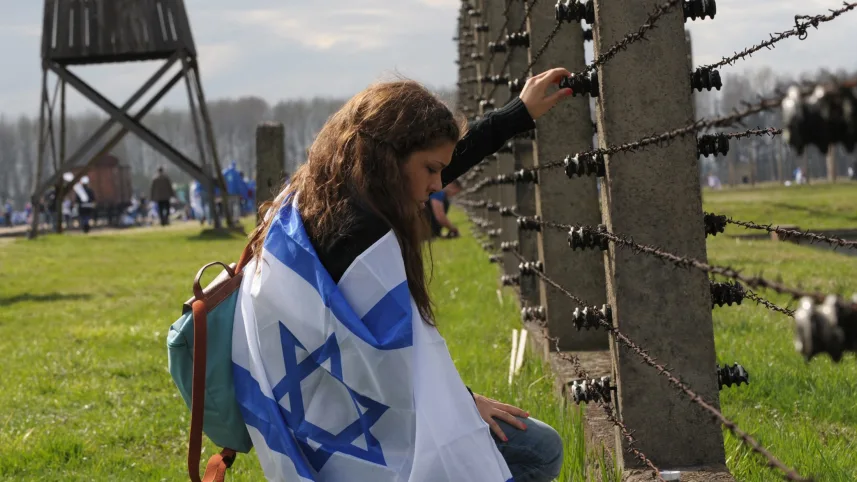
A woman, wrapped in an Israeli flag, stands in front of barbed wire at Auschwitz-Birkenau as people take part in the annual 'March of the Living,' in Oswiecim, April 19, 2012. AFP

Wrapped in Israeli flags, which to Palestinians is what the swastika was to the Jews, these Israeli marchers represent Zionist military might and ethnic cleansing.  It is in this way that Israel has subverted and corrupted the meaning of the Holocaust.
It is no wonder that all the evidence concerning Israel’s youth is that they are becoming even more racist and right-wing than their parents’ generation.
Gideon Levy wrote that
I have yet to hear a single teenager come back from Auschwitz and say that we mustn’t abuse others the way we were abused. There has yet to be a school whose pupils came back from Birkenau straight to the Gaza border, saw the barbed-wire fence and said, Never again. The message is always the opposite. Gaza is permitted because of Auschwitz.

Aerial view showing the layout of the largest concentration camp and death camp run by Nazi Germany during World War II at Auschwitz near the Polish town of Oswiecim, Poland, Aug. 25, 1944AP

Despite visiting Auschwitz ‘on patriotic brainwashing trips’ Israeli schoolchildren know nothing of what led up to the Final Solution. ‘At most they can tell you it was because of anti-Semitism, an explanation that suits the victim identity nurtured from childhood.’
Far from combating racism Holocaust Remembrance increases and reinforces the existing high level of racism in Israeli society. It provides Zionism’s racism with a moral legitimacy.
As Richard Silverstein noted in his article Yom HaShoah and Its False Premises Israel’s veneration and sacralisation of the Holocaust is in inverse proportion to its treatment of Israel’s living Holocaust survivors. Despite taking billions of dollars from the German government as reparations, Israel has kept them in abject poverty.
Brazil's far-Right President Bolsonaro is welcomed by Yad Vashem
The elevation of the Jewish Holocaust above all other acts of genocide not only suggests that it is unique but that it has nothing to tell us beyond the fact that it occurred. If the purpose of remembering and commemorating acts of genocide is to prevent their reoccurrence and to act as a warning against their repetition, why single out one act of genocide? The genocide of the Gypsies and the Disabled are all but omitted from Holocaust museums such as Yad Vashem and the Washington US Holocaust Museum. The genocide of Africans in the slave trade or Armenians forms no part of Holocaust Memorial Day.
Indeed from the days of Herzl onwards there has been a determined refusal by Zionism to acknowledge the Armenian massacres and genocide. Lucy Dawidowicz, a prominent Zionist historian went so far as to say that unlike the Nazis, the Turks had a ‘rational’ reason for massacring Armenians. Elie Wiesel, Alan Dershowitz and Arthur Hertzberg, all prominent Zionists, withdrew from an international  conference on genocide in Tel Aviv when the sponsors refused to remove sessions on the Armenians. (Novick pp. 192-193, Finkelstein pp. 69-70)  The Zionist lobby in the United States has repeatedly opposed any commemoration of the Armenian holocaust.
Yehuda Bauer, Professor of Holocaust Studies at the Hebrew University Jerusalem, in a debate with Dr Sybil Milton, the Senior Resident Historian at the US Holocaust Memorial Council argued that
‘the tragedy of the Gypsies’ whilst being ‘ no less poignant, and no less horrible’ was nonetheless not part of the Holocaust. Whilst ‘it happened at the same time as the Holocaust, and there are of course many similarities. Yet it appears to me that the Holocaust is very much a unique case. If someone prefers to call it Judeocide, that is his her privilege. It is exactly the same thing: it is the mass murder of the Jews at the hands of the Nazis.’
For Zionism the Holocaust is a Jewish only affair. Sybil Milton, who was herself Jewish, responded succinctly:
‘(The) Nazi genocide, popularly known as the Holocaust, can be defined as the mass murder of human beings because they belonged to a biologically defined group. Heredity determined the selection of the victims. The Nazi regime applied a consistent and inclusive policy of extermination- based on heredity- only against three groups of human beings: the handicapped, Jews, and Gypsies.’
This correspondence ‘Gypsies and the Holocaust’ can be found in The History Teacher, Vol. 25, No. 4. (Aug., 1992), pp. 513-521.
We are now living in an era where Israeli Rabbis in an elite pre-military training school can tell their students that Hitler was right, even if he chose the wrong victims. For all their commemoration of the Holocaust, even the most basic and elementary anti-racist and anti-fascist sentiments are missing in Israel. It is, after all, a state where the term ‘leftist’ is a form of abuse and where Donald Trump is more popular than any other country. Commemoration of the Holocaust serves a wholly nationalist and militarist agenda.
Zionism has appropriated the Holocaust and subverted it. When I was involved in the Anti-Nazi League, a mass anti-fascist movement which defeated the National Front in the late 1970’s our posters proclaimed ‘Never Again’. This also became the slogan and title of a book by Rabbi Meir Kahane of the Judeo-Nazi Kach movement.
The French military accompany the genocidal Interamhawe militia in Rwanda
This focus by political elites on the Holocaust has had no effect on the occurrence of genocide. In the late 1970’s, as a direct consequence of America’s secret war in Cambodia, there occurred the genocide of  nearly 2 million Cambodians. In 1994 there was another genocide, in Rwanda, when up to 1 million Tsutsis and moderate Hutus were murdered by the Hutu Interahamwe as French troops stood by and even protected the murderers. This is the same France that has all but made BDS illegal in the name of ‘anti-Semitism’.
Bill Clinton, who waxed lyrical about the Nazi Holocaust when opening the US Holocaust Museum in 1993 refused to intervene the following year in Rwanda. The US Administration was specifically warned about a ‘"final solution to eliminate all Tutsis" but decided against intervention.
Yad Vashem
What makes Israel’s use of the Holocaust particularly obscene is the role of Yad Vashem. It openly welcomes through its doors people like Viktor Orban, who last July faced an unprecedented picket by Holocaust survivors and others when he visited Yad Vashem. Orban, fresh from his campaign against Soros, praised as an ‘exceptional statesman’ Admiral Horthy, under whom nearly half a million Jews were deported to Auschwitz.
Hitler admirer and Philippine President Duterte pays homage at Yad Vashem
Following him last September was Rodrigo Duterte, the Philippine President who compared himself to Hitler. Brazilian President Jair Bolsonaro paid a visit in April to Yad Vashem. He described the Nazis as ‘leftists whilst ‘forgiving’ them for the Holocaust. South Africa’s Prime Minister, John Vorster, who was interned during the war for his support for the Nazis visited Yad Vashem in 1976. This prompted Professor Israel Shahak, a child survivor of the Warsaw Ghetto and Belsen to speak of Yad Vashem’s behaviour as ‘‘vile and ‘truly beneath contempt.’

Daniel Blatman, a Holocaust researcher at the Hebrew University described Yad Vashem as a

‘hard-working laundromat, striving to bleach out the sins of every anti-Semitic, fascist, racist or simply murderously thuggish leader or politician like Hungary’s Viktor Orban, the Philippines’ Rodrigo Duterte and Italy’s Matteo Salvini.

Matti Friedman in the New York Times described the reaction of staff at Yad Vashem to the long list of far-Right visitors. One staff member told him that
“There is distress here, and even anger, because many of us see a collision between what we believe are the lessons of the Holocaust and what we see as our job, and between the way Yad Vashem is being abused for political purposes.”
A member of a white supremacy group gives the fascist salute during a gathering in West Allis, Wisconsin, September 3, 2011REUTERS/Darren Hauck
Of course this should be taken with a pinch of salt given its record.
Friedman described an incident last June when Austrian chancellor, Sebastian Kurz, was told that the names of Austria’s lost Jewish communities, which were on a wall he was passing, had recently seen anti-Jewish incidents involving members of the Austrian Freedom Party, a party whose first two leaders were former S.S. officers. Mr. Kurz’s government is in coalition with the Freedom Party.
Kurz’s guide, Deborah Hartmann, mentioned to the chancellor that some of his allies were people who “need to be informed what the Holocaust was.” The Austrian embassy ‘made a rare official complaint’ and Yad Vashem issued an apology.
Blatman noted the absence of Yad Vashem from the 5th Global Conference on Genocide in Jerusalem in 2016. Why? It has nothing to say on anything bar the Jewish genocide. Blatman wrote of how  
None of the hundreds of scientific events organized by Yad Vashem has been dedicated to the Holocaust and genocide.... You have to look hard to find any reference to the destruction of other populations in the Holocaust, and its chief aim seems to be to silence criticism. Similar museums in Paris and Washington hold regular activities on these topics
Whilst Yad Vashem studies what happened to the Jews in Polish or Ukrainian cities ‘they rarely address Nazi atrocities against other ethnic groups’. They study the minute detail of what happened to the Jews without ever seeing the wider picture. Yad Vashem ‘helps keep the Holocaust in a narrow Jewish ghetto that serves the xenophobic manipulations Israel makes of it.’
That is why Yad Vashem has never given birth to a comprehensive book on the Holocaust such as Gerald Reitlinger’s The Final Solution or Raul Hilberg’s Destruction of the European Jews. Holocaust research in Israel has done nothing to combat racism.
That was the conclusion of Professor Elkana. If what Elkana wrote was true 31 years ago it is even more true now. For Zionism and the Israeli state, the Holocaust functions not as a warning against the dangers of racism but as means of silencing their critics. The Holocaust is Israel’s get out of jail free card. Elkana wrote:
‘Lately I have become more and more convinced that the deepest political and social factor that motivates much of Israeli society in its relations with the Palestinians is not personal frustration, but rather a profound existential "Angst" fed by a particular interpretation of the lessons of the Holocaust and the readiness to believe that the whole world is against us, and that we are the eternal victim. In this ancient belief, shared by so many today, I see the tragic and paradoxical victory of Hitler. Two nations, metaphorically speaking, emerged from the ashes of Auschwitz: a minority who assert,"this must never happen again," and a frightened and haunted majority who assert, "this must never happen to us again."
Elkan cited Thomas Jefferson as having written that democracy and worship of the past are incompatible. Elkana’s conclusion was that ‘For our part, we must learn to forget!... They must uproot the domination of that historical "remember!" over our lives.’
Gideon Levy wrote similarly
We have to forget as quickly as possible and make others forget to the degree possible. The time has come to get past the past. We needn’t erase it, but put it in its place; it’s over.’
The Holocaust cannot be forgotten. The question is how it is remembered, by whom and for what purpose. Zionism’s abuse of Holocaust memory has to be challenged. Under capitalism all memory serves a purpose. Holocaust remembrance is no different. Levy wrote that
The legacy of the Holocaust has caused Israel fateful damage; it solidified nationalism and validated militarism instead of shaping humanism, justice, morality and compliance with international law, which in Israel 2019 are considered treason or weakness.
Levy argues that what drives racism and hatred of Arabs is ‘self-victimization. After the Holocaust we are permitted to do anything, and of course, only with force.’
The Holocaust needs to be reclaimed by the Left and Anti-Fascism.  For too long the Zionist movement has got away with harnessing the Holocaust to the chariot of racism and ethnic cleansing.
Tony Greenstein


8 July 2016

Elie Wiesel – the Holocaust Survivor Who Refused to Acknowledge the Holocaust

Wiesel's Poisoned Legacy Lives on in the Settlements


Add caption
Elie Wiesel, who died earlier this week, was a survivor of Auschwitz.  Yet Wiesel came to symbolise all that is wrong with the Holocaust as we understand it.  Unlike Hajo Meyer who died earlier this year, Wiesel drew no lessons from the Holocaust because he argued that it defied human understanding. As Peter Novick observed in The Holocaust in American Life Wiesel NBC’s Holocaust because:
Hajo Meyer - Dutch survivor of Auschwitz and an anti-Zionist
‘Auschwitz cannot be explained nor can it be visualized.  The Holocaust transcends history.  The dead are in possession of a secret that we, the living, are neither worthy of nor capable of recovering. . . . The Holocaust [is] the ultimate event, the ultimate mystery, never to be comprehended or transmitted. Only those who were there know what it was; the others will never know.
Primo Levi
Wiesel transformed the Holocaust from an act of barbarity, a genocide and attempted extermination of a whole people, into a theology which cannot be comprehended.  Not for nothing it has been said that for Jewish people, the Holocaust has become their new religion.  And because it is a religion, there is no use trying to understand it.  It has no lessons for us because it cannot be understood.  It can only be used as a kind of talisman for the Israeli state.  The slogan ‘Never Again’ is to be interpreted as ‘Never Again for the Jews.’
disabled child at the gates of Auschwitz
Wiesel reserved for the Jewish people alone the concept of genocide and holocaust.  In 1982 he attempted to abort a conference on the Holocaust and Genocide in Tel Aviv because it included sessions on the Armenian Genocide.  The Israeli state didn’t wish its relations with the Turkish state to be compromised and so pressure was exerted to have the conference aborted.  Wiesel, ever the faithful Zionist, not only pulled out but tried to persuade others, including holocaust historian Yehuda Bauer to withdraw.  [Norman Finkelstein, Holocaust Industry, pp. 69-70]  The US Holocaust Museum virtually eradicated all mention of the Armenians after Israeli pressure and has also done the same with respect to the extermination of the Gypsies.

Despite this he is described as having ‘publicly condemned the 1915 Armenian genocide and remained a strong defender of human rights during his lifetime.’ 
Hajo Meyer
Wiesel was above all a Zionist.  At the same time as criticising the world’s silence over the holocaust, Wiesel demanded silence over Israel’s treatment of the Palestinians.[1] 

Elie Wiesel lived in Sighet, Transylvania, which was then part of Hungary but is now in Rumania.  In March 1944 the Nazis invaded Hungary and proceeded to round up the Jews of the provinces.  Wiesel confirmed that ‘We were taken just 2 weeks before D-Day, and we did not know that Auschwitz existed… everyone knew except the victims.’ [2]. Wiesel asked ‘Why didn’t we know?  To this day I try to understand what happened.  If ever there was a tragedy that could have been prevented, it was that one.’ [3] 

In fact Wiesel knew very well why the Jews of Hungary didn’t know.  It came out in the Kasztner Trial in Israel when the leader of Hungarian Zionism Rudolph Kasztner lost a libel trial after having been accused of being a collaborator by the survivors of the Hungarian holocaust.  As Wiesel said, the Jews didn’t know where they were being transported to.  The reason for this was because the Hungarian Zionist leadership had suppressed the Auschwitz Protocols of the Jewish escapees from Auschwitz, Rudolf Vrba and Alfred Wetzler.  Escape would have been relatively easy because Rumania was by then effectively neutral.

Wiesel wrote about this is his review of Tom Segev’s book The Seventh Million which was published in the LA Times of 23rd May 1993.

‘Segev is not the first to have revealed the shortcomings of the "Yishuv"--as the Jewish community in Palestine was then called--and its leaders. Playwright and novelist Ben Hecht wrote a violently polemical work, "Perfidy," dealing with the Kastner trial in the early 1960s. Through it, he attacked the Zionist establishment's timorous policy during the war and went so far as to accuse its major players of collaborating with the Germans.
….
Let us examine the strange episode of the haavar or "transfer."

In the mid-1930s, after Hitler's rise to power, while American Jewry fought to organize an economic boycott of Nazi Germany, the leaders of the Palestinian Yishuv entered into active, though unofficial, negotiations with Berlin regarding the transfer of German Jews and their wealth--some 30 million pound sterling--to the Holy Land.

Surely, Jewish Palestine--at the time the two words were not contradictory--needed money to finance its development, but this brazen pragmatism went against the political philosophy of a majority of world Jewry. There developed a growing perception that instead of supporting and strengthening the boycott, Palestine was, in fact, sabotaging it.

There were justifications. Yes, the country was poor and needed financial input and yes, this course of action provided a chance to save German Jews who might otherwise have decided to "wait and see" and let the last possible opportunity of salvation go by.

But Segev goes on to show, supported by devastating evidence, that later, even as Germany carried out its Final Solution--liquidating one ghetto after another, one community after another--the Jewish leaders of Palestine never made the rescue of European Jews into an overwhelming national priority. We know that Zionist leader Itzhak Gruenbaum, a future Minister of the Interior in David ben Gurion's first cabinet, considered creating new settlements more urgent than saving Jews from being sent to Treblinka and Birkenau.’

Despite knowing that the Zionist movement had betrayed the Hungarian Jewish community, his own family perished in Auschwitz and Buchenwald, Wiesel became their holocaust spokesman.  Unlike other holocaust survivors, Wiesel did not show empathy with others, in particular the Palestinians.  Time and time again he refused to speak out about Israel’s crimes or the racism  which mirrored much of what had happened in Germany and Eastern Europe in the 1930s and 1940s.
Wiesel's despicable Guardian advert
The most despicable incident occurred in 2014 when Wiesel placed an advert, on behalf of Rabbi Boteach and his group in major newspapers at the time of Israel’s murderous attack on Gaza, in which over 2,000 people were murdered, including 551 children.  Instead of condemning the use of American fighter jets, missiles and explosives against a defenceless Palestinian population, Wiesel tried to place an advert accusing the Palestinians of Gazas of ‘Child Sacrifice’.  According to Wiesel’s warped logic the death of Palestinian children was because they were ‘human shields’ used by their parents to defend themselves.  The idea is barely worth commenting on even now.  The Israelis pounded Gaza’s civilian infrastructure – water treatment plants, schools clinics, hospitals and residential housing.  To blame the victims for their own deaths is no different from the Nazis who blamed the Jews for having brought the Holocaust on themselves.

Literally Wiesel had come full circle, the victim of the extermination camps had now become the ardent supporter of mass murder.

Even the Times (but not the Guardian) rejected Wiesel’s 'Child Sacrifice' Ad London Times Rejects Elie Wiesel Anti-Hamas 'Child Sacrifice' Ad

Wiesel also became thoroughly corrupt and in his effort to earn a large return from his considerable fortune, lost it all when Bernie Madoff’s ponzi scheme collapsed in 2008.

Below are a couple of articles looking at Wiesel and also comparing Wiesel with a genuine hero, Primo Levi, who did retain his critical faculties and did not hesitate to condemn Israel’s war crimes.  Levi too was a former inmate of Auschwitz but unlike Wiesel was not prepared just to condemn Jewish deaths and ignore those who died at the hands of Jews.

Tony Greenstein

It Is Important to Have Perspective on Elie Wiesel's Legacy

Officially remembered as a moral giant, Wiesel provided cover to the invasions and occupations that have devastated the Middle East.
July 5, 2016

Sacrifice of Isaac Caravaggio
Photo Credit: Public Domain via Wikimedia

The news of Elie Wiesel’s death in the early morning of July 2 ushered in veneration and reflections from figures across the political spectrum, from Bill Clinton and Donald Trump to Benjamin Netanyahu and George W. Bush. The outpouring of high-level praise aimed at consolidating Wiesel as the eternal voice of the Holocaust and the central preceptor of its lessons. Those who criticized his legacy or pointed out his moral contradictions, meanwhile, were ferociously attacked by the forces he helped inspire. 

Back when I was in junior high school, the rabbi of my family’s synagogue urged me to read Wiesel’s book Night as part of my Bar Mitzvah preparations. The story offered a look at the existence of Jews deported to Auschwitz and Buchenwald that was as harrowing as it was accessible. Reading Night while studying a Torah portion that chronicled Israelite captivity in ancient Egypt helped cement the Holocaust as a central component of my Jewish identity. Countless other Jews my age experienced Wiesel’s work in a similar fashion and many came to idolize him. Like me, few of them knew much about the man beyond the tribulation he endured in Hitler’s death camps.

Though my experience was particular to American Jewish life, the general public has been familiarized with Wiesel over the course of several generations through educational curricula and an expansive commercial apparatus. In 2006, after Oprah Winfrey’s embarrassing promotion of James Frey’s memoir, A Million Little Pieces, which turned out to be a fabrication, her book club made Night its monthly selection. The public relations maneuver drove the book onto the national bestseller list and centered its author in the celebrity limelight. Soon after, Oprah joined Wiesel on a tour of Auschwitz, where he spoke before a camera crew in mystical terms about the souls of those were exterminated and how he communed with them as he stepped across the hallowed ground.

Through Oprah, Wiesel secured his brand as the high priest of Holocaust theology, the quasi-religion he introduced some 30 years earlier in a New York Times op-ed: “The Holocaust [is] the ultimate event,” he insisted, “the ultimate mystery, never to be comprehended or transmitted. Only those who were there know what it was; the others will never know.”

Reflecting on the impact of Wiesel’s work, Brooklyn College political science professor Corey Robin wrote that he had “turn[ed] the Holocaust into an industry of middlebrow morality and manipulative sentimentality” while sacralizing “the ovens [as] our burning bush.” For the masses of Jewish Americans who subscribed to Wiesel’s secular theology, he was a post-war Moses who interceded between the Western world and a catastrophe that substituted for a merciful God.

While Wiesel leveraged his literary talents to win sympathy for Jewish victims of genocide, he sought to limit the narratives of other groups subjected to industrial-level extermination. As a member of the advisory council of the U.S. Holocaust Memorial Museum in 1992, he lobbied against recognizing LGBTQ and Roma victims of the Holocaust. A decade earlier, when the Israeli Foreign Ministry demanded Wiesel exclude Armenian scholars from a conference on genocide, fearing damage to the country’s relations with Turkey, he resigned from his position as chair rather than defend the scholars. (It was not until 2008 that Wiesel called the massacre of Armenians by Ottoman forces a genocide.)
Wiesel seemed to view these other victimized groups as competitors in an oppression Olympics, fretting that widespread recognition of the atrocities they suffered would sap his own moral power. The universalist’s credo—"Never again to anyone"—was a threat to his saintly status, his celebrity and his bottom line.

Defending Israel, crimes and all

By popularizing an understanding of the Holocaust as a unique event that existed outside of history, Wiesel helped cast Jews as history's ultimate victims. In turn, he fueled support for the walled-in Spartan state that was supposed to represent their deliverance, and defended everything it said it had to do for their security. “My loyalty to my people, to our people, and to Israel comes first and prevents me from saying anything critical of Israel outside Israel,” Wiesel wrote.

In the face of increasingly unspeakable crimes against Palestinians, Wiesel counseled silence. “I must identify with whatever Israel does—even with her errors,” he declared.

Wiesel’s unwavering commitment to Israel undoubtedly influenced his vocal support for President George W. Bush’s invasion of Iraq. “We have a moral obligation to intervene where evil is in control. Today, that place is Iraq,” he proclaimed in a 2003 op-ed. He went on to demand American-orchestrated regime change in Syria, Libya and Iran. “To be Jewish in this world is to always be concerned,” he told an audience on Capitol Hill, endorsing Israeli Prime Minister Benjamin Netanyahu’s push for a U.S. attack on Iran. Wiesel’s support for successive assaults on Middle Eastern countries—always on the grounds of defeating “evil”—made him a key asset of neoconservatives and liberal interventionists alike.

Since 9/11, Wiesel’s figure has helped keep America’s imperial designs safely shrouded in the ghosts of Buchenwald and Babi Yar. As the literary critic Adam Shatz wrote, “the author of Night has gone from being a great victim of war crimes to being an apologist for those who commit them—all while invoking his moral authority as a survivor.” Even after the invasions Wiesel advocated for spurred the deaths of some 100,000 Iraqi civilians and the rise of ISIS, his aura remained intact, keeping him insulated from accountability.

Embracing hustlers and demonizing Palestinians

When federal authorities busted Bernard Madoff’s ponzi scheme in 2008, Wiesel lost the millions he had amassed through his career as writer and lecturer on the Holocaust. To recoup his losses, he turned to the furthest shores of the American right-wing, forging mutually beneficial relationships with a coterie of pro-Israel hate preachers and hustlers.
Rabbi Shmueli Boteach
Just months after losing his investments with Madoff, Wiesel accepted $500,000 from Pastor John Hagee for a single speech. Addressing Hagee’s congregation in San Antonio, Texas, Wiesel heaped praise on the Christian Zionist preacher who once described Hitler as a “half-breed Jew,” then called him his "dear pastor" in a subsequent interview. Hagee’s rants against gays and the indisputably antisemitic passages that prompted John McCain to rescind the preacher’s endorsement during his 2008 presidential campaign were of little relevance to Wiesel as he scrambled to regain his fortune.
Around this time, Wiesel fell in with Shmuley Boteach, a self-styled celebrity rabbi who functioned as a liaison for Republican mega-donor Sheldon Adelson. (Adelson began funding Wiesel’s foundation in 2007 with a donation of $1 million). Boteach operated as Wiesel’s de facto agent, arranging high-profile—and likely high-paying—speaking gigs with figures ranging from Baywatch star Pamela Anderson to Senator Ted Cruz. In return, the ethically tainted Boteach was able to bask in the presence of a man regarded with near-universal veneration.

I met Wiesel for a brief moment at New York University’s Bronfman Center for Jewish Life in February 2014. He had just shared a stage with Boteach, Adelson and Paul Kagame, the Rwandan strongman whose M23 proxy militia helped fuel the Congolese genocide. During the event, which was as surreal as it was outrageous, Kagame’s security team brutally ejected a lone audience member who took Wiesel’s call to challenge injustice as a cue to rise from his seat in protest against the Rwandan dictator. Afterward, I approached Wiesel and asked him about his vehement support for Jewish settlers ejecting Palestinians from their homes in occupied East Jerusalem. He told me to contact his office and shuffled away.

That July, Israel embarked on its most lethal operation to date against residents of the besieged Gaza Strip, destroying or damaging some 100,000 homes and killing over 2,200 people, including 551 children. At the height of the assault, a shockingly Islamophobic full-page ad appeared in the New York Times under the banner of Boteach’s World Values Network non-profit, which has received substantial funding from Adelson.

“Jews rejected child sacrifice 3,500 years ago. Now it’s Hamas’s turn,” the ad declared. Hammering on the common pro-Israel myth that Palestinians do not value their children’s lives as much as Israelis do, the ad denigrated the besieged residents of Gaza as “worshippers of death cults indistinguishable from that of the Molochites.” The text concluded with the signature of its author, Elie Wiesel, the man who would be eulogized by fellow Nobel Prize-winner Barack Obama as “one of the great moral voices of our time.”

With Wiesel’s death, the elites who relied on him for moral cover leapt at the opportunity to claim his legacy. Meanwhile, the teachings and testimonies of Holocaust survivors who insisted on applying the lessons of the genocide universally—including to Palestinians—remained confined to the margins.

Destroying the dissidents

Among the Jewish dissidents to emerge from the nightmare of World War Two Europe was Marek Edelman, a member of the Warsaw ghetto resistance who published an open letter to Palestinian resistance fighters during the Second Intifada, addressing them respectfully as “Palestinian Partisans” while beseeching them not to attack civilians. There was also Hajo Meyer, who spent months in Auschwitz, where he lost his parents, and spent his later years writing slashing critiques of the Zionist movement’s base exploitation of the Holocaust. Like Meyer, Hedy Epstein invoked her experience surviving genocide (she escaped on the kindertransport) to emphasize the urgency of her activism for Palestinian rights. In her final years, she embarked on an aid flotilla to the besieged Gaza Strip and participated in countless demonstrations for human rights, even getting arrested protesting police brutality in St. Louis, Missouri.

Many Israeli Jews who had fled Europe during the 1930's banded together in radical organizations like the Socialist Bund, Matzpen and the communist party known as Maki to challenge the military occupation of Palestinians that began inside Israeli territory in 1949. One of the earliest leaders of the Israeli Communist Party, Meir Vilner, used his position in the Knesset (Israel’s parliament) to expose the massacre by Israeli soldiers of 47 innocent Palestinian farmers in 1956 in the town of Kfar Kassem, where Prime Minister David Ben Gurion had ordered a media blackout.

“What we wanted to escape in Vilna [Lithuania] we found here [in Israel],” Vilner said after uncovering the atrocities Israel’s military had committed. “There, hatred was directed against Jews; here against Arabs.”

When these dissidents could not be ignored, they have been denigrated by pro-Israel forces as self-haters, race traitors and even frauds. This year, when the Austrian parliament invited Hedy Epstein to participate in an event on women survivors of the Holocaust, she was smeared by Efraim Zuroff, a self-styled “Nazi hunter” who headed the Simon Wiesenthal Center’s Jerusalem office. “She is not a survivor in the classical sense,” Zuroff claimed, suggesting that Epstein’s support for Palestinian rights nullified her experience of escaping genocide. The Jerusalem Post’s Benjamin Weinthal piled on, painting Epstein as a “pro-Hamas, anti-Israel Jew” and attempting to link her to Iranian Holocaust deniers. As a result of the pressure, the parliamentary event was canceled. Epstein died three months later at age 91.

On the day of Wiesel’s death, those who took a critical view of his legacy were subjected to the same wrath as the survivors who challenged the segregationist principle he represented. Condemning his anti-Palestinian tirades was painted by right-wing and pro-Israel outlets as tantamount to Holocaust denial, and invited a torrent of incitement and death threats transmitted through social media. (A quick browse through my Twitter interactions will show an almost endless stream of disturbing imprecations).

With Elie Wiesel gone, his most zealous defenders have set out to destroy those who embraced the message he espoused in his Nobel Prize acceptance speech, but which he ultimately failed to uphold: “Silence encourages the tormentor, never the tormented. Sometimes we must interfere. When human lives are endangered, when human dignity is in jeopardy, national borders and sensitivities become irrelevant.”

Max Blumenthal is a senior editor of the Grayzone Project at AlterNet, and the award-winning author of Goliath and Republican Gomorrah. His most recent book is The 51 Day War: Ruin and Resistance in Gaza. Follow him on Twitter at @MaxBlumenthal.


Primo Levi (Photo: MENCARINI MARCELLO/AFP/Getty Images)

The late Elie Wiesel was an immensely complicated figure who helped raise public awareness of the Holocaust, but who also became consumed by his own celebrity and the immense power he wielded in the world.

It is hard not to compare the careers of Wiesel and the Italian-Sephardi Primo Levi who both survived the hell of Auschwitz, but who took very different paths to express their witness.

The stark contrast between their approaches could not be more pronounced: Levi was very much a man of rationalism, science, and literature who sought to provide a more humanistic understanding of the tragedy he experienced, while Wiesel emphasized Jewish ethnocentrism and remained wedded to the alienated Ashkenazi view of the world.  Wiesel was a tortured believer, while Levi was very much a non-believer who provided a more panoramic view of culture and civilization.

Wiesel was a key part of the Abe Foxman/Alan Dershowitz institutional axis, while Levi continued in the intellectual path of the Sephardic tradition and could be seen in the line of great writers like Jorge Luis Borges, Italo Calvino, and Umberto Eco.

The Levi vision is on full display in the many writings contained in the massive Complete Works which was recently published in a handsome three-volume edition by Norton.

I have commented on Levi as a Sephardic writer in the following article and said “the writing of Primo Levi continues to present a much-needed contrast to the dark fatalism of Ashkenazim like Elie Wiesel.” The differences between Wiesel and Levi and their approaches to the Holocaust and to the world are very much a product of the Ashkenazi-Sephardi split.

Wiesel lived his life in a way that reflected the Shtetl mentality of the Eastern European Jews.  No matter how far he had moved in physical terms from the nightmare world of the Nazis, or how much public fame he garnered, his extensive advocacy on Holocaust matters and on human rights was always tied to these formative Ashkenazi foundations and its religious-theological complexities and muddled contradictions.

Levi on the other hand represented the cultural pluralism of the Sephardic tradition and its innate Cosmopolitan values.

Levi was an assimilated European Jew who was sometimes attacked by Ashkenazi ethnocentrists for not being “Jewish” enough, while Wiesel was intimately tied to the Jewish establishment that has so ill-served our people.

It was unfortunate, but not altogether unexpected, to see Wiesel victimized in the Bernie Madoff swindle. Like many members of the American Jewish establishment, Wiesel was hoodwinked by Madoff who presented himself as a solid member of the Zionist tribe, a loyal adherent of what has now become the primary cause of the Jewish community.  Wiesel was bilked out of his personal fortune as well as money earmarked for his charitable foundation. He once famously compared Madoff to God.

Where Primo Levi shied away from the spotlight and was often made uncomfortable by this alienated Jewish ethnocentrism, Elie Wiesel was always front-and-center in the establishment Jewish community, and fully devoted to promoting its reactionary political values.

Sunday’s e-mail newsletter from Arutz Sheva reminded us of the high esteem that Wiesel is held in the Settler community. The newsletter contained no less than four separate articles on Wiesel.
From the looks of it, Wiesel is a figure much-beloved in the Settler community and by Hard-Line Zionists more generally.  He famously refused to speak out on behalf of the suffering inflicted by Israel on the Palestinian community, preferring instead to rubber-stamp official Israeli policy and remain silent on the issue of Jewish persecution of others, at the same time that he was extremely vocal on the issue of human rights for other oppressed groups in the world.

It is interesting to note that the lengthy New York Times obituary made no mention of the Palestine Question in Wiesel’s very extensive record of human rights advocacy:

For a critical look at Wiesel’s career there is the excellent article at Mondoweiss by Marc Ellis that does raise these troubling issues.

Zachary Braiterman provides a valiant, but often incoherent PILPUL argument trying to justify Wiesel’s many hypocrisies and moral failings.

There has been a rush to attack those who use Wiesel’s own moral values to criticize him, and then there are those who wish to valorize him at any cost.

In the final assessment, Wiesel contributed a great deal to our understanding of the Holocaust, while presenting this history in a framework fraught with the many problems and complications of the Ashkenazi experience and its difficult Jewish process.

By contrast, Levi’s struggle against Fascism always had the Universal as its primary focus.
In his text “Arbeit Macht Frei” we see that this universality was always uppermost in his mind.
The Holocaust was not strictly limited to Jews and Judaism, though it is obvious that Anti-Semitism played an oversize role in the barbaric Nazi movement.  Levi consistently presented the matter in the framework of a universalistic concern for humanity.

The following is a key passage from the essay that typifies Levi’s understanding of the nefarious Nazi ideology:
In reality, and despite appearances to the contrary, repudiation of and contempt for the moral value of work was and is essential to the Fascist myth in all its forms.  Under all militarism, colonialism, and corporatism lies the precise determination of one class to exploit the work of others, and at the same time to deny them any human worth.  This determination was already clear in the anti-worker character that Italian fascism assumed from the beginning, and it continued to assert itself, with increasing precision, in the evolution of fascism in its German version, up to the vast deportation to Germany of workers from all the occupied countries.  But it reached its crowning achievement and, at the same time, its reduction to the absurd in the universe of the concentration camp.

It is also important to mention here Levi’s much-discussed formulation of the “Gray Zone” which is a central thesis in his magisterial final book The Drowned and the Saved; a profound philosophical-moral interpretation of his experiences of the debased Concentration Camp universe:

We tend to simplify history, too, although we cannot always agree on the outline within which to organize facts, and consequently different historians may understand and construct history in incompatible ways.  But our need to divide the field between “us” and “them” is so strong – perhaps for reasons rooted in our origins as social animals – that this one scheme, the friend-enemy dichotomy, prevails over all others.  Popular history, and even history as it is traditionally taught in schools, reflects this Manichean tendency to shun nuance and complexity, and to reduce the river of human events to conflicts, and conflicts to duels, us and them, the Athenians and the Spartans, the Romans and the Carthaginians.  (Complete Works, volume 3, p. 2430)

A few pages later he provides a precise formulation of how this Manicheanism is essentially false:
The truth remains that in the concentration camps and outside them, there are people who are gray, ambiguous, and quick to compromise.  The extreme tension of the camp tends to augment their numbers.  They bear their own share of guilt (increasing in proportion to their freedom of choice), in addition to which there are the vectors and instruments of the system’s guilt.  The truth remains that most of the oppressors, during or (more often) after their actions, realized the evil they were doing or had done, and may have had misgivings, felt uneasy, or may have been punished, but their suffering is not enough for them to be counted among the victims.  By the same token, the mistakes and capitulations of the prisoners are not enough to align them with their jailers: the inmates of the camps – hundreds of thousands of people from every social class and every country in Europe – represented an average, unselected sampling of humanity.  Even if we leave aside the infernal environment into which they had been abruptly plunged, it is illogical to expect from them – and rhetorical and false to claim that everyone always practiced – the behavior of saints and Stoic philosophers.  (Complete Works, volume 3, p. 2440)

Levi’s “Gray Zone” is a bold attempt to analyze human motivations and behaviors in a complex and nuanced manner that might still seem somewhat shocking to our simplistic sensibilities as we ponder the nightmare that is presented by Auschwitz and how it operated.

The “Gray Zone” is a very difficult philosophical idea that was not possible in Wiesel’s vision of Auschwitz, but does indeed reflect Levi’s deeply rational and transparent vision of what he saw and experienced.

And in contradistinction to Wiesel’s adamant refusal to criticize Israel, Levi remained fully committed to his moral vision of Universal Justice.

At the time of Israel’s invasion of Lebanon in 1982 Levi wrote a heatedly polemical article “Who Has Courage in Jerusalem?” that was published in Turin’s La Stampa, Levi’s hometown newspaper, which had been publishing his columns, stories, and essays since 1968.

It is worth citing the following passage from this very courageous article:

I fear that this undertaking, with its frightening cost in lives, will inflict on Judaism a degradation difficult to cure, and will damage its image.  I sense in myself, not without surprise, a profound emotional link with Israel, but not with this Israel.

The Palestinian problem exists: it can’t be denied.  It can’t be resolved in the Arafat manner, by denying Israel the right to exist, but it cannot be resolved in the Begin manner, either.  Anwar Sadat was neither a genius nor a saint; he was only a man endowed with imagination, common sense, and courage, and he was killed because he had opened up a pathway.  Is there no one, in Israel or elsewhere, who is capable of continuing it?  (Complete Works, volume 3, p. 2597)

In one of the closing sections of the Complete Works, “Notes on the Texts,” Domenico Scarpa recounts that Levi soon joined other Italian Jewish intellectuals in calling for Begin’s resignation:
Although Levi could not have wanted it or predicted it, [his novel] If Not Now, When? came out at a bitter historical moment, shortly before the Israeli Army invaded Lebanon.  He and other intellectuals of Jewish origin distanced themselves from those acts of war.  Levi went so far as to call for the government of Menachem Begin to resign.  On July 11, 1982, advertisements for the novel came out with the headline “Tyre Sidon Beirut, June-July 1982,” referring to the cities where the bloodiest clashes between Israelis and Palestinians had taken place. (Complete Works, volume 3, p. 2860)
Scarpa notes that the ads for the book provided two Biblical quotes addressed to each of the warring parties.

Levi refused to check his morality at the door when it came to Israel.  Though an ardent Zionist for many years, he was not a man who could stand idly by and not speak his mind when he thought that things were wrong.

For his outspoken and courageous stand on the Lebanon War, Levi found himself attacked by Fernanda Eberstadt in the October 1985 issue of Norman Podhoretz’s Commentary magazine. Shockingly, Eberstadt does not consider Levi “Jewish” enough:

As a writer, Primo Levi represents a relatively unfamiliar combination in the literature of the Nazi concentration camps. He is a survivor without Jewish—or, more specifically, without East European—inflections, a memoirist endowed with all the fruits of a classical Mediterranean education, an aesthete, a skeptic, a mild, equable, and eminently civilized man who is more at home in Dante and Homer than in the Bible. Some of the qualities he brings to his work—secularism, cultivation, elitism (coupled with an attitude of amused affection toward the common man), and a lack of deep familiarity with Jewish history or religion—are typical of his generation of Italian Jewish writers. Virtues that are his alone include precision, economy, subtlety, a dry and rueful wit, an intimate understanding of the dramatic potential of understatement, and a certain frigidity of manner which combines effectively with the explosiveness of his subject matter.

Levi responded to the vicious attack in Commentary with a scathing letter to the editor that was published in the February 1986 issue.  The letter has now been republished in the Complete Works, volume 3, pp. 2719-2721.

Eberstadt never once explicitly mentions Levi’s attack on Begin and Israel’s Lebanon Invasion, but, in addition to the standard Anti-Sephardi racism, the article seethes with the a pent-up hostility towards those Jews who do not tow the party line.

It was a lesson that Wiesel understood very well, and it is well-nigh impossible to imagine him addressing the Israeli government as Levi did in 1982, just as it is difficult to imagine him speaking of the Holocaust in a way that does not emphasize a strictly Jewish ethnocentrism.

The Holocaust has been used in ways both legitimate and illegitimate and it has often been difficult to ferret out the differences.  At one point Zionists were silent on the issue of the Holocaust, seeing European Jews as cowards, but over time began to realize that the tragedy could be used for HASBARAH purposes.

The catastrophe of the Holocaust is one that will continue to eat away at all of us and our reading of the texts of survivors like Elie Wiesel and Primo Levi will serve as a key entry-point in dealing with what is often an unspeakably painful examination of the very depths of human depravity.

My Resistance to Elie Wiesel


[1]         Deconstructing Holocaust Consciousness, Joseph Massad, Journal of Palestine Studies, XXXII no. 1 p.88.
[2]           Nicholls, W.  Christian Anti-Semitism:  A History of Hate, London: Jason Aronson Inc., 1993 353.  Braham suggests that Bauer used ‘questionable psychological arguments’ in suggesting that Hungary’s  Jews had been informed about the Holocaust without having ‘internalised’ it.  Bauer had ‘selectively cited the recollections of some young Zionist couriers and community leaders, whereas the problem was that the survivors were not only ‘left in the dark about the secrets of Auschwitz, but in fact were misinformed while most of the leaders escaped…’ ‘Rescue Operations in Hungary:  Myths & Realities, p.27.  Yad Vashem Studies XXXII 2004
[3]           “The ‘Myth’ and Reality of Rescue from the Holocaust’, p.10. citing Wiesel’s introduction to Braham and Bel Vago, The Holocaust in Hungary 40 Years Later (New York:  Columbia University Press, 1985), p. xiv.