Roger Water’s Berlin Concert demonstrates how Political Culture can be subversive
Pickle is the weekly newsletter of alternative
Jewish cultural group Vashti, which was founded in 2019 by
Rivka Brown of Novara Media which supported the 'anti-Semitism' witchhunt. The group claims that it stands in opposition to
the existing leadership of British Jews but does it?

Vashti
is one of a number of groups which have come
about as a result of the Israel right or wrong, leadership of Britain’s Jews. Anything
that weakens the Zionist consensus should be welcomed. However in their
attempts to bridge the divide between anti-Zionism and Zionism there is a
danger of Vashti reinforcing the very
forces that caused them to form in the first place.

Jewish cultural politics can degenerate into
self-indulgence and an identity politics which celebrates being Jewish for its
own sake. It is but a short road to Zionism
A Jewish cultural politics that is not aware
of this can end up reflecting rather than challenging the Zionist grip on
British Jews. Any alternative Jewish political culture has to have as its focal
point the Palestinians.
Identity
politics carries with it the danger of counterposing the identity of the
oppressor against the oppressed, given the Zionist context of Jewish politics
today. Zionist feminism is a good example.
Ahed
Tamimi Exposes the Refusal of Western Feminism to Come to Terms with Zionism
and Imperialism,
White
Women as Slave Owners and the Myth of Sisterhood – Stephanie E. Jones and Why Zionist
Feminism is an Oxymoron.

The Board of Deputies, the BBC and Tory
establishment led the false ‘anti-Semitism’ attack on the Labour Left. Yet both
Rivka Brown and Novara Media supported the witchhunt of Chris Williamson, Jackie Walker
and Ken Livingstone. For some reason I was excluded from their attacks. Perhaps
that was because I was White unlike Jackie.
When Rivka Brown was invited to a meeting billed as “A
celebration of Jewish Radicalism” which was co-sponsored by Jewish Voices
for Labour, I immediately wrote to JVL, pointing out Rivka’s poisonous
attack on Chris Williamson as a ‘Jew
Baiter’. I asked them to take their name off. To their credit they
did so. See Solidarity
is the Bread and Butter of Socialism. In the end Brown withdrew entirely.

Pickle & the Rachel Mars Interview
In the current Pickle Emma Jude Harris interviews Rachel Mars, a performance
artist, starring in The
Forge at the Barbican. The Forge consists of Mars welding
together a replica of the gate at Dachau concentration camp. The original was stolen in 2014. It bore the slogan arbeit macht frei (work makes you free).

Dachau was the
first Nazi concentration camp and it opened on 22 March 1933, not for Jews but
for communists and trade unionists.
Performance
art is about challenging
the conventions of visual art and using one’s body
as the medium to convey hidden meanings. The mind boggles at what Mars was
hoping to communicate by recreating a sign that symbolised Nazi terror. It is clear
from her interview that she was not challenging conventional norms. I can’t imagine
anything more boring than watching someone welding a gate on stage.
The first
question Harris asked was ‘What do you feel is your “inheritance” as a Jewish person?’ which in itself begs the
question as to whether there is a common Jewish inheritance. Mars’ response
that ‘this came up in therapy this week – so the
need to go to therapy is the first one.’ speaks to class not ethnicity. Do
more Jews than non-Jews go to therapy or is it a particular type of person?

Rachel Mars
‘As a Jewish person, I have inherited many
things … a love of language, and argument, and disagreement, and debate, a
certain type of love for a certain sense of humour, the need for a particular
kind of community, and also a helpful feeling of otherness in Britain. But also
an unnamed grief or sadness… because of Holocaust inheritance. I've inherited a
big hole where there should be a lot of other people and their histories….’
The apotheosis
of otherness is diversity and the depoliticisation of racism. The result is Lammy,
Sunak and Braverman and the celebration of betrayal and collaboration.
Does
being ‘othered’ give you a ‘helpful feeling’? What is Jewish
otherness? It sounds very much like the Zionist desire to keep Jews separate
from non-Jews. Otherness was forced on Jews by anti-Semitism. The response was
unity with non-Jews. And do you miss people you’ve never seen or known?
Jewish humour came about
as a result of oppression. It was a way of mocking authority and turning the
tables. In the words of Saul Bellow ‘Oppressed
people tend to be witty.’ Today Jewish people are not oppressed. This
reference to Jewish humour is nothing more than pastiche, the romanticisation
of a past that has long disappeared.
The
interview goes from the bizarre to the banal as Emma asks ‘So what is your least favourite Holocaust memorial? And why?’ to which Rachel responds
‘Ooh. I've got quite a lot of favourite ones?’
Banal
because there is no questioning of why the Jewish holocaust is memorialised when
no other acts of genocide are treated in this way. Bizarre because it treats holocaust
memorials as if she was a child choosing her favourite candies.

In 2013
the National Congress of American Indians petitioned
for a National American Indian Holocaust Museum. It’s still waiting.
The
Smithsonian’s National Museum of the American Indian depends
on donations from American Indians themselves for support and this is not a
Museum dedicated to the American Indian Holocaust.
The American Indian Genocide Museum in Texas
is a voluntary organisation dependent on public donations. It does not receive
the hundreds of millions of dollars that have been spent on the US Holocaust Memorial
Museum [USHMM] in Washington.

What
about a US National Slavery Museum? In 2001 a non-profit organization was founded in Fredericksburg, Virginia, to
raise funds and campaign to establish a national museum on slavery. In 2008 the
project died due to its inability to raise sufficient funds to pay property
taxes, let alone begin construction. It has been abandoned.
The
Legacy Museum in Montgomery, Alabama was established in 2018
at an estimated cost of $20 million raised from private donations and
charitable foundations. It was established by the Equal Justice Initiative, a
non-profit organisation. It costs $5 to enter.

Contrast
this with the USHMM. In October 1980, Congress authorised the establishment of
the USHMM in Washington. It received lavish funding from corporate America via
tax deductible donations for its construction. It opened in April
1993. In the current year it will receive
$65 million in Federal money. Entrance is free.
The USHMM
commemorates just one holocaust. That of Jews. As a result
of lobbying by Turkey, Israel, and American Jewish/Zionist organizations,
there is no mention of the Armenian genocide in the museum. As I document in Zionism
During the Holocaust, Elie Wiesel, who was instrumental in founding the
USHMM, attempted to destroy an
international conference on genocide in Tel Aviv in 1982 because it included
sessions on the Armenian holocaust. Israel’s Foreign Ministry made strenuous efforts to sabotage the
conference.
In
December 2003, 67% of the USHMM’s budget was provided by federal funds. Its
operating budget depends largely on US government funding. The Federal
Government also donated 1.9 acres of land in the centre of Washington for its
construction.
So I
have a question for Rachel Mars and Vashti. Why does the US Government spend hundreds
of millions of dollars maintaining a national holocaust museum for a genocide
that took place in Europe yet it isn’t prepared to build or subsidise a
national museum to remember slavery or the extermination of the Indians?
According
to the National
Congress of American Indians,
the American Indian population was approximately 10 million in 1500 and barely
237,000 in 1900. Nearly 98% of Native Americans were wiped out through colonisation
– be it by disease or extermination. Yet there is no federally funded museum to
commemorate this.
It’s not
just in America that the Jewish holocaust is commemorated. Virtually every
European state has its memorials and museums. As I pointed out in my open
letter (see below) to Vashti, a Holocaust Memorial Bill is currently
being proposed by the very same government which describes
the boat refugees as an ‘invasion’.
So while
Rachel Mars picks and chooses which are her favourite memorials, as if she was
a child choosing her favourite toy, the victims of other holocausts go unremembered.
Emma Harris observers how
‘Germany did an amazing job of memorialising
everything, and that it’s so incredible that they've had all these
interventions’
to which Mars agrees. Not once does it occur to
these two sages to ask why this is so and the relationship to the virtual
outlawing of solidarity with the Palestinians. Could it be that the German
state is memorialising the holocaust as a way of cementing its military
relationship with Israel, the West’s strategic ally in the Middle East?
If these two empty heads, sated with their vapid
identity politics, had any knowledge of the history of German imperialism they
would know that genocide
did not begin with the Jews but with the Herero and Namaqua people in
South-West Africa between 1904 and 1907 where Darwinian theories of race supremacy were applied.

Eugenic experiments
were conducted by Eugene Fischer, who became the leading racial hygienist under
the Nazis and Director of the Kaiser
Wilhem Institute of Anthropology. Fischer defined the Herero Africans as an
“inferior race.”
Fischer came to Shark
Island and other concentration camps to conduct medical experiments on the Herero
prisoners, who were subjected to sterilisation and injections of smallpox,
typhus and tuberculosis. 310 Herero and mixed-race children of Herero women and
German men were made test subjects of “lesser racial quality.”

Fischer’s
medical experiments were a testing ground for later medical experiments on Jews
and others during the Holocaust. Fischer’s The Principles of Human Heredity
of Race Hygiene,” was read by Hitler in Landsberg prison in 1924. Fischer
became Chancellor of the University of Berlin, where he taught medicine to Nazi
physicians including Josef Mengele. What happened in SW Africa and Shark Island
became ‘a template
for the Holocaust.’

German memorials to the Rhineland
Bastards, and the victims of the Herero and Namaqua genocides are
conspicuous by their absence. When Harris and Mars congratulate the German
state on having ‘memorialised everything’
they fail to ask why not anyone else.
Mars referred
to how ‘impactful’ the Jewish Museum
in Berlin is yet failed to mention how the Israeli and German states forced the resignation
of its previous Director, Peter Schaffer, in June 2019. Mars’ interview is an
example of the triumph of form over substance.

Schafer
had previously been criticised
for inviting a Palestinian scholar to give a lecture at the museum. But it was
a post to the museum’s Twitter account that cited an open letter signed by 240
Jewish and Israeli scholars which sparked the Zionist backlash.
The post concerned
a parliamentary motion declaring the BDS movement antisemitic. The scholars
said that “Parliament’s decision doesn’t
assist the fight against anti-Semitism. On
the contrary, it undermines it.” The museum used the
hashtag #mustread in its retweet and added a quote from the letter.

The Jewish Museum in
Berlin had, for a long time, been in the firing line for its
independent political stance. It had come under attack in 2013 for having
invited British Jewish scholar Brian Klug to give its annual Kristallnacht lecture and before
that Judith Butler.
At the end of the
interview Harris asks why Mars feels that her
work is an ‘important intervention for
you to be making right now’? Mars refers to a ‘picture of a small boat trying to make it to
Dover…. We really need to make this about now – this is not going away.”

Yet there is no obvious
connection between welding a replica gate and present day racism against
refugees. On the contrary in praising the variety of different holocaust memorials,
without ever asking why, she contributes to the legitimation of the very states
that demonise refugees today. Mars refers to how
‘Britain is constantly trying to
position itself as [the] only saviour for the Jewish community in the
Holocaust. And if the Jewish community accepts that narrative, that is a major
problem’
without any reference to what actually
happened. It’s not only the ‘Jewish community’ i.e. its Zionist leaders but
Mars and Harris themselves who fawn over the Holocaust Memorial Industry.
The USHMM obscures the role of
the United States and the State Department under Breckinridge Long, in turning away Jewish refugees. As Albert Einstein wrote in a letter to Eleanor Roosevelt,
the policy of erecting bureaucratic hurdles ‘makes
it all but impossible to give refuge to the victims of fascist cruelty in
Europe.’ A report to Treasury Secretary Henry Morgenthau on the ‘Acquiescence of This Government in the
Murder of the Jews,’ concluded that ‘it
takes months and months to grant the visa and then it usually applies to a
corpse.’
You
would look in vain in the interview for any mention of the policy of the State
Department towards Jewish refugees from Nazi Germany. Likewise in Britain, the
Holocaust memorial industry consciously avoids all mention of the role of the
British government and Home Secretary Herbert Morrison in turning away Jewish
refugees from Vichy France who were desperate to get out in the autumn of 1942
before the Nazis overran the territory.
Given the fake ‘anti-Semitism’
campaign in the Labour Party it is worth bearing in mind that in October 1942
Morrison received a delegation of eminent churchmen and public figures such as
Eleanor Rathbone and Lord Astor, asking him for visas for 2,000 Jewish children
and the elderly in Vichy France. Morrison refused.
On 31 December 1942
after the Allies had declared that Germany was exterminating Europe’s Jews
Morrison made it clear that ‘he could not
agree that the door should be opened to the entry of uncategorised Jews.’ Morrison
believed that if the Jews were allowed to remain in Britain after the war ‘they might be an explosive element in the
country, especially if the economic situation deteriorated.’
Morrison believed that
most Jews were communists and feared that they would be prominent in any
industrial unrest. Morrison was said to doubt that there was a holocaust. Morrison
was also a supporter of Zionism so you won’t find any mention of this by the Zionists.
What Mars’ interview shows
is that a Jewish cultural politics that concerns itself with form not
substance, which reflects instead of questions, ends up supporting the Zionist holocaust
narrative and whitewashing the role of the West. To fail to ask why there are
memorials to the Jewish but not Gypsy or Disabled holocaust, still less the
Native Americans or Slavery, is to collude in a narrative that uses the holocaust
dead to oil the wheels of the West’s war machine.

Roger
Waters in Berlin Shows How Political Culture Can Challenge Racism & Fascism
If you want to
understand how Political Culture can be subversive then you only have to look
at the concert
Roger Waters has just held in Berlin. Judging by the reactions of the same Berlin
police who banned
Nakba Day demonstrations, Waters has scored a bullseye.
The German police are
the linear descendants of the Nazi Security Police which united
with the SS in September 1939, except now they claim to be anti-Nazi and
opposed to anti-Semitism.

Roger Waters has challenged
the Nazi-style behaviour of the German state for its suppression
of solidarity with the Palestinians. The hypocrisy of the German Police who are
alleging that comparisons between Israel and the Nazis are criminal ‘incitement’
is breathtaking.
Moshe
Yalon calls Israeli Ministers Ben Gvir
& Smotrich ‘Mein Kampf in
reverse’
Such comparisons are
legion in Israel. Ex Likud Defence Minister Moshe Yalon calls out Ben Gvir
and Smotrich as Jewish Nazis ‘Mein Kampf
in reverse’. Today’s headline in Ha’aretz is Netanyahu’s
Cabinet Ministers in Race to See Who Is Most Fascist.

Roger donned an
imitation fascist garb to draw a comparison between the suppression of
anti-Zionism in Germany today and its suppression by Nazi Germany. This may be
painful for those who pretend that they are now opposed to anti-Semitism but it
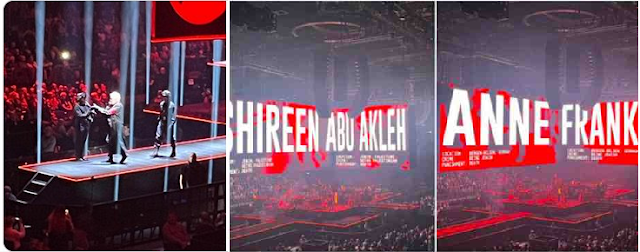
is nonetheless true. The Times of Israel reported
that Waters had ‘sparked outrage”
by projecting Anne Frank’s name at recent concerts
to draw comparisons between Israel and Nazi Germany. Such comparisons are
considered antisemitic under the widely-used IHRA definition of antisemitism.

If comparing Israel to Nazi Germany
is anti-Semitic according to the IHRA then that only demonstrates how flawed the
definition is!
Anne Frank, although
only a teenager, never expressed Zionist sentiments and she considered Zionists
freaks and oddities, as did most of Europe’s Jews. Anne wrote in her Diary (11.4.44)
that
‘My first wish after the war is that I may become
Dutch! I love the Dutch, I love this country…’

Palestine was not on
her horizons. Zionism has colonised her name. Waters enraged
the Zionists even further by linking Anne Frank’s name to that of Shireen abu
Akleh, who was assassinated by Israel.
Vashti’s Cowardly Cultural Politics
The bravery of Roger Waters and his demonstration of how political
culture can challenge bourgeois ideology is in contrast to the insipid and
anaemic cultural politics of Vashti,
who prefer to venerate a rusted Nazi gate than challenge the way that the holocaust
has been used to underpin and legitimise the Palestinian genocide.
Vashti doesn’t dare make such comparisons
because of the ‘offence’ it might cause to the Zionist leadership in Britain.
The Board of Deputies complained
that it was “very concerning” that
Waters will be performing in the UK, calling his concerts “political rallies.” Perish
the thought. A concert that is political! Clearly Board members didn’t attend
the Free Mandela concerts a generation ago.

Joe Biden’s ‘anti-Semitism’
Ambassador Deborah Lipstadt, a junk holocaust historian, was quick out of the
stalls in condemning Roger Water’s as was her European counterpart Katharina von Schnurbein.
Death to the Arabs Demonstration in Jerusalem
We should take our hats off to Roger Waters. The comparisons
between Israel and Nazi Germany are many and varied, from according different
rights to different ethnicities to marches chanting ‘death
to the Arabs.’ If the Zionists don’t like the comparison it’s because it’s
true.
Tony Greenstein
Open Letter to Vashti
Dear Eli
Machover/Vashti,
It was with a growing incredulity
that I read your interview with performance artist, Rachel Mars. The focus
was on ‘Holocaust
memorialisation and the ways our inherited trauma shapes the art we create’.
What stands out most
is the inability of Rachel or the interviewer, Emma Jude Harris, to place holocaust
memorialisation in a political context. Simple questions such as why the focus
and emphasis is on the Jewish holocaust and why the holocaust in the Belgian
Congo and the Slave Trade attract so little attention were not even asked.
Not once does Rachel
or Emma ask how and why the ruling elites in our society have co-opted the
holocaust to imperialism, still less how Zionism has constructed an apartheid
society using the holocaust as its justification. Such simple questions yet
Emma did not feel the need to ask them and Rachel felt no need to mention them.

Questions such as why
the German political establishment has taken on a particular interpretation of
the holocaust as a justification for their integration into the NATO alliance and
how their support for Israel and Zionism has cemented that integration.
To seek answers to
such questions one would have to consult books such as Edith Zertal’s Israel’s
Holocaust and the Politics of Nationhood,
or Yitzhak Laor’s The
Myth of Liberal Zionism or my own newly released Zionism
During the Holocaust
– The Weaponisation of Memory in the Service of Nation and State.

Projected holocaust memorial in Victoria Gardens
Questions such as why a
rabidly racist government in Britain, that demonises asylum seekers crossing
the Channel as an ‘invasion’
is so keen on holocaust memorialisation that only three days ago it introduced a
Holocaust Memorial Bill
which will enable the erection of a holocaust memorial
in Victoria Gardens next to Parliament despite strong local opposition.
Rachel mentions the abundance of
holocaust memorials in Germany yet fails to mention the virtual outlawing of any manifestation of solidarity
with the Palestinians in Berlin or other parts of Germany.
My young Israeli friend, Stav, is
facing two weeks in a Berlin prison for taking part in Palestine solidarity
action. She refuses to pay on principle the fine that was imposed by the German
state for daring to express solidarity with the Palestinians and she also faces
being gaoled in Britain for taking part in actions against Elbit. None of this
was allowed to intrude on your arty-farty interview.
This is the real Jewish trauma
that Rachel Mars ‘forgot’ to mention as opposed to the synthetic trauma that
Israel and its diaspora Jewish offshoots have helped inflict on Jews as a way
of generating support for the ‘Jewish’ state. Emma mentions ‘intergenerational trauma’ among Jews but
Zionism has deliberately out to recreate and invent trauma as a means of
solidifying support for its racist enterprise.
As I noted in Zionism During the Holocaust if the behaviour and attitude of
non-Jews in Europe towards Jews had replicated that of Israeli Jews towards the
Palestinians, then not 6 but 7 or even 8 million Jews would have died in the
Holocaust.
This is the irony that escapes
not only Emma and Rachel but Vashti too. The most pro-Zionist party today in
Germany is Alternative for Germany which
in the debate 3 years ago in the Bundestag wanted to make BDS illegal, is riddled
with neo-Nazis and holocaust deniers.

It was less than a month ago that
two parliamentary representatives of AfD followed,
in what has become a long tradition of neo-Nazis and the far-Right paying
homage to the holocaust, when they paid a visit to Israel’s
propaganda museum, Yad Vashem.
There is no mention of how, in attacking
Jewish anti-Zionists, the German state today is repeating the actions of the
Nazi state before 1939 against Jews who were not Zionists.
On 28 January 1935 Reinhard
Heydrich issued a directive stating:
‘the activity of the
Zionist-oriented youth organisations that are engaged in the occupational
restructuring of the Jews … lies in the interest of the National Socialist
state’s leadership…. (they are) not to be treated with that strictness that it
is necessary to apply to the members of the so-called German-Jewish
organisations (assimilationists).
In May 1935 Schwarze Korps, paper
of the SS, wrote that:
the Zionists adhere to a strict
racial position and by emigrating to Palestine they are helping to build their
own Jewish state.... The assimilation-minded Jews deny their race and insist on
their loyalty to Germany or claim to be Christians because they have been
baptised in order to subvert National Socialist principles
None of this appears in your
interview, even as background. No
mention of how it is the Palestinians who are now the real victims of the
European Holocaust and how the 'intergenerational trauma' of Jews is relieved
by supporting neo-Nazis in the Israeli government, as they cry 'death to the
Arabs'.’ The interview with Mars referred to there being no state sponsored
memorials to the victims of slavery or lynching in the USA, in comparison with a
holocaust which didn't occur in America. Mars says:
There's a new-ish memorial to lynching [in Alabama]. And that was not
state money. It was an individual pursuit, and it is incredible in terms of
design and impact.
Mars and her interlocutor don’t
ask why it is that a memorial to lynching is not sponsored by the state where
it took place or indeed by the Federal Government. It’s simply taken as an act
of god.
Not once do they ask why were hundreds
of millions dollars spent on the US Holocaust Museum in Washington yet the
American state does not see fit to memorialise the Holocaust of Native Indians
and Africans that took place on its shores?
Nor did this interview venture to
ask why it is that holocaust memorialisation conveniently omits Britain and
America’s record in turning away Jewish refugees from the Nazi holocaust. There
are some lessons from the holocaust that are best forgotten.
Mars witters on about the ‘sonic experience’ of the Jewish Museum
in Berlin and how ‘impactful’ it is yet
she fails to mention how the Israeli and German state took out the
previous Director of the Museum, Peter Schaffer, in June 2019.
Schaffer’s ‘crime’ was having retweeted
a report referring to a letter signed by 240 Israeli and Jewish scholars
rejecting the parliamentary motion condemning BDS as anti-Semitic. The museum
used the hashtag #mustread in its retweet and added a quote from the letter: “Parliament’s decision doesn’t assist the
fight against anti-Semitism.”
The Jewish Museum in
Berlin had, for a long time, been in the firing line
of the Israeli and German states for its independent political stand on
anti-Semitism. It had come under attack in 2013 for having invited
British Jewish scholar Brian Klug to give its annual Kristallnacht lecture and before that
Judith Butler.
The saccharine
cultural politics that Vashti offers has not questioned how Israel and the
Zionist movement, aided and abetted by the British and European states, has
colonised diaspora Jewish institutions. Why is it that everything that
Vashti touches has to be so superficial?
When I offered to write an
article about the weaponisation of the memory of the Holocaust, the theme of my
recent book, you didn't even acknowledge it. You must have taken fright at the
very thought of debating the uses to which the Holocaust has been put.
As for 'intergenerational trauma'
- I think there are other words for it like exploitation of past injustice in
order to perpetrate present injustices. But
do tell me. Is this a psychological or a political ailment? Or just schmaltz
dressed up as a pathology?
On a brighter note this will make
for an excellent blog on how the Zionist narrative of the holocaust persists,
even amongst those who claim not to be Zionist. Instead of creating a political
culture which asks searching questions what you are doing is engaging in a
cultural politics which simply reflects rather than questions existing culture and
assumptions surrounding holocaust and how memory is manipulated to serve nation
and state today.
I do not expect a reply to this
letter since I doubt that you are capable of one. With that in mind I am blind
copying it pending a blog.
Tony Greenstein


