Showing posts with label Eritreans. Show all posts

9 May 2018

African Refugees Get No Reprieve from Israel’s Racist Rage


Another brilliant article from the indefatigable Israeli-Canadian campaigner, David Sheen whose videos on Youtube are brilliant. See e.g. War on Africans 
Nothing better demonstrates the vicious racism of the Israeli state and what Zionism has led to than its treatment of the African refugees from Eritrea and Sudan.  Their crime is two fold - they are not Jewish and they are Black - an unforgivable combination.
They are called ‘infiltrators’ in a conscious echo of the term that was used to describe Palestinian refugees trying to return to their lands after 1948.  Thousands were murdered in cold blood as the Israeli Labour founders of Israel sought to ensure that Israel was as Jewish as possible.
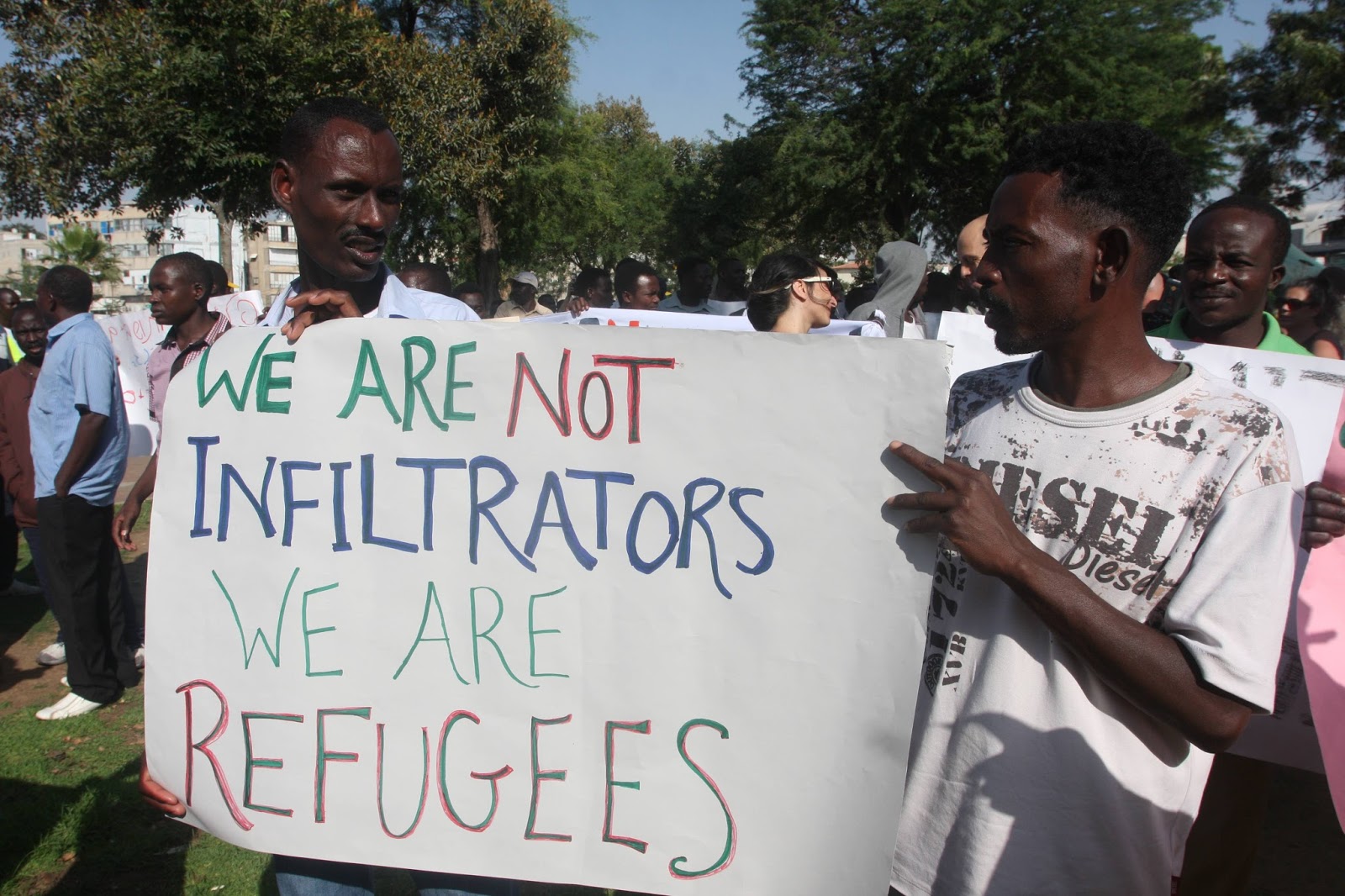
Challenging the racist Zionist description of Black African refugees
Why 'infiltrators'?  Because they are non-Jews infiltrating a Jewish state and thereby making it less Jewish.
Today Africans fleeing from the vicious police state in Eritrea and the genocide in Sudan are refused en masse the right to stay in Israel.  Like the Jews of Russia and Poland in the last century they have  been subject to vicious pogroms led by the Israeli government.
Those with illusions in the Israeli Labour Party should note that the ILP has given full support to Netanyahu. 

The fortunes of the African refugee community targeted by the Israeli government for deportation have swung wildly in recent days

April 23, 2018 David Sheen The Electronic Intifada
African asylum seekers protest against Israel’s deportation plan, South Tel Aviv, 25 February. , Oren Ziv ActiveStills
Prime Minister Benjamin Netanyahu first announced a United Nations-backed deal to resettle some of them in the West, but then quickly retracted the plan after right-wing Israelis complained that the deal was too generous to asylum seekers.“I listened closely to many comments about the agreement. As a result, after reevaluating the advantages and disadvantages, I decided to cancel the deal,” Netanyahu wrote on his Facebook page.
“Despite the growing legal and international limitations, we will continue to act with determination to exhaust all possibilities at our disposal to remove the infiltrators,” he added.

African refugees walk out of Holot
In November, it was reported that the Netanyahu government secured agreements with unnamed African nations for the latter to take in many of the approximately 40,000 refugees remaining in Israel, ostensibly in exchange for a fee of $5,000 per head.
But Netanyahu’s plans for expedited deportation were quashed after protests by refugee rights activists in Israel and abroad shamed those countries, now known to be Rwanda and Uganda, into disclaiming the scheme.
Unable to deliver on his promise to quickly expel all the Africans, Netanyahu grudgingly agreed to a plan brokered by the UN refugee agency UNHCR which, if carried out, would have seen thousands of the refugees resettled in Western nations in the coming years.
Eritreans mourn the victim of lynch mob 
But Germany and Italy, two of the countries cited by Netanyahu as committed to take in asylum seekers from Israel, quickly denied having ever agreed to accept refugees under the scheme.
Opposition to expulsion
Abandoned on all sides within hours of announcing the agreement, Netanyahu walked back the deal, first in part, then in whole, suspending it, and then canceling it altogether.
Although the deal would have provided political cover for Netanyahu’s planned expulsion of the refugees, his political camp vigorously opposed it because it also committed Israel to allowing around 20,000 Africans – mainly women and children – to remain in Israel for another five years and to help them move to parts of the country other than South Tel Aviv, where most of the community is concentrated.
Although a January poll showed that 66 percent of Israeli Jews support Netanyahu’s efforts to expel the refugees to Africa, a recent survey found that positions are reversed in those very areas where residents were more likely to actually encounter any of them.
A March poll revealed that in the greater Tel Aviv area, opposition to the expulsion reached 68 percent, and in the long-neglected neighborhoods of South Tel Aviv with the largest African populations, it hit 71 percent.
refugees at detention centre Holot
On 24 February and again on 24 March, some 20,000 people gathered in Tel Aviv to demonstrate in solidarity with the refugee community and demand that the Israeli government cancel plans to deport them, and instead work to improve the lives of all residents of the city’s delapidated southern district.
Protesters have criticized the Israeli government for having one of the lowest refugee acceptance rates in the world – less than 0.5 percent.
But Netanyahu has claimed that the non-Jewish refugees – about half Christian and half Muslim – pose a threat to Israel’s “national identity.”
In that sense Israel regards them similarly to how it has viewed indigenous Palestinians since its founding, when it expelled 750,000 Palestinians from their homes and barred them from returning because they are not Jews.
And local racists have long labored to shore up support for Netanyahu’s anti-African policies, and to demand that even crueler measures be taken against them.
“Mortal threat”
Shlomo Maslawi, representing Netanyahu’s ruling Likud Party on the Tel Aviv city council, told Israeli TV that he would oppose Netanyahu’s now retracted plan, even though it included promises to invest in the overburdened neighborhoods of South Tel Aviv, until “the Eritreans are gone, down to the last Eritrean – only then will there be rehabilitation.”
In recent weeks, as refugee rights advocates across the country and around the world stepped up their protests, forcing the African governments conspiring with Israel to deny their involvement, Netanyahu lashed out at the refugees, smearing them as a mortal threat.
If he had not built a high-tech fence on Israel’s southern border five years ago, Netanyahu told an audience in March, the number of Africans in the country would be significantly higher, a condition he deemed “much worse” than “severe attacks by Sinai terrorists.”
Coming under rare criticism from some of Israel’s staunchest American defenders, other government officials also doubled down to defend the mass deportations to African states.
Interior minister Aryeh Deri told Israeli army radio that to take these asylum seekers, mainly from Eritrea and Sudan, and expel them to Rwanda and Uganda, would merely mean returning them “to their natural place.”
Avraham Neguise, currently Israel’s only Black legislator, a Jew of Ethiopian origin, also spoke out in support of the deportation to Rwanda and Uganda, telling Israel’s i24 TV, “Well, they came from Africa, and they’re going back to Africa.”
Yitzhak Yosef, one of Israel’s two national chief rabbis, also heaped scorn on the Africans in a sermon last month, in which he called Black people “monkeys” and the Hebrew equivalent of the N-word.
His fellow chief rabbi, Yisrael Lau, had already used that Hebrew version of the N-world to describe Black people, on his very first day in office.
Vigilante violence
These and many other incidents of anti-African incitement have ramped up racism against the refugees. The rage against asylum seekers has grown into a political force capable even of pressuring Netanyahu to cancel Israel’s international agreements.
But the most frightening effects of increased anti-Black sentiment are reserved for the refugees themselves.
Vigilante violence against African refugees has become increasingly common in recent years.
In 2012, an Israeli firebombed a daycare for the young children of African refugees, and in 2014, an Israeli man was indicted for stabbing an Eritrean baby in the head.

Israel's Labour 'Opposition' is as racist as Likud
According to prosecutors, the man later stated: “I attacked Black terrorists, there was a Black baby, they said that a Black baby, Blacks in general, are terrorists.”
The firebomber received only community service, while the stabber was sent for psychiatric treatment.
Since that time, in separate incidents, two refugees – Haftom Zarhum from Eritrea and Babikir Ali Adham-Uvdo from Sudan – were beaten to death in public places by Israeli mobs.
The charges against Adham-Uvdo’s killers were reduced from murder.
One of the killers is a minor whose sentence for “intentional injury” to Adham-Uvdo is yet to be determined. The adult assailant received a maximum jail sentence of 10 years for manslaughter in a plea bargain, although he will probably be released in just a few years.
An Israeli court is currently offering Zarhum’s killers community service.
Coerced to self-deport
This anti-African incitement, coupled with the news that African refugees, including some recently expelled from Israel, have experienced torture, extortion and detention in Libya, where open-air slave markets have been documented, is taking a toll not only on adults, but on Israeli youth, as well.
In February, one refugee confessed that a group of Israeli schoolchildren had approached him on a public bus and asked him, “How much can we sell you for?”
With the Rwanda-Uganda deal shelved in shame, and the UN deal for resettlement in the West now derailed by Netanyahu himself, the fate of the 40,000 African refugees left in Israel is once again unclear.
In lieu of the UN deal, Netanyahu is now reportedly pressuring coalition partners to reopen the Holot internment camp that it closed down only last month in anticipation of the planned expulsions.
Starting in December 2013, Israel rounded up thousands of African men into this detention center, in order to pressure them to self-deport.
By Netanyahu’s count, the government was able to coerce more than 20,000 to leave Israel in this way – a third of the African refugee community.
When the Israeli high court forbade the government from keeping those men incarcerated there for more than a year, the latter banned the refugees who it was compelled to release from moving back to Tel Aviv or Eilat, the two Israeli cities with the largest asylum-seeker communities at the time.
As Israel released Holot’s remaining inmates in March, it informed them that the list of cities they were now forbidden from living or working in had mushroomed from two to seven, adding to the list Petah Tikva, Bnei Brak, Ashdod, Netanya and Jerusalem.
Now Netanyahu’s coalition partners say they may now pass an even harsher version of the so-called Anti-Infiltration Law which they have used to criminalize refugees.
The new bill would build in measures to insulate it from being overturned by the high court.
If they follow through on their threat to neuter the court’s powers, there would no longer be any legal impediment to jailing the African refugees indefinitely in Holot until they agree to self-deport to whatever destination Israel coerces them to go to.
David Sheen is an independent writer and filmmaker. Born in Toronto, Canada, Sheen now lives in Dimona. His website is www.davidsheen.com and he can be followed on Twitter: @davidsheen.

3 January 2016

The ethnic cleansing of Africans in Israel

The Top 9 Israeli Government anti-Refugee Racists 2015


mobfire - the people want the Africans to be burned
Anti-African racism was peddled by both center-left Zionist Union candidate Isaac Herzog and right-wing Zionist incumbent Benjamin Netanyahu while campaigning ahead of the March election. Oren Ziv ActiveStills

Since 2012, the number of non-Jewish refugees from African countries in present-day Israel has shrunk from a peak of approximately 64,000 to fewer than 46,000.
Israel’s successful efforts to reduce the number of Africans living in territory it controls must be recognized for what it is: ethnic cleansing.

For the last four years, I have compiled an annual list of the public figures most responsible for Israel’s racist treatment of Africans.

The list reads as both an indictment of populist opinion-makers and a retrospective of the assaults on refugees that have taken place in the last 12 months.
9. Yisrael Katz - transport minister

In April this year, around 800 refugees drowned when the boat carrying them sank in the Mediterranean.
African Refugees Leaving Holot Internment Camp
In the face of this horrific tragedy, a top Israeli minister chose to revel in the government’s successful efforts to keep refugees out. Yisrael Katz, a leading figure in the right-wing Likud party who heads both ministries for transportation and intelligence and atomic energy, wrote in a Facebook post:
“Europe is having a difficult time dealing with the migrants, and with creating solutions for this difficult issue. While there are differences between us (the migrants traveling to Europe must cross a sea while those heading for Israel have a direct overland connection), you can see the rectitude of our government’s policy to build a fence on the border with Egypt, which blocks the job-seeking migrants before they enter Israel. The elections are over — you can give us some credit now.”
Racist ringleaders
The same week that Katz posted his morbid message, it emerged that among a group of African men who Islamic State militants in Libya had executed for not being Muslims were three Eritreans who Israel had previously deported for not being Jews.
Infiltrators is a loaded term that was used to refer to Palestinian refugees, expelled from Palestine who tried to return.  Its use with refugees is intended to convey the message that the refugees are 'as bad as' the Arabs
Taking a cue from Katz, some Israelis responded to the news over social media with expressions of joy and calls for more of the same.

8. Ben-Dror Yemini - journalist

For years, Ben-Dror Yemini has used his regular column in Israel’s best-selling daily newspaper Yediot Ahronot to attack Africans, as well as Palestinians and progressive Israeli Jews. This August, one of his articles may have shattered all previous records for the depths to which an establishment journalist is willing to descend in support of Israel’s war on Africans.
In it, Yemini argues that African men should be transferred out of Israeli cities and into desert detention centers, in order to prevent romantic relationships between them and Jewish Israeli women, specifically, Black Jewish Israeli women. Yemini notes that this motive would be rejected as racist if it were stated aloud, so he advises against raising this point publicly.

Suggesting that Jews in south Tel Aviv were paying an “unbearable price” because of the Africans living among them, he claims that there are arguments for reducing the number of Africans in city centers that “cannot be presented because they are outside the rules of political correctness.”
Racist riot against refugees
7. Tie: Nissan Ben Hamo and Rafi Ben Shitrit - city mayors

In August, after Israel’s high court ordered the release of African refugees who had been held in the Holot detention center for more than a year, the government grudgingly agreed to let them go, but with a condition.

In the final days before the deadline decreed by the court, the government issued documents to 1,200 of those being released, declaring that they were not permitted to live or work in either Tel Aviv or the Red Sea resort of Eilat.
Eritrean refugees mourn their comrade who was killed by a lynch mob in Beersheva bus station
The decision to restrict entrance to the two cities which contain the largest African communities in Israel posed a serious challenge for the released internees. Barred from accessing their only real support system in Israel — family and friends — the refugees scrambled to find lodging for the night in smaller towns where they didn’t have close contacts.

Within hours of leaving Holot, 20 were arrested in Tel Aviv for violating the conditions of their release.

Residents in Tel Aviv protest against African refugees in August. Keren Manor ActiveStills

On the morning that the first 600 were released from Holot, Nissan Ben Hamo, the mayor or Arad, wrote on Facebook that he would not permit any of these Africans to settle in that city. Ben Hamo followed up his tough talk by posting police officers at entrances to the town with instructions to stop Africans coming in.

Ben Hamo also called upon residents to “maintain alertness” and threatened to mobilize the entire town to resist the arrival of Africans, potentially with physical force. He wrote on his Facebook page: 
Holot Internment Camp
“If we have to strengthen our struggle on this issue, I won’t hesitate to call on all residents to join the fight for the city’s well-being.”

Soon, the local authority of Bisan (Beit Shean), a town in the north of present-day Israel, issued a similar declaration that it would not permit African refugees to settle there. Rafi Ben Shitrit, the mayor, urged the town’s police commander to take “immediate action to prevent illegal infiltrators from staying in Beit Shean,” insisting that they were “not only unwanted but dangerous.”

6. Moshe Yaalon - defense minister

In August, Israeli soldiers shot and wounded three citizens of African states attempting to enter Israel from Egypt. When asked about the incident, the army provided several different accounts of the event that contradicted one another.

And when Defense Minister Moshe Yaalon was asked about the incident in Israel’s parliament, the Knesset, he refused to comment.

Yaalon displayed a similar nonchalance about the shooting of an African a few months later.

In October, after a gunman opened fire at the central bus station in the southern city of Bir al-Saba (Beer Sheva), killing an Israeli soldier and wounding 11 others, an Israeli security guard shot an innocent passerby, Eritrean refugee Haftom Zarhum.

Other Israelis at the scene proceeded to kick Zarhum in the face and slam a large bench onto him as he writhed on the floor, cursing him all the while. The crowd then blocked medics who tried to evacuate him to the local hospital.

Eritreans mourn in Tel Aviv on 21 October during a memorial for Haftom Zarhum, who died after he was shot by an Israeli security guard and beaten by a mob in Bir al-Saba. Oren Ziv ActiveStills

The killing of Zarhum would seem to be an open and shut case of a murderous hate crime. His attackers were caught on camera assaulting him.

They were even interviewed on Israel’s Channel 2 and gleefully took credit for stomping Zarhum to death.

A week later, one of Zarhum’s attackers returned to Channel 2 and said that he had no regrets over his role in the incident.

And yet, Yaalon’s defense ministry decided that Zarhum would not be recognized as a victim of terrorism because he entered Israel “illegally.” Without this status, his surviving family members are not entitled to any Israeli government compensation.

More than two months have passed since Zarhum was killed. No charges have yet been filed against the men who were responsible for his death.

5. Issac Herzog - opposition leader

Another one of the ways that Israeli society becomes increasingly racist is when centrist parties like Labor adopt right-wing rhetoric in order to chase after right-wing votes.

In recent years, Labor has not played the foil to Prime Minister Benjamin Netanyahu, but instead acceded to almost all of his hawkish proposals. Instead of standing firm against Israel’s lurch to the right, Labor has attempted to ply votes away from Likud with right-wing proposals.

That tendency has increased ever since Isaac Herzog was elected to lead the party in November 2013. It has been especially evident in Herzog’s solid support for Netanyahu’s military campaigns in Gaza and the West Bank, but also in his support for expelling Africans from Israel.

It was not always so. When the Knesset first voted to amend the country’s “anti-infiltration” law in January 2012 to sanction the roundup, detention and expulsion of African refugees, Herzog opposed the measure.

When the Knesset voted to amend the law a second time in December 2013, Herzog didn’t show up for the vote. And by the time the Knesset voted to toughen it a third time in December 2014, he voted in favor of the amendment, along with several other Labor lawmakers.

In May 2012, Herzog wrote an opinion piece, challenging arguments by human rights groups that Eritreans in Israel deserved protection as refugees.

In March 2015, Herzog repeated this refrain in an attempt to peel anti-African votes away from Netanyahu on the eve of the Israeli national elections, saying, “We need to negotiate with Eritrea on the return of the Eritreans back to Eritrea.”

This year, Labor led a successful effort to abolish the Knesset’s committee on foreign workers, one of the few forums in which the concerns of refugees could receive a hearing in parliament.

In September 2015, Labor publicly complained that Netanyahu’s government has not done nearly enough to expel Africans from the country. In a public statement, Herzog’s Labor Party wholeheartedly adopted the far-right’s propaganda points, insisting without any basis that most refugees in Israel have no valid claim to refugee status.

“The crisis of the refugees from Syria is not similar to the issue of the infiltrators from Africa who are mostly migrant workers,” the statement read. “If only Bibi’s government had created immigration laws, it would be possible to send back to their country those who are in Israel for their welfare and for work. But the Likud government is only good at talking, and it is responsible for the troubles of the residents of south Tel Aviv.”

4. Ayelet Shaked - justice minister
During her first term as a Knesset member, from 2013 to 2015, Ayelet Shaked headed the parliamentary “lobby to return the infiltrators to their countries,” a group dedicated to expelling all African refugees from Israel.

In her second term, Shaked was appointed justice minister, a position she has not shied away from using to advance the lobby’s objectives.

Each time Israel’s high court has struck down amendments to the “anti-infiltration” law as a violation of the country’s basic laws, right-wing lawmakers have raged against the judicial decisions and plotted to neuter the court’s ability to void legislation.

To this end, Shaked introduced a bill in the Knesset to limit the high court’s power to overturn laws. And as judges entered the eleventh hour of deliberations over the Knesset’s third amendment to the “anti-infiltration law” this year, Shaked began to upload videos to the Internet which purported to show African refugees in a negative light.

Shaked expressed a desire to pressure the judges into issuing a ruling that would leave the Africans under lock and key.

Within hours, Shaked removed one of the videos she had uploaded after it was pointed out to her that the footage had been filmed in Turkey, not Israel.

Ultimately, under threat of losing some of their powers, the high court judges agreed to let the government’s third amendment stand, with the caveat that refugees could only be detained for a year.
Disappointed that her victory was only partial, Shaked has begun to examine ways of filing criminal charges against Africans who enter Israel.

3. Gilad Erdan - public security minister

During Gilad Erdan’s brief term as interior minister, he secured the passage of the third amendment to the “anti-infiltration” law that enabled the incarceration of Africans in desert detention centers.
In the new Netanyahu government, Erdan heads the information, strategic affairs and public security ministries.

But before taking on his new roles, Erdan decided that any African who did not have a refugee status application pending must return to Africa, or be imprisoned indefinitely if they refused.

In July, an Israeli court threw out an appeal by human rights groups to quash this draconian directive.
A report by two groups working with refugees in Israel found that some of the Sudanese nationals that Israel had sent back to Sudan were being tortured by government forces upon their return.

African refugees jailed in Holot desert prison camp pray after eating a meal breaking the Ramadan fast in July. Oren Ziv ActiveStills

For the remainder of 2015, Erdan’s attacks on refugees consisted not of legal injunctions, but rather of racist incitement.

In April, a massive earthquake shook Nepal. This tragic event was mainly a cause for consternation in Israel because the country is a popular destination for Israeli tourists, and also a popular source of surrogate mothers to bring babies to term for gay Israeli couples.

Then serving as interior minister, Erdan responded rapidly to the quake by ordering the airlift of Israeli citizens out of the danger zone, and to also bring along a small number of local women who were in the final stages of pregnancy with Israeli fetuses.

Appearing on a popular television news show to discuss the development, Erdan emphasized that the Nepalese women’s presence in the country was “temporary.”

“We won’t convert them [to Judaism] and let them stay here,” he said.

The show’s host retorted sarcastically, “Of course, after the birth they will obviously end up in Holot,” referring to Israel’s desert detention center for African refugees.

In response, Erdan burst out in hearty laughter.

Four months later, after Erdan had already left his post at the interior ministry, he admitted that the true purpose of the third amendment to the “anti-infiltration” law was to incarcerate Africans in order to put pressure on them to leave Israel.

As public security minister in the current government, Erdan has used news of Islamic State’s activities in Africa as a pretext to call for tightening the screws even further on refugees in Israel.

Without evidence, he has warned that African refugees could be Islamic State recruits, casting them as “a real security risk.” Erdan has prodded Netanyahu’s Counter-Terrorism Bureau into considering some African refugees as terrorists.

2. Silvan Shalom - interior minister

In Israel, the person with the most influence over the lives of refugees is the interior minister, responsible for deciding who is and who isn’t allowed to enter the country. For the bulk of 2015, that person was Likud legislator Silvan Shalom.

It came as no surprise when Shalom maintained the anti-African policies of his predecessors. At least as far back as 2011, Shalom publicly identified refugees as a “threat.” At that time, when citizens of African states accounted for 13 percent of the population of the southern city of Eilat, Shalom, then minister for development of the Naqab (Negev) and Galilee regions, proposed the building of a border fence to keep Africans out of Israel.

“The fence is critical for the defense of the city of Eilat from terror cells and of course from huge waves of infiltrators flooding the city,” Shalom said.

Though Shalom’s hardline stance came as no shock, the level of anti-Black racism that emanated from his own household managed to exceed the expectations of some outside observers.

Just a month into his term as interior minister, his wife, the broadcaster Judy Shalom Nir Mozes, publicly insulted the US president in a reductionist and racist tweet: “Do u know what Obama Coffee is? Black and weak.”

In August, Shalom decreed that any African refugee freed from Israel’s desert detention centers by a high court order would henceforth be forbidden from living or working in either Tel Aviv or Eilat, turning those cities into “sundown towns.”

Many Israeli cities have long operated as de facto sundown towns. Palestinian citizens of Israel are harassed and run out of these cities once the sun sets, ostensibly in order to prevent romances between Jews and people of other religions.

While some of the groups who chase non-Jews out of town after dark are vigilantes who operate independently, others work in concert with the police and the municipalities.

Also in August, in an effort to undercut the refugee claims of Eritreans, who make up three quarters of the asylum-seeker population in Israel, Shalom defended the dictatorship in Eritrea. “You apparently don’t know what is happening in the country,” he responded to the accusation that Eritrea is an autocratic regime, but admitted that his belief was based on testimony by Eritrea’s own ambassador to Israel.

“Of course. Who [else] would provide the information?” he said.

Before the month ended, Shalom authorized a new rule that would put almost every non-Jewish African living in Israel at risk of being rounded up and taken to the desert detention center Holot.

Prior to the new protocol, only Eritreans and Sudanese who had already lived in Israel for many years could be summoned to Holot. Shalom’s new criteria stipulated that any Eritrean or Sudanese in Israel can be detained in Holot, regardless of the date that they entered the country.

In November, Shalom’s ministry distributed the proposed text of a fourth amendment to the “anti-infiltration” law, seeking to increase the duration that refugees can be incarcerated at Holot. In addition, the new amendment specifies that even asylum-seekers who are parents to young children can now also be forced to live at Holot.

In the last days of December 2015, Shalom resigned his post and quit the Knesset after six women came forward and accused him of serious sex crimes.

1. Benjamin Netanyahu - prime minister
Just days before national elections were held in March, Prime Benjamin Netanyahu published a video recounting what he considered to be the greatest accomplishments of his last term in office.

Among these, he took credit for preventing the entry of African refugees or in his words, “infiltrators.”

We shut off, completely closed off access to terrorists, to infiltrators to the State of Israel,” he said.  “The only state that managed to control its borders.”

This was no idle boast. Eritreans and Sudanese make up more than 90 percent of the asylum-seekers living in Israel. And yet Israel has awarded refugee status to only four of the former and zero of the latter.

In the words of an editorial published by the Tel Aviv newspaper Haaretz in February, “Israel is the least moral country in the world when it comes to awarding asylum to those who deserve it.”

Once Netanyahu secured reelection, he set to the task of divvying out government ministries among party loyalists and coalition partners.

Among those appointed to serve in his new cabinet were all three Likud lawmakers who were featured speakers at a May 2012 anti-African rally in Tel Aviv that devolved into a full-on race riot: Danny Danon, Yariv Levin and Miri Regev.

For years, Netanyahu has led a team of ministers who demonize Africans in the minds of the Israeli public by associating them with terrorism and fatal diseases.

But Netanyahu knows that it isn’t appropriate for the head of the government of a self-styled Western democracy to cast all refugees as criminals.

So while he calls refugees “infiltrators” in Hebrew, his English-language statements mistranslate his slur word as “migrants.”

For four years running, Netanyahu has led Israel’s war on refugees: promoting racists to positions of power, ensuring the passage of anti-African legislation and inciting racial hatred against a defenseless community.

Haaretz accurately summed up Netanyahu’s anti-African legacy in an editorial it published in July, under the headline, “Israel thinks African asylum-seekers aren’t human beings.

David Sheen is an independent writer and filmmaker. Born in Toronto, he now lives in Dimona in present-day Israel. Website: www.davidsheen.com. Twitter: @davidsheen