There is one and only one
issue – Labour’s Silence on Genocide in Gaza and the Attack on Rafah
Whatever
else you can say about George Galloway he is not without controversy. Politically
he has a long record of forming alliances and then falling out with his
partners – whether it is the SWP
in Respect or the Stalinist Communists Party of Great Britain - Marxist
Leninist in his Workers Party.
I say ‘his’
because the Workers Party revolves around George. It is very much his baby and
it is highly unlikely that the membership would overrule him on any major issue
or indeed have the means to do so.
🚨Twitter deleted the post, so reposting to expose Israeli army crimes!
Last video of kids martyrs of Husouna family massacre They fled from Gaza to Rafah in search of safety, escaping shelling Israeli army killed them inside their tent along with all family members last night ! pic.twitter.com/hlW7qWqFJx
This is what war criminals Keir Starmer & Peter Kyle Support
George is
politically eclectic. He is a brilliant speaker, an old-fashioned orator in an
age when the leader of the Labour Party freezes like a rabbit
caught in a car’s headlights whenever anyone gets to challenge him as Audrey
White did when Starmer ventured into Liverpool.
George is not
someone that socialists find easy to support. He is anti-abortion for a start and
dismissive of issues of sexual orientation and sexual oppression -all of which heputs into a basket called ‘wokery’. There is
a distinct impression that he panders to some very basic prejudices such as
homophobia and transphobia in the belief th at if you ignore these issues then
you will get basic workers’ unity.
Likewise George’s
attitude to race which is most evidenced in his failure to oppose the Tories
scapegoating of asylum seekers. George disgracefully
attacked the SNP for having supported demonstrators in Glasgow who
freed two refugees who were seized by the Home Office’s Border Unit.
He was also
vehemently pro-Brexit and was quite prepared to support a racist like Nigel
Farage. Indeed he tried to
become a candidate in the European elections for the Brexit Party.
He even formed
an alliance in Scotland with Tories and that he even shared a platform with David
Clews, a member of the Patriotic Alternative.
Deserted!
So what are
his pluses?
George has
been a consistent anti-imperialist and was expelled from the Labour Party as an
MP for opposing the Iraq War. When summoned to Congress to address allegations
regarding oil sanctions he turned in a fine and memorable
performance.
On the
issue of Palestine George also has a good record. There was a time when he supported
the two-state solution. I know because I debated the issue with him at my old
college St Mary’s in Strawberry Hill, Twickenham. But as he later admitted I
was right and he was wrong on this.
So I
understand why it is that many people refuse to support Galloway because of his
de facto alliance with racists and
reactionaries.
Letter in the Scottish National from anti-racist campaigner Mark Brown
However the
by-election in Rochdale is not about Galloway but what he stands for on the one
key issue in Britain and indeed the world.US and British imperialism’s support for the genocide in Gaza. All other
issues pale by comparison. The lives of thousands of Palestinians hang in the
balance at this moment and Galloway’s disgraceful opportunism over refugees,
Brexit and Farage are minor by comparison.
Galloway
and only Galloway is able to win this election. If Galloway wins the election
it won’t be his previous positions that are highlighted in Britain against the
racist imperialists Sunak and Starmer but his position on an immediate
ceasefire in Gaza.
This is the
key dividing line in British politics. It is the most crucial issue that we
face today. It would be utter sectarianism for anyone on the left to ignore
this. We cannot choose who our representatives are sometimes. Galloway’s
victory will be a victory for the Palestinians. What he thinks about Brexit or
refugees is frankly irrelevant at this time.
A defeat
for Starmer’s candidate, Azhar Ali is now certain now that the Labour Party has
withdrawn its
support for him, allegedly over his ‘anti-Semitic’ comments about Israel having
been forewarned of the October attacks but in reality because of the
realisation that he was going to lose.
We need Galloway’s
victory to make it crystal clear to that apology for a human being, the robotic
Keir Starmer that support for genocide is unacceptable.
GENOCIDE IN
GAZA IS THE ONLY ISSUE IN THE ROCHDALE BY-ELECTION
It
is Doubtful Whether Johnson Will Survive to the End of June but Underlying the
Vote Are Political Differences Such as Brexit
There is a word for taking delight in someone else’s
misfortunes – Schadenfreude. It is
difficult to think of a more detestable character than Boris Johnson. A bona
fide racist,
homophobe,
anti-Semite,
Zionist,
arch imperialist
and warmonger,
anti-democratic, contemptuous of the poor, sexist. There aren’t enough
adjectives to describe this sociopath.
Johnson's nearly 3-year stint as Prime Minister has been one
unmitigated disaster. Brexit has resulted in political paralysis in Northern
Ireland and a £20
billion drop in exports to Europe compared to 2018, some 12%.
But it is in the sustained attack on refugees and asylum
seekers and democratic rights which marks this government out. The Police
& Crime Sentencing Act, the ‘Spy
Cops’ or Covert Human Intelligence
Sources (Criminal Conduct) Bill, which allows government bodies to authorise
law-breaking by undercover operatives in the UK. The other is the Overseas
Operations Bill, which is gives state operatives a license to murder and
torture. The new Public
Order Bill continues the tradition.
The fact that Starmer’s Labour abstained on the first two
demonstrates just how far to the right the Labour Party now is. The proposed
Public Order Bill continues in the tradition of giving the Police yet more
powers whilst whittling away at the right to protest and demonstrate such as for
example locking on.
It even proposes
banning people from taking part in demonstrations. The Serious Disruption Prevention Orders can either be made following a
protester’s conviction or on application to a Magistrates’ Court from a Chief
Constable of a local police force. You do not need to be convicted of an offence to
be issued with one.Serious
Disruption Prevention Orders encourage the expansion of police intelligence
gathering on a range of social and political movements.
Jeremy Hunt, a leadership candidate stuck the knife in earlier today
So there are no regrets at Johnson’s imminent demise. However
there is no reason to believe that his successors will be any more enlightened.
It is the lack of any serious socialist challenge to the present ruling class consensus
which is most worrying.
Underneath the present crisis are the continuing tremors from
Brexit and Britain’s role in the world. Johnson was of course happy to throw in
British imperialism’s lot with US imperialism whereas his opponents looked to Europe.
Except that in the current crisis of a proxy war in Ukraine the European Union
has itself subordinated its foreign policy to the United States.
We can however enjoy the scene of the wretched corrupt Johnson
twisting in the wind as his opponents move in for the kill. Let us hope that he
takes Pritti Patel with him!
Sturmer demonstrates he is unable to rise to the occasion
Keir Starmer of course has demonstrated how useless he is,
even for a bourgeois politician. He is not only humourless and boring but he
has no political antennae. The obvious reaction to 41% of Tory MPs voting
against Johnson was to say he had lost the confidence of his own MPs (just 60
Tory backbenchers supported in addition to the payroll vote) and should resign.
What did Mogadon Man do?He said that Tory MPs should be condemned for their vote of confidence
in Johnson. A complete misreading of the situation as tomorrow’s newspaper
headlines will remind him. Even The Telegraph, Johnson’s old paper nicknamed
the Torygraph for its loyalty to the Tory Party has called
the vote a ‘Hollow Victory’ and said
that it ‘’tears the Tory party apart’ and
that Johnson’s authority is ‘crushed’ with
‘rebels circling to finish him off’.
The tragedy is that the Labour Party doesn’t have a similarly
ruthless way of finishing off the tailor’s dummy who is currently leading it.
If by some mischance Starmer were to become Prime Minister thenhis popularity and authority would decline at
an even faster rate than Johnson’s as they share the same poisonous politics
but Starmer lacks Johnson’s synthetic charisma. If Johnson’s aversion to the
truth was seen as his major personal handicap we should remember that Starmer
is no less the liar.
The 10
Pledges he used to win the Labour leadership election have been junked.
Starmer also deliberately hid the fact that he was backed by an assortment of
the mega rich including open
Zionists and other racists. After all Starmer is a ‘Zionist
without qualification’ and he has signed up Johnson’s agenda on NATO and Ukraine.
We should take the opportunity that Johnson’s imminent demise
offers to strengthen our own opposition to the raft of Tory legislation in the
offing.
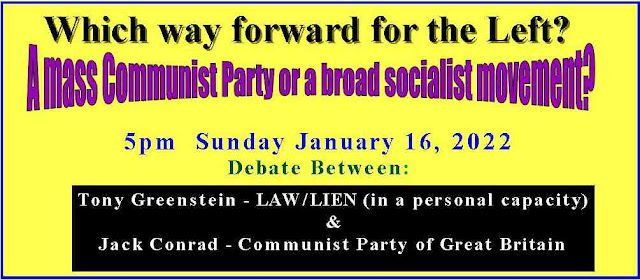
Tonight we had the launch meeting of the new
Socialist Labour Network (LAW/LIEN) and 150 people attended. Ian Hodson,
President of the Bakers Union was the guest speaker.
The process of forming a new organisation began
at the end of November when All Members Meetings of Labour-in-Exile-Networkand Labour Against the Witchhuntvoted to merge into a single organisation. Both
LAW and LIEN had been proscribed by Labour’s National Executive Committee last
July 20th.
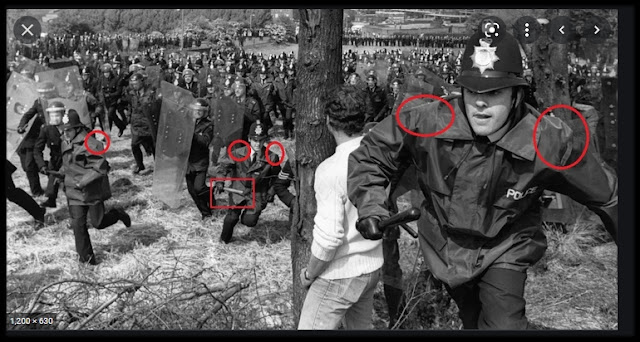
Orgreave when the Police were used as Thatcher's cavalry to destroy the strike
The
decision of the 2 organisations to merge was taken in the teeth of opposition
from Labour
Party Marxism which is the Communist Party of Great Britain in the Labour
Party. 5 of the 6 members of LAW’s Steering Committee were also opposed to
the merger and 4 of them explained their reasons in a statement Why we resigned.
The
fact that the CPGB and its leading theoretician Jack Conrad felt the need to
personalise a political disagreement suggests that the CPGB is finding it
difficult to mount a sustainable argument.
LPM
insisted, contrary to all the evidence, that what was being proposed was not a
merger but a liquidation and notwithstanding the evidence they have continued
to insist that this is the case.
My article, for which I had provided a heading ‘Why the merger of LAW and LIEN is
not a liquidation’ was retitled Not a
liquidation? It was also accompanied by a subheadline ‘Abandoning any pretence of class politics, Tony Greenstein defends what
he calls the ‘merger’ of LAW and LIEN and advocates yet another ‘transitional’
halfway-house broad front’
Despite
Conrad admitting that ‘LAW has done very
little, has been paralysed even’ my argument that LAW had not been
liquidated was described as ‘clearly a
pedantic attempt to pull wool over eyes.’ Conrad continues to argue that
‘while the words ‘liquidation’ and
‘closing down’ did not appear in motion 1, only someone who wants to cover up,
to obfuscate, to hoodwink, would object to such an assessment.’
Such an unnecessary expenditure of verbs! To allege that your political
opponents are, effectively, lying is not the way to conduct a comradely debate.
And the evidence for such an assertion?Zilch.
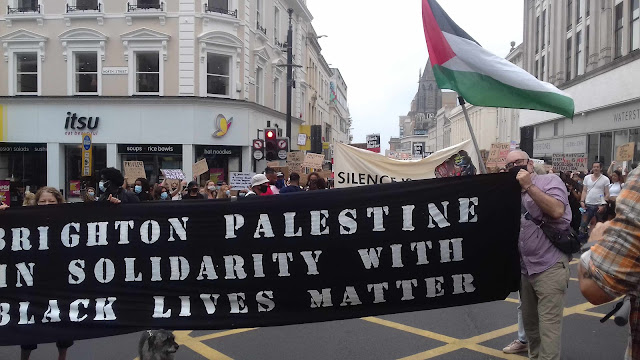
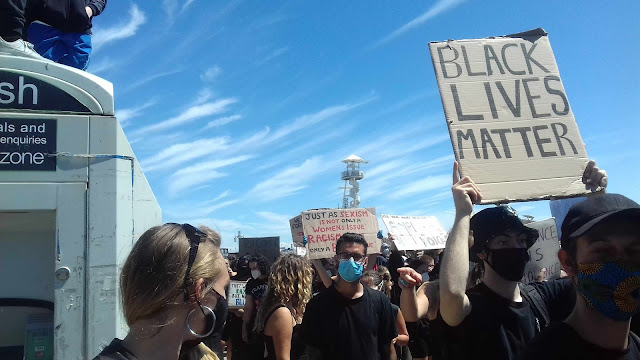
Black Lives Matter demonstration in Brighton
As far as the CPGB and other far-left groups are concerned the key task
is to form a revolutionary socialist or communist party with which capitalism
can be brought to an end. And suffice to say they have the key to the holy
grail.
Many of us saw the Corbyn movement as a quite momentous political event.
Hundreds of thousands of people joined the Labour Party. It made a profound
effect politically and at the 2017 General Election, millions of people voted
for a radical, not revolutionary, manifesto.But for the sabotage of Labour’s right-wing, Corbyn could have won. As
it is he obtained the largest swing since 1945 for Labour. One thing is for certain.It put the frighteners on the British establishment. It also showed the potential for radicalism in Britain.
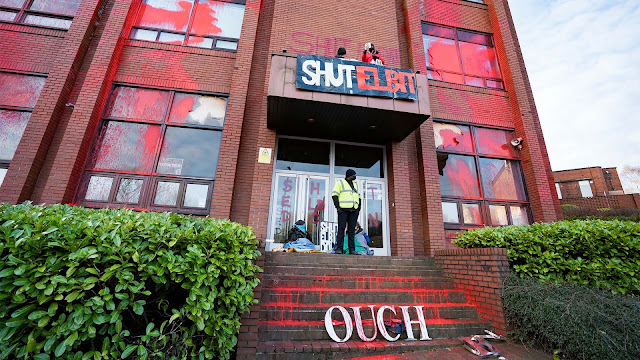
Elbit's factory in Oldham - they've had enough and are closing
But to the CPGB what happened under Corbyn Project was merely a
diversion. An inevitable failure. Jack lays
out his stall thus:
‘What needs to
be understood is that socialist - ie, Marxist - parties, are built top-down,
not bottom-up. What is primary is the programme: ie, theory. It is from there
to the masses and in the process, of course, theory is enriched, concretised,
taken to new heights. It should also be understood that Marxist parties do not require
revolutionary conditions in order to grow. They can grow in peaceful, seemingly
almost uneventful, conditions.’
The idea of even thinking about building
a socialist movement outside the Labour Party is given short shrift. It is what
they call a half way house, a Labour Party Mark II. What is needed in their eyes
is to jump from a small revolutionary group to a mass revolutionary CommunistParty without even pausing for breath.
Labour
needs be refounded as a united front of a special kind and politically armed
with a Marxist programme and put under a tried and tested Marxist leadership.
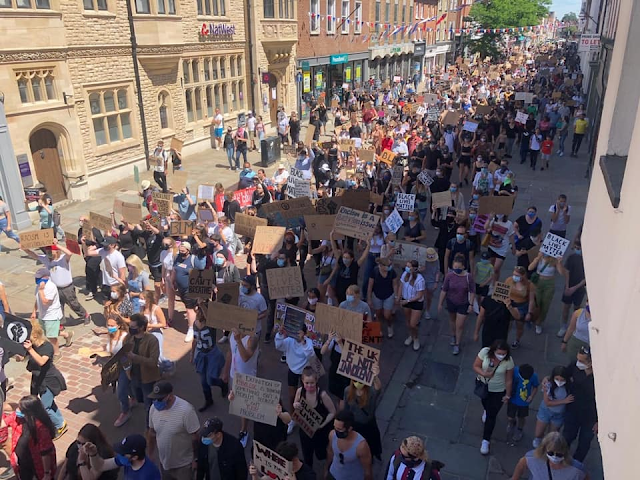
BLM demo in Chichester, a town 30 miles from Brighton
What
then of the Corbyn movement itself?Jack
doesn’t pull his punches.
what
was notable about them - especially, sad to say, the younger generation - is
that they were not politically determined, not politically educated and
therefore did not fully engage. They voted Jeremy Corbyn against Owen Smith,
but had not much of a clue when it came to national executive elections.
My
own view is that we are not in revolutionary conditions or a pre-revolutionary
period. On the contrary we are in a period of deep reaction, symbolised by
Brexit, which was a project of the Right and far-Right.
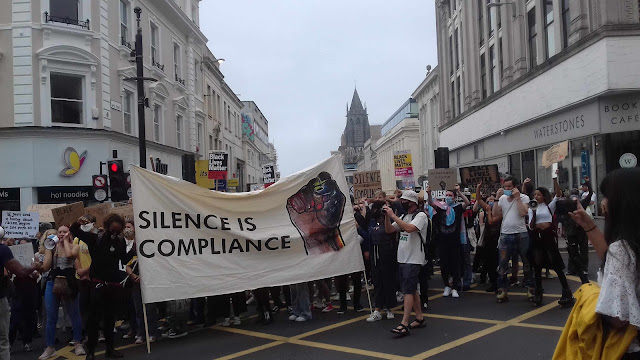
Black Lives Matter demonstration in Brighton
We
need to look to our strengths and weaknesses. Trade union strike action has
been at an all time low. Unions today are half the size they were under
Thatcher.Yet at the same time we have
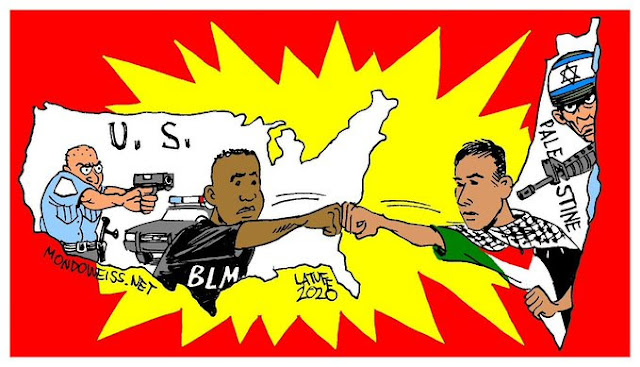
seen the rise of social movements like Black Lives Matter, Extinction Rebellion
and direct action groups like Palestine Action. The question for socialists is
how we can relate to and generalise from the specific. We need to be able to
make the connection between climate change and environmental destruction and
the nature of capitalism and how it operates. In other words socialism needs to
be made relevant.
Only
this week we learnt that Palestine Action had chalked up its first victory, the
closure of
Elbit’s factory in Oldham. I have a personal investment in this campaign as I’m
presently out on bail for taking part in an action. It demonstrates that direct
action can work. It is no accident that Palestine Solidarity Campaign, which is
controlled by the former Trotskyist Socialist Action denounced Palestine Action
in the strongest terms.
Black Lives Matter demonstration in Brighton
Other
issues include a theoretical assessment of the period we are in, the decline of
trade union power, the conservatism of a working class that is supposed to be the
agent of revolutionary change and asking questions such as whether revolution
is even possible in the heart of the imperialist beast.
The recent Loyalist riots should remind us that the
Good Friday Agreement was a palliative not a solution – only the end of
Partition will achieve that
Yesterday was the
anniversary of the death of Bobby Sands, MP for Fermanagh and South Tyrone. Sands
died on hunger strike 40 years ago. Despite being elected to parliament he was
allowed to die because Thatcher was determined not to concede to demands for
political status for the IRA prisoners.
In the end the demands of the hunger strikers
were conceded because even the stupidest member of the British ruling class
came to understand that their intransigence had simply resulted in massively
increased support for the IRA and Sinn Fein. In 1983 Gerry Adams was elected as
MP for West Belfast displacing Gerry Fitt ‘the Brit’.
Of course Bobby Sands was
deemed a ‘terrorist’ as have all those who took up arms against the British in
the colonies.And Ireland was our oldest
colony. If you are a British racist then the British army could do no wrong
wherever it ventured whereas those who took up arms against it were always in
the wrong.
Israel has the same policy today.
Anyone who opposes Israel’s occupation army is considered a terrorist whereas
Israel, despite its atrocities against children even is never considered a
terrorist state.
However the days of Unionism
are numbered. Britain no longer has a strategic interest in maintaining the
union. British investment today is in the South not the North.The shipyards and engineering factories of
Belfast are gone. That is why successive governments from Harold Wilson onwards
have refused to resurrect the Protestant Supremacist police statelet that
existed between 1921 and 1969.
Brexit has produced some
uncomfortable truths for the Unionists. Large sections of the Protestant
farming community look towards the South and the European Union today, not the
mainland. That is why Boris Johnson, despite promises to the contrary, reneged
on his promises to the DUP and placed a tariff border down the Irish sea in
order that Northern Ireland could stay in the customs union.
The days of the Unionist
veto are long since gone. The Protestant community itself was split during the
2016 referendum over Europe. The DUP, being a stupid party, never thought that
Brexit would hasten the end of Unionism.
There is probably a majority
for Irish unity today in the north of Ireland. I would expect that if such a
referendum were held and Boris Johnson will resist one to the end, that a chunk
of the Protestant community would also vote to unite.
History is against the
Loyalists of Ulster. They are an anachronism of the Empire. The days of the
Curragh Mutiny are long since gone. Of course the Protestant paramilitaries
would promise civil war and violence should a referendum be held on the border.
When I visited Northern
Ireland in the 1980s as part of a Labour Party delegation from Brighton we
visited the headquarters of the UDA, a Protestant terrorist group who were
legal at the time, because some forms of terrorism were acceptable to the
British army.
Speaking to Andy Tyrie, the
commander and John MacMichael, who was later assassinated by the IRA, was like
being taken back in time. They looked to the golden days of Empire. They told
us of the days in Liverpool when there was a sectarian Protestant party on the
Council which allied with the Tories never asking themselves why working class
people should vote Tory. In Liverpool that party disappeared but not in
Northern Ireland.
The Protestant working class
voted against its own interests and for Unionist parties allied to the Tories since
1922. That is the effect of settler colonialism. It creates an alliance between
the settler working class and ruling class even if, as in the case of Northern
Ireland the privileges that the Protestant working class gained over their
Catholic neighbours were minimal.
The Good Friday agreement
which ended the struggle of the IRA and led to a power sharing agreement in the
Northern Ireland Assembly was in essence a palliative. The British ruling class
was under immense pressure from the American ruling classto resolve the crisis, which Blair did.
However the situation in the North has not been resolved as the latest riots
demonstrated.
Beneath the surface the old
antagonisms remain. The Protestant working class is embittered that they have
been ‘sold out’ as if the British ruling class every owed any loyalty to those
who pledged fealty to them.
At the heart of the problem
is the border, Partition. Of course today it is a notional border without
customs posts. It is a border without any natural geographical features such as
rivers.Its basis for existing was the
need to produce an artificial majority for the Protestants in the North.
As James Connolly, the
revolutionary socialist who was executed for his part in the Easter Rising
said, Partition would create ‘a carnival
of reaction on both sides of the border’. He was of right in his prediction
Not only in Ireland but India, Cyprus and Palestine. Partition and communalism
were the favourite divide and rule tactics of the British in their efforts to
maintain neo-colonial rule.
The British working class has
never been distinguished by its support for the struggle of Irish people or the
IRA but during the miners’ strike, when there were massive confrontations with
the British state, the Police and reputedly the army in civilian uniforms, this
began to break down,
I worked closely with miners
from Kent coalfield and visited and stayed with strikers in Yorkshire. I heard
repeatedly the same sentiment after the failed IRA attack on the Grand Hotel in
Brighton in 1984: ‘Pity they didn’t get
her.’ Indeed to my surprise, as I was volunteering in an old peoples’ home
at the time (when Councils ran such things) one of the cooks in the kitchen
expressed her disappointment that Thatcher had survived.
During the bitterest episode
of class struggle in the last century, elements of the British working class began
to see that the struggle of colonial peoples against the British ruling class was
also their struggle.
Below isthe article I wrote last year and beneath
that Peter Bolton’s article in the Canary.
Tony Greenstein
The Stupidity of
Thatcher and the British Government in Refusing Political Status for Republican
Prisoners led to the growth of Sinn Fein North and South
Bobby Sands wasn’t the first Irish hunger striker nor
was he the last to die. Terence MacSwiney, the elected Sinn Fein
Mayor of Cork, died in Brixton prison in October 1920 after 74 days on hunger
strike. He had been arrested by the British government on a charge of sedition,
a clearly political ‘crime’. 10 hunger strikers
died in 1981.
Roy Mason, Labour's Northern Ireland Secretary, behaved like a typical
British Colonial Secretary
Their demands were for the return of political
status which had been removed on March 1 1976 by Merlyn Rees, Labour’s Northern Ireland
Minister. He was succeeded by the hated Roy Mason who was worse than any Tory
imperialist ruler.
At first the reaction to the removal of political
status was the blanket and dirty protest where faeces were spread on the
walls. Eventually that led to the hunger strikes. The behaviour of Roy
Mason in provoking what became the hunger strikes led to the defeat of the
Labour government when Frank MacGuire,
the Independent Republican MP for Fermanagh and South Tyrone abstained in
person.
Of course there are racists and imperialist dupes who
chime up that the IRA were ‘men of violence’ and ‘terrorists’. The same people
have no problem in supporting the ‘men of violence’ when it comes to the
invasion of Iraq, the bombing of Libya, Israel’s war against the Palestinian
people and any other imperial adventures. But when people fight back against
colonialism and imperialism it is terrorism. The same is true in
Palestine. The only ‘terrorists’ are the Palestinians, never the Israeli
state.
The 10 Hunger Strikers Who Died
During the 16th and 17th
centuries Ireland and in particular Ulster was subject to the Plantation, the colonisation
of Ireland by thousands of settlers from Britain, Scotland in particular. This
was enabled through the confiscation, i.e. theft of land from the indigenous
population. This Protestant population was then used as a foil by the British
state in order to undermine and subvert Irish unity.
The same happened in Palestine with the settlement of
Jews from Europe and it is what the Indian government today is intending to do
in Kashmir.
Bobby
Sands funeral cortege accompanied by 6 IRA men
I was a member of the Troops Out Movement and I
arrived on a fact finding/solidarity tour on 8th August 1981 as the
9th hunger striker, Thomas McElwee died. I’ll never
forget the scene on the Falls Road, the main road through the Catholic ghetto
of West Belfast, with hundreds of women banging dustbin lids on the road to
announce the death.
Here was a working class community basically in
insurrection. I had never seen anything like this and wasn’t to see anything
like it until I stayed during the miners’ strike in the South Yorkshire village
of Armthorpe in December 1984. Armthorpe had been subject to a siege by
the corrupt and murderous South Yorkshire Police.
Although he died, it was
Bobby Sands who won out against Thatcher
The British strategy in Northern Ireland was
criminalisation. According to this fiction the IRA and INLA were merely common
criminals like any bank robber. This has always been the reaction of the
British to colonial uprisings. Whether it was the Indian Mutiny or
the Mau Mau Uprising
in Kenya the only reason that people rebelled against British rule was for base
criminal reasons. There was nothing political about it. This was the
self-deception that the British comforted themselves with. It was an illusion
and a lie.
The 5 Demands
The fact is that the Catholic population of Northern
Ireland had never accepted the constitutional set up. In 1918 Sinn
Fein won the all-Ireland general election
winning 73 out of 105 seats. The Liberal government under Asquith had refused to
implement the Home Rule Act of 1914 as a consequence of the Curragh Mutiny by
army officers. After the Easter Rising in 1917 and Sinn Fein's election victory, which the British refused to accept, there began the war of independence.
There was a civil war in the Free State in Southern
Ireland between 1922 and 1923. The British had threatened war and destruction
unless the Irish accepted Partition. Partition, the favourite solution of
imperialism to its divide and rule tactics in settler colonies, was imposed on the
Irish people. The nationalist population of the north of Ireland had never
accepted Partition and the IRA was the consequence.
Some of the thousands of mourners at Bobby Sands funeral
Partition has had disastrous consequences wherever it
has been imposed in the world, be it Cyprus or India or indeed
Palestine. As James Connolly predicted, Partition
would mean a carnival of
reaction both North and South, would set back the wheels of progress, would
destroy the oncoming unity of the Irish Labour movement and paralyse all
advanced movements whilst it endured.
The Northern Ireland police statelet was created in
1921 and until 1972, when direct rule was imposed, there was what was called a Protestant state for a
Protestant people with gerrymandering widespread. For example in Derry, there
was a perpetual Unionist council even though Catholics formed the majority of
the population by the simple device of making Catholic wards larger.
There grew up a civil rights movement
in northern Ireland. In 1967 the Northern Ireland Civil Rights Association was
formed. It was a completely peaceful movement but it was met with state and
unionist violence.
The march had been called in defiance of an appeal by
Northern Ireland Prime Minister Terence O'Neill for an end to protest. The
Northern Ireland Civil Rights Association
and some Derry nationalists had advised
against it. Supporters of Ian
Paisley, led by MajorRonald Bunting ,
denounced the march and mounted counter-demonstrations along the route.
At Burntollet an Ulster loyalist
crowd numbering in the region of 300, including 100 off-duty members of the Ulster Special Constabulary (USC), attacked the
civil rights marchers with stones as well as iron bars and sticks spiked with
nails. Nearby members of the Royal Ulster Constabulary (RUC) did nothing to
prevent the violence.
In the Battle of the Bogside,
from 12-14 August the B-Specials, an all-Protestant paramilitary force and
Unionists tried to invade what became Free Derry. It was repelled by a civil
insurrection and barricades were thrown up. It was a colonial rebellion by the
Catholics of the north. It was euphemistically called ‘The Troubles’.
At that time there was no IRA. The IRA was
reformed and split into the Officials ‘stickies’ and Provisionals. The
former claimed to be Marxist but ended up as the right-wing Workers Party in
Southern Ireland. In 1969 the IRA stood for ‘I Ran Away’.
In 1981 the Hunger Strike began on March 1st
with Bobby Sands, the officer commanding the IRA in Long Kesh refusing his
breakfast. On March 5th the sitting nationalist MP Frank MacGuire
died. Bobby Sands was nominated in the by-election that
followed and he defeated the sole Unionist candidate, Harry West by some 1,400
votes. Sands never took his seat. He died 26 days later.
This was the context in which the hunger strikes
took place and the sacrifice of Bobby Sands and the other 9 men.
Eventually the relatives of the hunger strikers insisted that the strike was
called off but the demands were effectively won by then. In any event the
British government had lost politically and northern Ireland would never be the
same again.
The hunger strike led to the rise of Sinn Fein and in
1983 Gerry Adams was elected as the MP for West Belfast defeating the sitting
MP, Gerry ‘the Brit’ Fitt. The continual accusation by supporters of Britain’s
occupation was that the IRA didn’t have the support of the Catholic population.
The election of Bobby Sands by the voters of Fermanagh and South Tyrone and
then the victory of Gerry Adams proved once and for all that the IRA had the
passive, if not active, support of the working class Catholic population of
Northern Ireland.
In the succeeding years the right-wing Social
Democratic and Labour Party, the ‘moderate’ nationalist party, was eclipsed and
Sinn Fein became the majority party of the Catholic population.
British colonialism has always been led by stupid and
arrogant imperialists and none was more stupid than Thatcher who believed that
her attempts to criminalise the Republican struggle would somehow stop the
march of history.
With the Good Friday Agreement
under Blair in 1998 the violence in Northern Ireland stopped, at least for the
time being but as long as Ireland is partitioned, there will never be peace.
Today marks the 40thanniversary
of the death of Bobby Sands inside the H-blocks of Long Kesh internment camp.
On 5 May 1981, Sands laid
down his life for his and his comrades’ right for recognition as political
prisoners. On this day, we should remember the sacrifice he made for the cause
of Irish freedom. But his struggle does not just provide an example that all
anti-imperialists should follow. It also serves as an important reminder of the
ruthless brutality of the British government in Ireland under the leadership of
then-prime minister Margaret Thatcher. And that is equally something that we
should never forget.
‘Criminalisation’
leads to ‘blanket protest’
On 1 March, 1976, the
British government announced
an end to ‘Special Category’ status for members of paramilitary organisations
imprisoned for offences related to the conflict in Ireland. This formed part of
a multi-pronged propaganda strategy to falsely
portray the republican insurrection against British rule as some kind of
aggravated crime wave.
In response,
republican prisoners began
a series of protests to regain the lost privileges, as well as the symbolic
importance of prisoner of war status. This included the right to
wear one’s own clothes, free association and exemption from prison work. IRA
volunteer Kieran Nugent began
the ‘blanket protest’ when he refused to wear a prison uniform. Thrown into his
cell naked, he draped
himself in the only thing available – a grey, prison-issue blanket.
The
‘dirty protest’ and the 1980 hunger strike
After suffering
beatings from prison officers on their way to the shower areas, republican
prisoners began
the ‘no wash protest’, in which they refused to bathe, cut their hair or shave.
When prison officers refused
to empty their chamber pots, republican prisoners were forced to smear their
own excrement on the walls, which marked the beginning
of the ‘dirty protest’.
We will not share
your information with third parties. Please see our Privacy Policy for information.
In 1979, their
prospects became even bleaker with the election
of the right-wing
government of Margaret Thatcher in Britain. When it became clear
that Thatcher wouldn’t grant even the most modest of concessions, republican
prisoners began
a hunger strike in 1980. It ended
without any deaths when her government appeared to concede some of the
strikers’ demands. But the document containing the terms of the agreement turned
out to be vague and open to interpretation, and the prison regime was quickly
returned to a situation little better than how it was before.
A
second hunger strike, and this time to the death
Determined not to be
double-crossed again, the new Officer Commanding (OC) of the republican
prisoners, 27-year-old Bobby Sands, launched
a second hunger strike with a crucial difference from the last. The strikers
would stagger
their joining of the fast one-by-one and two
weeks apart so that each would near death one at a time. As OC, Sands volunteered
to go first, making him the most likely to die. On 1 March, 1981, Sands refused
his prison food, beginning the second hunger strike in Long Kesh just over two
months after
the end of the first.
On 5 March, less than
a week into Sands’ fast, Frank Maguire, the independent
nationalist member of parliament for Fermanagh and South Tyrone, died
suddenly and unexpectedly, leaving his seat in Westminster vacant. The
republican leadership on the outside hatched a plan. They were forever getting dismissed by
political opponents for not having a mandate, but if they stood Sands as a
candidate in the resultant by-election
and won, they could demonstrate
to the British government and the wider world that the hunger strikers’ demands
had popular support in the community.
A
bittersweet victory
On 9 April 1981,
Bobby Sands won
the election with over
30,000 votes – almost 10,000 more than Thatcher
had won in her home constituency of Finchley in the 1979
UK general election. The victory provided the republican
movement with a powerful morale boost and demolished the British government’s
argument that they had no support.
But in spite of
Sands’ victory, along with international
pressure from the Irish diaspora abroad and others around the world,
Thatcher refused
to budge. On May 5, 1981, Bobby Sands died
of starvation 66 days into his fast at 27 years of age. Over 100,000 mourners lined his cortege in one
of the largest
political funerals in Irish history.
International
outcry
Sands’ death led to international outcry at
the treatment of the prisoners and Thatcher’s intransigence in meeting their
demands. Critics pointed
out that as members of a guerrilla army operating in contested
territory, republican prisoners were entitled
under the Geneva Convention to be recognised as prisoners of war. One letter,
sent from one Bernard
Sanders (then-mayor of Burlington, Vermont in the US), stated:
We are deeply disturbed
by your government’s unwillingness to stop the abuse, humiliation and degrading
treatment of the Irish prisoners now on strike in Northern Ireland…
We ask you to end
your intransigent policy towards the prisoners before the reputation of the
English people for fair play and simple decency is further damaged in the eyes
of the people of Vermont and the United States.
In October 1981, the
British government eventually conceded
most of the prisoners’ demands; but not before nine more republican hunger
strikers had followed
Sands to the grave.
This episode perhaps shows
more than any other the utter depravity, brutality, ruthlessness and lack of
humanity that lurked within the twisted soul of Margaret Thatcher. All but one
of the men were under
30 years old and left
behind grieving mothers, fathers, brothers, sisters and, in some cases, children
– all for the ‘crime’ of fighting back against foreign oppression and
discrimination in their own country.