Showing posts with label Adam Raz. Show all posts

12 September 2022

Why does the ‘only democratic state in the Middle East’ (Israel) sends Defence Ministry Agents to Archives in order to brow-beat them into hiding historical documents?

For nearly 20 years Israeli Arabs lived under military rule – not because they were a Fifth Column but to prevent them returning to the land that had stolen been from them
Haganah terrorists expelling Palestinian refugees from Haifa


Israel is a state that has been built on myths – whether it is that ‘god’ gave the settlers the land of the Palestinians or the fiction that in 1948, the Palestinians miraculously ran away on the orders of the Arab states in order that a Jewish state could be created. As Ilan Pappe, Benny Morris and other historians have demonstrated, the Palestinians left because they were forced to do so.
I have previously covered the topic of the desperate efforts of the Israeli state to prevent the truth emerging. This has taken the form of reclassifying documents that have been released to historians, presumably on the assumption that they were not copied and therefore any one quoting from them can’t prove that what they said is true.
At the end of this article in Ha’aretz, Adam Raz quotes the cynical comments of Yehiel Horev, the former director of the Malmab, the secretive Defence Ministry unit which is dedicated to rewriting the history of the Israeli military’s deeds. In an interview he made his purposes crystal clear:
“When the state imposes confidentiality, the published work is weakened… If someone writes that the horse is black, if the horse isn’t outside the barn, you can’t prove that it’s really black.”

Of course all nations based their identity on myths such as the tales of King Arthur and his knights. Israel’s national myths are not just about ancient tales of kings but about recent events where the evidence is crystal clear.  Myths that are national lies with the sole purpose of legitimising the theft of land.
Before and after - the Palestinian Al Hambra cinema in 1937 and today a Church of Scientology centre
From 1949 to 1966 Israel’s Arab population was kept under military government. They could not leave their villages without permission. As is the case with everything in Israel the excuse was that the Arabs were a fifth column, a security threat.
We now know, as the article by Adam Raz explains, that this was never true and was not believed by the military establishment either. The purpose of military rule was in order to prevent Israel’s Arabs, who had often been displaced by the fighting from their villages, from returning to their land.
A law, the Absentee Property Law was passed in 1950 with the specific purpose of defining the property of persons who were expelled, fled or left the country after 29 November 1947 as well as their property (land, houses, bank accounts etc.), as “absentees”.

Property belonging to absentees was placed under the control of the Custodian for Absentees’ Property. The Absentees’ Property Law 1950 was the main legal instrument used by Israel to take possession of the land belonging to the internal and external Palestinian refugees.
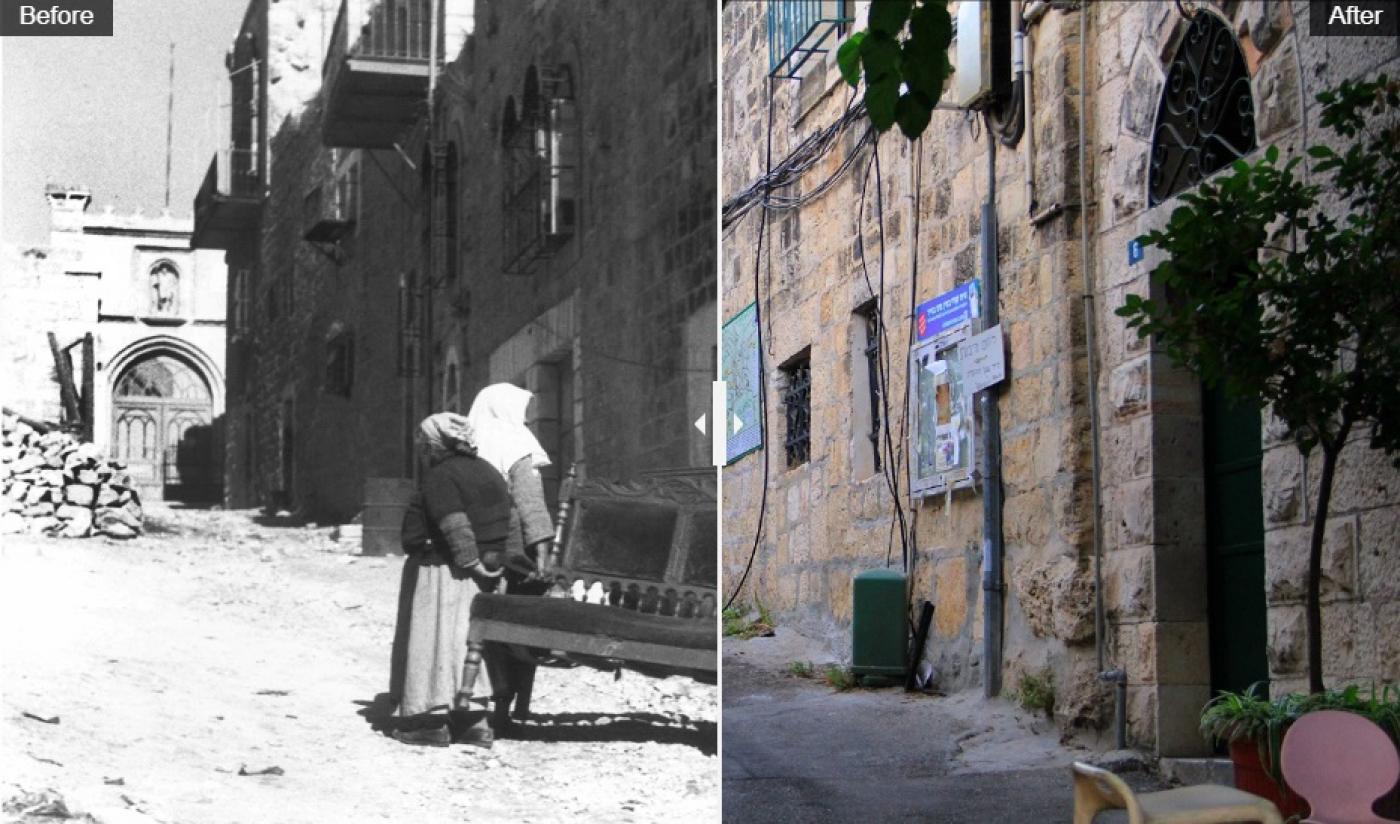
Zionists loot a sofa from a Palestinian house (left) and today (right)
An Orwellian category Present-Absentees was created. You could be present in Israel, having not been expelled, and still be absent.  Even if you left your house in 1948 because of the fighting or you were forced out by the Haganah you were still counted as an Internally Displaced Person. Of course Israeli Jews who were forced to leave their homes faced no such prohibition.
It is estimated today that 1 in 4 Israeli Palestinians are Internally Displaced Persons. That lies at the root of inequality in Israel, an inequality emphasised by the Jewish Nation State Law that made ‘Jewish settlement’ into a national virtue.
Palestinians are not permitted to live in the homes they formerly lived in, even if they were in the same area, the property still exists, and they can show that they own it. [Tom Segev, 1949: The First Israelis, pp. 68-91].
However it was one thing to pass a racist law but it was another thing to implement that law. Israeli Palestinians desired nothing more than to return to where they were living but for Zionism, all wings of the Zionist movement including the ‘left’  Mapam, it was an article of faith that no Palestinian should ever return to their home even if they only moved a mile away for safety.
Thus it was that military rule was instituted over Israel’s Palestinian population.  By forbidding them to leave their villages without permission it made it that much easier to prevent unauthorised access to their previous homes. This was necessary because although Zionist settlers moved into their former villages this took time, not least because at that time there weren’t enough Zionist settlers.
Thus Israel was born in a fit of ethnic cleansing and today the job of Malmad and the Ministry of Defence is to keep documents of the time secret and hidden and to perpetuate the myth that the Palestinian refugees left of their own accord.
We should bear this in mind when Israel's racist Ambassador to London, Tzipi Hotoveli, states that the Nakba and the forcible expulsion and dispossession of the Palestinians in 1948 was an 'Arab lie'. It is a Zionist lie that there was no expulsion and the fact that that lie is written into Israeli law makes no difference whatsoever.
Tony Greenstein
A document unsealed after 60 years reveals the Israeli government’s secret intentions behind the imposition of a military government on the country’s Arab citizens in 1948: not to enhance security but to ensure Jewish control of the land
Top of Form
Bottom of Form
Top of Form
Bottom of Form
Jan 31, 2020 11:50 AM
Arabs awaiting a security check in Kfar Qasem, during the War of Independence.GPO

Israel’s defense establishment has for years endeavored to conceal historical documentation in various archives around the country, as was revealed in an article in Haaretz last July.
That article, which followed up on a study by the Akevot Institute for Israeli-Palestinian Conflict Research, noted that for closed to 20 years, the staff at Malmab – the Defense Ministry’s secretive security department (the name is a Hebrew acronym for “director of security of the defense establishment”) – had been visiting public and private archives and forcing their directors to mothball documents relating to Israeli history, with special emphasis on the Arab-Israeli conflict. This was done without legal authority. The article sparked a furor, and dozens of researchers and historians urged the defense minister at the time, Benjamin Netanyahu, to halt the clandestine illegal activity. Their appeal received no response.
When the state imposes confidentiality, the published work is weakened… If someone writes that the horse is black, if the horse isn’t outside the barn, you can’t prove that it’s really black.
What sort of documents did Malmab order the directors to hide away in their archives’ safes? The many and varied examples include: thick files kept by the military government under which Israel’s Arab citizens lived for 18 years; testimony about the looting and destruction of Arab villages during the Independence War; cabinet ministers’ comments on the Arab refugee situation, following that war; evidence of acts of expulsion and testimony about camps set up for captives; information about Israel’s nuclear project; documents relating to various foreign policy issues; and even a letter sent by the poet and Holocaust survivor Abba Kovner about his own anti-Arab sentiments.
It’s not clear whether Malmab has reduced its activity in the archives since the article was published. However, it can be said that during the past six months, files earlier ordered closed by Malmab have been reopened, adding to our knowledge of the history of the two peoples who share this land. Though none are earth-shattering in historical significance, these are important documents that shed light on significant aspects of various events.
One such document is a secret codicil to a report drawn up by the government-appointed Ratner Committee in early 1956. The document, restored from oblivion in a safe at the Yad Yaari Research and Documentation Center at Givat Haviva, is titled, “Security Settlement and the Land Question.”
The importance of the information included in the codicil can be seen within the context of the history of the military government imposed on Israel’s Arabs in 1948, just months after independence, and abolished only in 1966. There were about 156,000 Arabs in Israel at the war’s end. Following the armistice agreement with Jordan (April 1949) and the annexation of the Triangle – a concentration of Arab locales in central Israel – 27 villages, from Kafr Qasem in the south to Umm al-Fahm in the north, also fell under the jurisdiction of the military government.
Administratively, the latter was divided into three regions: north, center (Triangle) and Negev. Sixty percent of Israel’s Arab citizens lived in Galilee, 20 percent in the Triangle and the rest in the Negev and in various so-called mixed cities, such as Haifa and Acre. In practice, about 85 percent of all Arab citizens were under the rule of the military government, subject to night-time curfews and regulations requiring them to obtain a travel permit before leaving their area of residence.
Related Articles
Bottom of Form
The military government was based on the Defense (Emergency) Regulations, promulgated in 1945 by British mandatory authorities, and invoked by Israel to facilitate supervision of the movement and settlement of its Arab citizens, and to prevent their return to the areas captured by Jewish forces in the Independence War. The Jewish public was told that the purpose of the military government was to deter hostile actions against the state by its Arab citizens. In practice, however, it only exacerbated the enmity between the two peoples.

The secret addendum. Described the military government as a tool in the struggle against Arab "trespassers.
The military government, an ugly episode in Israeli history, was the subject of severe criticism at the time, not least by certain members of the Jewish community. Various parties on both the left and the right – Ahdut Ha’avodah, Mapam, the Communist Party and Herut (precursor of Likud) – objected, each for its own reasons, to its imposition. One reason for the opposition was that, as early as the early 1950s, the Shin Bet security service had concluded that the country’s Arab citizens did not pose any sort of security risk.

Opinion was also divided in Mapai, the ruling party (precursor of Labor). The state committee that was headed by Prof. Yohanan Ratner, a retired general and architect, was the second body appointed to consider whether the military government was necessary. The first, convened by Prime Minister David Ben-Gurion, in 1949, had decided to leave the status quo in place. In February 1956, the three members of the Ratner Committee reached the unanimous conclusion that “the military government has been reduced as much as it can be, and there is no place for a further reduction.” That this was probably a foregone conclusion is attested to by a remark made in public by a member of that panel, Daniel Auster (mayor of Jerusalem until 1950): “Of 200,000 Arabs and other minorities now residing in Israel, we did not find one who is loyal to the state.”
Secret action
A few years later, in the early 1960s, when pressure mounted to abolish the military government, Ben-Gurion explained that it was still essential in order to prevent an insurrection by the country’s Arabs. The state’s existence depends on the presence of the military government, he maintained, although he did not mention the opposition to it of the security establishment. However, it gradually became clear that what truly interested the advocates of the government was not security but control over land. That had been facilitated by Article 125 of the Defense (Emergency) Regulations (1945), under which a military commander can issue an order to close “any area or place.”
In a closed meeting of the Mapai leadership, in 1962, Ben-Gurion stated that without article 125, “we would not have been able to do what we did” in the Negev and Galilee. “Northern Galilee is Judenrein [empty of Jews],” he warned. 
“We will find ourselves in that situation for many years if we do not prevent – by means of Article 125, by administrative force and military force – entry into forbidden areas. And in the eyes of the Arabs these forbidden areas are theirs. Because the land of Ayalon [Valley] is Arab land.”
Despite the inherent logic of this argument, few testimonies exist about the military government’s latent nationalist motivations. For one thing, there was a tacit understanding, rarely violated, that this was not a subject for public discussion. The secret appendix to the Ratner Committee’s report, found in the Yaari Archives and in the State Archives, and being published here for the first time, is highly illuminating about the true motives that guided the country’s leaders.
According to the panel, the army alone could not safeguard state lands: only Jewish settlement – “security settlement,” as it was called – could do that in the long run. It was thus essential to establish Jewish settlements in the three geographical zones overseen by the military government. Such a process, however, would be lengthy, the committee members agreed, and in the meantime Arab citizens uprooted in the war wanted to return to their homes – something that could not be prevented through legislation. In the view of the codicil’s framers, “The laxness [by the Arabs] in seizing these areas is due mainly to the fact these areas were closed by the military government or under its supervision.” They added that only “the vigilance of the military government’s representatives largely prevented more serious lawlessness in regard to land seizure.” In other words, it was that government that prevented the Arabs from returning to their lands.
The report’s authors also objected to a decision made by Pinhas Lavon, a senior Mapai figure who opposed the military government and who replaced Ben-Gurion as defence minister in early 1954 (but resigned a year later during the so-called Lavon affair, which involved a covert operation in Egypt that went wrong). Lavon cancelled the prior decision to divide Galilee into 46 separate, closed areas in which Arabs needed a permit to move from one to another. A division into three or four zones would be enough, to his mind, and would ease life for Arab citizens. The committee members were adamantly against this, arguing that it had led to excessively free movement by the Arabs, because of which “the takeover of the state’s lands increased.”
The Ratner Committee exceeded the official mandate it received upon its appointment in late 1955. Its secret codicil also includes detailed recommendations for amending property laws, particularly an Ottoman statute from 1858. The latter stipulated that anyone, Jew or Arab, who resided on land for 10 years consecutively was entitled to retain it permanently. Now, eight years after Israel’s founding, the committee was worried that within two years, much land would be lost and transferred to Arab citizens. Its recommendation, then, was to abolish the time frame in regard to remaining on these lands.
The text of the secret codicil shows unequivocally that a major task of the military government was to act as a means to control the state’s lands until their permanent status could be regularised and until, with state support, Jewish settlement could begin in formerly Arab areas. Hence, one of the committee’s conclusions: 
“Until the stabilisation of security settlement in the few reserve areas that can still be settled, it is essential to maintain the military government in these places and to strengthen its apparatus… so that the military government can ensure, directly and indirectly, that the lands are not lost to the state.”
The panel described the military government as a tool in the struggle against Arab “trespassers,” and added that without the military government, “many more areas are liable to be lost to the state.” In a reprimand to the state, the committee noted that the military government was suffering from “known laxness… as a result of the criticism being levelled at it.”
Published in part at the time (without the secret section), the Ratner Committee’s recommendations provoked considerable public and governmental criticism. Ben-Gurion, who received a copy of the report in February 1956, blocked discussion of it for months because of disagreements within the government. The Sinai War, which erupted in October 1956, meant that it stayed off the agenda for an even longer period. Ultimately, the report was never submitted to the government for approval, but nevertheless served as the basis for policy in the coming years. In 1958, another committee, headed by Justice Minister Pinhas Rosen, suggested far-reaching changes in the military government, effectively proposing its almost total abolition. Not surprisingly, the cabinet held lengthy discussions in 1959 about whether to publish the recommendations of the Rosen committee.
Why did the state continue to conceal a report that was written more than six decades ago? The explanation might lie in a cabinet session in July 1959, in which Education Minister Zalman Aranne stated that “among the conclusions are some that are political.” In other words, security had nothing to do with it. He added, “The thing must be done, but not revealed, such as Judaizing Galilee, for example.”
Perhaps it’s appropriate here to recall the words of Yehiel Horev, the former director of the Malmab, who admitted in an interview to Haaretz last July that the defense establishment is simply trying to hamper historians.
“When the state imposes confidentiality, the published work is weakened… If someone writes that the horse is black, if the horse isn’t outside the barn, you can’t prove that it’s really black.”
Adam Raz, a historian, is a researcher at the Akevot Institute for Israeli-Palestinian Conflict Research and author of the book “Kafr Qasem Massacre: A Political Biography,” published in both Hebrew and Arabic.

10 December 2021

Demolishing the Myth that Israel was a Democracy before 1967 and that anti-Arab Racism Began Under Begin and Netanyahu

 There is nothing that Likud has done that the Israeli Labor Party didn’t do before it

There is a comforting myth beloved of ‘left’ Zionism that before 1967 and the 6 Days War and Occupation, life for Israeli Palestinians (‘Arabs’) was idyllic compared to life under Likud. From 1948-1977 the Israeli Labor Party formed Israel’s governments. Racism in Israel according to supporters of Labour Zionism and the Two State Solution only began from 1977 onwards.

The article When the Shin Bet Chief Warned That Educated Arabs Are a 'Problem' for Israel by Israeli historian Adam Raz in Ha’aretz demolishes this myth and shows what life was really like in Israel for Israeli Palestinians.

Far from life being idyllic if you were an Arab, life was in many ways worse than under Likud. From 1948 to 1966 85% of Israeli Arabs were under military occupation. They couldn’t leave their village to go to the next one without permission of the army and local governor.

As Adam says the typical myth about Israel which racists like Keir Starmer promote, is that it is a ‘rumbustious democracy’. It is anything but. Israel has a permanent State of Emergency, because according to its security mythology, it is ‘under attack’ by the Arabs, despite the fact that it has a peace agreement with Jordan and Egypt. In Syria Israel regularly conducts bombing raids and in Lebanon it is Israel which has always done the attacking though today the border is quieter because Israel knows that Hezbollah has the capability to retaliate to Israeli aggression.

It would not be stretching things to say that Labour Zionism was more racist than its Revisionist cousins. When the ‘socialist’ Zionists were campaigning to boycott Arab Labour and Produce in the 1920s and 30s, literally picketing orange groves and work places to prevent Arabs working for Jewish employers, the Revisionists were happy to employ Arab labour (because it was cheaper). 

David HaCohen, former Managing Director of Solel Boneh, Histadrut’s building company, described his difficulties explaining to other socialists the dilemmas of socialist Zionism

‘I had to fight my friends on the issue of Jewish socialism, to defend the fact that I would not accept Arabs in my Trade Union, the Histadrut; to defend preaching to housewives that they should not buy at Arab stores; to defend the fact that we stood guard at orchards to prevent Arab workers from getting jobs there... to pour kerosene on Arab tomatoes; to attack Jewish housewives in the markets and smash Arab eggs they had bought... to buy dozens of dunums from an Arab is permitted but to sell God forbid one Jewish dunum to an Arab is prohibited; to take Rothschild the incarnation of capitalism as a socialist and to name him the ‘benefactor’ – to do all that was not easy.’[i]

Not for nothing did the late Professor Ze’ev Sternhell describe Labour Zionism as ‘nationalist socialism’. [Founding Myths of Israel] He made clear that but for the associations with the Nazis he would have called it ‘national socialism’. And before anyone cries ‘anti-Semite’ they might pause to consider that Sternhell was a child survivor of the Nazi ghetto of Przemsyl. The ‘socialist’ Zionists opposed class struggle against Jewish employers because for Zionism unity of Jews, regardless of class, was more important than class solidarity with Palestinians.

David Ben Gurion, the most important figure in Labour Zionism and Israel’s first Prime Minister coined the slogan ‘from class to nation’. In other words the class struggle was to be waged as a national struggle against the Arabs.

This is another example of the similarity of Zionism with Nazism ideologically. For the Nazis, their ‘socialism’ consisted of attacking the Jews as the representatives of capitalism. Whilst German capitalism was to be respected, Jews were fair game. Anti-capitalism was transmuted into anti-Semitism.

As Adam Raz makes clear, archival documentation of the repression of Israel’s Palestinians is very exceptional today. With the advent of digitalisation of archives Israel’s censors have taken it as the opportunity to reclassify what were once declassified documents. This would be unheard of in Britain and the United States yet Israel’s political echelon never misses an opportunity to inhibit any research that demonstrates the historic oppression and structural inequality of the Arab sector.

Adam describes how the ILP government ‘espoused a policy of segregation and of subordinating Arab society to Jewish society’. Of course Israel’s military argued that they hadn’t done enough to ‘suppress the development of Arab society’. Indeed ‘Some thought that it would be useful to exploit a future war to expel the Palestinian citizens.’

You can see in both the security and political sectors all the old attitudes of the British ruling class to native peoples. Amos Manor, head of Shin Bet (Israel’s security service) ‘viewed the traditional clan-based hierarchy among the Arabs as the basis of what used to be called in the British Empire ‘indirect rule’ i.e. rule through collaborators, local chiefs and village elders. “We must not expedite processes with our own hands. The existing social frameworks should be preserved… as a convenient governing tool.”

This is colonisation in its purest form. Manor warned of the dangers of an educated class: ‘“As long as they’re half-educated, I’m not worried.” When the Nazis invaded Poland their first target for extermination was not the Jews but Polish intellectuals. More Jews died in the first 2 years of Nazi occupation because they were intellectuals than died because they were Jewish.

We see the same attitudes amongst Israeli Labor Party’s military apparatchiks as in the officials who ruled the Raj. Manor explained that “Revolutions are fomented not by the proletariat, but by a fattened intelligentsia,” Manor would not have been out of place as a District Commissioner in Nigeria in the 1920s or in an India that was being deliberately under-developed.

Aharon Chelouche of the Israeli Police admitted that it might be “reactionary” to strengthen the Arabs’ conservative social structure, “but… by means of these frameworks, we control the Arab territory better.” In Africa this was called tribalism. The Nazis also followed a policy of strengthening the traditional leaders.

It is fascinating to eavesdrop on these private conversations. Today any discriminatory measures against Israel’s Arab population is justified by the all-embracing term ‘security’.  Jewish security of course. Israel’s Supreme Court bends its knee at the very mention of the word. Everything can be justified by this one word.  Yet in private it was a different story.

Yosef Harmelin, the next head of Shin Bet explained the real “problem”:

“Our interest is to preserve Israel as a Jewish state. That is the central problem. When we say ‘security,’ that is what’s meant. Not necessarily a revolution by the Arabs.”

Pinhas Kopel, the Police Commissioner elaborated and in the process described exactly what a Jewish State really meant:

 “Every such action must be seen not in terms of what’s good for the Arabs, but what’s good for the Jews.”

As Adam explains

‘throughout the 1965 discussion, the question of the possibility of expelling Palestinian citizens from the country kept surfacing’. 

This is the answer to those who pretend that talk of the Naqba is an ‘Arab lie’ (Tzipi Hotoveli, Israeli Ambassador).

Aharon Chelouche explained that although he had tried to create “an atmosphere of emigration in Jaffa,” this was not possible in 1965. Too many people were watching but the security echelon were hoping for another war which would provide the pretext for more ethnic cleansing.

Meir Amit, the head of Mossad (MI6) was a hardliner who urged a ‘hard hand, not halfway.” He urged that “Please, if [we have] a whip – strike.” 

Verbin, the commander of the military government, didn’t, as Adam says, beat around the bush.

“We expelled around half a million Arabs, we burnt homes, we looted their land – from their point of view – we didn’t give it back, we took land… We want to say to ourselves, ‘You, the Arabs, should be happy about what we are doing,’ [but] we stole the land and we will continue to steal, and from our view point that is ‘redemption of the Galilee.’”

He warned that unfortunately “to generate a war catastrophe” which would allow further ethnic cleansing “is out of the question,”.

Officials like Meir Amit, the head of Mossad Verbin, Ezra Danin, an Arab affairs adviser in the Foreign Ministry, took a more ‘liberal’ approach. But this too is reminiscent of British imperialism. There were those, like Thomas MacCaulay and Governor General Bentinck who believed in educating a native Indian middle class whereas the majority of British  officials and those like Lord Curzon believed in the efficacy of an iron hand.

British like Israeli colonial policy was a result of intense discussions among colonial officials and their masters.

As Adam says, we will need to wait a few more decades to find out what the top security officials of today think about the country’s Palestinian citizens. I imagine that there will be no surprises because a Jewish state cannot be other than a state of racial supremacy.

Those who pretend that Israel can be a Democratic and a Jewish State are fooling themselves.  Not only because enshrining in its constitution that a certain ethnic/racial group should be in a majority is racist in itself, but because an ethno-national Jewish state cannot be other than racist towards non-Jews.

In his second article How Israel Tormented Arabs in Its First Decades – and Tried to Cover It Up Adam Raz describes the testimony of military officers in the Kafr Qasim Massacre. In 1956, on the eve of the Suez War, when Israel attacked Egypt, the Border Police deliberately massacred 49 inhabitants of Kfar Qasim, men, women and children, on order from the military command. No killer served more than 13 months in prison because, then as now, Arab life was cheap.

One officer was asked, were you “imbued with the feeling that the Arabs are the enemies of the State of Israel?” to which he replied “Yes.” He was asked, “Would you kill anyone? Even a woman, a child?” “Yes,” he reiterated. Another police officer testified that had he been ordered to do so, he would have opened fire at a bus packed with Arab women. Another explained, “I was always told that every Arab was an enemy of the state and a fifth column.”

One officer remarked that if he were to come across an infant who had “violated” curfew – “It might sound cruel, but I would shoot him. I would be obligated to do so.”

This is the State that western politicians defend with every last breath in their body

Tony Greenstein 

Bedouin Arabs outside the military governor’s office in Be’er Sheva in 1950. The clan-based hierarchy worked to the benefit of Jewish authorities.Credit: GPO

When the Shin Bet Chief Warned That Educated Arabs Are a 'Problem' for Israel

Extraordinary declassified documents reveal the reasons cited by Israel’s top security officials for repressing the country’s Arab minorityAdam Raz

Adam Raz

Sep. 16, 2021

When it comes to the state’s attitude toward its Palestinian citizens, the policy of making available historical documents from the archives is made on the basis of several criteria. One of them starts with the assumption that declassifying documentation that reveals a policy of inequality is liable to harm the country’s image and generate a possible reaction from Israel’s Arab population.

Because the state’s approach to the Arab public has long been essentially repressive, it’s not surprising that the documentation available for perusal is very limited. It follows, then, that any attempt to present an ongoing description of the positions taken by senior figures in the security establishment over the years is almost doomed to fail. Nonetheless, two files that recently became available for perusal in the Israel State Archives offer an exceptional look at the bedrock views of the country’s top security officials toward the country’s Palestinian citizens during its early decades, and reveal their guiding principles.

The two documents in question were declassified following a request submitted by the Akevot Institute for Israeli-Palestinian Conflict Research. The first, titled “Summary of a Meeting about the Arab Minority in Israel,” relates to a meeting held in February 1960, at the request of Uri Lubrani, the Arab affairs adviser to Prime Minister David Ben-Gurion. Lubrani convened the heads of the security units that dealt with the “Arab issue,” a term used frequently in discussions during that period. 

The second document, “Basic Policy Guidelines Regarding the Arab Minority in Israel,” from July 1965, contains dozens of pages of remarks made during another meeting by senior government officials and the ranking security authorities. Its goal was to sum up the results of 17 years of policy, since 1948, in regard to Israel’s Palestinian citizens and to recommend both short- and long-term policy on that subject.

In both cases, a clear picture arises. The security authorities were a tool in the hands of those in the government who espoused a policy of segregation and of subordinating Arab society to Jewish society. In both cases, the security officials argued that in the years since the 1948 war the government had not taken sufficient actions to suppress the development of Arab society. Some thought that it would be useful to exploit a future war to expel the Palestinian citizens.

In the 1960 discussion, for example, the police commissioner, Yosef Nachmias, stated, “The Arab sector must be kept as low as possible, so that nothing will happen,” meaning, the status quo would be maintained there. He added that Israel had not yet reached the “limits of exploitation” of the Palestinian citizens, and care must be taken not to arouse the Arab “appetite.” Similarly, Amos Manor, the head of the Shin Bet security service, ‘viewed the traditional clan-based hierarchy among the Palestinian citizenry as providing an advantage for the Jewish authorities.’ Manor was of the opinion that “We must not expedite processes with our own hands. The existing social frameworks should be preserved… as a convenient governing tool.”

Manor warned that educated Arabs could constitute a “problem” and added, “As long as they’re half-educated, I’m not worried.” Israel, he stated, must preserve the Palestinian citizens’ “traditional social regime,” because it “slows the pace of progress and development.” He warned that the quicker the Arab sector progresses, "the more trouble we'll have. In 40 years we'll have problems that can't be solved."

The Shin Bet director had a sociological justification for why Palestinian citizens should be prevent from acquiring education. “Revolutions are fomented not by the proletariat, but by a fattened intelligentsia,” he explained. His next remarks are noteworthy: “All the laws must be applied, even if they are not pleasant. Illegal means should be considered [by the authorities] only when there is no choice, and even then – only on condition: that there are good results… Aggressive governance must be maintained, without taking public opinion into account.” Aharon Chelouche, the head of the special-ops unit in the Israel Police, stated in the 1965 meeting that it might be “reactionary” to strengthen the Arabs’ conservative social structure, “but… by means of these frameworks, we control the Arab territory better.”

Amos Manor, who headed the Shin Bet between 1953-1963.Credit: IDF Spokesperson's Unit

Outwardly, the “Arab issue” was always presented as a security matter, but in the closed meeting in 1965 the participants allowed themselves to comment on the subject with exceptional openness. Yosef Harmelin, who succeeded Manor as Shin Bet chief, laid things on the line: “Our interest is to preserve Israel as a Jewish state. That is the central problem. When we say ‘security,’ that is what’s meant. Not necessarily a revolution by the Arabs.” Yehoshua Verbin, the commander of the military government that Arab citizens were subject to between 1948 and 1966, made it clear to the participants that “there is no public problem that is not a security problem.” 

Pinhas Kopel, the police commissioner, seconded them and added, “Every such action must be seen not in terms of what’s good for the Arabs, but what’s good for the Jews.” Moshe Kashti, the director general of the Defense Ministry, an example of a local “liberal” type, said, “I am in favor of liberalization of the economy. I am somehow against liberalization among the Arabs.” Self-criticism was voiced by Shmuel Toledano, the prime minister’s adviser on Arab affairs. He noted the existence of two schools of thought on the so-called Arab issue and was critical of the leading one, which saw every social problem through a security prism. He was in the minority.

Throughout the 1965 discussion, the question of the possibility of expelling Palestinian citizens from the country kept surfacing. Scholarly research, drawing on historical documentation, previously found that among some decision-makers, a policy and even concrete plans to deport Arab citizens were dominant until the 1956 Sinai War. The newly declassified minutes show that similar ideas continued to exist into the 1960s as well. Reuven Aloni, deputy director general of the Israel Lands Administration, a body that to this day continues (as the Israel Land Authority) to play a major role in the discriminatory distribution of land in Israel, spoke frankly and asked rhetorically, what, “theoretically,” if Israel could act as it wished, “would we want to do?” He also answered his question: “Population exchange.” He said he was “quite optimistic that a day will come, in another 10, 15 or 20 years, when there will be a situation of a certain kind, with a war or something resembling a war, when the basic solution will be a matter of transferring the Arabs. I think that we should think about this as a final goal.” 

The representative of the police, Aharon Chelouche, also spoke about “emigration” and immediately explicated, “In this business, we have a Jew who succeeded and expelled an entire city [after the end of the 1948 war] – Majdal [now Ashkelon], in 1949-1950.” He said he had tried to create “an atmosphere of emigration in Jaffa,” but that it was not possible to rely on such plans today.

Harmelin, the Shin Bet director, agreed with others that the “Arab minority” would never be loyal to the state. In his view, “the solution then was to expel the Arabs,” but today that is “a solution that we are all familiar with, [but] which is not practical.” He added, “I have a number of thoughts” – without elaborating – about how “to prevent an increase in the Arabs’ share” of the country.

Ezra Danin, an Arab affairs adviser in the Foreign Ministry who had dealt with this subject for decades, was concerned not only with the impractical nature of various “emigration” plans, but also their moral implications. “How will we solicit the help of the world, which we need, while we implement actions that the fascists or the Iranians carry out?” He wondered how the government could accept a “satanic proposal” of a “population exchange” and noted, “One doesn’t arrive at a population exchange from a position of comfort. One arrives at population exchange by bringing things to that pass.”

From 1948 to 1966, the military government was the principal instrument for oppressing the country’s Palestinian citizens. Meir Amit, the head of the Mossad between 1963 and 1968, thought that the policy in practice was too polite. He urged a “hard hand, not halfway.” Amit’s view was that “we have a whip, we use it to make a loud noise,” but “we lash the air, and below the surface everything grows.” He concluded, “Please, if [we have] a whip – strike.” 

Yosef Nachmias, the police chief, suggested that "The Arab sector must be kept as low as possible," adding that "we haven't yet reached limits of exploitation” of Palestinian citizens.

Verbin, the commander of the military government and one of the country’s “experts” on the “Arab problem,” wasn’t someone who beat around the bush. He explained the problem facing the Jewish authorities: “Today’s Arabs are not the Arabs of 17 years ago. The generation of the desert is dying out. Those we harassed, those from whom we took their homes, are the good ones, with them we get along.” The worst of the lot, he said, were those who were born around the mid-1940s. He didn’t mince words:

“We expelled around half a million Arabs, we burnt homes, we looted their land – from their point of view – we didn’t give it back, we took land… We want to say to ourselves, ‘You, the Arabs, should be happy about what we are doing,’ [but] we stole the land and we will continue to steal, and from our view point that is ‘redemption of the Galilee.’” He added that “to generate a war catastrophe” in the shadow of which the Arabs will be expelled “is out of the question,” and there was no knowing what the future would bring.”

Not all the participants espoused identical views, but it’s clear that the majority agreed that “we’re not talking equality.” Danin, for example, was critical of the isolationist stance that was taken in the discussion. While Shmuel Ben Dor, the deputy director general of the Prime Minister’s Office, wondered, “How can we talk about all the means that have been raised here and at the same time talk about means that display a just approach to the citizen?”

Verbin rebuffed the criticism of the military government’s toughness and broadened the scope of the discussion: “If someone is harassing the Arabs, it is the State of Israel…  The Yishuv [i.e., the state] and the [national] institutions are the biggest anti-Semites regarding the Arab problem… If there is anyone that is being cruel when it comes to the Arab subject, it is the whole Yishuv… The Yishuv is harassing them and will continue to harass them for many years to come.”

In December 1966, a year and a half after the 1965 meeting, the military government was abolished. The result was the lifting of some of the restrictions and of the supervision that had been imposed on these Israeli citizens, and a heightening of their equality with the country’s Jewish citizens. But that wasn’t enough. It’s clear that many among the Jewish public thought that with the justified abolition of the military government, the segregationist policy toward the Arab citizens had also been terminated. That was not the case then and it is not the case today. 

In practice, the viewpoint expressed by the ranking security officials in the 1960s continues to define the state’s attitude toward its Palestinian citizens. We will need to wait a few more decades to find out what the top security officials of today think about the country’s Palestinian citizens.

Adam Raz is a researcher at Akevot Institute for Israeli-Palestinian Conflict Research.

How Israel Tormented Arabs in Its First Decades – and Tried to Cover It Up

Military policemen inspect a suspicious sack of onions found in possession of Arab citizens, in 1952. Credit: Beno Rothenberg/National Library


A person who violates a curfew shouldn't be killed, but they can be slapped and hit with a rifle: Newly declassified documents reveal the ways military rule embittered the lives of Israeli Arabs

The origins of the brutality documented in all its ugliness last week – an Israeli soldier shooting an unarmed Palestinian who was trying to protect the electric generator he needs to function, amid the abject poverty of the South Hebron Hills – date back quite a few decades, to the period of military rule in Israel proper. Testimony from recently declassified documents, together with historical records in archives, shed light on the acute violence that prevailed in the “state within a state” that Israel foisted upon extensive areas of the country where Arab citizens lived, from 1948 until 1966.

For more than 18 years, about 85 percent of the country’s Palestinian citizens were subject to an oppressive regime. Among other strictures, any movement outside their own villages had to be authorized, their communities were under permanent curfew, they were forbidden to relocate without formal approval, most political and civil organizing was prohibited, and entire regions where they had lived before 1948 were now closed to them. Although this part of the past has largely been repressed among most of Israel’s Jewish population, it constitutes an integral part of the identity and collective memory of the country’s Arab citizens. Those memories include, in addition to the regime of authorizations, daily abuse and a web of informants and collaborators.

In practice, for those subjected to the military government, Israeli democracy was substantively different than it was for the Jews. Yehoshua Palmon, Prime Minister David Ben-Gurion’s adviser on Arab affairs, wrote to the headquarters of the military government – in a letter from October 1950 culled from the State Archives – that reports had been received according to which military government personnel in the Triangle (a concentration of Arab communities adjacent to the Green Line, in the center of the country) were employing “illegal pressure during interrogations of residents, such as using dogs [against them], threats and the like.” 

A year later, Baruch Yekutieli, Palmon’s deputy, explained to the cabinet secretary that the situation in the Arab areas sometimes required “a strong hand on the part of the authorities.” Although he did not go into detail about that policy, testimonies that have been made public describe its implementation – and all of them reflect an experience of humiliation and subjugation. 

Thus, it became known that representatives of the military government threatened citizens so as to prevent them from complaining about actions taken against them; a military governor (there were three, for the Negev, the Triangle and the north) demanded that people frequenting a village café show their respect by standing up when he entered and threatened anyone who disobeyed; soldiers amused themselves when intimidating an Arab citizen by leaning on him by placing a firearm on his shoulder; and others prevented Muslim citizens from praying. In other cases, military government representatives harassed farmers and destroyed their property; people were humiliated regularly and addressed in coarse language; violence was perpetrated on children; and military government personnel made threats against Arab citizens if they didn’t vote in elections for the candidates favored by the authorities.

The military governor in the south, Yehoshua Verbin, maintained in testimony he gave in early 1956 to a government committee – and recently made public at the request of the Akevot Institute for Israeli-Palestinian Conflict Research – that “the military government is too liberal and gentle. Let us not speak of cruelty at all, because that is groundless, it is a calumny for which there is no basis in any case.”  

However, remarks by the governor of the Triangle, Zalman Mart, in his 1957 testimony in a trial relating to the Kafr Qasem massacre the previous year – when Border Police shot and killed 49 Arab villagers who were unaware that a curfew had been imposed – refute Verbin’s assertions. According to Mart, there was no obligation to kill a person who violated a curfew, but there was a sort of protocol for punishment: “You can slap him, hit him with a rifle on the leg, you can shout at him.”

A cluster of lengthy testimonies by Border Police personnel, who acted as the police force in the Arab villages, offers a picture of day-to-day life under the shadow of the military government. The officers’ unabashed candor in their testimony in the Kafr Qasem trial is harrowing. Were you “imbued with the feeling that the Arabs are the enemies of the State of Israel?” one officer was asked – to which he replied, simply, “Yes.” The police officer was asked, “Would you kill anyone? Even a woman, a child?” “Yes,” he reiterated. Another police officer testified that had he been ordered to do so, he would have opened fire at a bus packed with Arab women. And another explained, “I was always told that every Arab was an enemy of the state and a fifth column.”

The officers showed little sense of pity when asked about shooting helpless individuals, most of them affirming that they would do so if required. One of them noted that if he were to come across an infant who had “violated” curfew – “It might sound cruel, but I would shoot him. I would be obligated to do so.”

Men interrogated by an Israeli army officer, 1952.Credit: Beno Rothenberg/National Library

Some of the complaints made by the subjects of the military government were submitted anonymously. A report of the Jewish-Arab Association for Peace, sent in 1958 to a ministerial committee, opened by explaining the reasons for the anonymous charges: “In previous cases the military government apparatus employed threats and pressure against people [meaning Palestinian citizens of Israel] who gave testimony against it.” The association compiled a large number of accounts and appended the complainant’s name to each one, requesting that “the honorable ministers ensure that there be no such pressure and that people not be made to suffer because of their testimony.”

Several testimonies from the village of Jish (Gush Halav) dating from 1950, stored in the Yad Yaari Archive, shed light on what the military government tried to conceal. A local resident, Nama Antanas, related how its personnel had burst into his house in the middle of the night and taken him for an interrogation. Antanas was accused of buying a pair of smuggled shoes. The interrogators told him that if he wasn’t going to talk, they would see to it that he did. According to his testimony, “Amid this, I was ordered to take off my shoes and remove my head covering. When I did so, I was forced to sit on the floor and my legs were lifted and placed on a chair. At that moment, two soldiers approached me and started to beat me on the soles of my feet with a wooden stick made from the rough branch of a date tree.” Afterward, he was thrown out, unable to walk.

For those subjected to the military government, Israeli democracy was substantively different than it was for the Jews.

Another person, who was identified as al-Tafi, also related that security forces had burst into his house and beat him mercilessly. One military government official explained that they were going to execute him and ordered him into a car, as his wife stood by, distraught. After a short drive the car pulled over to the side of the road and a pistol was pressed against Al-Tafi’s head. After he was pummeled again and thrown into an animal pen, where, he said, he languished for two weeks. 

Hana Yakub Jerassi was subjected to similar treatment, after the military governor told him he was “garbage.” He was beaten on his hands until they bled. “Afterward I was taken out and one of my friends was brought in, and they did the same to him as to me. Then a third was brought in and they did the same.” 

For many, that was the routine.

The diverse sets of testimony we have uncovered compel us to doubt the words of Mishael Shaham, the commander of the military government between 1955 and 1960. In 1956 he told a government committee that was debating the future of that body that it was “not serious,” and that it even “constitutes an element for education to good citizenship.”  

What’s clear is that the state took steps to conceal from the public information about what went on within the realm of the military government. In February 1951, then-Israel Defense Forces Chief of Staff Yigael Yadin was furious at the publication of a report about the expulsion of 13 Arab villagers from their villages. According to Yadin, “Reports of this sort are liable to be harmful to the state’s security, so a way needs to be found for the censorship to delay their publication.” The poet Natan Alterman knew what he was talking about when he wrote “Whisper a Secret,” a poem that criticized the tough censorship regime, a year later.

The military government apparatus was dismantled years ago, but its spirit lives on in Israel and outside it – in the occupied territories. Back then this apparatus supervised and ruled the country’s Palestinian citizens within the Green Line, whereas now policing actions are conducted by soldiers against a civilian population across the Green Line. And there is another similarity. Now, as then, the majority of the Israeli public lives with the wrongs being perpetrated and is silent.

Adam Raz is a researcher at the Akevot Institute for Israeli-Palestinian Conflict Research. This article is based upon the book “Military Rule, 1948-1966: A Collection of Documents,” published this month by Akevot.


[i]                         David Hirst, The Gun and the Olive Branch, p.185, Faber, 2003 citing Ha’aretz 15.11.69.