Showing posts with label Susya. Show all posts

21 January 2023

80,000 Israeli Jews Demonstrated to Defend A Racist Supreme Court and ‘Jewish’ Democracy

 Israel’s Supreme Court is and always has been a Court of Ethnic Cleansing, Colonialism and Zionism

80,000 people, almost all of them Jewish, demonstrated last weekend against the judicial reforms of the new Coalition Government which would allow the Knesset to override any Supreme Court judgment by a one vote majority and which would enable the government to hand pick new Supreme Court judges.

Conspicuous by their absence were Israeli Palestinians. The message that went out was that this demonstration was about ‘protect(ing)  democracy in Jewish and Zionist Israel – and not democracy in Israel.’ In other words, Jewish Democracy.

It had already been made clear the previous week, when there were two demonstrations in Tel Aviv, that slogans such as ‘End the Occupation’ were not welcome. Mansour Abbas of the United Arab List, an Islamist Party which accepts that Israel is a Jewish State, in return for minor concessions, called for people not to bring the Palestinian flag.

The Supreme Court has always been a Zionist court. Although it has a token Arab judge that is for the sake of appearance. Not once has the Supreme Court struck down a racist piece of legislation whose purpose was to reduce the rights of Arab citizens. The Supreme Court is fully wedded to the idea of a Jewish Supremacist state.

From the Law of Return, which granted Jews a right to ‘return’ to Israel at the same time as Palestinian refugees were excluded, to the Absentee Property Law 1950, whose sole purpose was to confiscate land from Palestinians, the Supreme Court has been consistent in supporting anti-Palestinian laws.

Jeremy Corbyn, when asked, during the debate against Owen Smith in 2016 for leadership of the Labour Party, what he most admired about Israel and its achievements, said:

“I admire the verve and spirit of the towns and cities in Israel. I admire the separation of legal and political powers in the system of democratic government that’s there.”

It was one more act of appeasement by Corbyn, thus demonstrating his ignorance of the supremacist nature of the Israeli state.

The Supreme Court has presided over the theft of Palestinian land in the West Bank using a variety of legal tricks. In July 2022 it ruled that the Mitzpeh Kramim settlement could stay because the land was stolen in ‘good faith’.

The Supreme Court has create the legal architecture of Israeli Apartheid. The most notable cases are those involving the question of whether Israel is a state of all its citizens or whether it is a state of the Jewish ‘nation’.

In 1972 this question was decided in George Tamarin v State of Israel. Tamarin wanted his nationality changed from ‘Jewish’ to ‘Israeli.’ Justice Agranat ruled that

‘the desire to create an Israeli nation separate from the Jewish nation is not a legitimate aspiration. A division of the population into Israeli and Jewish nations would… negate the foundation on which the State of Israel was established. ‘There is no Israeli nation separate from the Jewish People. The Jewish People is composed not only of those residing in Israel but also of Diaspora Jewry.’

Why is a nationality embracing all of a State’s citizens, as opposed to the metaphysical ‘Jewish nation’, not legitimate? The Supreme Court did not say. In the process the Supreme Court clung to the Zionist fiction that Jews, from China to Argentina, India to Brazil, are members of a single Jewish Nation.

In 2013, in Uzzi Ornan v the State of Israel, the Supreme Court  confirmed the Tamarin ruling that there was no such thing as an Israeli nationality. It stated that ‘there is no proof of the existence of a uniquely 'Israeli' people’, ignoring the fact that every other state in the world accords the same nationality to those possessing the same citizenship and living within its borders.

What the court was doing was ruling that Israel is not a state of all of its citizens but only of its Jewish citizens and notionally Jews living outside Israel. The idea that Israel is a state of Jews, wherever they live, is the fiction that underpins Israeli Apartheid. Effectively it was saying that Jews are a race.

Today Zionists don’t talk openly of a Jewish race except for overt racists like the new ‘Culture’ Minister Miki Zohar MK who opined that ‘the “Jewish race” is the smartest in the world and possessing of the “highest human capital,”’

A mythical Jewish nation/race trumped the rights of Israel’s Palestinian citizens, which is why Israeli citizenship is meaningless because Jewish and non-Jewish citizens have very different rights  in a Jewish state.

If there was any doubt about this then Netanyahu made this explicit when he said, in 2019, in response to Israeli actor, Rotem Sela, who had protested that even Arabs are human beings, that

Israel is not a state of all its citizens. According to the basic nationality law we passed, Israel is the nation state of the Jewish people – and only it.

In 2018 this was codified in the Jewish Nation State Law which made any notion of equality in Israel redundant. This law held that:

1 (a) The Land of Israel is the historical homeland of the Jewish People, in which the State of Israel was established.

1 (b) The State of Israel is the nation state of the Jewish People in which it realizes its natural, cultural, religious and historical right to self-determination.

1 (c) The realization of the right to national self- determination in the State of Israel is exclusive to the Jewish People.

Section 4(b) relegated Arabic from the status of a recognised language to one with a ‘special status’ which in practice has meant no status. Section 7 originally supported the creation of Jewish only settlements and communities but, with an eye to how this would be interpreted overseas this became

‘The State views the development of Jewish settlement as a
national value, and shall act to encourage and promote its
establishment and consolidation.’

Even though Israel has been established for nearly 75 years, Jewish settlement, i.e. colonisation and displacement of Israeli Palestinians, is still a ‘national value’. Judaisation of the Galilee, Negev/Naqab and East Jerusalem is an ongoing process of house demolition, land theft and the eviction of Palestinians. In nearly every case the High Court (i.e. the Supreme Court) has ruled in favour of Jewish settlement and applied the Absentee Property Law which allows Jews to ‘reclaim’ properties that they owned prior to 1948 whilst at the same time denying Arab citizens or residents any equivalent right to reclaim homes that they once owned.

In July 2021 the Supreme Court held, by 10-1, that the overtly racist Jewish Nation State Law was constitutional even though it explicitly discriminated against Israel’s Palestinian citizens. In the process they affirmed that that Arab citizenship was all but worthless.

The one Supreme Court justice who ruled against the law was its only Arab member, George Karra. Not one Jewish judge was prepared to leave their Zionism and racism at home. This is the Supreme Court that thousands of Israeli Jews are taking to the streets for.

Adalah, the Legal Centre for Arab Minority Rights in Israel, issued the following statement at the time:

The Israel Supreme Court approved a law that establishes a constitutional identity, which completely excludes those who do not belong to the majority group. This Law is illegitimate and violates absolute prohibitions of international law… the Attorney General and the Knesset decided to ignore and disregard these violations in their responses to the case….

The Israeli Supreme Court has not protected Palestinians from the most racist laws in the world since World War II and the fall of the apartheid regime in South Africa. Rather, the Court upheld the Citizenship Law, banning Palestinian family unification in Israel; the Admissions’ Committees Law, which allows small communities built on state land to discriminate against Palestinian families using the criterion of “social suitability”; the Nakba Law, which prohibits any groups or schools that receive state funding from commemorating the Nakba (the Catastrophe); the Boycott Law, which makes calls for boycott a civil tort, actionable for damages; and now the Jewish Nation-State Basic Law. Adalah will continue to work internationally to expose the discriminatory and racist nature of this law, a law which clearly shows the Israeli regime, as a colonial one, with distinct characteristics of apartheid.

Those who are protesting in Israel are demonstrating for Jewish rights in a Jewish state not for the democratic rights of all Israeli citizens. That is why Israel’s Arab minority, apart from a few professional Arab politicians, ignored these demonstrations.

Below I summarise some of the more egregious decisions of the Supreme Court.

The Supreme Court has never hesitated to defer to Israel’s internal security police, Shin Bet and the Israeli army. There isn’t a single instance in which the Court challenged the judgement of the army or police when it came to infringing on the liberties of Palestinians.
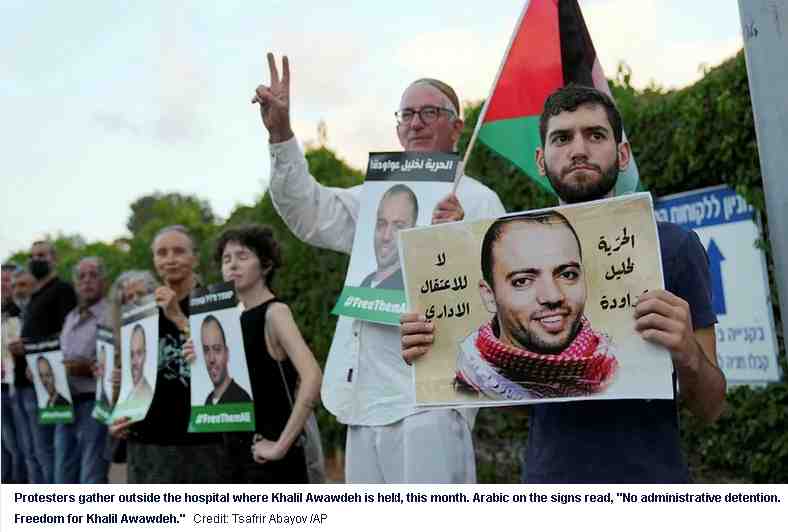
Ha’aretz described how, last September, the court rejected a petition to release a hunger-striking administrative detainee Khalil Awawdeh whose body weight had dropped to 38 kilograms (under 84 pounds). He was going blind and his consciousness was blurred. His hunger strike had lasted at that point for 172 days.

Justices Daphne Barak-Erez, Ofer Grosskopf and Alex Stein wrote that after having reviewed confidential material that Awawdeh’s lawyer could not see, there exists “firm and substantial justification” for Awawdeh’s continued detention.’

As Awawdeh’s condition deteriorated even further another petition was submitted to the High Court and Justice Anat Baron, a ‘liberal’ judge by Israeli standards, ruled that no significant change had occurred in the circumstances that would justify court intervention.

Along with Justices Stein and Chaled Kabub, Baron ruled that the fact that no indictment had been filed had no bearing on the strength of the evidence. Revealing the evidence “might severely harm state security.” In other words, the High Court of Justice decided that the dying man must not be released because of the danger he posed.

And then what happened?

24 hours later, wonder of wonders: The Shin Bet security service agreed to release the detainee upon his completion of the current period of detention, at the beginning of October. Until then he will stay in the hospital as a free man.

Administrative Detention is imprisonment without trial. It is repugnant in any democratic society. Internment Without Trial was last introduced in the UK in 1971 in Northern Ireland and abolished in 1975 yet in Israel it is a permanent feature of the legal system.

Israel routinely locks up Palestinians without trial, for 6 months at a time, renewable indefinitely, without the High Court saying a word. It accepts, without question, the word of Shin Bet. The ‘evidence’ is not seen by either the prisoner or his legal representatives. The High Court acts as a military court when it comes to Palestinians. Jews rarely experience Administrative Detention, however heinous their offences, because Israel’s Supreme Court is Israel’s Colonial Court.

Ha’aretz commented:

The justices of the High Court must now hang their heads in shame. If further proof were needed that in matters of the occupation the court is nothing more than a hollow rubber stamp, a body that automatically and blindly submits to every Shin Bet caprice, this case is incontrovertible proof. On Tuesday, Awawdeh was still dangerous, on Wednesday he was no longer dangerous, and all this with the approval of the High Court of Justice that, as in many other cases, was led up the garden path by the Shin Bet.

The role of the High Court is to oversee and restrain the Shin Bet, not to become its abject servant. This week the court showed it fails in this duty, and also made a laughing stock of itself.

In September 2022 it was revealed that Israel's Supreme Court Had 74 Interns in the Past Two Years. Only One Was Arab. A Supreme Court internship is highly prestigious, and is considered a springboard to advanced studies at prestigious universities abroad, and to positions at leading law firms and the State’s prosecution. Every Justice among the 15 serving may choose two interns for an internship period of 12 or 18 months. Some become fully-paid legal assistants to the judges following their internship.

Professor Muhammad Watted, Dean of Safed Academic College Law School explained that

an intern doesn’t sit at the Supreme Court to make coffee. They speak their mind, persuade, and can provide the judge for whom they work with a different perspective.

 Prof. Yuval Elbashan, formerly Dean of the law school at the Ono Academic College commented that

Since time immemorial, it has been university graduates interning at the Supreme Court, mostly from Tel Aviv University and the Hebrew University. It is sad to see that nothing has changed. It’s the same old song….

A Supreme Court internship is very prestigious and highly-regarded. It enables admission to advanced studies at the leading American universities.”

Gideon Levy’s in A Hostile Take Over of a Hostile Institution wrote that:

This pathetic battle over the character of Israeli democracy, a democracy intended solely for the privileged, is the joke of the year. It’s a tempest in an apartheid teacup: Our democracy-for-Jews-only is in danger. Save it! All of the pathos and every piece of artillery has been pulled out to save this fake democracy.

But it is also not a democracy when 5 million people are living under its auspices with no citizenship and no rights, with the approval of the High Court of Justice – that is, the Supreme Court sitting as a constitutional. Consequently, the hysteria that has erupted over the planned injury to the Supreme Court is bizarre and even outrageous….

Through its support for the occupation, the court sowed the poisonous seeds whose fruits we are reaping today. If it had refused to legitimize the occupation back when it had the power to do so, there would be no Itamar Ben-Gvir, there would be no settlements and there might even be no occupation.

It’s impossible to view it as a democracy with the exception of the occupation: The occupation has become an inseparable part of the state, that defines its evil system of government – apartheid with the High Court’s approval.

What did the High Court do to protect democracy against the occupation? Almost nothing. What could it have done? Almost anything. …

the Palestinian people, which lives under occupation, received no relief from this court, the court betrayed its trust. A court that never took a position in principle against the legality of the settlements; that approved administrative detentions, aka detention with trial; that delayed for years before graciously agreeing to take a stand against torture; that approved mass deportation… and home demolitions; and that turned its face against international law is a court that sabotaged democracy.

It’s actually rightists and settlers who ought to be grateful to this court for having legitimized the occupation for them. The left should have come out against it long ago….

The Supreme Court functioned more like a military court than like a gatekeeper. It was the obedient servant of the executive branch. It’s impossible to sing paeans of praise to it now and mourn the fact that it is being weakened.

Great danger now lies ahead for civil rights, freedom of expression and other freedoms in Israel. For instance, we will quickly find ourselves with a Knesset for Jews only, and that will be only the beginning.

Demolishing the Homes of Palestinian ‘terrorists’ but not Jewish terrorists

Perhaps the most egregious example of the ingrained racism of Israel’s Supreme Court concerns its ruling that the homes of Palestinians engaged in resistance to the occupation which kills an Israeli should be demolished but that the homes of Jewish terrorists should not be demolished.

Demolishing a home because a member of that family engages in ‘terrorism’ is itself illegal under international law because it is a form of collective punishment. However the Supreme Court regularly      disregards international law.
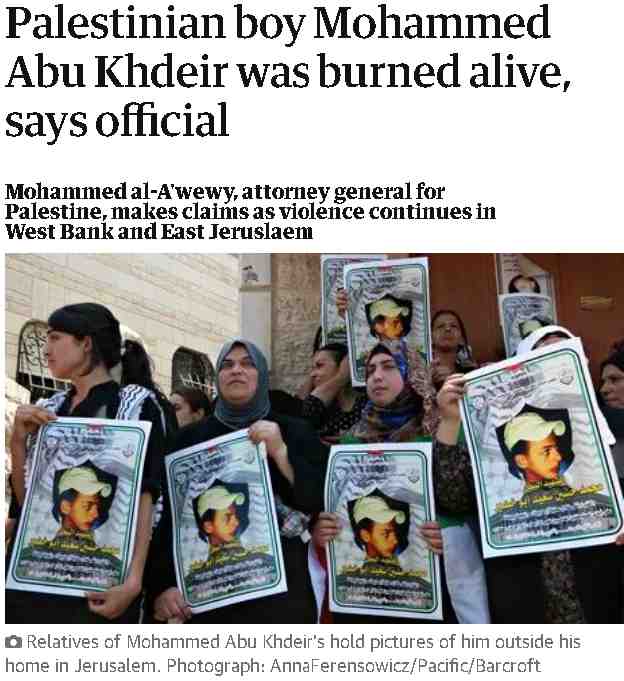
The argument that is used to justify this state of affairs is that Arabs are deterred from attacking Israelis by demolishing their family homes whereas Jews are not deterred.

So in the case of Mohammed Abu Khdeir, a 16 year old Palestinian boy who had petrol poured down his throat which was then set alight, the homes of Yosef Haim Ben David, 33, and two minors were not demolished.  If however the roles had been reversed, then the perpetrators’ family homes would have been demolished.
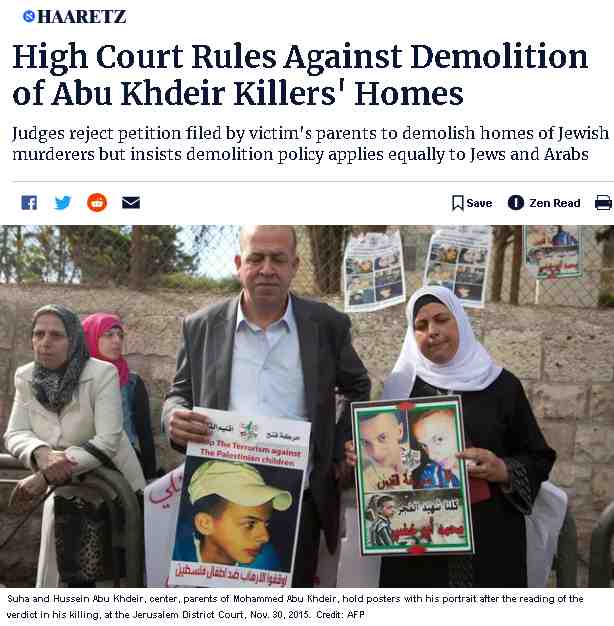
The bogus argument is made that Palestinian ‘terrorism’ is far  higher than Jewish terrorism.  It is bogus because of course most Jewish terrorism is by the army.  In other words it is legal as befits an occupying arm.

Whatever sophistry is employed the fact is that there are two standards of justice in Israel – one for Palestinians and another for Israelis.

The May 21 Riots and Pogroms

In May 2021 a series of riots and pogroms erupted as the Israeli state attacked the Gaza Strip. True to form the Israeli judicial system, just like the Czarist authorities over a century ago, gaoled the victims of the violence and dealt kindly with the pogromists. Except that in Czarist Russia the victims were Jewish whereas today they are Arabs.

In Good Riddance to the High Court Masking Israel's Moral Decay Akiva Eldar wrote how for Palestinians
it would actually be a very good thing if the new Knesset quickly enacted an override law. From their perspective, the High Court of Justice is the Israeli occupation’s flak jacket, the fig leaf that covers the ruler’s moral and legal nakedness. 
I wrote in What is the Meaning of Ben Gvir, Smotrich and Israel’s Far-Right Government? that it is western apologists for Israeli Apartheid who are most affronted by the proposed reforms, because now the Supreme Court will be revealed for the racist, colonial institution it is.

Alan Dershowitz, whose career has included defending Jeffrey Epstein and American neo-Nazis, said that:

“It will make it much more difficult for people like me who try to defend Israel in the international court of public opinion to defend them effectively, It would be a tragedy to see the Supreme Court weakened.”

But it was Aharon Barak who clinched the argument.

The High Court has acted as a kind of legal “Iron Dome,”. Without a credible independent court, deemed as ensuring Israel’s democratic functioning, including in its treatment of the Palestinians, “our chief of staff and government ministers will immediately be arrested when they travel overseas…  The leaders of the country will be put on trial in the International Criminal Court in The Hague.”

It was no surprise that President Isaac Herzog told the Knesset’s that
“Israel’s diplomatic and legal institutions, including our Supreme Court, will continue to be a diplomatic and legal defensive shield for us on the international front.”

In a speech in January 2019 Supreme Court President Esther Hayut said that

one of the important side effects of judicial review is its contribution to Israel’s international legitimization.” Its intervention helps “bolster Israel’s claim of ‘complementarity’ when it deals with criminal proceedings in foreign courts, whether international or those of other countries.”

Hayut was right. The last time Israel dealt with the International Court of Justice in the Hague, the government hid behind the High Court’s apron. The Foreign Ministry argued that the High Court’s rulings (which ordered the state to change the route in some places) prove Israel’s ability to scrutinize itself.

In response to the ICJ’s ruling that the separation fence is a form of annexation and is therefore illegal, the Likud-led government headed by Ariel Sharon said that “Israel will continue acting in accordance with the decisions of the High Court, which has exclusive authority to discuss this issue.”

It is no surprise that Hayut has broken with tradition and entered the political arena with a fierce attack on the proposed legal reforms. As Akiva Eldar wrote:

Castrating the High Court would destroy the warped legal edifice created by Justice Meir Shamgar when he served as the military advocate general. He invented the term “administered territories” as a replacement for “occupied territories” and proposed throwing the High Court’s doors wide open to Palestinian residents of the territories, even though they aren’t Israeli citizens.

Baker Zoubi described a series of cases where the courts dealt leniently with Jewish pogromists and harshly with Palestinian Israelis. In June 2021 Ya’akov Cohen was convicted of violently assaulting Said Musa, a Palestinian citizen of Israel, in Bat Yam. The prosecution sought a sentence of 4-7 years for Cohen, who kicked Musa while he was lying helpless on the ground after having been dragged out of his car by several Jewish assailants, including Cohen. The judge however sentenced him to only 15 months in prison, justifying his ruling by arguing that Cohen “believed in the moment that the victim of the crime [Musa] was trying to carry out a car-ramming attack.”

In November 2021 Adham Bashir was convicted of taking part in an attack on Mor Janashvili, a Jewish Israeli, in Akka. The prosecution requested that Bashir, who threw a stone at Janashvili’s car and broke its windshield, be sentenced to 10-13 years. The three judges agreed and sentenced him to 10 years in prison explaining that: “This was an ugly and dark attack that requires significant punishment.”

Sabrin Bashir, the mother of Adham Bashir, said that a Jewish man rammed his car into several Arab youths, and her son “went to see the youth who was run over and he was a relative of ours.” After he had been arrested

We were prevented from seeing him for several months. They kept telling us that the indictment talks about throwing a stone at the ramming vehicle, even though the driver got out of it and fled. Do you get such an indictment for throwing a stone at an empty vehicle? The sentence does not match the act.

The prosecutor’s office decided not to file charges against Jewish Israelis who were suspected of involvement in the shooting of Musa Hassona in Lydd/Lod in May 2021. At the same time, seven Arabs from the same city were indicted for the killing of Yigal Yehoshua, after they admitted to throwing stones at his car.

According to Mossawa Center, a Haifa-based human rights organization, the police and the Shin Bet arrested about 3,600 Israeli Palestinian citizens since the events of May 2021. Around 360 were indicted, and more than 100 were convicted and sent to prison. In the rest of the cases the accused are under house arrest or in detention until the end of the proceedings. According to Mossawa, in cases where appeals were filed, the Supreme Court increased the sentence.

Data provided in June 2021 to Aida Touma-Suleiman MK from Hadash showed that the prosecutor’s office requested the arrest of 190 Palestinian citizens and 17 Jewish citizens as a result of the unrest. The Al-Mezan Center for Human Rights reported that 77% of indictments for crimes of incitement to violence and racism filed by the prosecutor’s office in recent years were filed against Arab citizens.

At the end of November 2022, four residents of Tamra received prison terms of between five and seven years, after they were convicted of throwing stones and beating a Jewish Israeli who entered Tamra during the May events. Unusually, the Jewish man, Shir Alkalay, actually requested that his attackers receive a lighter sentence after signing a traditional “Sulha” (forgiveness) agreement with them, but the court ruled that

“the harm to the public interest must be considered more broadly here… the personal security and right to freedom of movement of the Jewish population are damaged to the core.”

When has an Israeli colonial court given a moment’s consideration to the freedom of movement of the Arab population?

Muhammad Agbaria from the village of Mu’awiya was convicted after confessing to firing a gun at police officers in Wadi Ara, as well as throwing bricks at police and Shin Bet officers from the roof of his house when they came to arrest him the next day, injuring them. His family claimed that the confession was extracted from him by force.

Ilham Agbaria, Muhammad’s sister, said that her brother had been in detention for a year-and-a-half before being sentenced.

“We’re appealing to the Supreme Court, but we don’t expect his sentence to be reduced. Criminals and murderers aren’t sentenced to 15 years, but when a guy goes out and shouts about respect for him and his people, he gets such an unjust punishment.

“We see how they punished Jews who attacked Arabs, and how they punish armed criminals in our society,” said Nassim Qabha, Agbaria’s son-in-law. “They think they can prevent youths from going out to protest the next time, but it won’t help them, because force doesn’t work against our people.”

In December 2022 dozens of mothers from the Sheikh Jarrah neighborhood of East Jerusalem organized a protest in front of the Jerusalem District Court, where the mother of prisoner Bilal al-Jabari said that her 19-year-old son has been detained for a year without trial, with the prosecution demanding an eight-year prison sentence.

The authorities insist on unfair punishments against young people, despite the daily harm to the residents of Sheikh Jarrah from settlers, all under the auspices of the police.

Balad chairman Sami Abu Shehadeh said that the

unfair rulings are a clear testament to the fact that this system is part of Israel’s apartheid regime, which allows the murderers of Musa Hassuna and Muhammad Qiyan (a Palestinian citizen of Israel who was killed by undercover police in Umm al-Fahm in May 2021) roam free, while the victim who protected his home is being put on trial.

According to Al-Mezan, although there are similarities in the details of the indictments filed against Jews and those filed against Arabs, the sentences against the Arab defendants were specifically tailored to punish young Arabs for their participation in the events of May 2021.

This is a double standard between Jews and Arabs in rulings on indictments regarding national issues… the severe punishments are a dangerous precedent and indicate that the Israeli justice system is racing toward extremism and discrimination.

In May 2022 Ha’aretz described the High Court  as ‘the Occupation's Rubber Stamp’ before going on to describe it as

 the kashrut department of the settlement enterprise and the slaughterhouse where petitions against the occupation’s injustices were sent to die. Our supreme legal institution upholds land theft, supports home demolitions as a punitive measure, signs off on detentions without trial, allows the prolonged blockade of two million people in the Gaza Strip and hasn’t prevented entire communities from being evicted from their homes.

It described the High Court as a

‘whitewasher of the injustices of the occupation. In a ruling issued in the dead of night – ironically, between Memorial Day and Independence Day – the court permitted the expulsion from their homes of about 1,000 Palestinian residents of Masafer Yatta… for the benefit of Israel Defense Forces training. As a result, eight Palestinian villages whose residents have lived in them for generations will be destroyed.

David Mintz, Ofer Grosskopf and Isaac Amit, rejected the petitioners’ argument that they had lived there before it was declared a firing zone in 1981. Miraculously, none of the hundreds of Jewish settlers living in the area (most of whom came later) has been asked to leave his home or his settlement for the army’s firing zone. And so, with the imprimatur of the High Court, Israeli apartheid has been legitimized in this area of the South Hebron Hills.

In view of the selective expulsion based on nationality, it will no longer be possible to refute the argument that an apartheid regime has replaced the military occupation in the territories. Occupation is temporary by definition; apartheid is liable to persist forever. The High Court approved it….

These 1,000 residents, over whose heads the sword of expulsion now hangs, were born and raised in this land of caves, in which shepherd communities live in very harsh conditions, without electricity or running water, all while remarkably preserving their traditional way of life. This doesn’t only involve expelling people from their homes but also destroying a living culture. The High Court lent a hand to this.

The court also rejected the argument that the prohibition in international law against forced population transfer is binding on the court or that it applies to Israel…. Justice David Mintz, who is himself a settler, in effect ruled that international law on this matter, and perhaps also regarding other matters, is not binding on one country in the world – Israel – and depends upon its consent….

The fact that it was published in the dead of night may indicate that even within its walls there are those who recognized the disgrace this verdict brings upon the court and the country.

Amira Hass described Masafer Yatta as home to traditional Palestinian cave-dwellers since at least the beginning of the 20th century. The Prosecutor described the area and the structures that have been built alongside the original residential caves – including schools, mosques, and a medical clinic. Because Palestinians are never granted planning permission they were all ‘illegal’.

The Palestinians’ lawyer, Shlomo Lecker, attempted to correct this misrepresentation, fearing the judges would get the wrong impression. The clinic is a tent, Lecker noted. As for the schools, he said,

it’s a shame there are no photos showing how pitiful they are, since Israel has been repeatedly denying Palestinians permission to build.’

The argument that Palestinians rarely if ever receive planning permission, unlike Jewish settlers, made no impression on the ‘justices’. After all that is what Zionism is about.

Lecker told the judges that there was no escaping the conclusion that in the eyes of the state, there are legal people (who are entitled to live comfortably in recently built settlements) and illegal people, who aren’t entitled to the same comfort as the settlers, despite having lived in the region long before them. It is they that the state demands permanently leave their homes.

Removal of Palestinians was precisely the intention of Ariel Sharon in the early 1980’s. Preventing the spread of the Arabs in the area required that it be declared a firing zone, Sharon told the army, according to minutes from a 1981 meeting of the Ministerial Committee on Settlement Affairs. There, like in the Jordan Valley, the genetic code of the firing zones is halting the process of natural Palestinian rural development that has been ongoing for many generations.
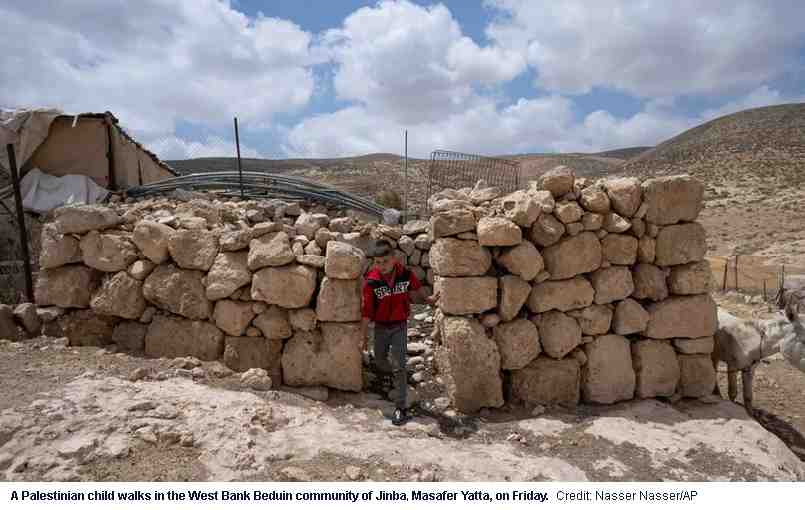
Another measure to halt the natural development was the transfer of Palestinian land reserves and water sources to the settlements, contrary to international law. In the early 1980s, Israel built the settlements of Carmel, Maon, Metzadot Yehuda and Susya in the Masafer Yatta area. With the support of Israeli authorities, these settlements have been joined over the years by additional illegal and unauthorized outposts: Havat Talia, built in the 1990s, followed by Avigayil, Havat Maon, and Mitzpeh Ya’ir - all built in the early 2000s.

Prosecutor Bart is a resident of the settlement of Neveh Daniel, east of Bethlehem, in the Gush Etzion Settlements Bloc. One of the three justices considering the petitions is David Mintz, a resident of the settlement of Dolev, west of Ramallah. As a Palestinian folk proverb asks: ‘When the rooster’s the judge, what kind of a ruling can a grain of wheat expect?’

Tony Greenstein

31 July 2015

Susya - Destruction of Palestinian Village Put on Hold

Susya – the reason why Israeli Settlers can Burn Palestinian Infants to Death 


Today a settler attack on two Palestinian homes killed a Palestinian infant and severely injured his parents and siblings.  Palestinian infant burned to death in West Bank arson attack; IDF blames 'Jewish terror'  This attack did not come out of thin air but was the consequence of an Occupation that treats Palestinians as little more than human animals. 
Photos of Ali Saad Daobasa, an 18-month-old Palestinian killed by suspected Jewish extremists, lie in his house that was firebombed in the West Bank village of Douma, Friday, July 31, 2015. Photo by AP
Israel’s proposed demolition of the Palestinian village of Susya has, after massive international pressure, been put on hold.  However it is, but one, of many dozens of such evictions.  All the publicity however goes to the demolition of two buildings in the Bet El illegal settlement and even then the Government and the Army’s Civil Administration did their best to retrospectively allow the construction of settler buildings on private Palestinian land.  Israel: Eviction of settler zealots near Ramallah exposes cracks in Benjamin Netanyahu's cabinet 
When you demolish Palestinian homes without a seconds thought, then you are dehumanising them.  They don’t have ordinary needs for shelter, warmth and food.  They are the untermenschen.  It is little wonder that settlers then absorb that message and decide to expedite the process and set fire to inhabited buildings.  If there are deaths, so much the better, because then the Palestinians will get the message that they are not wanted.
Damage to the home of the Daobasa family after Friday's arson attack, July 31, 2015. (Credit: AFP)
Netanyahu’s Cabinet contains the Party of the Settler Pogromists and Arsonists, HaBayit HaYehudi (Jewish Home).  They have given consistent support to the repression of the Palestinians inhabitants of the Occupied Territories and are supporters of transfer, i.e. expulsion.  To weep crocodile tears now over the death of a Palestinian infant after having whipped up racial hatred is the height of hypocrisy.  But that is Zionism. 

Activists with ‘All That’s Left’ prepare a banner that will read, ‘Stand With Susya,’ June 13, 2015. (Photo by Michael Schaeffer Omer-Man)
When Palestinians are found to have killed Jewish settlers their houses are demolished, thousands of Palestinian homes are raided and they of course are locked up for decades and tortured.  When or if the culprits of the latest tragedy are caught, their homes will be safe.  After all how can you demolish houses in a settlement when you are committed to building new settlements?  They will no doubt be subject to psychological analysis and found to be incapable of pleading or otherwise sick rather than criminal thugs.  The settlement(s) where they lived will not be raided.  In other words the treatment of settler killers is entirely different to that of the Palestinians.  

Diaspora Jews bring solidarity to south Hebron Hills

Over 70 Jews from around the world headed to Susya last weekend, where they stood with the residents of the West Bank village under threat of demolition against displacement and settler violence. 


It was part anti-occupation activism, part Jewish summer camp, part WWOOF and a little reminiscent of young foreigners coming to volunteer on a kibbutz. Over 70 Jews in their 20s and 30s, mostly from English-speaking countries, spent last Friday and Saturday in the impoverished Palestinian village of Khirbet Susya, whose residents are living under a looming threat of a second forced displacement from their homes. The first time was 30 years ago.
It was my second time in the village that week. A few days earlier, I went to cover a solidarity visit by Palestinian Prime Minister Rami Hamdallah and the heads of mission of every single European Union member state. The tent erected by local Palestinian authorities to host their prime minister was still standing when I arrived in Susya on Saturday. This time instead of an assortment of body guards, PA systems and television crews, the large tent was full of sleeping bags and handful of activists painting banners.

The youngsters came as part of a delegation from a group called All That’s Left. Two and a half years ago, I was among the 15 or so core founders of the group, whose self-defined common denominator was to be “unequivocally opposed to the occupation and committed to building the diaspora angle of resistance.” And although I soon dropped out, I have watched them closely since, curious and often proud of their creative, inspiring activism and seemingly bottomless reserves of energy and optimism.
The trip to Susya had been in the works for months. The plan was to bring as many Jews — and others — somehow connected to overseas communities to the south Hebron Hills, where Palestinians live in a spattering of villages often composed of a few dozen tents without any connection to electricity or running water. Almost all of them are under constant threat of demolition by the Israeli army, and almost all of them are located within a few hundred meters of Israeli settlements that are illegal under international law but protected and provided for by Israel.
Palestinian Prime Minister Rami Hamdallah (center-right) inside a tent in the West Bank village of Susya, June 8, 2015. (photo: Michael Schaeffer Omer-Man)
All That’s Left was asked to come, invited by local residents who know the value of solidarity. Susya has become one of the flagship cases of 21st century dispossession in the West Bank. Countless Palestinian, Israeli and international activists, diplomats, artists and many others have come to express their support in recent years. Villagers work closely with organizations like B’Tselem, Rabbis for Human Rights, Ta’ayush and Breaking the Silence. At the official event earlier in the week, the United Nation’s humanitarian coordinator for the West Bank optimistically noted that public campaigns and international efforts have succeeded in preventing planned displacements in the past. Maybe it could work here, too.
Nasser (left) speaks to members of All That’s Left as Yuval, a member of the group, translates from Arabic to English, June 13, 2015. (Photo by Michael Schaeffer Omer-Man)
But the primary aim of the two-day visit by the young, mostly American and British Jews, was to make an immediate, tangible and positive impact on the lives of the Palestinian residents of Susya and two neighboring villages, Bir el-Eid and Umm al-Khair. For weeks beforehand they held fundraisers and launched a Kickstarter-type online campaign in order to buy building materials, work tools and plants. The villagers wanted help with two things: repairing their derelict, dirt access roads, and planting new fields of za’atar, a variant of thyme common throughout the Levant.

Early Friday morning, 50 or so All That’s Left members set out from Jerusalem, hoping to get in a few solid work hours before the sun made it impossible to break through the packed earth and move an endless supply of rocks. That night, they slept in the tent erected for the diplomats and Palestinian prime minister.
By the time I arrived Saturday morning, in a bus with two dozen activists and a few +972 bloggers, the volunteers had already left for their day of road flattening in a nearby village. After a short briefing on the problems Susya is facing and the type of work they need help with, we were brought to a small za’atar field with no more than a dozen rows and instructed about which weeds and rocks needed to go and which were “good for the za’atar.” Gardening tools and buckets in hand, the activists got right to work. The atmosphere was energetic — reminiscent of something between a Habitat for Humanity project and foreign Zionist volunteers in the 1950s coming to help “reclaim the land,” albeit this time for Palestinians.
All That’s Left activists planting working on the za’atar field in Susya, June 13, 2015. (Photo: Michael Schaeffer Omer-Man)
After a couple of hours, though, the sun was bearing down and all but a couple of the volunteers — who were determined to get every last weed — decided that their work was done, sardining themselves into the comically scant shade of a few freshly planted olive trees. A few hours later, the chain-gang contingent returned for lunch and everyone squeezed back into the prime ministerial tent, adorned with left-over Fatah flags and banners of current and former PLO chairmen Abbas and Arafat. As people finished their lunch of bread, vegetables, tahini and — not quite vegan — tuna, the men who had been accompanying us most of the day noticed young settlers coming down the hill from the adjacent settlement that long ago took over not only Susya’s land, but also its name.
Graffiti reading 'revenge' found at the scene of the arson terror attack in Douma, July 31, 2015. (Credit: AP)
Aside from the press event with the politicians and diplomats earlier in the week, all of my previous experience visiting the south Hebron Hills has been while reporting on the work of Ta’ayush, a group that, pretty much on a weekly basis, puts its bodies in between aggressive, violent settlers and Palestinian herders and farmers. The south Hebron Hills is notorious, along with the hill country south of Nablus, as an epicenter of settler violence — the Wild West. This is a place where the Israeli army escorts Palestinian children on their way to school, to protect them from settlers. It is an area where videos of settler violence long ago stopped being a newsworthy phenomenon.

And here they came. The All That’s Left group had received briefings on how to react in case this type of thing happened. Non-violence was key, and nobody really wanted to get arrested — a regular occurrence when left-wing Israeli activists stand between Palestinians, settlers and the often clueless soldiers dispatched to whichever remote, arid valley in which the settlers have decided to make their presence felt that day. The activists there on Saturday ran, or walked quickly toward the interlopers — but everybody stopped short after 100 meters or so when it became clear that they weren’t actually coming to make trouble. Back to tea, and a little bit of group learning.
A view of the tents that comprise the village of Susya. Located in Area C of the West Bank, which is under full Israeli control, the village does not have electricity or running water, June 13, 2015. (Photo by Michael Schaeffer Omer-Man)
An hour later, however, different settlers were spotted on another hill a couple of small valleys over — this time approaching a patch of olive trees owned by residents of Palestinian Susya. A handful of the Palestinian men and a dozen children start running in their direction. I grab my camera and another dozen of the activists and I follow suit. By the time we arrive the settlers are gone and Nasser, the group’s point man in the village, is talking, distraught and out of breath, to three soldiers who have just arrived.

It seems that a few settlers had come down from the direction of the settlement of Susya and started snapping off branches from the relatively young olive trees. When Nasser approached, they started throwing stones. A lone female soldier who was positioned at a watchtower seemingly in the middle of nowhere and yet smack in the middle of all the action, had tried to tell Nasser to leave. Maybe she told the settlers to leave, too. Either way, nobody really cared. She had to duck to avoid being hit by the stones being thrown by the settlers. Nasser got the whole thing on video.

A few minutes later, a civilian police officer and an officer from the Civil Administration, a nice term for a Military Government, arrived. The police officer looks at the broken olive branches and remarks, “the settlers wouldn’t cut down trees — it’s Shabbat.” But he seems far more interested in the video of the stone throwing. With his cell phone, the cop films the video, interviews the female soldier who witnessed the whole thing, and promises to look for the culprits.
Nobody really takes them seriously. According to research by Israeli human rights organization Yesh Din, only 7.4 percent of Israeli police investigations into settler violence and vandalism against Palestinians result in indictments. More often than not, the official reason cited for closing the investigations is “perpetrator unknown.” In other words, for whatever reason, the police cannot locate a suspect — often times in spite of video evidence and eyewitnesses.

The police left. The army left. Nasser promised to go to the police station later to file an official complaint and hand over a copy of the video. We all headed back across the two cracked valleys toward the tent. It was getting late and the bus was coming soon to take us back to Jerusalem. The organizers of the All That’s Left group started their debrief session, asking participants to talk about their experiences, discussing strategies for moving forward and logistics for the trip home.
An Israeli police officer films video of settlers throwing stones, being shown to him by Nasser under an olive tree just meters from where the incident took place, June 13, 2015. (Photo by Michael Schaeffer Omer-Man)
At some point I decide to wander toward the main road in order to take some photos, when an army jeep approaches. An officer gets out. A captain. He yells to me, “hey, kiddo! Come over here.” I walk over, not quite knowing what to expect. “Call over Nasser,” he tells me. “We caught the guys who were throwing stones and I want to see his video to make sure it’s them.” A little stunned, I point him in the right direction. The lieutenant doesn’t want to walk into the village. Maybe it’s all the activists, maybe he’s lazy, maybe he doesn’t feel safe. Who knows. Another Palestinian man approaches and, after getting the same explanation, starts yelling for Nasser. Nasser brings over his laptop. In an almost identical scene as before, they crouch below an olive tree to mitigate the harsh glare and watch the video. It’s them, the officer says, adding, “they’re not from here. The people in [the settlement of] Susya don’t want trouble either, you know.” “Sure,” Nasser says with a shrug, promising to bring the video to the police station the next day.

And so it ends. There’s no way of knowing if it would have ended differently had dozens of international and — Jewish — Israeli activists been there that day. It’s clearly an anomaly, but maybe the soldiers and police took their job more seriously that day? Maybe they just got lucky? Maybe the suspects won’t even be charged. It doesn’t really matter. Susya is still facing imminent demolition, its residents in danger of forced displacement. The army wants to move them into Palestinian-controlled cities, out of Area C, the part of the West Bank Israel retains complete control over, and which many in Israel’s government hope to one day annex.
The story of Susya is not extraordinary. The same thing is happening — without dozens of Jewish solidarity activists — in other communities in the south Hebron Hills, in the E1 area near Jerusalem, in the Jordan Valley and even inside the Green Line in villages like Al Araqib. In all of those places, the Israeli army is trying to move Palestinians out in order to move more Jews in, or at least to give them control over more land. Susya is not extraordinary, it is probably not the village that will get the world’s attention. Susya is one story of the occupation. And the solidarity visits, by diplomats, foreign college students or Palestinian and Israeli activists, is one story of resistance.

A traffic jam in the middle of the desert 

The rendezvous was scheduled for 11:30 am, outside the Arlozorov Street Railway Station in Tel Aviv. I arrived at 11:35. "Three buses have already been filled, but don’t worry – the fourth bus will soon arrive" said the organizers’ representative. "There will be a place for anyone who wants to go to the protest in Susiya."

It is long since there was such a wide response to a call for a demonstration in the wild West Bank. Among the passengers could be seen quite a few long-time activists who had however not been seen in recent years. Why did the case of Susiya evoke so much attention, in Israel and throughout the world? (Circulating on the bus was the current New York Times op-ed page, featuring a moving personal story of a Susiya resident). This tiny threatened village is in every way worthy of support and solidarity - but in the past, quite a few instances of no less outrageous injustice have been perpetrated and met a virtually complete indifference and silence. One can never know in advance which particular case will become the focus and symbol of a struggle.

 
Little more than an hour's drive separates the vast metropolitan Tel Aviv from the godforsaken hamlet of Susiya in the middle of the desert. First the travel is along congested intercity highways – then, through back roads which become ever more narrow and in bad repair, the further one continues to the east and south. Somewhere, without noticing, the Green Line is crossed into the territory where there is not even a semblance of democracy, where the landscape is predominantly brown rather than green - apart from the occasional green patch of a settlement, which had the privilege of being connected to the Israeli water system.

At the end of the trip, the narrow road forks, and the sign to the right side says "Susiya" - but nevertheless, we turned to the left. The sign erected by the military authorities refers to the other Susiya – the Israeli settlement Susiya, which claims to be the continuation of a Jewish village of the same name which existed on this location during the Roman and Byzantine period. "Come and see Susiya - an ancient Jewish town" says the sign on the road we had not taken.

The Jews who lived here 1,500 years ago had lived in caves. In the Twentieth Century, Palestinians had been living in these same caves, until in 1986 the army came to expel them and turn the caves into an archeological site managed by the settlers. The Palestinians had to move to miserable shacks erected on what was left of their land. Is it possible that they actually were the descendants of those who resided in those caves in the Fifth Century? At the beginning of the Zionist Movement David Ben Gurion brought up that at least some of the Arabs in this country are descendants of Jews who lived here in the past, and who at some time were converted to Islam and started speaking Arabic. In 1918 Ben Gurion even published an entire book on this subject, in cooperation with the future President of Israel Yitzhak Ben-Zvi, including detailed historical documentation to support this theory. But before long it became clear that, even if some of the Palestinians’ ancestors had been Jewish, at present they have no interest whatsoever in being Jewish or promoting the Zionist Project. So, Ben-Gurion and his colleagues lost interest in further promoting this issue.

In the direction of Palestinian Susiya there was no road sign. For the Israeli authorities, it simply does not exist. "The competent military authorities take the position that there had never existed an Arab village named Susiya" stated on the Knesset floor Deputy Defense Minister Eli Ben-Dahan, of the Jewish Home Party. "Palestinian structures were built without permits on that location, and were demolished during the 1995-2001 period. Illegal construction continued, against which demolition orders were issued. In May 2015 the Supreme Court rejected a petition by the Palestinians for an interim injunction against the demolition of these structures."

There are no road signs, but it is not difficult to find Palestinian Susiya, with the Palestinian flag painted on rocks along the road. Four buses arrived from Tel Aviv and three from Jerusalem, plus quite a few private cars, and a minor traffic jam was created in the middle of the desert. "Pay attention, it is now the hottest hour of the day, it's one of the hottest places in the country, and there is almost no shade" warns the young woman in charge of my bus. "Please be sure, all of you, to cover your heads and take water with you. For those who have not brought it with them, we provide bottled water". On a low ridge above the bus could already be seen a human stream winding its way towards the rally.

The concrete cover of a rainwater collection cistern has become a makeshift podium, with several loudspeakers and a Palestinian flag flying. When the group from our bus arrived, the speeches were already under way, in a mixture of Arabic, English and Hebrew. "67 years after the Palestinian Nakba, it is still going on! They want to expel the residents of Susiya from their land! Are we going to let them do it?" cried former Palestinian Minister Mustafa Barghouti, eliciting a loud chorus of "No! No!". "After the Apartheid regime in South Africa fell, Nelson Mandela said that the fight is not over, the next part is the Palestinian struggle. We are here, we are struggling. We will go on struggling until Palestine is free!" (Chanting in Arabic and English "Free Palestine! Free Palestine! Free, free Palestine! "

Susiya resident Nasser Nawaj'ah, a leader activist of the struggle, spoke in Hebrew to those who came from Tel Aviv and Jerusalem: "Welcome to Susiya, all of you, welcome to Susiya, the fighting Susiya which will not give in! Our struggle is already going on for decades. In 1982, they erected the settlement of Susiya on our land. In 1986, they expelled us from the caves and turned them into an archaeological site of the settlers, then we moved to the farmland, all what was left to us. In 2001, they destroyed everything and drove us away, but we came back and set up our village again. You are most welcome here, we are grateful for the solidarity and support of all those who have come here. You are the other face of Israel, the face which is different from what we see of the soldiers and settlers who come to us every day. You give us hope, the hope that we can still live together, Palestinians as Israel's neighbors in peace."

He was followed by Professor Yigal Bronner, who teaches history of India at the Hebrew University of Jerusalem and is a prominent activist of the Ta'ayush Movement, which is active already for many years in support of the residents of the South Hebron Hills. "We are here in Susiya. What is Susiya? Not much. Some cisterns which the army had not filled with dirt, a few sheep which the settlers have not yet stolen, some olive trees that have not yet been cut down. What is Susiya? Susiya is 350 people who hold on to the land, clinging and clinging and holding on and not giving up, because it's their home. Quite simply, this is their home. Opposite us is the other Susiya. The Susiya which is armed and surrounded by a fence, which is connected to to water and electricity and sewage and has representatives in all the corridors of power, and it wants to grab what little is left of this Susiya where we stand. Susiya against Susiya, this is the whole story. The Palestinian Susiya has no soldiers and no police and no representatives in the Knesset and in fact it does not have the vote. But it has us. We are here to stand with Susiya and we will not leave. We will do everything we can to be here and prevent the destruction. And if does take place, we will be here the next morning to rebuild, together with the residents. Susiya is not alone! "(Chanting of "Susiya, Sussiya do not despair, we will end the occupation yet!" in Hebrew and "Yaskut al Ikhitlal", "Down with the Occupation" in Arabic.

"It is very important that you all came here, it is important to continue the struggle. There will be here another demonstration next Saturday, and on August 3 at 9:00 am there will be the hearing on the appeal of Susiya at the Supreme Court. It is very important to be there! Susiya is not alone! Susiya is not alone!"

After the speeches - the march to the edge of the ridge. "For anyone who feels badly affected by the heat and sun, there is a tent with shade and plenty of water. Don’t get hurt unnecessarily. And now – forward!"

Together with the Palestinians, locals and those who especially came, we all moved ahead to the rhythmic beating of the "Drummers Against the Occupation", and the heat did not seem to reduce their energy and enthusiasm. Above the crowd were waving the placards of "Combatants for Peace", one of the demonstration's organizers, with the caption "There is Another Way" in Hebrew, Arabic and English.  "Though shalt not rob thy fellow" read the big sign carried by Rabbi Arik Asherman, who already for many years did not miss any demonstration, "Rabbis for Human Rights" being another of the protest initiators. Other Biblical slogans: "Have we become the like of Sodom, did we assume the face of Gomorrah?", "Save the poor his robber, protect the miserable from the heartless despoiler" "Zion shall be built on Justice", "Each shall sit in content under his vine and his fig tree."

A five years old Palestinian girl held upside down a large sign in Hebrew reading "No more land grab!". One of the Israelis drew the attention of a woman in traditional Palestinian dress, apparently the grandmother. The granddaughter, laughing, turned the sign in correct direction before the press photographers arrived at this part of the march parade. Near was walking a strapping young man wearing a T-shirt of the FC St. Pauli soccer club of Hamburg, Germany, whose fans are known for their fight against racism, and next was a woman whose shirt proclaimed "Stop the Pinkwashing!", protesting the cynical use made of LGBT people by the government international PR apparatus ("Hasbara"). The text on the bag of a veteran Jerusalem activist referred to the elctions earlier this year: "We did not succeed in throwing Netanyahu out, which is very harsh and painful, but at least let him keep his paws off Susiya!"

At the end of the march, dozens lifted with great effort a 30-metre long sign reading: "Susiya is Palestinian, and Palestinian it will remain!". When the buses on the way back passed the official sign about "The ancient Jewish town" we could see it at the top of the ridge above the road.

If Susya falls so will others

It’s ramshackle – and it’s home. A child in Susya, photo by Rina Castelnuovo for The New York Times
Israel, Don’t Level My Village
By Nasser Nawaja, NY Times July 23, 2015

SUSIYA, West Bank — IN 1948, as Israeli forces closed in on his village of Qaryatayn, my grandfather carried my father in his arms to Susiya, about five miles north, in the South Hebron Hills area.

“We will go back home soon,” my grandfather told my father.

They did not. Qaryatayn was destroyed, along with about 400 other Palestinian villages that were razed between 1948 and the mid-1950s. My family rebuilt their lives in Susiya, across the 1949 armistice line in the West Bank.

In 1986, my family was expelled from our home once again — not because of war, but because the occupying Israeli authorities decided to create an archaeological and tourist site around the remains of an ancient synagogue in Susiya. (A structure next to the abandoned temple was used as a mosque from about the 10th century.) This time, it was my father who took me in his arms as the soldiers drew near.

“We will return soon,” he said.

If, in the coming weeks, the Israeli government carries out demolition orders served on some 340 residents of Susiya, I will be forced to take my children in my arms as our home is destroyed and the village razed once again. I do not know if I will have the heart to tell them that we will soon go home; history has taught me that it may be a very long time until we are able to return.

In 2012, the Civil Administration branch of Israel’s Defence Ministry issued demolition orders against more than 50 structures in Susiya, including living quarters, a clinic, shop and solar panels. The reason given in these orders was that our village was built without permits from the Israeli military authorities.

The new Susiya was built on Palestinian villagers’ private agricultural land, but that is no safeguard. In practice, it is virtually impossible for a Palestinian living in what is known as Area C — the 60 percent of the West Bank under both civil and security control of the Israeli military — to receive a building permit. According to Bimkom, an Israeli nonprofit focused on planning rights, more than 98 percent of Palestinian requests for building permits in Area C from 2010 to 2014 were rejected.
The threat has now become immediate. Following the initial distribution of demolition orders, there was a political and legal campaign spearheaded by the residents of Susiya that had support from Palestinian, Israeli and international activists and rights groups. The village was not demolished, our case returned to the courts and the pressure let up.

But this past May, a few months after the re-election of Prime Minister Benjamin Netanyahu, the Israeli Supreme Court justice Noam Sohlberg, who himself lives in an Israeli settlement that is considered illegal under international law, caved in to pressure from right-wing and settler organizations and ruled in the High Court that the Israeli military could go ahead with demolitions in the village — despite the fact that the higher-ranking Supreme Court had scheduled a hearing for our case on Aug. 3.

Earlier this month, I learned from lawyers working against the demolition of Susiya that representatives of the Israeli military had stated their intent to demolish parts of our village before the Aug. 3 hearing. Since the May ruling, we in Susiya have been grateful for an outpouring of support and solidarity. Last week, the State Department’s spokesman, John Kirby, made a strong statement on the issue.

“We’re closely following developments in the village of Susiya, in the West Bank,” he said, “and we strongly urge the Israeli authorities to refrain from carrying out any demolitions in the village. Demolition of this Palestinian village or parts of it, and evictions of Palestinians from their homes, would be harmful and provocative.”

That was a step in the right direction, but we need more than mere declarations now. If the Israeli government demolishes all or part of Susiya once again, it will be for no other reason than that we are Palestinians who refused to leave, despite immense pressure and great hardships of daily life under occupation.

The situation in Susiya is only one of many such situations in Area C of the West Bank. Several villages near ours have pending demolition orders as well.

If Susiya is destroyed and its residents expelled, it will serve as a precedent for further demolitions and expulsions through the South Hebron Hills and Area C of the West Bank. This must not be allowed to happen.

This story is not a story of Jews against Muslims, or even a story of Israelis against Palestinians. We’re grateful for the many messages of support our village has received from Jewish communities around the world, and the groups and activists working by our side include many Israelis. This is simply a story of justice and equality against dispossession and oppression.


Nasser Nawaja is a community organizer and a field researcher for the Israeli human rights organization B’Tselem.