Showing posts with label Peres. Show all posts

4 April 2019

There is nothing that Netanyahu has done that Labour Zionism didn’t do before him

The Contradiction at the heart of secular Zionism is the God given right to Palestine

A ceremony on an Israeli kibbutz in July 1951. Wikimedia Commons. These members of a Jewish only settlement carried red flags but lived and settled the land of the Palestinians who had been expelled
As the Israeli Labour Party heads for its worst election result ever in Israel’s General Election, Amira Hass has written an important article reminding us of the unbroken line that connects Likud and the settler movement to Labour Zionism and the Israeli Labour Party. Amira Hass, along with Gideon Levy is one of only two non-Zionist journalists in Israel. She lives in the West Bank and unlike other Jews there, she is not a settler.
The Israeli Labour Party, until 1977, continuously formed Israel’s governing coalitions. As late as 1969, the Israeli Labor Alignment, together with Mapam, a left-Zionist party, won 56 out of 120 Knesset seats. The latest opinion polls suggest it will gain just 10 seats (or 15 combined with Mapam's successor Meretz). A historic low. The ILP has been out of government since 2011 and it hasn’t formed a government since 1999.
It is always tempting to believe that the ILP represents an alternative to Netanyahu, even that it is a social democratic or left-wing party. That is the illusion that Zionist groups such as the Jewish Labour Movement and Labour Friends of Israel foster. However it is an act of deception.
As former leader Shelly Yacimovich declared it was a ‘historic injustice’ to characterise the ILP as a left-wing party. The ILP ‘"has always drawn its power from being a centrist party. There have been both hawks and doves within its ranks.’
This is true.  It would be a terrible injustice to paint the Israeli Labor Party in socialist colours. As Professor Ze’ev Sternhell showed in The Founding Myths of Israel the ILP and Mapai, which was formed in 1930 from two Labour Zionist parties – Ahdut Ha’avodah and Hapoel Hatzair – was never socialist.  Indeed it was not until Hapoel Hatzair was satisfied that the ‘socialist’ rhetoric of Ahdut was purely verbal and that its socialism meant nothing more than Jewish working class solidarity against the native Arabs that it agreed to a merger.
Labour Zionism and its institutions, in particular its ‘union’ Histadrut (which was also Israel’s second largest employer until the 1980’s) built the Israeli state and constructed its racist, Zionist and Jewish supremacist nature. All the institutions of Israeli apartheid, such as the Jewish National Fund and Jewish Agency, were made into partners of the Israeli state under Israeli Labour governments. 

What Labour's Shimon Peres dispensed with in 1985 was the pseudo-socialist, collectivised forms of colonialism. State capitalism gave way under the Stabilisation Pact to monetarism, a slashing of the government budget and food subsidies, a hike in interest rates and all the other remedies favoured by the Chicago economists. Zionism however did not change its settler colonial colours merely its internal social and economic forms.
It is often forgotten that it wasn’t Likud but the Israeli Labour Alignment which helped to launch the settler movement. The pioneers of the settler movement came from the Israeli Labour Party and in particular the militaristic Ahdut Ha'avodah party which reunited with Mapai (Israeli Labor Party) in 1965.  Sponsored by Deputy Prime Minister Yigal Allon, Labour Zionist stalwarts such as Yitzhak Tabenkin and Yisrael Galili made an effortless transition from the Israeli labour movement to the Greater Israel Movement, Gush Emmunim and the settler movement.
Gush Emunim settlers establishing the West Bank settlement of Elkana in 1979
The contradiction at the heart of Labour Zionism has always been that its secularism rested on a biblical foundation. That is why there can be neither a secular nor a socialist Zionism. Historically secularism in Israel, be it of the Zionist left or right, either foundered or gave way to religious Zionism and Jewish Orthodoxy. Even Zionism's atheists base their right to the Land of Israel on the god they deny! Even the most ardent non-believers quote the Bible as their foundational land deeds! 
This was the imagery of the Zionist labour movement until it ran out of excuses for its nepotism and corruption
Amira Hass, quite correctly, described the expansionism of Zionism as lebensraum’. For those unfamiliar with the term, this was the Nazi term ‘living space’. It described Hitler's quest for territory in Russia and Eastern Europe and was an essential component of volkish ideology. ‘Living space’ was how the Nazis and German nationalists before them expressed their imperialist desires and it is appropriate to describe Israel’s thirst for land in similar terms.

Of course according to the IHRA definition of anti-Semitism this is ‘anti-Semitic’, which is but one demonstration of the attempt to close down debate today since Israelis themselves continually use Nazi metaphors to describe Israel’s behaviour.
Tony Greenstein
When Israeli governments in the 1960s and 1970s worked hard to steal Palestinian land while quoting God’s promises to atheists, they paved the way for parties promoting Jewish supremacy
Amira Hass Mar 11, 2019 11:28 PM
A twisted but single line stretches between Israel Galili and Bezalel Smotrich, between Yigal Allon and Levi Eshkol and Moshe Feiglin, and between Golda Meir and Yitzhak Rabin and Ayelet Shaked.
Israel Galili - one of the Labour militarists who after the 1967 war became supporters of the Greater Israel movement
We, the Arabs and the leftists, were right when we warned during the 1960s and 1970s that the settlement enterprise was a disaster. We erred in believing that the world would intervene in time and preempt the Lebensraum impulses, the urge to create “living space.” We thought that in the end, the heads of the Labor movement would learn from the expansionist impulses of other nations. After all, they were the sons and brothers of the victims of Lebensraum. But we were wrong. So now we’ll have Feiglin, the latest hot name in the gallery of those preaching to expel the Palestinians, sitting in the next Knesset.
Racism is an ideology that evolves in order to justify and protect the excessive material and social rights that a certain group of people has acquired, due to years of historical circumstances. Like men, conquering nations find it hard to give up their accumulated spoils and profits and will do anything to hold onto them.
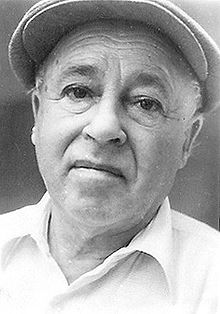
Yitzhak Tabenkin - one of the most important figures in Labour Zionist history who became an ardent supporter of settling the West Bank
Immediately after June 1967, the Labor Alignment government cynically manipulated international law, ravaged the occupied Palestinian lands to Judaize them, and developed bureaucratic methods to reduce the number of Palestinians living in the country. One can trace the cynicism and the line that stretches from Galili to settler-leader-turned-minister Uri Ariel in a new study by the Kerem Navot organization, titled “Seize the Moral High Ground,” which researches the history of orders to seize land for “temporary military purposes.” Seizing Palestinian land for military purposes and then transferring it to the settlements was not invented by Likud, but by the Alignment. The Alignment holds the copyright on steadily gnawing at Palestinian land while abusing its owners to give an established settlement another road, another water pipe, another security buffer zone.
(l to r) Ben-Aharon, Yigal Allon and Yitzhak Tabenkin. Allon became Deputy Prime Minister and was an ardent militarist and expansionist formulating the Allon Plan which advocated keeping the Jordan valley.
When the Labor governments worked hard to steal land on the grounds of security while quoting God’s promises to atheists, they paved the way for the hundreds of thousands of Jews who are now going to vote for parties promoting the ideology of a superior Jewish race – and these are many and varied, praise God. Eshkol allowed the destruction of the Mughrabi Quarter and dispersed its Palestinian residents to the winds to make way for the Western Wall Plaza, and Allon was the first minister to move to Jerusalem’s Old City.
The occupation bureaucracy they developed prevented the return home of tens of thousands of Palestinians who found themselves outside the West Bank in the summer of 1967, and restricted Palestinian construction in Jerusalem with the help of planning laws. These governments laid the attitudinal foundations for the Third Temple, whose construction is being planned by some people with the utmost seriousness. The spirit of the mass expulsions of 1948, the desire to empty the land of Arabs, infused them.
Professor Ze'ev Sternhell, a childhood survivor of the Nazi occupation of Poland and a world expert in fascism was the target of a bomb from right-wing settlers a few years ago
The racist-messianic justifications have persuaded an increasing number of Jewish Israelis, because the spoils acquired have grown tremendously over the years. It’s hard to give them up, and they want more. That’s why Benjamin Netanyahu hastened to explain that the State of Israel is not a state of all its citizens. He fears that votes might go from him to Feiglin and Kahanist candidate Itamar Ben-Gvir.
When the world proved it could not block either the Alignment or Likud governments, the land gluttons proceeded to gorge themselves with redoubled enthusiasm. The armed, aggressive, murderous racism of the settlement messiahs and their servants is intensifying, because the inferior nation is not inferior. It is resisting. It is educated, eloquent and refuses to disappear. It is rooted in its land.
Emboldened, the Feiglins and the Smotriches will try to expel masses of Palestinians. They will fail only if all the descendents of the Alignment – not just Ta’ayush activists and a handful of anarchists – prevent it with their bodies.
Why is it hard for me to imagine the leaders of Kahol Lavan halting the trucks?

15 February 2016

Israel & Saudi Arabia Seek the Partition of Syria


Good friends - Israel's Defence Minister Moshe Ya'alon and Prince Turki al-Faisal, former ambassador to the US and the former head of Saudi's intelligence agency

An interesting article in YNet – the on-line version of Israel’s most popular newspaper, Yediot Aharanot, is copied below.

Israel is pushing, with its Turkish and Saudi partners, for the partition of Syria into its confessional components – Sunni, Alawite, Druze and Kurd.  It serves Israel’s  purposes to fragment Syria, the better to control her and to conquer more territory in the future.
Pinhas Lavon, Israel's Defence Minister & Chief of Staff (later Defence & Foreign Minister) Moshe Dayan

I have copied below extensive tracts from Livia Rokach’s Israel’s Sacred Terrorism, which contain extracts from the Diaries of Moshe Sharrett, Israel’s second Prime Minister.  Sharrett, who was felled in 1955 by a combination of the Kasztner trial and the come back of Israel’s first Prime Minister and hawk, David Ben-Gurion, found himself surrounded with plots by his subordinate ministers and the Chief of Staff, Moshe Dayan, to conquer more territory and interfere in the neighbouring countries in order to for example control the water sources that Israel required.

David Ben-Gurion, Israel's first Prime Minister and architect of Expansion and the Expulsion of Palestinians in 1948
The Diaries demolish the myth that is sustained in the West to this day, that Israel was a state looking for peace surrounded by war mongering Arab states.  On the contrary Israel’s leaders looked continually for pretexts for war and sought, through terrorist operations in states like Egypt, where Zionist agents planted bombs and created the appearance of destabilisation, to deliberately manipulate the truth.  The operation in Egypt became known as the Security Mishap or the Lavon Affair, after the Defence Minister who initiated it.  Israel, engaging in the usual hasbara, portrayed itself as the victim in situations where it was the aggressor.
Moshe Sharrett - Israel's second Prime Minister and its only dove
Below we see the attempts to take advantage of the situation in Syria following the fall of its leader Shishlaky.  So the Defence Minister, Lavon, urged an invasion of Syria because he alleged Iraq had ‘practically moved into Syria’.  In fact it had done nothing whatsoever.

What Israel is doing today is to fulfill the dreams of Ben-Gurion, Lavon and Dayan.
Moshe Sharrett and David Ben Gurion -  Israel's first and second  Prime Ministers
Livia Rokach – Israel’s Sacred Terrorism
Chapter 4      "A Historical Opportunity" to Occupy Southern Syria
Pinhas Lavon - Israeli Defence Minister responsible for terrorism in Egypt and Iraq - deposed by Ben Gurion
On January 31, 1954 Moshe Dayan went on to outline his warplans. Sharett's note for that day continues:

The second plan-action against the interference of the Syrians with our fishing in the Lake of Tiberias. . . .The third-if, due to internal problems in Syria, Iraq invades that country we should advance [militarily, into Syria] and realize a series of "faits accomplis." . . . The interesting conclusion to be drawn from all this regards the direction in which the new Chief of Staff is thinking. I am extremely worried. (31 January 1954, 332)

On February 25, 1954, Syrian troops stationed in Aleppo revolted against Adib Shishakly's regime. After lunch Lavon took me aside and started trying to persuade me: This is the right moment to act this is the time to move forward and occupy the Syrian border positions beyond the Demilitarized Zone. Syria is disintegrating. A State with whom we signed an armistice agreement exists no more. Its government is about to fall and there is no other power in view. Moreover, Iraq has practically moved into Syria. This is an historical opportunity, we shouldn't miss it.

… I asked if he suggests to act immediately and I was shocked when I realized that he does. I said that if indeed Iraq will move into Syria with its army it will be a revolutionary turn which will ... justify far reaching conclusions, but for the time being this is only a danger, not a fact. … He repeated that time was precious and we must act so as not to miss an opportunity which otherwise might be lost forever. Again I answered that under the circumstances right now I cannot approve any such action. … I saw that he was extremely displeased by the delay. However, he had no choice but to agree. (25 February 1954, 374)

The next day the Shishakly regime actually fell. The following day, February 27, Sharett was present at a meeting where Lavon and Dayan reported to Ben Gurion that what happened in Syria was - "a typical Iraqi action." The two proposed again that the Israeli army be put on the march. Ben Gurion, "electrified," agreed. Sharett reiterated his opposition, pointing to the certainty of a Security Council condemnation… The three objected that "our entrance [into Syria] is justified in view of the situation in Syria. This is an act of defense of our border area." Sharett closed the discussion by insisting on the need for further discussion in the cabinet meeting, scheduled for the next morning:
Shimon Peres - Labour Prime Minister and later President - Ben Gurion protegy and famous for plotting against all and sundry - Trusted by no-one - responsible for developing Israel's nuclear weapon
Lavon's face wore a depressed expression. He understood this to be the end of the matter. (27 February 1954, 377)  
On Sunday, February 28, the press reported that no Iraqi troops had entered Syria. The situation in Damascus was under the complete control of President Hashem Al Atassi. The cabinet approved Sharett's position and rejected Lavon's vehement appeal not to miss a historical opportunity. Lavon said "The U.S. is about to betray us and ally itself with the Arab world." We should "demonstrate our strength and indicate to the U.S. that our life depends on this so that they will not dare do anything against us." The premier's victory, however, was to be short-lived….  
On December 12, 1954, however, a Syrian civilian plane was hijacked by Israeli war planes shortly after its takeoff, and forced to land at Lydda airport. Passengers and crew were detained and interrogated for two days, until stormy international protests forced the Israelis to release them. Furious, Sharett wrote to Lavon on December 22:  
It must be clear to you that we had no justification whatsoever to seize the plane, and that once forced down we should have immediately released it and not held the passengers under interrogation for 48 hours. I have no reason to doubt the truth of the factual affirmation of the U.S. State Department that our action was without precedent in the history of international practice. ..... What shocks and worries me is the narrow-mindedness and the shortsightedness of our military leaders. They seem to presume that the State of Israel may or even must-behave in the realm of international relations according to the laws of the jungle. (22 December 1954, 607)  

Sharett also protested to Lavon against the scandalous press campaign, which he suspected was inspired by the security establishment and which was aimed at convincing public opinion that the Syrian plane was stopped and forced down because it violated Israeli sovereignty and perhaps endangered its security. "As a result, the public does not understand why such a plane was released and naturally it concludes that we have here an unjustified concession on the part of the government" - (ibid.)  

On December 11 five Israeli soldiers were captured inside Syrian territory while mounting wiretapping installations on the Syrian telephone network. A month later, on January 13, 1955, one of them committed suicide in prison. The official Israeli version is, once again, that the five had been abducted in Israeli territory, taken to Syria, and tortured. The result was a violent emotional upsurge in Israel, all the more so as this news arrived shortly after the condemnation in Cairo of members of an Israeli terrorist ring which had been described to public opinion as an anti-Jewish frame-up. The prime minister confided to his personal diary:  

A young boy has been sacrificed for nothing.... Now they will say that his blood is on my hands. If I hadn't ordered the release of the Syrian plane [we would have had our hostages and] the Syrians could have been forced to free the five. The boy . . . would have been alive ... our soldiers have not been kidnapped in Israeli territory by Syrian invaders as the army spokesman announced .... They penetrated into Syria and not accidentally but in order to take care of a wiretapping installation, connected to a Syrian telephone line ... I have no doubt that the press and the Knesset will cry about torture. On the other hand, it is possible that the boy committed suicide because he broke down during the interrogation and only later he understood what a disaster he has brought upon his comrades and what he did to the state. … Anyway, his conscience probably caused him to take this terrible step. (3 January 1955, 649)  

….It is clear that Dayan's intention ... is to get [Syrian] hostages in order to obtain the release of our prisoners in Damascus. He put it into his head that it is necessary to take hostages, and would not let go. (10 February 1955, 714)  

CHAPTER 7 The Lavon Affair: Terrorism to Coerce the West

To Aharon Barkatt, then secretary general of Mapai, Sharett painted the following picture of Israel's security establishment:

Dayan was ready to hijack planes and kidnap [Arab] officers from trains, but he was shocked by Lavon's suggestion about the Gaza Strip. Maklef [who preceded Dayan as Chief of Staff] demanded a free hand to murder Shishakly but he was shaken when Lavon gave him a crazy order concerning the Syrian DMZ. (25 January 1955, 682)

He [Lavon] inspired and cultivated the negative adventuristic trend in the army
and preached the doctrine that not the Arab countries but the Western Powers
are the enemy, and the only way to deter them from their plots is through direct actions that will terrorize them. (26 January 1955, 685)

Peres shares the same ideology: he wants to frighten the West into supporting Israel's aims.

APPENDIX 5 Israeli Newspaper Reveals Government's Attempt to Stop Publication of Israel's Sacred Terrorism

1.Retaliation activities Quotations from Sharett show that these activities were never carried out in revenge or retaliation, as the were presented to be, but that they were the product of the premeditated policies of David Ben Gurion and Moshe Dayan. These policies aimed at heating the borders, as a preparation for war, and as a pretext to vacate and disperse Palestinian refugees who lived in camps close to the borders. Quotations from Sharett's book also reveal that President Yitzhak Ben Zvi hoped for an Egyptian attack to justify lsrael's occupation of half of Sinai. Sharett reveals, furthermore, that the incidents on the Syrian border were also a result of an Israeli initiative. Sharett details at length the reasons behind the blood-bath committed by the 101 unit, under the command of Arik Sharon, in the village of Kibya, where fifty-six innocent Arab villagers were killed. He also recites how the government decided to publish a false communique, in which this event was portrayed as a partisan action carried out by civilian "settlers."

2.The plan for the occupation of Southern Syria Sharett reveals that Ben Gurion, Dayan and Pinhas Lavon requested in February 1954 to exploit the toppling of the Syrian dictator, Adib Shishakly, by occupying southern Syria and annexing it to Israel. They also requested to buy a Syrian officer who would acquire power in Damascus and establish a pro-Israel puppet government. These things seem more actual today in light of the deteriorating position of Hafez al-Assad and Israeli declarations in this regard.

3.The intention to partition Lebanon Sharett reveals that already in February 1954 Ben Gurion proposed a large Israeli operation to dismember the Lebanese state and to establish a Maronite-Christian state in one of its parts. Extended discussions were held as a result. Ben Gurion explicated the plan at length in a letter to Sharett, and Sharett answered in a long letter in which he opposed the plan vehemently, Ben Gurion was ready to invest large sums in bribing Christian leaders in Lebanon. Sharett also revealed that the chief of staff supported the plan of buying a Lebanese army officer who would be used as a puppet, and who would make it seem that the intervention of the Israeli army would be in response to his call for the liberation of Lebanon from Muslim subjugation. In the eyes of today's reader this plan seems an accurate blueprint for what took place in Lebanon after that- the civil war, the establishment of the Maronite enclave of Major Sa'd Haddad and labeling it "free Lebanon."

5. See Ha'aretz of' 29 June 1979, commenting on a recent wave of terrorist actions in Syria attributed to the Muslim Brothers: "If Syria assumes its Sunni character again, as it was prior to the rise of the Ba'ath and the Alawites to power, new and varied opportunities may open up to Israel, Lebanon and the whole Middle Fast. In view of such a possibility, Israel must keep vigilant and alert: It must not an opportunity which might be unrepeatable". A quarter of a century later, The same formula is being used. In general, a close refilling of the Israeli press through 1979 suggests that Israel is again deploying efforts in various directions to bring about the fall[ of Assad's regime, and to install a Damascus regime which would go along with Israeli policies. "Israel is aiming at installing a Sadat in Damascus," one Israeli political figure told us in September 1979.


Israeli officials at Munich conference: Unrealistic to believe Syria can become united anew, partition 'only possible solution'.
Reuters
Published: 02.14.16, 12:29 / Israel News

Israel voiced doubt on Sunday that an international ceasefire plan for Syria would succeed, suggesting a sectarian partition of the country was inevitable and perhaps preferable. [to whom?!]

While formally neutral on the five-year civil war racking its neighbor, Israel has some sway among the world powers that have mounted armed interventions and which on Friday agreed on a "cessation of hostilities" to begin within a week.

Ruins in Homs, Syria, seen from a Russian drone
The deal, clinched at a Munich security conference, is already beset by recriminations between Russia, which backs Syrian President Bashar Assad militarily and wants to see his rule restored, and Western powers that have called for change in Damascus involving select opposition groups.

Addressing the conference after he met European counterparts and Jordan's King Abdullah, Defense Minister Moshe Ya'alon said he was "very pessimistic" about the truce's prospects.

"Unfortunately we are going to face chronic instability for a very, very long period of time," he said. 

"And part of any grand strategy is to avoid the past, saying we are going to unify Syria. We know how to make an omelette from an egg. I don't know how to make an egg from an omelette."

Referring to some of the warring sects, Ya'alon added: "We should realize that we are going to see enclaves - 'Alawistan', 'Syrian Kurdistan', 'Syrian Druzistan'. They might cooperate or fight each other."

Damascus (Photo: AFP)
Ram Ben-Barak, director-general of Israel's Intelligence Ministry, described partition as "the only possible solution."

"I think that ultimately Syria should be turned into regions, under the control of whoever is there," he told Army Radio, arguing that Assad's minority Alawite sect had no way to heal its schism with the Sunni Muslim majority.

"I can't see how a situation can be reached where those same 12 percent Alawites go back to ruling the Sunnis, of whom they killed half a million people there. Listen, that's crazy."

Helped by Russian firepower, Syrian government forces and their allies have been encircling rebel-held areas of Aleppo. That would give Assad effective control of western Syria, Ben-Barak said, although much of the east is dominated by Islamic State insurgents.

An Assad victory in Aleppo, Ben-Barak said, "will not solve the problem, because the battles will continue. You have ISIS there and the rebels will not lay down their weapons."

While sharing foreign concerns about Islamic State advances, Israel worries that the common threat from the insurgents has created a de-facto axis between world powers and its arch-foe Iran, which also has troops helping Assad.

"As long as Iran is in Syria, the country will not return to what it was, and it will certainly find it difficult to become stable as a country that is divided into enclaves, because the Sunni forces there will not allow this," Ya'alon said in an earlier statement.

At the conference, Ya'alon also met with Saudi Prince Turki al-Faisal, a former ambassador to the US and the former head of Saudi's intelligence agency, and the two shook hands.

Ya'alon said that Israel had channels of communications with neighboring Sunni Arab countries [i.e. Saudi Arabia and the Gulf statelets]. "Not only Jordan and Egypt. I speak about the Gulf states and North African states too ... For them, Iran and the Muslim Brotherhood are the enemy. They are not shaking hands (with Israelis) in public, but we meet in closed rooms."