Zionist 'Human Rights’ Lawyer’ Arsen Ostrovsky Defends the Israeli Army against Ahed


The Jewish Chronicle has managed to find the only 'human rights lawyer' in the world who defends State violence against a child because she 'provoked' them. It's akin to having a feminist lawyer defending a rapist because his victim was also provocative. The obscenity of the Jewish Chronicle and its far-Right Editor Stephen Pollard beggars belief.
 |
| Ostrovsky is the 'human rights lawyer' who is also Director of an Apartheid Institute |
Arsen
Ostrovsky is Director of the Israeli
Jewish Congress which tells us that its ‘vision
is promoting the principle of Israel as the State of the Jewish People.’ In other words it is opposed to Israel being
a state of its own inhabitants. It is a
strange form of human rights when you only defend the rights of one section of
the population. This is the Zionist
version of human rights.
 |
| Zionist 'human rights lawyer' Arsen Ostrovsky - who defends the 'human rights' of the Israeli army against a 16 year old girl Ahed Tamimi |
The
Israeli Jewish Congress’s goal
is ‘Promoting and strengthening the Jewish
character of Israel as a Jewish and democratic state as stated in the
Proclamation of Independence.’ The problem
is that Israel can either be a Jewish or a democratic state. It can’t be both. In practice as the new Jewish State Bill is
making clear, Israel is a state of its Jewish citizens first and foremost.
If
Ostrovsky is a human rights lawyer then Dr Harold Shipman was an example of medical ethics at their best. And by the same
token the Yorkshire Ripper was a committed supporter of women's liberation and Jimmy
Saville was, as the BBC used to maintain, someone devoted to children’s
rights.
What
is surprising is that so many Jewish people surrender their critical faculties
when reading the Jewish Chronicle under its far-Right tabloid editor Stephen
Pollard. Pollard is better known for his
defence
of anti-Semites such as the Polish MEP Michael Kaminski, who is nonetheless
an ardent supporter of Israel, as most anti-Semites today are.
 |
| Professor Mordechai Kedar - an advocate of rape against Palestinian women |
In
what is a new low, even for the Jewish Chronicle, the self-styled ‘Israeli human
rights lawyer’ Arsen Ostrovsky decries the comparison of Ahed with Malala, the
West’s favourite human rights symbol.
Ostrovsky writes that ‘Well, for
starters, Malala, a Nobel Peace Prize winner, was shot in the head...’ What
he didn’t say was that Ahed’s cousin Mohammed, just an hour before her
confrontation with soldiers invading the grounds of her house, was also shot in
the head and likewise nearly died.
Despite
the acts of violence of the Israeli army against the Tamimi family, one of whom
was murdered only this week, this despicable ‘human rights lawyer’ accused the Tamimis, who have a long history
of opposition to colonialism going back
to the 1930’s of ‘provoking’ the Israeli army.
 |
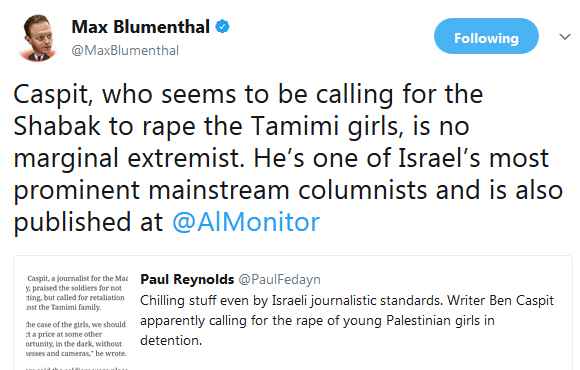
| Ben Caspit who wanted to 'exact a price in the dark, without witnesses or cameras' with a 16 year old girl |
Ostrovsky is no difference from apologists for rape who argue that their clients were 'provoked' by the victim. Ahed has herself been the subject of threats of rape and sexual violence. Ma'ariv columnist Ben Caspit, a Zionist liberal mind, wrote in an article (Hebrew) that
“In the case of the girls, we should exact a price at some other opportunity, in the dark, without witnesses and cameras”,
and what would you do with a 16 year old girl in the dark, without witnesses or cameras? The threat of sexual violence barely needs stating because in Israeli society the threat of rape and sexual violence against Palestinians, including children, is ever present.

Threats of rape and violence against Palestinian women are standard. There is former Colonel Mordechai Kedar, a Professor at Bar Ilan University who argues that because of the 'honour' system amongst Palestinians, the threat of rape will deter the men from engaging in resistance.
'The ill-treatment of Palestinian minors held within the Israeli military
detention system is “widespread, systematic and institutionalised,” a
report by the UN children’s fund found. Israeli Abuse Of Palestinian Children In Prison ‘Systematic,’ Says UN Report
According to the Jewish Chronicle's 'human rights lawyer' Ostrovsky it is those with guns
who are ‘provoked’ by civilians who have the audacity to resent them trampling over their grounds, stealing their land and water and who fire tear gas and
rubber bullets at peaceful demonstrations.
 |
| Steven Pollard is happy to defend antisemites as long as they are pro-Israel like Michal Kaminski |
If
you want to sign this letter to the Jewish Chronicle please write to:
Dear Editor,
Even by the Jewish Chronicle’s abysmal standards the attack on Ahed
Tamimi by ‘human rights’ lawyer Arsen Ostrovsky was a disgrace. [Give her an Oscar: Ahed Tamimi has a track record in provoking
the IDF], 5th January 2018]
Ahed is a 16 year old girl who has been detained without access to her
parents or lawyers. Ostrovsky compares Ahed with Malala, who was shot in the
head. He fails though to mention that
barely an hour before Ahed was filmed slapping a soldier her cousin, 15 year
old Mohammed, was shot in the head by an Israeli soldier.
Far from Ahed provoking Israel’s military, the soldier she slapped had
entered the grounds of her home uninvited.
The provocation was entirely that of the soldiers. Nabi Saleh, the village where Ahed lives has had
its land and even its only spring confiscated for the use of the nearby
settlement Halamish.
Ostrovsky’s portrait of the Tamimi family as violent is
outrageous. They live under military rule.
It is the Tamimis who have been subject to violence. Only this week another cousin 17 year old Musab
died after being shot in the neck. Their
father Bassem has been arrested 9 times and severely tortured.
Ahed was dragged out of her bed at 4 am in the morning by soldiers. This is an outrageous way to detain a
child. This could not and would not happen
to a Jewish child.
As Ha’aretz noted,
when a Jewish settler Yifat Alkobi, who is an adult, slapped a soldier and
engaged in five separate acts of violence, including throwing stones, she was bailed
not imprisoned. Ahed faces a 14 year
prison sentence as she is tried in a military court that has a 99.74%
conviction rate.
Ahed’s only offence is to peacefully resist a violent occupation. An occupation, the reality of which the
Jewish Chronicle takes care not to report.
Yours faithfully,
Below
is an excellent article by Jonathan Cook, the ex-Guardian journalist who lives
in Nazareth, on who is the David and who is the Goliath.
Tony
Greenstein
Jonathan Cook 8 January 2018
Sixteen-year-old Ahed Tamimi may not be what Israelis had in mind when,
over many years, they criticised Palestinians for not producing a Mahatma
Gandhi or Nelson Mandela.
Eventually, colonised peoples bring to the fore a figure best suited to
challenge the rotten values at the core of the society oppressing them. Ahed is
well qualified for the task.
She was charged last week with assault and incitement after she slapped
two heavily armed Israeli soldiers as they refused to leave the courtyard of
her family home in the West Bank village of Nabi Saleh, near Ramallah. Her
mother, Nariman, is in detention for filming the incident. The video quickly
went viral.
Ahed lashed out shortly after soldiers nearby shot her 15-year-old cousin
in the face, seriously injuring him.
Western commentators have largely denied Ahed the kind of effusive
support offered to democracy protesters in places such as China and Iran.
Nevertheless, this Palestinian schoolgirl – possibly facing a long jail term
for defying her oppressors – has quickly become a social media icon.
While Ahed might have been previously unknown to most Israelis, she is a
familiar face to Palestinians and campaigners around the world.
For years, she and other villagers have held a weekly confrontation with
the Israeli army as it enforces the rule of Jewish settlers over Nabi Saleh.
These settlers have forcibly taken over the village’s lands and ancient spring,
a vital water source for a community that depends on farming.
Distinctive for her irrepressible blonde hair and piercing blue eyes,
Ahed has been filmed regularly since she was a small girl confronting soldiers
who tower above her. Such scenes inspired one veteran Israeli peace activist to
anoint her Palestine’s Joan of Arc.
But few Israelis are so enamoured.
Not only does she defy Israeli stereotypes of a Palestinian, she has
struck a blow against the self-deception of a highly militarised and masculine
culture.
She has also given troubling form to the until-now anonymised Palestinian
children Israel accuses of stone-throwing.
Palestinian villages like Nabi Saleh are regularly invaded by soldiers.
Children are dragged from their beds in the middle of the night, as happened to
Ahed during her arrest last month in retaliation for her slaps. Human rights
groups document how children are routinely beaten and tortured in detention.
Many hundreds pass through Israeli jails each year charged with throwing
stones. With conviction rates in Israeli military courts of more than 99 per
cent, the guilt and incarceration of such children is a foregone conclusion.
They may be the lucky ones. Over the past 16 years, Israel’s army has
killed on average 11 children a month.
The video of Ahed, screened repeatedly on Israeli TV, has threatened to
upturn Israel’s self-image as David fighting an Arab Goliath. This explains the
toxic outrage and indignation that has gripped Israel since the video aired.
Predictably, Israeli politicians were incensed. Naftali Bennett, the
education minister, called for Ahed to “end her life in jail”. Culture minister
Miri Regev, a former army spokeswoman, said she felt personally “humiliated”
and “crushed” by Ahed.
But more troubling is a media debate that has characterised the
soldiers’ failure to beat Ahed in response to her slaps as a “national shame”.
The revered television host Yaron London expressed
astonishment that the soldiers “refrained from using their weapons” against
her, wondering whether they “hesitated out of cowardice”.
But far more sinister were the threats from Ben Caspit, a leading
Israeli analyst. In a column, he said Ahed’s actions made “every Israeli’s
blood boil”. He proposed subjecting her to retribution “in the dark, without
witnesses and cameras”, adding that his own form of revenge would lead to his
certain detention.
That fantasy – of cold-bloodedly violating an incarcerated child –
should have sickened every Israeli. And yet Mr Caspit is still safely ensconced
in his job.
But aside from exposing the sickness of a society addicted to
dehumanising and oppressing Palestinians, including children, Ahed’s case
raises the troubling question of what kind of resistance Israelis think
Palestinians are permitted.
International law, at least, is clear. The United Nations has stated
that people under occupation are allowed to use “all available means”,
including armed struggle, to liberate themselves.
But Ahed, the villagers of Nabi Saleh and many Palestinians like them
have preferred to adopt a different strategy – a confrontational, militant
civil disobedience. Their resistance defies the occupier’s assumption that it
is entitled to lord it over Palestinians.
Their approach contrasts strongly with the constant compromises and
so-called “security cooperation” accepted by the Palestinian Authority of
Mahmoud Abbas.
According to Israeli commentator Gideon Levy, Ahed’s case demonstrates
that Israelis deny Palestinians the right not only to use rockets, guns, knives
or stones, but even to what he mockingly terms an “uprising of slappings”.
Ahed and Nabi Saleh have shown that popular unarmed resistance – if it
is to discomfort Israel and the world – cannot afford to be passive or polite.
It must be fearless, antagonistic and disruptive.
Most of all, it must hold up a mirror to the oppressor. Ahed has exposed
the gun-wielding bully lurking in the soul of too many Israelis. That is a
lesson worthy of Gandhi or Mandela.
By +972
Blog
|Published
January 5, 2018
Gaby Lasky, the human rights attorney representing Ahed Tamimi and her
mother Nariman, talks to +972 about what it means for a Palestinian to be
put on trial in the occupier’s military courts, and some of the dangerous
precedents being set.
By Joshua Leifer
Israeli lawyer Gaby Lasky (C-L) speaks with her client sixteen-years-old
Ahed Tamimi (2R) before she stands for a hearing in the military court at Ofer
military prison near the West Bank of Ramallah, January 1, 2018. (Activestills)
The video of 16-year-old Ahed
Tamimi confronting two Israeli soldiers outside of her home in the village
of Nabi Saleh has become ubiquitous, broadcast across every media platform for
weeks. So have the pictures of Ahed, handcuffed and surrounded by guards in
court. Posters of Ahed have even appeared on bus
stops in London. What those images often fail to properly convey is that
Ahed is being detained in a military prison and being tried in a military
court, and how that differs from the way a minor would be treated in
an Israeli civilian court.
Attorney Gaby Lasky represents Ahed Tamimi and her mother, Nariman.
Lasky, a former secretary general of Peace Now and a member of the Tel
Aviv-Jaffa City Council for the left-wing Meretz party, has spent much
of the last decade defending Palestinians, many of them involved in the
popular struggle against the occupation.
I spoke with Lasky on Thursday about the challenges of working in
Israeli military court, where 99.7
percent of Palestinian suspects are convicted; about the cases against Ahed
Tamimi and her mother, Nariman; and about the structural injustices built into
the Israeli legal system in the occupied territories.
The difficulty of Ahed’s case goes beyond the legal challenges
Palestinians living under occupation face when arrested by the Israeli army,
Lasky told me. “The video shows the essence of the conflict between Israel and
the Palestinians,” she stressed. Depending on where you stand, and
perhaps who you are, watching the 16-year-old girl face down two heavily armed
Israeli soldiers can
reinforce either the Palestinian and Israeli narrative.
The following has been edited for length.
What does it mean that the judge is wearing the same uniform as the
prosecution?
The military court is not a court of justice in the regular sense; it’s
an organ of the occupation. It perpetuates the occupation. Both the judge and
the prosecution are wearing the same uniform, and are part of the same system,
and the defense is not.
What are some of the obstacles in a case like Ahed’s that would be
different if she were being tried in a civilian court?
First, it would be much, much easier to get her released from detention.
I brought to court a lot of examples of adults who were released in cases where
their offenses were greater than hers. [Civilian] courts in Israel do tend to
release [suspects on bail]. Her being a minor would have made things even
easier in an Israeli court. Cases in military court are more difficult from the
get-go much because the laws are stricter, the charges are heavier, and rights
are only partially protected.
But the difficulty with Ahed’s case is not only that we’re facing a
military court; it’s the fact that the video shows the essence of the conflict
between Israel and the Palestinians. Someone can see the narrative of the
Palestinians in that video, and on the other side, Israelis can see the narrative
of Israel in that video.
When you talk about an offense in a regular court, you can always talk
about the circumstances of the incident. In this case, the circumstances are a
16-year-old girl who was born into occupation. The military court doesn’t take
those things into consideration. It’s not an issue that is brought to the
table. It’s a given. But if you want to see the whole picture, you have to talk
about these things.
What is the case against Ahed?
The most serious charges against her are the ones regarding the video
incident. She has 12 different charges in her indictment regarding five
different incidents. Regarding the video, she’s charged with assault of a
soldier, disrupting the work of a soldier, and incitement.
She has other charges regarding stone-throwing but they are old — one of
them is almost two years old. Nobody thought to report it or arrest her or
question her at the time. The evidence against her regarding all of the other
incidents was produced only after she was arrested and they found old pictures
of Ahed [on her mother’s Facebook].
But it was only after her arrest that soldiers were asked to come and
give testimony regarding what they saw two years ago. They were presented with
these pictures after she was in every newspaper or television program, and then
asked if they could identify her in a photo line-up. That’s how they obtained
all of the evidence against her.
What is the case against Nariman, Ahed’s mother, who was arrested hours
after her daughter? Would a civilian court ever consider live-streaming on
Facebook as a form of incitement?
It’s really dangerous that the prosecution is implying that
live-streaming is the worst form of incitement. It would mean that a reporter
doing a live report at a demonstration where someone says, “come join us in the
demonstration,” would constitute incitement in the eyes of the prosecution.
What the prosecution is trying to do is very dangerous for freedom of the
press.
Ahed’s case has been all over the news, getting a lot attention for a
case in Israeli military court. But what aren’t we hearing about? What’s not
getting out to the public?
Most people don’t know that the occupier has courts that put on trial
people living under occupation just because they don’t follow the rules of the
occupier. The Israeli public doesn’t want to hear about the occupation, and
it’s the same for the court of the occupation.
It is amazing that a 16-year-old youngster has forced everyone to have
an opinion about the occupation, to have to deal with the fact that people are
born into occupation, that their rights are infringed upon, and that they’re
taken to prison when they’re 16 years old for offenses that don’t merit
detention in Israel.
Some in the Israeli public think the soldiers behaved as they should,
others say they were humiliated. It was this humiliation that brought about
Ahed’s arrest. But even so, everyone now has to deal with the occupation and
what it does to the soldiers and to the people who live under occupation. Even
without wanting to, Ahed’s case opened a door that has been closed for a long
time for most of the public in Israel.
Joshua Leifer is an associate editor at +972
Magazine.