Showing posts with label Gaby Lasky. Show all posts

22 December 2021

Shahar Peretz and Eran Aviv, Gaoled for Refusing to Serve in Israel's Army - These Are the Israelis We Should Be Supporting - Not the Zionists

To Starmer, Lammy and the Jewish Labour Movement Israel’s Refuseniks are the ‘Wrong Sort of Israelis’


In today’s Labour Party Starmer and Evans are expelling anyone who is seen as supporting the Palestinians.  According to Starmer this is because ‘every Jew in the Labour Party matters’ although if you are a Jewish member of the Labour Party you are 5 times more likely to be expelled or suspended.

The reason is because we are the wrong sort of Jew.  Opposition to Israeli Apartheid and its settlement enterprise is equated with anti-Semitism. That is their justification for opposing BDS, the only means of putting pressure on the Israeli state.

The fact that the same hypocrites are only too eager to support sanctions on Iran, China and a host of other countries points to their selective opposition to sanctions.

To Starmer and Johnson young Israelis who refuse to serve in Israel’s army are the ‘wrong sort of Israeli’. That is why it is important to support them.


We should be under no illusions that these brave young people are a tiny minority, a sliver, of Israel’s Jewish population who come under immense social and political pressures. That is why they need, more than ever, our support.

Shahar has been sentenced to imprisonment for the third time. She described how life is made as difficult as possible for those who break the national concensus. She wasn’t allowed, as of right, to have access to writing materials:

Some days I could only get a pen for 10 minutes; on Saturdays or holidays you don’t get a pen at all. Privacy is a luxury I don’t get to have as a prisoner and I was not allowed to write anything without the rest of the inmates, guards and commanders getting to see what I’m writing.’

In prison, ‘writing is in itself a form of activism’

the prison authorities  hindered my ability to document what goes on behind bars, write articles and develop ideas and plan on how to share my experiences once I am released for a few days. The military does not want me to write, speak or share my thoughts. They are trying to silence me. 

The silencing of political refusers is a small part of a more violent pattern of behavior - The silencing of the Palestinian struggle for human rights in the West Bank and Gaza

Shahar wrote that

‘it is this silencing, this attempt to erase, hide and deny what is really happening, that makes me stand proud and declare my refusal publicly.’

As Amira Hass wrote for female prisoners ‘writing is the rarest of ‘privileges’. The Israeli Army doesn’t allow female soldiers to write. This  has been applied in the new military prison at Neve Tzedek (in Hebrew, Oasis of Justice). ‘They’re not allowed to hold writing implements, except for a half hour or 20 minutes a day at best.’

MK Gaby Lasky (Meretz) asked why this was so and Gali Ofir, an adviser to Defense Minister Benny Gantz, answered that: “The decision to restrict the use of writing implements was made by the commander of the prison base.” Which is no explanation at all.
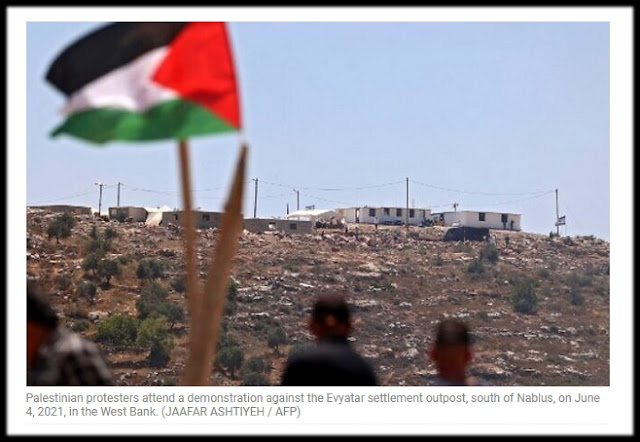
Israeli soldiers help built illegal settlement

Amira Hass was told that there are no restrictions on writing implements. ‘In short, the anonymous military official lied to me.’ In the wings of imprisoned male soldiers, this ban is not enforced. 

Tair Kaminer, who was imprisoned in two different military jails in 2016, said that she and fellow inmates kept using writing implements for painting, writing journals and letters to family and friends, which was essential for breaking the boredom. “We could ask for paper and pens any time of day and the wardens would give it to us,”

The writing ban was not the decision of one governor alone. This decision was a premeditated attempt to prevent detailed descriptions of life inside prison to be circulated outside. 

Peretz spent 58 days in military prison. She told Haaretz:

In my first and second sentences I was told that we could ask for a pen between 1 o’clock and 4 o’clock in the afternoon. But the pen was given according to the commanders’ timetable. Sometimes only for 10 minutes
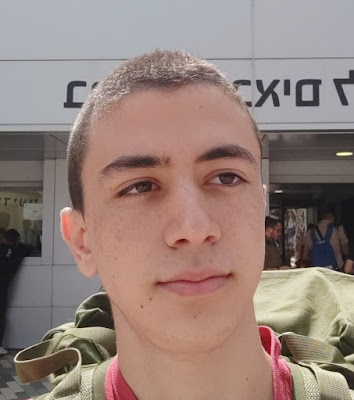
Eran Aviv 

Eran Aviv said that in the men’s wings there were pens on the table all the time for their use. During Peretz’s third term in prison
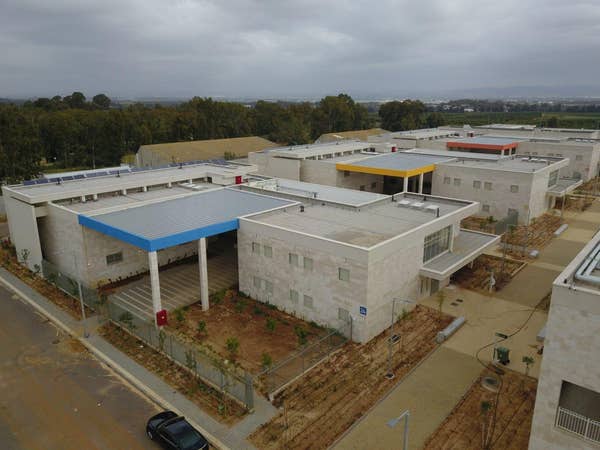
The new military prison Neve Tzedek, near the Sharon Junction in central Israel.

 “it had been decided that there would be a single writing time for all the women. From 20 minutes to half an hour... Every day it was different. Sometimes the commanders told us that today’s writing would be allowed only for women who want to write requests to the prison authorities. And so I didn’t get a pen on Sunday or Monday last week. You can only write in the yard... Sometimes 20 girls come out to write, but there are only five pens. And still everyone has to go back to their cell after the half-hour. The commanders stand over us and read what we write. I wrote a letter to my boyfriend and one of the commanders asked me: ‘What, you have a boyfriend?’”

Afterwards the commander-wardens count the pens to make sure all were returned. Shahar described the regime of petty punishments:

 “We can be in the yard and suddenly the commander says: ‘Who wants to write?’ It’s completely random. And I don’t have time to go back to my cell and get my sudoko booklet. It can be at 3 P.M. or 6 P.M. And it might not happen at all. When one day we mentioned to the commander that we hadn’t received pens, she answered ‘Right, and you won’t get any today.’ I tried to understand the reason for the ban. The main answer is that we might stab one another. So why is there a ban on felt-tip pens, which can’t stab? The commanders bring razor blades to the girls. That’s not dangerous? Another answer is that they don’t want us to scribble on the walls and the uniforms. There are cameras in every cell except in the showers and toilets. In the yard they are listening everywhere. All the time they can see what we’re doing and punish us. One of the commanders told me, angrily, that a pen is a privilege and not a right. I came here with sudoko and writing booklets, with all kinds of plans to document what goes on in prison. And I came home with everything almost empty.”

Lasky was told that it had been decided to lift the ban on writing “as long as the prisoners do not make wrongful use of writing implements.” The mind boggles as to what the Israeli military consider a ‘wrongful use’.

Donate to help the Refusers

Oren Feld

At the end of October a protest was organised by Yesh Gvul (There Is a Limit) and supported by conscientious objector support network Mesarvot and the Communist Party of Israel, Maki, demanding the release of three refuseniks, Eran Aviv, Shachar Perez and Oren Feld — at Tzedek prison, near Netanya. Feld, who is the Hadash (Democratic Front for Peace and Equality) Jerusalem branch secretary, which is part of the Joint List. He was just released after 14 days in military jail. Feld is 29 years old and an MA student.

See Protests to demand release of Israeli communist and other military refuseniks
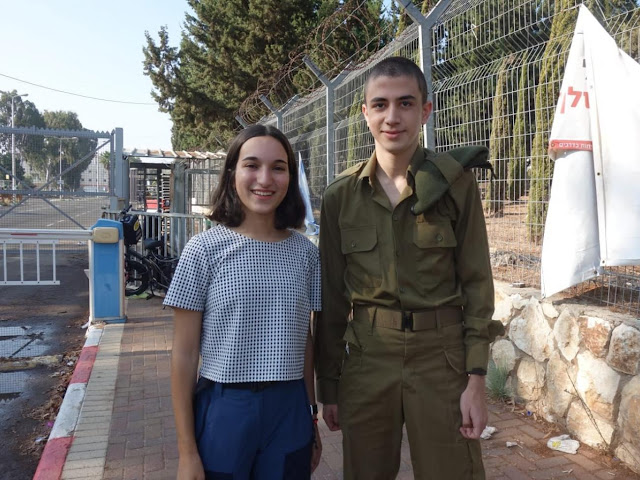
Eran Aviv and Shahar Peretz

On December 16 Eran Aviv wrote a letter ‘as a free man’.

After spending 114 days in military jail for refusing to enlist to the Israeli military and not be complicit in the occupation of the Palestinian territories, I finally received an exemption from military service.

Eran spoke about how

Just a few months back we facilitated the Shministim letter (Shministim meaning high school seniors in Hebrew) that was signed by 120 high school students declaring their intention to refuse to enlist and become soldiers of the occupation.

Eran appealed to people to ‘Join our growing community by donating today to help support our objection to the occupation.’ 

Oren wrote about how, when he was first drafted to the Israeli military as an 18 year old,

‘I did not have the strength to resist it. Now I do. I spent 3 years of my life in a military service I did not believe in and over the years I have witnessed numerous injustices and wrongdoings performed by the army.’

That is why now, at the age of 29 years, I said ENOUGH when I was called to do reserve duty. I will no longer be a part of an institution that oppresses, kills, and exploits innocent people. It is time to speak the truth about the history of our land, - starting with past expulsions of Palestinians and continuing with the multiple present day measures aimed at the ethnic cleansing of Palestinians, that are part of everyday life. Only truth will stop the occupation.

The occupation manifests itself in many forms. It has controls over the Palestinian leadership; It controls transportation routes through the use of lockdowns and blockades; It performs mass arrests; It has the power to prohibit gatherings and demonstrations. The occupation is undeniable, and it is a political choice: there is no justification for an endless, limitless foreign rule over millions of innocent people.

I choose peace. That is why when I received the order to report for reserve duty, I told my army commander that I will not comply. He sentenced me to 14 days in jail for my refusal. I sent a request to the conscientious committee asking them to release me from reserve duty, but they denied my request and I went to military jail. Serving time was a harsh and humiliating experience but I will continue to stand firm in the face of oppression!

Sentenced to 14 days in prison for refusing to serve the occupation

Tom Kearney described how at the end of August 2021 when many students had just left school Shahar Peretz in the town of Kfar Yona, Israel, was drafting a statement to present at the local army induction base. On the 31 August, she attended the Tel Hashomer base, refusing to enlist in the Israeli Defence Force (IDF). Her actions resulted in her being sentenced to be detained in a military prison.
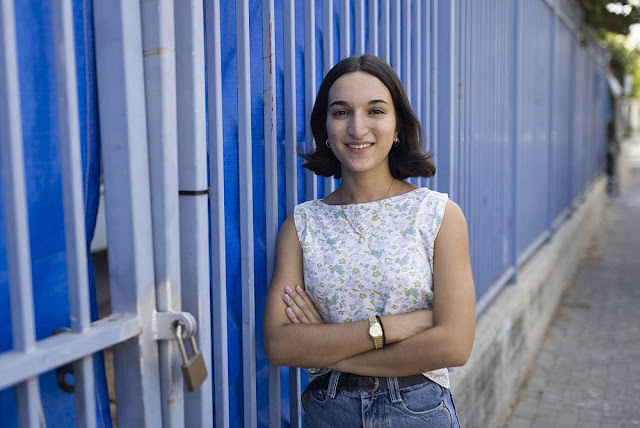
Shahar Peretz - conscientious objector

Shahar, 18, is one of 120 teenagers who signed the “Shministim Letter” (an initiative with the Hebrew nickname given to high school seniors) in January, in which they declared their refusal to serve in the Israeli army in protest of its policies of occupation and apartheid in Gaza and the West Bank.

While Shahar was drafting her statement Eran Aviv, 19 from Tel Aviv, was preparing for his fourth period of imprisonment as a conscientious objector.
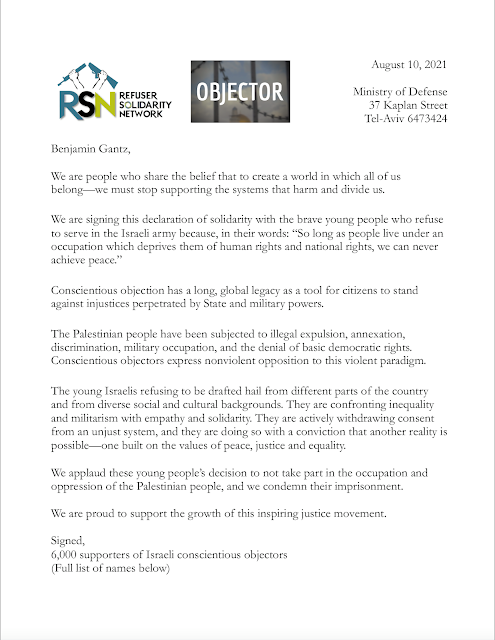
In a recent interview, facilitated by the Refuser Solidarity Network both Shahar and Eran described how young people, from an early age, are habituated through school and the wider society to their joining the IDF. They described seeing uniforms or machine guns being carried on buses as a natural part of the public arena, which they argued has resulted in a space that sanctifies soldiers, death, and dead heroes and where streets are named after commanders.

Shahar remarked that she had decided to refuse to join the army after participating in a summer camp between Palestinians and Israelis. She said that she could not become part of system that oppresses them and their families daily.

“I do not want to wear a uniform that symbolises violence and pain. I do not want to become their enemy

Eran expressed the view that there are two systems in Israel and the Occupied Territories (OTP), Israeli civil law and Israeli military law and that Palestinians live everyday subjected to military law. He described how conscripts in the military service are taught that the only way to protect Jewish people is through force. They are therefore expected to practice violence and of course many Palestinians object and are violent in return.

Shahar concurred with Eran’s view by describing witnessing, whilst volunteering to assist Palestinian farmers in the Hebron hills in the West Bank, Palestinian children being attacked and harassed by Israeli soldiers as they walked to school.

Both Shahar and Eran have found their immediate families supportive of their actions, but many in the local community have expressed criticism accusing them of negating their national and civic duty to undertake military service. Shahar appears to have experienced more verbal abuse through social media and at times has felt fearful for both herself and her family though she has not been threatened with physical violence. Eran expressed the view that he has experienced more criticism whilst in prison than from his community, even though some soldiers he has met in prison were there because they had gone AWOL due to their dislike of the army and their experiences in it.

Both Eran and Shahar admitted that their prospects may be adversely affected by their decision, but 

both passionately expressed their need to be an active contributor to the struggle to make conscientious objection a legitimate option and to work towards peace and reconciliation between Israelis and Palestinians.’ 

Shahar Peretz was sentenced to 10 days in a military prison on 1st September after refusing to join the Israeli army. She has subsequently served a second term of imprisonment, during which she had her 19th birthday and on 24th October was imprisoned for a third time for 30 days.

Eran Aviv returned to a military prison on 1st September and was recently sentenced for a 6th term of imprisonment on 24th October. He has now completed a total of 114 days in jail and there are recent concerns expressed by his supporters that he is finding his time in prison increasingly difficult.

You can sign up for monthly updates at https://www.refuser.org Facebook Page for Refusers International

Ha’aretz reported that 60 High School Seniors Refuse to Serve in the Israeli Army Because of the Occupation

Departing from previous letters of this kind, the signatories call out the country’s education system for various issues, such as encouraging enlistment in the Israel Defense Forces and emphasizing the Jewish narrative in Bible and history classes.

They also draw attention to issues they say the curriculum ignores, such as the expulsion of Arabs in 1948 and the current violation of human rights in the occupied territories. The teens wrote:

“The state demands that we enlist into an army that is ostensibly meant to ensure the existence of the state. But in practice, army operations are not directed mainly at defending against enemy armies, but at subjugating a civilian population. Thus, our mobilization has a context and implications.” They say their refusal to enlist is not an act of disengagement or turning away from Israeli society, but rather “the taking of responsibility for our actions and their implications.”

They added:

“We grew up with the ideal of the heroic soldier, we sent them care packages, we visited the tanks they fought in, we dressed up as soldiers in premilitary training camps and we elevated their deaths on memorial days. The fact that this is the reality we’re all used to does not make it a-political. Enlistment is a political act, no less than refusal to do so.”
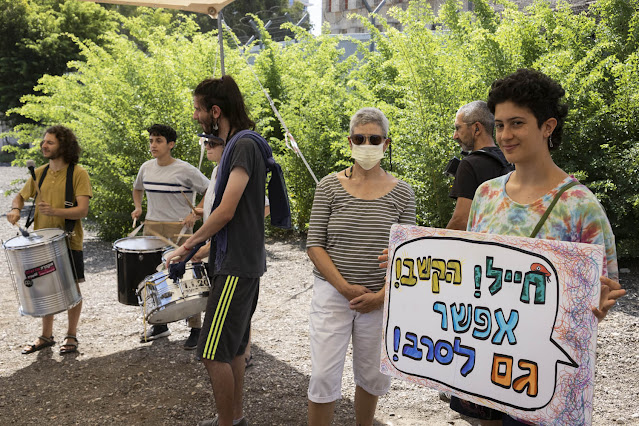
Supporters gather at the IDF induction base

The letter referred to “the policy of apartheid as expressed in two separate legal systems, one for Palestinians and one for Jews” and to the occupation, as expressed in “societal racism, an inflammatory political discourse and police violence.”

One of the signatories, Daniel Paldi of Tel Aviv, said:

“From a very young age we are raised to be soldiers. Civic classes don’t do much to change the one-directional course of the school system, its pinnacle arriving with the preparations for enlistment in high school.”

Paldi added:

“Why is refusal to enlist perceived as a political action, but school activities meant to encourage enlistment seen as self-evident? It starts with school trips to Jerusalem and the Golan Heights, in which no political contexts are discussed. We’re only told about the battles. There’s an elephant in the room that no one is talking about.”

Paldi noted that on a school trip to southern Israel, the guides warned that “If we don’t work the land, someone else will take it.”
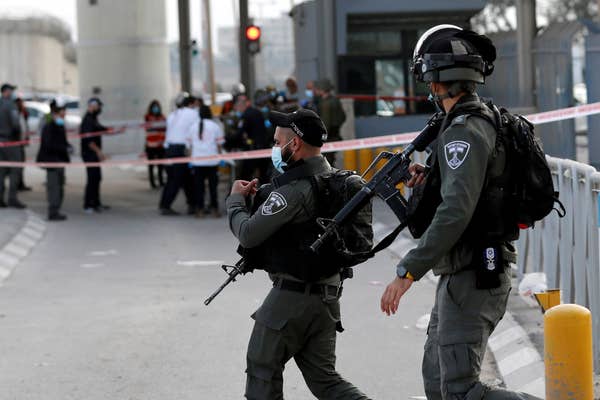
Members of Israeli border police walk at the scene of an incident, at Qalandia checkpoint near Ramallah in the West Bank, December 7, 2020. Credit: Mohamad Torokman / Reuters

“Until we talk about the Nakba in class, how it happened that most of the Palestinians who lived here fled or were expelled, or about the theft of their possessions, we won’t understand how much the problem remains part of our lives. This is sweeping history under the rug. When I began to understand this, I immediately started thinking about what else we were ‘sold’ in school.”

After a struggle lasting months, including spending 56 days in a military prison, one of the signatories of the letter, Hallel Rabin of Kibbutz Harduf, was awarded an exemption from military service as a conscientious objector.

Rabin says the schools only teach the Jewish narrative. In history and civics classes, they present a zero-sum game, in which the right and justification for Jews to live freely automatically denies the rights of the other population.”
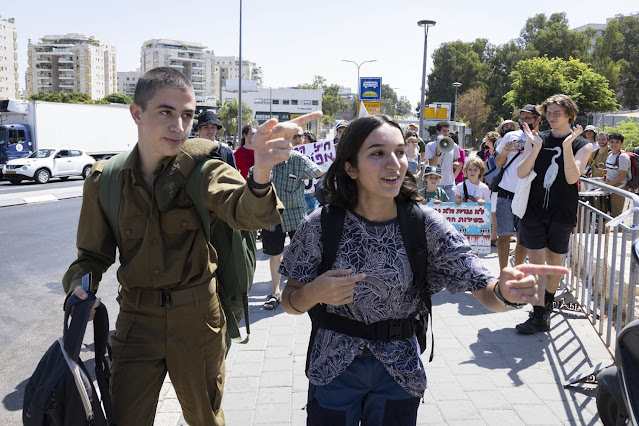
Supporters gather at the IDF induction base to show their solidarity with Shahar Perets and Eran Aviv over their refusal to join the Israeli army, Tel Hashomer, central Israel, August 31, 2021. (Oren Ziv)

·         See Israeli woman jailed three times for refusing to join the army

·         Israel: Conscientious objectors Eran Aviv and Shahar Peretz resist for peace

11 May 2018

Even poets are a threat to Israel's Jewish Supremacist State

What Kind of State Gaols and Prosecutes a Poet for Incitement?  A Police State

The myth of Israel as a democratic state is widespread.  In the words of Emily Thornberry, Labour’s racist Shadow Foreign Secretary, Modern Israel is a beacon of freedom, equality and democracy.”
Dareen Tatour
Labour's racist Shadow Foreign Secretary, Emily Thornberry
As Ahmed Tibi quipped, Israel is a democratic state for Jews and a Jewish state for Arabs. 
In practice even for Jews, Israel is becoming less and less democratic.  The term ‘leftist’ is today a term of abuse in Israel. Israeli human rights NGO’s – even liberal Zionist ones like B’tselem and Breaking the Silence - are under increasing pressure from legislation such as the NGO Law that forced them to highlight their funding prominently when over half of it comes from overseas whereas right-wing NGO’s, which typically receive their money from private individuals are exempt.  The idea being to portray them as in hock to foreign interests and therefore traitors.

After having been gaoled and held under house arrested for 2½ years, this month Palestinian Israeli poet Dareen Tatour was, predictably, convicted by an Israeli magistrate of incitement to violence and support for terrorism.  As Jonathan Cook observed, Dareen had endured two and a half years of jail and harsh house arrest – denied access to computers and phones. Now she is at risk of a sentence of up to eight additional years in prison.
Emily Thornberry - Labour's Racist  Shadow Foreign Secretary
Poetry invariably exploits complexities of language and ambiguities of meaning but over the protests of scholars of the Arabic language, the court relied on translations of Tatour’s poetry by an Israeli policeman who translated the Arabic word “shaheed”, which for Palestinians refers to any victim of Israeli oppression, to “terrorist”.
 It is not a trial, it is a theatrical play,” Tatour said of the legal proceedings.
A handful of Israeli literary figures, including the author A B Yehoshua, protested at the unprecedented move to jail a poet, something they noted that even the most repressive regimes usually avoid doing.

Israeli Jewish incitement against Arabs never merits any attention from the State

A Hebrew literature professor, Nissim Calderon, warned: “What begins by undermining the freedom of a Palestinian poet will surely continue by undermining the freedom of Israeli poets.”
Yet the real incitement is against Israel’s Arab citizens. The lie about Palestinians being ‘incited’ to oppose the Israeli occupation (because they would otherwise love it!) hides the fact that there is an ongoing campaign of harassment and threats from Israeli posters to social media.  Without exception Israeli incitement against Palestinians goes unpunished.  But if a poet makes a reference to resistance then the full force of the law descends on her.

Israeli Jewish incitement against Arabs never merits attention from the State
However in the two years, between November 2015 and October 2017 some 280 Palestinians were arrested for posts on Facebook.
A Report from 7amleh, the Arab Centre for the Advancement of Social Media shows what the reality of incitement on social media really consists of.
·         Every 71 seconds there is an inciting post uploaded against Palestinians
·         A total of 445,000 calls for violence, hate speech posts and curses against Palestinians
·         One out of nine posts about Palestinians contains a call for violence or a curse
·         50,000 Israeli social media users wrote at least one inciting post against Palestinians

May 4, 2018 By Richard Silverstein
Dareen Tatour, the poet as terrorist-criminal
Young Palestinian poet, Dareen Tatour, wrote a poem in the midst of the Knife Intifada three years ago. Entitled, Resist, the poem called for resistance against Israeli Occupation, and steadfastness in the face of oppression. Standard poetic themes in the face of injustice. There are literally thousands of similar poems, including memorable ones written by Israel’s first national poet, Haim Nachman Bialik.
But in Israel, writing such a poem and using Facebook and YouTube to disseminate it will get you branded a terrorist. Dareen was arrested three years ago. Her trial was postponed for that entire period and she was placed under strict house arrest. She was only permitted to leave her home once per weekend, and then only with police minders.
Israeli Jewish incitement against Arabs never merits any attention from the State
Yesterday, the court finally made a decision in her case: guilty. No surprise since Israeli courts convict 98% of Palestinian security defendants of their “crimes.” Dareen was found guilty of “incitement” and belonging to a terror group. It makes no difference that she doesn’t belong to any terrorist group. Expressing sympathy with the goals of the Palestinian national movement is enough to be deemed a terrorist.
Here is an eyewitness account of the shameful spectacle presided over by Judge Adi Bambilia, a judge so ashamed of her verdict that she mumbled her way through it so it would be that much harder for the assembled world media to know the result and report it:
The judge came in only after the media was allowed to take pictures in the courtroom. She sat on her high bench, said that the verdict is long, and that she would read only some of it. She read in a low voice and people complained that they can’t hear. She usually uses a mike – but not today. The guards wanted to throw out of the court the people that complained – but the judge requested them not to do it.
It all took hardly a few minutes, The only sentence that could be heard clearly was when the judge cited some old court ruling about the importance of the freedom of expression. Soon she concluded: “I decided to convict…” Then she went on in a very low voice to name the articles of conviction by their technical numbers, without any explanation, and soon disappeared through the back-door to her chamber.
Just one item indicating the ludicrousness of the Israeli State’s case against Dareen. It presented as an expert witness, a “translator” who grievously mistranslated her poem to claim it called for violence. The prosecution called the witness an “expert” in both spoken and literary Arabic, when he couldn’t even translate her poem properly. You remember Bibi’s dog and pony show headlined by the charge: “Iran Lied.” Well, forget that. Israel lied, “big time,” as both Trump and Netanyahu would say.
Dareen’s plight might have amounted to little amidst the sea of suffering and injustice perpetrated on Palestinians regularly by the Israeli military-intelligence apparatus, but her cause was taken up by an international human rights campaign supported by, among others, the literary freedom NGO, PEN. Its director visited Dareen under house arrest and took a picture with her to show the international artistic world’s solidarity.
While Israel may deem a terrorist, I honor her here by publishing her original video including her poem and its Hebrew and English translations. Keep in mind that Israel considers all of us accessories to terrorism by merely reading this. By the way, YouTube has restricted the video warning viewers that it contains inappropriate content. You have to click through the warning before you can view it. Thanks YouTube for standing for artistic freedom in the face of Israeli censoriousness!
Here is a statement Dareen’s lawyer, Gaby Lasky, published on Facebook yesterday. I’ve translated it:
English translation:
Resist, My People, Resist Them
In Jerusalem, I dressed my wounds and breathed my sorrows
And carried the soul in my palm
For an Arab Palestine.
I will not succumb to the “peaceful solution,”
Never lower my flags
Until I evict them from my land.
I cast them aside for a coming time.
Resist, my people, resist them.
Resist the settler’s robbery
And follow the caravan of martyrs.
Shred the disgraceful constitution
Which imposed degradation and humiliation
And deterred us from restoring justice.
They burned blameless children;
As for Hadil, the sniper shot her in public,
Killed her in broad daylight.
Resist, my people, resist them.
Resist the colonialist’s onslaught.
Pay no mind to his agents among us
Who chain us with the peaceful illusion.
Do not fear doubtful tongues;
The truth in your heart is stronger,
As long as you resist in a land
That has lived through raids and victory.
So Ali called from his grave:
Resist, my rebellious people.
Write me as prose on the agarwood;
My remains have you as a response.
Resist, my people, resist them.
Hebrew translation (actually done by Israelis who know Arabic!):
'What’s more surprising is that there are still people in Israel who expect a fair trial for Palestinians ... as if Israel were still a democracy'
 May 06, 2018 9:15 PM

Poet Dareen Tatour at the Nazareth Magistrate's Court on May 3, 2018 Credit Gil Eliahu
Israeli literary figures lambasted Thursday’s conviction of Arab poet Dareen Tatour on charges of incitement to violence and support for a terrorist organization.
The Nazareth Magistrate’s Court convicted Tatour, 36, on account of three posts published on social media, including a poem titled, “Resist, my people, resist them.” According to a translation of the Arabic-language poem that appeared in the indictment, it included the lines, “I won’t agree to a peaceful solution / I’ll never lower my flag / until I remove them from my homeland.”
Tatour, an Israeli Arab who lives in Reineh, near Nazareth in the country’s north, said after the verdict that she didn’t regret anything and planned to appeal the ruling.
“I wasn’t surprised by the verdict, given everything that’s been happening here,” said Ilana Hammerman, an editor, translator and writer. “The Israeli justice system has been taking this attitude for many years already. What’s more surprising is that there are still people in Israel who expect a fair trial for Palestinians and opponents of Israeli policy ... as if Israel were still a democracy. Anyone who’s surprised is someone who’s sitting with his eyes closed. This is the general direction in which Israel is heading.”
Bottom of Form
It’s impossible to know whether this government attributes such importance to poetic imagery that it pounces like this on a Palestinian poet, or whether its compete lack of understanding of poetry causes it to treat every word like a drawn knife,” said author A.B. Yehoshua, an Israel Prize laureate. “The time has come for judges to read more Hebrew poetry throughout the generations and see the imagery and language it contains.”
Nissim Calderon, a Hebrew literature professor at Ben-Gurion University of the Negev who served as a witness in the trial, said, “The verdict is a blow to one of the deepest traditions of Hebrew poetry – the poet’s freedom from being put on trial over his words. This was upheld under British rule toward Hebrew poets who called for the use of violence, and it’s of value to Israelis themselves even before being an obligation toward the occupied Palestinians. What begins by undermining the freedom of a Palestinian poet will surely continue by undermining the freedom of Israeli poets.”
Navit Barel, a poet and editor, said, “This isn’t an issue related to literary taste or editorial choice. It’s an issue of freedom and justice. This is a sad and frightening day for Israeli democracy. The court was asked to rule on the interpretation of a poem in a language the judge doesn’t read, and it decided this poem was dangerous.”
Barel noted that she has heard demonstrators at a protest shouting, “Rabin is looking for a friend” – a reference to assassinated Prime Minister Yitzhak Rabin – at the army’s chief of staff. “Which of them was sentenced as an inciter?” she asked, adding, “I’ve heard a Hebrew refrain on the radio in which a singer sang that leftists are killing their brothers, handing them over to foreigners. The law clearly laid down rules on the question of what constitutes incitement. Would an Israeli Jew who said or wrote much worse things than the poem in question be brought to trial?”
Tatour was arrested in October 2015, when Palestinians were carrying out stabbing attacks against Jews almost daily. The indictment accused her of publishing posts on Facebook and YouTube “which contained calls to commit acts of violence or terror and for praising and identifying with acts of violence or terrorism.”
One video clip she posted showed masked men throwing stones and firebombs at Israeli security forces with a voiceover of her reading her poem. By the time the indictment was filed, the prosecution said, the clip had been watched more than 200 times and received several favorable responses.
“The content, its exposure and the circumstances of its publication created a real possibility that acts of violence or terrorism will be committed,” the indictment said.
Aside from the “Resist” poem, Tatour was charged over two other posts. In one, she wrote, “Allah Akbar and praise God, Islamic Jihad has decreed a continuation of the intifada throughout the West Bank and its expansion to all of Palestine. We must begin within the Green Line,” meaning inside Israel. That post received 35 likes.
The second post contained a picture of Asra’a Abed, a Nazareth resident who was shot and wounded after pulling out a knife in Afula’s central bus station, along with the caption “I’m the next martyr.”

See Sharing Rhymes, Hundreds Support Arrested Palestinian Poet Dareen Tatour in Jaffa

'People shouldn’t go to jail in Israel because of poetry' says one attendee of a Jaffa event rallying for poet who has been under house arrest since October 2015
Janan Bsoul
Aug 31, 2017 6:03 PM
Full house for the solidarity event supporting Palestinian poet Dareen Tatour in Jaffa, August 30, 2017. Daniel Tchetchik

There was only room to stand in the Arab-Hebrew Theater of Jaffa on Wednesday night as hundreds showed their support for Palestinian poet Dareen Tatour, who was arrested in October 2015 after posting a poem on YouTube and Facebook.
Tatour, who was charged with incitement, has now been under house arrest in her parents’ home in the Galilee village of Reineh, near Nazareth, for almost two years.
The auditorium was so full that organizers had to place additional seats in the foyer for attendees.
“She’s been under arrest for two years because of a poem denouncing the murderers of Mohammed Abu Khdeir and the Dawabsheh family,” said Tatour’s father, Tawfik, who opened the event. He was referring to the July 2014 killing of a East Jerusalem teenager and the deaths of three members of a Palestinian family during an arson attack in the West Bank the following year.

“Despite the great injustice that was done to Dareen, we can and must live together in peace,” her father stated. “Regrettably, the ministers and prime minister use every chance they get to incite – not only against Arabs but against anyone who doesn’t agree with them; against anyone who wants to live in a world without occupation and racism,” he added.
Actors Leora Rivlin and Doron Tavori reading transcripts from Dareen Tatour's trial, August 30, 2017. Daniel Tchetchik

“In October 2015, the police stormed the house of poet Dareen Tatour,” said journalist Orly Noy, hosting the evening. “Only during the third time they interrogated her did they show her the poem for which they arrested her, and for which she has been under arrest for two years."
There’s a tendency to persecute Arab Israelis who see themselves as Palestinians, express their opinion on the occupation and object to Israel’s policy,” Noy added. “Today, we cry out: ‘Dareen Tatour is not alone!’”
“Dareen is undergoing a Kafkaesque trial,” said Tatour’s lawyer, Gaby Lasky. “The indictment says ‘The State of Israel against Dareen Tatour.’ It should be Dareen’s indictment against Israeli society, which reads poetry by a poet who says ‘I’m the next victim’ and then persecutes her. This is a society that accuses the victim. A poet must be protected. People shouldn’t go to jail in Israel because of poetry.”
Palestinian rap artist Tamer Nafar performed “Spoken Word,” while poets Tal Nitzan and Mahmoud Abu Arisha recited some of their poems. Actors Doron Tavori and Leora Rivlin read some of Tatour’s trial transcripts. Writer Sheikha Haliwa and poet Rachel Peretz read poems penned by Tatour. Haliwa read them in Arabic and Peretz read their Hebrew translation.
“Tatour may not be a great poet,” said one of the audience members, “but arresting her is a stupid, dangerous act. People’s freedom of expression must not be limited, regardless of their work’s quality or disagreements about it.”
Attendees at the evening in support of poet Dareen Tatour in Jaffa, August 30, 2017. Daniel Tchetchik
A short film was screened in which Tatour read one of her poems, “Resist, My People, Resist Them,” accompanied by dramatic music and images of riots between soldiers and Palestinians. The audience applauded.
7amleh Centre recently conducted a research to measure the extent of Israeli incitement against Palestinians on social media for the year 2017, which has been published today. The main key findings were as follows:
·         Every 71 seconds there is an inciting post uploaded against Palestinians
·         A total of 445,000 calls for violence, hate speech posts and curses against Palestinians
·         One out of nine posts about Palestinians contains a call for violence or a curse
·         50,000 Israeli social media users wrote at least one inciting post against Palestinians

Whilst Facebook intensifies its efforts to suspend, delete and ban Palestinian accounts and pages under the pretext of “incitement”, the social media giant expanded its platform for Israeli incitement, 82% of which takes place on Facebook, according to a recent study conducted by 7amleh. 2017 witnessed a rapid upsurge of right wing Israeli Facebook groups and pages that incite against Palestinians, some of which include The Shadow (an extreme right-wing Israeli singer), Roaring for the Right, Against Extreme Leftist Media, Reclaiming Jewish Nationality, Fighting for the Land of Israel and The Lies of the Leftists (all translated from Hebrew) in addition to the rising incitement perpetrated on Facebook pages of mainstream Israeli media.
This index was developed by monitoring violent and inciting rhetoric according to a list of 100 keywords of expressions, names and personalities in Hebrew with the aim of measuring the level of violent rhetoric and hate speech at the hands of Israeli social media users. Interestingly, the results indicate that the level of Israeli violence on social media has decreased from 2016 but increased from 2015.
Jerusalem was the main focal point for online violence against Palestinians and the research illustrates that 50,000 inciting posts against Arabs were uploaded in July 2017 alone in light of the events at Al Aqsa mosque and Israel’s attempt to install electronic gates. This online violence was mainly directed towards Palestinian politicians, such as Ahmad Tibi and Haneen Zoabi.
Nadim Nashif, the Executive Director of 7amleh has expressed grave concern at the results of the research, which exposes Facebook’s complicity in perpetuating the double standards of the Israeli government of silencing and shutting down Palestinian content whilst allowing for the spread of Israeli incitement. Furthermore, the Israeli government fails to hold any Israeli accountable for online violence while at the same time it jails hundreds of Palestinians based on this unfounded claim of incitement.
7amleh is the only Palestinian non-governmental organization dedicated to utilizing online resources to empower marginalized Palestinian communities and enhance their capacities in advocacy and raising social awareness. Our values are based on the unwavering belief of freedom of speech, we work to protect the digital rights and freedom of speech for Palestinians. 7amleh, through its dynamic and community-based approach, works in response to the subjugation of Palestinian voices and aims to build a Palestinian society that is able to breach geo-political boundaries and use digital platforms en masse to advance the community’s rights and well-being, 7amleh conducted this research in cooperation with Vigo Social Intelligence and Berl Katznelson Foundation.