The Labour Party, anti-Semitism and Zionism
 |
| British soldiers running through Jerusalem - the Zionists were only able to build their state |
This is an excellent article by John
Newsinger. It appears in the January
edition of the Magazine International Socialism. It shows how the Labour
Party’s support for Zionist settler colonialism was part and parcel of its
support for British Empire as a whole.
It also shows how Labour’s support for Zionism was accompanied by the
most virulent anti-Semitism. Those who
supported Zionism did so as a means of being rid of the Jews who were coming
here.
We should bear this in mind when confronted
with the fake anti-Semitism campaign of the Labour Right and their Zionist
appendages today. When anti-Semitism was
a form of state racism then Labour leaders, from the very top, were imbued with
anti-Semitic sentiments. Today, when
anti-Semitism barely exists, every charlatan including of course the execrable
Chuka Ummuna wants to be seen to oppose it.
Labour’s formal adherence in its 1917 War Aims
Memorandum to the abandonment of ‘every
form of imperialism’ was honoured in the breach. The only commitment that was kept was the
commitment to support Zionism. Sydney
Webb, who before becoming Minister for the Colonies in the 1929 government of
Ramsay MacDonald, as Lord Passfield, combined ardent support for Zionism with
anti-Semitism. Webb remarked that whereas ‘French,
German, Russian Socialism is Jew-ridden. We, thank heaven are free”. This was because there was ‘“no money in it! Ramsay MacDonald too was anti-Semitic in his contrasting of the
healthy Zionist pioneers with the ‘rich
plutocratic Jews’ who subverted all governments.
 |
| Checking ID in 1945 |
Labour
politicians ‘enthusiastically embraced
what they believed to be a progressive settler colonialism, swallowing whole
Zionist propaganda that their settlement was actually benefiting the
Palestinians and that Palestinian opposition was the work of a clique of
reactionary landlords misleading an ignorant peasantry.’ Arab opposition to Zionism derived not from
their own grievances but because their feudal leaders misled them.
How did they know this? Because the Zionist settlers told them. There is no evidence that British Labour
leaders ever questioned the Jewish only nature of the kibbutzim or that they
opposed the boycott of Arab labour (i.e. economic apartheid).
Newsinger quotes Labour MP Josiah Wedgewood as
saying that Labour should ‘“immigrate the Jews until the
higher civilisation is numerous and wise enough to make democracy safe for all”
and then the new Dominion would “be of
real political and commercial service to the Empire, for Palestine is the
Clapham Junction of the Commonwealth’.
Wedgewood interesting enough in July 1942 co-authored a pamphlet with
the representative in England of the anti-Zionist Polish Bund, Shmuel Ziegelbojm, who later committed suicide. The Zionists were remarkably indifferent at
the time to the Holocaust, which they even denied was happening.
The only obvious mistake in the essay is
where Newsinger says the riots of August 1929 left 133 settlers dead. In fact and this was the tragedy of what
happened, the Arab mob who had been incensed by the provocations of the
Zionists took their vengeance out not on the settlers but on the largely
Orthodox anti-Zionist Jews in Palestine’s 4 holy cities of Jerusalem, Tiberias,
Hebron and Safed, thus driving them into the arms of the Zionists.
The result
of these riots was that Passfield issued a White Paper restricting Jewish
immigration to Palestine, land sales and also proposing the introduction of a
Legislative Council. This was a red rag
to the Zionists who were able to exert enough pressure on the government for
MacDonald in the famous MacDonald White Paper to abandon these proposals.
 |
| Herbert Morrison - Deputy Labour Leader, racist homophobe who as Home Secretary refused to reprieve a woman from the gallows because she was a lesbian |
Herbert
Morrison was one of a number of Labour leaders who made a visit to Palestine as
the guest of the Zionist movement. None
of them bothered to inquire into how the Arabs felt. Morrison told how ‘The New Jew to be found in Palestine was a revelation to me.’ He
praised the Zionist settlements whose work was “typical of the finest of British colonisers in the history of our
Empire. You cannot sneer at this kind of thing”. We should bear this in
mind when Zionist propagandists of today describe Zionism as ‘Jewish
self-determination’ as opposed to colonisation.
Talk of the ‘new Jew’ was
quite common then. In fact it was a
thoroughly anti-Semitic concept, because it was being contrasted with the ‘old
Jew’ of the diaspora.
 |
| Lord Rothermere, owner of the Daily Mail, with a friend |
These visits to Palestine by Labour politicians, for whom the Arabs were
invisible, were like the visit of Viscount Rothermere of the Daily Mail to Germany
in 1933. In the Australian Daily News of
4.9.33 he described how.
‘I urge all British young men and women
to study closely the progress of this Nazi regime in Germany. They must not be
misled by the misrepresentations of its opponents. They have started a clamorous campaign of
denunciation against what they call 'Nazi atrocities,' which, as anyone who
visits Germany quickly discovers for himself, consists merely of a few isolated
acts of violence.
The ability
of politicians and journalists to visit countries and see only what they wanted
to see is not a modern phenomenon.
Newsinger remarks that ‘These
accounts are reminiscent of those provided by the visitors who were given
conducted tours of Stalin’s Russia in the 1930s and returned home singing its
praises.’
The British
agreed in 1935 to provide some form of representative institutions to buy off
the Arabs. As Newsinger remarks ‘What is remarkable is that the opposition to
establishing representative institutions in a British colony was led by the
Labour Party. Understandably, the episode is pretty much written out of Labour
Party history.’ On 26 February 1936, the Labour leader in the Lords, Lord
Snell, proposed a motion opposing any measure of self-government for
Palestine. Together with the
arch-imperialist Tories in the Commons – Winston Churchill and Leopold Amery –
Labour helped defeat self-government for the Palestinian Arabs.
 |
| Detail of Allenby Entering Jerusalem |
Eventually the increase in Jewish
immigration and their exclusion from the land which the Zionists bought up drove
the Arabs to launch a strike in 1936 and a rebellion which lasted till
1939. From 1936-39 some 5,000 Arabs were
killed, whole villages demolished and over one hunded Palestinians at least
were hanged. Palestinian villages were bombed from the air but ‘at a time when Labour MPs loudly condemned
fascist aerial bombing of civilian targets in Spain, they were completely
silent about British bombing of civilian targets in Palestine.’ Indeed in
October 1938 Josiah Wedgewood urged “the
exemplary destruction of the Arab town of Jaffa”.
 |
| Ernest Bevin - Labour's Post-war Foreign Secretary |
The British
were forced, in the 1939 White Paper to make concessions to the Arabs such as
restricting Jewish immigration to 75,000 over 5 years, as they could no longer
hold down the Palestinians and at the same time fight Germany. The Zionists of course were outraged.
Newsinger
describes how, when the fight against fascism in Britain was at its height,
Herbert Morrison speaking at a Labour Party conference on the day of the Battle
of Cable Street in October 1936 denounced the fascists and the communists in
equal measure for the violence and proposed a Public Order Act which was used
primarily against the Left not the fascists.
Labour’s contribution to the fight against Oswald Moseley and the
British Union of Fascists was to close down those sections of the Labour Party
such as the Labour League of Youth which had taken part in the anti-fascist
fight.
War-time Home Secretary Herbert Morrison set his face against the
admission of Jewish refugees during the war “unless
in some quite rare and exceptional cases it can be shown that the admission of
the refugees will be directly advantageous to our war effort’. The excuse given was that this would stir up
anti-Semitism. Labour Ministers gave
full support to the government policy of refusing to admit Jewish refugees. As
Tory Colonial Secretary Oliver Stanley admitted, if more Jewish refugees were
allowed into Britain or Palestine then this might lead “certain Axis countries, notably Rumania, to extrude Jews from their territories,
as an alternative to the policy of extermination”.
When one hears Tory MPs and Theresa May bleat today about
‘anti-Semitism’ one should remember that the Tory Colonial Secretary of the day
feared that the Rumanians would stop exterminating their Jews and send them to
Britain instead.
 |
| Clement Attlee was an ardent cold war warrior and imperialist |
The excuse
that admitting Jewish refugees might stir up anti-Semitism was a pathetic
excuse to which Attlee and Morrisson wholly subscribed. Some 78% of people polled supported admitting
Jews who could escape from Nazi occupied Europe. But if Morrison and the Labour Ministers
were opposed to the admission of Jewish refugees they were quite prepared to
release, in November 1943, the fascist leader Sir Oswald Moseley and his wife
from prison despite overwhelming popular opposition.
After the
war the Labour government refused to admit Jewish refugees in Displaced Persons
camps into Britain despite admitting thousands of Nazi collaborators, including
a complete 8,000 Ukrainian Waffen SS unit.
The International Post-War Settlement” issued in the spring of 1944 stated
that a future Labour government had “to
let Jews, if they wish, enter this tiny land in such numbers as to become a
majority” and that there was a necessity “for transfer of population. Let the Arabs be encouraged to move out, as
the Jews move in”
After the
war the Labour government, in the interests of Empire, quickly dumped all this
nonsense. This in turn provoked a war
with the Zionist terror militias which culminated in Britain handing back the
Palestine Mandate to the UN in September 1947.
Newsinger shows how anti-Semitism ran through the veins of the leading
Labour politicians. Hugh Dalton,
Chancellor the Exchequer until he inadvertently leaked the details of his
budget in 1947 ‘persistently referred to
his fellow socialist Laski as the ‘under-sized Semite’ while also
ridiculing his far-left ‘yideology’”.
 |
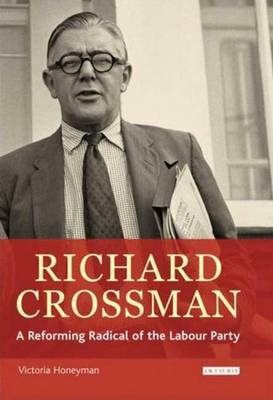
| Richard Crossman was the most ardent of all Labour Zionists - he regretted that the Zionists hadn't been able to slaughter the Palestinians as they settled the land too late |
But even
though Attlee and Bevin came into conflict, for imperial reasons, after 1945
with the Zionist settlers, the Left of the Labour Party under Bevan and Foot
retained their support for the Zionists.
People like the future Prime Minister Harold Wilson were ardent
pro-Zionists. Indeed it was a feature of
Labour politics until 1982 that the Left in the Labour Party was pro-Zionist
and the Right, people like Christopher Mayhew, Andrew Faulds and David Watkins
were pro-Arab. Worst of all in this
respect was Richard Crossman, who became Minister of Housing under Wilson. He was what today might be called the ‘soft
left’. In a memorial Weizmann lecture in
1959 he noted of the imperialists that “No
one”, at least until the 20th century, had “seriously challenged their right, or indeed, their duty, to civilise
these continents by physically occupying them, even at the cost of wiping out
the aboriginal population”. If only the Zionist settlers had “achieved their majority before 1914, they
would have been accepted without any compunction of any kind”. This is the kind of imperialist sewer that
the Labour left worked in.
As Newsinger notes ‘even the Labour left saw the world through a
British imperial lens.’ Despite the
conflict with the Zionists in the immediate post-war period, the Labour
government soon began to enthusiastically support the Israeli state because
this was an integral part of its relationship with the United States.
When the USA condemned Israel’s
invasion of Egypt in 1956 and its complicity with Britain and France in the
Suez War, the Labour Party under Gaitskell and Bevan joined in the
condemnation. Labour was at times more
attuned to the needs of British imperialism than the Tories. Nonetheless under Harold Wilson Labour took
an ardently pro-Israeli position supporting its attack on the neighbouring Arab
states in 1967. In 1973 at the time of
the Yom Kippur war, Ted Heath, the Tory Prime Minister cut off arms supplies to
Israel. It was Wilson who moved a
parliamentary motion to condemn this but, for the first time, Labour MPs rebelled against Labour’s pro-Zionist
policy, 15 voting to keep the embargo and 70 abstaining. David Watkins MP described this as ‘historic’.
In 1982 with the invasion of
Lebanon, support for Zionism further decreased in the Labour Party and with the
advent of Tony Blair the circle was squared.
Now it was the Right of the Labour Party who supported Israel and
Zionism and it was the Left who were pro-Palestinian. Newsinger brings us up to date with the
current false anti-Semitism campaign whose target is the left leadership of the
party under Jeremy Corbyn.
Tony
Greenstein
 |
| Harold Wilson - Labour's most pro-Zionist Prime Minister until Blair came along |
John Newsinger
In June and
July 1917, the then secretary of the Labour Party Arthur Henderson visited
revolutionary Russia on behalf of Lloyd George’s coalition government. He
returned extremely disturbed by what he had seen. The radicalism of the Russian
working class appalled him and he recognised the danger that the revolutionary
contagion could spread. The growing unrest in Britain and the possibility that
it might become infected with the spirit of Bolshevism required that the Labour
Party move to the left, that it reorganise itself, adopt a reformist socialist
programme for the first time and make clear its war aims. The party had to
reposition itself if revolution was to be avoided in Britain.
The leading
Fabian Sidney Webb was brought in to help draw up Labour’s new prospectus which
included a “Memorandum on the Issues of the War”.1 The first
draft was discussed at the Labour Party conference on 10 August 1917. Section
xii of the document proclaimed the party’s support for Zionism: Palestine was
to become “a Free State under international guarantee”.2 This was
nearly three months before the coalition government issued the Balfour
Declaration.
Webb’s
Statement of War Aims was formally adopted as party policy at a joint
conference of the Labour Party and the TUC on 28 December 1917. It proclaimed
that the war was being fought so that “the world
may henceforth be made safe for democracy” and went on to call for “the complete democratisation of all
countries”, for “the frank
abandonment of every form of imperialism”, for “the suppression of secret diplomacy”, for “the universal abolition of compulsory military service in all
countries” and for “the entire
abolition of profit-making armaments firms”. The statement explicitly
rejected “the imperialist aims of
governments and capitalists” in the Middle East. And Section F of the
document, “The Jews and Palestine”, once
again committed the party to support the establishment of a free state in
Palestine “to which such of the Jewish
people as desire to do so may return and may work out their salvation, free
from interference by those of alien race and religion”.3
What is
interesting, of course, is that of all the pious sentiments expressed in the “Statement of War Aims”, the only one
that the Labour Party has actually adhered to over the years has been its
Zionist commitment. Far from abandoning every form of imperialism, successive
Labour governments have ruthlessly pursued the imperial interests of British
capital and to this end have abandoned “democratisation”,
conducted “secret diplomacy”,
supported “compulsory military service”,
embraced “profit-making armaments firms”
and pursued “imperialist aims” in the
Middle East. Indeed, the statement provides a pretty much perfect mirror image
of Labour’s actual policies when in power, excepting its Zionist commitment.
The only times this commitment has been compromised is when it was seen to
conflict with British interests in the Middle East during the term of the
1945-51 Labour government. And even then the Labour left, as we shall see,
vigorously campaigned against the government and moreover positively celebrated
the Zionists’ eventual triumph. Wholehearted reconciliation between Labour and
the Zionists soon followed.
 |
| This was how Britain maintained 'order' in Palestine |
Why did
Labour embrace Zionism in 1917? The principle motive seems to have been the
belief that the commitment would assist the British war effort by engaging the
sympathy of the Jewish community in the United States and more particularly
that of the Jewish community in Russia who were seen as an important force in
the revolutionary movement in that country. More generally, there was also the
belief that a Zionist settlement in Palestine that was under British protection
would be a strategic asset that would help bolster British power and influence
in the region. Certainly, Webb himself had no sympathy for Zionism beyond its
usefulness to the British war effort and the British Empire. In the words of
Leonard Woolf, he was, for all the empty rhetoric of the Statement of War Aims
“a common or garden imperialist
conservative” as far as the British Empire was concerned.4
And,
moreover, Webb was on occasion quite capable of giving voice to anti-Semitic
prejudice. He once remarked on how glad he was that there were “no Jews in the British Labour Party” and
that whereas “French, German, Russian
Socialism is Jew-ridden. We, thank heaven are free”, something he put down
to there being “no money in it”.5 The
predominant view in the Labour Party at this time was that the British Empire
was a force for good in the world, that any abuses could be reformed and that
the “native” populations positively
benefited from colonial rule, including from white settlement. From this point
of view, Zionist settlement in Palestine was to be supported as something that
would benefit the Arab population, a belief strongly encouraged by the Zionists
themselves. Nevertheless, the essential underpinning of the Labour Party’s
commitment to Zionism was, from the beginning and continues to be today, its
usefulness first to the British Empire and, since the 1950s, to the British
State’s “special relationship” with US imperialism.
 |
| Just as today people go to visit Israel and see nothing amiss so Lord Rothermere visited Nazi Germany and was pleased with what he saw |
The 1920s
In The
Chariot of Israel, published in 1981, Harold Wilson, the former Labour
prime minister and himself a staunch Zionist, celebrated the fact that it was impossible
“for a political party to be more
committed to a national home for the Jews in Palestine than was Labour”. As
he pointed out, “since 1917…this theme
had been incorporated in Labour’s statement of war aims” and “had been reiterated eleven times from then
to May 1945”.6 In 1920,
for example, the Labour Party conference voted unanimously in favour of a
resolution, “Palestine for the Jews”.
It was proposed by J Pomeranz, the secretary of Paole Zion (the “Jewish
Socialist Labour Party”), that had affiliated to the Labour Party that year.
The following year, a similar resolution, proposed, once again, by a Paole Zion
delegate, was carried unanimously. And when Labour first took office in 1924,
the colonial secretary, J H Thomas, a completely unapologetic imperialist, told
the commons that the government had determined “after careful consideration of all circumstances to adhere to the
policy of giving effect to the Balfour Declaration”. Labour supported the
League of Nations’ Mandate that gave Britain control of Palestine and was
wholeheartedly committed to the establishment of “a Jewish autonomous Commonwealth” in the country.7 The wishes
of the Arab population, both Muslim and Christian, counted for nothing. There
was to be no self-determination for the Palestinian people.
This support
for Zionism was reinforced by the visits that various leading party members
made to Palestine between the World Wars. James Ramsay MacDonald himself
visited the country in 1921 and was very favourably impressed by the Zionist
settlers he met, “Israelites returning to
Zion”. His A Socialist in Palestine was published by Paole Zion the
following year. Here, he described how the settlers were building a “dwelling place” in “the home of their fathers…in socialist fashion and upon the foundations
of communal idealism”. “They were”, he
wrote, “a happy fraternal company of men
and women, brown of face and sturdy of limb, everyone engaged in hard manual
labour”. They had come together “to
rebuild Palestine and fence it against capitalism”. As for the “Muslim”
opposition to Zionist settlement, the Palestinian people were being misled by
their leaders, “who wish for strife and
to engage in riots and pogroms”. Nevertheless, MacDonald convinced himself
that the Zionist settlement would benefit the Arabs and that already “the Jewish worker is helping the Arab to
raise his standards”. His acceptance of the proposition that the Arab
population would benefit from the Zionist settlement was something that he was
very much persuaded of by the settlers he met because there is no evidence of
his discussing the situation with any Arabs.
One
remarkable passage in A Socialist in Palestine shows that while
MacDonald embraced the Zionist project with some enthusiasm, he was still
gripped by the most vicious anti-Semitic stereotypes. He contrasted the
settlers with “the rich plutocratic Jews”
who were quite likely to “make one
anti-Semitic”. The Jewish plutocrat, the future Labour prime minister
seriously argued, in terms redolent of the Protocols of the Elders of Zion,
“is behind every evil that governments
do, and his political authority, always exercised in the dark, is greater than
that of parliamentary majorities”.8 This belief
that the Jewish capitalist was somehow worse than the non-Jewish capitalist
dated back to the Boer War, which sections of the British left did indeed blame
on Jewish financiers. MacDonald had still not escaped this prejudice 20 years
later, the evidence of the First World War notwithstanding.9
The Labour
MP who took up the Zionist cause with the greatest enthusiasm and determination
between the World Wars was Josiah Wedgwood (the great-great-grandson of the
famous potter of the same name). He claimed to have been one of the instigators
of the Balfour Declaration and made clear in his memoirs that he became
convinced of the efficacy of Zionism when he saw the “political and strategic virtue in a buffer state between a German
Turkey and a British Egypt and Africa”. During the winter months of
1926-27, he and his wife toured Palestine where “the whole Zionist organisation
entertained us from Dan to Beersheba”. Here he encountered “the best Jews in the whole world”.10 This
experience prompted him to write The Seventh Dominion which was
published in 1928. Here he urged an end to the Mandate and the formal incorporation
of a Jewish Palestine into the British Empire as the seventh self-governing
Dominion along with Canada, Australia, New Zealand, South Africa, Ireland and
Newfoundland. He wrote: “They will
say…that I am an imperialist…if it be imperialism to be convinced that the race
that spread from…these islands is the finest on Earth and in history, then I am
an imperialist.” As far as Palestine was concerned the task was to “immigrate the Jews until the higher
civilisation is numerous and wise enough to make democracy safe for all”
and then the new Dominion would “be of
real political and commercial service to the Empire, for Palestine is the
Clapham Junction of the Commonwealth”. With the port at Haifa secure, “the British fleet can look after the Near
East in comfort and security”.11
Wedgwood’s
enthusiasm for the Zionist cause was such that he saw Palestine as but the
first step in the Zionist settlement of the Middle East. On one occasion,
speaking to a Zionist audience in the United States, he compared the settlement
of Palestine with the white settlement of Massachusetts, observing that beyond
that initial foothold “spreads the
illimitable land…Irak is crying out for cultivation”. Was it ever possible,
he wondered, to set a limit to the expansion of “a successful colonising western race”?12 And as for
the Palestinians, Wedgwood was often not even prepared to maintain the pretence
that the Zionist settlement would benefit the Palestinian people. As he told
the House of Commons: “every change in
cultivation or in civilisation does injure some people, and these wandering
Bedouin have suffered and must suffer as civilisation advances”.13
Wedgwood’s
advocacy of Zionism was too extreme for the mainstream Zionist movement which
preferred to proceed more cautiously, disguising rather than proclaiming its
objectives. But it was taken up by the breakaway right wing of the movement,
the fascist-influenced Revisionists, led by Vladimir Jabotinsky. In February
1929, Wedgwood launched a pro-Zionist pressure group, the cross-party Seventh
Dominion League, in London with the intention of establishing branches
throughout the Empire. A Jerusalem branch was set up in May 1928 with
Jabotinsky elected chair. Wedgwood was to maintain close relations with the
Revisionists into the Second World War.
Imperial
concerns
For the
British, support for Zionism was predicated on it being of strategic benefit to
the Empire. As the 1920s unfolded a number of factors began to call this into
question. First of all, the Zionist project itself had stalled with the number
of settlers arriving throughout the 1920s making it extremely unlikely that
they would ever achieve a numerical supremacy over the Palestinian population.
Indeed, in 1926 more settlers left Palestine than arrived. Secondly, the
settlement was nevertheless generating increasing unrest among the Arab
population, not only in Palestine, but in neighbouring countries as well. The
dispossession of the Palestinian peasantry was creating hostility, not just
towards the Zionists, but towards the British as well. Far from strengthening
the British position in the Middle East, the Zionist settlement was weakening
it. This was the situation when the second Labour government, a government
without an overall parliamentary majority, took office in 1929.
The new
colonial secretary, Sidney Webb, now Lord Passfield, was regarded as a friend
by the Zionists for his role in Labour’s 1917 commitment to their cause. In
fact, his support was absolutely conditional on their usefulness to the Empire
and this he no longer felt was the case. In August 1929, the Revisionists had
deliberately provoked confrontation with the Arabs, leading to clashes that
left 133 settlers dead, and sent shock waves through the British administration.
Passfield began to pull back from the Zionist commitment. His wife, Beatrice
Webb, gives a good insight into his thinking in her diaries. She wrote that “expediency” as well as “justice” demanded that the government
had to protect the interests of the Arab population. Unless Britain was “prepared to keep an army of occupation in
Palestine indefinitely” to defend the settlers against Arab attacks then
measures would have to be taken for the “protection
of the Arab”, to prevent them from being “gradually extruded by economic
pressure” with all the consequences that would inevitably follow. And the
government also had “to consider the
feelings of the Mohammedans of India, not to mention Egypt”. Indeed, she
considered that “responsibility for this
debacle lies with the fatuous promise of a Palestine Jewish Home” and
thought that future governments would be grateful that Sidney had forced the “Jews…to be more considerate and reasonable”.14
One of the
things that Passfield objected to was the Zionists’ Jewish labour only policy,
driving out and excluding Arab workers from employment wherever they could. On
one occasion, he asked a group of Zionists how they would feel “if we said no Jews can be employed in
certain sections of England”, but he nevertheless admitted that there was
nothing the government could do to “prevent
the Jews from excluding Arab labour”.15
Passfield’s
proposals were embodied in a White Paper published on 21 October 1930 and
provoked what has been described as “the
first open political confrontation between the Zionist movement and the British
Government”.16 In the
White Paper he proposed restrictions on Zionist land acquisition and on Jewish
immigration. Even more threatening were the proposals for a legislative council
with its inevitable Arab majority. What he proposed did, in his own words, “negate the idea of a Jewish state”. He
found himself at the centre of what he described as a “Jewish hurricane” that mobilised the Zionist movement throughout
the world against the Labour government.17
Zionist
supporters from all parties in the Commons accused the government of having
repudiated the Balfour Declaration with the Conservative front bench joining
the attack. On top of this the government faced a by-election in Whitechapel, a
constituency with a large number of Jewish voters. The Liberal candidate was
Barnett Janner, a staunch Zionist (he later defected to Labour). On 27 October,
the Zionist leader Chaim Weizmann spoke at a public meeting attended by over
4,000 people condemning the government, and there was a real fear that, despite
a majority of over 7,000, the seat might be lost. The local Labour Party was
controlled by the Transport and General Workers’ Union with both the deceased
MP, Harry Gosling, and the new Labour candidate, James Hall, being officials of
that union. To ensure that the seat was not lost, the TGWU general secretary,
Ernest Bevin, declared against the White Paper and made clear that he would
instruct all Labour MPs sponsored by the union to oppose it. He was at this
time and for some years afterwards regarded as a close ally by the Zionists.
Despite this the Labour majority was still reduced to just over 1,000.
In the face
of this onslaught the government retreated. Prime minister Ramsay MacDonald
repudiated Passfield’s White Paper and submitted to terms effectively dictated
by Weizmann. On 13 February 1931 a letter from MacDonald to Weizmann was read
into Hansard, reversing government policy, and as Weizmann later jubilantly put
it, enabling “us to make the magnificent
gains of the ensuing years. It was under MacDonald’s letter that Jewish
immigration into Palestine was permitted to reach figures like forty thousand
for 1934 and sixty-two thousand for 1935, figures undreamed of in 1930”. This
episode was “a severe test” of the
Zionist movement which nevertheless “emerged
triumphant”.18
The 1930s
With the
humiliating defeat of Passfield’s White Paper, Labour reverted to its staunch
support for Zionism. Once again this was reinforced by Zionist-sponsored
visits. In 1935 Herbert Morrison, who was very much on the right of the party,
a staunch Zionist and imperialist, was particularly impressed. He remarked that
he knew “the London Jew very well”
and that the settlers he had met were “not
obviously Jews at all”. Indeed, “The
New Jew to be found in Palestine was a revelation to me. Go to see him if the
chance comes in your way”.19 His visit
was “one of the most inspiring
experiences I have ever had” and what he saw was “socialism on the highest level”. The following year, he told the
Commons that when he had returned from Palestine he had felt “that I should like to give up this business
of the House of Commons and join them in the clean, healthy life that they are
leading”. The Zionist settlement was “one
of the most wonderful manifestations in the world”. What they were about “is work typical of the finest of British
colonisers in the history of our Empire. You cannot sneer at this kind of thing”.20
Even more
impressed was Susan Lawrence, who came from the left of the party. She had been
a Poplar councillor, imprisoned along with George Lansbury in 1921, she went on
to become a Labour MP, and although she lost her seat in 1931, was still on the
National Executive Committee. Lawrence reported back on her visit in the most
fulsome terms: “I cannot tell you with
what an uplift of spirit I saw our old Utopia in News from Nowhere
actually practised. It seemed so beautiful, it seemed so impossible, but there
it was”. It was, she wrote, “a fine
thing to have set one’s foot in Utopia.” On her return, she confided that
on her retirement she planned to return to Palestine and live out her days in a
hut on a kibbutz. She never did, of course.21
These
accounts are reminiscent of those provided by the visitors who were given
conducted tours of Stalin’s Russia in the 1930s and returned home singing its
praises. The tourists who visited Palestine as the guests of the Zionists came
home apparently completely unaware of the growing unrest among the
Palestinians, dispossessed and discriminated against, denied even the limited
concessions that were being made to the “native” populations in other colonies.
The Jewish labour only policy left these tourists unmoved. Instead they
enthusiastically embraced what they believed to be a progressive settler
colonialism, swallowing whole Zionist propaganda that their settlement was
actually benefiting the Palestinians and that Palestinian opposition was the
work of a clique of reactionary landlords misleading an ignorant peasantry. As
Paul Kelemen puts it, as far as the Labour Party was concerned, Zionism was “a
benign form of colonialism”.22
This
enthusiasm was given official standing when on 14 November 1935, in the run up
to the general election, the Labour leader, Clement Attlee, issued a statement
endorsing Zionism:
The British
Labour Party recalls with pride that in the dark days of the Great War they
associated themselves with the ideal of a National Home in Palestine for the
Jewish People, and that ever since, the annual Conferences of the Party have
repeatedly reaffirmed their enthusiastic support of the effort towards its
realisation.
They have
never faltered, and will never falter, in their active and sympathetic
co-operation with the work of the political and economic reconstruction now
going forward in Palestine.23
The Great Revolt
While Labour
renewed its commitment to Zionism, the Tory-dominated National Government found
itself having to grapple with the problems that Zionism was causing for the
British Empire. The rise of anti-Semitism in Germany and Eastern Europe in the
1930s revitalised the Zionist movement. The Nazi regime’s policy of forced
emigration, in particular, dramatically increased the number of Jewish
immigrants into Palestine, up from 12,553 in 1932 to 33,337 in 1933, 45,267 in
1934 and 66,472 in 1935. What drove these numbers up was not just the Nazi
policy of driving German Jews out of the country, but also the anti-Semitic
exclusionary policies followed by Britain and the United States with the
intention of keeping Jewish refugees out. For the Palestinians, the rise in
Jewish immigration created a crisis whereby an eventual Zionist takeover of the
whole country began to look increasingly likely if nothing was done.
Confronted
with this situation, the National Government decided that concessions had to be
made to the Palestinians if an explosion was to be avoided. Proposals for a
Legislative Assembly were revived, and were once again regarded as a potential
disaster by the Zionists: the Palestinians would never voluntarily agree to the
takeover of their country and so had to be denied effective representation
until there was a Zionist majority. What is remarkable is that the opposition
to establishing representative institutions in a British colony was led by the
Labour Party. Understandably, the episode is pretty much written out of Labour
Party history.
On 25
November 1935, a Palestinian delegation, led by the Mufti of Jerusalem, met
with the High Commissioner for Palestine, Arthur Wauchope, to demand
self-government. Weizmann hoped to defeat the move by back-room pressure, but
the Labour opposition, very much against his wishes, raised it in parliament.
On 26 February 1936, the Labour leader in the Lords, Lord Snell, proposed a
motion opposing any measure of self-government for Palestine, a motion that was
supported by every speaker except the government spokesman. The debate was a
humiliating setback, constituting “an
expression of no confidence in the government”. Having succeeded in the
Lords, Labour decided to attack the government in the Commons once again, very
much against Weizmann’s wishes. This was “a
striking illustration of how the Gentile Zionists often outpaced the Zionist
leadership”.24 On 16
March, Labour initiated a debate in the Commons where the attack was
orchestrated by Josiah Wedgwood. He enlisted the support of a number of senior
Conservatives, Winston Churchill, Leo Amery and Austen Chamberlain, and the
government was once again comprehensively humiliated. The proposals for a
Legislative Assembly were dropped. Wedgwood boasted of how he had “slain the
Palestine Constitution” and had reduced the Colonial Secretary, J H Thomas, to
“tears”.25 It was this
Labour victory that provoked the Great Revolt—the great Palestinian rebellion
that began with the proclamation of a general strike on 20 April 1936—once
again something that is generally written out of Labour Party history.
This is not
the place for a history of the revolt.26 The
struggle continued into 1939 with at least 5,000 Palestinians killed. Eventually
a large proportion of the British Army’s fighting strength had to be deployed
effectively to reconquer the country, a task that was carried out with
considerable violence and great brutality. The use of torture and summary
execution was widespread, collective punishment of Palestinian towns and
villages was routine, with houses wrecked or demolished altogether leaving
thousands homeless and destitute, and thousands of Palestinians were interned
without trial in appalling conditions. The RAF bombed and machine-gunned
defenceless Palestinian villages. As George Antonius put it at the time,
British repression had turned Palestine “into a shambles”.27 And the Zionist
settlers gave the British campaign their full support, providing
strike-breakers and taking the opportunity to extend the Jewish labour only
policy, volunteering as police and providing armed patrols, the Special Night
Squads, that were themselves involved in torture and summary executions. The
Revisionists actually launched a terrorist campaign against the Palestinians in
1938, exploding bombs in crowded markets without any warning and causing dozens
of fatalities.
How did the
Labour Party respond to this brutal colonial war? At a time when Labour MPs
loudly condemned fascist aerial bombing of civilian targets in Spain, they were
completely silent about British bombing of civilian targets in Palestine.
Indeed, far from opposing or even criticising the repression, Labour urged the
government on. Herbert Morrison, for example, could not understand why “the
ringleaders of the strike and the murders” had not been rounded up. He was
outraged by the “brutal murders and shootings” that were threatening “one of
the finest moral efforts in the history of mankind”, and claimed that the whole
thing was got up by “the agents of Herr Hitler and Signor Mussolini”. Indeed,
rather than any concessions to the Arabs being necessary, Morrison went on to
recommend that Transjordan (today’s Jordan), be opened up for Zionist
settlement.28 Inevitably
the most extreme stance was taken by Wedgwood, who in October 1938 urged “the exemplary
destruction of the Arab town of Jaffa”. This would have a wholly beneficial
effect throughout the Middle East:
The awful
fate of Jaffa will be advertised throughout the East by thousands of refugees;
the chain-gangs will advertise it in Palestine. Respect for the angry
Englishmen would restore our prestige; Baghdad, Alexandria and Beyrout would
fear a like fate; and Palestine would coo like a sucking dove. In a world which
respects only Hitlers, we must show that we too can if necessary behave in the
same way.29
There were
hardly any voices raised on behalf of the Palestinians within the Labour Party.
When George Mansur of the Arab Labour Federation complained to the Labour
Party’s Imperial Advisory Committee about the conduct of British troops and
police, including the rape of a 12-year-old girl by soldiers, he was ignored.
There was no investigation of his allegations and no evidence that he even received
a reply.30 The
coverage of the Great Revolt in the Daily Herald was written by a
Zionist, A L Easterman, who went on to become political director of the World
Jewish Congress. He told the paper’s readers that the Palestinian struggle was
the work of feudal landlords and fascist agents and that the Palestinian people
had no genuine grievances but were being misled.31 This was
the way the Great Revolt was presented at the time. As the pacificist writer
Reg Reynolds wrote, in words with a somewhat contemporary ring to them, all
this was accompanied by “the hysterical denunciations of all opponents of
Zionism as ‘fascists’”, including those like himself “who had done what we
could to help Jewish refugees”.32
“A capitulation
to violence”
With the
danger of European war approaching, the government felt the need to make
concessions to the Palestinians. The troops garrisoning the country might soon
be needed elsewhere so in May 1939 the Neville Chamberlain government issued a
White Paper that effectively repudiated the Balfour Declaration. For the next
five years Jewish immigration was limited to 75,000 and thereafter would only
be resumed with Palestinian agreement. Once again the strategic needs of the
Empire prevailed.
This turn
was bitterly opposed by the Labour Party. At the May-June 1939 Party conference
a resolution, with only two delegates against, was carried condemning the White
Paper as “a further surrender to aggression” that placed “a premium on violence
and terror” and was “a setback to the progressive forces among both Arabs and
Jews”. The resolution stated that “considerable benefits have accrued to the
Arab masses as a result of Jewish immigration and settlement”. A succession of
speeches condemned the government for capitulating to “fascist” terror in
Palestine. Arthur Creech Jones, a future colonial secretary, for example,
complained that the Revolt was the work of “fascist imperialism”, that there
was “no clash between the Arab and Jewish interests”, but that “the ignorance
of the Arabs” was being exploited. The Zionists were being “asked to end their
experiment because our own government is unable to secure good order, is unable
to restrain the fascists, is unable to check the bandits who come in from outside”.
The White Paper was “a capitulation to violence”.33 This was
the overwhelmingly dominant view inside the Labour Party.
This stance
continued into the war. In 1940 the Labour Party published a volume, Labour’s
Aims in War and Peace. While it contains contributions by Attlee, Morrison,
Arthur Greenwood, Leonard Woolf, Harold Laski, Hugh Dalton and others, what
stands out here is the section on “The British Labour Party and the Jewish
Problem” with its condemnation of the 1939 White Paper and its declaration of
support for the Balfour Declaration and for “the continued growth of the Jewish
national home in Palestine by immigration and settlement”.34
Labour and
the fight against anti-Semitism
British
society was permeated by anti-Semitic prejudice between the World Wars. While
never as virulent as anti-black racism, it was nevertheless widespread,
infecting sections of the left as well as the Conservative right. In the 1920s,
for example, George Orwell sometimes made use of vicious anti-Semitic
stereotypes in his writing, a practice that he only abandoned with the rise of
Nazism.35 And there
is the liberal economist Maynard Keynes who, after a visit to Berlin in 1926,
could write: “if I lived there, I felt I might turn anti-Semite… It is not
agreeable to see civilisation so under the ugly thumbs of its impure Jews who
have all the money and the power and the brains”.36
While Keynes
never abandoned his anti-Semitic prejudices, the realities of Nazi rule saw him
become a champion of the cause of Jewish refugees.37 It is important
to emphasise here that the most virulent anti-Semitism existed on the right
and, as Josiah Wedgwood insisted, in the 1930s, the Conservative Party had
grafted onto itself “a degree of anti-Semitism which would have been
inconceivable in Britain before 1919”. Moreover, when Oswald Mosley and the
British Union of Fascists made their attempt to build a mass fascist movement
founded on a violent exclusionary anti-Semitism in Britain, it was the left
that opposed him and defeated him. What part though did the Labour Party play
in the fight against the BUF?
Without any
doubt, thousands of rank and file Labour Party members and supporters took an
active part in opposing and defeating the BUF, but this was expressly against
the wishes of the Party leadership. When the BUF held a rally in Hyde Park on 9
September 1934, the 3,000 fascists were confronted by a counter-demonstration
120,000 strong. The Labour leadership had urged people to stay away. John
Strachey condemned Labour’s tactics at the rally: “stay away from the fascist
demonstration; ignore fascism; it will all blow over. I believe it true to say
that the Labour Party have not yet issued a single leaflet or pamphlet on the
subject, and definitely tried to prevent all members of the Labour Party from taking
part in a demonstration of this sort”.38 The Labour
leadership took the same line when the BUF attempted to march through the East
End and were stopped at Cable Street on 4 October 1936. Perhaps as many as
300,000 people took to the streets to stop the march, putting up barricades and
fighting the police, many of whom made no secret of their fascist sympathies.
This was a great working class victory.
The Labour
Party conference was meeting at the same time as the Battle of Cable Street was
taking place. Herbert Morrison, speaking on behalf of the leadership, condemned
the violence which he blamed equally on the Communists and the BUF and called
for new public order legislation to strengthen police powers. That was the
Labour leadership’s solution. When the National Government introduced its
Public Order Act Labour supported it, even though many people warned it would
be used against the left; indeed the first prosecutions resulted in the
imprisonment of Durham miners fighting for union recognition. Even Morrison’s
over-sympathetic biographers admit that his stance resulted in him being “hated by many active in the Labour movement”
and his advocacy of “lectures and
leaflets” to fight the fascists was regarded as “laughable” by those “in the
thick of the disturbances”.39 This is not
to say that the Labour leadership did nothing. It initiated steps to close down
those party organisations that had actively participated in the fight against
the BUF. The left-wing Socialist League was disaffiliated and the Party’s youth
organisation, the League of Youth, was purged.
Less well
known is the Labour Party’s acquiescence in the Tories’ determination to keep
Jewish refugees out of Britain during the Second World War. Labour was a party
to one of the most shameful wartime episodes: the refusal of the British
government to attempt any rescue of European Jews. Indeed, both Attlee and
Morrison were full partners in this as senior members of Winston Churchill’s
wartime coalition government. This is not to argue that a majority of European
Jews could have been rescued, indeed, given the ferocity of the Nazis this is
quite unlikely. But rather that the British government set its face against any
rescue attempt, involving even small numbers. As Pamela Shatzkes puts it: “The annihilation of European Jewry was a
central German war aim; preventing it was not an Allied war aim”.40 Indeed,
rescue was seen as a positive hindrance by the Churchill government.
It is worth,
at this point, making clear what the socialist position would have been at this
time: an unrelenting and uncompromising fight against anti-Semitism in all its
manifestations and a welcoming open door policy to refugees from Nazi rule. If
this had been the approach of the British and US governments then hundreds of
thousands, perhaps millions, of European Jews would have been saved. Instead,
only “several thousands” found refuge in Britain during the war, and this was “despite rather than because of government
policy”.41 The Nazis
did not prohibit emigration from the territories they had occupied until August
1941 or from Germany itself until October 1941. The problem was, as Bernard Wasserstein
puts it, less the Nazis than “the extreme
reluctance of all countries to admit them”. There can be little doubt that
as far as Britain was concerned, the government’s policy with regard to
refugees was anti-Semitic. While every effort was made to deny entry to Jewish
refugees, in the spring of 1940 the government was ready to receive as many as
300,000 refugees, who never materialised, from Holland and Belgium.42
The rescue
of the Jews
Growing
awareness of the policy of genocide that the Nazis adopted after the invasion
of the Soviet Union actually led to increasing pressure on the Churchill
government to make some sort of response. On 25 June 1942, the Daily
Telegraph reported that over 700,000 Jewish men, women and children had
been killed “in the greatest massacre in
the world’s history”. Five days later on 30 June it carried the headline, “More Than 1,000,000 Jews Killed in Europe”
and informed its readers that it was the Nazi’s intention “to wipe the race from the European continent”. That same day
similar reports were carried in “most
British newspapers”.43
Soon after,
the government came under pressure to offer sanctuary to refugee Jewish
children and old people living in Vichy France. On 2 September, Morrison, by
now Home Secretary, spoke at a Labour Party rally in London where he condemned
“the infamous cruelties practised upon
the men, women and children of Europe” and on the 23 September in a Home
Office memorandum he made clear that his policy was “not to admit during the war additional refugees…unless in some quite
rare and exceptional cases it can be shown that the admission of the refugees
will be directly advantageous to our war effort”.44 As for the
Vichy refugees, the government decided not to admit the elderly and imposed
conditions of entry that reduced the number of children eligible to between 300
and 350, and then to only 20, even though the Jewish Refugee Committee promised
to meet the costs of their upkeep. As Morrison explained to his Cabinet
colleagues, letting them in would “stir
up an unpleasant degree of anti-Semitism”.45 Government
prevarication saw this even limited opportunity for rescue pass when the
Germans occupied Vichy in November 1942.
Pressure
continued to build up, with Labour MP Sydney Silverman warning the government
that if something was not done, “the
Jewish East End would explode with anger and frustration”.46 Ministers
realised they had to be at least seen to be doing something. On 17 December
1942, the foreign secretary, Anthony Eden, responded in the Commons to a
prepared question from Silverman with a statement condemning the unfolding
Holocaust and promising retribution against those involved. As Shatzkes points
out, however, this statement was “issued
in the hope that a rhetorical flourish without direct commitment to action
would serve to fob off the pressure groups’ agitation. Unfortunately from
Eden’s point of view, ‘it had a far greater dramatic effect than I intended’”.47 He
complained that his statement’s “main
effect…had been to stimulate complaints that the government was not doing
enough to help the victims of the Nazi regime”.48
In an
attempt to head off the pressure the government established a Cabinet
committee, the Committee on the Reception and Accommodation of Jewish Refugees,
chaired by Attlee (effectively deputy prime minister), who was joined by
Morrison, Eden and the Tory colonial secretary, Oliver Stanley. Its job was to
defend “the British policy of inaction”.49 At the
first meeting on 31 December 1942, Morrison made clear that Britain would only “take a limited number of refugees, say from
1,000 to 2,000 but certainly not more” and they would be held on the Isle
of Man “as long as he thought necessary”.50
When the
committee met for a second time on 7 January 1943, it had a new concern.
Stanley is actually minuted as warning that if more Jewish refugees were
allowed into Britain or Palestine then this might lead “certain Axis countries, notably Rumania, to extrude Jews from their
territories, as an alternative to the policy of extermination”.
Consequently, it was absolutely vital that the policy of accepting “only the limited number of Jewish children
with a small number of accompanying women from Eastern Europe should be firmly
adhered to”. This prompted a telegram to the British ambassador in
Washington, Lord Halifax, warning him of the danger that the Nazis might change
“from a policy of extermination to one of
extrusion” with the intention of embarrassing the Allies “by flooding them with alien immigrants”.
Soon after
Attlee told the Commons (19 January 1943) that there would be no change in the
exclusionary policy because the government believed that “the only real remedy for the consistent Nazi policy of racial and
religious persecution lies in an Allied victory”. In his account of this
episode, the late Martin Gilbert, very much an Establishment historian,
nevertheless could not keep his incredulity and outrage out of his prose. As
Gilbert sarcastically points out, Attlee made no mention of the fear that the
Nazis and their allies might “‘extrude’
their Jews instead of killing them” in his statement.51 Needless to
say the Committee’s deliberations do not figure in any of the biographies of
Clement Attlee.
The
Committee faced serious problems, however. Over the Christmas of 1942, Victor
Gollancz, the left-wing publisher and founder of the Left Book Club, wrote a
pamphlet, LET MY PEOPLE GO: Some practical proposals for dealing with
Hitler’s MASSACRE OF THE JEWS and an appeal to THE BRITISH PUBLIC, a
tremendous indictment of Nazi crimes and British government inaction. He rushed
it into print before the end of the year.52 This
32-page pamphlet, which cost 3d (about 59p today), sold an astonishing 250,000
copies in three months, prompting “hundreds of petitions and letters offering
money, accommodation and food”. The flood of letters was so great that the
government took the unprecedented decision to stop replying to them. In March
1943 the National Committee for Rescue from Nazi Terror (NCRNT) was formed by
Eleanor Rathbone MP, Gollancz, William Beveridge, Francis Meynall and others to
campaign for rescue. Under Meynall’s prompting the NCRNT commissioned a Gallup
poll which found strong support for rescue: 78 percent of those questioned
supported allowing refugees into the country, 68 percent temporarily and 10
percent on a permanent basis.53
Even the
Oxford Union debating society came out in favour of rescue: when Gollancz
proposed a motion “that a more energetic
and practical policy be pursued by the government towards the rescue of Jews in
Europe” early in 1943, the opposing speakers unprecedentedly crossed the
floor to vote with him, and the resolution passed with an overwhelming
majority.54
The
Churchill government successfully resisted this massive pressure for rescue,
appearing to promise action but with every intention of doing as little as
possible. One other point worth making here concerns Morrison’s repeated claims
that allowing Jewish refugees into the country would stoke up anti-Semitism.
This almost certainly reflected his own prejudices as much as any real fear,
because although a strong Zionist who enthusiastically supported Jewish
emigration to Palestine, he certainly did not want European Jews coming to
settle in Britain.55 What he
argued was that in effect capitulation to anti-Semitism was the best way to
fight it.
But this was
compounded by the government’s decision to do nothing whatsoever to fight
anti-Semitism on the Home Front. As Tony Kushner observes, the government would
not “allow any official discussion or
attacks on anti-Semitism. The subject was banned from the popular Brains Trust and efforts to air the
subject on other BBC programmes were constantly thwarted”.56 The Home
Office even refused to do anything to curb the publication of anti-Semitic
propaganda during the War. Morrison, for example, refused to take any action
against the Scottish ultra-Protestant Nazi sympathiser Alexander Ratcliffe
when, in 1943, he brought out what was probably the first British Holocaust
denial publication, The Truth about the Jews. Attempts to revive British
fascism in the form of the British National Party and the British People’s
Party were allowed by the government despite protests.
Under
intense Tory pressure, including from Churchill himself, Morrison released
Oswald Mosley from prison on 20 November 1943, despite a tremendous wave of
protest. According to Angus Calder, “nine
people out of ten felt that Mosley should not have been released, and a wave of
angry demonstrations followed the announcement”.57 At factory
meetings across the country resolutions demanding Mosley be re-imprisoned were
overwhelmingly passed. When Morrison made his announcement of Mosley’s release
in the Commons, delegations from over 300 factories demonstrated outside,
chanting “Mosley In, Morrison Out”.
In the Commons, the Communist MP Willie Gallacher asked why Mosley had been
released while Gandhi was still imprisoned.58
Not only was
the Labour Party wholeheartedly involved in the Churchill government’s policy
towards Jewish refugees and the question of rescue, but it continued aspects of
this policy once it came to power in 1945. Once again this is something that
has been pretty much written out of Labour Party history, but the 1945-51
Labour government refused to let Holocaust survivors into Britain. This was at
the same time as the government brought over 200,000 Eastern European workers,
Poles, Latvians, Lithuanians, Estonians and Ukrainians, into Britain to remedy
a shortage of labour. As David Cesarani pointed out, “it is all but impossible to avoid the conclusion that racism was at
work”. Even more disgraceful, however, was the fact that among those allowed
into the country were many former members of the Waffen SS from the Baltic
states and, absolutely incredibly, an entire surrendered Ukrainian Waffen SS
Division, over 8,000 strong. This was not an accident but, as Cesarani shows,
deliberate policy. The problem involved in putting Latvian SS men down the
mines was actually the subject of official discussions because of concern at
the response of British miners to their “Waffen SS blood-group tattoos” which
the British miners would see when they were showering. The Home Office
reluctantly went along with barring men with SS tattoos from mining, but they
were considered suitable “for other occupations in Britain for which they were
not obliged to remove their outer clothing”.59 The
decision to bring the Ukrainian Waffen SS Division into the country had, a Home
Office minute notes, been made “with the
Prime Minister’s approval”.60
There were
protests at the time with a number of newspapers objecting, but let us leave
the last word on this with a letter to his MP from M L Hyams of Coventry that
was passed to the Foreign office in June 1947:
While denying asylum to thousands of displaced
persons and having no compassion on these poor, homeless, starving creatures,
the British government brought into the country 8,000 bloodthirsty cut-throats,
part of a German force which was guilty of the most brutal atrocities against
defenceless people during the war. One can’t help feeling there is something
wrong with the mentality of a government, especially a socialist government
which on the one hand refuses to give succour to so many helpless creatures
whose only crime was they were either Jews or defied the Nazi hordes, and on
the other hand opens the door of this country to scoundrels whose entry is an
insult.
The Foreign
Office “scurried to find a reply… Several
versions were drafted, each of them evasive and confusing”.61 The one
thing that is clear from this sorry narrative is that despite the support of
thousands of its members for the fight against anti-Semitism, the Labour Party
was and is not a reliable participant in that fight.
Putting the
Empire first
Labour
remained committed to the Zionist cause in Palestine throughout the war,
although the 1939 White Paper was never withdrawn by the Churchill Coalition
government. This commitment was decisively reaffirmed in a party statement on “The International Post-War Settlement”,
drawn up by Hugh Dalton, and issued in the spring of 1944. The section on
Palestine stated quite bluntly that a future Labour government had “to let Jews, if they wish, enter this tiny
land in such numbers as to become a majority”. There was a necessity in
Palestine “for transfer of population.
Let the Arabs be encouraged to move out, as the Jews move in”. They should
be “compensated handsomely for their
land” and their “settlement
elsewhere…generously financed”. Indeed, “we
should re-examine also the possibility of extending the present Palestinian
boundaries by agreement with Egypt, Syria or Transjordan”. Dalton decided
to leave out a recommendation for “throwing
open Libya or Eritrea to Jewish settlement as satellites or colonies to
Palestine”.62
The whole
document was adopted as policy at the December 1944 Labour Party conference.
According to Weizmann, in this statement “the British Labourites, in their
pro-Zionist enthusiasm, went beyond our intentions”.63 Not even
the Revisionists had “advocated so
extreme a political solution”.64 The Tory
Oliver Stanley warned him that the policy was “Zionism plus plus” and risked “encouraging
the Jews to believe that the next British Government…will do everything for
them”.65 At its May
1945 conference Labour restated its commitment yet again with Dalton looking
forward to “a happy, free and prosperous
Jewish state in Palestine”.66 The
commitment was Labour Party policy during the 1945 general election and was
included in the party’s 1945 Speaker’s Handbook where it was stated once again
that Zionist settlers should be allowed into Palestine “in such numbers as to become a majority” and that “the Arabs be encouraged to move out as the
Jews move in”.67
It was
abandoned immediately the party took office. The interests of the Empire took priority
over any commitment to the Zionist cause. Ministers were made aware that any
attempt to implement this commitment would seriously, perhaps fatally,
undermine the British position throughout the Middle East which required Arab
collaboration. For Weizmann, the Churchill government had “already failed us” by its refusal to scrap the 1939 White Paper,
but:
If ever a
political party had gone unequivocally on the record with regard to a problem,
it was the British Labour Party with regard to the Jewish National Home; [but]
within three months of taking office, the British Labour Government repudiated
the pledge so often and clearly—even vehemently—repeated to the Jewish people.68
This
precipitated an armed Zionist revolt against British rule in Palestine, a
revolt supported by both the Soviet Union and the United States, as a way of
weakening the British position in the Middle East; it was to end with the British
effectively forced out of the country.69
At the time
and subsequently, the claim was made that the Labour government’s Palestine
policy was dictated by Foreign Secretary Ernest Bevin’s anti-Semitism. For
Labour MP Ian Mikardo, for example, it went as far back as the Whitechapel
by-election when Bevin blamed the Jews for Labour’s reduced vote. Mikardo goes
on to write of Bevin’s “fanatical
hatred…for the Jews in Palestine”.70 It is
certainly true that Bevin responded to the Zionists’ defiance of the British
Empire in anti-Semitic language and on other occasions gave voice to vicious
anti-Semitic prejudices. But this was not the mainspring of the policy he
followed. Indeed throughout the 1930s and into the 1940s, he had been regarded
as one of Zionism’s most reliable supporters inside the Labour Party. Now the interests
of the British Empire came first.
And his use
of anti-Semitic abuse was not unique among the labour leadership. In their
biography of Harold Laski, Isaac Kramnick and Barry Sheerman refer to him
having to put up with not just “the
bullying anti-Semitism of Ernest Bevin”, but also “the more cultivated sarcasm of the economics don Hugh Dalton,
who…persistently referred to his fellow socialist Laski as the ‘under-sized
Semite’ while also ridiculing his far-left ‘yideology’”.71 Dalton was,
as we have seen, an extreme Zionist. He also routinely referred to Africans as “niggers” and Arabs as “wogs”. The prime minister Clement Attlee
was himself not free of anti-Semitic prejudice. On one occasion in March 1951,
when he was considering a number of junior appointments to the government, he
rejected Ian Mikardo and Austen Albu even though they were both highly
recommended because they were Jews: “they
both belonged to the chosen people, and he didn’t think he wanted any more of
them”.72
While the
Labour government had reneged on the Party’s Zionist commitment, the Labour
left rallied to the cause. Inside the government, Aneurin Bevan continued
urging a pro-Zionist stance and actually considered resigning over the issue
early in 1947. He argued in Cabinet that “it was not necessarily true that we
must avoid estranging Arab states. A friendly Jewish state would be a safer
military base than any we should find in any Arab state”.73 This,
needless to say, was not an anti-imperialist position, but rather a different
understanding of what was the best policy for British imperialism. For Bevan
and the so-called Tribunite left, the alliance with Zionism, complete with
British military bases, remained the best way to sustain Britain’s strategic
position in the Middle East. Outside the government, Richard Crossman, Michael
Foot, Ian Mikardo, Woodrow Wyatt, Sidney Silverman and others maintained a
hostile opposition to government policy both in the Commons and outside. In
1946, Foot and Crossman co-authored a pamphlet, A Palestine Munich?,
savagely attacking the government for its betrayal of Zionism (there was a
third unacknowledged co-author: Arthur Koestler, who received 25 percent of the
royalties, and was a supporter of the right-wing terrorist Stern group at the
time).74 It was
published in time for the Labour Party conference. The pamphlet emphasised
Labour’s longstanding commitment to Zionism, condemned the government’s
betrayal, apologised for Zionist terrorism and argued that a “Judean state”
would ally with Britain and “leave in British hands the port of Haifa and such
airfields and installations as we require”.75 At the same
time, Tribune maintained a constant pro-Zionist critique. On 8 August
1947, it solemnly proclaimed that the truth had to be told: “the Palestine
tragedy represents a breakdown of social democracy. For the British forces
operating against the Palestine Jews are under the orders of a British Labour
Government”.76
The most
determined advocate of Zionism on the Labour left was Richard Crossman MP and
it is worth briefly considering his views for the light they throw on the
Labour left’s thinking at the time and after. As far as Crossman was concerned,
Zionism was “an important part of the Socialist creed”. Even though he was a
supporter of the removal of the Palestinians, he still acknowledged that what
was involved was a choice of evils. He convinced himself that the injustice
done to the Palestinians was the lesser evil because the fact was “that no
western colonist in any other country had done so little harm, or disturbed so
little the life of the indigenous people”. Indeed, the Zionists were bringing
“social progress” to the Middle East, “which, in the long run, would benefit
the Arab”. He wrote this in 1947.77 His fury
against the government’s Palestine policy was extreme to say the least. As far
as he was concerned Attlee and Bevin were “murderers” who had “plotted to
destroy the Jews in Palestine, and then encouraged the Arabs to murder the
lot”. He could never “forgive them for genocide”. This was written in 1954.78
Looking back
on these events in 1959, when he delivered that year’s Chaim Weizmann Memorial
Lectures at the Weizmann Institute in Israel, Crossman pondered what he
considered the great Zionist misfortune: their colonising effort came too late
to be respectable. In the 19th century and before it had been “assumed that
civilisation would be spread by the white man settling overseas”. In South
America, North America and South Africa, white settlers had brought civilisation.
“No one”, he writes, at least until the 20th century, had “seriously challenged
their right, or indeed, their duty, to civilise these continents by physically
occupying them, even at the cost of wiping out the aboriginal population”. If
only the Zionist settlers had “achieved their majority before 1914, they would
have been accepted without any compunction of any kind”. Instead, “they had the
misfortune to come after Woodrow Wilson and Lenin had proclaimed
self-determination a principle”. He actually complained, quite unfairly, about
Attlee and Bevin having had a “prejudice in favour of the native and against
the white settler”.79
Crossman, it
is worth remembering, passed as a serious intellectual both inside and outside
the Labour Party. “No one” objected to the civilising of countries by wiping
out their aboriginal populations! The principle of self-determination was to be
regretted! This reactionary nonsense was written by a senior Labour MP, still
on the left of the Party, who was to go on to be Minister of Housing, Leader of
the Commons, Minister of Health and then editor of the New Statesman.
Obviously the objections of the subjected or even wiped out populations counted
for nothing in his intellectual universe.
Crossman had
been converted to Zionism by Weizmann himself who persuaded him that all
gentiles carried the anti-Semitic bacillus and that while it might lie dormant
for years, there were conditions in which it would inevitably become active.
Weizmann told him that anti-Semitism became virulent when “the number of Jews should rise beyond the safety level for that
particular nation”. The only cure for anti-Semitism was “the creation of the Jewish State”.80 Coming from
anyone other than a Zionist, this argument would, of course, be considered
viciously anti-Semitic. Crossman accepted it completely: anti-Semitism was
caused by there being too many Jews and the answer was for them to be resettled
in Palestine. Weizmann went out of his way to cultivate Crossman, telling him
he was the British Émile Zola,81 something
that Crossman tried to live up to with his attack on Bevin’s policy: “I Accuse Bevin”, which appeared on the
front page of the Sunday Pictorial newspaper on 14 February 1949, a week
after the Israelis had shot down five British aircraft.82 For
Crossman, Zionism remained his political touchstone: he cried when Weizmann,
his “spiritual father” died and in
1972 started to write Weizmann’s biography, something he never completed.83
The British
defeat in Palestine and the subsequent establishment of the state of Israel
were enthusiastically celebrated by the Labour left. The expulsion of 800,000
Palestinians from their homeland, referred to by Palestinians as the Nakba or
catastrophe, was either ignored or played down in exactly the same way that the
brutal repression of the Great Revolt had been ignored in the late 1930s.
Indeed, far from driving the Palestinians out, according to Sydney Silverman,
the Zionists “did their utmost to
persuade them to stay”. Similarly, Crossman argued that they were never driven
out but left on the orders of their leaders who he accused of unjustified
scaremongering. And anyway, as he told the Commons, their homes were “only mud huts…terribly bad villages full of
vermin”.84 The
Palestinians were disregarded as a non-people, whose fate was of no account
whatsoever, compared with the establishment of Israel, “a country which was both socialist and freedom-loving”.85 Alongside
this rhetoric though, left spokesmen also argued that an alliance with Israel
was the best way to sustain British influence in the Middle East.
In 1950,
Woodrow Wyatt visited Israel where he saw “democratic
socialism”, inspired, he believed, by “the
achievements of British socialism”. He also regretted Bevin’s “prejudice against Zionism”, because “Israel might easily have been a member state
of the British Commonwealth” and, if it had been, “action might have been taken in time to prevent the loss of Abadan oil”.86 By action,
he meant military intervention. Even the Labour left saw the world through a
British imperial lens.
Labour
reconciled with Zionism
The Labour
government’s reconciliation with Zionism was quickly accomplished. By January
1950, Morrison was publicly proclaiming that Israel was “one of the greatest experiments in the modern world”. And in March
1950, the Labour government formally recognised the state of Israel. As June
Edmunds argues, it was the concern to maintain “a strong alliance” with the United States that produced this
turnaround with Bevin himself telling the Israelis “that his Palestine policy had been a failure”.87 This
concern with the “special relationship”
with the US continues to underpin Labour’s attachment to Israel today; the more
the US came to regard Israel as strategically important, so the more
pro-Zionist became the Labour leadership.
There were
still difficulties. In 1956, the Labour opposition condemned British collusion
in the Israeli attack on Egypt and the subsequent Anglo-French Suez invasion.
Labour’s opposition was not motivated by any principled objection to invasion,
but rather to an invasion that was not supported by the United States. Both the
then Labour leader, Hugh Gaitskell and the shadow foreign secretary, Aneurin
Bevan, were strong Zionists, but whereas it was once the interests of British
imperialism that came first, now it was the interests of US imperialism. Even
so, when Edward Short MP proposed an Early Day Motion supporting Israel, 81
Labour MPs signed it. The likes of Morrison described Israeli military success
as “wonderful” while a drunken Dalton
celebrated it by “cursing the wogs”.88 The year
after the Suez invasion, the Labour Friends of Israel was established, as a
demonstration that the party’s condemnation of the British and French
governments did not extend to Israel. And with the succession of Harold Wilson
to the Labour leadership in 1963, the party now had one of its most committed
Zionists ever at the helm, a man who in retirement was to write a history of
Zionism and modern Israel, The Chariot of Israel!
There was
overwhelming support for Israel within Labour ranks during the 1967
Israeli-Arab War with the left-wing Labour MP Eric Heffer urging the Israelis
to hold on to their conquests. As one of the handful of opponents of Zionism
within the Parliamentary Labour Party Christopher Mayhew later observed the
strength of the Zionist commitment at this time led “to a uniquely close
friendship with a foreign government which was occupying large areas of its
neighbours’ territory, was exercising, through measures of military government,
colonial rule over a million subjects, and was openly practising racial
discrimination in its immigration and housing policies”.89
Actions that
Labour would have condemned if carried out by any other government were either
condoned, supported or ignored. At the same time, those within the party who
tried to raise concerns about the plight of the Palestinians were subject to
what one of their number, David Watkins MP, described as a “fascist-like reaction”. They were
effectively prevented from speaking in the Commons by constant barracking from
their own side. One particular left MP, Margaret McKay, a former Communist,
union organiser and from 1951 to 1962, the TUC’s chief women’s officer, had a
replica Palestinian refugee camp erected in Parliament Square. The Party
leadership was outraged. For her pains, she was inundated with “obscene hate mail…which included packets of
excreta”. Far from taking steps to protect her, the party allowed her
opponents within her constituency party, who ran a “scurrilous campaign” against her (she was inevitably accused of
anti-Semitism), to begin a de-selection process. She stood down as an MP in
disgust in the run up to the 1970 general election.90
While the
Labour leadership’s commitment to Israel became stronger and stronger, after
1967 there was a growing realisation among many members and supporters that far
from being a socialist enclave surrounded by menacing fascist Arabs, Israel was
a powerful, militarily aggressive state, intent on the further conquest of Arab
land and either the removal of the Arab population or their reduction to
colonial status. By the time of the 1973 “Yom Kippur” War, there was enough
dissatisfaction with Labour’s continued support for Israel to provoke a
significant revolt. David Watkins, one of the rebel leaders in the Commons,
describes it as “a major turning
point…epoch-making”.91 When the
fighting broke out, the Heath government imposed an arms embargo on the
combatants. Wilson demanded that arms supplies to Israel should be continued,
to show British support for both Israel and the United States. According to
Wilson:
As soon as
news of the invasion became known I telephoned the Israeli Ambassador…Michael
Comay, and made an immediate appointment to see him and be briefed. Thereafter
I was in contact with him every day to hear of developments. The first thing he
told me was that Mr Heath’s government had placed an embargo on the shipment of
spares and ammunition to Israel for the Centurion tanks Britain had supplied
when Labour had been in power.92
Wilson
proposed attacking the embargo on Israel with a three-line whip in operation.
But it soon became clear that there was too much opposition for this to be
carried off; in the event 15 Labour MPs voted to support the embargo and more
than 70 abstained. Somewhat over-optimistically, Watkins describes “that
historic vote on 18 October 1973” as having ended “50 years of Zionist domination
of Labour attitudes… Nothing would ever be the same again”.93 The coming
to power in Israel of the Likud Party in 1977 continued the disenchantment that
more and more Labour members, including a number of MPs, felt.
The 1982
invasion of Lebanon with the massacres at the Sabra and Shatila refugee camps
was a further blow. Even Wilson was to describe Ariel Sharon as “the most evil man I have come across in Israeli
politics”.94 When the
then Labour leader Neil Kinnock visited Israel in 1988 during the Intifada, he
condemned one of the refugee camps he visited as “a vast slum. It is hell”. He publicly complained about the
shooting of young Palestinians, many of them “when they are going in the opposite direction”, ie, running away.
Nevertheless, according to his biographer, the Israelis “knew that Kinnock had consistently defended them” in the past and
an empty joint statement calling for reconciliation was issued with the leaders
of the Israeli Labour Party.95 Even this
limited criticism of Israeli brutality was to be abandoned when Tony Blair
became Labour leader.
Blair and
beyond
Under Blair
the party leadership’s support for the US and for Israel became once again
unquestioning and total regardless of the complexion of the Israeli government.
Indeed, according to one recent study, it became commonplace for the Labour
Friends of Israel “to be chaired by
rising Blairite backbench MPs…on their way into ministerial ranks…Kim Howells,
Jim Murphy, Jane Kennedy, Stephen Twigg, James Purnell”. The Labour Friends
of Israel reception at party conferences “became
one of the largest and most well-attended events”.96 There was
still more criticism of Israel than would have been conceivable in the 1950s
and 1960s, and, of course, Blair’s eventual downfall was to be triggered by his
uncritical support for Israel’s attack on Lebanon in 2006. However, this
episode provides a distorted picture of the strength of opposition to Israel;
many of Gordon Brown’s supporters, themselves members of the Labour Friends of
Israel, joined in calling for Blair to go over this issue, even though their
concerns were factional rather than critical of Israel. Even so, while the
Labour right has remained wholly committed to Zionism, the voices on the left
that oppose it have been strengthened by the great movement that was provoked
by the Iraq invasion. The growth of anti-imperialism as a force in British politics
contributed massively to the radical critique of Zionism. The contemporary
Labour left has to be seen as, at least in part, a product of that
anti-imperialist movement.
How have the
Zionists responded to increased criticism of Israel? Over the years we have
seen a determined effort made to label anti-Zionism as anti-Semitic. While this
is nothing new in itself—such abuse has a long history—the scale and intensity
of the attack has dramatically increased in recent years. And even more
recently it has become bound up with the campaign the Labour right has waged
against Jeremy Corbyn and his supporters. There has been a sustained attempt
made to discredit the Corbynites by alleging that they are somehow responsible
for the Labour Party having a serious problem with anti-Semitism, that the
Labour left and the left outside the Labour Party is, in fact, anti-Semitic.
Anti-Zionism and anti-Semitism are being deliberately conflated. The most
recent example of this is David Rich’s truly appalling book, The Left’s
Jewish Problem: Jeremy Corbyn, Israel and Anti-Semitism.97 The title
says it all. That a work of such profound intellectual dishonesty has been so
widely welcomed shows the determination with which this particular smear is
being propagated. The smear has to be fought.
There are
two points worth making here: first that the allegations are politically
motivated smears, perpetrated by people completely without shame, and second
that they do considerable damage to the real fight against anti-Semitism. For
socialists the fight against anti-Semitism is of vital importance both because
of the crimes against Jewish people that it has been responsible for but also because
it has been anti-Semitism that has legitimised Zionism and that made possible
the dispossession of the Palestinian people. The left in the broadest sense,
certainly not the Labour right, has always been the mainstay of the fight
against anti-Semitism in Britain. At a time when there are powerful right-wing
campaigns underway in Britain, Europe and the United States to mobilise
prejudice, racism, anti-Semitism and Islamophobia, the attempt to label the
British left as anti-Semitic is a shameful travesty that can only help the
forces of reaction.
John Newsinger is a member of Brighton SWP. He is
joint editor, with Richard Lance Keeble, of the George Orwell Studies journal.
Notes
1 Cliff and Gluckstein, 1996, pp70-71. As
Webb himself put it: “The best safeguard against ‘Bolshevism’ is a strong
Labour Party in Parliament.”
3 Stansky, 1969, pp318-322.
4 Woolf, 1968, p236. Woolf was for many
years Secretary of the Labour Party’s Advisory Committee on Imperial Questions.
7 Levenberg, 1945, pp207, 215-216. Paole
Zion became the Jewish Labour Movement in 2004 and is still affiliated to the
Labour Party.
8 MacDonald, 1922, pp2, 6, 11 and 19.
9 Brustein and Roberts, 2015, p158. They
argue convincingly that “left-wing anti-Semitism in Britain reached what might
be considered its height during the Boer War”. Although they refer to the left,
in fact the anti-Semitism within both the Labour Party and the Social
Democratic Federation was vigorously opposed by the left in those
organisations.
10 Wedgwood, 1941, pp132 and 194.
14 MacKenzie and Mackenzie, 1985, pp230-231.
17 Radice, 1984, pp280-281.
18 Weizmann, 1949, pp335-336.
19 Gorny, 1983, p125. Gorny writes of Morrison
displaying “a tinge of prejudice” here which, as we shall see, is something of
an understatement.
20 Donoughue and Jones, 2001, p256.
21 Gorny, 1983, pp125, 128.
23 Levenberg, 1945, p209.
26 See Newsinger, 2010, pp140-149.
28 Levenberg, 1945, pp279, 281, 295; Kelemen,
2012, p91.
29 Mulvey, 2010, p187. In a letter urging the
Zionist settlers to greater militancy that he allowed to be made public, he
opposed the settlers carrying out “reprisals in the form of murdering innocent
Arabs”, but was all in favour of “lynch law”. He even endorsed the use of
violence against the British authorities when they tried to interfere with
illegal immigration—Wedgwood, 1951, p192.
31 According to Francis Nicosia, “German arms
were never provided to Arab insurgents in Palestine”—see Nicosia, 1985, p181.
As for the Italians, while they undoubtedly encouraged Arab revolt against
their British rivals, even providing small quantities of arms, at the same time
they also made approaches to the Zionists, urging them to switch their
allegiance to Italy, a country that “was
not afraid of the Arabs and knew how to deal with them”. The Italian
government also offered the Zionists the Gajjam area in recently conquered
Abyssinia as a subsidiary settlement—Rose, 1973, p105. And, of course, the
Zionist leadership in Palestine was well aware that it was confronting a mass
popular revolt; indeed David Ben Gurion actually remarked that if he was an
Arab, he “would rise up against an
immigration liable some time in the future to hand the country and all of its
Arab inhabitants over to Jewish rule. What Arab cannot do his math”—see
Teveth, 1985, pp167-168.
33 Levenberg, 1945, pp229, 234-235.
37 According to one of his biographers, as
late as December 1945, Keynes gave expression to his hostility to the Labour
government by veering off “into his facile anti-Semitism as aroused by its
‘socialist advisors…who like so many Jews are either Nazi or Communist at
least’”—Felix, 1999, p288.
39 Donoughue and Jones, 2001, p225.
42 Wasserstein, 1999, pp41 and 118.
43 Bolchover, 2003, pp8-9.
48 Bolchover, 2003, pxxv.
51 Gilbert, 2001, pp110-112.
52 Gollancz, 1942. At the back of the pamphlet
Gollancz urged readers to pass it on when they had read it so the likelihood is
that its readership was substantially higher than 250,000.
53 Wasserstein, 1999, p117.
54 Dudley Edwards, 1987, pp375-376.
55 Certainly as far as Eleanor Rathbone was
concerned, in her dealings with Morrison, he showed a “barely concealed dislike
of Jews and open hostility towards refugees”—Cohen, 2010, p169.
59 Cesarani, 1992, pp80-81 and 99-100. As
Cesarani points out, the Labour government also expedited the removal from the
country of black and Asian soldiers and workers recruited in the Caribbean for
war work at the same time.
60 Khromeychuk, 2013, p119.
62 Pimlott, 1985, pp389-390.
67 Labour Party, 1945, p189.
69 See Newsinger, 2015, pp5-32.
70 Mikardo, 1988, pp98-99.
71 Kramnick and Sheerman, 1993, pp206-207.
They also tell of an occasion in 1944 when Bevin was asked to meet with three
members of Labour’s NEC, who happened to be Jewish, to discuss post-war
reconstruction with them (Laski was one of the them). He supposedly responded
that “he could spend his time better than in discussing Britain’s future with
three yids” (p552).
72 Dalton, 1986b, p508. Dalton records himself
as responding: “Don’t touch either of them”.
74 Koestler’s relations with the Stern group
are explored in Scammell, 2009, pp252, 255, 276, 280-281, 328, 333.
75 Crossman and Foot, 1946, p31.
77 Crossman, 1947, pp61 and 176.
79 Crossman, 1960, pp58, 59, 67.
80 Crossman, 1960, pp21-22.
81 Zola had played a major role in the defence
of Alfred Dreyfus.
82 Howard, 1991, p146. Crossman was staying
with Weizmann in Palestine when news of the shooting down of the RAF planes was
given to him and assured him on his own testimony that it was “good
news”—Crossman, 1960, p72.
84 Kelemen, 2012, pp128 and 132.
86 Wyatt, 1952, pp167 and 177. For the Labour
government and the Abadan crisis see Newsinger, 2015, pp174-177.
87 Edmunds, 2000, pp38 and 39.
88 Edmunds, 2000, p48; Adams, 2011, p125.
89 Mayhew and Adams, 1975, p27.
90 Watkins, 1996, pp114-115. Margaret McKay
had earlier published an autobiography as Margaret McCarthy, Generation in
Revolt (1953), that is still well worth reading. It covers her experiences
as a Communist and her reasons for breaking with the Communist Party.
91 Watkins, 1996, p118. The book was published
before Blair became Prime Minister.
References
Adams, Jad,
2011, Tony Benn (Biteback Publishing).
Attlee,
Clement, 1940, Labour’s Aims in War and Peace (Lincolns-Prager).
Bolchover,
Richard, 2003, British Jewry and the Holocaust (Littman Library of
Jewish Civilization).
Boyle, Susan
Silsby, 2001, Betrayal of Palestine: The Story of George Antonius
(Westview Press).
Brustein,
William and Louisa Roberts, 2015, The Socialism of Fools? Leftist Origins of
Modern Anti-Semitism (Cambridge University Press).
Calder,
Angus, 1979, The People’s War: Britain 1939-1945 (Jonathan Cape).
Cesarani,
David, 1992, Justice Delayed: How Britain Became a Refuge for Nazi War
Criminals (Heinemann).
Cesarani,
David, 2016, Final Solution: The Fate of the Jews 1933-1949 (Macmillan).
Cliff, Tony
and Donny Gluckstein, 1996, The Labour Party: A Marxist History
(Bookmarks).
Cohen,
Susan, 2010, Rescue The Perishing: Eleanor Rathbone and the Refugees
(Vallentine Mitchell).
Collette,
Christine, 2000, “‘Le soleil du socialisme commence a se lever sur le monde’:
The Utopian Visions of Labour Zionism, British labour and the Labour and
Socialist International in the 1930s”, in Christine Collette and Stephen Bird
(ed), Jews, Labour and the Left (Ashgate).
Copsey,
Nigel, 2010, “‘Every time they made a Communist, they made a Fascist’: The
Labour Party and Popular Anti-Fascism in the 1930s”, in Nigel Copsey and
Andrzej Olechnowiez (eds), Varieties of Anti-Fascism: Britain in the
Inter-War Period (Palgrave).
Crossman,
Richard, 1947, Palestine Mission: A Personal Record (Hamish Hamilton).
Crossman,
Richard, 1960, A Nation Reborn: The Israel of Weizmann, Bevin and Ben-Gurion
(Hamish Hamilton).
Crossman,
Richard, 1981, The Backbench Diaries of Richard Crossman (Hamish
Hamilton).
Crossman,
Richard and Michael Foot, 1946, A Palestine Munich? (Gollancz).
Dalton,
Hugh, 1986a, The Second World War Diary of Hugh Dalton 1940-45 (Jonathan
Cape).
Dalton,
Hugh, 1986b, The Political Diary of Hugh Dalton 1918-40, 1945-60
(Jonathan Cape).
Dalyell,
Tam, 1989, Dick Crossman: A Portrait (Weidenfeld and Nicolson).
Donoughue,
Bernard and G W Jones, 2001, Herbert Morrison: Portrait of a Politician
(Phoenix).
Dudley
Edwards, Ruth, 1987, Victor Gollancz: A Biography (Gollancz).
Edmunds,
June, 2000, The Left and Israel: Party-Policy Change and Internal Democracy
(Macmillan).
Felix,
David, 1999, Keynes: A Critical Life (Praeger).
Gilbert,
Martin, 2001, Auschwitz and the Allies (Pimlico).
Gollancz,
Victor, 1942, “LET MY PEOPLE GO”: some practical proposals for dealing with
Hitler’s MASSACRE OF THE JEWS and an appeal to THE BRITISH PUBLIC
(Gollancz).
Gorny,
Joseph, 1983, The British Labour Movement and Zionism 1917-1948 (Frank
Cass).
Greene,
Toby, 2013, Blair, Labour and Palestine: Conflicting Views on Middle East
Peace After 9/11 (Bloomsbury).
Hession,
Charles, 1984, John Maynard Keynes (Macmillan).
Howard,
Anthony, 1991, Crossman: The Pursuit of Power (Pimlico).
Kelemen,
Paul, 2000, “Looking the Other Way: The British Labour Party, Zionism and the
Palestinians” in Collette, Christine, and Stephen Bird (eds), Jews, Labour
and the Left 1918-1948 (Ashgate).
Kelemen,
Paul, 2012, The British Left and Zionism: The History of a Divorce
(Manchester University Press).
Khromeychuk,
Olesya, 2013, “Undetermined” Ukrainians: Post-War Narratives of the Waffen
SS “Galicia” Division (Peter Lang).
Kramnick,
Isaac, and Barry Sheerman, 1993, Harold Laski: A Life On The Left
(Hamish Hamilton).
Kushner,
Tony, 1989, The Persistence of Prejudice: Anti-Semitism in British Society
during the Second World War (Manchester University Press).
Labour
Party, 1945, Speaker’s Handbook.
Levenberg,
Schneier, 1945, The Jews and Palestine: A Study in Labour Zionism (Paole
Zion).
Littman,
Sol, 2003, Pure Soldiers or Sinister Legion: The Ukrainian 14th Waffen-SS
Galicia Division (Black Rose Books).
London,
Louise, 2000, Whitehall and the Jews, 1933-1948: British Immigration Policy,
Jewish Refugees and the Holocaust (Cambridge University Press).
MacDonald,
James Ramsay, 1922, A Socialist in Palestine (Paole Zion).
MacKenzie,
Norman and Jeanne Mackenzie, 1985, The Diary of Beatrice Webb, volume 4:
1924-1943: The Wheel of Life (Virag0).
Martin,
Kingsley, 1953, Harold Laski, 1893-1950 (Gollancz).
Mayhew,
Christopher, and Michael Adams, 1975, Publish It Not: The Middle East Cover
Up (Longman).
McCarthy,
Margaret, 1953, Generation in Revolt (Heinemann).
Mikardo,
Ian, 1988, Backbencher (Weidenfeld and Nicolson).
Mulvey,
Paul, 2010, The Political Life of Josiah C Wedgwood: Land, Liberty and
Empire 1872-1943 (Boydell Press).
Newsinger,
John, 2007, “Orwell, Anti-Semitism and the Holocaust”, in John Rodden (ed), The
Cambridge Companion to George Orwell (Cambridge University Press).
Newsinger,
John, 2010, The Blood Never Dried: A People’s History of the British Empire
(Bookmarks).
Newsinger,
John, 2015, British Counterinsurgency (Palgrave Macmillan).
Nicosia,
Francis, 1985, The Third Reich and the Palestine Question (I B Tauris).
Penkower,
Monty Noam, 2002, Decision on Palestine Deferred: America, Britain and
Wartime Diplomacy, 1939-1945 (Routledge).
Pimlott,
Ben, 1985, Hugh Dalton: A Life (Jonathan Cape).
Radice,
Lisanne, 1984, Beatrice and Sidney Webb: Fabian Socialists (Macmillan).
Reynolds,
Reginald, 1956, My Life and Crimes (Jarrolds).
Rich, Dave,
2016, The Left’s Jewish Problem: Jeremy Corbyn, Israel and Anti-Semitism
(Biteback).
Rose, N A,
1973, The Gentile Zionists: A Study in Anglo-Zionist Diplomacy 1929-1939
(Frank Cass).
Scammell,
Michael, 2009, Koestler: The Indispensable Intellectual (Faber).
Shatzkes,
Pamela, 2002, Holocaust and Rescue: Impotent or Indifferent? Anglo-Jewry
1938-1945 (Palgrave).
Srebrnik,
Henry, 1990, “The British Communist Party’s National Jewish Committee and the
Fight Against Anti-Semitism During the Second World War”, in Tony Kushner and
Kenneth Lunn (eds), The Politics of Marginality: Race, the Radical Right and
Minorities in Twentieth Century Britain (Frank Cass).
Stansky,
Peter (ed), 1969, The Left and War: The British Labour Party and World War 1
(Oxford University Press).
Stein,
Joshua, 1992, Our Great Solicitor: Josiah C Wedgwood and the Jews
(Susquehanna University Press).
Teveth,
Shabtai, 1985, Ben Gurion and the Palestinian Arabs (Oxford University
Press).
Vaughan,
James, 2013, “‘Keep Left for Israel’: Tribune, Zionism and the Middle East
1937-1967”, Contemporary British History, volume 27, number 1.
Wasserstein,
Bernard, 1999, Britain and the Jews of Europe 1939-1943 (Leicester
University Press).
Watkins,
David, 1996, Seventeen Years in Obscurity: Memoirs from the Back Benches
(Book Guild).
Wedgwood,
Cicely V, 1951, The Last of the Radicals: Josiah Wedgwood, MP (Jonathan
Cape).
Wedgwood,
Josiah, 1941, Memoirs of a Fighting Life (Hutchinson).
Weizmann,
Chaim, 1949, Trial and Error: The Autobiography of Chaim Weizmann
(Harper).
Westlake,
Martin, 2001, Kinnock: The Authorised Biography (Little, Brown and
Company).
Wilson,
Harold, 1981, The Chariot of Israel: Britain, America and the State of
Israel (Weidenfeld and Nicolson).
Woolf,
Leonard, 1967, Downhill All The Way: An Autobiography of the Years 1919-1939
(Hogarth Press).
Wyatt,
Woodrow, 1952, Into The Dangerous World (Weidenfeld andNicolson).