
It is a Terrible
Mistake for Sections of the Left to Support the Corrupt and Repressive Iranian
Regime in the Name of Anti-Imperialism
From left: Sepideh Rashno, Mahsa Amini and Nika Shakarami. Composite: Shutterstock
Brighton demonstration in support
of the Iranian womens’ struggle
I attended a demonstration today in central Brighton in
support of the protests of Iranian women. There were
about 200 people there comprising a mixture of forces, including supporters of
the Shah of Iran and those who believe that the United States and western
imperialism will come to their aid.
.jpg)
Brighton demonstration
It is not surprising that after 43 years of this repressive
regime that many have illusions in the good intentions of the Western
imperialists. If such illusions were to persist after the overthrow of the
Mullahs, Iran’s population would exchange the frying pan for the fire.
And that is precisely why the anti-imperialist left in the
West has a duty to support the current struggle because it is only on this
basis that our warnings against trusting Biden, Israel and western imperialism
can be trusted. To side with the Mullahs
would only convince Iranians that the left is their enemy.
Iranian womens protest
It would also be a terrible mistake to believe, as some on
the Left do, that the ‘anti-imperialism’ of the Iranian regime demands that we
sacrifice the democratic and social rights of the Iranian people for the
greater good of the people of the Middle East.
The overthrow of imperialism in the Middle East cannot take
place on the backs of the repression of women, national minorities and workers. Quite the contrary, the struggle against Iran’s
corrupt and brutal theocratic regime is perfectly compatible with the overthrow
of US imperialism.

It is clear that the United States and Israel support the
even more murderous regimes of Saudi Arabia, the Gulf and Egypt. They are hardly
likely to be a supporter of democratic and workers’ rights in Iran.
It is in any case a mistake to see the Iranian or Syrian
regimes as anti-imperialist. They are regimes which would be
happy to make their peace with US imperialism and Israel if they had
half the chance. The problem is that the US and Israel want no challenge to
their regional hegemony.
Demonstrations in Iran
The sanctions that the United States has imposed on Iran have
not hurt the corrupt clerics but the people of Iran. It was the same with
Iraq. Sanctions killed ordinary people
not Saddam Hussein. The United States has no interest in freedom for the people
of Iran.
.jpg)
Brighton demonstration
Some people have forgotten the Iran Contra
deal under Reagan when Israel supplied Iran with billions of dollars of
weaponry in return for money which was used to fund arms to the Contras who the
United States were using to try and overthrow the Sandanistas in Nicaragua.
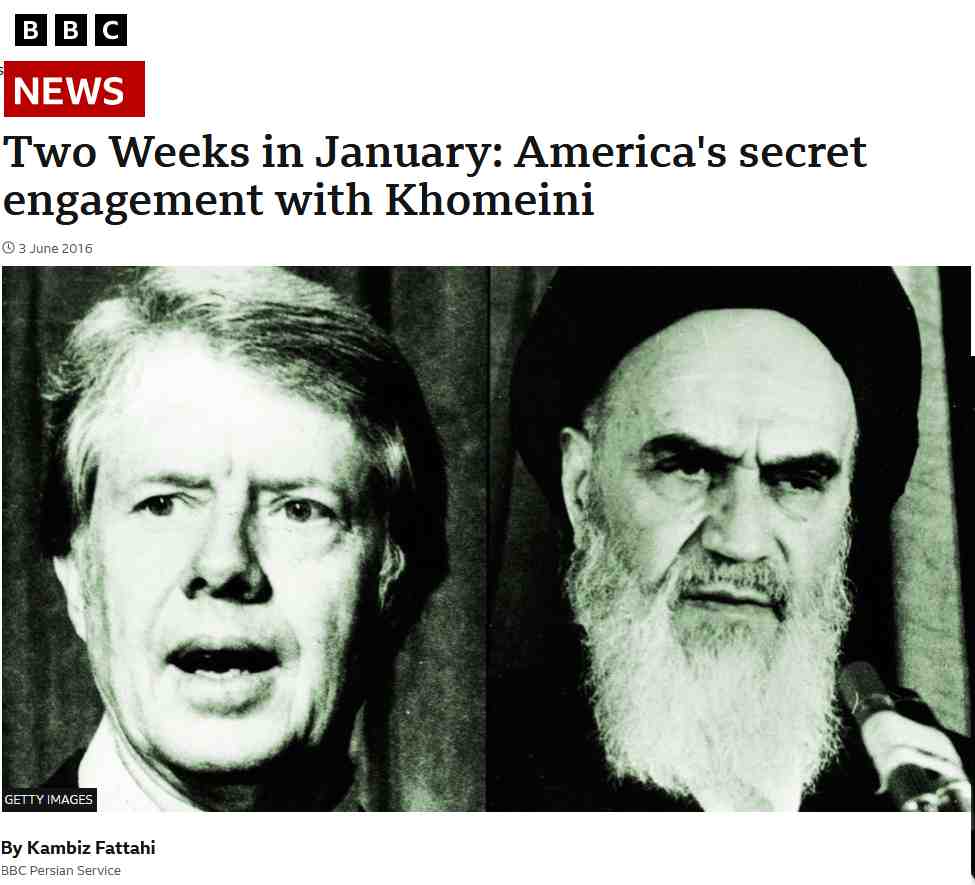
Also forgotten is that under Jimmy Carter the United States came to the aid
of Ayatollah Khomeini in ensuring the loyalty of the Shah’s army in order to
ward off a workers’ revolution.
On 27 January 1979, Ayatollah
Khomeini... the man who called the United States ‘the Great Satan’ sent a
secret message to Washington.
If President Carter could use his
influence on the military to clear the way for his takeover, Khomeini... would
calm the nation. Stability could be restored, America's interests and citizens
in Iran would be protected.
At the time, the Iranian scene was chaotic. Protesters clashed with troops, shops were closed, public services suspended. Meanwhile, labour strikes had all but halted the flow of oil, jeopardising a vital Western interest.

Persuaded by Carter, Iran's
autocratic ruler, Mohammad Reza Shah Pahlavi, had finally departed on a
"vacation" abroad, leaving behind an unpopular prime minister and a
military in disarray - a force of 400,000 men with heavy dependence on American
arms and advice....
Khomeini told the White House not
to panic at the prospect of losing a strategic ally of 37 years and assured
them that he, too, would be a friend.
"You will see we are not in any particular animosity with the Americans,"
said Khomeini, pledging his Islamic Republic will be "a humanitarian one,
which will benefit the cause of peace and tranquillity for all mankind".
.jpg)
Brighton Demonstration
Khomeini's
message is part of a trove of newly declassified US government documents... that
tell the largely unknown story of America's secret engagement with Khomeini...
This story
is a detailed account of how Khomeini brokered his return to Iran using a tone
of deference and amenability towards the US that has never before been
revealed.

Iranian school girls chase out
Basij
This is the background to the ‘anti-imperialism’ of Iran. The
Iranian clerical regime is a byword in brutality, from hanging Kurdish freedom
fighters, gays and others from cranes to torture and brutality. The economic
policy of the mullahs could be taken out of Thatcher’s playbook. Privatisation
and corruption are the order of the day.
.jpg)
Brighton demonstration
The Iranian workers movement has consistently fought the
regime of Ayatollah Khameini. Workers representatives have been repeatedly arrested,
tortured
and in some cases executed.
There is nothing progressive in this regime.

Ayatollah Khameini
The Iranian regime would happily come to terms with the Zionist
regime in Tel Aviv given half the chance but Israeli leaders prefer
confrontation as a means of ensuring their regional hegemony.
Of course the politics of the protesters in Iran differ enormously. There are supporters of the Shah, people who believe that Biden is sincere when he pledges his support as well as revolutionary workers and students. What is essential is that workers and students in Iran retain their independence and don’t align themselves with forces which will undoubtedly turn against them when the time is right.

police sexual assault on Iranian
woman
The United States and Israel don’t want to see a
revolutionary workers’ regime replace the regime now in power. They wish to
replace the theocratic regime with a regime that does their bidding whilst
keeping the repressive apparatus of the state in place.
Above all it is for Iranian socialists and communists to make
this point and win over the Iranian masses. No revolution is pure and the
protests in Iran are taking on a revolutionary form. However to support the reactionary rulers of
Iran is the precise opposite of socialist solidarity and anti-imperialism.
The current wave of protests began on September 16 after the murder of 22-year-old Mahsa Amini, following her arrest by Morality Police for not wearing her hijab ‘properly’. Since then, dozens of videos posted online show schoolgirls protesting in their schools and in the streets, chanting, waving, and burning their head coverings.
ripping up Ayatollah Khomeini's
picture
Nika Shakarami was 16 when she
burned her headscarf at a Tehran protest. She was last seen alive on September
20 being followed by security forces. The government claims she fell from a
building, the same fate of Sarina
Esmailzadeh, also 16, in Karaj, west of the capital on September 24.
According to media reports, both families were pressured not to contradict the
official story.

As of
October 11, the Iran-based Society to Support Children claims that 28 children
have been killed during the protests, most in Sistan and Baluchistan province,
and 9
children have been named by rights groups and media outlets as
having been killed by security forces.
I do not
see how anti-imperialists and socialists can condemn Israel for shooting dead children
and civilian protestors and then turn a blind eye to Iranian state repression.
Socialism is not built on hypocrisy.
Police Thugs Attack Woman
The
deputy commander of Iran’s Revolutionary Guard Corps stated on October 5 that “the average age of most people detained
during the protests is 15.” This in itself should tell people something
about the nature of the protests. It is
as much a youth rebellion against the Tyrants of Tehran.
The repression
has fuelled outrage among Iranian youth. Videos on social media show that in
Saqez, the home of Mahsa Amini, scores of schoolgirls
marched through the streets in protest, while girls in Karaj crowded a man, an
official – out of their school gate, chanting “Dishonorable.” In another video on Twitter,
schoolgirls remove their head coverings and chant against a man from the Basij,
a volunteer paramilitary force that is part of Iran’s Revolutionary Guards, who
had come to the school to speak about the Mahsa Amini protests.

Senior
officials claim that youth have been “trapped” by exposure to the internet, but
videos posted online indicate the schoolgirls’ stand is earning solidarity: men and women are seen joining them,
and boys are burning headscarves too.
In the weeks leading up to the incident, footage of similar episodes had
been spreading with increased frequency online, evidence of the growing pressure being exerted on women by
the regime. But this particular video went viral, and led to Rashno being
arrested, abused and forced into making an apology on state television.

“a turning point for many
women who had been resisting the morality police and fighting the mandatory
hijab and slowly pushing the limits of what the state considered proper attire
said Negar Mortazavi, an Iranian journalist and political analyst.

When news broke of Mahsa Amini’s death protests that began outside the hospital where she died spread across Iran within a week. Women burned their headscarves and cut their hair, leading the protests in which thousands of Iranians demanded the end of Ayatollah Khamenei’s rule and chanted Amini’s name.
The hijab is not just a piece of cloth. It’s one of the key pillars of
the ideology of the Mullah’s regime. One of the most striking images of these
protests is the sight of schoolgirls hanging signs that read “woman, life, freedom” in classrooms.

“It takes immense courage
and bravery for any woman to do this, but especially for young girls who are
risking arrest, expulsion from school, and even death when joining these
protests,”
said
Mortazavi.
Among the over 200 people who have been killed by Iranian state security during
these protests is Nika Shakarami, a 16-year-old whose death has been shrouded
in disinformation. Her family have described being threatened for going public
about her death.

Her mother told journalists she received a call from Nika who said she
was running away from security officials before her phone went dead. The family
went looking for her at hospitals and police stations but were told they had no
one with that name. Meanwhile, videos of her singing and joking around were
shared around the world.
Nine days later, the police showed images to her mother to confirm that
the dead body in the photograph was Nika. “Her
cheeks were broken. Her teeth were broken. She had received a severe blow
behind her head, and her skull was dented,” her mother said.

The Iranian government says Nika was thrown from the top of a building
and died and that it is a criminal matter and has nothing to do with the
protests and security forces. In her burial certificate, obtained by BBC Persian, the cause of death is stated as
multiple blows caused by a hard object.
“This
has been part of the regime’s playbook in previous crackdowns of mass protests
where security forces commit brutal violence against protesters, while denying
that violence and those who are killed by it. It happened in 2009 with the
state trying to deny that Neda Agha-Soltan and other protesters were
killed by security forces, it happened again in 2019.”
See How
three Iranian women spurred mass protests against hardline regime
Iran’s theocratic regime is clearly worried. Ali Larijani, a former Speaker of the Majilis, Iran’s parliament, has called for a re-examination of the enforcement of compulsory hijab law and an acknowledgment that the protests have deep political roots, and are not simply the product of US or Israeli agitation.
Though protesters continue to be killed and arrested by security
officials, schoolgirls rebelling against the hijab or shouting “Basij get lost!” from school buildings
presents a “huge dilemma” for the
regime, according to Prof Ali Ansari, a specialist in Middle Eastern history. “What are they going to do with them? They
can’t shoot a bunch of schoolgirls.”

Protests
challenge the regime,
Yassamine Mather, Weekly Worker
Across
the whole country, in every city, in every town, there is revolt. But does
‘post-nationalism’, rather than class politics, provide the solution?
Anti-government protests in Iran following the ‘morality
police’ killing of Mahsa Amini, who was arrested for nothing more than wearing
her headscarf too loosely, have now lasted two weeks. They have spread across
all 31 provinces and almost every city and town is affected, despite the use of
military force, including the Revolutionary Guards. The government has also
closed down parts of the internet in an attempt to avoid coordinated action and
the reporting of the rash of protests and demonstrations.
Both in New York, where he was speaking to the UN general
assembly, and on his return to Tehran, president Ebrahim Raisi blamed
“conspirators” for inciting unrest and pledged to crack down on “those who
oppose the country’s security and tranquillity”. I doubt he is stupid enough to
believe his own conspiracy theory, yet I see some western ‘anti-imperialists’
are repeating the same nonsense: apparently there are no demonstrations in the
wonderful Islamic Republic - it is all western propaganda!

In reality tens of thousands have taken part in protests,
often risking their lives, as they faced state forces using live ammunition,
tear gas and pepper spray. So far dozens of demonstrators have been killed and
hundreds have been injured, while journalists, students, labour activists,
social media users who have defended the protests have been arrested. Yet the
protests continue.
All this amounts to a serious challenge to the Islamic
Republic, but we should not underestimate the strength of the forces of
repression - the regime will use everything in its power to suppress the
movement.
Supreme leader Ali Khamenei has so far failed to issue any
statement in response to the protests and there are rumours that he is unwell.
However, I am always suspicious of such claims and it is likely that, sooner or
later, he will appear on TV to condemn it all as a dastardly conspiracy. But
the good news is that the protests have created further divisions amongst all
the factions of the regime. The ‘conservatives’ are blaming former president
Hassan Rouhani for the more liberal attitude to the wearing of the hijab in
some urban areas during his presidency, while others are calling for the
relaxation of the rules about head covering for women - and, of course, the
hard-liners know that any retreat will cost them dearly.
Slogans
The demonstrations are largely spontaneous - no-one takes
seriously those who claim they are leading them. Such claims have come from
rightwing groups, such as Mojahedin e-Khalq - the loony Islamist grouping
supported by sections of the US neocon Republicans - as well as individuals who
support the son of the ex-shah (he is also backed by neocons). As many Iranians
have pointed out on social media, it is ironic that opposition groups who are
financed by anti-abortion rightwingers in the US are showing concern for a
woman’s right to choose their dress code in Iran.
Some of the slogans, such as ‘No shah, no sheikh!’, are very
good - especially useful when the ex-shah’s son tries to take advantage of the
protests. One of the most popular slogans on recent protests is ‘Death to the
oppressor, be it shah or “leader”!’ (a reference to Khamenei), and another is
‘Death to the dictator!’
All this is positive, but spontaneity has its limitations.
Some comrades inside Iran have pointed out that these protests are
‘post-nationalist’, meaning that the murdered woman, Mahsa Amini, was Kurdish,
but protests are occurring in Farsi-speaking towns, in Azeri and Baluchi
cities, with the same fervour as those where Kurds form the majority, and, of
course, this is highly positive.
But other aspects are more problematic. For example, another
of the main slogans is ‘Woman, life, freedom!’, which was originally used
against Islamic State in Syrian Kurdistan by the YPG - the darlings of the soft
left and sections of the anarchist movement. In my opinion, however, it is not
a progressive slogan - which class of women, for example? As I wrote last week,
the issue of policing the hijab in Iran is a class issue. And ‘life’ for whom?
Capitalists, clerics, landowners or the working class? Even if the reference to
freedom relates to very superficial forms, such a call is meaningless in a
developing country without dramatic economic changes. Otherwise, after a short
period of tolerating some liberties, the new order could well impose repression
and another dictatorship to control economic unrest.
However, as the protests continue, new forces are now joining
them. Some university lecturers have cancelled classes, announcing they will
not resume teaching until arrested students are released. The Iranian teachers
union is calling for strikes, and on September 29 university staff and
students announced a nationwide strike of the higher education sector. Workers
in the Haft Tapeh union have issued statements in solidarity with the protests
and there are calls for a ‘nationwide strike’ - although at this stage it is
not clear if those calling for such a strike have anything concrete planned.
Another positive aspect is the fact that women who themselves
observe the rules on the wearing of the hijab have joined the protests. This
shows that the protests are not just about the hijab, but a woman’s right to
choose what she does in every aspect of her life, after 43 years of political
and religious oppression.
The veteran socialist, Ardeshir Mehrdad, in a short text
written this week, tells us:
A woman takes off her hijab and stands on a wall surrounded
by black-clad men. A woman sits on a platform looking at heavily armed
policemen wearing boots and leaves her hair out with calmness ... A woman
stands against a number of special forces of oppression; without the slightest
fear or trembling in her voice, she calls them “murderers”.
No doubt women have been in the forefront of these protests
and again this is very positive. Having said that, claims that this is a ‘feminist
revolution’ are nonsense. This must be seen as part of the preparation for a
revolution to overthrow the capitalist Islamic Republic of Iran, with
all its factions - its clerical as well as civilian and military. The
protestors are not just concerned about head covering. Of course, the death of
Mahsha Amini initiated the current movement, but protests against this regime
started in earnest a few years ago and they have since grown in size, duration
and determination.
In fact Iranians have protested against dictatorship and the
oppression of women, together with national and religious minorities, since
February 1979. What makes the current movement different is that it has a
material base: there are economic reasons for the way in which demonstrations
are spreading and ordinary people are showing unbelievable courage confronting
the oppressive forces. Protestors have also learnt from the riots of 2018 and
demonstrations against the abolition of subsidies in 2019. Today, they are
prepared to confront the armed forces - as opposed to the last two times, when
they were much more timid.
The continuation of neoliberal economic policies by
successive Islamist governments (‘reformist’ and conservative), in a country
faced with severe economic sanctions, has created a situation where the gap
between the rich and the poor is increasing daily; where the rate of inflation
often exceeds 40%; where unemployment is growing and there seems no end to
people’s daily suffering. In such circumstance women’s equality cannot be
achieved simply by a change in government leaders. But the Iranian left seems
incapable of coming up with any strategy, any long-term plan.
Nationalism
Two of the most important groups present in these protests
are women and ethnic minorities, and, in what can be considered the
‘post-nationalist’ approach of these two groups, what we find is, in fact,
nationalism - the culture, language, history and rights of different
ethnicities is strongly emphasised. Basically, ‘post-nationalism’ interweaves
with traditional nationalism.
It promotes equality that includes the presence of all
nationalities and condemns any superiority of a particular group over others.
This approach can strengthen the already existing unity of these currents, but
it acts against the development of class unity. ‘Post-nationalism’
puts a strong emphasis on individuality, and this means it cannot consider any
class over and above any other.
When it comes to the left in exile, we should not expect
anything much from them - and, reading some of the recent articles written inside
Iran, I am not sure there is much hope for the left there either!
Writing on the website, Naghd Eghetssad Siassi
(‘Political Economy Critique’), Faegh Hosseini asks:
Can you trust street protests that are not led by a
particular organisation or leadership? Yes! You can trust such protests, and
political and social activists have to show this trust. This issue has two
sides: firstly, the question is: can we hope in general to organise protests
without any organisation behind it? Secondly, what facilities and needs are
there to form these currents?
He then proposes councils and ‘post-nationalism’.
To quote a left group’s recent statement, translated from
Farsi, ‘post-nationalism’
… recognises all people as equal, including immigrants,
citizens, professionals, workers, men and women, and any ethnicity. Any
socio-political thought that enters a region and culture must be changed
according to the needs and characteristics of the target society, and the
thought of post-nationalism is no exception to this rule.
The confusion in the above text shows the triumph of
capitalist liberalism even in the thoughts of those who write on a left
website. Class is equated with gender and nationality, while the reality is
that, both amongst women and national minorities, class remains the most
important defining issue. If we all unite with no understanding of class, it is
obvious who will benefit from any change in government: those with economic
power - the owners of land and capital.
Ex-‘feudals’ in Kurdish areas are nowadays either part and
parcel of the current regime in Iran or they are, in Iraqi Kurdistan,
benefiting from Israeli or Saudi funding. They are not part of the protests.
Women associated with the leaders of the Islamic Republic and women whose
families are among the super-rich are not protesting either. They have not
suffered the oppression of the religious state, living in suburbs beyond the
reach of the Gasht-e Ershad morality police. Then we have women associated with
the many repressive organs of the Islamic Republic or its propaganda machine -
they are part of the enemy. The officers of Gasht-e Ershad are often women and,
for example, detention centres employ women to beat up female prisoners. We
cannot talk of participants in a movement challenging the current order without
referring to economic and political power - and here class and class allegiance
is absolutely essential.
State forces might be able to suppress the current protests,
but the ground beneath the Islamic Republic is gradually slipping away with
generalised dissatisfaction, rising poverty, high inflation and neoliberal
economic policies, such as the abolition of subsidies. So the protests will
continue in some form or another and the Iranian people will surely succeed in
overthrowing the Islamic Republic sooner or later.
Clearly the regime is getting weaker, but the question
remains: who will replace the current bunch of corrupt, lying and sanctimonious
clerics?
See also Beware
of concerned neocons Yassamine Mather


