You Cannot Call BDS a ‘Cult’, Support the Existence of an Apartheid State
& Attack the Slogan of the Movement ‘Palestine
Must be Free’ & Expect To be Worshipped
Like An Ancient God
Norman Finkelstein has been a
remarkable analyst and critic but he has also acted like a bull in a china shop.
Finkelstein’s demolition of the
fraudulent Joan Peter’s From Time Immemorial,
which claimed that it was the Zionist settlement which attracted the
Palestinians to Palestine and that there were therefore no refugees, was a classic
example of how to deconstruct an opponent’s argument. To say that Finkelstein demolished Peters and her wretched book, whilst swimming against
the tide of favourable reviews in all the mainstream press, the NYT included,
is an understatement.
When Daniel Goldhagen wrote the
execrable ‘The
Germans: Hitler’s Willing Executioners’ which said that the Germans
killed Jews because they were a particularly sadistic and cruel nation, Finkelstein
tore him to pieces. So devastating was his criticism
that Goldhagen threatened him with libel initially, rather than reply to the
substance of the criticism.
Holocaust Industry
Finkelstein’s Holocaust
Industry, helped change the debate over the weaponisation of the memory
of the holocaust but it nonetheless refrained from drawing any conclusions
about the relations between the Zionists and the Nazis which are surely
relevant to the Zionists’ exploitation of the holocaust?
The pre-eminent holocaust scholar
Raul Hilberg, author of the Destruction
of European Jews was a ‘strong
supporter’ of Finkelstein. Finkelstein savaged the Zionist Jewish Claims Conference which has
embezzled millions of dollars, intended for the holocaust survivors, for the
Zionists’ pet projects (as well as engaging in more mundane corruption).
This was all too much for the Socialist Workers’ Party
resident guru, Professor Alex Callinicos [Finkelstein
and the holocaust] who declared, in a review which, more than anything,
demonstrated that the SWP is incapable of a serious analysis of anti-Semitism today
or how the holocaust has been used to undermine Palestine solidarity.
How different is his assertion that “the field of
Holocaust studies is replete with nonsense, if not plain fraud” from the
Holocaust revisionist David Irving’s rantings during his recent libel case?... so
exaggerated is his polemic that at times he comes, quite contrary to his own
intentions, dangerously close to giving comfort to those who dream of new
holocausts.
Perhaps this is one reason why the
SWP front organisation, Stand Up to
Racism, continues
to march with genocidal Zionist organisations like Glasgow Friends of Israel.
The misnamed Zionist group Honest Reporting was more than happy to take advantage of Finkelstein's attack on BDS as were other Zionists
Finkelstein is not an anti-Zionist
I say all this because Finkelstein
has one major flaw. And it’s not just an overweening ego. Finkelstein is not an
anti-Zionist nor is he a socialist, despite once having been a Maoist. His
support for a 2 State Solution, which he has never disavowed, is based on the
myth of the ‘International Community’ which is nothing more than an attempt to
cloak the interests of US imperialism in a democratic garb. His faith in
International Law as the arbiter of relations between states and nations has
been shown to be hollow with the genocide in Gaza.
Gaza has demonstrated that international
law is unable to prevent Israel from committing genocide in Gaza because it has no enforcement mechanism. As long as Israel is
backed by the United States it can and does act with impunity. International law can’t
even prevent states like Germany and Britain supplying arms
for the genocide.
Finkelstein is erratic in that he
took a correct position on the 7th October attack by the Palestinian
Resistance, namely that it was akin to a slave revolt against their masters,
but he refused to draw the necessary conclusion that the slaves destroyed the
institution of slavery where they could (Haiti) because it was incompatible
with their own freedom and liberty.
Norman has consistently supported the
continued existence of the Israeli state and played down its supremacist and
apartheid nature. That's what support for 2 States means.
Finkelstein's Opposition to
the slogan 'From the river to the sea, Palestine will be free' echoes
what the Zionists say
In his interview with the Guardian,
Finkelstein made plain his disagreement with the slogan ‘Palestine will be free, from the river to the sea’ when he said:
“What do you mean by Palestine will be free? Do you
mean there is no room for Israel?”
But then he went on to say something
even more interesting.
“Palestine
will be free” can also mean something else. It can fit into what’s called the
settler colonial framework, which basically says, “Settlers do not have
legitimate rights to the land. The land belongs to those who are ‘Indigenous’
to it. And everybody else, at most, can live there on the sufferance of the
Indigenous majority, or they have to pack up and leave.” And the reason that
slogan is ambiguous is because the movement is ambiguous about what its goal
is. And if you try to remove the ambiguity, you risk breaking up the movement.
Finkelstein
did not say this to the encampment at Columbia University. At Columbia he beat about the
bush and was vague and waffled on about strategic
goals. He didn’t say ‘what about Israel’ there because he knows the reception
that would have got. As soon as he had he finished speaking the students
broke into the very slogan that he was trying to get them to disavow! Clearly
his argument was not very convincing.
What Finkelstein said in his Guardian
interview is that he doesn’t agree with the settler-colonial framing that apparently sees
Israel as a product of western colonialism and imperialism and in which the
settlers have no rights. What Finkelstein is doing is deliberately distorting and caricaturing the settler-colonial
paradigm. It does not say that the
settlers don’t have legitimate rights to the land. That was never said in South
Africa, quite the contrary. What it said was that the settlers were entitled to live as equals with
the indigenous and that is what Palestinians say today.Although to be blunt I wouldn’t blame Palestinians
for saying for example that the neo-Nazi settlers on the West Bank should fuck
off back home.
What the settler colonial framework does
say is that the settlers’ rights are no greater than those who are indigenous
to the land and they have to jettison their belief that they are superior. All
of this Finkelstein disparages and distorts.
In
essence Finkelstein is a liberal democrat. That is why he is so fond of the
reactionary Mahatma Ghandi whose acceptance of communal electorates helped pave
the way for Partition and the present day Hindu Supremacist state of India and
the permanent military dictatorship of Pakistan.
Finkelstein isn’t prepared to say
that Israel is a settler colonial state that has got to go. On the contrary he
admires the early Zionists, the kibbutzim, their ‘idealism’, the ‘austere life’
and the ‘rugged individualism’ of the early Labour Zionist settlers. This isn’t
a matter of speculation. It is what he wrote in correspondence to me.
It is unfortunate that Finkelstein,
who is very close politically to Noam Chomsky, who himself has never disavowed Zionism,
hasn’t made his position clear on Zionism and the continued existence of a Jewish
State. When Finkelstein calls Israel a ‘lunatic’ or ‘satanic’ state what he is
doing is saying that the genocide it is carrying out today and the expansion
now in Syria isn’t on account of Zionism but relates to the ‘thuggish’
messianic vision of Netanyahu as an individual.
— susan abulhawa | سوزان ابو الهوى (@susanabulhawa) November 30, 2024
Susan Abulhawa & the Oxford Union Debate
Susan Abulhawa,
who made that brilliant
speech at the Oxford Union debate on November 28, which was won by
278-59, was highly critical of Finkelstein’s behaviour for many of the same reasons as I've given. Susan wrote:
Finkelstein decided to back
out ostensibly because Morris wasn't coming, but in reality, I think he didn't
want to be overshadowed by actual Palestinians who can speak more cogently and
eloquently than him on the matters pertaining to our own lives, on which he
claims expertise, almost exclusively. Norman is a star and shall be treated as
a star. Therefore, he demanded to have his own Oxford Union session, undiluted
with the voices of pesky Palestinians. That left a gaping hole in the
opposition's side, which could not be filled on such short notice. That's why
the president of the union, Ebrahim Osman-Mowafy stepped in....
Norman Finkelstein had his own event the following
day and everyone fawned over our white American savior. Yes, I'm angry. Norman
came to be invited because I suggested he be there to have an academic
counterweight to Morris. Rather than supporting Palestinians, he withdrew,
apparently because he's too special and important.
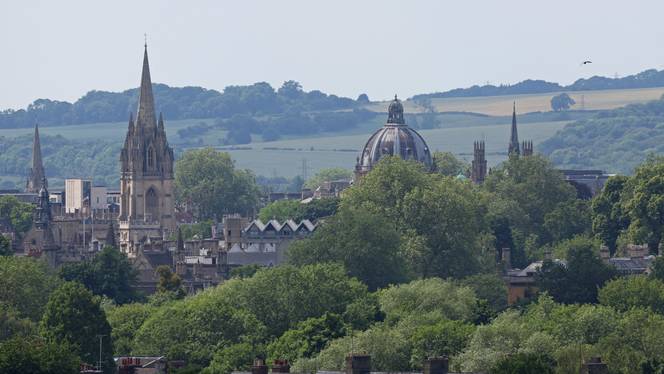
The Spires of Oxford
However it wasn’t Finkelstein’s event
the next day which made a political impact but the Oxford Union Debate which
the pro-Palestinian side won by 4-1. Given that he had been invited at Susan’s
suggestion his failure to co-ordinate tactics with her is indicative of
his individualistic and egotistical approach when it comes to being part of a collective movement.
Finkelstein's Infantile E-mail
It was because of my recent blog
in which I called on Finkelstein to ‘Stop Undermining the Global Movement in
Support of the Palestinians’
and then a subsequent challenge by me to debate his objections to the Palestine Must be Free slogan (which he
declined) that he sent me an infantile email. I guess I should be amused at finding
out how thin Norman’s skin is!
Norman’s email was notionally in response to a
circular I sent to people advertising a webinar on December 3, How
Anti-Semitism has Complemented Zionismin which Tony Lerman, Barnaby
Raine, Michael Richmond and myself spoke. Norman wrote:
I’m tempted to ask readers of my
book to email Finkelstein (normfinkelstein@gmail.com/norm6344@gmail.com) to disabuse him of his
belief! However that would be to respond in kind.
All I can say is that
it’s clear that Finkelstein was stung by my criticisms and instead of debating it out as we have done before, our usually
loquacious academic pundit responded with a temper tantrum. Clearly Finkelstein finds it difficult to defend his opposition to the slogan without having to defend his other views such as the two state solution.
UPDATE Out of over 2,400 posts in 10 years of this blog this post has received the highest number of hits ever - over 117,000 so far and climbing. The second highest blog, at the beginning of the year was on Ahed Tamimi, the gaoled Palestinian child and the no. of hits was 104,000. Clearly this post has struck a chord. As a child I lived in Merthyr Tydfil, South Wales for a year.One of the things that has stuck with me since
that time was the hostility amongst Welsh working class people to Churchill as
a result of his sending the troops and police into the valleys to help the coal
owners defeat the striking miners, some of whom were shot.
But Churchill’s reputation was made primarily in imperial affairs. It is indisputable
that Churchill was primarily responsible for the slaughter at Gallipolli in 1915.Prior to that there was his period as Home
Secretary when he took personal control of the Sydney Street siege in January 1911.Two Latvian revolutionaries were
holed up there and they were besieged by police and troops.When the building caught fire he ordered the
fire brigade not to put the flames out and allowed those inside to burn to
death.As Colonial Secretary he presided
over Partition in Ireland and over the beginning of the Mandate in Palestine.In Palestine he introduced the murderous
Black and Tans who had seen bloody service in Ireland.
Churchill saw very early the potential of Zionism as an antidote to Communism amongst Jews
Adam Jones, editor of the Journal of Genocide Research,
calls Churchill "a genuine genocidaire",
noting that he called Indians a "foul
race" and said that the British air force chief should "send some of his surplus bombers to
destroy them." [Jones, Adam (2016-12-16). "Chapter 2 State and Empire; War and
Revolution". Genocide:
A Comprehensive Introduction. Routledge]
Whether it was sending in the army to protect the coal owners in Wales or presiding over the famine in Bengal in 1942,
Churchill was a mass murderer.Churchill’s
whole career had been dedicated to the preservation of the Empire.In January 1931 he resigned from the
Conservative Shadow Cabinet over self-government for India.Churchill was a died-in-the-wool supporter of
the British Empire.
Churchill made his reputation in the second world war, primarily through
his fighting speeches.However his
opposition to Hitler was not from an anti-fascist perspective.He saw Hitler as a threat to British interests.Initially he had welcomed Hitler as an
anti-communist.During the War Churchill
was distinguished by his refusal to do anything to alleviate the position of
the Jews including the bombing of Auschwitz and the railway lines leading up to
it.He was however a die hard Zionist and
that is why Zionist supporters treat him kindly, despite his undoubted anti-Semitism.
Striking up a familiar pose
During the war he advocated the mass bombing of German cities like
Dresden and Nuremburg.Thousands died as a result yet the war itself was
advanced.These were undoubtedly war
crimes.When Greece was liberated he put
the local Nazi collaborators back in power as his main goal was keeping the Greek
Communists out of power.
His most famous tract Zionism andBolshevism was published in the
Illustrated Sunday Herald on 8 February 1920.Suffice to say that Churchill was not overfond of revolutionary Jews!He wrote of the ‘International Jew’ as being responsible
for all the ills his class suffered from, including the French Revolution!
Churchill enjoying himself at the Sydney Street siege
‘The adherents of this sinister confederacy are mostly men reared up
among the unhappy populations of countries where Jews are persecuted on account
of their race.... This movement among the Jews is not new. From the days of
Spartacus-Weishaupt to those of Karl Marx, and down to Trotsky (Russia), Bela
Kun (Hungary), Rosa Luxembourg (Germany), and Emma Goldman (United States),
this world-wide conspiracy for the overthrow of civilisation and for the
reconstitution of society on the basis of arrested development, of envious
malevolence, and impossible equality, has been steadily growing. ... It has
been the mainspring of every subversive movement during the Nineteenth Century;...
There is no need to exaggerate the part played in the creation of
Bolshevism and in the actual bringing about of the Russian Revolution by these
international and for the most part atheistical Jews.. ...
Zionism offers the third sphere to the political conceptions of the
Jewish race. In violent contrast to international communism, it presents to the
Jew a national idea of a commanding character.’
Churchill like most of his class saw Zionism as an alternative to the
attractions of revolution for Jews. Those who see that the origins of Zionism were
progressive are very much mistaken.
Churchill's Police confront the miners in South Wales
A statue of former British prime minister Winston Churchill is silhouetted in front of the Houses of Parliament in London in 2015., Luke MacGregor/Reuters
“History,” Winston Churchill said, “will be
kind to me, for I intend to write it myself.” He needn’t have bothered. He
was one of the great mass murderers of the 20th century, yet is the only
one, unlike Hitler and Stalin, to have escaped historical odium in the
West. He has been crowned with a Nobel Prize (for literature, no less), and
now, an actor portraying him (Gary Oldman) has been awarded an Oscar.
As Hollywood confirms,
Churchill’s reputation (as what Harold Evans has called “the British Lionheart on the ramparts of civilization”) rests
almost entirely on his stirring rhetoric and his talent for a fine phrase
during World War II. “We shall not flag
nor fail. We shall go on to the end. … We shall fight on the beaches, we shall
fight on the landing grounds, we shall fight in the fields and in the streets.
… We shall never surrender.” (The revisionist British historian John
Charmley dismissed this as “sublime nonsense.”)
Words, in the end, are all that
Churchill admirers can point to. His actions are another matter altogether.
Blenheim Palace where Churchill was born
During World War II, Churchill declared himself in favor of
“terror bombing.” He wrote that he
wanted “absolutely devastating,
exterminating attacks by very heavy bombers.” Horrors such as the
firebombing of Dresden were the result.
In the fight for Irish
independence, Churchill, in his capacity as secretary of state for war and air,
was one of the few British officials in favor of bombing Irish protesters,
suggesting in 1920 that airplanes should use “machine-gun fire or bombs” to scatter
them.
Dealing with unrest in
Mesopotamia in 1921, as secretary of state for the colonies, Churchill acted as a war criminal: “I am strongly in favour of using poisoned
gas against the uncivilised tribes; it would spread a lively terror.” He ordered large-scale bombing
of Mesopotamia, with an entire village wiped out in 45 minutes.
In Afghanistan, Churchill declared that the Pashtuns “needed to recognise the superiority of [the
British] race” and that “all who
resist will be killed without quarter.” He wrote: “We proceeded systematically, village by village, and we destroyed the
houses, filled up the wells, blew down the towers, cut down the great shady
trees, burned the crops and broke the reservoirs in punitive devastation. …
Every tribesman caught was speared or cut down at once.”
In Kenya, Churchill either
directed or was complicit in policies involving the forced relocation of local
people from the fertile highlands to make way for white colonial settlers and
the forcing of more than 150,000 people into concentration camps. Rape, castration, lit cigarettes on
tender spots, and electric shocks were all used by the British authorities to torture Kenyans under
Churchill’s rule.
But the principal victims of
Winston Churchill were the Indians — “a
beastly people with a beastly religion,” as he charmingly called them. He wanted
to use chemical weapons in India but was shot down by his cabinet colleagues,
whom he criticized for their “squeamishness,”
declaring that “the objections of the
India Office to the use of gas against natives are unreasonable.”
Churchill’s beatification as an
apostle of freedom seems all the more preposterous given his 1941 declaration
that the Atlantic Charter’s principles would not apply to India and the colored colonies. He
refused to see people of color as entitled to the same rights as himself. “Gandhi-ism and all it stands for,” he declared, “will, sooner or later, have to be grappled with and finally crushed.”
In such matters, Churchill was
the most reactionary of Englishmen, with views so extreme they cannot be
excused as being reflective of their times. Even his own secretary of state for
India, Leopold Amery, confessed that he could see very little difference between Churchill’s attitude and Adolf
Hitler’s.
As a dedicated racist Churchill was a strong believer in racial purity and selective breeding - eugenics
Thanks to Churchill, some 4
million Bengalis starved to death in a 1943 famine. Churchill ordered the
diversion of food from starving Indian civilians to well-supplied British
soldiers and even to top up European stockpiles in Greece and elsewhere. When
reminded of the suffering of his Indian victims, his response was that the
famine was their own fault, he said, for “breeding
like rabbits.”
Madhusree Mukerjee’s searing
account of Churchill’s role in the Bengal famine, “Churchill’s Secret War,”
documents that while Indians starved, prices for foodgrains were inflated by
British purchases and India’s own surplus grains were exported, while
Australian ships laden with wheat were not allowed to unload their cargo at
Calcutta (where the bodies of those who had died of starvation littered the
streets). Instead, Churchill ordered that grain be shipped to storage depots in
the Mediterranean and the Balkans to increase the buffer stocks for a possible
future invasion of Greece and Yugoslavia. European warehouses filled up as
Bengalis died.
This week’s Oscar rewards yet
another hagiography of this odious man. To the Iraqis whom Churchill advocated
gassing, the Greek protesters on the streets of Athens who were mowed down on
Churchill’s orders in 1944, sundry Pashtuns
and Irish, as well as to Indians like myself, it will always be a mystery why a
few bombastic speeches have been enough to wash the bloodstains off Churchill’s
racist hands.
Many of us will remember
Churchill as a war criminal and an enemy of decency and humanity, a blinkered
imperialist untroubled by the oppression of non-white peoples. Ultimately, his
great failure — his long darkest hour — was his constant effort to deny us
freedom.
Winston Churchill is rightly remembered for
leading Britain through her finest hour – but what if he also led the country
through her most shameful hour? What if, in addition to rousing a nation to
save the world from the Nazis, he fought for a raw white supremacism and a
concentration camp network of his own? This question burns through Richard
Toye's new history, Churchill's Empire, and is even seeping into the Oval Office.
George W Bush left a bust of Churchill near
his desk in the White House, in an attempt to associate himself with the war
leader's heroic stand against fascism. Barack Obama had it returned to Britain.
It's not hard to guess why: his Kenyan grandfather, Hussein Onyango Obama, was
imprisoned without trial for two years and was tortured on Churchill's watch,
for resisting Churchill's empire.
Can these clashing Churchills be reconciled?
Do we live, at the same time, in the world he helped to save, and the world he
helped to trash? Toye, one of Britain's smartest young historians, has tried to
pick through these questions dispassionately – and he should lead us, at last
and at least, to a more mature conversation about our greatest national icon.
Churchill was born in 1874 into a Britain
that was washing the map pink, at the cost of washing distant nations blood
red. Victoria had just been crowned Empress of India, and the scramble for
Africa was only a few years away. At Harrow School and then Sandhurst, he was
told a simple story: the superior white man was conquering the primitive,
dark-skinned natives, and bringing them the benefits of civilisation. As soon
as he could, Churchill charged off to take his part in "a lot of jolly little wars against barbarous peoples".
In the Swat valley, now part of Pakistan, he experienced, fleetingly, a crack
of doubt. He realised that the local population was fighting back because of
"the presence of British troops in
lands the local people considered their own," just as Britain would if
she were invaded. But Churchill soon suppressed this thought, deciding instead
they were merely deranged jihadists whose violence was explained by a
"strong aboriginal propensity to kill".
He gladly took part in raids that laid waste
to whole valleys, destroying houses and burning crops. He then sped off to help
reconquer the Sudan, where he bragged that he personally shot at least three
"savages".
The young Churchill charged through imperial
atrocities, defending each in turn. When concentration camps were built in
South Africa, for white Boers, he said they produced "the minimum of suffering". The death toll was almost
28,000, and when at least 115,000 black Africans were likewise swept into
British camps, where 14,000 died, he wrote only of his "irritation that Kaffirs should be allowed to fire on white men".
Later, he boasted of his experiences there: "That was before war degenerated. It was great fun galloping
about."
Then as an MP he demanded a rolling
programme of more conquests, based on his belief that "the Aryan stock is bound to triumph".
There seems to have been an odd cognitive dissonance in his view of the
"natives". In some of his private correspondence, he appears to
really believe they are helpless children who will "willingly, naturally, gratefully include themselves within the golden
circle of an ancient crown".
But when they defied this script, Churchill
demanded they be crushed with extreme force. As Colonial Secretary in the
1920s, he unleashed the notorious Black and Tan thugs on Ireland's Catholic
civilians, and when the Kurds rebelled against British rule, he said: "I am strongly in favour of using poisoned
gas against uncivilised tribes...[It] would spread a lively terror."
Of course, it's easy to dismiss any
criticism of these actions as anachronistic. Didn't everybody think that way
then? One of the most striking findings of Toye's research is that they really
didn't: even at the time, Churchill was seen as at the most brutal and brutish
end of the British imperialist spectrum. Prime Minister Stanley Baldwin was
warned by Cabinet colleagues not to appoint him because his views were so
antedeluvian. Even his startled doctor, Lord Moran, said of other races: "Winston thinks only of the colour of their
skin."
Many of his colleagues thought Churchill was
driven by a deep loathing of democracy for anyone other than the British and a
tiny clique of supposedly superior races. This was clearest in his attitude to
India. When Mahatma Gandhi launched his campaign of peaceful resistance,
Churchill raged that he "ought to be
lain bound hand and foot at the gates of Delhi, and then trampled on by an
enormous elephant with the new Viceroy seated on its back." As the
resistance swelled, he announced: "I
hate Indians. They are a beastly people with a beastly religion." This
hatred killed. To give just one, major, example, in 1943 a famine broke out in
Bengal, caused – as the Nobel Prize-winning economist Amartya Sen has proved –
by the imperial policies of the British. Up to 3 million people starved to
death while British officials begged Churchill to direct food supplies to the
region. He bluntly refused. He raged that it was their own fault for "breeding like rabbits". At
other times, he said the plague was "merrily"
culling the population.
Skeletal, half-dead people were streaming
into the cities and dying on the streets, but Churchill – to the astonishment
of his staff – had only jeers for them. This rather undermines the claims that
Churchill's imperialism was motivated only by an altruistic desire to elevate
the putatively lower races.
Hussein Onyango Obama is unusual among
Churchill's victims only in one respect: his story has been rescued from the
slipstream of history, because his grandson ended up as President of the US.
Churchill believed that Kenya's fertile highlands should be the preserve of the
white settlers, and approved the clearing out of the local "blackamoors". He saw the local
Kikuyu as "brutish children".
When they rebelled under Churchill's post-war premiership, some 150,000 of them
were forced at gunpoint into detention camps – later dubbed "Britain's
gulag" by Pulitzer-prize winning historian, Professor Caroline Elkins. She
studied the detention camps for five years for her remarkable book Britain's
Gulag: The Brutal End of Empire in Kenya, explains the tactics adopted under
Churchill to crush the local drive for
independence. "Electric shock was widely used, as well as cigarettes and
fire," she writes. "The screening teams whipped, shot, burned,
and mutilated Mau Mau suspects." Hussein Onyango Obama never truly
recovered from the torture he endured.
Many of the wounds Churchill inflicted have
still not healed: you can find them on the front pages any day of the week. He
is the man who invented Iraq, locking together three conflicting peoples behind
arbitrary borders that have been bleeding ever since. He is the Colonial
Secretary who offered the Over-Promised Land to both the Jews and the Arabs –
although he seems to have privately felt racist contempt for both. He jeered at
the Palestinians as "barbaric hoards
who ate little but camel dung," while he was appalled that the
Israelis "take it for granted that
the local population will be cleared out to suit their convenience".
True, occasionally Churchill did become
queasy about some of the most extreme acts of the Empire. He fretted at the
slaughter of women and children, and cavilled at the Amritsar massacre of 1919.
Toye tries to present these doubts as evidence of moderation – yet they almost
never seem to have led Churchill to change his actions. If you are determined
to rule people by force against their will, you can hardly be surprised when
atrocities occur. Rule Britannia would inexorably produce a Cruel Britannia.
So how can the two be reconciled? Was
Churchill's moral opposition to Nazism a charade, masking the fact he was
merely trying to defend the British Empire from a rival?
The US civil rights leader Richard B. Moore,
quoted by Toye, said it was "a rare
and fortunate coincidence" that at that moment "the vital interests of the British Empire
[coincided] with those of the great overwhelming majority of mankind".
But this might be too soft in its praise. If Churchill had only been interested
in saving the Empire, he could probably have cut a deal with Hitler. No: he had
a deeper repugnance for Nazism than that. He may have been a thug, but he knew
a greater thug when he saw one – and we may owe our freedom today to this
wrinkle in history.
This, in turn, led to the great irony of
Churchill's life. In resisting the Nazis, he produced some of the richest
prose-poetry in defence of freedom and democracy ever written. It was a cheque
he didn't want black or Asian people to cash – but they refused to accept that
the Bank of Justice was empty. As the Ghanaian nationalist Kwame Nkrumah wrote:
"All the fair, brave words spoken
about freedom that had been broadcast to the four corners of the earth took
seed and grew where they had not been intended." Churchill lived to
see democrats across Britain's dominions and colonies – from nationalist leader
Aung San in Burma to Jawarlal Nehru in India – use his own intoxicating words
against him.
Ultimately, the words of the great and
glorious Churchill who resisted dictatorship overwhelmed the works of the cruel
and cramped Churchill who tried to impose it on the darker-skinned peoples of
the world. The fact that we now live in a world where a free and independent
India is a superpower eclipsing Britain, and a grandson of the "savages" is the most powerful man
in the world, is a repudiation of Churchill at his ugliest – and a sweet,
ironic victory for Churchill at his best.
The Greatest Briton or a Ruling Class Racist and Imperialist?
BBC Sycophancy and Bias at its best (or worst!)
When I lived in Merthyr Tydfil in 1963, I was only 10 but I was taken aback by the hostility of the people to Winston Churchill. Merthyr of course was at the centre of the mines of the Rhonda valley. None of this has come out in the BBC's usual sycophantic coverage of ruling class 'heroes'.
On the 50th anniversary of his state funeral,
there has been a plethora of mush about the great person to live in the British
Isles since Alfred burnt the cakes. The
truth however has been conveniently omitted, another casualty of Churchill’s
many wars. In Ireland he oversaw
Partition, in Palestine he gave unstinting support to the Zionists whilst doing
nothing for the Jews of Auschwitz and the Extermination Camps. In Wales and Liverpool he sent troops in to
do battle against working-class strikers.
In other words he was a thorough racist and imperialist (as the cutting
from the Guardian demonstrates) but he made a few rousing speeches in WWII.
Always a racist - being a Zionist was therefore natural
In 1931 he had resigned from the Conservative Shadow Cabinet because of his disagreement with even the most limited concessions to Indian nationalism and support for the Government of India Act. His primary reason for fighting Hitler was to defend the British Empire and he came into conflict with Field Marshall Wavell over this. He was quite open about his belief that the 'half naked fakir' Ghandi should be murdered and presided over the death by starvation of at least 2 million Indians in Bengal during WW2.
In Greece Churchill was responsible for putting the
collaborators with the Nazi occupation back in power in order to defeat the
Communists. A Channel 4 programme on
this was shown about 25 years ago and was then promptly banned and never shown
again. Part of the film can be seen
here.
Tony Greenstein
“One may dislike Hitler’s system and yet admire his
patriotic achievement. If our country
were defeated I hope we should find a champion as indomitable to restore our
courage and lead us back to our place among the nations.” Winston Church, Step by Step, p.143.
Regarding
the Iraqi Kurds, Churchill beat Saddam Hussein to it by nearly 50 years. As Colonial Secretary he explained:
'I do not
understand this squeamishness about the use of gas. We have definitely adopted
the position at the Peace Conference of arguing in favour of the retention of
gas as a permanent method of warfare. It is sheer affectation to lacerate a man
with the poisonous fragment of a bursting shell and to boggle at making his
eyes water by means of lachrymatory gas.
I am
strongly in favour of using poisoned gas against uncivilised tribes. The moral
effect should be so good that the loss of life should be reduced to a minimum.
It is not necessary to use only the most deadly gasses: gasses can be used
which cause great inconvenience and would spread a lively terror and yet would
leave no serious permanent effects on most of those affected.
But
Churchill did not believe in discrimination when it came to meting out ruling
class ‘justice’.The socialist newspaper
Justice laid the responsibility for the deaths at Churchill’s feet, and
said:
“For the
fourth time in five years, British people have been murdered in the streets by
the forces of law and order on the instruction of a Liberal Government.
Belfast, Tonypandy, and now Liverpool and Llanelly… Their hatred of our class
is only modified by their contempt, as witness the alacrity with which
middle-class hooligans rushed forward to be enrolled as special constables in
the hope of an opportunity of breaking the heads of the ‘mob.’”
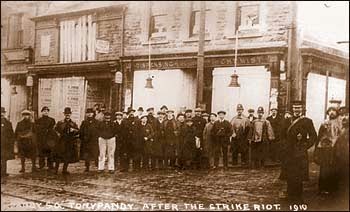
The Rhonda Riots
In the First World War the Gallipolli disaster cost tens
of thousands of lives and achieved nothing.
In the Second World War, apart from a few rousing speeches what was his
contribution? Wasting a year fighting
all the way up Italy instead of launching the second front in France in
1943.
Communist fighters
After WWI
he strongly favoured intervention in Russia to depose the revolutionary government
there. The following passage, from an article Churchill wrote in 1920, might
sound familiar to anyone who has ever read any material from the far-right:
“In
violent opposition to all this sphere of Jewish effort rise the schemes of the
International Jews …. There is no need to exaggerate the part played in the
creation of Bolshevism and in the actual bringing about of the Russian
Revolution by these international and for the most part atheistical Jews.”
Churchill was an avid supporter of the Zionist movement and in Ireland was responsible,
as Colonial Secretary, for the implementation of the Anglo-Ireland Treaty of 1920,
including the Partition of Ireland.He
was also responsible for the creation of the death squads of the Black and Tans
and the incorporation of Protestant para-military groups into the Royal Ulster
Constabulary.
In later
years he expressed his admiration for fascism in Italy, publicly praising it on
a visit to Italy in 1927, but also praising Mussolini’s labour policies during
the British General Strike in 1926. Franco, meanwhile, was a “great man” who
had “united his country.”
Churchill
wasn’t so keen on people fighting to attain their liberty. Gandhi, for example,
was a “half-naked fakir” who should be “lain bound hand and foot at the gates
of Delhi and then trampled on by an enormous elephant.” See
Even
worse if you were a rebellious Kurd in British-governed Iraq in the 1920s: Below is a history of British involvement in Greece and how we put Nazi collaborators back in power. That has many lessons for today and the base of Golden Dawn's support.
When 28 civilians were killed in Athens, it wasn’t the Nazis who were to
blame, it was the British. Ed Vulliamy and Helena Smith reveal how Churchill’s
shameful decision to turn on the partisans who had fought on our side in the
war sowed the seeds for the rise of the far right in Greece today
A
day that changed history: the bodies of unarmed protestors shot by the police
and the British army in Athens on 3 December 1944. Photograph: Dmitri
Kessel/Time & Life Pictures/Getty Images
“I can still see it very
clearly, I have not forgotten,” says Títos Patríkios. “The Athens police firing
on the crowd from the roof of the parliament in Syntagma Square. The young men
and women lying in pools of blood, everyone rushing down the stairs in total
shock, total panic.”
Greek demonstrators shot dead by Nazi collaborator regime
And then came the defining moment: the recklessness of youth, the passion of
belief in a justice burning bright: “I jumped up on the fountain in the middle
of the square, the one that is still there, and I began to shout: “Comrades,
don’t disperse! Victory will be ours! Don’t leave. The time has come. We will
win!” “I was,” he says now, “profoundly sure, that we would win.” But there was no
winning that day; just as there was no pretending that what had happened would
not change the history of a country that, liberated from Adolf Hitler’s Reich
barely six weeks earlier, was now surging headlong towards bloody civil war.
Even now, at 86, when Patríkios “laughs at and with myself that I have
reached such an age”, the poet can remember, scene-for-scene, shot for shot,
what happened in the central square of Greek political life on the morning of 3
December 1944.
This was the day, those 70 years ago this week, when the British army, still
at war with Germany, opened fire upon – and gave locals who had collaborated
with the Nazis the guns to fire upon – a civilian crowd demonstrating in
support of the partisans with whom Britain had been allied for three years.
The crowd carried Greek, American, British and Soviet flags, and chanted:
“Viva Churchill, Viva Roosevelt, Viva Stalin’” in endorsement of the wartime
alliance.
Twenty-eight civilians, mostly young boys and girls, were killed and
hundreds injured. “We had all thought it would be a demonstration like any
other,” Patríkios recalls. “Business as usual. Nobody expected a bloodbath.”
Britain’s logic was brutal and perfidious: Prime minister Winston
Churchill considered the influence of the Communist Party within the
resistance movement he had backed throughout the war – the National Liberation
Front, EAM – to have grown stronger than he had calculated, sufficient to
jeopardise his plan to return the Greek king to power and keep Communism at
bay. So he switched allegiances to back the supporters of Hitler against his
own erstwhile allies.
Tonypandy 1911 when Police and Miners were called in to attack Miners
There were others in the square that day who, like the 16-year-old
Patríkios, would go on to become prominent members of the left. Míkis
Theodorakis, renowned composer and iconic figure in modern Greek history,
daubed a Greek flag in the blood of those who fell. Like Patríkios, he was a
member of the resistance youth movement. And, like Patríkios, he knew his
country had changed. Within days, RAF Spitfires and Beaufighters were strafing
leftist strongholds as the Battle of Athens – known in Greece as the Dekemvriana – began, fought not between the
British and the Nazis, but the British alongside supporters of the Nazis
against the partisans. “I can still smell the destruction,” Patríkios laments.
“The mortars were raining down and planes were targeting everything. Even now,
after all these years, I flinch at the sound of planes in war movies.”
And thereafter Greece’s descent into catastrophic civil war: a cruel and
bloody episode in British as well as Greek history which every Greek knows to
their core – differently, depending on which side they were on – but which
remains curiously untold in Britain, perhaps out of shame, maybe the arrogance
of a lack of interest. It is a narrative of which the millions of Britons who
go to savour the glories of Greek antiquity or disco-dance around the islands
Mamma Mia-style, are unaware.
The legacy of this betrayal has haunted Greece ever since, its shadow hanging over
the turbulence and violence that erupted in 2008 after the killing of a
schoolboy by police – also called the Dekemvriana – and created an abyss
between the left and right thereafter.
“The 1944 December uprising and 1946-49 civil war period infuses the
present,” says the leading historian of these events, André Gerolymatos,
“because there has never been a reconciliation. In France or Italy, if you
fought the Nazis, you were respected in society after the war, regardless of
ideology. In Greece, you found yourself fighting – or imprisoned and tortured
by – the people who had collaborated with the Nazis, on British orders. There
has never been a reckoning with that crime, and much of what is happening in
Greece now is the result of not coming to terms with the past.”
Before the war, Greece was ruled by a royalist dictatorship whose emblem of
a fascist axe and crown well expressed its dichotomy once war began: the
dictator, General Ioannis Metaxas, had been trained as an army officer in
Imperial Germany, while Greek King George II – an uncle of Prince Philip, Duke
of Edinburgh – was attached to Britain. The Greek left, meanwhile, had been
reinforced by a huge influx of politicised refugees and liberal intellectuals
from Asia Minor, who crammed into the slums of Pireaus and working-class
Athens.
Both dictator and king were fervently anti-communist, and Metaxas banned the
Communist Party, KKE, interning and torturing its members, supporters and
anyone who did not accept “the national ideology” in camps and prisons, or
sending them into internal exile. Once war started, Metaxas refused to accept
Mussolini’s ultimatum to surrender and pledged his loyalty to the Anglo-Greek
alliance. The Greeks fought valiantly and defeated the Italians, but could not
resist the Wehrmacht. By the end of April 1941, the Axis forces imposed a harsh
occupation of the country. The Greeks – at first spontaneously, later in
organised groups – resisted.
But, noted the British Special Operations Executive (SOE): “The right wing
and monarchists were slower than their opponents in deciding to resist the
occupation, and were therefore of little use.”
Britain’s natural allies were therefore EAM – an alliance of left wing and
agrarian parties of which the KKE was dominant, but by no means the entirety –
and its partisan military arm, ELAS.
There is no overstating the horror of occupation. Professor Mark Mazower’s
book Inside Hitler’s Greece describes hideous
bloccos
or “round-ups” – whereby crowds would be corralled into the streets so that
masked informers could point out ELAS supporters to the Gestapo and Security
Battalions – which had been established by the collaborationist government to
assist the Nazis – for execution. Stripping and violation of women was a common
means to secure “confessions”. Mass executions took place “on the German
model”: in public, for purposes of intimidation; bodies would be left hanging
from trees, guarded by Security Battalion collaborators to prevent their
removal. In response, ELAS mounted daily counterattacks on the Germans and
their quislings. The partisan movement was born in Athens but based in the
villages, so that Greece was progressively liberated from the countryside. The
SOE played its part, famous in military annals for the role of Brigadier Eddie
Myers and “Monty” Woodhouse in blowing up the Gorgopotomas viaduct in 1942 and
other operations with the partisans – andartes
in Greek.
By autumn 1944, Greece had been devastated by occupation and famine. Half a
million people had died – 7% of the population. ELAS had, however, liberated dozens
of villages and become a proto-government, administering parts of the country
while the official state withered away. But after German withdrawal, ELAS kept
its 50,000 armed partisans outside the capital, and in May 1944 agreed to the
arrival of British troops, and to place its men under the officer commanding,
Lt Gen Ronald Scobie.
On 12 October the Germans evacuated Athens. Some ELAS fighters, however, had
been in the capital all along, and welcomed the fresh air of freedom during a
six-day window between liberation and the arrival of the British. One partisan
in particular is still alive, aged 92, and is a legend of modern Greece.
Commanding presence: Churchill leaving HMS Ajax to attend a conference ashore. Athens can be seen in the background. Photograph: Crown Copyright. IWM/Imperial War Museum
In and around the European parliament in Brussels, the man in a Greek
fisherman’s cap, with his mane of white hair and moustache, stands out. He is Manolis
Glezos, senior MEP for the leftist Syriza party of Greece.
Glezos is a man of humbling greatness. On 30 May 1941, he climbed the Acropolis
with another partisan and tore down the swastika flag that had been hung there
a month before. He was arrested by the Gestapo in 1942, was tortured and as a
result suffered from tuberculosis. He escaped and was re-arrested twice – the
second time by collaborators. He recalls being sentenced to death in May 1944,
before the Germans left Athens – “They told me my grave had already been dug”.
Somehow he avoided execution and was then saved from a Greek courtmartial’s
firing squad during the civil war period by international outcry led by General
de Gaulle, Jean-Paul Sartre and the Archbishop of Canterbury, the Rev Geoffrey
Fisher.”
Seventy years later, he is an icon of the Greek left who is also hailed as
the greatest living authority on the resistance. “The English, to this day,
argue that they liberated Greece and saved it from communism,” he says. “But
that is the basic problem. They never liberated Greece. Greece had been
liberated by the resistance, groups across the spectrum, not just EAM, on 12 October.
I was there, on the streets – people were everywhere shouting: ‘Freedom!’ we
cried, Laokratia! – ‘Power to the People!’”
The British duly arrived on 18 October, installed a provisional government
under Georgios Papandreou and prepared to restore the king. “From the moment
they came,” recalls Glezos, “the people and the resistance greeted them as
allies. There was nothing but respect and friendship towards the British. We
had no idea that we were already giving up our country and our rights.” It was
only a matter of time before EAM walked out of the provisional government in
frustration over demands that the partisans demobilise. The negotiations broke
down on 2 December.
Official British thinking is reflected in War Cabinet papers and other
documents kept in the Public Record Office at Kew. As far back as 17 August
1944, Churchill had written a “Personal and Top Secret” memo to US president
Franklin Roosevelt to say that: “The War Cabinet and Foreign Secretary are much
concerned about what will happen in Athens, and indeed Greece, when the Germans
crack or when their divisions try to evacuate the country. If there is a long
hiatus after German authorities have gone from the city before organised
government can be set up, it seems very likely that EAM and the Communist
extremists will attempt to seize the city.”
But what the freedom fighters wanted, insists Glezos “was what we had
achieved during the war: a state ruled by the people for the people. There was
no plot to take over Athens as Churchill always maintained. If we had wanted to
do that, we could have done so before the British arrived.” During November,
the British set about building the new National Guard, tasked to police Greece
and disarm the wartime militias. In reality, disarmament applied to ELAS only,
explains Gerolymatos, not to those who had collaborated with the Nazis.
Gerolymatos writes in his forthcoming book, The
International Civil War, about how “in the middle of November, the
British started releasing Security Battalion officers… and soon some of them
were freely walking the streets of Athens wearing new uniforms... The British
army continued to provide protection to assist the gradual rehabilitation of
the former quisling units in the Greek army and police forces.” An SOE memo urged
that “HMG must not appear to be connected with this scheme.”
Archbishop Damaskinos. Churchill had previously described Damaskinos as a 'pestilent priest' and a 'survivor of the middle ages'
In conversation, Gerolymatos says: “So far as ELAS could see, the British
had arrived, and now some senior officers of the Security Battalions and
Special Security Branch [collaborationist units which had been integrated into
the SS] were seen walking freely in the streets. Athens in 1944 was a small
place, and you could not miss these people. Senior British officers knew
exactly what they were doing, despite the fact that the ordinary soldiers of
the former Security Battalions were the scum of Greece”. Gerolymatos estimates
that 12,000 Security Battalionists were released from Goudi prison during the
uprising to join the National Guard, and 228 had been reinstated in the army.
Any British notion that the Communists were poised for revolution fell
within the context of the so-called Percentages Agreement, forged between
Churchill and Soviet Commissar Josef Stalin at the code-named “Tolstoy
Conference” in Moscow on 9 October 1944. Under the terms agreed in what
Churchill called “a naughty document”, southeast Europe
was carved up into “spheres of influence”, whereby – broadly – Stalin took
Romania and Bulgaria, while Britain, in order to keep Russia out of the
Mediterranean, took Greece. The obvious thing to have done, argues Gerolymatos,
“would have been to incorporate ELAS into the Greek army. The officers in ELAS,
many holding commissions in the pre-war Greek army, presumed this would happen
– like De Gaulle did with French communists fighting in the resistance: ‘France
is liberated, now let’s go and fight Germany!’
“But the British and the Greek government in exile decided from the outset
that ELAS officers and men would not be admitted into the new army. Churchill
wanted a showdown with the KKE so as to be able to restore the king. Churchill
believed that a restoration would result in the return of legitimacy and bring
back the old order. EAM-ELAS, regardless of its relationship to the KKE,
represented a revolutionary force, and change.”
Meanwhile, continues Gerolymatos: “The Greek communists had decided not to
try to take over the country, as least not until late November/early December
1944. The KKE wanted to push for a left-of-centre government and be part of it,
that’s all.” Echoing Glezos, he says: “If they had wanted a revolution, they
would not have left 50,000 armed men outside the capital after liberation –
they’d have brought them in.”
“By recruiting the collaborators, the British changed the paradigm,
signalling that the old order was back. Churchill wanted the conflict,” says
Gerolymatos. “We must remember: there was no Battle for Greece. A large number
of the British troops that arrived were administrative, not line units. When
the fighting broke out in December, the British and the provisional government
let the Security Battalions out of Goudi; they knew how to fight
street-to-street because they’d done it with the Nazis. They’d been fighting
ELAS already during the occupation and resumed the battle with gusto.”
The morning of Sunday 3 December was a sunny one, as several processions of
Greek republicans, anti-monarchists, socialists and communists wound their way
towards Syntagma Square. Police cordons blocked their way, but several thousand
broke through; as they approached the square, a man in military uniform
shouted: “Shoot the bastards!” The lethal fusillade – from Greek police
positions atop the parliament building and British headquarters in the Grande
Bretagne hotel – lasted half an hour. By noon, a second crowd of demonstrators
entered the square, until it was jammed with 60,000 people. After several
hours, a column of British paratroops cleared the square; but the Battle of
Athens had begun, and Churchill had his war.
Manolis Glezos was sick that morning, suffering from tuberculosis. “But when
I heard what had happened, I got off my sick bed,” he recalls. The following
day, Glezos was roaming the streets, angry and determined, disarming police
stations. By the time the British sent in an armoured division he and his
comrades were waiting.
“I note the fact,” he says, “that they would rather use those troops to
fight our population than German Nazis!” By the time British tanks rolled in
from the port of Pireaus, he was lying in wait: “I remember them coming up the
Sacred Way. We were dug in a trench. I took out three tanks,” he says. “There
was much bloodshed, a lot of fighting, I lost many very good friends. It was
difficult to strike at an Englishman, difficult to kill a British soldier –
they had been our allies. But now they were trying to destroy the popular will,
and had declared war on our people”.
At battle’s peak, Glezos says, the British even set up sniper nests on the Acropolis.
“Not even the Germans did that. They were firing down on EAM targets, but we
didn’t fire back, so as not [to harm] the monument.”
On 5 December, Lt Gen Scobie imposed martial law and the following day
ordered the aerial bombing of the working-class Metz quarter. “British and
government forces,” writes anthropologist Neni Panourgia in her study of
families in that time, “having at their disposal heavy armament, tanks,
aircraft and a disciplined army, were able to make forays into the city, burning
and bombing houses and streets and carving out segments of the city… The German
tanks had been replaced by British ones, the SS and Gestapo officers by British
soldiers.” The house belonging to actor Mimis Fotopoulos, she writes, was burned
out with a portrait of Churchill above the fireplace.
“I recall shouting slogans in English, during one battle in Koumoundourou
Square because I had a strong voice and it was felt I could be heard,” says
poet Títos Patríkios as we talk in his apartment. “‘We are brothers, there’s
nothing to divide us, come with us!’ That’s what I was shouting in the hope
that they [British troops] would withdraw. And right at that moment, with my
head poked above the wall, a bullet brushed over my helmet. Had I not been
yanked down by Evangelos Goufas[another poet], who was there next to me, I
would have been dead.”
On
their knees: women protest against the shootings, which led to more than a
month of street fighting in Athens.Photograph: Dmitri Kessel/The LIFE Picture
Collection/Getty
He can now smile at the thought that only months after the killing in the
square he was back at school, studying English on a British Council summer
course. “We were enemies, but at the same time friends. In one battle I came
across an injured English soldier and I took him to a field hospital. I gave
him my copy of Robert Louis Stevenson’s Kidnapped
which I remember he kept.”
It is illuminating to read the dispatches by British soldiers themselves, as
extracted by the head censor, Capt JB Gibson, now stored at the Public Record
Office. They give no indication that the enemy they fight was once a partisan
ally, indeed many troops think they are fighting a German-backed force. A
warrant officer writes: “Mr Churchill and his speech bucked us no end, we know
now what we are fighting for and against, it is obviously a Hun element behind
all this trouble.” From “An Officer”: “You may ask: why should our boys give
their lives to settle Greek political differences, but they are only Greek
political differences? I say: no, it is all part of the war against the Hun,
and we must go on and exterminate this rebellious element.”
Cabinet papers at Kew trace the reactions in London: a minute of 12 December
records Harold Macmillan, political advisor to Field Marshal Alexander,
returning from Athens to recommend “a proclamation of all civilians against us
as rebels, and a declaration those found in civilian clothes opposing us with
weapons were liable to be shot, and that 24 hours notice should be given that
certain areas were to be wholly evacuated by the civilian population” – ergo,
the British Army was to depopulate and occupy Athens. Soon, reinforced British
troops had the upper hand and on Christmas Eve Churchill arrived in the Greek
capital in a failed bid to make peace on Christmas Day.
“I will now tell you something I have never told anyone,” says Manolis
Glezos mischievously. On the evening of 25 December Glezos would take part in
his most daring escapade, laying more than a ton of dynamite under the hotel
Grande Bretagne, where Lt Gen Scobie had headquartered himself. “There were
about 30 of us involved. We worked through the tunnels of the sewerage system;
we had people to cover the grid-lines in the streets, so scared we were that
we’d be heard. We crawled through all the shit and water and laid the dynamite
right under the hotel, enough to blow it sky high.
“I carried the fuse wire myself, wire wound all around me, and I had to
unravel it. We were absolutely filthy, covered [in excrement] and when we got
out of the sewerage system I remember the boys washing us down. I went over to
the boy with the detonator; and we waited, waited for the signal, but it never
came. Nothing. There was no explosion. Then I found out: at the last minute EAM
found out that Churchill was in the building, and put out an order to call off
the attack. They’d wanted to blow up the British command, but didn’t want to be
responsible for assassinating one of the big three.”
At the end of the Dekemvriana, thousands had been killed; 12,000 leftists
rounded up and sent to camps in the Middle East. A truce was signed on 12
February, the only clause of which that was even partially honoured was the
demobilisation of ELAS. And so began a chapter known in Greek history as the
“White Terror”, as anyone suspected of helping ELAS during the Dekemvriana or
even Nazi occupation was rounded up and sent to a gulag of camps established
for their internment, torture, often murder – or else repentance, as under the
Metaxas dictatorship.
Títos Patríkios is not the kind of man who wants the past to impinge on the
present. But he does not deny the degree to which this history has done just
that – affecting his poetry, his movement, his quest to find “le mot juste”.
This most measured and mild-mannered of men would spend years in concentration
camps, set up with the help of the British as civil war beckoned. With
imprisonment came hard labour, and with hard labour came torture, and with
exile came censorship. “The first night on Makronissos [the most infamous camp]
we were all beaten very badly.
“I spent six months there, mostly breaking stones, picking brambles and
carrying sand. Once, I was made to stand for 24 hours after it had been
discovered that a newspaper had published a letter describing the appalling
conditions in the camp. But though I had written it, and had managed to pass it
on to my mother, I never admitted to doing so and throughout my time there I
never signed a statement of repentance.”
Patríkios was among the relatively fortunate; thousands of others were
executed, usually in public, their severed heads or hanging bodies routinely
displayed in public squares. His Majesty’s embassy in Athens commented by
saying the exhibition of severed heads “is a regular custom in this country
which cannot be judged by western European standards”.
The name of the man in command of the “British Police Mission” to Greece is
little known. Sir Charles Wickham had been assigned by Churchill to oversee the
new Greek security forces – in effect, to recruit the collaborators.
Anthropologist Neni Panourgia describes Wickham as “one of the persons who
traversed the empire establishing the infrastructure needed for its survival,”
and credits him with the establishment of one of the most vicious camps in
which prisoners were tortured and murdered, at Giaros.
From Yorkshire, Wickham was a military man who served in the Boer War,
during which concentration camps in the modern sense were invented by the
British. He then fought in Russia, as part of the allied Expeditionary Force
sent in 1918 to aid White Russian Czarist forces in opposition to the Bolshevik
revolution. After Greece, he moved on in 1948 to Palestine. But his
qualification for Greece was this: Sir Charles was the first Inspector General
of the Royal Ulster Constabulary, from 1922 to 1945.
The RUC was founded in 1922, following what became known as the Belfast
pogroms of 1920-22, when Catholic streets were attacked and burned. It was,
writes the historian Tim Pat Coogan, “conceived not as a regular police body,
but as a counter-insurgency one… The new force contained many recruits who
joined up wishing to be ordinary policemen, but it also contained murder gangs
headed by men like a head constable who used bayonets on his victims because it
prolonged their agonies.”
As the writer Michael Farrell found out when researching his book Arming
the Protestants, much material pertaining to Sir Charles’s
incorporation of these UVF and Special Constabulary militiamen into the RUC has
been destroyed, but enough remains to give a clear indication of what was happening.
In a memo written by Wickham in November 1921, before the formation of the RUC,
and while the partition treaty of December that year was being negotiated, he
had addressed “All County Commanders” as follows: “Owing to the number of
reports which has been received as to the growth of unauthorised loyalist
defence forces, the government have under consideration the desirability of
obtaining the services of the best elements of these organisations.”
Coogan, Ireland’s greatest and veteran historian, stakes no claim to
neutrality over matters concerning the Republic and Union, but historical facts
are objective and he has a command of those that none can match. We talk at his
home outside Dublin over a glass of whiskey appositely called “Writer’s Tears”.
“It’s the narrative of empire,” says Coogan, “and, of course, they applied
it to Greece. That same combination of concentration camps, putting the murder
gangs in uniform, and calling it the police. That’s colonialism, that’s how it
works. You use whatever means are necessary, one of which is terror and
collusion with terrorists. It works.
“Wickham organised the RUC as the armed wing of Unionism, which is something
it remained thereafter,” he says. “How long was it in the history of this
country before the Chris Patten report of 1999, and Wickham’s hands were
finally prised off the police? That’s a hell of a long piece of history – and
how much suffering, meanwhile?”
The head of MI5 reported in 1940 that “in the personality and experience of
Sir Charles Wickham, the fighting services have at their elbow a most valuable
friend and counsellor”. When the intelligence services needed to integrate the
Greek Security Battalions – the Third Reich’s “Special Constabulary” – into a
new police force, they had found their man.
‘I carried the fuse wire myself: Manolis
Glezos, senior MEP and ‘a man of humbling greatness’ in Brussels. Helena SmithPhotograph:
Helena Smith/Observer
Greek academics vary in their views on how directly responsible Wickham was
in establishing the camps and staffing them with the torturers. Panourgia finds
the camp on Giaros – an island which even the Roman Emperor Tiberius decreed
unfit for prisoners – to have been Wickham’s own direct initiative.
Gerolymatos, meanwhile, says: “The Greeks didn’t need the British to help them
set up camps. It had been done before, under Metaxas.” Papers at Kew show
British police serving under Wickham to be regularly present in the camps.
Gerolymatos adds: “The British – and that means Wickham – knew who these
people were. And that’s what makes it so frightening. They were the people who
had been in the torture chambers during occupation, pulling out the fingernails
and applying thumbscrews.” By September 1947, the year the Communist Party was
outlawed, 19,620 leftists were held in Greek camps and prisons, 12,000 of them
in Makronissos, with a further 39,948 exiled internally or in British camps
across the Middle East. There exist many terrifying accounts of torture, murder
and sadism in the Greek concentration camps – one of the outrageous atrocities
in postwar Europe. Polymeris Volgis of New York University describes how a
system of repentance was introduced as though by a “latter-day secular Inquisition”,
with confessions extracted through “endless and violent degradation”.
Women detainees would have their children taken away until they confessed to
being “Bulgarians” and “whores”. The repentance system led Makronissos to be
seen as a “school” and “National University” for those now convinced that “Our
life belongs to Mother Greece,’ in which converts were visited by the king and
queen, ministers and foreign officials. “The idea”, says Patríkios, who never repented,
“was to reform and create patriots who would serve the homeland.”
Minors in the Kifissa prison were beaten with wires and socks filled with
concrete. “On the boys’ chests, they sewed name tags”, writes Voglis, “with
Slavic endings added to the names; many boys were raped”. A female prisoner was
forced, after a severe beating, to stand in the square of Kastoria holding the
severed heads of her uncle and brother-in-law. One detainee at Patras prison in
May 1945 writes simply this: “They beat me furiously on the soles of my feet
until I lost my sight. I lost the world.”
Manolis Glezos has a story of his own. He produces a book about the
occupation, and shows a reproduction of the last message left by his brother
Nikos, scrawled on the inside of a beret. Nikos was executed by collaborators
barely a month before the Germans evacuated Greece. As he was being driven to
the firing squad, the 19-year-old managed to throw the cap he was wearing from
the window of the car. Subsequently found by a friend and restored to the
family, the cap is among Glezos’s most treasured possessions.
Scribbled inside, Nikos had written: “Beloved mother. I kiss you. Greetings.
Today I am going to be executed, falling for the Greek People. 10-5-44.”
Nowhere else in newly liberated Europe were Nazi sympathisers enabled to
penetrate the state structure – the army, security forces, judiciary – so
effectively. The resurgence of neo-fascism in the form of present-day far-right
party Golden Dawn
has direct links to the failure to purge the state of right-wing extremists;
many of Golden Dawn’s supporters are descendants of Battalionists, as were the
“The Colonels” who seized power in 1967.
Glezos says: “I know exactly who executed my brother and I guarantee they
all got off scot-free. I know that the people who did it are in government, and
no one was ever punished.” Glezos has dedicated years to creating a library in
his brother’s honour. In Brussels, he unabashedly asks interlocutors to
contribute to the fund by popping a “frango” (a euro) into a silk purse. It is,
along with the issue of war reparations, his other great campaign, his last
wish: to erect a building worthy of the library that will honour Nikos. “The
story of my brother is the story of Greece,” he says.
There is no claim that ELAS, or the Democratic Army of Greece which replaced
it, were hapless victims. There was indeed a “Red Terror” in response to the
onslaught, and on the retreat from Athens, ELAS took some 15,000 prisoners with
them. “We did some killing,” concedes Glezos, “and some people acted out of
revenge. But the line was not to kill civilians.”
In December 1946, Greek prime minister Konstantinos Tsaldaris, faced with
the probability of British withdrawal, visited Washington to seek American
assistance. In response, the US State Department formulated a plan for military
intervention which, in March 1947, formed the basis for an announcement by
President Truman of what became known as the Truman
Doctrine, to intervene with force wherever communism was considered
a threat. All that had passed in Greece on Britain’s initiative was the first
salvo of the Cold War.
Glezos still calls himself a communist. But like Patríkios, who rejected
Stalinism, he believes that communism, as applied to Greece’s neighbours to the
north, would have been a catastrophe. He recalls how he even gave Nikita
Khrushchev, the Soviet leader who would de-Stalinise the Soviet Union “an
earful about it all”. The occasion arose when Khrushchev invited Glezos – who
at the height of the Cold War was a hero in the Soviet Union, honoured with a
postage stamp bearing his image – to the Kremlin. It was 1963 and Khrushchev
was in talkative mood. Glezos wanted to know why the Red Army, having marched
through Bulgaria and Romania, stopped at the Greek border. Perhaps the Russian
leader could explain.
“He looked at me and said, ‘Why?’
“I said: ‘Because Stalin didn’t behave like a communist. He divided up the
world with others and gave Greece to the English.’ Then I told him what I
really thought, that Stalin had been the cause of our downfall, the root of all
evil. All we had wanted was a state where the people ruled, just like our
[then] government in the mountains, where you can still see the words ‘all
powers spring from the people and are executed by the people’ inscribed into
the hills. What they wanted, and created, was rule by the party.”
Khrushchev, says Glezos, did not openly concur. “He sat and listened. But
then after our meeting he invited me to dinner, which was also attended by
Leonid Brezhnev [who succeeded Khrushchev in 1964] and he listened for another
four and a half hours. I have always taken that for tacit agreement.”
Taking
charge: Lt Gen Ronald Scobie (centre) who, on 5 December 1944, imposed martial
law and ordered the aerial bombing of the working-class Metz quarter of Athens.Photograph:
Dmitri Kessel/The LIFE Picture Collection/Getty
For Patríkios, it was not until the Soviet invasion of Hungary in 1956, that
the penny dropped: a line had been drawn across the map, agreed by Churchill
and Stalin. “When I saw the west was not going to intervene [during the
Budapest uprising] I realised what had happened – the agreed ‘spheres of influence’.
And later, I understood that the Dekemvriana was not a local conflict, but the
beginning of the Cold War that had started as a warm war here in Greece.”
Patríkios returned to Athens as a detainee “on leave” and was eventually
granted a passport in 1959. Upon procuring it, he immediately got on a ship to
Paris where he would spend the next five years studying sociology and
philosophy at the Sorbonne. “In politics there are no ethics,” he says,
“especially imperial politics.”
It’s the afternoon of 25 January 2009. The tear gas that has drenched Athens
– a new variety, imported from Israel – clears. A march in support of a
Bulgarian cleaner, whose face has been disfigured in an acid attack by
neo-fascists, has been broken up by riot police after hours of street-fighting.
Back in the rebel-held quarter of Exarcheia, a young woman called Marina
pulls off her balaclava and draws air. Over coffee, she answers the question:
why Greece? Why is it so different from the rest of Europe in this regard – the
especially bitter war between left and right? “Because,” she replies, “of what
was done to us in 1944. The persecution of the partisans who fought the Nazis,
for which they were honoured in France, Italy, Belgium or the Netherlands – but
for which, here, they were tortured and killed on orders from your government.”
She continues: “I come from a family that has been detained and tortured for
two generations before me: my grandfather after the Second World War, my father
under the Junta of the colonels – and now it could be me, any day now. We are
the grandchildren of the andartes, and our
enemies are Churchill’s Greek grandchildren.”
“The whole thing”, spits Dr Gerolymatos, “was for nothing. None of this need
have happened, and the British crime was to legitimise people whose record
under occupation by the Third Reich put them beyond legitimacy. It happened
because Churchill believed he had to bring back the Greek king. And the last
thing the Greek people wanted or needed was the return of a de-frocked monarchy
backed by Nazi collaborators. But that is what the British imposed, and it has
scarred Greece ever since.”
“All those collaborators went into the system,” says Manilos Glezos. “Into
the government mechanism – during and after the civil war, and their sons went
into the military junta. The deposits remain, like malignant cells in the
system. Although we liberated Greece, the Nazi collaborators won the war,
thanks to the British. And the deposits remain, like bacilli in the system.”
But there is one last thing Glezos would like to make clear. “You haven’t
asked: ‘Why do I go on? Why I am doing this when I am 92 years and two months
old?’ he says, fixing us with his eyes. “I could, after all, be sitting on a
sofa in slippers with my feet up,” he jests. “So why do I do this?”
He answers himself: “You think the man sitting opposite you is Manolis but
you are wrong. I am not him. And I am not him because I have not forgotten that
every time someone was about to be executed, they said: ‘Don’t forget me. When
you say good morning, think of me. When you raise a glass, say my name.’ And
that is what I am doing talking to you, or doing any of this. The man you see
before you is all those people. And all this is about not forgetting them.”
Timeline:
the battle between left and right
Late summer 1944 German forces withdraw from most of
Greece, which is taken over by local partisans. Most of them are members of
ELAS, the armed wing of the National Liberation Front, EAM, which included the
Communist KKE party
October 1944 Allied forces, led by General Ronald Scobie,
enter Athens, the last German-occupied area, on 13 October. Georgios Papandreou
returns from exile with the Greek government 2 December 1944 Rather than integrate ELAS into the new
army, Papandreou and Scobie demand the disarmament of all guerrilla forces. Six
members of the new cabinet resign in protest 3 December 1944 Violence in Athens after 200,000 march
against the demands. More than 28 are killed and hundreds are injured. The
37-day Dekemvrianá begins. Martial law is declared on 5 December January/February 1945 Gen Scobie agrees to a ceasefire in
exchange for ELAS withdrawal. In February the Treaty of Varkiza is signed by
all parties. ELAS troops leave Athens with 15,000 prisoners 1945/46 Right-wing gangs kill more than 1,100 civilians,
triggering civil war when government forces start battling the new Democratic
Army of Greece (DSE), mainly former ELAS soldiers 1948-49 DSE suffers a catastrophic defeat in the summer of
1948, with nearly 20,000 killed. In July 1949 Tito closes the Yugoslav border,
denying DSE shelter. Ceasefire signed on 16 October 1949 21 April 1967 Right-wing forces seize power in a coup
d’état. The junta lasts until 1974. Only in 1982 are communist veterans who had
fled overseas allowed to return to Greece
A group of Greek historians writes
concerning this article. It was reported that British troops opened fire
on the Greek demonstrators from the Grande Bretagne hotel in Athens on
December 3 1944. The hotel was British military headquarters, but the fire
from it could also have come from Greek police. We also said that the
Greek anti-Nazi resistance, ELAS/EAM, agreed not to oppose the landing of
British troops in May 1944. The historians point out that the agreement
was formalised at Caserta in September.