Showing posts with label DPAC. Show all posts

8 October 2022

Don’t Pay UK is in Disarray and Without A Strategy but they Won’t Admit It

 When I suggested that DPUK needed to democratise I was cancelled & removed from its WhatsApp groups
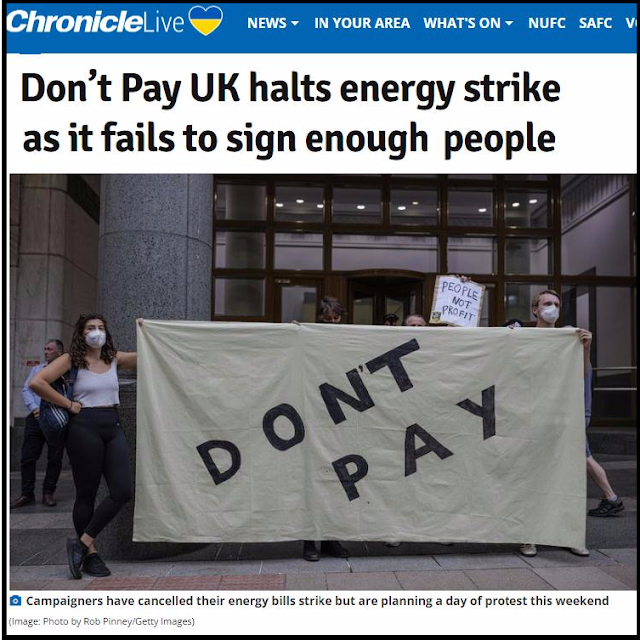
Last June, with dire predictions of massive rises in the energy cap, Don’t Pay UK suddenly appeared on the scene. Where it came from was always a bit of a mystery and how they were able to finance large amounts of leaflets and a slick website, to say nothing of premises/phones/ admin etc. was even more a mystery.

But like most people I was more concerned with mobilizing against the energy price rises than questioning where DPUK had come from. The fight against  the Tories and neo-liberalism was the priority not navel gazing. And if a benevolent capitalist had provided seed money so what?

All this occurred in the midst of political paralysis as the government was convulsed over Boris Johnson’s future as Prime Minister. In essence we had no government for nearly 3 months.

Not only was the rise in energy prices forecast as hitting £3,800 in October, £5,000 in January 2023 and up to £7,000 by April 2023 but the Tory party was engaging in a fantasy contest between two lunatic right-wingers who were competing as to who would hammer the poor most.

I was among a number of those in the labour and trade union movement who were arguing that we had to consider a Can’t Pay Won’t Pay campaign and look carefully at and learn the lessons of the battle against the Poll Tax 30 years ago. Not that the two struggles were the same.  On the contrary there were important differences which DPUK has never seemed to understand

On the socialist left there had already been a vigorous debate about the merits of not paying energy bills and there was an important constituency who said that not paying would not work.  Groups such as Disabled People Against the Cuts were particularly vociferous in arguing that disabled people couldn’t take part in such a campaign.  A position I disagreed with but which many people supported.

Some us had begun to set up a Can’t Pay Won’t Pay campaign in Brighton with the aim of campaigning for a mass refusal to pay.  However we were all aware of the differences between 30 years ago and now and the difficulties we faced.

Brighton & Hove Can't Pay Won't Pay/DPUK Meeting August 30

The Crispin Flintoft Show, which is a twice weekly Zoom show consisting of mainly expelled and suspended Labour Party members as well as those who have managed to cling on despite Starmer, has regular attendances of around 500.  In May the featured speaker was Tommy Sheridan, the leader of the campaign against the Poll Tax who warned of the differences between the Poll Tax campaign in 1989/90 and the battle against the energy prices today.


On June 24, the Socialist Labour Network held a meeting with Tommy Sheridan, Ian Hodson, President of the Bakers Union and Paula Peters of DPAC on the theme of Can’t Pay Won’t Pay.

In Brighton we decided to hold an inaugural meeting of Can’t Pay Won’t Pay and I was approached by Andrew Farrar, an anarchist associated with DPUK, to work jointly together. CPWP agreed to hold a joint public meeting on August 30.

Brighton & Hove Can't Pay Won't Pay/DPUK Meeting August 30

The meeting on August 30 was jointly chaired by Nehaal, who is currently Vice President of the National Union of Students and myself. Speakers included the President and Secretary of the Trades Council, Matt Webb and Andy Richards and Sheila Hall, who was a councillor in 1990 who was suspended along with 5 other Labour councillors for refusing to implement the Poll Tax. Also speaking was the man who served the longest sentence (30 months) for his part in the poll tax riot.

Over 150 people attended and it was judged by all that it was a great success. But then things began to go downhill. Activity fell off and it proved difficult to get people to run a weekly stall in the town centre. The only activity since then was on October 1st when a rally of about a 100 was held at Brighton Clocktower. Given that there was a strike meeting at The Level of nearly 1,000 people it is clear that the campaign had stalled.

Following the public meeting at a weekly coordination meeting an objection by Farrah was made to my attending a regional meeting (in fact a national meeting of regional groups).  No doubt after words in his ear.  However I did get out of him that these meetings were attended by between 20 and 30 people, which for a national meeting is pathetic.

I made several attempts to discuss DPUK’s strategy in the different chat groups and each time they were met with personal abuse by a few anarchists who were more concerned with how oppressed they were and how many identities they could claim than progressing the campaign. Comments such as

I’m a woman. The mother of a disabled person. A teacher in the most deprived area of Brighton. You don’t get to filibuster me into silence. I’m big enough and ugly enough not to stand for this

was one such contribution from an unnamed anarchist who harboured a deep grudge over the role of Militant in the Poll Tax 30 years ago. I pointed out that I too had a disabled child to care for but didn’t see what relevance this crass resort to identity politics had for the campaign against energy price rises.

This particular person was obsessed by the fact that Sheila Hall had spoken at the public meeting because Sheila had been a supporter of Militant 30 years ago. Clearly she spoke for other anarchists.

DPUK's key mistake was in making withholding payments conditional on the number of pledges

It is a fact that the All Britain Anti Poll Tax Federation which was set up in November 1989 was led by the Militant Tendency who had recently been expelled from the Labour Party. Although Tommy Sheridan had made some injudicious remarks about those arrested in the Poll Tax Riot no-one can take away from him the fact that he had been gaoled for 6 months for defying the Scottish courts over his presence at a Warrant Sale or for his leadership of the campaign against the Poll Tax in Scotland, which suffered from the Poll Tax one year earlier than the rest of the country.

The fact that Tommy and 5 others had been elected to Glasgow City Council spoke volumes about how the Glaswegian and Scottish working class felt whereas the anarchist contribution to the campaign was nugatory.  Yet these sectarian comments kept coming up from certain individuals and local Admins acted to protect these sectarians.

When I responded to a few of these characters I received a ‘final warning’ from an unelected moderator of one of the chat groups. Clearly democratic debate is anathema to identity politics anarchists.  As a result I decided to have no personal interaction with any individual and to simply post political observations as to the current state of play. Nonetheless this didn’t satisfy the flaky anarchists who had appointed themselves as Admins and I was removed without warning or explanation last Tuesday.

I should add that at no time was any Admin elected.  All of them were friends who appointed each other, as Nehaal admitted. Anarchists are opposed in theory to leadership but in practice they are opposed to an elected leadership because of course nothing will happen unless some people take the initiative.

Don’t Pay UK Nationally

So what is going on in DPUK? I attended a national meeting of activists about 3 weeks ago. It was chaired by Simon, a well-known Brighton anarchist. There were a total of 112 in attendance. It was made clear that DPUK’s leadership consisted in essence of a group of friends of a similar political persuasion.

All the speakers were pre-selected and no audience participation was allowed. I guess this is anarchism in action. There was though a vigorous discussion in the chat and the main theme in that was the need to discuss a political strategy. However the meeting finished after just one hour and those with their hands up were simply ignored.

What DPUK has are hidden, unelected and unaccountable leaders.  We used to call it the ‘tyranny of structurelessness’ in which feminist and other organizations, which were leaderless in theory, ended up with unelected leaders by default and thus were far more undemocratic than those bureaucracy ridden institutions of the labour movement.

From my own impressions a large number of people have been signed up as potential activists or organizers but, as is common with anarchist campaigns, there is no direction or strategy. It has been suggested that DPUK is deliberately engaging in the mass collection of data such and email addresses for other purposes.  Whether this is true I do not know, however there is little sign of any adherence to data protection legislation.

In 2-3 years time DPUK will be calling an energy payment strike

DPUK’s Lack of a Political Strategy

On its website DPUK state that ‘We will take this action [withholding payments] when we reach 1 million pledges to strike.’ The only problem is that at the time of writing only 198,551 people have signed up pledging to stop their direct debits.  Three days ago it was 195,510.  In other words the number of people signing up and pledging to stop paying via direct debit is increasing by 1,000 a day. At this rate it will take over 2 years to reach the figure! 

This is simply no way to run a campaign. Before Liz Truss’s pledge that bills would be capped at an average of £2,500 DPUK were receiving 10,000 pledges per day.  In other words there has been a precipitate drop in people pledging to stop their direct debits.  Yet there has been no mention of this. Complete radio silence.

In practice a pledge is unenforceable anyway and it is anyone’s guess how many people who have signed a pledge have thought twice about it.  In any event stopping a direct debit doesn’t mean not paying. There are a number of ways of paying energy bills of which direct debits are just one. In short DPUK have been blind sided by the government’s decision to stuff the mouths of the energy companies with gold to the tune of £170 billion.

As Catherine Furae of Live Chronicle wrote, Don’t Pay UK halts energy strike as it fails to sign enough people. Except that DPUK hasn’t told its own supporters that it has called off the action. Instead they simply urge them to greater efforts.

Where has DPUK gone wrong?

Because DPUK was set up undemocratically without any attempt to involve people in the wider anti-cuts and trade union movement they embarked on what was clearly a very risky strategy without any discussion or prior thought about involving wider forces.

It is obvious that at a time when working class people and trade unions are engaged in mass strike action that there is a need to engage the unions and workers in any campaign against the energy prices rises. But unfortunately these anarchists tend to have little involvement with unions nor do they care much for what they see as just another manifestation of the labour bureaucracy.

In my view there was absolutely no need to make an unrealistic target of 1 million the pivot of a campaign against the energy prices. Instead there should have been an attempt to involve the wider labour movement for example by calling a conference.  The fact is that Britain’s anarchists are not exactly well placed in the trade union and labour movement.

If there had been an attempt to hold e.g. a large zoom conference then the follies and dangers of setting an unrealistic target figure as the be all and end all of the campaign could have been pointed out.  Instead of media gimmicks and there is no doubt that DPUK attracted a lot of media attention, a strategy of building in local communities could have been put in place and leaflets highlighting the estimated energy costs could have been used instead of simply saying Don’t Pay.

Whether even this would have worked is open to doubt but as things stand DPUK have failed at the first hurdle.

I should add that although I disagree with anarchism politically I have respect for many anarchists who are involved in anti-fascist or Palestine solidarity work. But I find it difficult to muster much enthusiasm for those whose contempt for democracy matches that of Sir Keir Starmer.

Has DPUK Anywhere to Go?

Any Can’t Pay Won’t Pay campaign is going to face very serious obstacles not least the fact that 4 million households have pre-payment meters.  To date DPUK has simply ignored this problem. It is also a fact that millions of people are simply going to be unable to pay their heating bills this winter. The question is how to marry these together.

It seems to me that any campaign has to focus on working class areas of high deprivation where the issue is of most concern. The problem of pre-payment meters has to be addressed. I’m no technical expert but if it is possible to physically neutralize or bypass these meters then this should be done – en masse.

I certainly do believe that a CPWP campaign can succeed but it will be difficult if divorced from the wider labour and anti-cuts movement. The current DPUK policy of clamping down on any discussion of strategy and focusing instead on how many leaflets one can distribute, to the point of cancelling and removing troublesome activists, show that this organization, given its secrecy and lack of democracy, isn’t up to the task it has set itself, which is reversing the present price rises.

No mass movement that isn’t democratic can hope to succeed in a battle with this government. Democracy isn’t a luxury it is a necessity.
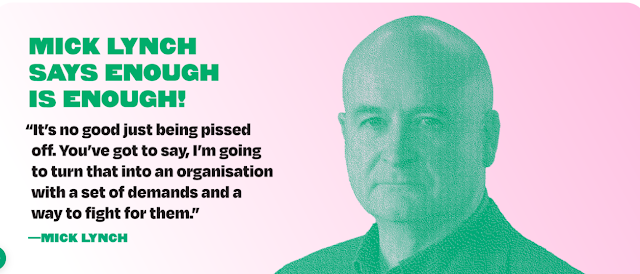
As DPUK has stagnated it's been overtaken by Enough is Enough

DPUK’s Refusal to Speak About Public Ownership

When I opened the public meeting in Brighton I was interrupted by applause when I mentioned that the crisis could not be resolved until the utility companies were under public ownership again. It is obvious to all and sundry that as long as energy in Britain is owned by private monopolies there can be no solution to the continuing price rises.

The Tories and Starmer Labour are opposed to public ownership. But here is the curious thing. Try as you might, it is impossible to find a single reference to public ownership of the energy companies on the DPUK site. As far as those who control DPUK are concerned such questions are irrelevant because both involve capitalist production. Of course DPUK don’t say what their real position is.  They simply don’t mention it as they hide behind their curious identity politics.
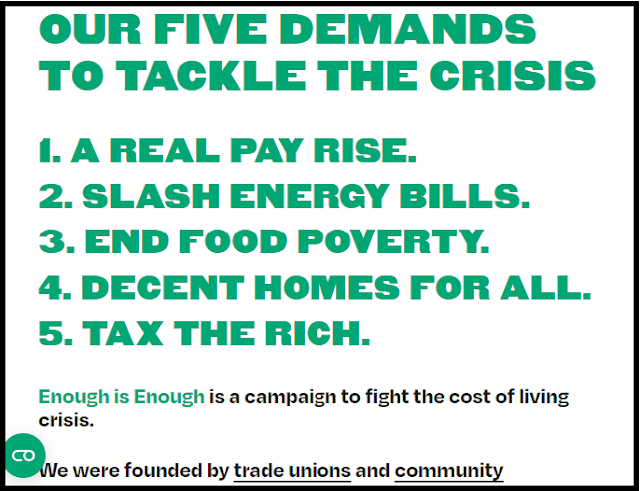
They may be mild but at least Enough is Enough is Making Political Demands - DPUK is saying Nothing

According to We Own It 66% of the public support nationalisation. The fact that both Truss and Starmer are opposed to public ownership might tell our youthful anarchists something about neo-liberalism, which is founded on a hatred of public ownership. However anarchists combine both liberalism and ultra-leftism.  Ultra leftist because they make no distinction between private ownership of energy companies and public or state ownership. Unfortunately bodies like the IMF do make such a distinction.

I have deliberately avoided the speculation of people like Ben Timberley and others as to whether or not DPUK is a genuine group or not. I always tend to assume the best but there is no doubt that DPUK is now seriously floundering as its lack of any meaningful strategy has caught up with it. It seems like a good idea that got lost along the way.

I have also sent an Open Letter 'The Silencing of Dissenting Voices' to members of Brighton & Hove DPUK!

Tony Greenstein

An Interesting ‘Conversation’ with Morrigan, one of the Founders of DPUK

 My falling out and expulsion from Brighton DPUK began with a ‘conversation’ with Morrigan, a teacher and one of the founders of DPUK.   She objected to my report on the above national meeting of DPUK (and implicitly that of Dave Hill) on how it was a controlled affair before going off on one.

First she felt the need to establish her identity – not only a woman, but a teacher in a difficult school, a carer for a disabled son etc. I pointed out that I too care for a disabled son but I’m not sure what relevance that had to the discussion!

However to Morrigan, displaying the fine arts of anarchist identity politics this was all ‘mansplaining’, which is shorthand for having the temerity to disagree with a woman!

Anarchists?

Anarchists come in all shapes and sizes, from syndicalists to lifestyle and personal politics anarchists. For many anarchism is a rebellion against capitalist conformity but that often leads to a rejection of collective action in favour of individualism and a rejection of the labour movement and trade unions.

Morrigan above demonstrates a deep hostility to the left and the idea of class as the motivating force in society in favour of identity politics where anyone can claim to be oppressed.  Indeed on the basis of ID Pol. you can claim multiple oppressions. Her vitriol is directed at what was Militant but it is more applicable to all socialist groupings. Along with this is a rejection of theory in favour of spontaneity. It is but a short step to adopting the anarchy of the free market.

Anarchism rejects the idea of leadership but only in so far as that leadership is elected and accountable. As demonstrated in my expulsion by unnamed moderators (one of whom, Steve J has just written to me suggesting that my writing to individual members of Brighton DPUK was motivated by ‘sadness’ (!) there is no concept of due process or evidence. Hence Morrigan can lie quite blatantly about Militant and a speaker that I invited to the public meeting without any comeback.

There are of course anarchists such as the Bristol anarchists who have been sentenced to savage terms of imprisonment or those involved in Palestine Action who reject identity politics and the ideas of ‘safe spaces’  but many anarchists like Morrigan reject the very idea that they are on the left.

DPUK shows every sign of being a hidden political project masquerading as a campaign against the fuel price rises. It has been suggested that it is also a data harvesting project.

However once in her stride Morrigan had no compunction about attacking Sheila Hall, a former Labour Councillor in Brighton who was suspended for refusing to implement the Poll Tax.  Apparently she was a supporter of the Poll Tax according to the said Morrigan and guilty of numerous other sins.

At the end of the ‘conversation’ Morrigan complained of being bullied. Presumably disagreeing with someone in authority, as Morrigan clearly is in the group, is bullying. Well the Moderators certainly thought so.

The whole conversation is here and an extract is below.


23 June 2022

Can’t Pay, Won’t Bloody Pay! – Heating & Eating are a Right Not a Privilege

 Noone Should be Forced to Choose Between Warmth and Food and No one Should Die Because They Can’t Afford It

Registration Link

https://tinyurl.com/3hvbhjm9

Ian Hodson - President Bakers' Union

The Socialist Labour Network is launching a national Can’t Pay Won’t Pay campaign with a public meeting this Friday at 6.30 p.m. Speakers include Tommy Sheridan, the former Scottish Socialist MSP, Paula Peters of Disabled People Against the Cuts and Ian Hodson, the President of the Bakers Union, who was expelled from the Labour Party by Starmer last year.

30 years ago a mass non-payment campaign defeated Thatcher’s Poll Tax and forced Thatcher out of office. Why? Because people could not afford to pay the tax and furthermore they refused to pay a tax that was the same for a Duke and a Dustman.

Tommy Sheridan led the Poll Tax Campaign

Today people can’t afford their energy bills. Even before the next massive rise in prices in October one-third of people are unable to afford to heat their homes. By the end of the year this is going to rise to over half the population.

Even before the current price rises 1 in 4 people were forced to live in cold conditions. What this means quite simply is that thousands more people, the sick and elderly, will die for the sake of the massive profits that the energy producers make. Thousands are already dying each year because they can’t afford to heat their homes.

According to The Telegraph energy bills are set to pass £3,000 per annum by next January. In October 2021 they stood at £1,278. Last April prices rose by 54% to £1,971 per year. In October the price cap on annual bills will go up to £2,980. In other words a rise of 133% in 1 year.

Yet the railworkers are being savaged by the Government and the Tory Press for demanding 7% wage increases. The nurses who the Tories were happy to clap for are being offered just 3%. The unemployed and claimants have had their benefits increased by just 3%.

Rishi Sunak’s Windfall Tax (which was more generous than Starmer’s proposals) is just sticking plaster. Most people will get a £400 rebate in October and that will be it. Claimants will get £650 in two stages and disabled claimants an extra £150 or £300 if they are pensioners. Pensioners will also receive an additional £300 on top of the existing winter fuel payment. For details see here.

The strange thing is that gas prices are falling yet prices are rising. Why?  Because of the nature of our privatised energy market which is divided into those who generate the energy, those who transmit it and those who sell it.

Massive profits are being made by the energy sector at the same time as prices are going sky high. That is why the French company EDF can increase prices by just 4% in France because Macron has forced them to cut their profits. Boris Johnson of course is in hock to his friends in the City.

This waste of space has nothing to say but opposes the rail strike

Privatisation in the 1980s meant giving away assets built up by the tax payer over succeeding generations to the City for a pittance. Billions have been made at the consumers’ expense and with the latest price rises billions more will be made.

Of course the price rise has been made far worse by the war in Ukraine which NATO provoked with its insistence on expanding up to the borders of Russia, despite repeated promises at the time of German unification, by US Secretary of State James Baker, Helmut Kohl and John Major, that NATO wouldn’t expand.

In March 1991 John Major, for instance, was asked by the Soviet defence minister, Marshal Dmitry Yazov, about eastern Europe’s interest in joining Nato. Major, according to the diaries of the British ambassador to Moscow, Rodric Braithwaite, assured him “nothing of that sort will ever happen”.

Ironically Russia has also benefitted from the sanctions that have been imposed because of the increase in prices. It has been impossible for Europe to cut its dependence on gas and this has led the ruble to hit an all-time high, contrary to predictions in February that their economy would tank. According to CBS News the ruble is the strongest currency in the world this year!

The sanctions which have been imposed only benefit the United States energy market whose extraction of shale oil is far more expensive than Russia’s gas and oil. The other beneficiary is US arms manufacturers such as Raytheon and Lockheed Martin who have seen massive increases in profits as Jo Biden has handed them $40 billion in arms orders on top of previous orders.

Of course the United States can’t afford to fund a National Health Service or waive student debt but there is always money to fight NATO wars, be it in Ukraine or Afghanistan. Similarly in Britain. There isn’t enough money for things like free school meals but every time Johnson visits Zelensky in Ukraine, usually when things become too hot for him at home, he comes with promises of hundreds of millions of pounds of arms supplies. That is capitalism and the system we live under.

Our demands are simple.

Ø   Freeze energy prices at what they were before April 2022.

Ø   Nationalise the energy companies without compensation.

Ø   Abolish pre-payment meters. One of the more outrageous feature of the present crisis is that those on pre-payment meters, the poorest people in society, are paying the highest prices.

Tony Greenstein

25 March 2022

SHAFTED how disabled people found themselves on the front line

 How Disabled People Were Singled Out as part of the Austerity Offensive

SOCIALIST DISABILITY GROUP MEETING

Register here:

https://us02web.zoom.us/meeting/register/tZYpdemgqD0qHtC2Q-lBqGAVoJCAAKZMLXf3

The Socialist Disability Group (SDG) is holding an online meeting on Friday 25 March called “SHAFTED  — how disabled people found themselves on the front line.”

Disabled people have been the main sufferers of the pandemic, of the austerity that came before it and generally of government policies. Now, new legislation will cut benefits, make it more difficult to apply for help and cut many off from vital NHS services through privatisation and enormous waiting lists. This can not go on. As Christine Tongue of the SDG and the meeting’s organiser said:

We have to take action. We need a bold, grassroots fightback which will make our presence visible. It’s too easy for the world — especially politicians — to ignore people with disabilities. We’re not going to let that happen.

The main speaker at the meeting will be Paula Peters of Disabled People Against the Cuts, a group known for taking direct action and mounting imaginative protests.

But a special feature of the event will be contributions from the floor. Christine said:

We will have members of our network telling their own stories and saying what they would like politicians to do about their problems. But able or disabled, we welcome all to this meeting.

Disability and illness is a lottery.  Anyone can get it. The point about a civilised society is that we recognise that we have a duty of care to those who fall victim to disability.

My first experience of disability was when I was told I had Hepatitis C in 2012. I went on to experience chronic liver disease and cirrhosis of the liver. I had had hepatitis for 20+ years. I was however lucky in the sense that new non-interferon treatments were coming on stream.

Interferon, which was the only method of treating Hep C previously is an extremely toxic drug.  I was first treated with it in 2013, along with 2 other drugs, and after a couple of months I discovered that although it was killing the virus it was also killing me.  I spent 18 days in intensive care as a result.

In the summer of 2014 I was one of an initial 500 people nationally, part of a special government programme, who were judged to be the most sick, who were put on the new Harvoni treatment. You had to take 1 tablet a day for 3 month.  Each tablet cost $1000 dollars even though it cost $1 to make. As Gilead Sciences, the company which made the drug freely admitted, they were charging what the market would bear, even though their pricing policy meant that thousands of people died as a result. What was worse was that most of the research for the drug had been carried out at Cardiff University. This is capitalism at its rawest. See Big Pharma Prepares to Profit From the Coronavirus 

From 2013 to 2015 when I had a liver transplant I experienced what it was like to be old and frail. Taking more than a few steps was an effort. Walking to the shops was an ordeal. Taking part in political protests was simply impossible and I had to withdraw from the Sodastream protests that Brighton PSC were engaged in.

My first consciousness of what it was like to be disabled though was when I was Vice-President Welfare of Brighton Polytechnic Student Union, some 45 years ago! Disabled students who felt left out by the union suggested that the best way of understanding what they experienced was for me, as the responsible official, to navigate a campus in a wheelchair. Falmer was chosen as it was the most hilly.

It was an eye opening experience to realise the difficulties in reaching for handles that were too high or doors that were too heavy to open or steps that made even getting into a building difficult. Toilets were even more of an obstacle.

Things have improved since that time. Then disability toilets were the exception.  Automatic doors had not yet made an appearance. Ramps instead of or in addition to stairs were very much the exception.  But if some of the worst obstacles have been eliminated (& see Christine Tongue’s article for the Isle of Thanet News below) then the attacks on disabled people’s right to a decent living have not abated.

People won’t remember that in the 1970s there was no disability discrimination legislation. That was only introduced under John Major’s government as a result of our membership of the European Union. And the first Act was made as weak as possible. It was, for example, possible to justify both direct and indirect discrimination on grounds of cost whereas today direct discrimination can never be justified. The same was true when age discrimination laws were introduced.

Disability benefits have been under attack ever since the introduction of Disability Living Allowance in 1992, which unified all previous disability benefits and extended them to those with mental health difficulties. DLA was a good benefit because it was not means tested and because other earnings were disregarded. That was why it soon came under attack from New Labour. A campaign by the Daily Mail and the tabloids was launched against ‘bogus’ disability claimants who we were told were bankrupting the country.

All Work Tests were introduced run by companies such as ATOS with the clear purpose of getting as many people as possible off benefits. Incapacity Benefit was abolished by New Labour and towards the end of the Labour Government a Green Paper was issued by the Health Secretary Andy Burnham which floated the option of abolition of DLA for the over 60s (after all getting old means getting infirm!) or at the least abolishing Attendance Allowance. Burnham himself refused to deny that these options were on the table.

It was New Labour that set the scene for the Cameron Government and Ian Duncan Smith’s attack on the living standards of claimants generally and disabled claimants in particular. Introduced by the 2012 Welfare Reform Act it was a replacement for DLA for all those above the age of 16. It was meant to cut the cost of DLA by 20% whereas in fact it has risen.

Now that the COVID pandemic is considered by the government to have gone away (which it hasn’t) we can expect further government attempts to cut and restrict disability benefits as they embark on a new period of austerity.

Below is a lightly edited article by Ellen Clifford in Tribune in November 2020 and an article by Christine Tongue, of the Socialist Disability Group and a Steering Committee member of the Socialist Labour Network.

Tony Greenstein

Britain’s War on Disabled People

Ellen Clifford

In 2016, the UN said austerity had created a ‘human catastrophe’ for Britain’s disabled — but the last decade has also seen unprecedented organising to fight back.

Top of Form

Bottom of Form

Top of Form

Bottom of Form

Prior to 2010, the UK government was known as a world leader on disability. A decision was made under the Coalition government and carried forward by successive Conservative administrations that this progress had gone too far. This marked the first time in the history of modern social policy that things went backwards for disabled people. This was done in order to make disabled people pay for a financial crisis that they did not cause. It needed to be concealed from the public. The way in which right-wing politicians and the media achieved this was by creating a narrative that blamed disabled people themselves, purposefully stoking fires of division and hatred.

What the government did is one half of the story. The other half is the resistance mounted by disabled people themselves. If the Tories imagined that disabled people would be easy targets for their brutal cuts, they were wrong. Again and again, the government was forced into U-turns and concessions. These discrete wins along the way have not been able to halt the overall regression in material conditions for disabled people, wiping away the hard-won gains of generations of disabled campaigners before us. After more than a decade of tireless resistance against austerity and welfare reform, the odds against us have grown even greater.

Targeting Disabled People

In 2016, the UK became the first country in the world to be found guilty of grave and systematic violations of disabled people’s rights. This was the finding of an unprecedented investigation by the UN Disability Committee into the impacts of welfare reform and austerity measures. What was of concern was the rolling back of the rights of disabled people, driven forward, the inquiry revealed, by deliberate legislative and policy choices.

Regressive measures, badged as government ‘reforms’, were pushed through by the Coalition government in the face of sustained opposition. As a consequence, disabled people experienced negative changes within all areas of our lives. In 2018, the Equality and Human Rights Commission warned that

‘[d]isabled people are falling further behind in many areas, with many disparities with non-disabled people increasing rather than reducing’, and they called on the government to urgently adopt an ‘acute focus on improving life in Britain for disabled people’.

Measures implemented in the name of austerity and welfare reform have had a disproportionate impact on disabled people. This was the truth behind David Cameron’s lie that ‘we are all in it together’. Cuts to benefits (excluding pensions) and local government made up 50 per cent of the 2010 austerity plan. Disability and carers benefits make up about 40 per cent of non-pension benefits and social care makes up 60 per cent of local government expenditure. Thus, the decision to target spending reductions in these two areas automatically led to extensive cuts to income and services for disabled people.

The combination of cuts in benefits and services was found to hit disabled people on average nine times harder than most other citizens in research carried out by the Centre for Welfare Reform. For disabled people with the highest support needs, the burden of cuts was found to be nineteen times that placed on most other citizens. Contrary to the government’s repeated claim to be ‘protecting’ and ‘targeting resources’ on ‘the most vulnerable in society’, the cuts were effectively aimed at disabled people.

At the same time, decisions were made to benefit the rich and help households with the highest incomes. A 2019 report from the Fabian Society identified how changes to tax and benefit policies since 2010 have contributed to Britain’s crisis of inequality, revealing that the government is providing more financial support for the richest 20 per cent of households than the poorest 20 per cent.

Human Catastrophe

Evidence before us now and in our inquiry procedure as published in our 2016 report reveals that social cut policies have led to a human catastrophe in your country, totally neglecting the vulnerable situation people with disabilities find themselves in.

– Theresia Degener, chair of the United Nations Committee on the Rights of Persons with Disabilities

These words were addressed to representatives of the UK government during the concluding session of a routine public examination of the UK under the United Nations Convention on the Rights of Persons with Disabilities. It took place less than a year after the government dismissed the findings of the committee’s special investigation.


Death and suicides linked to cuts and benefit changes are the most extreme example of the human cost of austerity and welfare reform, but there have been many other terrible impacts, including rising poverty, food-bank use, debt, survival crime, and homelessness, in addition to dramatically escalating levels of mental distress. A study by academics from Liverpool and Oxford Universities published in 2015 found that reassessments for Incapacity Benefit from 2010 to 2013 were associated with an extra 590 suicides, 279,000 additional cases of self-reported mental health problems and the prescribing of a further 752,000 anti-depressants. Victims of welfare reform who have died or taken their lives as a direct consequence of benefit cuts are now a common item on daily media coverage.

Legislation and policies that have inflicted such suffering have also largely failed to deliver their stated aims. The transition from Disability Living Allowance (DLA) to Personal Independence Payment (PIP) was intended to save 20 per cent compared with DLA remaining in place, but it appears to have cost around 15 to 20 per cent more. A report from the Office for Budget Responsibility published in January 2019 estimated an overspend on the DLA/PIP budget of £2 billion, leaving an estimated £4.2 billion shortfall when compared to the original savings target.

On a societal level, cuts to local authority budgets threaten disabled people’s continued existence in the community alongside non-disabled people. Funding cuts to education and social care and a failure to invest in accessible social housing are leading us towards physical re-segregation and institutionalisation. Alongside this, there has been a fuelling of attitudes that ‘other’ and thereby marginalise disabled people: on the one hand, growing disadvantage, resulting from cuts to state-funded support and leading to greater reliance on charity, has encouraged a pitying view of disability; on the other, hatred and hostility towards disabled people have been enflamed by anti-benefit-claimant rhetoric used by the government to justify welfare reform.

Political Fallout

A government does not attack its own citizens en masse without consequence. The impacts of austerity and welfare reform on disabled people have played a significant but overlooked role in the political upheaval of the last ten years. In terms of retaining control of Westminster, the Tories were largely correct in their assumption that — as Iain Duncan Smith observed — ‘[disabled people] don’t vote for us’, and thus that their attacks on disabled people would not affect their chances of re-election. Nevertheless, Cameron’s miscalculation on the EU referendum can be attributed to his failure to adequately understand the impacts of his policies and the bitter anger towards anything regarded as ‘establishment’.

Welfare reform has politicised large swathes of people. Experiences where individuals have their benefits stopped are obviously traumatic for those affected, but all benefit claimants are now subject to a benefit assessment approach which is personally humiliating. Trauma, confusion, and anger can turn to demoralisation and distress, but they can also lead to politicisation and activism. Research by the University of Essex and Inclusion London found that, in order to make sense of their situation, claimants came to think about their difficulties within the context of politics and Tory attacks on disabled people. Those who adopted an attitude of resistance towards the system and/or became politically engaged were better able to restore a sense of self-esteem that had been taken from them by their interactions with the Department for Work and Pensions (DWP).

Issues affecting disabled people have the potential to cause far greater social upheaval than the public and political profile of disability suggests. Disabled people make up 22 per cent of the population, a figure that is often underestimated. We are geographically and generationally dispersed across the population. Issues relevant to us also affect our friends, family, neighbours, and the range of workers whose jobs are linked to disability. Lack of recognition for the social significance of disability issues within politics and the media reinforces in those experiencing them the idea that their lives are not valued by those in power, making them hungry for a change from the status quo.

Forefront of the Fightback

With the Disabled People’s Movement (DPM) in decline from the mid-1990s, resistance from 2010 onwards can be characterised as a return to grassroots activism. In a conscious departure from the identity politics era of disability campaigning, new groups such as Disabled People Against Cuts (DPAC) were set up with the explicit aim of building alliances and joining the wider anti-capitalist movement.

One of the ways in which the British government was able to get away with making war on disabled people was by the sheer volume and complexity of the measures they unleashed. Where disabled people and their allies succeeded in holding them back was through intense and varied activity operating on many fronts and involving many people, each making an invaluable contribution in their own way. Resistance has used every tool at its disposal — from research, lobbying, protests, endless legal challenges, awareness-raising, and direct action. Collectively, the stakes are too high to give up and give in.

Since 2010, campaigners have won significant victories such as forcing Atos, a global corporation with a revenue measured in billions, out of its contract to deliver the Work Capability Assessment.  The government has been free to ignore the UN disability committee findings but it was a considerable achievement for grassroots disabled activists to secure the unprecedented special investigation that took place from 2015–16. The findings served to validate the experiences of millions of disabled people under attack from their own government. The government’s failure to slash the DLA/PIP budget can be attributed to the hard work of campaigners, claimants, advisers, and public lawyers who have consistently resisted attempts by the DWP to introduce measures limiting eligibility for the benefit.

Disabled activists have been at the forefront of the anti-austerity movement. Despite our efforts, the direction of government policy is further regression of disabled people’s living standards. One of the impacts of this is that it is becoming harder for disabled people to mobilise resistance.


The War Goes On

In December 2019, the most right-wing government in modern British history was re-elected with a significantly increased majority.

This was disastrous news for disabled people. Under Boris Johnson, the Conservatives now had the parliamentary power not simply to carry on in the same direction with the continuation of policies that have spread inequality, poverty, and immiseration, but to ramp up their attacks and implement welfare reform measures that they were previously beaten back from achieving.

An early indication of what the election result meant for disabled people was the decision announced in the New Year’s honours list to award Iain Duncan Smith a knighthood. Duncan Smith had not held a ministerial appointment since his period as secretary of state for work and pensions from 2010 to 2016. The honour effectively endorsed the dismantling of the social security safety net over which he presided. It also suggested full government commitment to rolling out Duncan Smith’s big idea, Universal Credit, in spite of the well-evidenced harms it has caused.

Into this picture, we then had the Covid-19 outbreak. The pandemic exposed existing inequalities within society even more starkly than a decade of austerity and welfare reform had. Disabled people were at the same time most at risk from coronavirus and also largely ignored in official responses to the pandemic. At a time of great uncertainty and anxiety, disabled activists and health workers had to challenge NHS guidelines that stated that disabled people were not a priority for life-saving treatment. Two thirds of deaths from coronavirus in the UK are disabled people. Between 15 March and 2 May, 22,500 disabled people died from Covid-19 compared to 15,500 non-disabled people.

Campaigners suspect that Boris Johnson’s original strategy of seeking to create ‘herd immunity’ and the government’s failure to do more to protect disabled people was part of a deliberate plan to remove from society those whose lives are deemed to represent a cost burden on the state. This is not inconceivable. Both Johnson and his close adviser Dominic Cummings have expressed views described by researcher-activist Roddy Slorach as ‘textbook examples of eugenic opinion’.

Speaking to city bankers during his time as mayor of London, Johnson said:

Whatever you think of the value of IQ tests it is surely relevant to a conversation about equality that as many as 16 per cent of our species have an IQ below 85 while about 2 per cent have an IQ above 130 … the harder you shake the pack the easier it will be for some cornflakes to get to the top. And for one reason or another — boardroom greed or, as I am assured, the natural and God-given talent of boardroom inhabitants — the income gap between the top cornflakes and the bottom cornflakes is getting wider than ever.

Inequality is a state that Johnson and Cummings both regard as natural and even desirable for the functioning of society. It is nevertheless important to remember that the war against disabled people cannot just be attributed to individual ministers or Tory governments. Its existence is bound up with the intrinsic relationship between disability and capitalism.

What has happened since 2010 is a sharp reflection of the fundamentally important role that the category of disability plays within capitalist political economy, where it serves to identify the less productive members of society and enables a ‘weeding out’ from the rest of the population. Interrogating the relationship between disability and capitalism is a powerful way to expose the inequalities and cruelty of the system of exploitation under which we live. It is no wonder then that disability issues are so hidden and misunderstood within mainstream society: they need to be shrouded in myths and misconceptions in order to obscure the true nature of capitalism.

Those of us who want a fairer world must fight for improvements in the living conditions of disabled people as part of — not in isolation from — the rest of the working class. But our resistance must also be consciously situated within the struggle to transcend capitalism itself. Only then can we guarantee freedom from oppression and a society where diversity is truly valued.

Opinion with Christine Tongue: Mentioning the unmentionables

Look away now if you feel squeamish about talk of lavs, pants and pads and toilet issues in general.

My friend Mandy who has an undiagnosed neurological problem,  said to me “I sometimes can’t do two things at the same time. Standing up from the loo and pulling up my pants was just too much today. I fell flat on my face — hence the new bruises!”

My friend Sue, wheelchair user, has to use incontinence pads at night when getting to the loo involves hoists and transfers to a special bathroom wheel chair. But the pads she could get free from NHS supplies are not comfortable or adequate. She has to buy her own. A large weekly expense.

Some disabled people have catheters into their bladder —you pee into a bag beside your bed. It’s convenient but leaves you prone to infection.

I’m not at that stage yet, but with my failing legs and painful back, going to the loo is now a much more difficult process. Social services have provided metal surrounds and raised toilet seats for my home. But going outside your house is a minefield.

I’ve just had to get my long suffering partner to carry one of my toilet frames to a friends house. Last time I used his loo I nearly fell over trying to hold onto his bath and a door handle —the door opened, I lurched into the cupboard etc etc. You get the picture….

Why aren’t all houses designed with potential disability in mind. Whose mad idea was it to put in low toilets in modern bathrooms with no grab rails around them? Most people are taller than me so have a long way to haul themselves up from a low seat.

But public loos are not ideal. They may have wheelchair on the door but it doesn’t mean all disabled people can use the space.

The disabled loo in Broadstairs harbour needs a “radar” key to get in —just in case you able hooligans go in and use it for antisocial behaviour I guess. It’s a kind of master key for most disabled public loos. Nothing electronic about it and anyone can buy one. But for me, even though I now have a radar key I bought on the internet, I would have to stand outside, reach for my key, put my sticks in one hand, or prop them up on the wall in order to use the key. Mandy might have fallen over by now.

You get inside and need to lock the door. Another balancing act. But oh joy, two bars on each side of the loo to grab and lift yourself up with. I wonder how others get on with washing their hands. For me it’s another balance problem with no stick to lean on and sometimes a distance to the hand dryer.

The other disabled loo at Broadstairs bandstand doesn’t need a key and is easy to get into on my scooter — which gives you a safe stable object to hang onto. Which you need because there’s a lack of grab rails and the hand dryer is the other side of the room from the sink. Take a clean hanky and give it a miss is my advice.

People using the dryer will inevitably  drop water on the floor. A wet floor and sticks is not good! Which is why I like to take the scooter in with me. I can’t risk slipping. My bones are rebellious enough without shaking them up sliding on a wet floor.

What I’m talking about is often down to basic design. You won’t fall over if you have a grab rail in the right place. If you need pads and special pants let’s make sure the people who need them get the best available. As for public lavs, let’s make them accessible, clean, safe. Not locked! Why not?