Showing posts with label Baghdad. Show all posts

8 August 2023

Book Review: Avi Shlaim – Three Worlds: Memoirs of an Arab Jew

How Israel and Zionism Destroyed the World’s Oldest Jewish Community in Iraq

One World, London, 2023


Witness - The Last Jew of Babylon - 15 Jul 07 - Part 1

Avi Shlaim is Emeritus Professor of International Relations at St Anthony’s College, Oxford. He is also an Iraqi Jew who emigrated at the age of five to Israel before coming to England. It is a tale of 3 worlds – life in Iraq as an Arab Jew, in Israel as an alienated de-Arabised Jew and in England as a refugee from the Jewish ‘homeland.’ It is also, on a personal level, the story of how Zionism destroyed a Jewish community which was over 2,500 years old, in order to provide a working class for the ‘Jewish’ state to replace the Palestinian refugees.

Baruch Nadel, a journalist on Israel’s largest selling newspaper Yediot Aharanot, summed up the situation when he wrote that:

‘Zionism, not having saved the Jews of Europe found itself after the Second World War without a useful objective. To give a moral justification to the existence of their country, the Zionists looked for a way to “save” other Jews, regardless of their wishes. The only Jews with whom this would be possible were the Jews of the Arab world’. (Marion Woolfson, p. 198)

The Jewish Chronicle's idea of a review is a full-frontal attack with all the usual distortions!

The book is an intensely personal story that is symbolic of a far wider tragedy, the impact of Zionism on Iraq’s Jewish community.

Zionism was a movement that dedicated itself to one overriding goal since its founding at the end of the 19th century, the creation and perpetuation of a Jewish nation/race via the creation of a Jewish state. Shlaim describes how

We in the Jewish community had much more in common linguistically and culturally with our Iraq compatriots than with our European co-religionists. We did not feel any affinity with the Zionist movement and we experienced no inner impulse to abandon our homeland to go and live in Israel.

Witness - The Last Jew of Babylon - 15 Jul 07 - Part 2

Shlaim writes of how

Relations that were shaped over hundreds of years were erased in a few hours…. A history of more than 2,000 years is liquidated in less than 2,000 hours…. The interaction of two forces – Zionism and Arab nationalism – forced us to leave our homeland and transformed our lives beyond recognition.

This tragedy was personified in the figure of Shlaim’s father, Yusuf.  A rich and prosperous merchant in Baghdad, on first name terms with the ruling elite, his Jewish identity was ethnic cultural not Zionist nationalist. In Israel Yusuf was reduced to poverty, jobless and living off his wife, Saida’s earnings as a telephonist in the town hall.

Avi Shlaim

Shlaim recalls when, in 1963, his Uncle Isaac, who was living in London, travelled to Israel. Isaac was ‘utterly shocked by the deterioration in the fortunes of the whole family’.

His mother, who had owned a luxury villa by the Tigris River in Baghdad, now lived in a tiny one-room bungalow in Ramat Gan. He remembered his uncles Jacob, Sha’ul and Joseph as prosperous merchants and men of considerable social stature in Baghdad. Now he saw for himself how drastically they had gone down in the world.

Zionism was not a ‘home-grown product but a foreign ideology propagated by emissaries from Palestine.’ Shlaim describes his mother’s ‘emphatic’ reaction when he asked her whether they had had any Zionist friends in Iraq: ‘No! Zionism is an Ashkenazi thing. It had nothing to do with us.’

When the Zionist Committee was given permission to function by the British, the local Jewish leaders met with the High Commissioner to express their opposition. ‘The Zionists were unable to enlist the support of any influential Jewish leaders.’

The largest, richest Jewish community in the Arab world, over 125,000, fled Iraq in the space of less than one year as five bombs (Naim Giladi in Ben Gurion’s Scandals says there were six) exploded in places frequented by Jews. It was the bombs which triggered the stampede.

The Great Synagogue of Baghdad

On 21 July 1950, three months after the first bomb, the Shlaim family, except for his father who came over later, moved to Israel. The reason according to Saida, was that life had become too dangerous for Jews in Iraq and the bombs compounded this sense of insecurity.

Shlaim describes Iraq’s Jews during the Ottoman era as the ‘most integrated into local society, the most Arabised in culture and the most prosperous.’ He describes his own childhood as ‘privileged and pampered.’ Among his parents’ friends was Jamal Baban, Minister of Justice and the wife of the Prime Minister, Tawfiq al-Suweidi.

By 1880 there were 55 synagogues in Baghdad. During the British occupation they controlled 75% of its imports. In 1935 the Baghdad Chamber of Commerce consisted of 9 Jews, 4 Muslims and 2 Britons.

By the end of 1951 all but 6,000 Jews had left in Operation Nehemiah and Ezra. When they arrived in Israel they were sprayed with DDT like animals as they got off the plane. Ben Gurion referred to them as ‘savage hordes’ and Foreign Minister Abba Eban remarked that

The goal must be to instil in them a Western spirit and not let them drag us into an unnatural Orient.

In October 1960 Ben Gurion declared that Jews in Muslim countries had ‘lived in a society that was backward, corrupt, uneducated and lacking in independence and self respect.’ He warned that ‘there is the danger that the coming generation may transform Israel into a Levantine state.’ This contemptuous racism towards Arab Jews later translated into victory for Menachem Begin’s Likud in 1977 and the eclipse of what had been Mapai (the Israeli Labor Party).

Iraq’s Jews were pauperised overnight. Bankers, lawyers and other professionals were reduced to begging for casual work. Saida described how, with the passage of time, Baghdad looked more and more like a ‘lost Eden.’

Iraqi Jewish refugees in a Ma'abara (transit camp), April 1951

Living at first in tents, they were dispersed mainly to development towns and collective settlements on the borders of Israel, there to guard against ‘infiltrators’ – Palestinian refugees trying to return. They had no say in where they went. It was the defence establishment which decided on the location of the collective settlements and development towns. Shlaim describes how

Books were kept with the names of those who left without permission and the lists were sent to labour exchanges to deny the escapees employment and housing. The police were asked to set up checkpoints and not to allow them to pass. Such draconian measures belied Israel’s claim to be a free and egalitarian society.

The Zionist movement saw a Jewish state in Palestine as a colonial outpost in the Middle East. In the words of the founder of Political Zionism, Theodor Herzl,

 ‘We should there form a portion of a rampart of Europe against Asia, an outpost of civilization as opposed to barbarism.’

Zionism was founded on a contempt for the Jewish diaspora that rivalled that of the anti-Semites. Zionism began by accepting that Jews did not belong in the countries where they lived. It agreed with the anti-Semites that ‘exile’ had produced asocial characteristics in the Jews which in turn had led to anti-Semitism.

Zionism literally despised the Jewish Diaspora which it held responsible for all the ills Jews had suffered from, including the Holocaust. According to Jacob Klatzkin, the Jews were

a people disfigured in both body and soul – in a word, of a horror… some sort of outlandish creature… in any case, not a pure national type... some sort of oddity among the peoples going by the name of Jew

Such was the vehemence of these denunciation that Joachim Doron was moved to describe how:

rather than take up arms against the enemies of the Jews, Zionism attacked the ‘enemy within’, the Diaspora Jew  himself and subjected him to a hail of criticism…. Indeed a perusal of Zionist sources reveals criticism so scathing that the generation that witnessed Auschwitz has difficulty comprehending them.  [Journal of Israeli History 8, Classic Zionism].

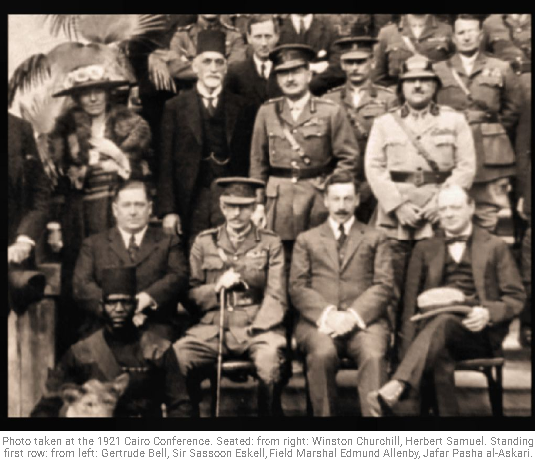
King Faisal I with Sir Sassoon Eskell, the Jewish first Minister of Finance, on an official tour of duty in Baghdad

The Ashkenazi leaders of Israel were determined that the Arab Jews must forget their roots and culture. They were to be shamed and made to forget where they had come from. Shlaim described how, if he was to identify one key factor that shaped his relationship to Israeli society, it would be an inferiority complex.

Shlaim describes how mortified he was as a child one day when his father approached him in a playground with other children and began talking to him in Arabic, forcing him to respond. Shlaim wrote that:

An impressionable young boy I picked up and internalised the beliefs and biases of my new environment. I wanted to turn my back on my Arab heritage… Speaking Arabic did not sit well with the new identity I was adopting.

His sister Dalia refused to speak Arabic, even at home, ‘because she regarded it as the language of the despised Diaspora.’

The first lesson in the moulding of the Arab Jews was for them to discard Arabic. Hebrew was the language with which they would become acculturated and assimilated to Israel’s western-style culture. In the 1920s and 1930s a similar battle had been waged against Yiddish – another diaspora language. In the 1940s Ramat Gan became a battle ground in the country’s language war. A Yiddish language press was blown up by Hebrew language fanatics.

Shlaim describes how the sense of alienation he felt as a child translated into poor performance at school where he was shy and withdrawn, refusing to participate in and keeping silent.

I internalised the inferior status that I thought society had assigned to me and I behaved accordingly…. I felt out of place on account of being a Sephardi, an Oriental, a Jew from the East, a Mizrahi.

Shlaim describes one incident in his class where the teacher ordered him to remove his necklace and ring. Wearing jewellery, especially by men, did not accord with Zionism’s austere ideology. ‘It was a deeply humiliating experience… This was my equivalent of being sprayed with DDT.’ Yet despite this he passed his national exam.

Shlaim and many other Arab/Misrahi Jews faced the condescending racism of their Ashkenazi peers. Education Minister, Israeli Labor’s Zalman Aran, believed that poor performance in school reflected low native intelligence rather than external socio-economic factors. In 1959 Mizrahi children constituted 50% of their age group but only 18.8% of those attending academic secondary schools.

The curriculum was also Zionised.  History was

more related to the project of nation building than to the disinterested pursuit of the truth…. The rich cultural heritage of the Arab-Jews was not just ignored, it was erased.

Jewish history was the history of Jewish suffering, what Salo Baron called the ‘lachrymose conception of Jewish history.’

At Israeli universities there is a department of history and a department of Jewish history devoted to rewriting history according to nationalist imperatives. At this time the Holocaust did not figure prominently and this situation pertained until the Eichmann trial.
Once the Holocaust became part of Israel’s war of propaganda then holocaust history too began to be rewritten to accord with the Zionist narrative. The heroism of the Warsaw Ghetto Uprising

was appropriated by Israeli propagandists to portray other Diaspora Jews as passive and weak in contrast to Israel’s ‘new-Jews.

As I show in Zionism During the Holocaust, the Zionist fighters in Warsaw fought despite the instructions of their own youth movements in Palestine to escape and come to Palestine. The real fight they were told was against the Arabs not the Nazis.

Yemenite immigrants gather for a photo at Rosh Ha’ayin

The 1950s was the era of Israeli Labor governments. During this time thousands of babies were stolen from Yemenite women to be given to Western Jews whilst the mothers were told that their babies had died.

Shlaim argues that anti-Semitism and anti-British feelings became intertwined as Iraq’s Jews were seen by Arab nationalists, as British agents.

On April 1 1941 an anti-British coup by four senior army officers, the Golden Square, caused the royal family and regent Abdul Illah to flee to Transjordan. Rashid Ali al-Gaylani an ardent nationalist was appointed as Prime Minister and it was immediately decided to send an artillery force to lay siege to the RAF base in Habbaniya. Not until the end of May did the British regained control.

Immediately after, on June 1, as British soldiers waited at the gates of Baghdad, a pogrom broke out against Iraq’s Jews. Up to 189 were killed, hundreds injured and 10 women were raped. Shlaim suggests that keeping the troops outside Baghdad was ‘a fatal miscalculation’ but was it a miscalculation or something more sinister?

British historian Tony Rocca, in an investigation for the Sunday Times, found that Sir Kinahan Cornwallis, Britain’s ambassador, denied the Army’s requests to put down the anti-Jewish mobs and ‘while the Farhud raged, Cornwallis went back to his residence and played a game of bridge.” Marion Woolfson in Prophets in Babylon asked whether Cornwallis deliberately used the Jews of Baghdad as a foil for anti-British sentiment. Recounting ‘Farhud’ that ended 2,400 years of Iraqi Jewry

Shlaim describes how his mother, Saida, learnt that the British had deliberately not sent their troops into Baghdad and that

the secret motive of the British was to turn the Jews into scapegoats for the national humiliation that they themselves had inflicted on the Iraq army and the Iraqi people.

Yemenite Jews in camps

To the Zionists the Farhud is proof of the enmity of Iraq’s Arabs for their Jewish brethren. Yet it is a fact that hundreds of Jews were saved by their Moslem neighbours before troops were sent in by the Regent to clear the mobs. Shlaim quotes the case of one Muslim woman who stood in front of her neighbour’s gate with her Colonel husband’s loaded rifle, threatening to shoot anyone who came near them.

Compared to the horrendous massacres that were taking place in Europe at around the same time, when thousands of Jews were being killed in pogroms, what happened in Iraq was minor and one-off by comparison. Today Zionism has forgiven what happened in Europe since its main enemy is in the Middle East not Europe, with the neocon fiction about a ‘Judeo-Christian’ heritage.

To the Zionists this was proof that Arab society was anti-Semitic. According to the Zionist narrative ‘It was a turning point in the history of the Jews in Iraq.’ Yet if that is so, why did Iraq’s Jews take such ‘persuading’ to leave in 1950-1? Shlaim is clearly correct when he says that anti-Semitism was on the increase but that nonetheless ‘it was more of a foreign import than a home-grown product.’ 

Many Iraqis looked to the Nazis in the 30s and 40s because the Nazis were the enemy of their enemy, not because they supported Hitler’s doctrines of racial supremacy. Arabs too were Untermenschen. It was Britain not Germany that was occupying their country.

However anti-fascism was also strong among Iraqis. As Orit Bashkin observed, ‘during the years 1941-1952, most of the influential Iraqi intellectuals were identified with Socialist and Communist goals.’ It was the Left, that was ‘the most resolute opponent of Nazism and Fascism.’ [Iraqi Shadows, Iraqi Lights, Arab Responses to Fascism and Nazism, Ed. Israel Gershoni, 2014]

Shlaim says that it was ‘as supporters of the British that the Jews of Baghdad were murdered and looted.’ This is undoubtedly true but I have my doubts whether it was ‘an innocent celebration of a Jewish festival (which) became the spark for a barbaric pogrom.’ Shlaim says that the Jews were dressed up in their finery during the festival of Shavuot and that they were mistaken for celebrating the return of the British and royal family. Other reports suggest that a Jewish delegation had gone to the airport to welcome the Regent back.

Far from there being a pattern of attacks against Iraqi Jews, as the Zionists argue, there had been no such attack for centuries. The Iraqi Jewish leaders saw the Farhud as ‘an aberration’

In the wake of the Nakba and because a steady number of Jews were leaving Iraq illegally, the Iraqi parliament on 9 March 1950 passed a Denaturalisation Law which allowed Iraqi Jews to relinquish their citizenship and emigrate. At first very few Jews registered and even those who did were hedging their bets. On the first day after the law passed, just 3 people registered. But then the first bomb went off outside the American Cultural Centre and Library on March 19. Yet by April 7 just 126 Jews had registered. Then on April 8 a grenade was thrown at the Dar al-Bayda, a Jewish owned coffee shop. Four Jews were injured and the next day 3,400 Jews turned up to register.

It was widely suspected that the Israeli government had come to an agreement with Nuri e-Said that in exchange for Iraq’s Jews being allowed to emigrate, Iraq could keep their assets. An advocate of such an agreement was Mordechai ben Porat, the leader of the Iraqi Zionists and later a member of the Knesset.

By the end of 1950 90,000 Jews had registered to leave. On 14 January 1951 a hand grenade was thrown into the courtyard of the Masuda Shemtov synagogue. Three Jews were killed and 25 were injured. By the beginning of March 1951 105,400 Jews had registered to leave. But then Prime Minister Nuri e-Said introduced a law by which all Jewish assets were frozen and then confiscated and shops were closed and sealed by the police.

A couple more bombs were thrown at Jewish owned enterprises and by the end of 1951 over 120,000 Jews had registered to leave.

Chapter 7 Baghdad Bombshell, takes up the story that the Zionist movement in Iraq, decided to ‘encourage’ those Jews who were unwilling to emigrate to Israel of their own accord by exploding bombs in places Jews frequented.  This was first broken by Haolem Hazeh and Israel’s Black Panthers and then taken up by authors David Hirst, Marion Woolfson, Abbas Shiblak and Naim Giladi,

The Zionists have denied any role in the setting off of bombs in Baghdad but they have not explained why they were hiding caches of weapons that could have equipped an infantry company. As Israeli historian and journalist Tom Segev wrote:

It is significant the rumor arose at all, and that it was persistently repeated, even by Iraqi Jews. Obviously the idea was not unthinkable.’ [Tom Segev, The First Israelis']

When Iraq hanged Yusuf Basri and Shalom Salih Shalom for having taken part in the bombing campaign, Israel mounted a campaign of support for them among Iraqi Jews. As a classified document to Foreign Minister Moshe Sharrett admitted, Iraqi immigrants in the transit camps greeted the hangings with the attitude ‘That is God’s revenge on the movement that brought us to such depths.’

It is indisputable that the bombs played a major part in the emigration of the Jewish community. The question is whether or not the Zionist underground played any part. Shlaim’s research suggests that 3 of the bombs were the work of the Zionists in the person of Yusuf Basri, who was arrested on 10 June 1951. Traces of TNT were found in his car. Basri’s controller was an Israeli intelligence agent, Max Binnet. In all 12 arms caches were uncovered.

Shlaim uncovered in the course of his research vital new evidence of Zionist involvement in the bombing campaign in the form of a new witness Yaacov Karkoukli, who served several prison sentences in Iraq for his involvement in Zionist activities.

Karkoukli was a fanatical Zionist who agreed with the bombing campaign and supplied new and important information as to who was responsible. Shlaim concludes that the bomb at the Dar al-Beyda on 8 April 1950 was carried out by the right-wing Iraqi nationalist party Istiqlal and the others by the Zionists or, in the case of the Masuda Shemtov bombing, at their instigation by bribing an Iraqi policeman, Salem al-Quraishi to have it carried out by one Salih al-Haidari’.

Shlaim asked Karkoukli whether that meant that Zionist activists had deliberately set off the bombs to which he replied in the affirmative. Karkoukli also confirmed that the Israeli government had given tacit consent to the confiscation of the property of Iraq’s Jews, mentioning that Israel intended to use this to offset claims by Palestinian refugees.

Shlaim also uncovered an Iraqi Police Report into the bombing obtaining one page of a 258 page document. Shlaim writes that

this report constitutes undeniable proof of Zionist involvement  in the terrorist attacks that helped terminate the two and a half millennia of Jewish presence in Babylon.

The report pointed to the involvement of Zionist agents in the bombing, coupled with the fact that Zionist activist Yusef Basri led the Iraqi police from one arms cache to another.

The Zionist movement in Iraq had both opportunity, means and motive to carry out the bombing campaign. We know from the Lavon Affair shortly after, in which Israeli agents had been caught planting bombs in Egypt, that Israel had no compunction about committing terrorist acts in neighbouring countries. They did this despite the fact that it would inevitably rebound on Egypt’s large Jewish community and cause hostility and suspicion against them.

Zionism rewrote the history of Arab Jews so that the ‘Jewish’ state became the climax of their dreams, rescuing them from centuries of pogroms and discrimination. Accordingly the Arab Jews eagerly came to Israel in order to achieve their liberation.

This narrative is a post-facto self-serving justification. The Jews of the Arab world had lived in relative peace and harmony with their fellows. The Arab East had been a place of refuge for Jews fleeing from the Spanish Inquisition. Maimonedes, the greatest of Jewish philosophers, had sought refuge in Egypt as Saladdin’s personal physician. Jewish-Moslem relations in Spain had been harmonious in comparison with the Christian attacks on them.

To listen to Zionist and neocon propagandists you would be forgiven for thinking that the Holocaust  had occurred in Arabia not Europe. That is why at the 2015 World Zionist Congress Netanyahu blamed the Mufti of Jerusalem for inspiring Hitler to perpetrate the Holocaust.

The story of how it was the Muslims who fought with the Jews against the Crusaders at the Battles of Hatin and Haifa and how Saladdin’s capture of Jerusalem enabled the Jews who had been expelled to return has been erased from Zionism’s historical memory. Even Zionist historian Bernard Lewis had to admit that ‘There is nothing in Islamic history to parallel the Spanish expulsion and Inquisition, the Russian pogroms, or the Nazi Holocaust.’

It has suited the needs of the Israeli state to rewrite the history of Arab relations with the Jews as one of enmity and persecution. However it wasn’t enmity between Jew and Arab that explains the Israeli-Arab conflict but the imposition by British colonialism of Zionism on the Middle East and Palestine. It is this that explains the deterioration of relations between Arab Jews and their non-Jewish neighbours.

Above all it was the expulsion of the Palestinians in 1948 and the defeat of the Arab armies that caused the deterioration in relations between Jew and Arab in the Arab countries. As a Jewish State Israel purported to represent Jews the world over, including those living in the Arab countries. Jews in many of these countries were singled out as a client intermediary group, creating suspicion and hostility..

Zionism made it impossible for Jewish communities to survive in the Arab world. Not only did Israel expel ¾ million Palestinians in 1948 but they did it in the name of all Jews. Not surprisingly many Iraqis questioned the loyalty of Iraq’s Jews. When UN Resolution 181 was passed in November 1947 the General Council of Iraq’s Jews sent the UN a telegram opposing the creation of a Jewish state.

Shlaim describes how a ‘powerful popular wave of hostility towards both Israel and the Jews living in their midst swept through the Arab world’ after the defeat and expulsion of the Palestinians. Britain’s unpopular ruler, Nuri e-Said, ‘actively whipped up popular hysteria and suspicion against the Jews.’  Zionism was outlawed and this marked the start of the official persecution of the Jews. Shlaim describes how his mother ‘singled out the birth of Israel as the decisive point in the crisis of Iraqi Jews.’

If Israel and the UK were at war imagine how Jews here would be treated. One only has to look at how the United States treated its Japanese citizens during WW2 after the attack on Pearl Harbour to understand that the hostility between Israel and the Arab countries was bound to impact adversely on the Jews of those countries.

The final part of the book concerns the decision of his mother to send her son to England to continue his education. On 7 September 1961 Shlaim set sail from Haifa to Marseilles and he was accepted as a pupil at the Jewish Free School in London.

It was now that Shlaim began to blossom academically. He describes how ‘considerable glamour and kudos’ attached at that time to being an Israeli yet because he was an ‘Israeli of the wrong kind’ he was left in something of a quandary as his different identities collided.

Shlaim described how Jewish history that was taught at JFS focussed on persecution and martyrdom whereas Israeli history emphasised heroism and redemption: ‘the history we were taught at school was scarcely distinguishable from Zionist propaganda.’  One suspects that the same curriculum is still being followed today.

Shlaim concludes from the experiences of his family that

there was another category of victims of the Zionist project: the Jews of the Arab lands…. Unlike Europe Iraq did not have a ‘Jewish problem’…. Zionism changed all that. By endowing Judaism with a territorial dimension… it accentuated the difference between Jews and Muslims in Arab spaces… Zionism not only turned the Palestinians into refugees; it turned the Jews of the East into strangers in their own land. In 1947-49 it was not only the land of Palestine that was partitioned but also the past.

Shlaim who is now a supporter of a one democratic state solution notes how this would also renew the relevance of the Arab Jew. In his concluding remarks Shlaim notes how ‘apartheid in the twenty-first century is simply not sustainable.’

If I have one criticism of this book it is that we need a Dramatis Personae of all the friends and family who make an appearance. At times I found it difficult to follow the many different stories.

Tony Greenstein

7 September 2012

Israel – The most racist state in the world

How Strange!  The Only Democracy in the Middle East is also the world's most racist state 

A very interesting article that bears close reading.  I’ve taken out the ‘industrialised’ bit as it is in the West i.e. the imperialist heartland that racism, the exploitation of the labour power of those in the 3rd world is based.  The underdeveloped world is the recipient not the cause of racism.

Sami Michael in his Haifa apartment, July 2006 (photo: Lisa Goldman)

This article is a devastating analysis of racism in Israel – and he also includes as equally complicit in the racism against Misrahi Jews the Israeli Communist Party.  Although it has moved away from its 1948 Stalinist position and provided the only political home for Arabs in Israel under Military Rule (1948-67) it was still controlled by those Jewish members who had signed up to Israel’s Independence.  At the time Stalin and Gromyko supported the Zionist enterprise and war in order to remove British imperialism from the region.  In the process they helped destroy the strong Communist Parties in Iraq and Egypt.

Tony Greenstein


Lisa Goldman
Published August 9, 2012

The following is the translation of a speech delivered by prominent Israeli author Sami Michael at a conference in Haifa in June 2012. It is a ‘cri de coeur’ that is full of love and grief.

Born and raised in Iraq, Mr. Michael was a political activist and member of the Communist party; when a warrant for his arrest was issued in 1948, he fled to neighboring Iran. Unable to return to Iraq, he immigrated to Israel in 1949. After working as an engineer and as a journalist for the Haifa-based Arabic newspaper Al Itihad, he became an acclaimed novelist who has been nominated http://www.haaretz.com/print-edition/news/palestinian-writer-nominates-sami-michael-for-nobel-prize-1.171023 for the Nobel Prize in literature. He is still a human rights activist and is today the president of ACRI – the Association for Civil Rights in Israel.

For many years Mr. Michael described himself as not a Zionist, but a patriotic Israeli. He identifies proudly as an Arab Jew and an Iraqi.

In his controversial speech last month, he said he was too old to emigrate but envied those who could. Although he insists he is still a patriotic citizen, he no longer feels that Israel can be his spiritual homeland: It has turned its back on “humanistic values and the rights of mankind.” Racism, fanatical religiosity and the occupation are destroying the state, he says. We are liable to lose it all.

I first met Mr. Michael at his Haifa apartment in the summer of 2006, during what Israel calls the Second Lebanon War and Lebanon calls the July War, when I accompanied a European journalist as a translator. That interview was interrupted a couple of times by the siren announcing incoming rockets. In my blog post about the meeting I embedded a brief video clip of Mr. Michael speaking Arabic. Looking at it now, I feel as though six years is a very, very long time. A lifetime. It’s a strange thing to say about a meeting that took place in wartime, but I think he was more optimistic then. I am pretty sure I was.

Israel is the most racist state in the industrialized world

Sami Michael at the 2012 ACUM Awards ceremony Photo by Daniel Tchetchik
By Sami Michael

I was born in 1926 into a generation that is gradually fading away. Very few remember the fall and catastrophic collapse of the second largest empire in the world. France, the great world power that had built the Maginot Line, the most perfectly designed defense line in history, that had at its disposal a mighty army, air force and navy, was vanquished within the course of only three weeks before our astonished eyes. Not only was this a shock, but ever since then my world has become more fractured. Concepts such as permanence, a reality that is self-understood, and a stable life have been discarded from my personal dictionary yet they have acquired a central place in the sacred Israeli lexicon, and serve as a virtual Maginot Line. Perhaps the things I am about to say are harsh, but for me they are a warning bell for my countrymen, and this is why I have chosen to say them in the mother tongue of my children and grandchildren.

Israel is the only state established after the Second World War that from the very dawn of its existence became an astounding success story. It could be set up as a model for the scores of countries that emerged from colonial subjection and have not yet achieved their dreams. How is it that this same Israel finds itself, after only a few decades, externally submerged in an insoluble dispute and internally ruptured almost to a state of paralysis? I think that the answer lies in the fact that Israel has never dared to confront itself directly with three basic problems that have accompanied it from the day of its existence: the place of Israel within the Arab world, the social and racial gaps, and the secular-religious divide.

The dominant culture in Israel has always directed its eyes towards the West. But this West, as always, weighs the existence of Israel as well as other countries in terms of economic profit and strategic value. The European settlers in Algiers, Zimbabwe and South Africa lasted longer than Zionist settlement in Israel. The hold that white men had over South Africa developed into an impressive power, but when the order of priorities changed in the world, it seems that the wall of Western support was a passing illusion, treacherous and deceptive. The State of Israel is in fact the product of traditional Jewish intercession. When the fathers of Zionism in Europe garnered sympathy for the establishment of a Jewish state they made use of the argument that the entity to be created would spread a wave of advanced European culture into the Middle East. This approach took root in Israeli consciousness, and until today Europe is the spiritual Mecca for a large section of the Israeli intelligentsia, especially for those writers considered as the shapers of public opinion. In my view, this is one of the deep internal conflicts in the Zionist idea. Zionist ideology emerged against the background of European anti-Semitism, yet the fathers of Zionism volunteered to serve as the agents of that very culture which nurtured a hatred of the Jews. It thus transpires that those upholding this approach regard the generations of anti-Semitism, the expulsion from Spain, the atrocities of Nazi Germany as if they had occurred on another planet, in some imaginary era.

As a result of continual brainwashing of themselves, Europe is upheld in the minds of many Israelis as a cultural lighthouse and a source of inspiration for an enlightened society. Proudly, we portray ourselves in our own eyes and in those of our sympathizers in Europe as the firm bridgehead for European culture in a backward and hostile world. In extreme historical ignorance, the fathers of Zionism were unaware of the horrors of European conquest in the Arab world, from the Persian Gulf to the Atlantic Ocean. I do not believe that by ingratiating ourselves with European culture we have won the admiration of Europe, but we have certainly acquired the bitter hatred of the Arab peoples both as agents serving a dangerous enemy and as perpetuators of occupation by that same enemy. The Arab peoples have paid a very heavy price to eliminate European occupation. Their struggle cost them many victims, but in the formal sense they have achieved independence. Therefore they may forgive the wrongs of the past caused by European conquest, but so long as Israel exists they cannot declare their final victory over European occupation.

The State of Israel, from the day it was established, has proved how well based and logical are the Arab suspicions of us, from the identification of Israel in the 1950s with the sins of the French in Algiers, through Israeli participation with the armies of Britain and France in 1956 against Egypt for nationalizing the Suez Canal, and ending with our active enthusiasm at the conquest of Iraq, not to mention our direct conquest and settlement in Gaza and the West Bank. Israel, a tiny island, has become a mark of shame on the proud forehead of the Arab peoples. These are the peoples who obliterated every foreign element that tried to acquire a stake in the region and who overcame the Mongols, the Crusaders and European occupation.

The historical background of the region and the present situation of Israel as a lonely island arouse anxiety in the heart and pessimistic thoughts. I shall refer to the most significant problems, those that keep me awake.

Racism

Racism and deep social gaps are serious problems that have existed in Israel from its earliest days until now. Herzl, the visionary of the state, grew up in Austria and became a great world figure. As a journalist he came into contact with various cultures. By contrast, those who realized his vision were mostly influenced by an East European ghetto mentality. The Jews in Eastern Europe were for the most part centered upon themselves and suffered from oppression, isolation and pogroms. Possibly for that reason the Jew related to his neighbor and to those different from him as a source of danger. Unlike the language spoken by the Jews of Arab and Islamic countries, the language of East European Jews was completely different from the one spoken in the surrounding society. Yiddish was the accepted form of communication among the various exiled communities in Eastern Europe. Moreover, the Jews there did not know very much about the Arab East and Arab Jews. But the Jews in Arab countries were open to Arab culture during its golden age as well as in its decline, from a flourishing Andalusia and the glorious Abbasid Empire until the dark ages under Ottoman rule. There was no contact between ghetto Jewry and the Jews of Arab countries. In the view of the ghetto-dweller, the Jew spoke the Mamma-Loshen, Yiddish. On the other hand, the Arab Jew enjoyed a freedom of movement, and was aware that other Jews existed in the world who differed from him in language and customs, although he had no knowledge of the isolated ghetto Jews.

The encounter between the Jews of Arab countries and those of Eastern Europe occurred in the Land of Israel and was a traumatic one filled with suspicion. East European Jews were the first to settle in Palestine and left their mark on the spiritual, cultural and political character of the new state, even though they were few in number at the time when the state was established. I arrived in Israel in 1949 and the identity card number I received was 733440, which means that the state had less than three quarters of a million Jews at that time. There had been some expectation that after the Holocaust and the founding of the state, great waves of migration from that Jewry which had suffered from the abominable crimes of Europe would flood into it. The disappointment was bitter among the veteran members of the ‘Old Yishuv‘ (The body of the Jewish residents in Palestine until 1948). European Jewry did not knock at the gates of the Jewish state. At the same time, in 1948, a wave of repression swept over the Jews in Arab countries in revenge for the defeat of their armies. Until then the Jews had enjoyed an impressive and flourishing presence in the Arab world. They took advantage of their contacts with the outside world and enriched their Arab countries on economic and cultural levels. They were concentrated in the larger cities and therefore had a prominent influence in countries that were mainly agricultural. For example, more than 20 percent of the residents in the Iraqi capital, Baghdad, were Jews. This was a rare situation in the world. But after the establishment of the State of Israel was declared, the existence of Jews in Iraq, as in other Arab countries, became impossible. Almost all the Jews in those countries streamed into the new state as refugees. In the view of the ‘Old Yishuv‘, these Jews were not very different from the defeated Arab enemy. They spoke its language, they had adopted their customs, they were dark-skinned like them, and they even gave their children Arabic names. The ‘Old Yishuv‘ regarded them as primitive and inferior, similar to the enemy they had overcome on the battlefield. The shock was enormous. An ‘Old Yishuv‘ leader expressed the frustration felt then by saying: The state was founded for one people, and another people came to settle in it.

Until today, more than sixty years after the State of Israel was established, this rift has not been mended. Mentally, it takes the form of racism, and socially it expresses the gap in status. How strange it is that these two population groups, so different from one another to the point of estrangement in their orientation, should have so carefully nurtured this rift. The salon leftists – and in Israel, it is worth noting, the leftists have never left the salon – repudiated Eastern Jewry as expendable “raw material”, or in the Communist jargon of that time: the “lumpen-proletariat”. This was in spite of the fact that immigrants from Egypt, Lebanon and Bulgaria, and especially from Iraq, held an impressive Communist record from their countries of origin. The Communist establishment in Israel treated these immigrants with blatant arrogance. At the beginning of the 1950s there were immigrant camps in which 20 percent of their dwellers voted for the Communist Party in the Knesset. Not one of them was promoted to a position of any value in the party. The central committee of the Communist Party was and still remains today more “purified” of Mizrahi Jews than any other establishment in the state. The suspicion and arrogance towards the Mizrahi communities was a solid impenetrable barrier in the ranks of the Communist Party.

The racism seeped into many other spheres, and shamefully increased the social gaps. Until today, in most of the important state institutions and especially in the academic and cultural ones, we witness an under-representation of those who came from Arab countries. The Israeli left have adopted this approach and continues in its racist policy, amounting actually to a political symbolic suicide on its part, rendering itself an insignificant elitist cult in Israeli society. The other stronghold of racism is the ultraorthodox Jewish community in Israel.

Thus, if the Israeli left displays its racism with circumspection and uses denial tactics to hide it, the Ashkenazi Haredi (ultra-orthodox) bloc displays its version of racism openly and unabashedly. In the eyes of the Haredim, Mizrahi Jews were nothing but an existential danger to them. Mizrahi Jewry was not extremist in its faith. Their religious practice developed within the context of Islam as a pragmatic one, and created a broad network of cultural and economic ties with the Islamic political establishment. The fierce competition among the authoritative admorim (religious leaders) and rival extremist sects did not exist in the East. In Iraq, Syria, Lebanon, and Egypt, the Jewish religious establishment showed leniency towards those who preached change and progress within the Jewish community.

Moreover, this establishment did not become ossified but initiated Halachic (Jewish religious laws) regulations that reflected changes in time, place and new conditions. The Ashkenazi Haredim regarded this as endangering their existence and therefore treated pragmatic Mizrahi Jewry as proscribed and unclean. For generations they adopted a violent and aggressive sectarian faith, and from within their isolationist fortresses they aimed their racist darts at the Mizrahi communities without restraint or shame. Even those Mizrahi Jews who gave up their pragmatic traditions to join the Ashkenazi ultra-orthodox and adopted their strict codes, were kept in racist isolation within their enclaves in Israel. Two years ago I was personally forced to conduct a one-man demonstration in Tel Aviv against the horrifying display of racism in the Emmanuel School where a separation fence was set up in the school’s courtyard to prevent contact between the ‘pure’ Ashkenazi girls and the ‘impure’ Mizrahi girls. That same school enforced the wearing of a uniform, but the color chosen for the Ashkenazi pupils was different from that of the Mizrahi ones.

On my way to school in Baghdad, during the days when Nazi Germany was in power, I came across a graffiti inscription on the walls: “The Jew is of an inferior race,” and “Hitler is destroying the germs.” These slogans came to Iraq directly from Berlin. After seventy years, these words still harrow my soul. According to the racist Haredi doctrine here in Israel, my children and grandchildren, who have a mixed Iraqi-Russian-French-Polish-Dutch heritage, must also stand behind the fence together with hundreds of thousands of other children. I shall not deny that this strange fence has invaded my nightmares. I devoted my youth to a war against the influences of European racism and especially racism based on religion, color or origin. A third of my people perished because of this. In distant Baghdad, my friends – both Jews and non-Jews – and some of them dearly loved ones, paid with their lives in the struggle against this cursed racism.

How did we drag this racist disease into our homes here? How horrifying it is to find that a people who had paid a terrible blood price in the previous century because a racist fence had been drawn around it, could allow such a contemptible fence be constructed within its homeland?

We know very well when this abomination occurred and where. We remember well what price our people have paid for the fences and separation according to color. In my view this is a sacrilege that took place in a Jewish school which claims to be teaching the Holy Torah. If any other country had set up such an offensive fence we would, as Jews, have loudly protested against it. And here, in Israel, the left has for the most part kept silent. The ruling establishment did not lift a finger. The Supreme Court decreed that the fence should be removed. But those who set up the fence loudly announced that they would continue their policy even if this entailed sitting in jail.

Now, with the collapse of the phony left in Israel and the rise to power of the right in general, and of the Haredi right in particular, the racist divide has become an almost acceptable fact. Racism is gradually becoming entrenched in Israeli society with the political strengthening of the religious right. Racism is directed at Jews from Arab and Islamic countries, immigrants from Ethiopia and Russia, Arab citizens of Israel, Palestinians in the occupied territories, refugees and working migrants, gays, and the list goes on. The rising tide of racism continues to mount with the encouragement of Knesset and government members, both through infamous public statements and by legislating draconian anti-democratic laws against outsiders, foreigners, and against human rights organizations. In any case, Israel can pride itself on having the dubious title – the most racist state in the developed world.

Religion and State

The individual – or the state – that adopt a religious text as a spiritual guideline and certified document that grants ownership rights cannot remain secular for long. With the empowering of the electoral strength of Haredi Jewry, both Ashkenazi and Mizrahi, the socio-political structure has become extremely complicated. The Haredi empowerment, like the empowerment of the settlers, emerged from the hothouse of secular Zionism. Ben-Gurion sanctioned religious parties when he preached obsessively about Jewish consciousness. The Bible was given central importance even for teachers of literature. Over the years, from one election to another, the Likud party increased the sway of extremism, since it was ready to pay more and more in order to gain government control. The Haredim could not resist the great temptation and extended their hands to take their share of the pie without respecting the secular institutions of the state such as the courts of law, the army, and democratic values in general. Israel was thus a pioneer by international standards in encouraging religious factions to become active in the framework of political parties. By doing so, it brought destruction both on religion and on the norms of democratic and political life.

The religious bloc has gained power and influence not because of its vitality and conceptual originality, but merely thanks to the corrupting political bribery that is granted to it in order to be part of dubious coalition governments. The estrangement of the leftists to the rank and file of the people as well as its arrogance, play no negligent role in this deterioration. The instability of the security situation and the shattering of the impossible dream to achieve peace concurrently with occupation, has also led more and more people to believe that only a miracle or the mercy of heaven can save us from catastrophe. It should be remembered that in spite of its military supremacy, for the past forty-five years Israel has not won a decisive victory on the battlefield, not even against ordinary militias. After every confrontation, investigative committees were set up to examine where we had failed. When a tank or a plain are an insufficient response, then the tendency towards messianic belief flourishes. The nationalistic conflict between Israel and the Arab world has gradually turned into a religious confrontation between Judaism and Islam. We are living in a glorious age of Jewish halacha (religious law), like the Islamic shari’a law. Year after year the ramparts of democracy and secular rule are disintegrating before our eyes under the persistent pressure of religious nationalism.

Several years ago Salman Rushdie wrote that there are two theocratic states in the world – Iran and Israel. In the meantime the list has grown longer as a result of the disappointing ‘Arab spring’ that had been the hope of young secularists and had backfired against them. In his book The Satanic Verses, Rushdie writes: “Something is not right in the spiritual world of this planet … there are too many demons within human beings who claim that they believe in God”. My friend, A. B. Yehoshua claims that the Jews can be normal only in Israel. But I think that the secular visionary of the state is turning in his grave to see the state that is willingly abandoning its fate to the hands of abnormal demons. Bibi Netanyahu was raised to the seat of government on the wings of a Haredi slogan: “Bibi is good for the Jews”, meaning good for the Haredim, the intention being the destruction of secular democracy and the establishment of a repressive theological state. The triumphant march of religious nationalism is both impressive and terrifying. Thousands of higher education graduates are fleeing from Israel every year and prefer to conduct abnormal lives, in the terms of A. B. Yehoshua, in distant but more normal countries. I envy them, but I am too old to experience once again the trauma of the migrant, and therefore prefer to remain as a stranger in my own land.

The Occupation

The occupation is a veritable catastrophe for Israel. Greater Israel, the enthusiasm for conquest, to control and settle in the very heart of the dense Palestinian population, are a sweeping tide that strikes at the core of Zionism which sees itself as enlightened, secular and socialist. The term ‘Greater Israel’ did not emerge in the Likud party or in the yeshiva of national religious Judaism, but was coined in Kibbutz Ein-Harod by poets, writers and intellectuals, almost by the purest stream of moderate secularism. The Israeli-Palestinian dispute is the main factor in shaping the image of Israel in its various political, cultural and economic aspects. Over the years, the left and right polarized their positions until they created two opposing illusions that have only a fragile hold on reality. The left describes the Arabs and innocent angels, victims of brutal Israeli aggression. The right nurtures a burning hatred for the Arabs, as if they were unbridled monsters. It is commonly known that in every prolonged conflict, both sides become brutal. A prominent poet once declared: Ehud Barak is contemptible. He should send tanks against them and finish them off with machine guns. This poet belongs to the sane camp that is seemingly in search of a peaceful solution. He knows, of course, that our machine guns have already fired billions of bullets of every kind in the decades that have passed without any effect. We have turned the Sinai three times into a cemetery for Egyptian soldiers. We have razed Beirut to the ground and conquered it. We ravaged the Jordanian army. We threw nearly all resisting Palestinian intelligentsia into prison during the past forty-five years. For every Jew that was killed in the past three generations, at least ten Palestinians lost their lives. Our armaments nearly gave out in 1973 from all the killings we made in the Egyptian army, and without the American air lifts we would have been left with empty rifle barrels. A young boy in the refugee camps living in dire poverty is ready to die a hero’s death. He has nothing to lose. How many sons can we proffer who would be prepared to commit suicide and win the death of heroes?

Quite a few people have condemned the appalling declarations of Foreign Minister Avigdor Lieberman in Israel and outside it. But Lieberman is right in claiming that he is expressing aloud what others really think. Let us not deceive ourselves, the culture in Israel has already become no less poisoned than the extreme trends in Islam. From kindergarten until old age we have saddled the souls of our children with the heavy load of hatred, suspicion and aversion towards the alien and the dissimilar, especially towards the Arabs. The sane voice of culture is fading away. The authors of the fascist book “Torat HaMelech” (“The King’s Torah”), which advocates the murder of Arabs, were spared criminal charges for incitement to racism and violence. The Attorney General closed the file against them and thus allowed for the sale of this odious book. In the Israel of today the early buds of spiritual and cultural fascism are gradually sprouting. A vociferous writer recruited by the establishment demands that in the study of literature only those books that promote the Zionist ethos will be chosen. Ironically, there are humorous episodes even while we plunge into the depths. In a small town near Haifa, the head of the religious council instructed the public library to lock up all the secular works in a closed room that would not be accessible to the curious reader, but only by previous arrangement and for a limited period of time. In this spiritual prison-house the mouth of the poet who wanted to use a machine gun to murder Arabs has been sealed, and the books written by the writers of the establishment are also being covered over with dust. My own books as well.

I still define myself as an Israeli patriot, but the Israel that is gradually deteriorating, turning its back to humanistic values and the rights of mankind, cannot be my spiritual homeland.

Forever is an Illusion

Almost two thirds of the territory of Israel is desert land unfit for traditional agriculture. It is a country poor in natural resources. Nevertheless, it is one of the few states founded after the Second World War that quickly rose upwards to the status of a flourishing country. Thanks to the diligence of its inhabitants and their resourcefulness, a sophisticated agriculture has developed, high technology, and renowned medical expertise. Israel is placed among the leading countries in the world in many fields. Not by chance has it won a number of Nobel prizes in various disciplines. In spite of all these achievements, we still remain in a difficult period of time. Throughout history, not always in dramatic events such as total defeat in war or colossal natural disasters, one culture or another was destined for annihilation. Banal factors led to the decline and death of giant entities such as Ancient Greece, early Egyptian civilization, the Roman Empire, the Ottoman Empire; white supremacy in South Africa; and French settlement in Algiers. Only those lacking in foresight and profound thought brandish high-sounding words such as forever, eternally, and generations without end.

I think that Judaism is also in a state of deep conceptual and spiritual crisis after the shattering of all ideologies. From a spiritual viewpoint, religion in Israel has deteriorated to the level of cemeteries, idol worship and dark extremism. It seems as if religious leadership has retreated a few centuries backward to the world of superstition and blatant ignorance. The religion that had known how to flow together with developing life through brilliant figures such as Maimonides is desperately in need now for a leadership that will conduct fundamental reforms. The same crisis is also affecting the political leadership. Dwarf-sized opportunists are floating to the surface and it is heartbreaking to see how the people condone and even forgive a corrupt and deceitful leadership that bars the way to enlightened leaders of the stature of Abba Eban and Moshe Sharett.

Israel is threatened with severe existential dangers if the existing leadership does not have the wisdom to understand that Israel is not located in the peaceful northern regions of Europe but in the turbulent center of a tormented Middle East. We have no place in the Middle East in the future since we made ourselves detestable to it, after we have stressed day and night that it is detestable to us. So very detestable. If we do not find a solution besides the machine gun and the tank – which we have already seen to be helpless against a barefoot child with a stone in his hand – we may lose it all. The State of Israel is liable to become a passing phenomenon like the First Temple and the Second Temple.

The terrible tragedy is that our neighbors are in the same rotten situation; they have no Gandhi and we do not even have a mini-Roosevelt.