Showing posts with label Addameer. Show all posts

30 December 2021

Tim Llewellyn, former BBC Middle East Correspondent, on the BBC’s Wilful Distortion and Manipulation of News About Israel’s Oppression of the Palestinians

 The Contrast Between the BBC’s Treatment of Russia’s Banning of Memorial Whilst Ignoring Israel’s Banning of Six Palestinian Human Rights Groups is Striking
I was watching the midnight edition of BBC News 24. The top story was Russia’s banning of human rights group, Memorial. Fiona Bruce and the BBC’s Russia correspondent Steve Rosenberg didn’t even bother to give Russia’s reasons for the ban. It was taken as given that this was an egregious and indefensible act.

Bruce told us that it had come ‘at the end of a year when the Kremlin has cracked down vigorously on its critics.’ Rosenberg told us that

‘more and more it feels as if Russia is turning the clock back. ‘Liquidate’ the judge says.... The organisation was found to have broken Russia’s draconian foreign agents law. ‘Disgraceful decision’ was the reaction from the gallery.’
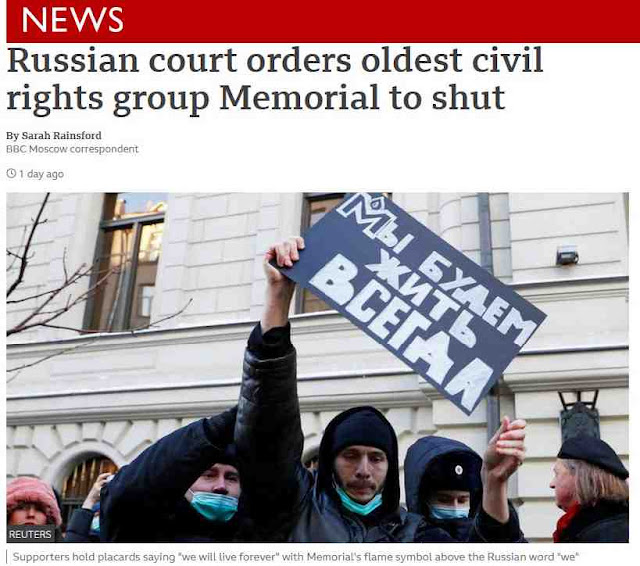
Grigory Yavlinky of the Yabloko Party was then interviewed who stated that it’s just ‘one more step from an authoritarian, totalitarian regime’ with an extended description of how Memorial was shining a light on ‘one of the darkest chapters of Russian history’ namely Stalin’s terror.’ 

Rosenberg told us that the founding of Memorial 30 years ago was a ‘symbol of the Soviet Union opening up, facing up to its past’. But the ‘shutting down of Memorial is a symbol also of how the past is being reshaped, rewritten and how civil society is under attack.’


https://www.youtube.com/watch?v=kWwCX0AjjNI

BBC 24 Hours makes the banning of Memorial a Russian Human Rights Group the lead news item

We were then shown a picture of Putin and the military, as a backdrop to the decision and we were told that Putin has been ‘using history to try to foster patriotism’.  Of course this is not something that would happen in the West!  Clearly the competition between Boris Johnson and Keir Starmer as to who can fit most Union Jacks into one photo shot is about something entirely different.

The BBC’s concern with human rights, be it in Russia, China or Hong Kong is selective and runs in tandem with British and Western Foreign Policy. When do we have similar reports on America’s client regimes such as Colombia or US support for coups against popular regimes that threaten its interests? When was the last BBC documentary on Saudi Arabia’s bombing of Yemen’s civilians or the threat that Israel poses to its neighbours?
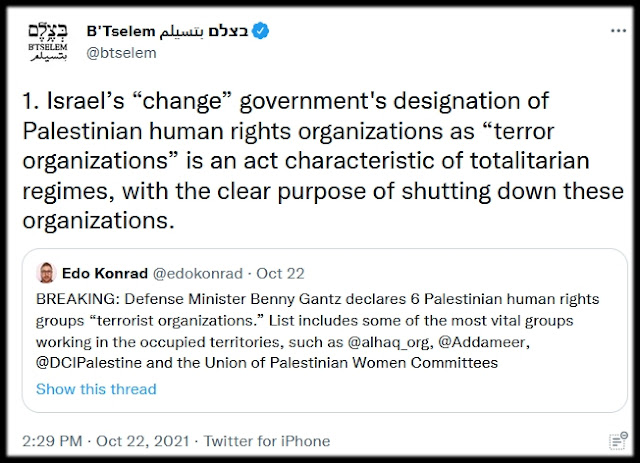
In October Israel banned not 1 but 6 Palestinian human rights groups. One of them, Al Haq, was founded in 1979, some 43 years ago. Nearly half as long again as Memorial.  Did the BBC give us an insight into its work and film its staff at work?  B’Tselem, the main Israeli human rights group described Israel’s banning as ‘an act characteristic of totalitarian regimes’. Did the BBC interview anyone who described Israel’s actions in these terms? Of course not.
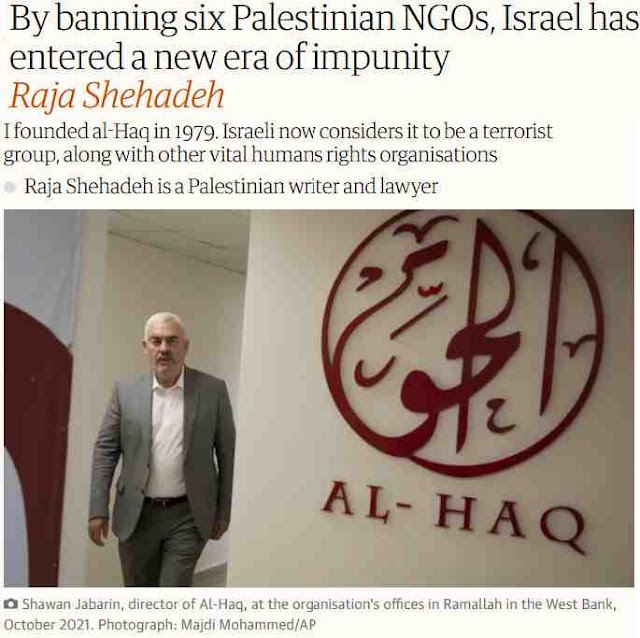
Memorial was banned by order of Russia’s Supreme Court, which is about as independent of government as our own Court of Appeal when it decided to hand over Julian Assange to the tender mercies of America’s judicial and prison system. Yet Israel didn’t even bother with the fig leaf of an order from Israel’s Colonial Courts. It was banned by edict from Israel’s War Minister  Benny Gantz. On this the BBC also had no comment

What limited coverage the BBC gave to Israel's banning of 6 human rights groups gave prominence to the accusations of 'terrorism' not the attack on the freedom of Palestinians

Who were the groups which Israel described as a front for the Marxist Popular Front for the Liberation of Palestine?

1.           Al-Haq, Law in the Service of Man,

2.           Addameer Prisoner Support and Human Rights Association, Bisan

3.           Center for Research and Development,

4.           Defence for Children International-Palestine (DCI-Palestine),

5.           the Union of Agricultural Work Committees (UAWC) and

6.           the Union of Palestinian Women’s Committees (UPWC).

Anyone who has any acquaintance with the work of these organisations knows that Israel’s motives in banning the groups was political and related to their opposition to the Occupation. The allegations were made without a shred of evidence.
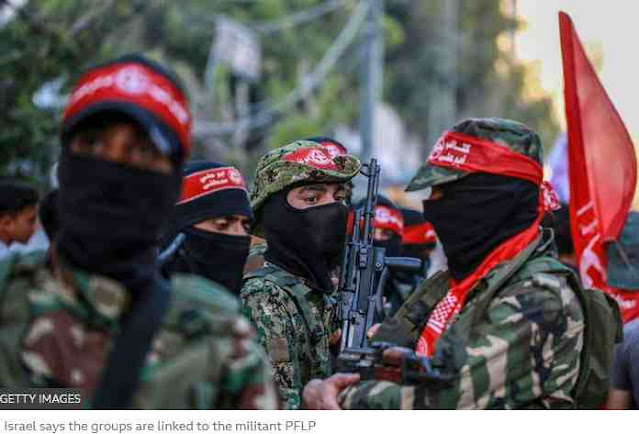
The BBC included a picture of PFLP guerillas as part of its McCarthyist guilt-by-association techniques - not once did it ask where the proof was that PFLP military operations were funded by groups like Defence of Children International-Palestine

The idea that these organisations cannot employ members or supporters of the PFLP is preposterous. The PFLP is a legitimate Palestinian organisation. Settler groups that regularly terrorise Palestinian farmers are described by Israeli Interior Minister Ayelet Shaked as the ‘salt of the earth’ but Palestinian civil society groups or indeed any group opposing Israel’s occupation are ‘terrorist’.

The background to the BBC’s bias, in which every Israeli attack on the Palestinians is ‘retaliation’ whereas Palestinian attacks on settlers or the military is ‘terrorist’ is laid out in Tim Llewellyn’s excellent talk which the Balfour Project hosted in August.

Tim Llewellyn, a former BBC Middle East reporter, described how the BBC has adopted the viewpoint of the British and American Establishment on Israel and how it systematically distorts its news output in favour of Israel. Of course if the Palestinians lived in Hong Kong or Tibet then the BBC would be all over them like a rash.

We can get some measure of the BBC’s attitude by its response to Tim’s article in the Guardian where it says that:

Although Tim Llewellyn was indeed a BBC correspondent some years ago, we note that he subsequently was active for a period with the Council for Arab-British Understanding (CAABU).

Having nothing to say to rebut the substance of Tim’s article the BBC resorted to attacking him personally because he is a member of CAABU, an organisation devoted to fostering British-Arab understanding.
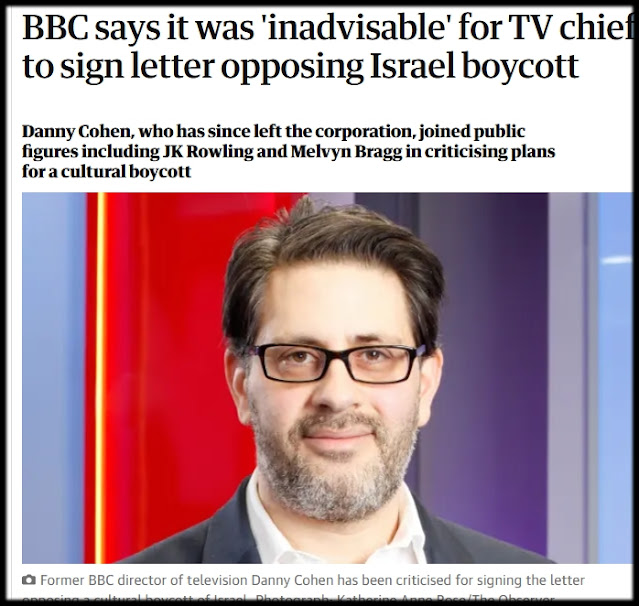
But when Danny Cohen, a former BBC Director of Television signed a letter in the Guardian opposing a cultural boycott of Israel, the BBC merely said it was ‘inadvisable’. There was no condemnation.

The BBC was born in the womb of the British state. It has a record of racism, support for colonialism and hostility to the working class and trade unions. I expect no different from it which is people should not pay the TV Licence fee.  There is no reason why ordinary people should pay to fund this anti-working class organisation.

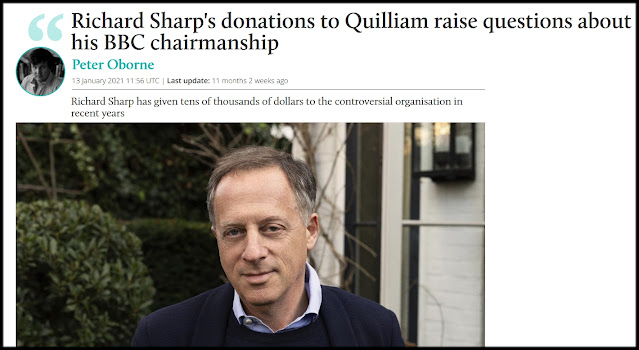
The BBC’s present Chairman Richard Sharpe, has donated £400,000 to the Tory Party over the last 20 years. As Richard Oborne detailed Sharpe donated a further £35,000 to the Islamaphobic charity Quillam, which itself was funded by some of the most virulent ‘counter Jihad’ organisations such as the John Templeton Foundation.

I disagree with Tim’s suggestion in the Guardian article that the responsibility for complaints should be taken out of the hands of the BBC Trust (which has been abolished) and handed to Ofcom, the state regulator.  Why? Because this has already been done and we saw how effective Ofcom was when it refused to investigate last year’s BBC Propaganda Film by John Ware, Is Labour Anti-Semitic?

I include below two previous articles that Tim Llewellyn wrote for the Guardian in 2009 and 2011 before Jonathan Freedland seized control of the Comment columns and before the Guardian’s dire editor, Freedland Kath Viner, gave the MI5 a veto over what the Guardian is allowed to print on Britain’s security state.

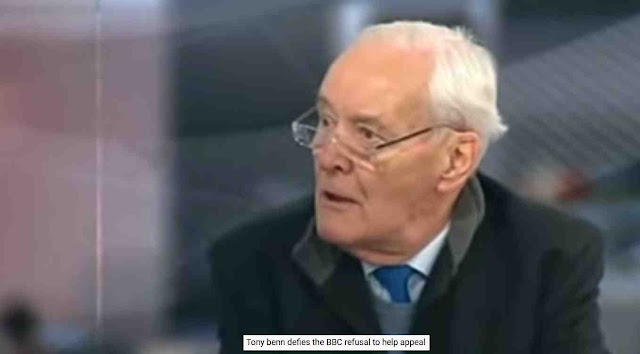
Below is Tony Benn’s interview on BBC Today programme where he defied the edict of BBC Director General Mark Thompson, who had banned an Appeal by the Disaster Emergency Committee. In 2008 Israel launched Operation Cast Lead in the course of which it killed 1400 people, 85% of whom were civilians, including 288 children.

Tony Greenstein
BBC is 'confusing cause and effect' in its Israeli coverage

A controversial book concludes Corporation still fails to present a fair and balanced picture of conflict
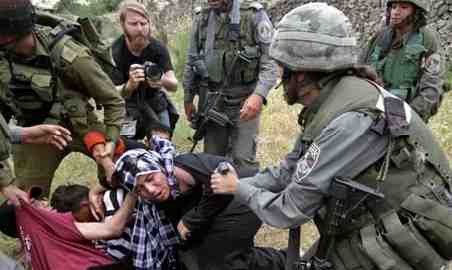
Israeli soldiers attack Palestinians during a demonstration marking al-Nakba Day in Bethlehem Photograph: Rex Features

Tim Llewellyn

Mon 23 May 2011 07.00 BST

British broadcasters' coverage of the Arab awakening over recent months has been brave and honest. These are difficult and dangerous stories. But the BBC – and in this article I am going to concentrate on the BBC, because it is the broadcaster we are taxed to enable and sets worldwide standards of fairness – and its teams have made every effort to report with balance and application.

However, the BBC coverage of Israel and Palestine, where another state continually kills and oppresses Arabs, is replete with imbalance and distortion.

I covered the Middle East for the BBC from the mid-1970s to the early 1990s, and am aggrieved by my ex-employer's continuing inability to describe in a just and contextualised way the conflict between military occupier and militarily occupied. There is no attempt to properly convey cause and effect, to report the misery, violence and pillage that demean and deny freedom to the Palestinians and provoke their (limited) actions.

Greg Philo and Mike Berry, in their book More Bad News from Israel, prove by textual analysis and follow-up interviews with viewers and listeners that I am right – and so are an increasing number of people who are becoming aware that the BBC sells them short on Israel. Philo and Berry's book, an updated edition of Bad News From Israel (2004), examines coverage of the Israeli blitz on Gaza, analysing BBC TV and ITV early evening bulletins between its beginning on 27 December 2008, and the ceasefire on 17 January 2009.

Siege and blockade

They find that the Israeli explanation of why it went to war on a mainly defenceless Gazan population is the one broadly accepted by the BBC. It was a "response" to Palestinian rockets. The Palestinian case, that the Israelis violated a ceasefire that had held for nearly five months in November 2008, and that the Gazans had endured many years of intensifying siege and blockade, which had reduced them to stagnation and penury, was rarely put, if at all. "The story was unpacked," the authors write, "in the manner of the Israeli view."

In the bulletins they examined, the BBC gave 421.5 lines of text to Israeli explanations of why they attacked Gaza: the "need for security", "enemy rockets", "to stop the smuggling of weapons". The BBC devoted 14.25 lines to references to the Israeli military occupation of the Palestinian territories and 10.5 lines to the blockade. The BBC repeatedly stressed the word [Israeli] "retaliation", and also implied that police stations bombed by the Israelis were military targets, describing other casualties as "civilian". It described these civilian installations as "targets". Newspapers such as the Guardian did point out the distinction.

"The offer that Hamas was said to have made, to halt this exchange [rockets v shells and air strikes] … was almost completely absent from the coverage,"

say the authors. They cite a BBC reporter saying: "Israel feels itself surrounded by enemies, with reason." They add: "We have not found a commentary noting that 'Palestinians feel themselves to be subject to a brutal military occupation, with reason.' Israel's official view is given as fact, they say, but the Palestinian view, on the rare occasions it is found at all, is not. Israelis "state", Palestinians "claim".

When the BBC and ITV did start reporting the horrific civilian casualties in Gaza and the use of phosphorus, Israeli spokespersons were immediately on hand to deny, explain or obfuscate. The Palestinians, especially Hamas, were rarely able to answer allegations. The Palestinians in situ usually lacked the resources or opportunity to make their case. The many articulate Palestinians in London available to help were rarely called on, whereas, as one BBC insider said, "the Israeli ambassador was practically camped at TV Centre".

More than two years on, the BBC continues to confuse cause and effect – Israeli attacks are always reported as retaliation to Palestinian violence or rockets, and the idea that Palestinian rockets, however ineffective, are armed resistance to Israel's hammering from land, sea and air is rarely broadcast. The daily indignities and brutalities of the siege and the occupation and the shelling and shooting of civilians are virtually absent from BBC consciousness unless an attack on Israel sparks interest.

Headline news

Philo and Berry quote the BBC correspondent Paul Adams, a Middle East expert: what is missing from the coverage, he says, is the view that the Palestinians are engaged in a war of national liberation, trying to throw off an occupying force. Any Israeli casualty is headline news, shown in high quality images. BBC teams are based in West Jerusalem, de facto Israeli territory, and are on hand. Arab casualties may be shown in reports of a funeral, usually agency film, the victim anonymous. The Israelis, it seems, are for the BBC "people like us". The Arabs are "the other".

Philo and Berry go on to interview viewers and listeners, all in higher education. They find that these focus groups were largely unaware of the Israeli occupation, often believing the Palestinians are the occupiers. Few knew that Hamas had been democratically elected in January 2006. "I had the impression they were a terrorist group from watching the BBC," said one respondent. In most cases, the assumption was that Palestinian rockets brought the invasion onto their own people's heads.

To complain means the official complaints procedure and dealing with the army of lawyers and layers of bureaucracy the BBC now deploys to see off all but the most assiduous. Editors and producers rarely respond individually to complaints and, if they do, do so with question-raising answers and self-justification.

For example, the BBC consistently describes illegal Israeli settlements as "held to be illegal". But they are illegal. Even the Foreign Office says so. The BBC always adds "Israel disputes this." Well it would, wouldn't it? Why these caveats? Why this reporting of a shout of denial from the convicted prisoner in the dock?
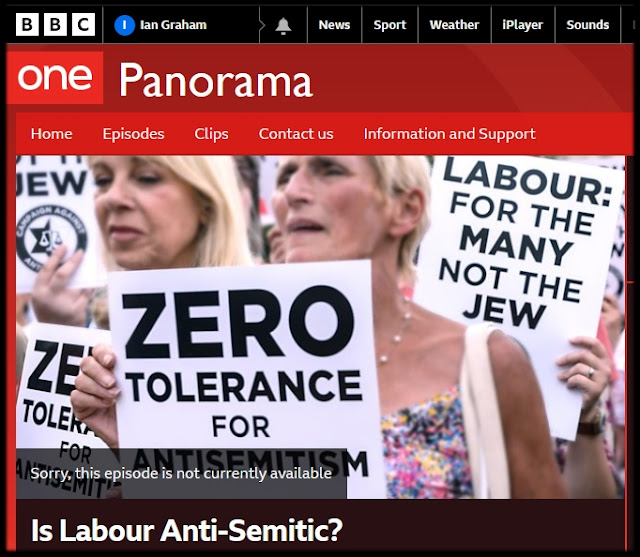
The BBC still has explained why it interviewed members of the Zionist Jewish Labour Movement without once revealing their identity

More than a month after I made an official complaint about this I have had no reply or acknowledgement. People who complained about Panorama's travesty of a documentary on the deaths caused when Israeli commandos boarded the Mavi Marmara, part of the Gaza aid flotilla, had to go through an obstacle course of form-filling and stonewalling.

The BBC Trust found the programme guilty on some counts but said it had not breached BBC guidelines of accuracy and impartiality. Why negotiate all this to end up with such contortionist, self-serving judgments?

Final arbiter

The BBC is on the defensive: the castle wall is the labyrinthine complaints procedure. It must be time for an independent body like Ofcom to be the final arbiter on BBC journalism, not the BBC itself. The BBC Trust, the highest court of appeal in these matters, is now chaired by Lord Patten, who has told us all how closely he intends to work with the director general, Mark Thompson: judge and potential defendant.

Why is BBC reporting like this? The book addresses this in Chapter 4. In my view, the rot set in during 2001, after 9/11. Israel and its friends were quick to capitalise on "terror" and "Arabs" and massively enhanced their propaganda effort here, gaining access to BBC staff at all levels. BBC managers and editors do not like being shouted at, and they are soft toys when someone makes a loud and apparently convincing case. The Palestinians have no such machinery. As one BBC producer says in More Bad News: "We all fear the phone call from the Israeli embassy."

The BBC's main Middle East bureau in west Jerusalem is liable to Israeli pressure, and it is in Israel that the BBC perspective on the regional conflict is formed.

Editorially, Israeli spokesmen are easily available and producers love that. As Peter Oborne pointed out on Channel 4 in late 2009, each of our three main political parties is amenable to the "Friends of Israel" lobby. Our coalition leadership duo have both pledged themselves publicly to Israel. So did Tony Blair and Gordon Brown.

The BBC, like a well-kicked hound, does not in its post-Hutton malaise wish to antagonise politicians. It goes with reporting that's as low-profile as possible on this most sensitive of issues. It lives in horror of being accused of anti-semitism, Israel's ultimate smear. Reporters and editors know they have to pitch the Israel story in a certain manner to get it on the air – in effect, self-censorship.

Perhaps the most overwhelming distortion of the BBC in its coverage of Israel and Palestine is what I term "spurious equivalence": that the Palestinians and Israelis are two equal sides "at war" over "disputed" territory and may the best man win. Or, come on chaps, shouldn't reason prevail? The BBC knows that the Palestinians are a people fighting for independence, but its coverage does not tell it like it is.

In 2006, an independent panel appointed by the BBC governors assessed impartiality in coverage of the Israel-Palestine conflict. Their review came after many complaints and the first edition of this book, which examined in similar form the BBC's distorted reporting of the Al-Aqsa (second) intifada and the subsequent Israeli bombardments and invasion of the cities of the West Bank.

The commission confirmed many of the Philo/Berry criticisms:

"BBC output does not consistently give a full and fair account of the conflict. In some ways the picture is incomplete and, in that sense, misleading."

Five years on, it remains so, and the BBC has put the commission's report under "File and Forget".

Tim Llewellyn was BBC Middle East correspondent from 1976-80 and 1987-92. More Bad News from Israel, by Greg Philo and Mike Berry, is published in paperback by Pluto Press at £15

BBC response to Tim Llewellyn's story

BBC News endeavours to report on all matters in the Middle East – as elsewhere – impartially, objectively and accurately.

We have extensive editorial guidelines which all reporters and producers are required to observe.

In a highly charged political atmosphere any impartial and accountable broadcaster will rightly find itself under scrutiny by all shades of opinion.

In the Middle East debate there are organised, motivated and effective lobby groups on both sides of the argument.

We listen to their concerns and act on them where we think they are justified, but in doing so we bear in mind that our audiences expect us to remain independent of political pressure.

Although Tim Llewellyn was indeed a BBC correspondent some years ago, we note that he subsequently was active for a period with the Council for Arab-British Understanding (CAABU).


This cowardly decision betrays the values the corporation stands for

Tim Llewellyn

Sun 25 Jan 2009 00.01 GMT

On Tuesday, speaking from a pulpit in Westminster Abbey, the director general of the BBC, Mark Thompson, paid tribute to one of the corporation's greatest journalists and broadcasters, Charles Wheeler, who died last summer at the age of 85.

Thompson spoke in reverential terms of Wheeler: his independence; his dislike of authority, any authority; his relentless search for the truth, in postwar Germany, in the United States of the 1960s and 1970s, LBJ, Vietnam, Nixon; in India, Kuwait, Kurdistan. Thompson was right. Wheeler was a giant among BBC journalists, rightly hailed as one of the best of his generation.

But even as Thompson spoke, the corporation was traducing every tradition that Wheeler, and many of us who still work for the BBC, have tried to live by. The corporation's chief operating officer, Caroline Thomson, had refused to allow it to broadcast an appeal on behalf of the Disasters Emergency Committee for Gaza. She said that one reason was that "the BBC's impartiality was in danger of being damaged". Could the BBC be sure, she added, that money raised for this cause would find its way to the right people?

How is the BBC's impartiality to be prejudiced by asking others to raise money for the victims of an act of war by a recognised state, an ally of Britain, using the most lethal armaments it can against a defenceless population? What sly little trigger went off in her head when Thomson questioned whether the aid would reach the right people? What right people? Hamas, the elected representatives of the Palestinian people? The hospitals and clinics run by private charities and the United Nations Relief and Works Agency? The mosques? The citizens of Gaza, persecuted beyond measure not only by their Israeli enemies but by the western powers who arm and sustain Israel and defy the democratic vote of the Palestinian people?

Is Thomson more fussed about some imaginary "war on terror" that even the new White House is shying away from than she is about upholding the free speech and freedom of action of the corporation?

This pusillanimous obeisance to some imagined governmental threat has aroused unprecedented anger across the BBC. Reporters and correspondents still on the staff, and who will not name themselves, are beside themselves with rage against a corporation that is traducing the very ideals it is supposed to uphold, and for which the director-general seemed to speak in Westminster Abbey.

This is what one former BBC World Service current affairs producer wrote to his colleagues yesterday:

"... I am rarely moved to comment on aspects of the BBC I can no longer influence. But I confess I am deeply saddened and confused - and frankly pleased to be distanced from such decisions - after listening to Caroline Thomson's obfuscating defence on Today of the refusal to broadcast the joint charity appeal on behalf of the suffering in Gaza. The question of partiality is a red herring. It is for the general public to respond to a humanitarian disaster as they choose."

Having dealt with different news managers at the BBC over the past 30 years or so, I can safely say that the modern BBC has become a body of lions led by donkeys. Reporters of the calibre of Jeremy Bowen, David Lloyn, Lyse Doucet, experts in their field and brave people all, will be appalled by the directions they are being given. Edward Stourton and the Today programme rightly produced Tony Benn yesterday morning because they knew he would articulate what their bosses have failed to: reason and humanity.

The big question that remains is this: what are the suits scared of? Why do BBC managers try to second-guess our government and even outreach it in grovelling to the United States and Israel?

BBC journalists, extant and retired, not the "usual suspects", not disaffected radicals and high-octane lefties, are incandescent with rage over this extraordinary piece of institutional cowardice.

The episode makes a travesty of the institution's posturing in Westminster Abbey last week, and discredits the honest reporters the BBC still has on its books and in the field.

Tim Llewellyn is a former BBC Middle East correspondent

19 January 2020

Israel, is the only state in the world where torture is legal

Israeli Doctors are Actively Complicit in Aiding and Abetting Torture but according to Emily Thornberry that IS WHY Israel a ‘beacon of freedom’


According to Emily Thornberry “Modern Israel is a beacon of freedom, equality and democracy”. Israel is also the only state in the world where torture is legal. See It’s now (even more) official: torture is legal in Israel
In 1987 the Landau Commission, which was set up as a result of the Bus 300 Affair, when two Palestinian prisoners were murdered by senior officers (one General Yitzhak Mordechai was later promoted to Command of the Southern Region), found that the use of violence, or ‘moderate physical pressure’ as they termed it, against prisoners was an acceptable method of interrogation. They argued, in the light of what they called "the concept of the lesser evil", that
Elyakim Rubinstein, Supreme Court Justice who approved of the use of torture
"actual torture . . . would be perhaps be justified in order to uncover a bomb about to explode in a building full of people . . . whether the charge is certain to be detonated in five minutes or in five days."
"To put it bluntly, the alternative is: are we to accept the offence of assault entailed in slapping a suspect's face, or threatening him, in order to induce him to talk and reveal a cache of explosive materials meant for use in carrying an act of mass terror against a civilian population, and there by prevent the greater evil which is about to occur? The answer is self evident."[15]
This was the justification that the Nazis used for torture. Defence of the State against its enemies. Chaired by Supreme Court Judge Moshe Landua, the Commission's Report stated:
Israeli torture victim
"The effective interrogation of terrorist suspects is impossible without the use of means of pressure, in order to overcome an obdurate will not to disclose information and to overcome the fear of the person under interrogation that harm will befall him from his own organization, if he does reveal information."[16]
"The means of pressure should principally take the form of non-violent psychological pressure through a vigorous and extensive interrogation, with the use of stratagems, including acts of deception. However, when these do not attain their purpose, the exertion of a moderate measure of physical pressure cannot be avoided."
In 1999 the Supreme Court, sitting as the High Court, ruled in Public Committee Against Torture in Israel v the Government of Israel, PD 73(4) 817 (1999) that the law does not permit the use of torture. However they also ruled that in a ‘ticking bomb’ case the use of such methods might not  cause the torturers to be legally culpable.

Prof. Yuval Shany explained in Back to the ‘Ticking Bomb’ Doctrine how the decision of Israel’s High Court in December 2017 in Abu Ghosh v. Attorney-General effectively reinvigorated the ‘ticking time bomb’ defence of Israel’s torturers.

The result is, as Btselem documents, that Shin Bet have continued to use torture as a routine method of interrogation with the connivance of the Israel’s Supreme Court. Since 1967 73 prisoners have been tortured to death.
Last December a Report from Addameer, the Palestinian Prisoner Support Unit and Legal Aid Group stated that
The occupation authorities, in particular, the Israeli intelligence agency “Shabak” resorts to torture and ill-treatment as standard operating procedure in a systematic and wide-scale approach against Palestinian detainees. Over the past three months, the intelligence agency subjected a number of detainees at Israeli interrogation centers to severe physical and psychological torture without any form of monitoring and protection.
The reaction of the Israeli state to Addameer’s Report was to impose a ‘gag order’ preventing them from printing details of the case of torture.  This too, as Emily will explain is another example of Israeli democracy at its best!
Other examples include 21-year-old Palestinian student Mays Abu Ghosh who is currently in an Israeli jail cell and a victim of torture. Mays, who was arrested for her activism, has been interrogated so violently that her parents could barely recognize her – yet this horrific story is being met with no huge outcry and very little media attention.
On August 29, Mays was arrested in her home during a sweep of Palestinian student activists and detained under trumped-up charges. 
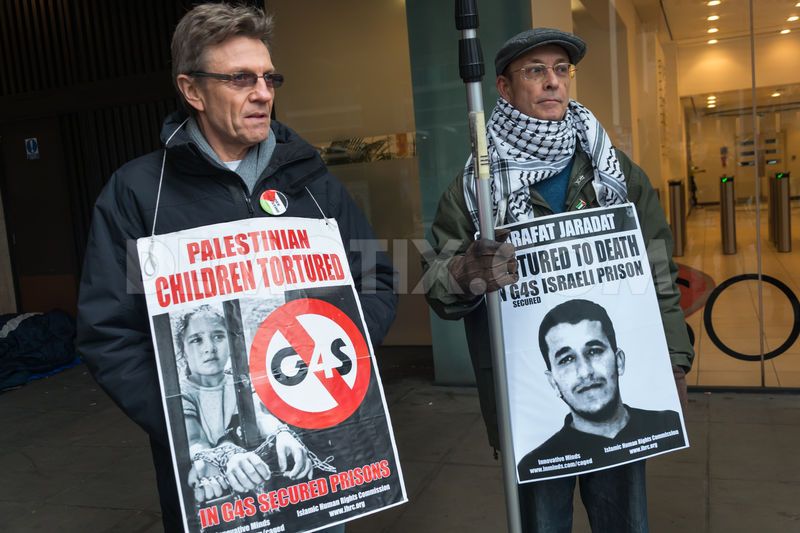
Demonstration protesting at the death under torture of Arafat Jaradat in an Israeli G4S prison
As a student journalist, Mays has been a vocal advocate of Palestinian rights. Now she’s being tortured for her lifelong resistance to displacement, and being labeled a “major terrorist” for her work organizing with fellow students against Israeli oppression of Palestinians. Her “crimes” include participating in a conference about the Palestinian right of return in Lebanon, and speaking about her late brother on a radio program.
When her parents were finally allowed to visit, Mays was so bruised and visibly wounded she was almost unrecognizable. Her mother couldn’t hug her because her body was in too much pain.
Addameer describes some of the torture techniques:
The Banana Position - Israel's own invention
·         Positional torture (stress positions): Israeli intelligence officers forced the detainees into a number of stress positions such as the banana position,[2] the frog position, sitting on an imaginary chair, squatting and many other different positions. Almost in all of these stress positions, the detainees would lose their balance and fall on the ground, which would lead to a harsh beating by the officers and then forcing the detainee back into the stress position. Other used stress positions included standing on their toes while their hands were shackled above their heads to a wall. Another position included sitting on a chair while handcuffed to the back, where the hands were positioned on a table behind the detainee’s chair. A third position involved the detainee laying on the ground with his/her hands chained to each other with iron cuffs and positioned behind his/her back. This position also includes officers sitting on the detainee to place pressure on his/her body while beat him/her ferociously.  
Illustrative use of torture
·         Harsh beatings: Israeli occupation intelligence officers used extreme methods of beatings against the detainees using their hands, legs, knees and even their fingers. The officers hit, slapped, punched, poked (using their fingers), and kicked the detainees. These methods resulted in severe and life-threatening injuries that included broken ribs, inability to walk, brutal bruises, swelling marks on the skin, ulcer wounds…etc. The officers, who exceeded five in number in some cases used to blindfold the detainees’ eyes so they would not expect the beating or know where it is coming from. Several of those detainees appeared in their court sessions with marks on their bodies, expressing severe pain, or in some cases arrived on wheelchairs. In one of the cases, the harsh beating was committed with the intention to kill the detainee, who was in fact transferred to the hospital in serious condition after around 30 hours of severe and extreme methods of beatings. In another case, the harsh beating aimed at injuries caused by a police dog during the arrest, the interrogators intended to target those previously obtained injuries, which were mainly on the detainee’s genital area causing the wounds to re-open twice. Also, in many other cases, the method of pulling the facial hair from its roots causing injuries and swelling marks was used.
An actor plays the role of torture victim
·         Sleep deprivation: this technique was implemented through different methods, in some cases the detainees spent around twenty days sleeping from one to three hours a day. Even when those detainees were sent to their cells to sleep, they would be disturbed with loud and eerie sounds made by the prison guards, the voices of other detainees being harshly beaten or the sound of knocking on their cell doors. In some cases, sleep deprivation ranged from 30 to 60 continuous hours, where the detainee would not be sent to sleep at all during these hours and would be woken up if he/she falls asleep during the interrogation. Some detainees were harshly slapped on their faces to wake up, others were also splashed with water. Detainees described the slaps as extremely severe causing them to feel dizzy.
·         The use of family members (emotional blackmailing): psychological torture and ill-treatment were used on the majority of these detainees, focusing on threats against their family members, and loved ones. Israeli occupation forces used the policy of collective punishment through arresting and bringing in some of the family members mostly to al-Mascobiyya interrogations center and Ofer prison. Eight family members for seven different detainees were arrested, and another ten family members were brought in for questioning. Some of these relatives were kept for a number of days while others were kept for hours. In all the cases, family members and loved ones were mainly brought in to pressure the detainees themselves. The interrogators made the detainees assume that their relatives got arrested and will be tortured as well. Relatives included fathers, mothers, brothers, daughters, wives, etc.
Palestinians dressed up as torture detainees
·         Interrogation at Israeli secret prisons: at least one of the detainees Addameer has documented their cases have stated that they were taken to unknown centers. The detainee said that the interrogators at this center were all face-covered and wearing a different uniform than the known usual uniforms. It has been revealed in the past that Israel has secret prisons that are removed from maps and airbrushed aerial photographs.[3]
Others such as Samir Arbeed have been left permanently disabled as a result of their experiences See Israel/ OPT: Legally-sanctioned torture of Palestinian detainee left him in critical condition
What is particularly reprehensible is the involvement of Israeli doctors and physicians in the use of torture. Doctors who monitor prisoners in order that they can help the torturers decide how far to go, who declare when a prisoner is fit enough for further torture and who deliberately lie in medical reports in order to cover for the torturers. Comparisons with American doctors who collaborated with the CIA in water boarding and SS doctors spring to mind.  See the article below How Israeli doctors enable the Shin Bet’s torture industry.
And far from the Israeli Medical Association opposing this they give the green light for such doctors to continue what they are doing. See for example the article by John Yudkin, Emeritus Professor at University College, London.
Physicians for Human Rights-Israel has stated that if the IMA refused to allow doctors to serve in security units commonly deploying torture the practice would come to a halt. The medical presence in these units offers moral legitimation to Israel’s interrogators. See Global medical watchdog complicit with Israeli abuses.
Yoram Blachar
In 2009 more than 700 doctors from around the world called for the Israeli President of the World Medical Association, Yoram Blachar, to step down, calling him “unfit for office” and claiming that he had turned a blind eye to the “institutionalised involvement of doctors” in torture in Israel.
In a letter they said that the appointment of Blachar, who was President of the Israeli Medical Association as president of the WMA was “a matter of grave concern.” The signatories, who included professors and doctors from 43 countries, said that the appointment
“makes a mockery of the principles on which the WMA was founded in 1947, which was a response to egregious abuses by Germany and Japan in World War Two.”
Other prominent doctors who 
support Israel’s use of torture include Sir Michael Marmot, former President of the WMA and a Professor at UCL.
Last November Heba al-Labadi and Abdul Rahman Mi’ri, two Jordanians who had been savagely tortured, were released from Administrative Detention (i.e. imprisonment without trial), Heba went on a 40 day hunger strike and this forced the Jordanian government to insist on the release of its nationals or face a freeze or worse in their diplomatic relations. The arrest of Labadi Mi’ri, a cancer survivor, was a major PR disaster for Israel. See A lesson for the Palestinian leadership: Real reasons behind Israel’s arrest and release of Labadi, Mi’ri
Tony Greenstein
By +972 Magazine October 7, 2019
From approving brutal interrogation techniques to writing false medical reports, doctors in Israel have taken an active role in the torture of Palestinian prisoners.
By Ruchama Marton
Illustrative photo of an Israeli soldier blindfolding a Palestinian prisoner. (Nati Shohat/Flash90)
If the Shin Bet runs a school for its agents and interrogators, the curriculum most certainly includes a class on how to tell a lie. The texts taught, it seems, do not change with the years. In 1993, responding to accusations that the Shin Bet brutally tortured Palestinian detainee Hassan Zubeidi, then Commander of the IDF Northern Command Yossi Peled told Israeli journalist Gabi Nitzan that “there is no torture in Israel. I served for 30 years in the IDF and I know what I am talking about.”
Twenty-six years later, Deputy Chief of the Shin Bet and former Shin Bet interrogator, Yitzhak Ilan repeated the same line to news presenter Ya’akov Eilon on national television while speaking about Samer Arbeed, a 44-year-old Palestinian who was hospitalized in critical condition after he had been reportedly tortured by the Shin Bet. Arbeed is suspected of organizing a deadly bombing that killed a teenage Israeli girl and wounded her father and brother at a spring in the West Bank in August. Ilan bristled at the notion that the Shin Bet was somehow responsible for Arbeed’s condition.
Putting aside these absurd forms of denial, as a doctor and founder of Physicians for Human Rights – Israel, I have always been troubled by how Israeli doctors cooperate with and enable Israel’s torture industry.
In June 1993, I organized an international conference in Tel Aviv on behalf of PHR against torture in Israel. At the conference, I presented a Shin Bet medical document that had been discovered by chance by Israeli journalist Michal Sela. In the document, the Shin Bet doctor was asked whether the prisoner in question had any medical restrictions when it came to keeping them in isolation, whether they could be tied, whether their face could be covered, or whether they could be made to stand for prolonged periods of time.
The Shin Bet denied such a document ever existed. “There is no document. It was simply an experimental paper that is not in use,” the agency claimed. Four years later, a second document, suspiciously similar to the first, came to light. That document asked doctors to sign off on torture in accordance with several previously agreed-upon clauses.
The first document, along with other findings, were published in the book titled “Torture: Human Rights, Medical Ethics and the Case of Israel.” The book cannot be found in Israel; Steimatzky, Israel’s oldest and largest bookstore chain, has banned its sale. Perhaps this is further proof that there is no torture in Israel.
After the document was uncovered, PHR turned to the Israel Medical Association and asked it to join the struggle against torture. The IMA requested that PHR hand over the names of the Shin Bet doctors who signed off on the document so that they could be dealt with internally.
I refused to hand over the names and told the IMA attorney that I was not interested in going after rank-and-file doctors — I wanted to change the entire system. That meant doing away with legitimacy granted to confessions exacted under torture, educating IMA members about non-cooperation with torturers, and particularly providing active help to those doctors who do report on suspicion of torture or brutal interrogations.
Back then, the IMA was satisfied with putting our statements while doing nothing to prevent the Shin Bet’s doctors from cooperating with torture. Furthermore, the organization failed to fulfill its obligation to establish a forum for doctors to report on suspected torture.
An ethical, moral, and practical failure
But it is not only doctors in the Shin Bet and the Israel Prison Service that collaborate with torture. Doctors in emergency rooms across Israel write false medical opinions in accordance with the demands of the Shin Bet. Take, for example, the case of Nader Qumsieh from the West Bank city of Beit Sahour. He was arrested in his home on May 4, 1993 and was brought to Soroka Medical Center in Be’er Sheva five days later. There a urologist diagnosed him a hemorrhage and a torn scrotum.
Qumsieh testified that he was beaten during his interrogation and kicked in his testicles.
Ten days later, Qumsieh was brought before the same urologist for a medical examination, after the latter had received a phone call from the Israeli military. The urologist wrote a retroactive letter (as if it had been written two days earlier), without actually conducting an additional examination of the patient, in which he said that “according to the patient, he fell down the stairs two days before he arrived in the emergency room.” This time, the diagnosis was “superficial hematoma in the scrotal area, which corresponds to local bruises sustained between two and five days prior to the examination.” The urologist’s original letter, written after the first examination, disappeared from Qumsieh’s medical file.
History teaches us that doctors everywhere easily and effectively internalize the regime’s values, and many of them become loyal servants of the regime. That was the case in Nazi Germany, in the United States, and in various countries in Latin America. The same goes for Israel. Qumsieh’s case, along with countless others, reflects the ethical, moral, and practical failure of the medical establishment in Israel vis-à-vis torture.
Already back in the 18th century, jurists — rather than doctors — published legal opinions accompanied by proof that there is no connection between causing pain and getting to the truth. Thus, both torture and confessions exacted through pain were legally disqualified. One can only assume that the heads of the Shin Bet, the army, and the police know this bit of history.
And yet, torture — which includes both mental and physical cruelty — continues to take place on a large scale. Why? Because the real goal of torture and humiliation is to break the spirit and body of the prisoner. To eliminate his or her personality.
The legal understanding for forbidding torture is based on the utilitarian idea that one cannot arrive at the truth through inflicting pain . But doctors are committed — first and foremost — to the idea that anything that causes physical or mental harm to a patient is prohibited.
The Shin Bet medical eligibility document allows for sleep prevention, it allows interrogators to expose prisoners to extreme temperatures, to beat them, to tie them for long hours in painful positions, to force them to stand for hours until the vessels in their feet burst, to cover their heads for prolonged periods of time, to sexually humiliate them, to break their spirits by severing their ties to family and lawyers, to keep them in isolation until they lose their sanity.
The Shin Bet’s medical eligibility form is not the same as the one used to check eligibility to join the air force or even to drive a car. This kind of “eligibility” leads the prisoner directly into the torture chamber — and the doctor knows this. The doctor knows to what kind of systematic process of pain and humiliation he or she is lending their consent and approval. It is doctors who oversee the torture, examine the tortured prisoner, and write the medical opinion or the pathology report.
The white robe passes through the torture chamber like a lurking shadow during interrogations. A doctor who cooperates with Israel’s torture industry is complicit in that very industry. If a prisoner dies during interrogation, the doctor is an accomplice to his or her murder. Doctors, nurses, medics, and judges who know what is taking place and prefer to remain silent are all accomplices.
We must unconditionally oppose all forms of torture — without exceptions. We, citizens of a democratic state, must refuse to cooperate with the crime of torture, and all the more so when it comes to doctors.
We must also not hide behind the idea that torture is a symptom of the occupation while telling ourselves that the practice will disappear when the occupation ends. Torture is a worldview according to which human rights have no place or value. It existed well before the occupation and it will continue to exist if we do not change that worldview.
Violent and cruel investigative practices do not benefit national security even if they are committed on its behalf. Torture causes a spiraling destruction of our very social fabric. Not only do those who carry out this terrible kind of “work” lose the values of morality, human dignity, and democracy, but also all those who remain silent, unwilling to know. In fact, all of us.
Dr. Ruchama Marton is the founder of Physicians for Human Rights – Israel. This article was first published in Hebrew on Local Call. Read it here.

Israel/ OPT: Legally-sanctioned torture of Palestinian detainee left him in critical condition

30 September 2019, 16:58 UTC
Updated: 30 October 2019, 12:07 UTC
The legally-sanctioned torture of a Palestinian detainee during interrogation by officers from Shin Bet, Israel’s Security Agency, further exposes the complicity of Israel’s authorities, including its judiciary, in the systematic violation of the human right to be free from torture, said Amnesty International today.
Samir Arbeed was arrested on 25 September on suspicion of being involved in the killing of a 17-year-old Israeli girl Rina Shnerb.
According to Israeli media reports and Samir’s lawyer, a “judicial body” granted Shin Bet special permission to “use exceptional ways to investigate” in his case, effectively sanctioning the use of methods amounting to torture during his interrogation.
“It is utterly outrageous that the use of torture during interrogations continues to be sanctioned by the Israeli authorities, from the Shin Bet, through the executive branch and all the way to the Supreme Court,”
said Saleh Higazi, Amnesty International’s Deputy Middle East and North Africa Director.
“Under international treaties, which legally bind Israel, the use of torture cannot be justified under any circumstances. This case exposes Israel’s claims that its judiciary upholds human rights as a complete sham.”
The use of torture cannot be justified under any circumstances. This case exposes Israel’s claims that its judiciary upholds human rights as a complete sham