Showing posts with label 1967 War. Show all posts

24 June 2015

New Film about Israeli War Crimes in 1967

In peoples’ understandable determination to uncover the truth of the Nakba and what happened in 1947-8, the massacres of the 1967 War have barely been covered. 

Still from the film Censored Voices shows a former Israeli solider listening back to an interview, censored by the military after the 1967 war.
Palestinian refugees from the 1948 War
A new Israeli film from Mor Loushi delves into some of the detail.  The execution and mass graves of Egyptian soldiers in the Sinai have been known about for some time and the deliberate sinking by Israel of the USS Liberty, an American spy-ship has also been well documented, as has the joint US/Israeli cover-up.
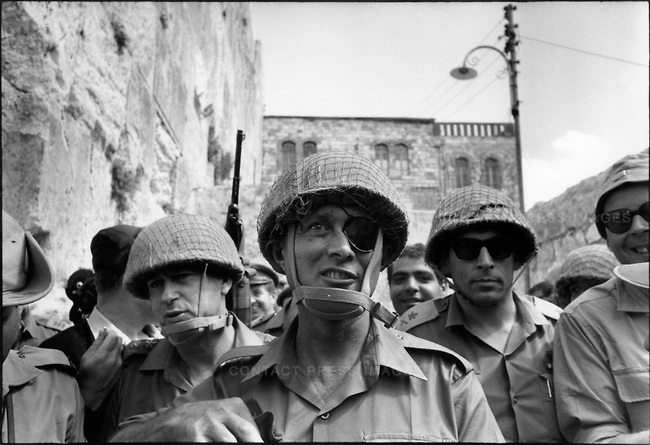
The iconic photo that the Zionists used to whitewash the invasion  - 3 soldiers at Jerusalem's Wailing Wall
Israeli Generals Yitzhak Rabin, Moshe Dayan and Uzi Narkis in Jerusalem
The 1967 war occurred because the bluster of Nasser allowed Israel a golden opportunity.  Having blocked Israeli ships from the Gulf of Aquaba Nasser foolishly ordered the UN troops in the Sinai to withdraw.  Israel of course took full advantage of this in order to conquer the Sinai, Golan and West Bank.

Tony Greenstein
The Zionist soldier's eternal dilemma

New evidence from 1967 war reveals Israeli atrocities


“In the operation we had to cleanse the inhabitants. This uprooting of a villager, rooted in his village and turning him into a refugee, by simply expelling him, and not one, two or three of them but a real eviction. And when you see a whole village is led like lambs to the slaughter without any resistance you understand what is the Holocaust.” — An Israeli soldier’s testimony in the documentary Censored Voices, directed by Mor Loushi (2015)
The USS Liberty, a spy ship, was attacked and nearly sunk by Israel because they didn't want the US knowing what their plans were.  US President Johnson covered it up.  It was only when the US sent planes to defend it that Israel called off the attack
In the wake of the June 1967 war, the Israeli author Amos Oz, then a reserve soldier in the Israeli army, together with a friend collated interviews with Israeli soldiers who participated in the war and asked them about the emotions the fighting triggered in them. The interviews were published as a book titled Conversations with Soldiers, more popularly referred at the time by my generation as the ”shooting and crying” book.
General Ariel Sharon at the battle of Abu-Ageila
The military censor (a function that still exists today, held recently by the present minister of culture, Miri Regev), erased 70 percent of the evidence since he claimed it would have harmed Israel’s international image.
An over confident Nasser laughing with Airforce pilots
This month an industrious Israeli filmmaker, Mor Loushi, is showing her new documentary based on most of this erased material. The atrocities reported by the soldiers include forced expulsions, like the one quoted above, graphic descriptions of summary executions of prisoners of war and hints of massacres of innocent villagers.

Evil repertoire

This 48th commemoration of the 1967 war coincided with the 67th commemoration of the Nakba, the ethnic cleansing of Palestine before and after Israel’s founding in 1948. There is more than a symbolic connection here. The evil repertoire confessed by the soldiers in the new film reminds us of the atrocities perpetrated 67 years ago on a much larger, though similarly horrific, scale.


The 1948 atrocities were ignored by the international community and for a long time the entire Nakba was denied while the Holocaust memory seemed to provide carte blanche to Israel to continue the ethnic cleansing of Palestine.

No wonder then, when in 1967 Israel’s territorial appetite was satisfied with the occupation of the whole of historic Palestine, as well as large territories from Egypt and Syria, it was achieved with the help of similar inhumane ethnic cleansing operations of expulsions and massacres.

There was one difference between the two chapters of atrocity committed in the two wars. In 1967, Israel was less secure about possible global, and even American, complacency in the face of its cruel methodologies on the ground and therefore attempted to hide them from prying eyes. The wall of secrecy Israel built, however, nearly cracked, when the US navy ship USS Liberty eavesdropped on the communications between the troops in the Gaza Strip on 8 June 1967, revealing probably both the summary execution of Egyptian prisoners of war and Palestinian civilians. The ship was destroyed on the same day from the air by the Israeli air force.

Later on, the atrocities were substantiated by eyewitnesses and came to the fore when mass graves were exposed in 1995 in the al-Arish area in Sinai, straining Egypt’s relations with Israel, as CNN reported at the time.

The network interviewed, for the first time, relatives and survivors of these war crimes who recalled the massacre of hundreds. The link between the unprovoked assault on the USS Liberty and the wish to hide the massacres and executions was thoroughly investigated by James Bamford in his 2001 book Body of Secrets.

Thus, the newly released tapes corroborate atrocities already known and told by those who were their victims (in this case, including 34 American navy personnel). This was very much in the same way as Israeli documents declassified in the 1980s corroborated the Palestinian oral history and testimonies of the Nakba.

Purifying the perpetrators

In both cases, it took a while for the victims’ version to be heard after years of being brushed aside by Western academia and the media as a figment of an oriental imagination.

The Israeli eyewitnesses in the new film do not mention names of places or dates — neither do we know who the Palestinian or Egyptian victims were. De-naming and dehumanization are two sides of the same coin and thus the new harrowing testimonies are cautiously presented as an act purifying the perpetrators rather than honoring the victims.

It is another case of “shooting and crying”: namely the problem is not that a girl lost her eye, a man’s house was demolished or an unarmed prisoner of war was executed. The aim is to cleanse the tormented soul of the victimizer and there is nothing like a good confession to make it all go away.
Names and dates, and even more so real human beings, require not only acknowledgement but also accountability. Saying sorry is not always enough, especially when the lesson is not learned. And, thus, year after year since 1967, including in recent weeks, Palestinians, with faces and names, are still expelled, imprisoned without trial and killed.

Permanent reality

This new film gives the impression that these crimes were the inevitable outcome of the June 1967 war. But in fact the crimes committed after the war were much worse in every aspect. The atrocities were not the outcome of the war, they were part of the means used by Israel to solve the predicament the new territorial achievement produced for the Jewish State: it incorporated in 1967 almost the same number of Palestinians it had expelled in 1948.

After the war, other means were added in the search for reconciling this predicament. The aim was still the same: to have as much of Palestine as possible with as few Palestinians in it as possible. The new strategy, after the war, was based on the logic that if you cannot uproot people you root them deeply in their areas of living without any outlet or easy access to the world around them.

The Palestinians all over Palestine were, since 1967, incarcerated in small enclaves surrounded by Jewish colonies, military bases and no-go areas that bisect their geography. In the occupied territories, Israel created a matrix of control many African National Congress leaders regard as far worse than the worst of apartheid South Africa. The Israelis marketed this method to the world as a temporary and necessary means for maintaining their rule in the “disputed” territories. The “temporary” means became a way of life and transformed into a permanent reality on the ground, for which Israel sought international legitimacy through the 1993 Oslo accords – and nearly got it.

This month as we commemorate the 48th year of the 1967, war we should remind ourselves once more that this was a chapter in a history of dispossession, ethnic cleansing and occasionally genocide of the Palestinians.

The “peace process” that began more than two decades ago was based on the assumption that the “conflict” began in 1967 and will end with Israeli withdrawal from the West Bank and the Gaza Strip.
The “conflict” had actually begun in 1948, if not before, and the worst part of it was not the 1967 military occupation of those parts of Palestine that Israel had failed to take over in 1948, but rather that the international immunity for these crimes still continues today.

One can only hope that those with the power to effect change in the world will understand, as did the soldier quoted in the opening of this piece, that there is more than one holocaust and that everyone, regardless of their religion or nationality, can be either its victim or its perpetrator.

The author of numerous books, Ilan Pappe is professor of history and director of the European Centre for Palestine Studies at the University of Exeter.

Israelis admit war crimes

Six Day War atrocities: Veteran's account of captives in Egyptian uniforms being shot in the desert adds fuel to scandal; 'A prisoner was given a shovel and started to dig. Then he was fired at'

Jerusalem

Gabriel Brun, a Jerusalem journalist who served as a signals sergeant- major in the 1967 Six-Day War, described yesterday how he saw fellow Israeli soldiers shoot dead five prisoners of war in Egyptian uniforms.

His story added fuel to an escalating scandal sparked by a retired brigadier-general, who confessed to executing 49 Egyptian prisoners during the 1956 Suez war. Egypt, with whom Israel signed a peace treaty in 1979, has demanded a full account. The Israeli Prime Minister, Yitzhak Rabin, who was chief of staff during the 1967 war, has ordered an investigation.

"What I saw happened on the morning of 7 June, the third day of the war," Mr Brun, who was then 24, told the Independent.

"I was at El Arish airfield in the Sinai desert, attached to the headquarters of an armoured division. I saw 120 to 150 Egyptian soldiers sitting with their hands tied behind their backs in a makeshift hangar made of sandbags. About 20 yards away I saw a trestle table with two men sitting behind it, their faces masked with khaki handkerchiefs. Individual prisoners were pushed out of the group, brought before this table and apparently interrogated. Some were sent back.

"I was about 30 or 40 yards away, so I couldn't hear what was said. I saw one man questioned, then marched about 200 yards into the desert by two military policemen.

"He was given a shovel and started to dig. After about 15 minutes, I saw the shovel thrown out. Then each of the two soldiers fired a round into the hole. Another guy was brought and shot, falling into the same hole. A third prisoner was brought to cover up the grave, then was marched back.
"I saw five prisoners killed in this way. Earlier I had heard 10 similar shots. I interpreted those to mean that another five were executed."

Mr Brun said an officer explained to him afterwards that the victims were Palestinian "terrorists", who were wanted for murdering Israelis and had tried to get away by merging with the fleeing Egyptians. The interrogators were officers in army intelligence.

Arye Biro, 69, the retired brigadier who admitted killing 49 Egyptian PoWs in the 1956 war, said on Wednesday he was not proud of what he had done, but did not feel like a war criminal. "I have ached over what I did," he said, "but under the same circumstances I think I would do it again."
Mr Biro commanded a paratroop company which dropped in the Mitla Pass, one of the two main routes from central Sinai to the Suez Canal.

"We were hundreds of kilometres behind enemy lines," he said. "Egyptian planes were flying over us unhindered. Egyptian troops were pouring into the area, and the prisoners were shouting, 'Just you wait, the Egyptian army will slaughter you'."

The paratroops were ordered to head south. According to Mr Biro, they had no transport for the prisoners and feared they would reveal the Israelis' position. So he and a lieutenant ordered the prisoners to lie face down, then shot them.

"They didn't cry out," he said dispassionately. "It was all over in a couple of minutes."

The paratroops' brigade commander was General Ariel Sharon, now an opposition Likud MP. He was not in the Mitla Pass at the time of the executions. But the battalion commander, Rafael Eitan, was. Mr Eitan, who rose to chief of staff, is now a hard-right candidate for prime minister. Asked if Mr Eitan ordered the killings, Mr Biro replied: "Ask him."

According to Meir Pa'il, a military historian and retired colonel, Moshe Dayan, who was chief of staff in 1956 and defence minister in 1967, reprimanded Mr Eitan for the killings during a meeting with battalion commanders.

Michael Bar-Zohar, an author and former Labour MP who handled Dayan's public relations after the 1967 war, said: "In every one of our wars, Israeli soldiers have killed PoWs. The high command did not want it, but it was tolerated up to a point. I know of only one case - in the 1982 Lebanon War - where an officer was court-martialled for killing a prisoner.

13 June 2015

Married to a Palestinian - The Journey of an American Jewess Irish Keltz

48 Years Ago: Commemorating the ’67 War

 Iris Keltz on June 8, 2015
 
East Jerusalem, 1967 From left to right, Ibrahim Khatib, Iris and Faisal Khatib and friends. (Photographer unknown)
 The following includes excerpts from Iris Keltz’s forthcoming book. Unexpected Bride in the Promised Land:


This week marks the 48th year since the ‘67 War. Israeli General Yitzhak Rabin was given the honor of naming the war. Considered possibilities were: The War of the Daring, The War of Salvation, The War of the Sons of Light. Rabin chose The Six Day War evoking thoughts of Genesis, but Israel created a new world in less than six days. With the destruction of the Egyptian Air Force, the war had been won in the first few hours. Palestinians call it the Naksa. For them it turned out to be—another Catastrophe.
In the summer of 1967 I cast my fate to the wind and hitchhiked from Paris to Jerusalem hoping to live on an Israeli kibbutz, but a caprice of fate found me welcomed and married into a Palestinian family within weeks of my arrival in East Jerusalem, Jordan. The likelihood of a Jewish-American woman finding sanctuary with “the enemy of our people” during a war that changed the face of the Middle East was just about zero. My family stressed the Jewish narrative of suffering in a Diaspora that lasted thousands of years, culminating in the Holocaust. On my bat mitzvah, I chanted from the book of Exodus about the Hebrew slaves leaving Egypt with miracles and signs of wonder—ten plagues and the parting of a sea. I read Anne Frank’s diary and prayed the horrors of the Holocaust would pass over the Secret Annex where she hid with her family like the Angel of Death had passed over the homes of the Hebrew slaves.
A two-lane highway cut through the desert between Amman and Jerusalem like a sword. As the jeep I was riding in ascended from the Jordan River Valley, Jerusalem appeared in the distance like a floating fortress. Ancient saw-toothed walls, church steeples, minarets, and a golden dome slowly came into focus. Resting on a ridge of hills running north and south, a Canaanite city-state founded four thousand years ago as an oasis for caravans crossing the Arabian Desert had become a city sacred to the world. Jews have dreamed of returning to Jerusalem ever since the Babylonian exile, but for me it was simply a resting place on my way to an Israeli kibbutz where I expected to be welcomed.

I was ridiculously nonchalant about setting foot in the Old City–– and ignorant. I didn’t know that Jerusalem had been divided in 1948 when Israel was created by the United Nations. Jordanian officials informed me it would take three days to get a visa allowing me to pass through the Mandelbaum Gate into West Jerusalem, Israel, and once my passport had an Israeli stamp, I would never be allowed into an Arab country–– but I didn’t care. From the window of the East Jerusalem youth hostel, I could see the flicker of lights in Israel. A sign posted in English and Arabic read: CAUTION! BORDER AHEAD! DANGER! MINES!

The Damascus Gate in the northern wall of the Old City was a short walk from the hostel. An imperious stone archway ushered me into a world where men dressed in ankle-length white robes and headscarves that protected them from the harsh desert sun. Giddy with discovery, I walked for hours. Donkeys carried burdens along sinewy streets. Women surrounded by mounds of fresh fruits and vegetables gossiped and shouted to passersby while babies nursed at their breasts. Merchandise spilled out of stalls little more than windowless units with corrugated metal doors. Household goods, clothing, jewelry, and tourist trinkets were displayed near trays of fresh baklava, sesame rolls, fruit, nuts, herbs and spices my nose could not identify.

A golden dome crowned with the crescent moon of Islam rose like a second sun over the Ottoman-built walls of Jerusalem. Like a moth drawn to light, I tried to find the golden domed mosque but ended up on a broad cobblestone street in the Christian Quarter. Tourists searching for religious trinkets walked between monks in brown habits and priests in black robes. Shop windows displayed filigreed silver and gold jewelry, olive wood crosses, brass bowls, leather goods, intricate boxes inlaid with mother-of-pearl, and hand-blown glass of unimaginable beauty.  Upon entering one of the shops, a dapper young clerk, speaking the Queen’s English politely asked if I would like a cup of tea, and could he help me find something. I was determined not to be pressured into buying. He asked how long I would be staying in Jerusalem.

“Three days.  I’m waiting for a visa to cross into Israel,” I said, watching for any change in his expression. Not a twitch.

“That’s not enough time. There is so much to see here.” I finally bought a leather shoulder bag engraved with camel caravans and smelled of sheep The clerk whose name was Ahmed invited me to meet his cousins, Samira, Marwan and Faisal. That’s how it all began. When the Khatib family jokingly referred to themselves as the “fearful Palestinians” I had no idea who they were talking about. I had never heard that word before. Growing up, all Arabs were generically referred to as Arabs, meaning those people who want to push the tiny Jewish State into the sea. No context was ever offered. But there was nothing fearful about this family who welcomed me into their home and their life.

Faisal who became my husband three weeks later, was a world traveler, a poet and an inspired oud player. His nimble fingers slid up and down the fretless Middle eastern guitar, its atonal notes sounding like a journey with no end. He offered to be my guide in the city of his childhood. In spite of assuring him that I was not on a religious pilgrimage, Faisal insisted on taking me to the Wailing Wall. “You’re Jewish. You must go to see the Wall.”

I followed him through the streets and back alleys in a city saturated with religious, historical and cultural memories. In the middle of a poor overcrowded neighborhood we got to the Wailing Wall. It was unmarked and unnoticed. No one stopped me from leaning my forehead against the cool stones. With a few exceptions, between 1948 and 1967 Israelis and Jordanians had been forbidden to cross each other’s border because officially a state of war existed between those countries. American passports did not mention religious affiliations, and here I stood alongside a Palestinian who was encouraging me to pray at the sacred wall.

The Temple Mount, known to Muslims as the Noble Sanctuary or Haram al Sharif, was a short walk from the Wailing Wall. Two mosques, built after the Muslim conquest of Jerusalem, have graced either end of the plateau for over 1300 years. The Dome of the Rock was the golden structure I had been drawn to on my first day in Jerusalem. Cobalt tiles imprinted with Quranic verses wrapped around the outside walls of the mosque like a blanket. Faisal secured permission for a non-Muslim to enter. The dome protected a massive sharp-edged black granite stone like a giant womb. Many believe this rock to be the site where Abraham (called Ibrahim by Muslims) almost sacrificed his son Isaac (Muslims believe it was Ishmael), where farmers threshed grain during the reign of King David, and where the Prophet Mohammed departed from earth when he rode his horse to heaven. At Zalatimo’s Sweet Shop, I became addicted to fresh squeezed carrot juice and knafeh, a cheese filled sweet pastry. We left the Old City and walked along Nablus Road to a walled-in garden. Let archeologists decide whether the Garden Tomb or the Church of the Holy Sepulchre was the true site of Christ’s crucifixion and resurrection. We didn’t care. I delayed my passage through the Mandelbaum Gate for a few days. 

One day an urgent telegram was waiting for me at the Jerusalem American Express. “War imminent. Stop. Take first boat or plane to Cyprus. Stop. Mom.” My Palestinian hosts believed none of this. We were blissfully ignorant. If I had bothered to read a newspaper, I would have understood the cause of my mother’s alarm. On May 14, 1967, Cairo announced their armed forces were on maximum alert. On May 18, Egypt demanded the recall of all UN troops stationed in the Gaza Strip and the United Arab Republic. Egyptian troops crossed the Suez Canal and took over UN positions in the Sinai. On May 22, the day Faisal and I got married, Egypt closed the Gulf of Aqaba to Israeli ships and ships carrying goods to Israel. By the time Faisal and I awoke on June 5, Israeli pilots had effectively destroyed the Egyptian Air Force in a surprise attack lasting less than two hours. Long-range bombers, fighter jets, transport planes, and helicopters, exposed in open-air hangars were bombed like sitting ducks. Israeli pilots were ordered to “destroy and scatter the enemy throughout the desert so that Israel may live, secure in its land, for generations.” They succeeded beyond their dreams.
Radio Amman announced Jordan had been attacked and the “hour of revenge had come.” While Radio Cairo broadcast patriotic music between calls to cross the 1948 Armistice line and liberate Palestine, Israeli tanks were steadily moving through the Sinai. Official Egyptian communiqués falsely claimed their military had downed more than one hundred and fifty Israeli bombers, and Israeli towns were being heavily shelled. International phone lines had been cut and Israel did not contradict these lies.

Faisal and I found sanctuary in his aunt’s basement apartment in Ramallah. We listened to broadcasts from Egypt, Jordan, Syria, and Israel. If either of us had understood Hebrew, we would have heard an Israeli broadcaster warn, “All of Israel is the front line.” Believing another Holocaust was imminent, Jews from around the world were boarding planes bound for Tel Aviv, ready to defend their precious nineteen-year-old country. I, too, wanted Israel to survive but could not fathom how Faisal and his family posed an existential threat—to me or to Israel. Our greatest fear was a direct hit to the building that sheltered us. The bleating and braying of terrified sheep, goats, and donkeys was heartbreaking. Without their human caretakers, the animals were thirsty and starving. Time was measured by shades of darkness and light. During a period of uneasy silence Faisal described our future honeymoon to Petra. I wondered where I’d be if I had gone through the Mandelbaum Gate––perhaps living on a kibbutz or hiding in an Israeli bomb shelter? Maybe I would have flown to Cyprus or returned to New York? I held imaginary conversations with my mother. “I told you to take the first boat or plane out of there,” she’d say, to which I would humbly reply, “You were right, Mom, I should have left when I had the chance but I discovered that Palestinians are not our enemy. We can live together,” something I hoped to convince her of someday.

On the morning of June 7 we heard the sound of soldiers shouting in Hebrew. We understood Ramallah was being occupied. Fellow survivors implored me to run into the street, wave my American passport and shout, “I’m American. Jewish. These people are my friends. My friends are your friends.” Helmeted soldiers, guns poised, barged into the basement apartment. They searched every room, confirmed we were unarmed, confiscated watches and gold jewelry but didn’t notice the gold wedding band I was hiding with the palm of my right hand. I held my breath until they were gone. My silence at that moment has come to haunt me.

The war was over! We had survived, but the world was irrevocably changed. Instead of being swept into the sea, Israel completed the occupation of historic Palestine. They conquered 42,000 square miles, including the West Bank and East Jerusalem, the Golan Heights, the Sinai Peninsula, and Gaza. The 1.3 million Palestinians living in these territories who suddenly came under Israeli military control became Israel’s responsibility. The battle for demographic domination was beginning. Just as Pharaoh had feared that the Israelites would become as numerous as the stars, the Israelis worried about being outnumbered by the Palestinians.

With youthful innocence, I shared life with the Palestinians moments before the curtain of occupation fell. I’m grateful to have seen the Wailing Wall when it was nestled in the heart of the ancient Moroccan Quarter, to have walked through the streets of Hebron with no soldiers in sight and to have experienced village life before the onset of modernization, pollution and occupation. I loved the pristine landscape between Jerusalem, Bethlehem and Ramallah before it was riddled with settlements and checkpoints. It was a borderless, seamless world that welcomed me. Renown Palestinian poet Mahmoud Darwish once wrote––unfortunately it was Paradise.

Solutions have been put forth––two states, one secular democratic state, a confederation, internationalizing Jerusalem, land exchanges––but solutions lie in a distant future paved with graves and broken families. Whatever compromises are reached, Israelis and Palestinians will remain entangled in each other’s lives. We must learn to empathize with “the other.” Change does not happen with arguable facts and conflicting narratives found in history books. Change starts with the human heart.

See more at