Fake Zionist 'Charity' Demonises Anti-racists and Anti-Zionists
Reprinted from The Electronic Intifada
20 March 2017
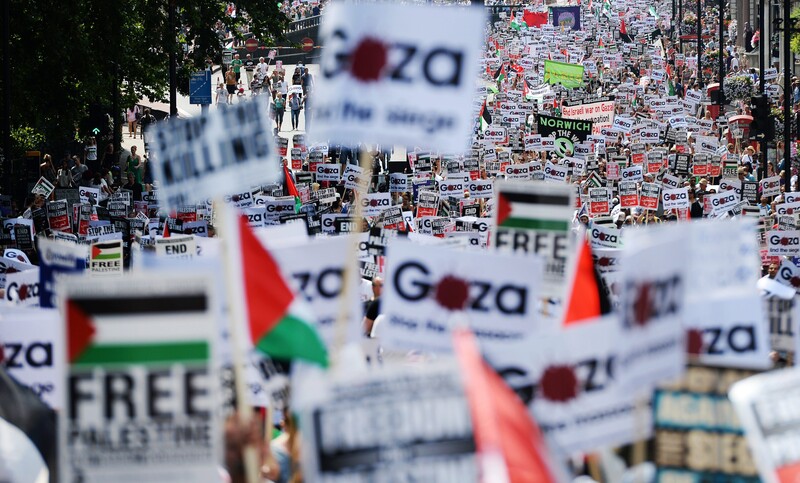 |
The UK-based Campaign Against Antisemitism was formed after massive protests against Israel’s military offensive in Gaza were held in London in the summer of 2014. EPA
The Campaign Against Antisemitism is a British propaganda organization and registered charity that specializes in defaming Palestine solidarity campaigners. When I launched a petition calling for the group to be deregistered, it responded in a hostile manner.
|
It first tried to persuade the website Change.org to take the petition down. When that failed, its supporters attacked the petition in an article published by the Daily Mail, a paper which once praised Adolf Hitler for having “saved Germany from Israelites of international attachments.”
Originality not being its strong point, the Campaign Against Antisemitism then alleged that I was a “notorious anti-Semite.”
The Campaign Against Antisemitism was formed in August 2014 during a major Israeli offensive against Gaza. Its purpose was to paint Palestine solidarity campaigning and opposition to Zionism, Israel’s state ideology, as anti-Semitic.
There was massive opposition to the attack on Gaza among the British public; an estimated 150,000 people took to the streets of London in one protest. Such was the climate of opinion that Sayeeda Warsi, then a Foreign Office minister, resigned from the government, describing its support for Israel as “morally indefensible.”
For some time, there had been a constituency within British Zionists who felt that establishment groups such as the Board of Deputies of British Jews were not active enough in defending Israel.
The Campaign Against Antisemitism organized a demonstration outside the Royal Courts of Justice in London in late August 2014, which it claimed was 4,500 strong. Its purpose was to link the protests against the attack on Gaza to anti-Semitism.
Ephraim Mirvis, Britain’s chief rabbi, spoke at the event, as did Vivian Wineman, then president of the Board of Deputies. Wineman was loudly booed.
Promoting harmony?
If it was true that there was an increase in anti-Semitism as a result of the attack on Gaza, then the obvious thing to do would be to emphasize that Britain’s Jewish community is not responsible for Israel’s actions, and that despite its claims, Israel does not act in the name of all Jews, many of whom strenuously oppose its policies and actions. The Campaign Against Antisemitism had no interest in doing so.One of the campaign’s stated objectives is to “promote racial harmony.” In practice, its activities are designed to achieve the exact opposite.
The Campaign Against Antisemitism consistently targets Muslims.
A search of the campaign’s archive reveals just two articles that mention Britain’s main fascist organizations – the British National Party, the English Defence League and the National Front. Those groups include Holocaust deniers within their ranks.
By way of contrast, there are some 77 articles attacking Jeremy Corbyn, the Labour Party leader and a veteran defender of Palestinian rights.
Meanwhile, 32 articles in the archive attack Shami Chakrabarti, a civil liberties campaigner and now a prominent Labour politician serving as shadow attorney general. In a 2016 report, she concluded that the Labour Party was “not overrun by anti-Semitism,” while acknowledging a “minority” of “hateful or ignorant attitudes and behaviors festering within a sometimes bitter incivility of discourse.”
That conclusion didn’t confirm the prejudices of the Campaign Against Antisemitism.
The Campaign Against Antisemitism reserved special animus for Gerald Kaufman, a longstanding lawmaker who died recently. In 2009, he compared the tactics of Israelis then attacking Gaza to those of the Nazis who killed his grandmother.
No less than 22 articles in the campaign’s archive attack Kaufman. The latest one – titled “Sir Gerald Kaufman MP’s words have left a rotting stain on our institutions” – shows that even death doesn’t prevent the Campaign Against Antisemitism deploying all its dirty tricks.
There is no one the Campaign Against Antisemitism hates as much as a Jewish opponent of Israel.
Serving the right
The campaign is at the service of the political right wing.Rebecca Massey, a prominent Labour Party activist in Brighton and Hove, has been accused of anti-Semitism for tweeting articles critical of Israel.
Ivor Caplin, a former defense minister who supported the illegal invasion of Iraq, is among those who have slandered Massey. Her real offense? She is a Corbyn ally, who has (successfully) contested an election to be a local party officer.
In its attack on socialists in the Labour Party, the Campaign Against Antisemitism, as a matter of course, talks about “racist Labour,” thus demonstrating that it lacks the political neutrality expected of a charity.
The Campaign Against Antisemitism is chaired by Gideon Falter, who is also a board member of the Jewish National Fund UK. The Jewish National Fund has a long history of supporting ethnic cleansing in Palestine.
Far from promoting racial harmony, the Campaign Against Antisemitism has sought to stir up conflict between Muslims and Jews.
“Littered with flaws”
Last year it published a report on “British Muslim anti-Semitism.” The report included a “profile” of the kind of person that the campaign was making allegations against. The profile was highly racist and offensive; according to the campaign, the typical Muslim anti-Semite was likely to be a first-generation immigrant and living in public housing. |
| The Campaign Against Anti-Semitism's Typical Muslim |
If someone had posted a similar portrayal of Jews, the campaign would have been the first to claim “anti-Semitism.”
The report alleged that “many British Muslims reserve a special hatred for British Jews.”
“On every single count, British Muslims were more likely by far than the general British population to hold deeply anti-Semitic views,” it added.
The conclusions were based on a poll conducted for the TV station Channel 4. Yet even the Community Security Trust, a staunchly pro-Israel group, raised doubts about the conclusions to which the Campaign Against Antisemitism jumped.
In a blog post for the Community Security Trust website, Dave Rich wrote: “This latest poll showed something else that is interesting, and is not specific to Muslims: that people who believe anti-Semitic things about Jews rarely think of themselves as anti-Semitic.”
“What is perhaps curious, though, is that this is not reflected in a more basic question that was asked in the same poll about how favorable or unfavorable Muslims feel towards Jewish people as a religious group,” Rich added. Asked what their feelings were towards Jews: on a sliding scale from 0-100 – where 0 is the least favorable – British Muslims scored 57.1 in their feelings towards Jews.
This hardly suggests rampant anti-Semitism.
The Campaign Against Antisemitism specializes in distorting statistics. In its annual “anti-Semitism barometer” report for 2015, it claimed that an opinion poll showed that “almost half (45 percent) of British adults believe at least one of the anti-Semitic statements shown to them to be true.”
The questions were carefully chosen to elicit the required answers. As Anshel Pfeffer from the Tel Aviv newspaper Haaretz observed – regarding the statement that Jews talk about the Holocaust too much in order to gain sympathy – “too many Jews … are often too quick to bring up the Holocaust in order to make a point. … Holding that opinion doesn’t necessarily make you an anti-Semite.”
Another statement was that “Jews’ loyalty to Israel makes them less loyal to Britain than other British people.” Is it surprising that one in five people believe this given that Jewish anti-Zionists are regularly accused of being “traitors”?
Clearly, many Zionists believe that their first loyalty is to Israel. That was why Israel’s ministries for foreign affairs and immigrant absorption distributed a questionnaire to American Jews a few years ago, asking where their loyalties would lie in the event of a crisis between the two countries.
Pfeffer’s conclusion was that the Campaign Against Antisemitism created “its own definition of anti-Semitism, which is more a reflection of what is impolite to say in public than what is actual bias against Jews.”
Anti-Semitism is hostility to Jews as Jews, not the holding of ephemeral beliefs.
The Institute for Jewish Policy Research in London has found that the Campaign Against Antisemitism’s “barometer” report was “littered with flaws” and the group’s work “may even be rather irresponsible.”
The institute has criticized the way that the Campaign Against Antisemitism has used data collected by the polling agency YouGov to make the “rather sensationalist claim that almost half of all British adults harbor some sort of anti-Semitic view.” YouGov had been commissioned to undertake the poll by the Campaign Against Antisemitism.
According to the Institute for Jewish Policy Research, “a far more accurate and honest read” of the data would “highlight the fact that between 75 percent and 90 percent of people in Britain either do not hold anti-Semitic views or have no particular view of Jews either way, and only about 4 percent to 5 percent of people can be characterized as clearly anti-Semitic.”
“Bordering on hysteria”
The Campaign Against Antisemitism has claimed that one in four British Jews had considered leaving the country in the past few years because of rising anti-Semitism.Even The Jewish Chronicle – an unmistakably pro-Israel publication – poured cold water on that claim. The newspaper’s own poll published in 2015 concluded that 88 percent of British Jews had no intention of emigrating.
The Campaign Against Antisemitism has also claimed that more than half of all British Jews felt that anti-Semitism echoed that of the 1930s. Anshel Pfeffer witheringly observed that if the Campaign Against Antisemitism and most British Jews “actually believe that, then it’s hard to take anything they say about contemporary anti-Semitism in their home country seriously.”
Pfeffer added that the conclusion showed “a disconnect bordering on hysteria … not only are they woefully ignorant of recent Jewish history but have little concept of what real anti-Semitism is.” Which just about sums up the Campaign Against Antisemitism.
The Campaign Against Antisemitism has claimed, too, that 84 percent of Jews believed boycotts of businesses selling Israeli products to be intimidation. This “finding” contrasts sharply with a rigorously controlled, academic survey on “The Attitudes of British Jews Towards Israel” by the sociology department at City, University of London.
That 2015 survey found that 24 percent of British Jews would support some sanctions against Israel if they thought it would encourage Israel to engage in the “peace process.” A “sizeable minority” (34-41 percent) among the young, the highly qualified academically and those who were not affiliated to a synagogue were in favor of sanctions under such circumstances, according to the survey.
The City survey also found that while 59 percent of British Jews identify themselves as Zionists, nearly a third – 31 percent – didn’t.
Other “findings” that have alarmed the Campaign Against Antisemitism were that 45 percent of Jews felt their family was threatened by Islamist extremism, 77 percent of Jews have witnessed anti-Semitism disguised as a political comment about Israel and 82 percent of respondents said that media bias against Israel fuels persecution of Jews in Britain.
These were not only replies to loaded questions, but ideas planted in the heads of people with the goal of obtaining the “right” answer. No attempt was made to put a question based on countervailing assumptions such as “Do you agree that criticism of Israel is not the same as anti-Semitism?” The result of such an approach would have been interesting, but it wasn’t on the agenda of the Campaign Against Antisemitism.
No doubt, the campaign is unconcerned with the criticisms that have been made of its work. The purpose of its work appears to be to make Jewish people feel insecure and encourage them to leave for Israel.
Zionism is founded on the “negation of the diaspora” – the belief that Jews do not belong in a non-Jewish society. After the killing of four Jews in a Paris kosher supermarket two years ago, Benjamin Netanyahu, Israel’s prime minister, flew to France and told French Jews to emigrate.
Fighting anti-Semitism has never been part of Zionism.
The Campaign Against Antisemitism has stated that it was formed to tackle anti-Semitism of “both a classical ethno-religious nature and also a political nature related to Israel.” In fact, the campaign devotes virtually all of its time to the latter and what it calls the “international definition of anti-Semitism.”
This definition is virtually identical to a working definition of anti-Semitism drawn up by the European Union’s Monitoring Centre on Racism and Xenophobia (now the Agency for Fundamental Rights) in Vienna. The definition was not formally adopted by the EU and was removed from the website of the agency several years ago.
The “definition,” previously vanquished, has come back to life. Originally drawn up in consultation with the pro-Israel lobby, the definition has now been given a veneer of respectability having been endorsed – with minor amendments – by an intergovernmental body called the International Holocaust Remembrance Alliance, which consists of 31 countries including the far right and anti-Semitic Polish and Hungarian governments. The definition conflates criticism of Israel with anti-Semitism.
Not only Britain’s Prime Minister Theresa May, but Jeremy Corbyn too has lent his support to this bogus definition of anti-Semitism.
All Britain’s major political parties are signed up to this definition. The Campaign Against Antisemitism is one of the beneficiaries.
Our task is clear. Palestine solidarity activists have to build a campaign against this definition of anti-Semitism, just as they did with its predecessor.
Tony Greenstein is a founding member of the Palestine Solidarity Campaign and the author of The Fight Against Fascism in Brighton and the South Coast.


