Showing posts with label Sydney Webb. Show all posts

17 January 2019

Support the Picket of Brighton Fabians and War Criminal Ivor Caplin

Say No to the pro-Israel Jewish Labour Movement and the Weaponisation of Anti-Semitism


Ivor Caplin was a Defence Minister in 2003 at the time of Blair’s war in Iraq. When the Chilcott Inquiry Report came out Caplin made it clear that he stood by an invasion that is held responsible for up to 1 million Iraqi deaths. The decision of the International Military Tribunal which presided over the trial of the Nazi war criminals at Nuremburg in 1946 made it clear that in accordance with the London Charter, to plan or instigate an aggressive war is a crime according to international law. The Iraq War was a war of aggression and Caplin was integral to the decision to go to war and therefore a war criminal.
It is surprising that Brighton Fabians has nonetheless decided to invite Caplin to speak to them on the topic Why Anti Semitism affects Labour's Political Ambitions". Perhaps for their next meeting they could invite the Yorkshire Ripper to give a lecture on the evils of violence against women? Or perhaps Tommy Robinson could help the Fabians out with a talk on the benefits of multi-racialism?
Fabian advert for meeting next Friday
No group has done more to spread the idea that the Labour Party is an anti-Semitic party than the JLM. They have targeted Jewish anti-Zionists in particular. They have directed their spleen at the non-Zionist Jewish Voice for Labour. Not only have I been expelled but Black-Jewish activist Jackie Walker has been suspended for over two years as a result of the JLM’s false and malicious allegations.
Meanwhile the JLM MPs like Louise Ellman are in the forefront of the attack on Palestinians. Only last week Ellman moved a motion seeking to cut off British funding for Palestinian Education in the West Bank. She did so in the company of a list of parliamentary lepers such as Tory Theresa Villiers, Stephen Crabb, John Howell, Andrew Percy, Guto Bebb and Bob Blackman. Bringing up the rear was Jim Shannon from the sectarian Protestant Democratic Unionist Party. Ellman is an officer of the JLM.
Historically the Fabians supported imperialism and racism, the British Empire in particular. In their 1900 pamphlet Fabianism and the Empire edited by George Bernard Shaw, the Introduction, made their position clear in the light of the forthcoming General Election.
... it is important that voters should make up their minds what Imperialism means. ... if it means a well-considered policy to be pursued by a Commonwealth of the communities flying the British flag, then it is as worthy and as weighty an issue as an election could turn on.   
Compare this with the policy of communists and socialists for the independence of the colonies. In 1929, Fabian architect, Sydney Webb (Lord Passfield) became Colonial Secretary. Zionism was an integral part of the British Empire. It is therefore no surprise that Fabians today should invite the anti-Corbyn JLM as a speaker. When Owen Smith challenged JC for the leadership, no less than 92% of the JLM voted for Smith and a mere 4% voted for Corbyn.
The JLM describes itself as the sister party of the Israeli Labour Party. The ILP was a party of government in Israel for the first 30 years in Israel (&today is almost irrelevant in Israeli politics) was responsible for organising the ethnic cleansing of over ¾ million Palestinians in 1948. Without the removal of the Palestinians there could be no Jewish state.
Today the ILP advocates segregation between Jew and Arab.  It believes in a Jewish state with as large a Jewish majority as possible. It is part of a national consensus that opposes the presence of non-Jews. That is why the ILP supported Netanyahu’s attempts to physically deport Black African asylum seekers back to Africa.
The JLM has assiduously waged a scurrilous campaign in the Labour Party painting the Left as ‘anti-Semitic’. What it and the Zionist meant by this was made clear when they made the adoption of the IHRA definition of anti-Semitism a cardinal principle. The IHRA is based upon 11 illustrations of ‘anti-Semitism’ 7 of which relate to Israel. Calling Israel a racist state is defined as anti-Semitism. 
Traditionally anti-Semitism was understood as hatred of Jews not a state. In the words of the Oxford English Dictionary, anti-Semitism was ‘hostility to or prejudice against Jews’.  That is still how the vast majority of people understand it but the Zionists are not concerned with traditional anti-Semitism but with defending Israel.
That is why a group of us, Labour Party and Palestine solidarity supporters and members are calling on people to demonstrate their opposition to both Ivor Caplin, the JLM and Fabian imperialism.
I should add as a personal note that the late Riad el-Taher, an Iraqi anti-war activist who was elected to the Executive of Hove Labour Party was fingered by Caplin (like many other members) for expulsion from the Labour Party. Riad was ‘administratively’ expelled i.e. without the right of appeal, by Iain McNicol. Riad was gaoled for 10 months in 2011 for having breached British sanctions against Iraq in the 1990’s.  Sanctions which led to the death of an estimated half a million Iraqi children. When confronted with this, US Secretary of State Madeleine Albright breezily declared of these deaths that ‘we think the price is worth it.’
This is the kind of man that the Fabians have invited to speak to them.
Tony Greenstein

11 July 2018

Fabian Imperialism is alive and kicking at the New Statesman


The Staggers Support for Zionism and Apartheid is bolstered by the fake anti-Semitism narrative


Emblazoned across the New Statesman’s masthead is the slogan ‘Free thinking since 1913’. Unsurprisingly it is a lie but all organisations like to wrap themselves in a comfort blanket. In the 1930’s it was best known for its support for Stalinism, the purges included. Its commitment to ‘free thinking’ did not extend to publication of George Orwell’s dispatches from the Spanish civil war, because they criticised the Stalinist attacks on the Anarchists and POUM.
The junk Zionist article that Jasper Jackson refused to allow a reply to


Born in the womb of Fabianism, the New Statesman soon abandoned even a token relationship to socialism, hence why its current editor Jason Cowley claims it is ‘celebrated for its progressive and liberal politics.’ The New Statesman does not do socialism or anti-capitalism, though a couple of its contributors would probably claim a passing attachment to socialist politics.
The New Statesman was formed in 1913 by Beatrice and Sydney Webb and it was as devoted to the British Empire as the Tories. Unlike the Tories who made no secret of their belief that they intended the Empire to last forever, a source of perpetual unearned riches, they were the moral wing of imperialism which held that colonialism was an act of self-sacrifice. The New Statesman believed that Britain was holding the colonies in trust for the natives as and until they had reached the requisite stage of civilisation.
Laurie (Red) Penney has been defanged - a lifestyle columnist
Sydney Webb was the prime representative of this wing of moral imperialism. As Lord Passfield, he was Secretary of State for the Colonies and the Dominions in the 1929-31 MacDonald government. In this capacity he issued the Passfield White Paper in response to the Report of the Hope-Simpson Report which arose out of the 1929 Arab riots. It recommended drastic reductions in Jewish immigration to Palestine. For anyone wanting to understand the background to the apartheid nature of the State of Israel today then this Report is required reading.
Crossman was the most ardent Zionist of all the New Statesman's editors

In A Nation Reborn Crossman regrets that the Zionist settlers didn't achieve their goals earlier since then they could have wiped out 'the aboriginal population'
The New Statesman has a long and inglorious record of support for Zionism. Perhaps its most openly racist editor was Richard Crossman (1970-72, though Paul Johnson runs him a close second), who served as Housing Minister in the Wilson government. In a memorial lecture to Chaim Weizmann, Israel’s first President, in 1959 Crossman regretfully noted in respect to the colonists, that “No one”, at least until the 20th century, had 

“seriously challenged their right, or indeed, their duty, to civilise these continents by physically occupying them, even at the cost of wiping out the aboriginal population”. 


If only the Zionist settlers had “achieved their majority before 1914, they would have been accepted without any compunction of any kind”.  
Owen Jones - the Guardian's tame left correspondent plies his wares at the Staggers


Crossman’s views about the rights and duties of settler colonialism fitted in with the moral debt that the civilised nations owed to their backward brothers. Settler colonialism, be it in southern Africa or the Middle East was seen as the most efficacious means by which the natives might be civilised. If that meant wiping out some of them, as a way of teaching good manners, then that was a price worth paying.
Sydney Webb/Lord Passfield the New Statesman's founder later became Colonial Secretary

Zionism was the bastard offspring of the New Statesman’s political and cultural outlook. It was seen as redressing an age old wrong, fitted in with the romantic imperialist view of the ‘restoration’ of the Jews and of course was of benefit to British imperial interests in the Middle East. 
Kingsley Martin -   The New Statesman's longest serving editor
It was only under the editorship of Bruce Page (1978-82) and his successor Hugh Stephenson (1982-86) that the Palestinians began to get more sympathetic coverage in the New Statesman, in part because of the Israel’s invasion of Lebanon in 1982 when over 20,000 Lebanese were killed. 


Supporting Zionism today

Although the New Statesman carries a few articles today on particular Israeli outrages, it is a firmly Zionist publication. What the New Statesman will never do is question the reasons why Israel behaves as it does.  It will not question Zionism, the ideology and movement that  created the Jewish, i.e. Apartheid nature of Israel. It is perfectly happy to carry articles on the Gaza massacres, when Israel gunned down over 120 unarmed Palestinians, especially when penned by the far-Right editor of the Jewish Chronicle, Stephen Pollard, but it won’t ask why there is land and education segregation in Israel.
The New Statesman really think its being clever to get the Jewish Chronicle's far-Right editor to issue a mild rebuke to Israel - the New Statesman preferred White liberals to Black spokesmen for the liberation movements in South Africa too

Pollard is well qualified to write articles on the murder of Palestinians being a member of the cold war Henry Jackson Society, former Editor of the Daily Express and someone who declared that Polish anti-Semite Michal Kaminski was ‘one of the greatest friends to the Jews in a town where antisemitism and a visceral loathing of Israel are rife. 
Kaminski supported the campaign to rehabilitate the name of Jedwabne, a village in Poland where, in 1941, up to 1600 Jews had been herded into a barn which was then set alight, by their fellow Poles.  As Pollard explained, although an anti-Semite Kaminski was also a strong supporter of Israel.

Supporting the Anti-Semitism Witchhunt in Labour 

It is no surprise that the New Statesman has been one of the most fervent supporters of the right-wing Labour Zionist campaign to paint the Labour Party as overrun by anti-Semitism. What is surprising is that this dedication extends to providing PR coverage for different factions within the Jewish Labour Movement, the British wing (or sister party) of the racist Israeli Labour Party.
Early last week a report appeared in the Jewish Chronicle stating that  the JLM’s war criminal Chair, Ivor Caplin (Defence Minister at the time of the Iraq War), after having met with Labour’s General Secretary, Jennie Formby, was happy with the Labour Party’s new Anti-Semitism Code of Conduct.  And so he should have been since it rested on an amended form of the fake IHRA definition of anti-Semitism.
However when news of this leaked out Caplin was subject to furious attacks by his fellow Zionists. What his opponents objected to in the new Code was best put by Pollard:

‘instead of adopting the definition as agreed by all these bodies, Labour has excised the parts which relate to Israel and how criticism of Israel can be antisemitic.’ [The Jewish Labour Movement did not approve Labour’s anti-Semitism guidelines. Here’s why]
The Staggers Corporate Editor - Jason Cowley

Caplin had clearly forgotten that the anti-Semitism witchhunt had nothing to do with anti-Semitism as opposed to Zionism and Israel. Even worse he didn’t seem to grasp that the purpose of the anti-Semitism witch-hunt was that it had to continue unti Corbyn’s resignation.
You might expect that the New Statesman would cover these things fairly and accurately.  That would be naive.  Instead it ran a PR puff on behalf of Caplin’s critics The Jewish Labour Movement did not approve Labour’s anti-Semitism guidelines. Here’s why.
The article by Katz and Langleben, the latter a councillor who had managed to wage a successful campaign to convince the electors in West Hendon that Labour was anti-Semitic.  So successful was he that they decided to oust him! Their article is a classic example of what Noam Chomsky called the manufacturing of consent. It rests on the taken for granted assumption that there is, what the authors call an ‘anti-Semitism crisis’ in the Labour Party.  The only crisis is the continuing levelling of false accusations by the Israeli states surrogates.
For the past three years the Labour Party has been the subject of a concerted campaign of false and bogus accusations of anti-Semitism.  It began with allegations that Corbyn had associated with a holocaust denier and its most recent manifestation was the bogus issue of Corbyn having defended an allegedly anti-Semitic mural on the grounds of free speech.
What is the role of the New Statesman?  Has it ever critically evalued the false ‘anti-Semitism’ campaign which stretches from those well known anti-racist papers, the Sun and Mail to the neo-liberal Guardian and the BBC? Is the New Statesman’s role simply to echo the ‘anti-Semitism’ drumbeat of the mass media?
There seems to be an open door in the New Statesman to any propaganda which reinforces the wall to wall media consensus that the Labour Party is overrun with anti-Semitism.
It is no surprise that in the wake of the attack and pending demolition of Khan al-Ahmar, to say nothing of Israel’s gunning down of over 120 unarmed Palestinians in Gaza, that Zionist organisations should resort to the tried and trusted tactic of alleging anti-Semitism. 
The JLM, of which Langleben and Katz are senior officers, is affiliated to the World Zionist Organisation, whose Land Settlement Division funds the settlement expansion in Palestine that dictates the demolition of Palestinian villages. Did it ever occur to the New Statesman that this might have some bearing on the PR puff that constituted Langleben/Katz’s article?  Did it ever occur to Jasper Jackson. who commissioned the article  to ask how the JLM’s affiliation to the WZO squares with their professed support for a  two state solution?
When I spoke to Jasper he didn’t seem to have a clue about the issues.  He was unable to even comprehend what the significance of the IHRA definition of anti-Semitism was and why Zionist groups were so keen on it rather than the 6 word definition in the OED.
I therefore submitted a response to the Katz/Langleben’s PR puff.  According to Jasper it was unsuitable.  Why?  Well of course he had no answer.
Tony Greenstein 

Although flawed Labour’s Anti-Semitism Code at least makes an attempt to distinguish between anti-Semitism and anti-Zionism
I can quite understand why Mike Katz and Adam Langleben of the Jewish Labour Movement are busily trying to repair the damage caused by their Chair, Ivor Caplin giving his assent to Labour’s new Anti-Semitism Code of Conduct.  However the internal difficulties of the JLM are less important than the principal issues at stake such as the weaponisation of anti-Semitism in the battle against the Corbyn leadership of the Labour Party.
Anti-Semitism is remarkably easy to define. It is not a mystery. According to the Oxford English Dictionary it is ‘Hostility to or prejudice against Jews’.  According to the definition drawn up by Oxford academic Dr Brian Klug “Antisemitism is a form of hostility to Jews as Jews, where Jews are perceived as something other than what they are.”  If you ask the man (or woman) on the Clapham Omnibus what is anti-Semitism they will tell you that it is someone who doesn’t like Jews and they would be right.  Anti-Semitism has nothing to do with opposition to Zionism or criticism of Israel.
Katz, Langleben and the pro-Israel Board of Deputies are insistent that the International Holocaust Remembrance Alliance definition of anti-Semitism is the only definition that matters. Why?  It is a strange definition that is over 450 words long. As Sir Stephen Sedley, the Jewish former Court of Appeal Judge wrote, the IHRA definition ‘fails the first test of any definition: it is indefinite.’
The reason why the IHRA is so long is because it attempts to conflate anti-Zionism and anti-Semitism. It is therefore not at all surprising that the Zionist movement in this country has reacted furiously to Labour’s new Anti-Semitism Code of Conduct which removes 4 of the 11 ‘illustrations’ of anti-Semitism in the IHRA.
In the words of Jewish Chronicle editor Stephen Pollard, the problem is that instead of adopting the complete definition ‘Labour has excised the parts which relate to Israel and how criticism of Israel can be antisemitic.’ For all of Katz and Langleben’s sophistry, their concerns relate to this one central point.
Katz and Langleben refer to the widespread adoption of the IHRA whilst failing to mention that the University College Union and Liberty have both rejected it because of the threat to freedom of speech that it poses.  Anti-racist and Muslim groups have also opposed it because it does nothing in the fight against racism.  The fact that the College of Policing has adopted it, given the record of police racism in this country, is not encouraging.
Yes it is true that 31 countries have adopted it, but the fact that these countries include the anti-Semitic governments of Hungary and Poland, to say nothing of the V-4 Visegrad Group should be a source of shame not pride.  What conclusions should we draw about a definition of anti-Semitism that Viktor Orban can sign up to?  This is the same Orban who believes that Admiral Horthy, the pro-Nazi ruler of Hungary during the war, who presided over the deportation of nearly half a million Jews to Auschwitz, was an ‘outstanding statement’.
The government of Poland too, which made it a criminal offence to mention the fact that thousands of Poles collaborated with the Nazi murder of Jews is also happy with the IHRA.
Perhaps Katz and Langleben would care to read Chemi Shalev’s, Menachem Begin Would Be Ashamed of Netanyahu’s Whitewash of Hungary’s anti-Semitism, Poland’s Holocaust Revisionism?  in Ha’aretz.  Shalev was referring to the recent endorsement, by the Prime Minister of Israel, of an accord with Poland’s anti-Semitic government which endorses a policy of  covering up small matters like the burning alive of 1,600 members of the Jewish community of Jedwabne , who 77 years ago were herded into a barn by fellow Poles. This is the real anti-Semitism that Katz and Langleben are silent about.
I don’t hear the JLM protesting about the invitation that Netanyahu has extended to his friend Viktor Orban, to make a state visit to Israel later this summer.  Meanwhile Jan Tomasz Gross, Anna Bikont and the other historians who uncovered what happened in Jedwabne, Radzilow and other villages in Poland face being sued in Polish courts.
Katz and Langleben’s allegation that ‘The Jewish community have clearly outlined their own definition of Jew hatred’ by which they mean the IHRA is simply untrue.  If you were to stop most Jewish people in the street and ask them what anti-Semitism was they would say hatred of Jews not criticism of Israel. What Langleben and Katz mean refer to as the Jewish community is the Zionist movement.
Nor is it true that Poale Zion/JLM have been the Labour Party’s Jewish affiliate since 1920.  It has been Labour’s Zionist affiliate. This is part of the shameful record of Labour’s support for the British Empire.  Unfortunately the Labour Party supported the colonisation by the Zionist movement of Palestine as it did many other colonial adventures.  The JLM is not a group that anti-Zionist and anti-racist Jews are able to join.  Indeed the JLM is open to non-Jews who are Zionists.
Labour’s new Anti-Semitism Code of Conduct has many flaws, not least the fact that it rests on a cut down version of the IHRA Definition of Anti-Semitism.  You cannot make a silk purse out of a sow’s ear. Instead of amending the definition they should have junked it altogether. Anti-Semitism is not a mystery that needs a special definition.
At a time when the far-Right in Britain, Europe and America overwhelmingly supports the Israeli state and Zionism and when the founder of the alt-Right, neo-Nazi Richard Spencer declares himself a White Zionist the attempt of Katz and Langleben to pretend that their opposition to Labour’s new Anti-Semitism Code of Conduct has anything to do with fighting hatred of Jews is risible.
Tony Greenstein  

See also:

New Statesman Bows to Zionist Censorship as they Delete Article on Israel’s Occupation


1 December 2016

New Statesman Bows to Zionist Censorship as they Delete Article on Israel’s Occupation

If the New Statesman boycotts the Palestinians we should boycott the New Statesman

Salah Ajarma on conditions under occupation

Salah Ajarma on the Right of Return

Founded in 1913, the New Statesman has long been identified with the Fabian Right of the Labour Party.  In the 1930’s under the influence of the Webbs, it became an uncritical supporter of Stalinist Russia, which it saw as socialist.  Censorship and the New Statesman have long gone together.   Wikipedia describes how, in 1938 under its longest serving editor, Kingsley Martin, it refused to publish George Orwell's dispatches from Barcelona during the Spanish civil war because they criticised the communists for suppressing the anarchists and the left-wing Workers' Party of Marxist Unification (POUM).  These later became famous in Orwell’s book Homage to Catalonia.
'It is an unfortunate fact,' Martin wrote to Orwell, 'that any hostile criticism of the present Russian regime is liable to be taken as propaganda against socialism'.  Martin also refused to allow any of the magazine's writers to review Leon Trotsky's anti-Stalinist book The Revolution Betrayed.
The view from Aida refugee camp, the Apartheid Wall separates it from Gilo settlement on the hill above

Israeli forces raid Aida refugee camp Sep. 9. (Photos: Muhammad al-Azzeh)
Despite this record the New Statesman, with the endearing modesty for which it is famous, proclaims that it is ‘celebrated for its progressive politics, scepticism, free thinking and the intelligence, range and quality of its writing.’

Unfortunately its progressive politics, free thinking and humbug have not prevented it from taking down from its web site a moving account of life in Aida refugee camp, which is just outside Bethlehem.  Aida is surrounded by Israel’s Apartheid Wall, which has resulted in the confiscation of  much of its best land.  The Wall is a hideous and ugly structure that is taller than the Berlin Wall which the New Statesman regularly assailed.

The New Statesman was the traditional voice of the ‘enlightened’ wing of British imperialism and it is no accident that Sydney Webb, one of its founders, later became Colonial Secretary as Lord Passfield in the 1929-31 Ramsey MacDonald government.  Whereas the Tories were open about the British Empire being the basis of British power in the world, Labour’s imperialists spoke the language of trusteeship, bringing civilisation to the backwards people, holding the land in trust for them.  Unlike the Labour Left, the New Statesman steered clear of any whiff of anti-colonialism.
A child is arrested and detained by Israeli occupation forces in Aida camp
It is, therefore, unsurprising that the New Statesman was for most of its history the strongest supporter of the Israeli state.  Israel could do no wrong under a succession of fiercely pro-Zionist editors.  Only in 1982 under Bruce Page and his successor, in the wake of Israel’s invasion of Lebanon, did the New Statesman wake up to the existence of the Palestinians and the transformation of Israel from an oasis of socialism in the Middle East to a war-mongering and expansionist state that was the close ally of US imperialism.
The article the New Statesman editors removed was by Salah Ajarma, a well known Palestinian activist and founder of the Lajee Cultural Centre.   The article is a factual account of conditions in the refugee camp and the difficulty Palestinian youth face growing up in such an environment.  Of course it is understandable that the Zionist lobby would take exception to such an article since they deny that there is any occupation.  Although I haven’t read the Zionist objections to the article, I suspect it revolves around ‘anti-Semitism’ which these days is another name for the truth.
The UN Relief and Works Agency for Palestine Refugees in the Near East (UNRWA) and the Lajee Center inaugurated the first ever child-friendly spaces – a football pitch and a playground – in Aida refugee camp in Bethlehem. Photo: UNRWA/Alaa Ghosheh
As I wrote in an earlier post, The New Statesman & the Perpetuation of the Myth of Labour ‘anti-Semitism’ Carrying on a tradition – The New Statesman, Zionism and Imperialism the New Statesman has given full support to the ‘anti-Semitism’ smear campaign in the Labour Party.   
According to Zionist mythology, Israel is merely reclaiming the lands it lost 2,000 years ago from the indigenous population!  The Palestinians, like all native peoples, are invisible except when they engage in resistance, which the Zionists term ‘terrorism’.  The traditional Zionist attitude was summed up in the slogan ‘A Land Without a People for a People Without a Land.’
As the Palestine Solidarity Campaign statement below states, having commissioned and put Salah Ajarma’s article up on its web site, as part of a partnership agreement between the New Statesman and PSC, the NS then took the article down again after objections by two Zionist blogs.  What is particularly damning is that instead of explaining their reasons, the New Statesman has refused to even communicate with PSC or Salah.
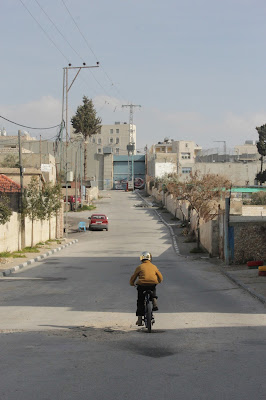
Aida refugee camp with the Wall ahead
The behaviour of the New Statesman is not an isolated example of political cowardice and concessions to Zionist settler colonialism.  In recent years the Guardian has undergone exactly the same metamorphosis such that it has been the leading campaigner in support of the ‘anti-Semitism’ smear campaign.  The liberal left is reverting to type as the Western ruling classes firm up their support for Israel.  The election of Donald Trump has been greeted with utter delight by Israel’s far-Right.  See for example Israeli Right hails Trump: 'The era of a Palestinian state is over' .
Our response to the New Statesman should be unequivocal.  We should support a boycott of this miserable paper that claims the affections of the Left.

 
Statement from Palestine Solidarity Campaign
Dear friend,

Palestinian voices are being censored and silenced. We cannot let this happen.
Earlier this month PSC commissioned an article from Salah Ajarma, the co-founder and Director of the Lajee Cultural Centre in Aida Refugee camp. The New Statesman published the piece as part of a two year partnership between the PSC and the New Statesman. Two pro-Israel blogs attacked the New Statesman for publishing the piece, shortly afterwards, the New Statesman deleted it without speaking to Salah or to PSC. They have since refused to offer any explanation or justification for the removal of the article.

This is a disgraceful attack on freedom of expression, a clear case of censorship, and a deliberate attempt to silence Palestinian voices. By doing this, the New Statesman have politically censored a human rights campaigner, who is living under very harsh conditions of military occupation in a refugee camp. We cannot stand by and let this happen. We cannot be silenced.


The red sloping roofs and lack of black water tanks identify the hilltop town as an Israeli settlement. It overlooks the Aida Refugee Camp, separated from it by the Wall.
It would appear the New Statesman have caved into political pressure to remove the article, and do not believe they owe Salah or PSC the courtesy even of a conversation: the editorial team won’t even take our phone calls. In an email to the PSC, the New Statesman stated that the article had been removed as a result of ‘reader complaints’, refusing any further elaboration and any editorial contact.

Salah's article describes the experiences of young Palestinian refugees in Aida camp and talks about how settlements impact his life and the lives of people in his community. New Statesman editors approved and published the article.

The New Statesman's actions are political censorship of a Palestinian human rights campaigner. We cannot stand by and let this happen.


This action does not align with the stated goals of the New Statesman to “hold our leaders to account and tell the stories that the world needs to hear”.
What is happening in Palestine is a story that the world needs to hear, and the account of a Palestinian should not be censored. The lack of explanation and refusal to speak to the Palestine Solidarity Campaign or Salah goes against all good journalistic standards and common courtesy
A giant key (said to be the world's largest) sits atop the entrance to the Aida Refugee Camp in Bethlehem, reminding residents to insist on their "right of return."

We did not want to make this public, we attempted to resolve the problem directly with the New Statesman, giving them the benefit of the doubt and attempting to speak to editors countless times.

However, we have now been told that the editors will not speak to us and that the decision to remove the article would not be explained or reversed.

We have a duty to stand up for justice, honesty, and integrity and so we must raise our voices about this.

Please join us to demand that the New Statesman
  • Republish the article
  • Offer an apology to Salah Ajarma for removing it without good cuase
  • Make a clear public statement as to your commitment to upholding the principle of freedom of expression
Please write to the editors of the New Statesman now – and show them that we will not be silenced and will not allow Palestinians to be censored.

In solidarity,
The team at PSC
Below is the article that the New Statesman has censored
The Frontline of Israel’s Settlement Regime by Salah Ajarma
Posted on November 18, 2016
Lajee Cultural Centre
By Salah Ajarma, the cofounder and director of Lajee Cultural Centre in Aida Refugee camp.

Aida refugee camp, in which I live and work, is on the edge of the famous town of Bethlehem. Our families established the camp in 1950 after being forcibly expelled from their homes by Zionist militias in 1948. Palestinians from our camp originate from villages in the Jerusalem and Hebron districts, just a few miles down the road. Those born since, still live in the refugee camp, and continue to struggle for the right to return to our homes.
In April 2000, me and a number of friends established the Lajee Centre, a community-based cultural centre for young refugees living in the camp. Through it we have sought to provide opportunities for the cultural, educational and social development of our young people, despite the violent military occupation under which we live. As an occupied refugee people, we are aware of the duty to educate our youth about their history and their rights. Only in this way will our struggle for freedom be carried to the next generation.

In 2002, Israel’s government began the construction of its illegal wall.[1] Its consequences are now perhaps well known – land confiscation, ghettoization, and an accelerated ethnic cleansing of Palestinians. In Aida the wall has been particularly obtrusive with its towering concrete blocks built directly opposite the Centre. The young people I work with have only ever known a life surrounded by this wall and under the constant surveillance of its ominous watchtowers. Before its construction, families and children would spend time in nature, in the olive groves that neighboured the camp. As one of the few green spaces available to us, I would often go there for picnics with my family when the weather was warm. This has now been shut off from us, creating a menacing, stifling atmosphere that we cannot escape. On the hill opposite, Israel’s illegal settlement of Gilo continues expanding onto land confiscated by the wall.

In October 2015, Aida Camp buried one of its sons, Abd al-Rahman Ubeidallah, who was shot in the chest by an Israeli sniper. He was 13 years old and killed on his way home from school. His peers, almost without exception, have all been arrested, beaten or fired upon. The head of Lajee’s film unit, Mohammad, was shot in the eye with a rubber-coated steel bullet whilst filming Israeli violations in the camp in 2013. We are routinely broken into by Israeli soldiers and border police who invade the camp, firing teargas indiscriminately and threatening our families over loudspeakers.
Mural in Aida depicting the Palestinian villages and towns from which the camp's residents were forcibly displaced after the Nakba in 1948
These intolerable conditions are particularly difficult for our young people who, in the midst of such cruelty, maintain an extraordinary optimism. It is difficult to understand how children raised in such an awful situation can remain so full of gentleness and hope. Lajee is always alive with laughter, dancing and singing and our youth have transformed this dreadful situation into a boundless love for our people and an insistent demand for freedom. Their resilience never ceases to inspire me, and it is for their future, and the future of my two young daughters, that I continue my work. These young people deserve to live with dignity and peace.

Our work in Lajee has found support from around the world. From the UK there has been a steady stream of delegations – teachers, trade unionists, students, doctors, politicians and academics – who have visited our Centre. Early this year I came to the UK with our dabke troupe, performing traditional Palestinian dance to packed out venues up and down the country. When Celtic supporters raised funds for Palestine in anticipation of a UEFA fine, it was to our football club that they donated over £79,000. Our experience of the generosity of the British people has left us in little doubt as to their values and their willingness to stand in solidarity with our just case.

The same cannot be said of the UK Government. As Palestinians, we know all too well the dishonourable history of Britain in our region, a legacy that has yet to be resolved. The UK Government, like many others, continues to support the discredited ‘peace process’ whilst taking very little meaningful action. Nowhere is this more evident than in the case of Israel’s continued construction of colonial settlements. The UK regards settlements as illegal and a barrier to peace, whilst nevertheless continuing to trade with them.[2] The contradiction between their stated aims, on the one hand, and the on-going financial relationship between UK-based companies and charities, on the other, has led to the longstanding perception amongst Palestinians that the UK Government is not serious about its desire for peace. What other explanation could there be for this inconsistency?
For us, talk of peace is contradicted by our daily experience of an oppression that receives significant material and financial support from the ‘international community’. That the collective efforts of the EU, the US and the UN have failed to even freeze the construction of settlements, never mind begin to dismantle them, feels indicative to Palestinians of the regard with which our rights are held. Settlement construction has become a touchstone issue because it reflects the reluctance of the international community to take even the most minimal action to check the relentless march of Israeli colonisation.

We need a different strategy, one in which the international community takes measures to pressure Israel into meeting its obligations under international law. Ending settlement trade is the place to start as there is already broad international agreement on their illegality. This international consensus needs to be actualised by halting the building of settlements and dismantling those already constructed. This would lay the foundation for a just peace in which the rights of the Palestinian people to national self-determination and to return to their homes can be realised.

For us in Aida, on the frontline of Israel’s settlement regime, the situation is urgent. Ending trade with settlements would deny Israel the means of maintaining their occupation and give us some relief from its immediate, choking effects. This would provide our children and us with the first glimmer of hope for a future of justice, dignity and peace.