War Criminals like Sharon Ended their days on the Gallows in Nuremburg
 |
| women survivors of the Phalangist/Israeli massacre |
In his Comment is Free article earlier this week, Avi Shlaim Emeritus Professor of International Relations at St. Antony's College, Oxford University asked that after the Sabra and Chatilla massacres, when Israeli troops lit up the night sky in order that their Phalangist fascist friends could butcher at least 2,000 unarmed civilians,
'who foresaw that the man who was declared unfit to be minister of defence would bounce back as prime minister?' This was after Sharon had been blamed by the Kahane Commission for allowing what took place to happen.
I wrote to Professor Shlaim that
'In Tribune, the old paper of Orwell, I wrote on 21.10.88. that:
'It is said that this who prevented him from become Chief of Staff ended up with him as Defence Minister and those who try to prevent him from becoming Defence Minister will end up with him as Prime Minister.'
In my view the ascent of this ex-Labour Zionist was all but inevitable.' Professor Shlaim wrote back very courteously to say that 'You were prescient about Sharon in 1988.'
Yet it was not that I was prescient. I have no ability to know what will or might happen in the future. I possess no crystal ball merely a method that I consider Marxist. Sharon's earliest actions, the murder of Palestinian refugees in the 1950's were sanctioned by Ben Gurion and Israeli Labour. One particularly vicious individual enjoyed killing refugees with his knife.
Sharon may have been condemned by well-meaning liberals Zionists internationally, but it was soon back to normal. In my view he was the only possible successor to Menahem Begin and the murder of Palestinians is hardly a crime in Israel. Coming from the bowels of Israeli Labour and retaining the friendship of that prime opportunist, Shimon Peres, his ascent to Prime Minister always seemed to be to be inevitable. Sharon was part of Zionism's traditions and not in any way antagonistic towards them.
Below are some other commentaries and articles on the welcome demise of Sharon.
Sharon's legacy is the empowerment of some of the worst elements in Israel's dysfunctional politics
The Guardian, Monday 13 January 2014
Ariel Sharon, who died on Saturday after eight years in a coma, was one of Israel's most iconic and controversial figures. His long and chequered career as a soldier and politician largely revolved around one issue: the conflict between Israel and its Arab neighbours. As a soldier he was involved at the sharp end of this bitter conflict. As a politician he became known as "the Bulldozer" on account of his contempt for his critics and his ruthless drive to get things done. Sharon was a deeply flawed character, renowned for his brutality, mendacity, and corruption. Yet despite these flaws he holds a special place in the annals of his country's history.
Sharon was an ardent Jewish nationalist, a dyed-in-the-wool hardliner, and a ferocious rightwing hawk. He also displayed a consistent preference for force over diplomacy in dealing with the Arabs. Reversing Clausewitz's famous dictum, he treated diplomacy as the extension of war by other means.
 |
| Israeli Prime Minister Menachem Begin and Minister Ariel Sharon (photo: Saar Yaacov/GPO |
The title he chose for his biography aptly summed him up in one word – Warrior. Like Shakespeare's Coriolanus, Sharon was essentially a fighting machine. His critics denounced him as a practitioner of "gun Zionism", as a perversion of the Zionist idea of the strong, fair-minded, and fearless Jew. To the Palestinians Sharon represented the cold, cruel, militaristic face of the Zionist occupation.
In 1953 Major Sharon committed his first war crime: the massacre of 69 civilians in the Jordanian village of Qibya. In 1982, as minister of defence, he led Israel's invasion of Lebanon in a war of deception that failed to achieve any of its grandiose geopolitical objectives. A commission of inquiry found Sharon responsible for failing to prevent the massacre by Christian Phalangists of Palestinian refugees in Beirut's Sabra and Shatila camps. This verdict was etched on his forehead like a mark of Cain. But who foresaw that the man who was declared unfit to be minister of defence would bounce back as prime minister?
 |
| Bush & Sharon 'man of peace' |
During the 2001 elections campaign Sharon tried to reinvent himself as a man of peace. His spin doctors cultivated the notion that old age was accompanied by a personal transformation from a sanguinary soldier into a genuine peace-seeker. President George W Bush famously described Sharon as "a man of peace". For the last 40 years the Arab-Israeli conflict has been my main research interest, and I have not come across a scintilla of evidence to support this view. Sharon was a man of war through and through, an Arab-hater, and a pugnacious proponent of the doctrine of permanent conflict. Following his rise to power Sharon therefore remained what he had always been – the champion of violent solutions.
The dominant preoccupation of Sharon's premiership was the "war on terror" against militant Palestinian groups. No peace negotiations with the Palestinian Authority took place between 2001 and 2006, and Sharon regarded this as something to be proud of. To his way of thinking negotiations necessarily involve compromise, and he consequently avoided them like the plague.
 |
| Former Israeli prime minister Ariel Sharon in Tel Aviv, December 16, 2001. (Photo: Moshe Milner/GPO) |
For this reason he also rejected all international plans aimed at a two-state solution. One was the 2002 Arab peace initiative, which offered Israel peace and normalisation with all 22 members of the Arab League in return for agreeing to an independent Palestinian state on the West Bank and Gaza, with a capital city in East Jerusalem. Another was the 2003 Quartet road map, which envisaged the emergence of a Palestinian state alongside Israel by the end of 2005.
Sharon was the unilateralist par excellence. His ultimate aim was to redraw unilaterally Israel's borders, incorporating large swaths of occupied territory. Stage one was to build on the West Bank the
so-called security barrier which the Palestinians call the apartheid wall. The international court of justice condemned this wall as illegal. It is three times as long as the pre-1967 border, and its primary purpose is not security but land-grabbing. Good fences may make good neighbours, but not when they are erected in the neighbour's garden.
Stage two consisted of the unilateral disengagement of Gaza in August 2005. This involved the
uprooting of 8,000 Jews and the dismantling of many settlements − a shocking turnaround by a man who used to be called the godfather of the settlers. Withdrawal from Gaza was presented as a contribution to the Quartet's road map but it was nothing of the sort. The road map called for negotiations; Sharon refused to negotiate. His unilateral move was designed to freeze the political process, thereby preventing the establishment of a Palestinian state and maintaining the geopolitical status quo in the West Bank.
The legal term "
depraved indifference" refers to conduct that is so wanton, so callous, so reckless, so deficient in a moral sense of concern, so lacking in regard for the lives of others, and so blameworthy as to warrant criminal liability. Sharon personified this kind of indifference in his approach to the Palestinians.
 |
| Israeli Prime Minister Ariel Sharon with U.S. President George W. Bush at the White House, April 14, 2004. (White House Photo) |
Towards the very end of his active life he bolted from the Likud to create the centrist party Kadima, but Kadima did not survive his demise. Today it has only two seats in the 120-member Knesset. So Sharon's last-minute attempt to bring about a realignment in Israeli politics ended in failure.
His enduring legacy has been to empower and embolden some of the most racist, xenophobic, expansionist, and intransigent elements in Israel's dysfunctional political system
Robert Fisk, The Independent, Sunday 12 January 2014
He was respected in his eight years of near-death, with no sacrilegious cartoons to damage his reputation; and he will, be assured, receive the funeral of a hero and a peacemaker. Thus do we remake history
Any other Middle Eastern leader who survived eight years in a coma would have been the butt of every cartoonist in the world. Hafez el-Assad would have appeared in his death bed, ordering his son to commit massacres; Khomeini would have been pictured demanding more executions as his life was endlessly prolonged. But of Sharon – the butcher of Sabra and Shatila for almost every Palestinian – there has been an almost sacred silence.
Cursed in life as a killer by quite a few Israeli soldiers as well as by the Arab world – which has proved pretty efficient at slaughtering its own people these past few years – Sharon was respected in his eight years of near-death, no sacrilegious cartoons to damage his reputation; and he will, be assured, receive the funeral of a hero and a peacemaker.
Thus do we remake history. How speedily did toady journalists in Washington and New York patch up this brutal man's image. After sending his army's pet Lebanese militia into the Sabra and Shatila refugee camps in 1982, where they massacred up to 1,700 Palestinians, Israel's own official enquiry announced that Sharon bore "personal" responsibility for the bloodbath.
He it was who had led Israel's catastrophic invasion of Lebanon three months earlier, lying to his own prime minister that his forces would advance only a few miles across the frontier, then laying siege to Beirut – at a cost of around 17,000 lives. But by slowly re-ascending Israel's dangerous political ladder, he emerged as prime minister, clearing Jewish settlements out of the Gaza Strip and thus, in the words of his own spokesman, putting any hope of a Palestinian state into "formaldehyde".
By the time of his political and mental death in 2006, Sharon – with the help of the 2001 crimes against humanity in the US and his successful but mendacious claim that Arafat backed bin Laden – had become, of all things, a peacemaker, while Arafat, who made more concessions to Israeli demands than any other Palestinian leader, was portrayed as a super-terrorist. The world forgot that Sharon had opposed the 1979 peace treaty with Egypt, voted against a withdrawal from southern Lebanon in 1985, opposed Israel's participation in the 1991 Madrid peace conference – and the Knesset plenum vote on the Oslo agreement in 1993, abstained on a vote for a peace with Jordan the next year and voted against the Hebron agreement in 1997. Sharon condemned the manner of Israel's 2000 retreat from Lebanon and by 2002 had built 34 new illegal Jewish colonies on Arab land.
Quite a peacemaker! When an Israeli pilot bombed an apartment block in Gaza, killing nine small children as well as his Hamas target, Sharon described the "operation" as "a great success", and the Americans were silent. For he bamboozled his Western allies into the insane notion that the Israeli-Palestinian conflict was part of Bush's monstrous battle against "world terror", that Arafat was himself a bin Laden, and that the world's last colonial war was part of the cosmic clash of religious extremism.
The final, ghastly – in other circumstances, hilarious – political response to Sharon's behaviour was George W Bush's contention that Ariel Sharon was "a man of peace". When he became prime minister, media profiles noted not Sharon's cruelty but his "pragmatism", recalling, over and over, that he was known as "the bulldozer".
And, of course, real bulldozers will go on clearing Arab land for Jewish colonies for years after Sharon's death, thus ensuring there will never – ever – be a Palestinian state.
Submitted by Ali Abunimah on Mon, 01/13/2014 - 21:31
 |
A civil defense worker inspects a child’s body among
victims of the September 1982 massacre at Sabra and Shatila refugee
camps in Beirut, during the Israeli invasion of Lebanon.
|
The tributes and praise from various world leaders, including US President Barack Obama and Swedish foreign minister Carl Bildt, for Israeli war criminal Ariel Sharon who died on Saturday, are vile but sadly predictable.
A UN insider with links to the Department of Political Affairs in New York – who asked not to be named in order to speak freely about the matter – told me that Ban’s statement "brings the UN’s obsequiousness towards Israel to a new high and the UN’s standing in the Middle East to a new low."
Ban offers his "condolences to the bereaved family and to the Government and people of Israel." Ban called Sharon "a hero to his people, first as a soldier and then a statesman."
Finally, says Ban, "Prime Minister Sharon will be remembered for his political courage and determination to carry through with the painful and historic decision to withdraw Israeli settlers and troops from the Gaza Strip."
Re-writing history
Ban does not acknowledge that Sharon’s "disengagement" aimed at isolating Gaza for "demographic" reasons and inaugurated a crushing siege that continues relentlessly.
But most striking, he does not acknowledge that Sharon will be most remembered by Palestinians, Lebanese and indeed quite a few Israelis, as the architect of Israel’s 1982 invasion of Lebanon in which tens of thousands of people were slaughtered.
To me, Ban’s tribute to Sharon is the most jarring because in many minds the United Nations is still supposed to stand for the post-World War II ideal of protecting the innocent against the violence of states and statesmen.
"Ill-judged"
My UN contact adds: "Palestinians, particularly those who suffered because of Sharon’s war crimes, deserve an apology, though Ban’s silence would have sufficed. Outside Israel Sharon is a war criminal, inside he is a hero. It would have been better for Ban’s credibility and his effectiveness as an ‘honest broker’ in the Middle East, had he chosen not to illustrate to the world in this ill-judged statement where he stood."
I’m not sure I agree Ban’s silence would have been preferable. At least now Ban is shorn of the mask of neutrality and there can be no doubt that he stands in full, enthusiastic complicity with Israel’s crimes against humanity.
We live in times with few moral moorings, where one day an utter mediocrity like Ban can praise Nelson Mandela, and a few weeks later call Ariel Sharon, an unrepentant mass-murder, a "hero."
[Below is an excerpt from "When Israel Was Apartheid’s Open Ally" by Lenni Brenner. It originally appeared in the November 5, 2007 edition of CounterPunch.]
Ariel Sharon, December 14, 1981: "South Africa Needs More Arms."
In 1989, Ariel Sharon, with David Chanoff, wrote Warrior: An Autobiography. He told of his 1981 trip to Africa and the US as Israel’s Defense Minister:
"From Zaire we went to South Africa, where Lily and I were taken to see the Angola border. There South Africans were fighting a continuing war against Cuban-led guerrilla groups infiltrating from the north. To land there our plane came in very high as helicopters circled, searching the area. When the helicopters were satisfied, we corkscrewed down toward the field in a tight spiral to avoid the danger of ground-to-air missiles, the Russian-supplied SAM 7 Strellas that I had gotten to know at the Canal.
On the ground I saw familiar scenes. Soldiers and their families lived in this border zone at constant risk, their children driven to school in convoys protected by high-built armored cars, which were less vulnerable to mines.
I went from unit to unit, and in each place I was briefed and tried to get a feel for the situation. It is not in any way possible to compare Israel with South Africa, and I don’t believe that any Jew can support apartheid. But seeing these units trying to close their border against terrorist raids from Angola, you could not ignore their persistence and determination. So even though conditions in the two countries were so vastly different, in some ways life on the Angolan border looked not that much different from life on some of our own borders."
Sharon went to Washington to deal with a range of Middle Eastern questions. He also
"took the opportunity to discuss with Secretary of State Alexander Haig, Secretary of Defense Casper Weinburger, and CIA Director William Casey other issues of mutual interest. I described what I had seen in Africa, including the problems facing the Central African Republic. I recommended to them that we should try to go into the vacuums that existed in the region and suggested that efforts of this sort would be ideally suited for American-Israeli cooperation."
By 1989 it was certain that apartheid was about to close down, hence Sharon’s "I don’t believe that any Jew can support apartheid." But a 12/14/81 NY Times article, "South Africa Needs More Arms, Israeli Says," gave a vivid picture of Israel’s earlier zeal for its ally’s cause:
"The military relationship between South Africa and Israel, never fully acknowledged by either country, has assumed a new significance with the recent 10 day visit by Israel’s Defense Minister, Ariel Sharon, to South African forces in Namibia along the border with Angola.
In an interview during his recent visit to the United States, Mr. Sharon made several points concerning the South African position.
First, he said that South Africa is one of the few countries in Africa and southwestern Asia that is trying to resist Soviet military infiltration in the area.
He added that there had been a steady flow of increasingly sophisticated Soviet weapons to Angola and other African nations, and that as a result of this, and Moscow’s political and economic leverage, the Soviet Union was ‘gaining ground daily’ throughout the region.
Mr. Sharon, in company with many American and NATO military analysts, reported that South Africa needed more modern weapons if it is to fight successfully against Soviet-Supplied troops. The United Nations arms embargo, imposed in November 1977, cut off established weapons sources such as Britain, France and Israel, and forced South Africa into under-the-table deals….
Israel, which has a small but flourishing arms export industry, benefited from South African military trade before the 1977 embargo.
According to The Military Balance, the annual publication of the International Institute for Strategic Studies in London, the South African Navy includes seven Israeli-built fast attack craft armed with Israeli missiles. The publication noted that seven more such vessels are under order. Presumably the order was placed before the 1977 embargo was imposed….
Mr. Sharon said Moscow and its allies had made sizable gains in Central Africa and had established ‘corridors of power,’ such as one connecting Libya and Chad. He said that Mozambique was under Soviet control and that Soviet influence was growing in Zimbabwe.
The Israeli official… saw the placement of Soviet weapons, particularly tanks, throughout the area as another danger.
South Africa’s military policy of maintaining adequate reserves, Mr. Sharon said, will enable it to keep forces in the field in the foreseeable future but he warned that in time the country may be faced by more powerful weapons and better armed and trained soldiers."
Ariel Sharon and George W. Bush
January 11, 2014
"Mondoweiss" - Ariel Sharon, who became prime minister of Israel despite a finding that he bore responsibility for the massacre of hundreds of Palestinian civilians two decades before, has died at 85 after being in a coma for eight years.
Sharon made a name for himself in 1953 by leading a massacre of Palestinian civilians in Jordan and in 1982, he led the Israeli invasion of Beirut, during which Israeli soldiers allowed Christian militias to enter two Palestinian refugee camps, Sabra and Shatilla, and massacres hundreds of civilians, including many women and children. Some reports put the death toll at 2,000-3,000.
Former Israeli prime minister and storied general Ariel Sharon, who was at the height of his power when he suffered a stroke in 2006 and fell into an irreversible coma
Among Palestinians and leftwing Israelis, he will be remembered as a powerful and reviled champion of Israel’s colonial settlement project, and the political force behind the construction of the vast concrete and steel separation barrier that snakes through the West Bank. Many will not forgive his role in the killing of hundreds of Palestinians in refugee camps in Beirut in the 1980s.
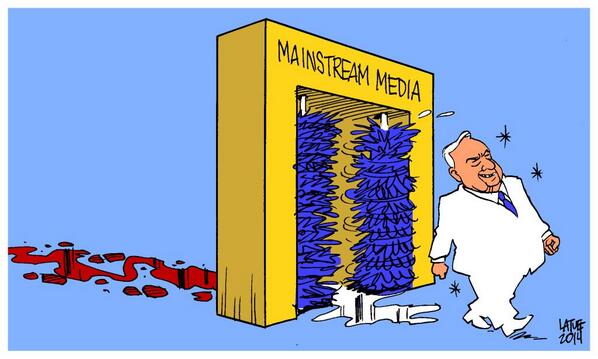
Carlos Latuff’s
headline is that the "war criminal dies, unpunished," with a cartoon at the link of a judge at the Hague expressing disappointment at the empty seat for the defendant. And he offers this visual summary of Sharon’s record:
"The Butcher of Sabra & Shatila dies"
Israel’s former prime minister Ariel Sharon, who spent the last eight years comatose after a series of strokes, died on Saturday, January 11. He was 85 years old.
A general, politician, statesman, and to many a notorious war criminal, Ariel Sharon was known to combine dogged personal ambition with strategic acumen and ruthlessness, which together shaped one of the most controversial and remarkable careers in Israeli political history.
His second paragraph deals with Sharon’s service in a unit Israeli PM David Ben Gurion launched to deal with Palestinian refugee militias in the 1950s. Including the Qibya massacre in Jordan:
As often as not, the attacks were against civilian targets, including refugee camps and villages in the Egyptian-occupied Gaza Strip and Jordanian-occupied West Bank. One such raid, on the village of Qibya in 1953, culminated in a massacre of 69 civilians who were gunned down as they tried to escape their homes or were buried under the rubble of detonated buildings. The public outcry was so severe that Ben-Gurion initially lied to the Israeli public…
When Reider gets to Sabra and Shatilla, he uses the figure 3000 for the dead and points out that the massacres had no real effect on Sharon’s political career: Sharon was found by the Kahan Commission to be responsible for the Sabra and Shatila Massacre of over 3,000 Palestinian refugees by Israel’s Lebanese allies, the Phalanges, and was made to resign – although he remained in the cabinet as minister without portfolio. Attempts to bring him to trial in international courts over the massacre went to no avail. Two years later, in 1984, Sharon came close to winning the leadership of the Likud, and returned to his ministerial career, first as minister for trade and industry and then as housing and construction minister. In the latter role, Sharon oversaw the construction of more than 144,000 housing units for Israeli settlers in the West Bank and Gaza.
NPR had a good obit this morning describing Sabra and Shatilla and Sharon’s responsibility for sparking the second intifada with his provocative visit to the Temple Mount in 2000.
CNN is also upfront about the massacre.
Many in the Arab world called Sharon "the Butcher of Beirut" after he oversaw Israel’s 1982 invasion of Lebanon while serving as defense minister…
During the Lebanon war in 1982, Sharon, a former army general then serving as Israeli defense minister, was held indirectly responsible by an Israeli inquiry in 1983 for the massacre of hundreds of Palestinians at the Sabra and Shatila refugee camps. He was forced to resign.
The Arab world reviled Sharon for masterminding the 1982 invasion of Lebanon, during which Israel’s Lebanese Christian allies massacred Palestinians in two refugee camps.
Sharon was forced to resign as defence minister after an Israeli inquiry found him indirectly responsible for failing to prevent the killings.
His provocative visit to Islam’s third holiest site, al-Haram al-Sharif (The Noble Sanctuary), while opposition leader, was said to have sparked the second Palestinian intifada (uprising) in September 2000.
Abdeen Jabara, former head of the American-Arab Anti-Discrimination Committee, offers this remembrance of the massacres:
Just after it occurred I went to Beirut to find injured survivors of the massacre of whom there were very few. I went with a nurse to a section of Beirut at night that had no electricity and with flashlights went thru some medical records which I took and copied to send to ADC headquarters so that we could get emergency medical visas for the victims. Ultimately some 15 young Palestinians and a few Lebanese in need of prosthetic devices, etc. came to the U.S for treatment.
While in Beirut I found a pamphlet written by an Israeli,
Amnon Kapeliouk, that was published in French that put responsibility for the massacre squarely on the shoulders of the Israelis. The commander of Israeli forces in West Beirut at the time was a person who was removed with Sharon after the Inquiry and later made Military Attache to Washington. I was head of ADC when that happened. We led a big campaign to have him declared persona non grata and also had a lawsuit filed against him by survivors. The lawsuit was dismissed on the grounds that he had diplomatic immunity. The Military Attache was quietly withdrawn and ultimately appointed to be the head of the Army.
I recall our going to a hotel in D.C. when Sharon came to visit. I got within a couple of feet of him in the hotel lobby and almost wanted to vomit. We had a protest but he was welcomed by official Washington with open arms.
That military attache was Amos Yaron. This
report says that Sabra and Shatilla had 2000 deaths.
The withdrawal from Gaza was a unilateral act intended to freeze out the Palestinian leadership and put the peace process itself on ice, so that Israel could deepen its hold on the West Bank. And guess what?
It worked.
In October, when Mr. Sharon led a reprisal raid into a Jordanian town said to be harboring militants after an Israeli woman and her two children were killed in the town of Yehud. Sixty-nine people, more than half of them women and children, were killed in the raid.
Deep in his story, Bronner offers a thorough
account of Sabra and Shatilla: The Israelis decided to secure several West Beirut neighborhoods, including Sabra and Shatila, Palestinian refugee camps where the Palestine Liberation Organization had residual bases and arms and thousands of fighters. But rather than move in themselves, the Israelis sent in the Phalangists, who killed hundreds of civilians. The massacre provoked international outrage, and many Israelis, already despondent that the "48-hour" Lebanon incursion had turned into a lengthy military and geopolitical adventure, were outraged. There were furious calls for Mr. Sharon’s resignation.
Mr. Sharon and Mr. Begin said this was intolerable slander. As Mr. Begin said, using the Hebrew word for non-Jews, "Goyim kill goyim, and they blame the Jews." Nonetheless, even Mr. Begin started to distance himself from Mr. Sharon, whose political demise began to seem inevitable.
The government established an official investigation of the massacre, led by Israel’s chief justice, Yitzhak Kahan. The investigating committee absolved Mr. Sharon of direct responsibility, but said he should have anticipated that sending enraged militiamen of the Phalange into Palestinian neighborhoods right after the assassination of the group’s leader amounted to an invitation to carnage. The committee
recommended his resignation.
Time magazine
reported that Mr. Sharon had actually urged the Gemayel family to have its troops take revenge on the Palestinians for the death of Mr. Gemayel. The magazine said Mr. Sharon made this point during his condolence visit to the family. It claimed further that a secret appendix to the Kahan Commission report made this clear.
Mr. Sharon sued Time for libel and
won a partial victory in Federal District Court in New York City. The court found that the secret appendix, which contained names of Israeli intelligence officers, included no assertion by Mr. Sharon of the need for Phalangist revenge. But it ruled that Mr. Sharon had not been libeled because he could not prove "malice" on the part of the magazine.
Thanks to Annie Robbins and Ira Glunts for help putting this together. This story initially put Qibya in Jordan. Thanks to a reader for correcting me.


