Is Zionism a Manifestation of Jewish Identity and if so What Does That Say About Being Jewish Today?
Introduction
Everyone knew that Apartheid in South Africa was a system of
racial domination by the White minority over the Black population. Likewise
everyone knew that Unionism in Northern Ireland meant Protestant
supremacy over the Catholic population, although in both cases apologists
for Apartheid and Unionism suggested that it was not so much about racism as
much as questions of identity and culture. [see
for example Graham Walker’s Old History:
Protestant Ulster in Lee's "Ireland", The Irish Review, No. 12
(Spring - Summer, 1992]
Supporters of Zionism, both the ideology and the movement, have
long denied that there is any comparison between Israel and Apartheid South
Africa. However the reality on the ground suggests otherwise. Every human
rights group of note – Amnesty
International, B’Tselem
and Human
Rights Watch - has produced detailed reports describing how
the mechanisms of Jewish supremacy work in Israel.
The IHRA ‘definition’ of anti-Semitism, whose sole purpose
was to conflate criticism of Zionism and Israel with anti-Semitism, says that
to even call the establishment of a Jewish state racist is anti-Semitic. Since
Israel is clearly a racist state, what
the IHRA is really saying is that something can be true and still be anti-Semitic.
So what is Zionism? Is it a synonym for being Jewish? Is it
a form of cultural or personal identity? And furthermore who should get to
define it? Is it the Zionists or their victims?
The Chakrabarti Report
In her Report
of 30 June 2016 into racism and ‘anti-Semitism’ in the Labour Party Shami
Chakrabarti wrote that:
it is for all people to self-define
their political beliefs and I cannot hope to do justice to the rich range of
self-descriptions of both Jewishness or Zionism, even within the Labour Party,
that I have heard. What I will say is that some words have been used and abused
by accident and design so much as to blur, change or mutate their meaning. My
advice to critics of the Israeli State and/or Government is to use the term
"Zionist" advisedly, carefully and never euphemistically or as
part of personal abuse.
This was a good example of the meaningless verbiage that advocates of the
diversity agenda and identity politics indulge in. Should we accept without
question people’s self-definition of their political beliefs? Do we accept neo-liberal
assertions that they are believers in economic and political freedom rather
than blood sucking vampires feeding off the NHS at the expense of health budgets?
If self definition is the end of the matter then there is no
way of distinguishing between the bogus and fraudulent and the truthful. Evidence
is irrelevant. Every exploiter becomes the exploited. Everything is subjective
and metaphysical. As David Feldman pointed out this leads
to “conceptual chaos”.
Should we accept that the Nazis were merely German patriots who were led astray? That is certainly the view of
those ardent supporters of Zionism, Germany’s Alternative for Germany which
is currently at 20% in the polls.

Members of the far-right Otzma Yehudit party, including party leader and National Security Minister Itamar Ben Gvir as well as Negev, Galilee and National Resilience Minister Yitzhak Wasserlauf hold a party meeting at the illegal West Bank settlement outpost of Evyatar, February 27, 2023. (Courtesy: Otzma Yehudit)
According to Chakrabarti’s vacuous wittering every political
charlatan can hide their corruption under the badge of cultural and personal
self-identity. Chakrabarti is right that anyone can self-define, but no one has
the right to expect someone else to accept that self-definition.
People defining themselves as Zionists in the belief that
they are merely expressing their ethnic and cultural identity are no different
from someone defining themselves as a Jeddi, which thousands
do. Except that the latter are harmless whereas Zionists are anything but.

Horatio Bottomley
A good example of this method was Horatio
Bottomley, who hid his frauds under the badge of patriotism. The Editor of John Bull, in 1922 he was gaoled for defrauding his electors and expelled from
parliament.
Chakrabarti didn’t have a clue about Zionism and saw it as a
form of personal identity, part of a ‘rich
range of self-descriptions.’ One wonders whether other racist ideologies could
be so described? And isn’t the definition of Zionism best left to the
Palestinians who have experienced it at the sharp end? Unfortunately
Chakrabarti did not possess the intellectual equipment to
interrogate her Zionist witnesses as to what Zionism meant in practice.
Why should some dim-witted middle class kid from Golders
Green or a Jewish American Princess, who believes she is suffering holocaust
trauma, be endowed with an insight into Zionism that the villagers of Masafer
Yatta are denied? Who has the greater experience of Zionism in practice? The
spoilt Jewish brat or the bereaved relatives of the children murdered in Jenin?

Yet illusions in Zionism persist. Neil Caplan in an article Talking
Zionism, Doing Zionism, Studying Zionism, wrote that
Zionism is also a multi-faceted
ideology that evolved into the modern State of Israel and has also produced a
voluminous historiography.
This is historic nonsense. Zionism did not ‘evolve’. The
State of Israel came about as a result of the the planned ethnic cleansing of three-quarters
of a million Palestinians. Nor was there anything multi-faceted about it. All
wings of Zionism, ‘left’ and ‘right’, agreed that the goal was a Jewish State
which inevitably meant the expulsion of the Palestinians. Yet thousands of
people believed this nonsense.
Nor is it simply bourgeois ideologues who believe that
Zionism is a movement with a left and a right. Many otherwise good socialists
also do so. Gilbert Achcar, who leads what remains of the Fourth International
in Britain, criticised the equation of Zionism and racism for its
totalizing nature. There is Zionism and
there is “Zionism”... we can hardly treat all Zionists ... as birds of the same
racist feather. [The Arabs and the
Holocaust (p.274)].
According to Jonathan Shamir in Zionism: the history of a contested word:
Anti-Zionism
is a negative ideology, and is therefore contingent on the definition of its
positive counterpart. The word Zionism, however, is so ambiguous and varied in
its meaning and so imbued with emotion, so firmly tied to identity, that
invoking it stifles any productive conversation.
Could you
expect a Holocaust survivor who found succour in Israel to disavow Zionism
entirely? Could you expect a Palestinian expelled from their home and prevented
from ever entering it again to be anything but an anti-Zionist?
To move
forward, we need to abandon these terms when it comes to discussing
Israel-Palestine.
What this
verbal flatulence means is that Palestinians should abandon their opposition to
Zionism in order to satisfy the tender consciences of liberal Zionists like
Shamir.
So the
question persists. What is Zionism? I hope that I can at least provide the outlines
of an answer and explain why Zionism is irredeemably racist and colonist.
What is Zionism?
Zionism began as a reaction of Jewish intellectuals and the petit-bourgeoisie to anti-Semitism and in particular the Odessa pogroms of 1881 after the assassination of Czar Alexander II. A section of Jewish society despaired of ever achieving equality with non-Jews and yet they feared the working class.
Zionism was a
reaction which accepted the framework of debate that the anti-Semites
set, namely that Jews did not belong in non-Jewish society. This led to the
setting up of the first Zionist organisation, The Lovers of Zion
in 1882.
Why did Zionism believe that Jews did not belong in non-Jewish society?
Firstly they held that anti-Semitism
was inherent in the non-Jew. Anti-Semitism could not be fought and if it couldn’t
be fought then the only option left was escape. Leon Pinsker of Hovvei Zion (Lovers of Zion) expressed this best:
Judeophobia is then a mental disease, and as a mental disease it is hereditary, and having been inherited for 2,000 years, it is incurable.

Theodor Herzl
Why fight something which was incurable? Fifteen years later, during the battle to exonerate Captain Dreyfus, Herzl expressed similar ideas:
In Paris... I achieved a freer attitude towards anti-Semitism, which I now began to understand historically and to pardon. Above all, I recognise the emptiness and futility of trying to 'combat' anti-Semitism.
Secondly,
because Jews were ‘exiled’ 2,000 years ago from their homeland, they lacked an attachment
to the soil of the country they lived in. As a result they had developed
anti-social qualities. It was only by re-establishing a Jewish state that Jews
could take their proper place in the world.
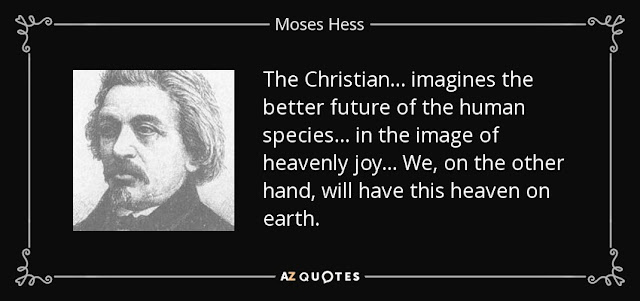
Intrinsic to the Zionist idea was that Jews, wherever they lived, formed a single Jewish nation. In essence this was a belief in a Jewish race. How could Jews who lived across the globe and who spoke a variety of difference languages, be members of the same nation? As Moses Hess, an early Zionist, wrote:
The Germans hate the religion of the Jews less than their race… The Jewish race is a primary race which… accommodates itself to all conditions and retains its integrity. The Jewish type has always remained indelibly the same throughout the centuries.
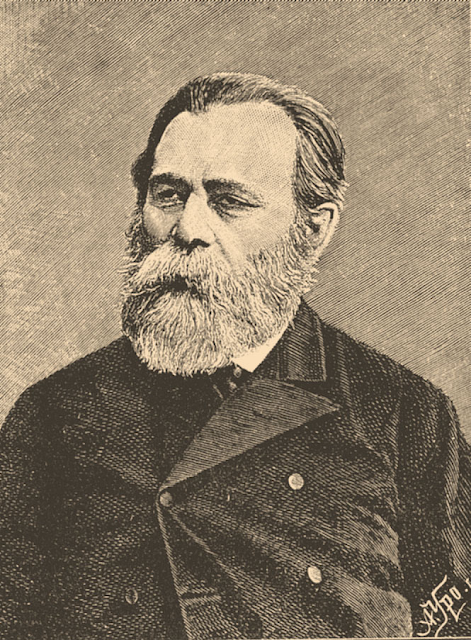
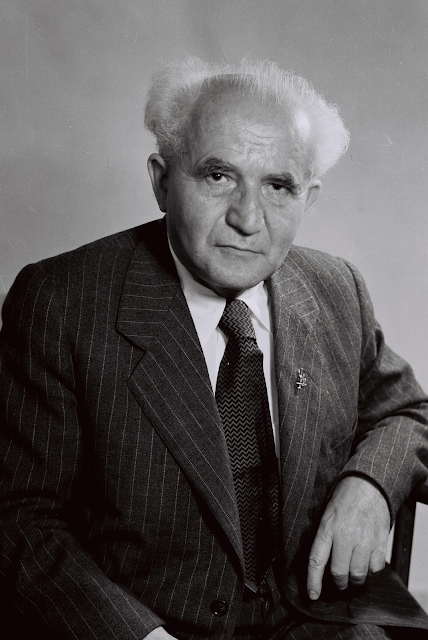
According to David Ben Gurion, Israel’s first
Prime Minister and the pivotal figure in post-Herzlian Zionism, ‘exile’ (Galut)
had been ‘a prolonged interlude in the
history of Israel’. The diaspora represented a historical void.
Ben Gurion and the Zionist movement held that until Emancipation in the 19th
century, Jews knew that the countries where they lived were only a temporary
exile, and it did not even occur to them that they were a part of the peoples
among whom they lived. That this is patent nonsense is borne out by the fact
that it took a
long fight
by the Jewish bourgeoisie before they achieved emancipation in the UK and elsewhere.
The Zionist
left, Poale Zion, which called itself Marxist, subscribed to the idea that
Jewish diaspora society could never be ‘normal’ until a Jewish Palestine was
created. Its founder Ber Borochov, had been expelled from the Russian
Social Democratic Party in 1901 for his Zionism.
Borochov
had a theory that the social structure of the Jews in the West resembled an inverted pyramid. There were too many rich Jews at
the top and too few Jewish workers at the bottom.
The
creation of a Jewish State, which was what marked out Zionism, would rectify
this problem. In order to form such a state the Zionist movement sought an
alliance with an imperialist power. Without an alliance with Britain or another
power, Zionism would have been just one more harmless messianic movement.
Everything
else is post-hoc justification. The myth has grown up that Zionism sought to
create a Jewish state as a refuge for Jews living under persecution. That their
goal was in essence humanitarian, even if their methods were not.
It needs
emphasising that the original Labour Zionist pioneers saw themselves as an
elite and held the diaspora in contempt. They were creating a new society and
dispensing with the old.
Zionism realised from the start that without anti-Semitism there was no Zionism. The Zionism movement needed the ‘push’ of anti-Semitism. As Herzl wrote in his Diaries,
The anti-Semites will become our most dependable friends, the antisemitic countries our allies.
Zionism was not simply an escape from an anti-Semitism
that couldn’t be fought. The Zionist pioneers saw themselves as elitists, the
‘new Jew’. Arthur Ruppin, the most important figure in Palestinian Zionism
after Ben Gurion, was an ardent believer in the racial sciences and eugenics.
This is not surprising since the claims of Zionism to Palestine are at root a
form of biological racism. Zionism believes that European Jews were descended
from the Hebrews tribes.
Chaim Weizmann, the President of the Zionist Organisation, said in 1919 that ‘Alas, Zionism can’t provide a solution for
catastrophes.’ The ZO ensured that Palestine was closed to thousands of
survivors of the Ukrainian pogroms. Professor Gur Alroey described how
‘Weizmann preferred
productive immigrants over needy refugees and thought the Land of Israel needed
strong, healthy immigrants, not refugees weak in body and spirit.’ [Ha’aretz
3.12.21]
Ben Gurion, the Chairman of the Jewish Agency, the pre-state government-in-waiting,
explained that the purpose of Zionism was first and foremost to establish a
state that would perpetuate the Jewish nation/race. Saving Jews as individuals was
secondary.
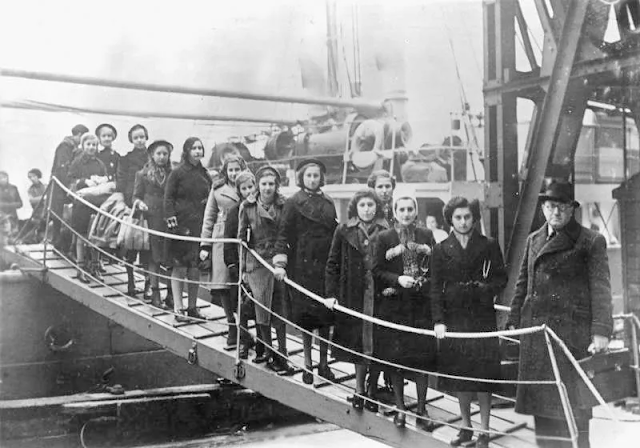
When, after Kristallnacht, the British government agreed to allow 10,000
Jewish children into Britain, (Kindertransport) the Zionists were furious. Ben Gurion,
in a speech to Mapai’s Central Committee on 9 December 1938 explained why:
If I knew that it would be possible to save all the children in Germany by bringing them over to England, and only half of them by transporting them to Eretz Yisrael, then I would opt for the second alternative. For we must weigh not only the life of these children, but also the history of the People of Israel. Yoav Gelber, ‘Zionist policy and the Fate of European Jewry,’ Yad Vashem Studies (1939-42) p. 199.
People are horrified by the desire of Ben Gurion to
save half the children as long as they went to Palestine, in preference to
saving all of them in the diaspora. The final sentence, counterposing the life
of the children to the history of the Jews, is often ignored. Ben Gurion’s
reason for opposing the emigration of Jews to anywhere but Palestine was his
view of the ‘history of the People’. Jewish history meant, above all, a Jewish state.
Redemption of the land
Zionism sought to ‘redeem’ the land of Palestine. Zionist propagandists
argue that ‘redemption’ of the land simply meant bringing back land into
productive use. Another Zionist myth. Most land in Palestine was already in
use. In Zionist mythology they were ‘making
the desert bloom.’ Ahad Ha'am, the principal figure in Cultural Zionism wrote in Truth
from Eretz Yisrael in 1891, at the time of the First Aliyah (wave of
emigration) that:
From abroad,
we are accustomed to believe that Eretz Israel is presently almost totally
desolate, an uncultivated desert and that anyone wishing to buy land there can
come and buy all he wants. But in truth this is not so. In the entire land it
is it is hard to find tillable land that is not already tilled. Only sandy
fields or stony hills, suitable at best for planting trees or vines and even
that after considerable work in clearing and preparing them – only these remain
unworked, because the Arabs don’t like to exert themselves today for a distant
future. [Alan Dowty, Much ado
about Little – Ahad Ha’am’s “Truth from Eretz Yisrael,” Zionism and the Arabs,
Israel Studies, Vol. 5, No. 2 (Fall, 2000)
So
what did Zionist redemption of the land really mean? Israeli
historian Jacob Talmon referred to
‘extremely
nationalistic and certain religious persons… who state that the Holocaust was a
necessary stage in the Jewish historical drama, as a type of suffering prior to
redemption. The price of redemption’
The Zionist leaders conceived the
destruction of European Jewry as a ‘final
apocalyptic vindication of Zionism.’ [Yechiam Weitz, Jewish Refugees and Zionist Policy
during the Holocaust, p. 351]
This messianism resembled the
Evangelical belief that Jews must die in order to achieve salvation through
Rapture. Zionism was a form of political Messianism, hence its description of
its colonisatory project as one of ‘Jewish Redemption’. [Days of Redemption, Allan Arkush,
Jewish Review of Books, Spring 2022],
Arkush quoted Nahum Sokolow, President
of the Zionist Organisation as explaining that
“Zionism
is the direct heir to the biblical promise and to Jewish messianic
expectations.”
Ben Gurion wrote
that one of the three principal tasks of Zionism was
Deepening
the attachment to the Messianic vision of redemption that is the vision of
Jewish and human redemption held by prophets of Israel.
Redemption was not
merely a religious or messianic idea but a practical programme of colonisation.
Ben Gurion, at a meeting of Yishuv’s Vad
Leumi, 5 May 1936. argued
that:
If
we want Hebrew redemption 100%, then we must have a 100% Hebrew settlement, a
100% Hebrew farm, and a 100% Hebrew port.
David Hacohen, a leader of Mapai and a member of
the Knesset from 1949 till 1969, with a break of two years, recalled in Ha’aretz, 15 November, 1962, what
the doctrine of “Hebrew Labor” meant:
I remember
being one of the first of our comrades [of Ahdut Ha’avodah] to go to London after the
First World War…. There I became a socialist….[in Palestine] I had to fight my
friends on the issue of Jewish socialism, to defend the fact that I would not
accept Arabs in my trade union,
the Histadrut; to defend preaching to housewives that they not buy at
Arab stores; to
prevent Arab workers from getting jobs there…. To pour kerosene on Arab tomatoes; to attack Jewish housewives in the markets and smash the Arab
eggs they had bought; to praise to the skies the Kereen Kayemet
[Jewish National Fund] that sent Hankin to Beirut to buy land from absentee
effendi [landlords] and to throw the fellahin [peasants] off the land — to buy
dozens of dunams — from an Arab is permitted, but to sell, God forbid, one
Jewish dunam to an Arab is prohibited. (my emphasis)
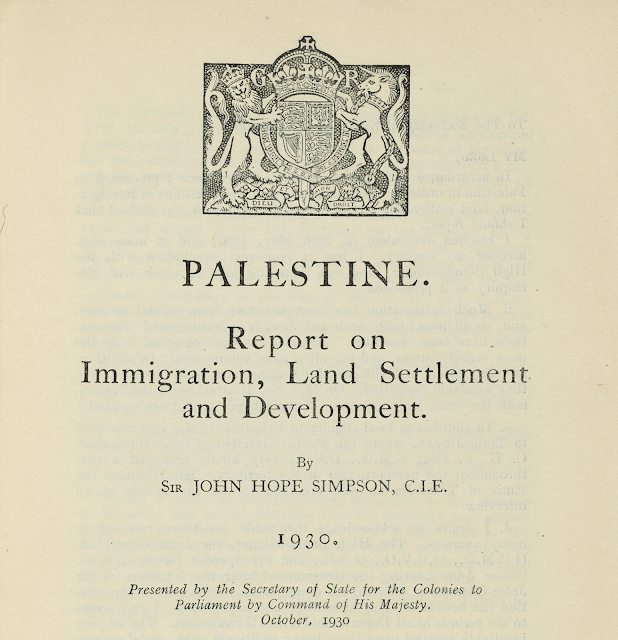
The 1930 Hope-Simpson
Report, set up in the wake of the 1929
riots found that:
Actually
the result of the purchase of land in Palestine by the Jewish National Fund has
been that land has been extraterritorialised. It ceases to be land from which
the Arab can gain any advantage either now or at any time in the future. Not
only can he never hope to lease or to cultivate it, but, by the stringent
provisions of the lease of the Jewish National Fund, he is deprived for ever
from employment on that land. Nor can anyone help him by purchasing the land
and restoring it to common use. The land is in mortmain and inalienable. It is
for this reason that Arabs discount the professions of friendship and good will
on the part of the Zionists in view of the policy which the Zionist
Organisation deliberately adopted.
Zionism today doesn’t refer to itself as
a colonising movement. It purports to be a national movement of the Jews, even
a national liberation movement but its founders were very clear that it was a
colonizing movement. On January 11 1902 Herzl wrote to Cecil Rhodes after whom Rhodesia was
named, asking:
“How, then,
do I happen to turn to you since this is an out-of-the-way matter for you? How
indeed? Because it is something colonial… I want you ... to put the stamp of
your authority on the Zionist plan…’
Baron Maurice de
Hirsch founded the Jewish
Colonisation Authority [ICA] in 1891 to settle European Jews in Argentina. After
his death in 1896 the ICA began funding colonisation in Palestine. In 1923 it
changed its name to Palestine Jewish Colonisation Authority. [PICA] Because it didn’t
subscribe to a policy of Jewish Labour, which meant a Boycott of Arab Labour, it came under continual attack from the
Labour Zionists and Histadrut.
The Zionist idea of redemption of the
land meant redeeming it from the Palestinian Arabs. The Jewish
National Fund, founded, in 1901, had
a policy laid down in its constitution that land once purchased could never be
sold back or let to Arabs. Its leases stipulated that Arabs could not even be
employed on the land.
There are those who
believed that Zionism was a form of scaffolding that would be abandoned once a
Jewish State was established. One such is Avraham Burg, a former Chair of the
Jewish Agency and knesset member of the Israeli Labor Party, who saw Zionism as
a kind of scaffolding
that was supposed to enable the Jewish people to move from [exile]to
sovereignty." In the past 150 years, that mission was accomplished, he
says. Now it's about time to remove the scaffolding. [The man who would tear down 'scaffolding' of
Zionism, 9.12.08]
Zionism
is not about to change its spots. The Israeli state was never going to be
normalised after the ethnic cleansing of 1948. Once it set out down along that
road it would continue, until we reach the present Israeli government, with
their open desire to transfer all Palestinians in the West Bank into Jordan.
Jewish Settlement
Clause7 of the Jewish Nation State Law
of 2018 stipulates that
The State
views the development of Jewish settlement as a national value, and shall act
to encourage and promote its establishment and consolidation.
This is a basic,
quasi-constitutional law. Clause 1(c) states that:
The
realization of the right to national self-determination in the State of Israel
is exclusive to the Jewish People

Jewish Settlement
means Jewish only settlement. So Be’er Sheva Magistrate’s Court accepted the Israel Land Authority’s claims requiring the residents
of the unrecognized Bedouin village of Ras Jrabah to evacuate by March 2024.
Why? In order that Israel could build a new Jewish neighbourhood for the city
of Dimona. [Ha’aretz, July 28, 2023] There has never been an eviction of an
illegal Jewish settlement for the reason that no Jewish settlement is illegal
whereas half of the Arab villages in Israel are ‘unrecognised’.
When people think of
Israeli settler-colonialism they think in terms of the West Bank but there has also
been a continual process of internal colonisation within the borders of
pre-1967 Israel. It goes by the name ‘Judaisation’,
which is the ‘thinning out’ of the Arab populations of the Galilee, Negev and
East Jerusalem. It is no different in principle to the Nazis’ Aryanisation of
German towns. These plans went under the name of the Prawer Plan and the Koenig Memorandum.

Itamar Ben-Gvir, Israel's Jewish Nazi Police & Security Minister
Judaisation did not originate with the
Judeo-Nazi Ben-Gvir. It was the brain child of Mapai and it came in the form of
the Koenig Memorandum. The Koenig Memorandum first became public in September 1976 when it was printed in Al Hamishmar, paper of the then leftist Zionist party, Mapam.
Israel
Koenig, the Report’s author was a senior member of Mapai and District
Commissioner for Northern Israel in charge of Israel’s Arab citizens who, for
the first 18 years lived under military rule.
A month ago the
Knesset approved an amendment to the Admissions Committee
Law 2011. The original law gave the right of Jewish communities of
up to 400 families to set up admissions committees which could exclude people
based on their perceived ‘social
suitability’. In practice this meant that no Palestinian Israeli could be
accepted. The amendment increases the number of families to 700.
The
amendment passed the Knesset by 42-11 with a number of the ‘Opposition’ voting
for it. Just 2 members of the Israeli Labor Party voted
against it. The original law was passed in 2011 in order to circumvent
a Supreme Court ruling in 2000 (Kadan)
that prevented the Israeli Lands Authority from selling to Jews only.
.jpg)
Ben-Gvir, Netanyahu
and ‘Zionist Values’
Ben-Gvir
and Netanyahu set the cat amongst the Zionist pigeons when they proposed a resolution in the Knesset
advocating that ‘Zionist values’ must inform Government policy.
One
indication of what these values are is Ben-Gvir’s statement that:
“We are losing
the Negev and the Galilee. This resolution will enable [us] to prioritize
values to Judaize the Galilee with settlement, and IDF soldiers and the
security forces,”
What you
might wonder is happening in the Negev and Galilee that they are in imminent
danger of being lost? Are they about to float away in the Mediterranean? Not at
all. I am reliably informed that they remain in the same position that they’ve
always been in!

What Gvir
means by lost is that they are ‘lost’ to the Jewish people. In other words
there are too many Arabs living there. According to the Times of Israel Yitzhak Wasserlauf, the Negev,
Galilee and National Resilience Minister, and Otzma Yehudit wants to Judaise
the Negev and Galilee because of ‘the
large Arab populations in those regions’.

Imagine
that the British government decided, in the light of the fact that ethnic
minorities make up the majority of Londoners, that they were going to adopt a British
First policy increasing the number of White Britons in London. Racist? How could
anyone doubt this yet in Israel ‘Judaisation’ is normal consensual Zionist
politics.
The Times
of Israel reported that in April ‘during a tour of illegal Bedouin villages in the Negev’ Ben-Gvir
stated that one of his goals as minister was “activities to increase Jewish settlement and its foundations in the
Negev and Galilee.”
This state of affairs exists in no other western country. Because Israel is a state of the fictional ‘Jewish People’ this racial engineering is not commented on. In the words of Netanyahu
“Israel is not
a state of all its citizens. According to the basic nationality law we passed,
Israel is the nation state of the Jewish people – and only it.”
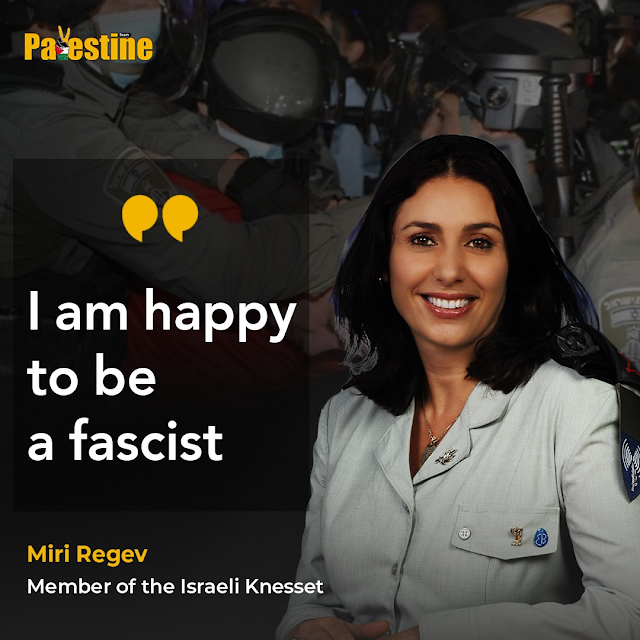
This was
in response to criticism by Israeli actor, Rotem Sela, who protested against
the racist incitement of Culture Minister Miri Regev who, in the election
campaign, had accused other Zionist parties of being willing to form a
government with Arab parties. Sela wrote:
“When the hell
will someone in this government convey to the public that Israel is a state of
all its citizens and that all people were created equal? Even the Arabs –
believe it or not – are human beings,”
Netanyahu
was right. Israel is not a state of all of its citizens. It is a state of its
Jewish citizens only. Within Israel only Jews have the right of
self-determination. Arabs have no such rights because they aren’t nationals of
the state they live in. They live in Israel on sufferance. I, who have never
lived in Israel, have more rights as a diaspora Jew than a Palestinian born there even
if they possess Israeli citizenship.
In
February Wasserlauf, lamented that just 14 percent of the
population of the Galilee was Jewish and even worse “an extra 135,000 Bedouin and Arabs” had been added to the region’s
population over the last decade, compared to “just 1,200 Jews.” In a state based on race, it is important that
the dominant or master race is in a majority everywhere. It is a racist
counting of heads.
The explanatory text
of Wasserlauf’s resolution states that considerations used by the government
and its various branches sometimes “ignore
basic Zionist values,” including “in
[the field of] settlement, security, culture, and immigration.” The
resolution states:
“We determine…
that the values of Zionism, as they are expressed in the Basic Law: Israel as
the Nation-State of the Jewish People, will be guiding and decisive values in
the formulation of public administrative policy, internal and foreign policy,
legislation and government activity and all its units and agencies… first and foremost
in the fields of settlement and in giving benefits to those who served in the
army and the security services, or civilian service, with priority for those
who performed combat duty,”
The Zionist
‘opposition’ rushed to oppose the latest proposals, even though they agree with
them. War criminal Tzipi Livni declared:
“This is not Zionism, this is the continuation
of the nationalistic insanity and another spit [in the face] for the values of
equality in the Declaration of Independence, which states that ‘The State of
Israel will strive towards the development of the land for all its
inhabitants,’”
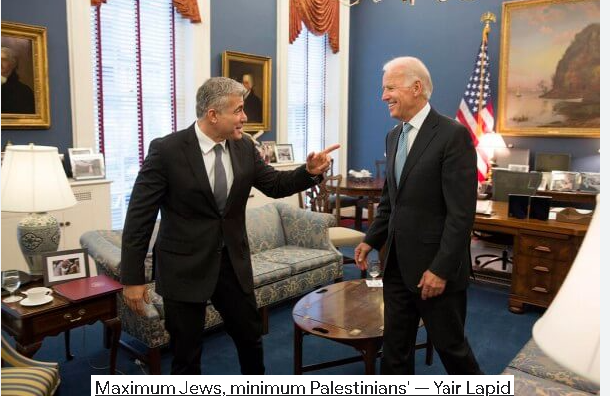
Yair Lapid, the last Prime
Minister, argued that the resolution was discriminatory against the Druze, who
alone amongst Israeli Arabs, serve in the Israeli army. Lapid said that ‘rather than the decision representing
Zionism, it represented racism.’ But Zionism is a form of racism. This is
the same Lapid who said
“My principle says maximum Jews on maximum land with maximum
security and with minimum Palestinians.”
The Israeli Labor
Party has always declared that it wishes to see a separation between the
Palestinians and Jews which was its reason for supporting a Palestinian ‘state’
(in reality a Bantustan) in the West Bank. It did not want a Palestinian
majority in a ‘Jewish’ state. Apartheid too was defined by its authors as ‘separate
development.’
When Netanyahu,
Wasserlauf and Ben-Gvir talk about Zionist values they are talking about the
values of the Labour Zionist movement and successive ILP governments. They are the
values of ethnic cleansing, land confiscation, discriminatory treatment, wars
of expansion and colonisation. It used to be called Jewish Labour, Land and
Produce. What the ILP started Ben-Gvir is finishing.
Tony Greenstein