Showing posts with label Polisario Front. Show all posts

14 March 2016

Gerry Downing, Anti-Semitism and the Socialism of Fools


Confusing the Jewish Question and Zionism

It was August Bebel, the leader of the German Social Democratic Party who described anti-Semitism as the ‘socialism of fools’.  Gerry Downing is nothing if not a fool.  A complete muddlehead leading a tiny Trotskyist group Socialist Fight.
The BBC made hay with Gerry Downing's idiocy
Downing entered into the headlines last week when he was cited by David Cameron in Question Time in the House of Commons I believe Socialist Fight is one of the splinters resulting from the implosion of the Workers Revolutionary Party of Vanessa Redgrave fame.
Abram Leon - author of The Jewish Question - a Marxist Interpretation - which Downing willfully misunderstands
It is an organisation that is causing much amusement to the Right.  However his defence or ‘understanding’ of Al Quada’s 9/11 attacks and the actions of ISIS are anything but amusing.  Downing’s playing with anti-Semitism is also no joke.  His actions have been used to discredit the wider left. 
Gerry Downing floundering with Andrew Neil
Downing, who has probably been somewhat taken aback at all the publicity his tiny sect has garnered, has mounted his own defence against the attacks from the capitalist media, Guido Fawkes, Cameron et al.  [Statement by Gerry Downing in reply to the Guido Fawkes / Cameron attack on the Labour Party and on me personally] 

Downing is fond of quoting Baruch Spinoza who said that “I have striven not to laugh at human actions, not to weep at them, nor to hate them, but to understand them.”
There is, of course, nothing at all wrong in understanding the actions of Al Qaeda or ISIS.  The problem is that Downing’s understanding is both simplistic and wrong.  Therein lies the problem.
Gerry Downing & John MacDonald in better days at a strike meeting
Gerry Downings main point, which is that the horrific massacres and oppression in the Middle East and elsewhere are the result of imperialism’s intervention and presence, is correct.  It is not controversial that the US war in Iraq killed approximately 1 million people.  Nor is it a secret that US and British imperialism supports oppressive regimes like Saudi Arabia, Egypt etc.  Where he goes wrong is in seeing om either Al Qaeda or ISIS any form of anti-imperialist force.
As Hilary Clinton freely admitted, Al Qaeda is a creation of the very US imperialism that Downing opposes.  That in itself should give him pause for thought.  The US deliberately created a fundamentalist Islamic military/political presence in Afghanistan and Pakistan in order to destroy the Soviet presence and the liberal bourgeois regime of the People's Democratic Party of Afghanistan (PDPA) under Babrak Karmal which had emerged in Afghanistan. 
A weak bourgeois regime had emerged in Afghanistan, overthrowing the previous king.  The USSR stepped in to support this regime and the US and  Britain did their best to put reactionary cut-throats in place, alongside their allies in the ISI intelligence service in Pakistan and the Saudi regime. 

The Taliban and Al Qaeda were the fruit of US imperialism and like Frankenstein’s monster they turned on their benefactor.  But there was and is nothing anti-imperialist about them.  Their politics represent the worst form of medieval savagery.  There is nothing progressive about them – whether it is women’s education, sharia law punishments, workers’ self organisation, the destruction of cultural symbols such as the Buddhist statues of Bamiyan or the Greek-Roman architecture at Palmyra. 

Like the Khmer Rouge these groups are neither fish nor fowl.  They defy political description.  Fascist is a easy shorthand but it isn’t really appropriate because fascism is a product of a modern industrial society where a movement based on a petit bourgeois rabble and lumpen elements are welded into a nationalist force capable of destroying working-class and progressive forces.
The Taliban, Al Qaeda and ISIS are modern movements, using modern technology, which are certainly a reaction to imperialism but a reaction of the most politically backward type.  It is akin in some ways to the feudal socialism of anti-Semitic movements like the Christian Social Party of Adolf Stocker.

ISIS for example are known to be controlled militarily by ex-Baathist officers who have adopted Islam as a convenient justification and legitimation for their barbarous rule.  How any socialist can support or ‘understand’, not as a means of analysis but as a form of apology, an organisation which enslaves young Yazidi women, whilst slaughtering all the men and older women, defies belief.  A group which openly uses rape as a weapon of war.  This genocidal group may indeed be a reaction to the US’s imperialist slaughter in Iraq, it may have come into conflict with the US and its sectarian Iraqi regime (although being supported by the Turkish regime), but what type of reaction is it?  Do we support any opposition, however reactionary, to US capitalism?  Would that include the KKK?

The actions of both ISIS and Al Qaeda have, if anything, been detrimental to liberation struggles in the Western Sahara, coming into conflict with Polisario as it attempts to confessionalise their struggles.  Likewise they have been a dire threat to the Tuareg people and the National Movement for the Liberation of Azawad (MNLA) in Mali, which have come into conflict with Al Qaeda in the Maghreb and local Islamist groups.  Indeed they have been responsible for poisoning the struggle of the Syrian people against Assad.

It is no accident that Israel is known to support al-Qaeda's al-Nusra in Syria and it is widely suspected of supporting ISIS and is known to be the largest purchaser of ISIS's oil wells.  Opposing Zionism is not on the agenda of ISIS or Al-Qaeda.

But it isn’t just Socialist Fight and Gerry Downing’s attitude to ISIS and Al Qaeda.  It is their barking attitude to what they term ‘the Jewish Question’.  In his Why Marxists must address the JewishQuestion concretely today Downing cites the classic Marxist tract ‘The Jewish Question – A Marxist Interpretation’ by Abram Leon, the leader of the Fourth International in Belgium, who died in Auschwitz, .  Downing states that:

The Jewish bourgeois were exceptionally well-suited for capitalist success because the social role of Jews as commodity-traders, and later money-traders and lenders: a ‘people-class’ in the phrase of Abram Leon, the great Belgian-Jewish Marxist theorist of the Jewish question, in medieval Europe prior to the emergence of capitalism, gave them the cultural advantage of a much older tradition in commodity economy than the ‘native’ ruling classes.”

Much of the above is arguable.  Did Jewish bankers have any more formidable advantages than those of Lombardy or Venice?  Were the Jewish bourgeoisie any more advantaged than the merchants of the City of London or the French Huguenots?  I doubt it.  What is certain is that a separate Jewish bourgeoisie, whose most famous representative was the Jewish financier and philanthropist Sir Moses Montefiore, disappeared in the 19th century.  As Leon noted:

‘The economic process from which the modern nations issued laid the foundations for integration of the Jewish bourgeoisie into the bourgeois nation.' (p.116, Jewish Question - A Marxist Interpretation)

Downing’s remark that ‘Zionism is the cutting edge of bourgeois reaction today’ is unexceptional.  There is no doubt that Zionist organisations such as the American Israel Public Affairs Committee (AIPAC) or Christians United for Israel are the most hawkish groups in terms of foreign policy.  In this they are allied with the neo-conservatives who dominated the Bush cabinet and who are fretting at Trump gaining the Republican nomination.

Likewise Downing’s statement that ‘The role Zionists have played in the attempted witch-hunt against Jeremy Corbyn’s Labour leadership campaign is glaringly obvious.’  cannot be doubted.  But this was a Zionist witchhunt not a Jewish one.  The Daily Mail initiated it and MPs like John Mann perpetrated it.  Mann is not Jewish, but he is a devoted Zionist.

Quite what the long gone Jewish Question (which was as much a problem with anti-Semitism) has to do with the role of Zionism is somewhat of a mystery.  Downing points out that 80% of Tory MP’s supported the Conservative Friends of Israel in the last parliament and that ‘leading figures in Labour like Ed Miliband and Ed Balls are involved with Labour Friends of Israel.  All this is true but most Tory MPs are not Jewish.  Likewise most LFI sponsors.  Ed Miliband, who is Jewish was far less sympathetic to Zionism than Ed Balls, who is not Jewish.

It is when Downing asserts that Zionism’s ‘supporters are highly conscious ethnocentric activists with a material base in terms of capitalist property, within the ruling classes of several imperialist countries, as well as Israel.  This caste has acquired major moral and political influence among much wider layers of the imperialist bourgeoisie. If this were not true, Zionists could not have the influence they do in the current situation.’ that Downing abandons Marxism and adopts anti-Semitism.

Zionism’s supporters are President Hollande of France and his Prime Minister Manuel Valls who are waging war on France's BDS movement.  They are David Cameron and John Hagee.  The supporters of Zionism and the racist Israeli state include both Jewish and non-Jewish politicians and capitalists.  It has nothing whatsoever to do with a transnational Jewish bourgeoisie.  This reeks of the Jewish Conspiracy Theory.  There is absolutely no evidence that the non-Jewish  bourgeoisie of Britain, the United State or France is engaged in a battle with the Jewish bourgeoisie.  This is fantasy land stuff.  

The problem is that the ruling elites in all the aforementioned countries support the Israeli state and attack anti-Zionists and the supporters of the Palestinians as ‘anti-Semites’.  That is why, in his interview on the BBC with Andrew Neil, Gerry Downing was, to put it mildly, left spluttering and inarticulate, since he knew deep down that what he was arguing made no sense from a Marxist or communist perspective.

That is the price of allowing Ian Donovan, who was excluded from the Communist faction of Left Unity and an open supporter of Gilad Atzmon into his organisation.  There is no Marxist or materialist analysis which explains the support for Zionism of Western bourgeois politicians and their acolytes in terms of a Jewish ethnic presence or lobby.  This is indeed the socialism of fools and idiots.

It is ironic that in the United States, the unexpected victory of the only Jewish candidate, Bernie Sanders, in the Michigan primary, was partly due to the overwhelming support for Sanders in the city of Dearborn, where 40% of the inhabitants are Muslim and Arab Americans.  [Muslim Voters Support Bernie Sanders in Michigan – Mass Media Can’t Work Out How to Explain This]

It should give even Gerry Downing pause for thought!

Tony Greenstein


31 July 2015

The Queen of Western Sahara Desert Blues Boycotts Israel


Western Saharan singer and actress Aziza Brahim has stated that she no longer plans to perform at the Jerusalem Sacred Music Festival in September.

In an announcement posted on the singer’s Facebook page, she said in Spanish and English that ”I’ve decided to cancel my concert at Jerusalem Sacred Music Festival. I want to express sincerely my followers’ understanding, support and the respect in which most of them have shown their opinions.”
According to a press release by BDS South Africa, some of Brahim’s “supporters and fans engaged with her via social media urging the artist to cancel her Israeli gig in solidarity with the Palestinian people.”


The release went on to say that campaigners had pointed out the parallels between Morocco’s illegal occupation of Western Sahara and Israel’s abuses of Palestinian rights.
As such, BDS South Africa called Brahim’s decision “an example of internationalism and the capacity to be involved in ones own struggle yet at the same time lend solidarity to others.”

Africa’s last colony


Aziza Brahim was born in the Sahrawi refugee camps which were established following the Moroccan occupation of Western Sahara in 1975. Partly educated in Cuba, she won a Sahrawi national music competition in 1995 and launched a singing and acting career.
Some of her songs are based on poems by her grandmother, al-Khadra bint Mabruk, known as the “poet of the rifles” in the Sahrawi national movement.

Western Sahara has been called “Africa’s last colony.” Divided between Morocco and Mauritania when Spain withdrew in the 1970s, against the wishes of the Sahrawi people’s anti-colonial movement, thousands of Sahrawi people have lived in refugee camps in Algeria for four decades.
The two sections of Western Sahara are split by the world’s second-longest wall – a fate which is familiar to Palestinians. As with Palestine, the international community has failed to act on the issue of Western Sahara, with a referendum plan announced in 1991 never implemented.

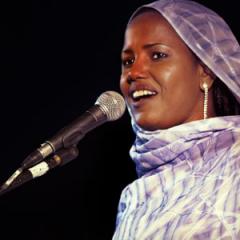
Aziza Brahim: Queen of Western Sahara Desert Blues

The life and music of singer Aziza Brahim is irrevocably bound to her heritage as a Saharawi native of Western Sahara, a small country sandwiched between Morocco and Mauritania. Born into a refugee camp, Brahim learned how to sing from her revolutionary grandmother, and grew up to make music that speaks out against the oppression of her homeland. We take a closer look at Western Sahara’s voice of resistance.


Due to its lack of self-governance, Western Sahara is considered to be the last African colony. Although the country was originally controlled by Spain, when the Spanish ended their colonisation of the territory in 1975, Morocco made the decision to take over the area. After the Moroccan invasion, half of the Saharawi population remained in Western Sahara, while the other half was forced to flee to southwest Algeria, where one of the largest refugee camps in the world was established. Brahim was born in the refugee camps in 1976. She never met her father, who remained behind in Western Sahara when the rest of her family fled to Algeria. While living in the refugee camps, she was exposed to the extreme conditions of living with 200,000 other Saharawi who all depended on international aid as a main source of survival, and where temperatures can reach 130 degrees Fahrenheit.

In 1993, a ceasefire was enacted when the Polisario Front, the Saharawi liberation movement for Western Saharan independence, and Morocco agreed to end the war and hold a referendum. This would allow the Saharawi to have a chance to vote for self-governance or integration with Morocco. However, 20 years after the ceasefire, and 40 years after the start of the war, the referendum still has not taken place.

While growing up, Brahim was greatly influenced by the many musicians in her family including her grandmother, Al-Kadra. Known as the ‘poet with the gun,’ her grandmother was one of the most influential female poets in the camps and has been referred to as the symbol of freedom and resistance. Brahim was encouraged by her family to compose poetry for her grandmother and later perform with her. At age 11, in 1987, Brahim received a scholarship to study in Cuba, but in 1995, she went back to the camps after she was no longer allowed to study music due to her scholarship requirements.
After going back to the camps, Brahim’s music career began to take off. She won first place at the annual National Culture Festival, a music festival organised by the Saharawi Minister of Culture in the camps. After winning, Brahim joined the National Saharawi Music Group, a group dedicated to representing Saharawi music through tours around Algeria and Mauritania. In the same year as her collaboration with the Saharawi Minister of Culture, two of her songs became hits when they were released by the Spanish label Nubenegra as a part of the album A Pesar de las Heridas, a record intended to celebrate Saharawi music by releasing songs by various Saharawi artists. Her talent was then discovered in 1998 by the popular Saharawi group, Leyoad, who invited her to join them. This allowed her to travel to Spain, France and Germany on their European tour.

Upon her return from Leyoad’s European tour, she began to record music with various Tuareg musicians for the Saharawi National Radio. Thousands heard her music and she began her rise to fame soon afterward. In order to further the growth of her music career, she moved to Spain, where she began to compose her own songs and tour around the country. In 2007, she began her first international collaboration with the Spanish-Latin jazz band Yayabo. A year later, she founded the group Gulili Mankoo, which brought together singers and composers from Western Sahara, Colombia and Senegal. During her time with the group, Brahim’s own style shifted to a focus on blues and rock.


With the collaboration of Gulili Mankoo, Brahim released her first album, Mi Canto. The album was produced by Brahim, but it was released worldwide by the French label Reaktion and was soon ranked number one in the World Music list. Some tracks, like the title, are in Spanish, while the other songs are sung in a mix of Spanish and Hassaniya, an Arabic dialect that traces back to Yemen and is spoken mainly in Western Sahara and Mauritania.

In 2009, Brahim’s international collaborations continued to expand. She recorded the song Interrapcion - Crisol 09 with the Basque rap group Oreka Tx and joined their tours around Spain and France. In the same year, Brahim was also featured in Listen To The Banned, an album dedicated to censored international music, especially from the Middle East and Asia.

In addition to her music, Brahim began her acting career in 2011, in the movie Wilaya, also known as The Tears of the Sand, by the Spanish director Pedro Pérez Rosado. The film tells a story of a Saharawi family trying to cope with the sudden death of their mother, as well as the visit of their little sister who has been living most of her life in Spain. The film accurately portrays the situation of many Saharawi families who have members who leave to study abroad for many years. Brahim not only acted in the film, but also produced its soundtrack. Wilaya received two awards at the Abu Dhabi Film Festival and Malaga Film Festival, including the award for Best Original Soundtrack. Brahim was also given the Freedom to Create Prize, an award given those who use the arts to fight oppression and advocate for the common good of societies.
In 2012, Brahim released her second album Mabruk, which translates to congratulations in Arabic. The album was released to honor her grandmother and congratulate her on all of her accomplishments. The album featured the collaboration of the popular Saharawi poet Bahia Mahmud Awah. The Dutch Magazine Heaven listed Mabruk as the album of the year. The success of the album landed Brahim a performance in the well-known international festival World of Music, Arts and Dance (WOMAD).
For her other albums, Brahim has used traditional African musical styles such as wolof and bambara, with instruments like the djembe and darbuka. Her newest album, Soutak, translated as ‘your voice’, was released in February 2014 and was dedicated to the events happening in Western Sahara and Mali. In an interview with the blog News and Noise, Brahim stated her reasons to dedicate the album to Mali and her musical influences in the album:

‘I have never been there, but Mali is seen as the cradle of the African music. I am as African as Arabian and I can relate myself to what happens over there – the extremists trying to ban the music not long ago – that’s why I want to show my support. Moreover, the music has always appealed to me. I am a big fan of the late Ali Farka Touré. You will hear some influences of the Desert-blues, especially in the song Lagi. The main guitarist on Soutak is Kalilou Sangare from Mali.’ (News and Noise)

The song Julud mentions her mother and honours all the sacrifices her mother has made for her. In this song, she used the tabal as the main instrument in addition to modern instruments. The tabal is a traditional Saharawi instrument played only by women.

Throughout the nine-track album, Brahim continues to mix Hassaniya and Spanish in her music. For Soutak, Brahim collaborated with the Spanish musicians Guillem Aguilar and Nico Roca, as well as the African musicians Kalilou Sangare and Badra Abdallahe. Throughout the album, Brahim mixes Arabian, Andalusian, African and Latin sounds, which had great influence on her while she lived in each location. The album, produced by Chris Eckman and released by the Glitterbeat Records, was ranked number one no less than twice in the World Music Charts Europe (WMCE). The success of Soutak landed her an appearance on the TV shows Later with Jools Holland in the UK and Vrije Geluiden in Amsterdam, along with interviews with dozens of international magazines and blogs.

Through her music, Brahim aims to be a voice of resistance, as she mentioned her interview for News and Voice:


‘No, I am not a politician. I am one of three generations who lives in a refugee camp and I represent my life and music. I feel the urge to give my music a context. The Saharawi live under Moroccan control and we are not allowed to express ourselves culturally. If we don’t protect our culture, our people will vanish. We have an oral tradition. How can we respect ourselves if we don’t have an identity? The lyrics are not only about the Saharawi, but about the suffering of other people as well. There is a global dimension. Every song tells a true story, and it’s not always about politics.’

Brahim feels a sense of responsibility to give an identity to those who face the hardships of the refugee camps and the lack of a peaceful solution to the long-standing conflict between Western Sahara and Morocco. With the combination of the oral tradition of Saharawi culture and the trend of the newer generation going abroad to study, there is a tendency to forget the importance of maintaining the tradition of Saharawi poetry and music. However, by collaborating with Saharawi and international musicians, Brahim has given the Saharawi a name, identity and reputation within the refugee camps and in Spain where most of the Saharawi who emigrated to find a better life currently live. Additionally, she has been influential in Western Sahara, where half of the Saharawi population continues to live under Moroccan occupation, and also abroad, where people from all walks of life are introduced to her passionate voice and diva style of desert blues.


By Agaila Abba