Kevin Higgins was the Poet Laureate of the Socialist Left and an Inspiration to the Oppressed

Kevin Higgins: Ode to Margaret Hodge
It was with shock and a deep sadness that
I awoke to the news that Kevin Higgins,
the great socialist Irish poet had passed away.
I first heard of Kevin when, on my
expulsion from the Labour Party, he wrote a poem We Are
Delighted To Announce according to which I had been executed for using ‘inappropriate language’. Later I saw Kevin regularly on the Crispin Flintoff Show.

I first met Kevin Higgins at
the fringe Future of the
Left Events last September at Labour Party Conference. I was there to do an
interview about my book, Zionism During
the Holocaust. Kevin introduced himself to me and invited me to the October
Over the Edge bookfair
that he and his wife Susan Millar DuMars ran in Galway for non-fiction writers each
year.
I was one of three authors who had
been invited. Unfortunately I had not read the travel details very carefully and I
arrived one week early! Kevin and Susan took it very well and booked me
into a B&B. I met both Kevin and Susan later that night and it was there
that I learnt that Kevin was not a well man.

We exchanged books and Kevin gave me a signed copy of his first poetry collection, The Boy With No Face. Unfortunately I can't remember what the anecdote was!
After the reading on 27 October Kevin
told me that he had been diagnosed with Acute Myeloid Leukaemia and would
likely be in hospital for a couple of months. ‘Hopefully during my confinement I'll still manage to cause a little
bit of politico-poetic mischief.’
All I could do was tell him that he was ‘too valuable to lose with your wonderful gifts and impish wit. I look
forward to seeing you on The Crispin show from hospital.’ Kevin’s response
was that ‘Yes, I must do the Crispin show
from the hospital. That would be fun.’ Kevin did do one further show before
he was sadly taken from us.

Six weeks later Kevin told me that he
was ‘feeling way way better than when I
saw you in Galway. Not out of the proverbial woods yet. But first two rounds of
chemo have done their thing.’ Unfortunately this was premature.
Kevin could not resist telling me how
the Israeli Embassy had phoned him to try to persuade him to call off my
reading:
Great
that we prevailed over those few Embassy trolls. One of them actually phoned me
while I was still in the A & E department before there was a room from me
in the Haematology Ward. Very funny conversation. I can't believe how
reasonable I managed to sound. He was calling from London and thought I'd be
really shocked to hear you had been expelled from the Labour Party; and so must
then obviously be a total reprobate. I thought, mate, you don't know who you're
talking too; I've been expelled twice. I think he thought we were liberal arts
admin types who would just collapse. After the reading a nurse came into my
room and immediately said: well, you're looking better! (And I hadn't started
the treatment yet and was in bad way). Your reading going so well really helped
my mood at about the worst possible time.
I wasn’t aware that Kevin’s diagnosis
was much more serious than he had let on. Below are a few reviews, articles and interviews
that give some idea of Kevin’s writings and activities.

In Mentioning
the war. Kevin was described as being:
Best known for his dark, satirical poems. Kevin Higgins published his
first book review in The Galway Advertiser in June 1999. Reading Mentioning the
War, it becomes obvious that Higgins is not like other critics. An enthusiastic
advocate for the work of the new generation of poets who have emerged from
Ireland’s thriving live poetry scene; he is also a merciless opponent of
hypocrisy and pretentiousness wherever he finds it. His writing is overtly
political in a way that draws comparison with George Orwell – the subject of
two extended essays here. It would be impossible to agree with everything in
this book; it is a book which often disagrees with itself. But on subjects as
diverse as socialist poetry and neoconservatism, funding for the arts and the
anti-war movement, Higgins informs, infuriates and entertains, as any good
critic should.
“The importance
of Higgins, in particular, in spearheading a whole new poetry
reading/performance movement in Ireland over the last decade cannot be
overstated…he is important not just to readers who might agree with his
political or ideological critiques but also to practitioners and students of
poetry itself regardless of their ideological inclinations.”
Philip Coleman
“There’s an
arresting phrase, a new angle on a writer or a political position you thought
you already knew about, in just about every piece here…The insights range from
the literary to the existential to the seriously amusing…one of the things
Mentioning the War offers, almost incidentally, is an insider’s account of how
to learn to write.”
John Goodby
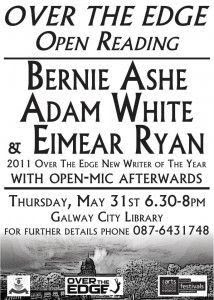
An
interview in The
Monthly explains how Over
The Edge came to be set up.
When did you set up Over the Edge?
We set up Over
the Edge in January 2003, that was the first reading in the Galway City Library
and it was Susan’s (Susan Millar DuMars) idea.

And what was the idea?
At the time we
really weren’t thinking about things like the differences between spoken word
or poetry or anything like that. We were thinking about writing and writers,
poetry and fiction, and especially those at an in-between stage in their
careers; those people who wrote poetry and fiction and who were somewhere between
getting their poems published in magazines and releasing their first collection
or going from reading at various open mics to being selected for a literary
festival. At that time there wasn’t really any opportunities for those people
to get a platform for their work.
We were, I
think, looking to build a community which could sustain people, rather than,
what tended to happen then, a situation where people wrote and read for a while
and then slowly drifted away. We wanted something that could keep people going
when things get a little difficult.
Do you think Over the Edge was a bridge between the established poetry scene and the more underground activity?
I think there
may have been a bit of that although to be honest I’m not sure we thought of it
in those terms.
There were
open mics in Galway that tended to be quite chaotic, and I’m sure other events
which came and went, but we wanted to build something that was sustainable.
We wanted to
have Over the Edge as something that had some permanence about it. And there
would be spaces for people so that if something else disappeared, we would
still be there. You could always come back to Over the Edge.
That was
another element in that we wanted to build and develop an audience. By doing
that we improved the situation for everyone in that there would always be
people who wanted to come just to listen, to be at the event, rather than poets
and writers reading to each other.
And it is still going?
Yes and in
some ways I think that it matters more now than it ever did.
I think over
the years there has been a dramatic shift in the way culture is approached and
viewed generally and that approach trickles down to poetry. The idea that you
can create something, maybe one thing, that will get you famous; that seems to
be an approach which has taken hold lately. It’s an X-Factor approach to
culture and I think an event which values quality and continuity is essential.
We have
maintained Over the Edge for nearly 20 years with the rock solid format of 3
featured readers and an open mic. We are going to have a 20th anniversary
celebration which we have already started the organising for.
Over the Edge was known for the quality of the readers. Do you feel you have been able to sustain that?
We would never
put anyone on a platform if we didn’t think they were up for that and capable
of doing it. It is quite different reading for 15 minutes than it is doing 1
poem at an open mic. We also have always put a fair bit of effort into who
reads with who so there is a good mix and balance for the audience. We were
always looking for contrast between writers and poets.
I do think
that is something that is missing from Literary Festivals over the years in
that the readers tend to be very similar. I have the view that this has
happened since the crash of 2008, where poetry and fiction, and from there the
programming of Literary Festivals, has become much more defensive, much more protective
since 2008.

Could you expand on that thought?
Back in 2008, people like myself and Dave Lordan were seen, and perhaps tolerated, as amusing reminders of the politics of the past because until the crash of 2008 we were not seen as having anything resembling a live relevance or threat, and this was despite the anti-war movement and other movements which emerged before the crash.
In the South
of Ireland you had articles in the Irish Times asking why people were not up in
arms about cuts and things like that and of course the water charges movement
seemed to shift attitudes when it emerged.
Since then you have had the situation with the Mother and Baby Homes,
the Repeal of the 8th Amendment , the electoral collapse of the Labour Party,
the rise of Sinn Fein (and other left forces) and the overarching of the Trump
years and I think because of all that there is, or has been, a tendency,
particularly in Literary Festivals, to try and cling on to the ideas of prior
to the crash
Effectively,
when there was a Liberal consensus of some sort it allowed more people who
might have been seen as eccentrics into the mix but almost all of that has gone
now.
Over the Edge
is an antidote to that situation.
Going back to Over the Edge, how was it funded?
When we
started off we couldn’t pay anyone because we had no funding. Then we received
400 Euros from Galway City Council which we used to pay travel expenses for
people travelling outside of Galway. At the time we really did think that we
were very privileged being able to do that.
We have always
been pretty careful with the funding we got because in the early days, funding
was pretty scarce and you could lose funding through no fault of your own
through austerity and various other reasons. We still pay people, travelling
writers and people who have published a book.
Below are some tributes to Kevin from those who knew him
best:
‘The Arts in Galway’
“So
sorry to learn of the passing of the passionate poet Kevin Higgins. He was a
skilled satirist, a deft wordsmith, a romantic with real powers of evocation, a
gentle presence too.
Galway Arts Centre:
“We at Galway
Arts Centre, are deeply saddened to hear of the loss of poet, writer and friend
Kevin Higgins. Kevin, along with his partner Susan Millar Du Mars have inspired
generations of Galway writers through their initiative "Over the
Edge" and through the extremely popular classes in writing that he ran in
Galway Arts Centre for many years. Our deepest sympathies go to his family and
friends.”
Below is
one of the last poems Kevin wrote. It perfectly sums up the shallow and insubstantial rich
boy who has become Prime Minister. Barely a week before I had suggested it might
be a good subject for a poem.
Monday, 07 November 2022 11:58

Published in Poetry
by Kevin Higgins, with images by Mick O'Dell
When
a boy, his mother used to
prop him on the ironing board
and steam out the creases.
Since he was about five
he's been the adult in the room
coming up with solutions
the gods of the Market will like.
He arrived with a birthmark
which, under a magnifying glass,
appears to read
Head Prefect.
He'll
be more efficient
than the previous occupant
at reducing the indigent
to ribcages which will act
as a necessary warning to others;
is the sort theatre aficionados
who enjoy browsing articles
about poverty on free Sundays
can imagine sitting beside
at a dinner party and being surprised,
he's actually quite familiar
with the dramas of Ibsen and being
beyond impressed to find themselves
in the presence of as icy and expensive
an intellect as this.
I cannot
recommend highly enough Kevin’s Thrills
and difficulties: Being a Marxist poet in 21st Century Ireland for a
political insight by someone who had been a member of Militant in his youth,
his disillusion with left groups and then his reengagement as a political poet.
I am though a different kind of Marxist to the one I was thirty
years ago, far less party orientated, far more concerned with the broader
movement. I again have people all around the world who I consider comrades.
People who, though their faults may be many, try to resist the current fashion
for putting oneself up for sale at what usually turns out to be a pretty low
price.
Kevin and
I conducted a conversation on Whatsapp in the wake of my appearance on October
27th at Over The Edge. Below is a precise of our conversations. In
the short time I knew Kevin I came to realise that he was a very special and
unique talent, with a political integrity that is rare. My heart goes out to
Susan.
[20:42,
28/10/2022] Kevin Higgins: Hi Tony, … Some rough news today. I've been
diagnosed with Acute Myeloid Leukaemia. Will be in hospital, they say, for at
least a couple of months. Likely start to chemo mid/late next week. Hopefully
during my confinement I'll still manage to cause a little bit of
politico-poetic mischief, though it won't be easy. It's been great getting to
know you, and congrats on the brilliant book sales last night. Warm best Kevin
[20:52,
28/10/2022] Tony Greenstein: Hi Kevin
I'm
really sorry to hear this. Good luck with the chemo. I know it will be really
tough but try and persevere as you are too valuable to lose with your wonderful
gifts and impish wit. I look forward to seeing you on The Crispin show from
hospital.
[20:58, 28/10/2022] Kevin Higgins: Thanks
Tony. Yes, I must do the Crispin show from the hospital. That would be fun
[23:30,
28/10/2022] Tony Greenstein: Yes that would be great. You could write a poem about Rishi Sunak
visiting a hospital today and being told to pay health workers more by a
patient and when he replied that he was trying was told that he wasn't trying
hard enough!!...
[07:09, 12/12/2022] Kevin Higgins: Hi Tony, thanks.
am feeling way way better than when I saw you in Galway. Not out of the
proverbial woods yet. But first two rounds of chemo have done their thing. Need
a wheelchair to go out of house as breathlessness is big issue, though also
very slowly improving. But it looks like I'll be able to go to this week's
December Over The Edge reading which will be the first time since September.
Hope all good your side. I was delighted with how your reading in October went;
I watched it on Facebook live in the hospital ward. Great that we prevailed
over those few Embassy trolls. One of them actually phoned me while I was still
in the A & E department before there was a room from me in the Haematology
Ward. Very funny conversation. I can't believe how reasonable I managed to
sound. He was calling from London and thought I'd be really shocked to hear you
had been expelled from the Labour Party; and so must then obviously be a total
reprobate. I thought, mate, you don't know who you're talking too; I've been
expelled twice. I think he thought we were liberal arts admin types who would
just collapse. After the reading a nurse came into my room and immediately
said: well, you're looking better! (And I hadn't started the treatment yet and
was in bad way). Your reading going so well really helped my mood at about the
worst possible time. Brilliant that you sold all those books too. Only sorry I
wasn't around for the afterwards at the House Hotel. Hope you're doing well.
Warmest wishes, and thanks for getting in touch, Kevin
[07:15,
12/12/2022] Tony Greenstein: Hi Kevin,
Yes
it was great to see you today looking better. I know you have a long way to go…. I heard there were 1 or 2 complaints but I didn't
know that it came from the Israeli Embassy. Perhaps you could write t his up
and I'd blog it. What a cheek for an
Embassy to try and interfere in local politics especially given the Jewish
neo-Nazis who are now in control in Israel. Yes being expelled from the Labour
Party must indeed be a crime to them but we all know that if you are Jewish
today you are 6 times more likely to be expelled from the LP. I was just the first.
Glad
he cheered you up though!
Take
it easy and maybe when you are better I can return for another reading!!
[12:18,
17/12/2022] Kevin Higgins: Hi Tony, sorry to take this long to get back to you.
I'd be happy to write up a piece for your blog about the Zionists we dealt with
around your reading. Some of it was even quite comical really. If it would be
okay for me to write that up for you in the early new year, that would be
great. Still settling into being back at home - which is great- but taking it
easy (which being a workaholic is not my best area!) Hope all good your side. Best
always, Kevin
[12:45,
17/12/2022] Tony Greenstein: Yeah that would be great. Yes please take it
easy. You are too valuable to lose. Your
health is your main priority. When I had
a liver transplant and leading up to it I dropped all political work to concentrate
on my health. You must do the same. Take care
Tragically Kevin was not able to write up his experience with
the Israeli Embassy trolls but I think people will be able to get a sense of
what happened.
Tony Greenstein


