Showing posts with label Kurdistan. Show all posts

14 October 2019

The Bloody Betrayal of the Kurds by Trump and the United States is Nothing New


Background to the Kurdish Struggle and the American Betrayal in 1963

The betrayal of the Kurds of Syria by Donald Trump and the United States is only the latest such betrayal. After having provided the foot soldiers in the fight against ISIS, losing 11,000 fighters in the process, Donald Trump has unceremoniously betrayed them to the Turkish dictator Recep Erdogan, whose forces have been fighting an undeclared war in Turkish Kurdistan since the breakdown of a ceasefire in July 2015. In essence there have been a continuing series of wars against the Kurds of Turkey since 1978.
The destruction of Cizre in Turkish Kurdistan is similar to Israel's destruction in Gaza
Turkish armed forces, which we should not forget are an integral part of NATO, have laid waste to substantial parts of the main Kurdish cities of Diyarbakır, Şırnak, Mardin, Cizre, Nusaybin, and Yüksekova. See Blood on Erdoğan’s hands and Palestinian solidarity cannot ignore the oppression of the Kurds in Turkey
In 1975 the Algiers Agreement between the Shah of Iran and the Iraqi Baathists was the latest betrayal when the Iranian state, at the behest of the United States agreed to withdraw support for the Kurdish fight against the Iraqi state.
During the Iran-Iraq war a genocidal war was waged by Saddam Hussein against Iraqi Kurdistan. Hundreds of villages were destroyed in Operation Al-Anfil. The most infamous attack was that on Halabja when some 5,000 Kurds were murdered with mustard gas and nerve agents after the town fell to the Iranian army.
Kurdish women in the Peoples Fighting Units are unique in the Middle East
At the time the West poured scorn on the suggestion that the massacre had taken place because the West supported Iraq against Iran. Indeed the West had supplied these chemical weapons, which were the later pretext for the invasion of Iraq in 2003, to the Batthist regime.
It would appear that the PYD and SDF have reached an agreement with Syria’s Assad regime which will allow Syrian troops enter Kurdistan in order to prevent the Turkish invasion. It is a bitter pill to swallow. The Kurds go from the frying pan into the fire given the bloody record of Assad.
Below is an article by Jabra Nicol in Matzpen, the magazine of the Socialist Organisation in Israel on the background to the fighting with the Iraqi army commanded by the Baathists.

Why the Kurds Should Be Supported ‒ by A. Sa’id (Jabra Nicola)

October 10, 1963
[This is a translation of an article that was published in Hebrew in Matzpen no. 11, October 1963]
The bloodshed in Iraqi Kurdistan is still ongoing; the bloody and terrorist regime of the Ba’ath party has mobilised two-thirds of the Iraqi army – three out of five divisions – with half of its armoured force, along with heavy artillery and jet aircraft, in its dirty war against the Kurdish people fighting for its freedom.
Turkey's Destruction in Cizre matches Israel's in Gaza
This dirty war began back at the time of Qassem’s rule in 1961.
The Kurdish people is one of the most ancient peoples in western Asia. For more than 5,000 years, it has inhabited a territory known as Kurdistan, at present divided between Turkey, Persia, Iraq, Soviet Armenia and Syria. As early as 1639, Kurdistan was partitioned between the Ottoman Empire and Persia; and after World War I, it was re-partitioned by the imperialists. At present there are two million Kurds in Iraqi Kurdistan, two million in Iran, another two million in Turkey, more than half a million in Syria and close to 15,000 in the Soviet Union.
These partitions, as well as other intrigues of imperialism in westernern Asia, delayed the national development of the Kurdish people and prevented its independence. The Kurdish people’s struggle for independence and national unification – the unification of Kurdistan – began at the end of the last [19th] century and culminated after the First World War. Since the beginning of the present [20th] century, the Kurdish people has risen about ten times against its enslavers. In 1919, it rose up under the leadership of Sheikh Mahmoud; and after a long struggle, English imperialism managed to suppress this uprising in blood and fire. Under the pressure of the Kurdish people’s struggle, British imperialism was forced in 1922 to recognise the right of Kurdish people, and with the consent of the Iraqi government at that time, an independent Kurdish government was established, whose capital was Al Suleimania. But soon Great Britain reneged on its obligations, reconquered the Kurdish territory and overthrew the young state.
In 1929, the Kurdish people rose again, and then once more in 1931. This latter uprising continued until 1942, and in 1943 the Kurds again rose up in Iraq, led by Mullah Mustafa al-Barzani, but the uprising failed and Barzani had to flee with a large number of his supporters and members of his tribe to Iranian Kurdistan. There they took part in a new uprising, leading to the declaration of an independent Kurdish republic. But the Iranian government soon managed to suppress the uprising and put an end to the Kurdish Republic. Again Barzani had to flee with members of his tribe. The United States having refused to grant him asylum, he waged fierce battles with the Turkish, Iranian and Iraqi armies and succeeded to break through the encirclement and reach the Soviet Union. Of the two thousand fighters, only 650 arrived in the Soviet Union, where they remained until the July 14 [1958] revolution in Iraq.
This revolution in Iraq promised the Kurdish people equal rights. The Provisional Constitution promulgated following the revolution stated that the Iraqi Republic was “a partnership between the Arabs and the Kurds”. The freedom fighters led by Mustafa Barzani, exiled in the Soviet Union, returned to Iraq, and the Kurdish people showed willingness to assist in building the new regime. 
Jihadist fighters from the so-called Syrian National Army fight alongside the Turkish army
When Qassem turned to the right, breaking with the forces of the Iraqi left, he also broke with the Kurds and pursued a policy of brutal national repression against the Kurdish people. From late 1960, the Iraqi government began supporting the landlords and the rest of the Kurdish reactionary forces in their war against the Kurdish peasants and progressive forces. Moreover, the government encouraged the reactionary press in Baghdad to raise the chauvinist slogan of Kurdish assimilation. Even the word “Kurdistan” was banned and the territory was called “Northern Iraq”. The Kurdish people have been denied the right to study in their national language and to elect their representatives to local and central government institutions.
The Kurdish masses are victims of poverty, exploitation, ignorance and disease; they are discriminated against in all areas of life: political, economic and cultural. Iraqi Kurdistan has only one primary school for every 3,500 residents and a high school for every 57,000. There are only 685 books in the Kurdish language in all Iraqi public libraries.
When the Kurdish people were forced to revolt against this oppression, the Qassem government sent the army against them, in the name of “the rule of law and order”. 
The Iraqi Communist Party, instead of raising the slogan of self-determination for the Kurdish people, supported the Kurdish people’s rights in very general and vague terms, but on the other hand regarded the slogan of separation and the establishment of an independent Kurdish state as an “imperialist plot”. In March 1962, an article appeared on the events in Iraqi Kurdistan in The Problems of Peace and Socialism – the journal of the World Communist Movement – stating:
 “The agents of CENTO [the pro-westernern Baghdad Pact] and oil companies have taken advantage of the situation and, relying on British forces in Kuwait, have fomented an armed rebellion against the Iraqi state under the slogans of ‘Defense of Barzani’ and the establishment of a ‘Kurdish State’. They want to carry out the old plan of isolating the northern regions and annexing them to Iran (that is, to CENTO) and, as the Communist Party has rightly argued, this activity, which is part of the general imperialist policy in the Middle East, has created a serious and dangerous situation in Iraq.”
Thus, instead of supporting the Kurdish uprising, the Iraqi Communist Party contented itself with “calling on the Qassem government to resolve the crisis in northern Iraq peacefully” and “in a way that will strengthen the unity of the Iraqi people against the intrigue of imperialism and reaction.” 
This opportunistic position of the Iraqi Communist Party was an integral part of its general policy, which was based on support for the Qassem’s regime and resolute opposition to Arab national unification. Accordingly, it saw the Kurdish uprising on the one hand as weakening Qassem’s rule, and on the other hand it viewed the separation of Kurdistan as weakening the Iraqi republic and pushing Iraq into Arab unification, because it would be very difficult for Iraq to remain economically and politically independent if it only kept the Arab part of its territory.
Due to this opportunistic policy, we are witnessing the current tragic situation in the anti-imperialist liberation movement in western Asia, a clash between two anti-imperialist nationalist movements – the Arab and Kurdish movements, both of which are integral to the general revolution of the colonial peoples.
Recognising the right to self-determination of the Kurdish people and establishing an independent Kurdish state would not in any way be detrimental to the Arab liberation movement; on the contrary, it would help this movement as well as the [anti]colonial revolution in general. Indeed, an independent Kurdish state in Iraqi Kurdistan could become a centre and lever for the entire Kurdish national movement in Iran and Turkey, both of which are members of CENTO; And this would be an immense revolutionary force against the main imperialist base in western Asia. On the other hand, it would help Arab national unification, which is at present one of the major problems of the Arab national liberation movement.
With the change in the political situation in Iraq following the Ba’athist coup, the Iraqi Communist Party does now support the Kurdish uprising and many of the communist Arab officers actively participate in battles together with the Kurds; but it still does not raise the slogan “right of self-determination up to separation” for the Kurdish people. And the Soviet Union supports in its press and speeches the Kurdish uprising, but on the other hand Soviet aid is still flowing to the Iraqi government and Aref ’s armies are fighting against the Kurdish people using Soviet weapons.
The Kurdish national liberation movement, like any other national liberation movement, is not without internal class contradictions, reflected in different political and ideological currents. The danger for the Arab national liberation movement and the colonial revolution in general does not, therefore, lie in secession of Iraqi Kurdistan and establishment of an independent Kurdish state, but in the strengthening of feudal and bourgeois forces in the Kurdish movement, which tend by their very class nature to link with imperialism. On the other hand, increasing the power of the masses and proletarian hegemony within the Kurdish liberation movement could be a major influence on the national and social liberation movement within Iraq as a whole. 
Here in Israel there has recently begun to be heard from various circles a voice of support and identification with the Kurdish people’s struggle in Iraq, but the rationale for this support is questionable and dangerous. Those circles, notwithstanding their political differences on other topics, view the Kurdish people’s struggle as an anti-Arab factor that weakens the Arabs and they use it as a pretext for fostering anti-Arab chauvinist sentiment and intensifying anti-Arab propaganda. Even circles purporting to be against the existing regime in Israel and for cooperation between the peoples of the region, such as [Uri Avnery’s] Ha’olam Hazeh, call for support for the Kurdish rebellion because it “opens a second front against our enemies” (the Arabs). They see the Kurdish movement as ally, being a non-Arab counterweight “within the region, most of whose inhabitants are Arabs”.
We too side with the Kurdish uprising in Iraq and call for supporting it, but for entirely different reasons. We see no contradiction between the Arab and Kurdish national and social liberation movements, but on the contrary: we see both as mutually complementary, and both as an integral part of the colonial revolution. The Kurdish uprising in Iraq is not a rebellion against the Arab masses, who are also fighting for their freedom, but is directed against the forces that oppress the Arab and Kurds alike. Every success of the Kurdish people in its current struggle is, at the same time, a success of the forces fighting against the bloody and terrorist regime that rules Iraq today. Support for the Kurdish uprising cannot be founded on the current Israeli policy – of cooperation with imperialism against the liberation movement of the colonial peoples – but on cooperation with the colonial movement as a whole against imperialism. If we have to look for allies in the region, we cannot find an ally in one liberation movement against another. The true allies of the Israeli masses are all the liberation movements in the region, the entire colonial anti-imperialist movement.
The Kurdish liberation movement, the uprising of the Kurdish people, was a major factor in overthrowing the regime of Nuri al-Sa’id, followed by that of Qassem. The current Kurdish rebellion will also be one of the most important factors in overthrowing Aref’s bloody regime. But the Kurdish liberation movement on its own cannot do so, and cannot bring liberation to the Kurdish people without close cooperation with all the anti-imperialist forces fighting against the current regime in Iraq.

23 June 2019

Palestinian solidarity cannot ignore the oppression of the Kurds in Turkey

Why Palestine solidarity activists should not give any support to the Erdogan dictatorship in Turkey

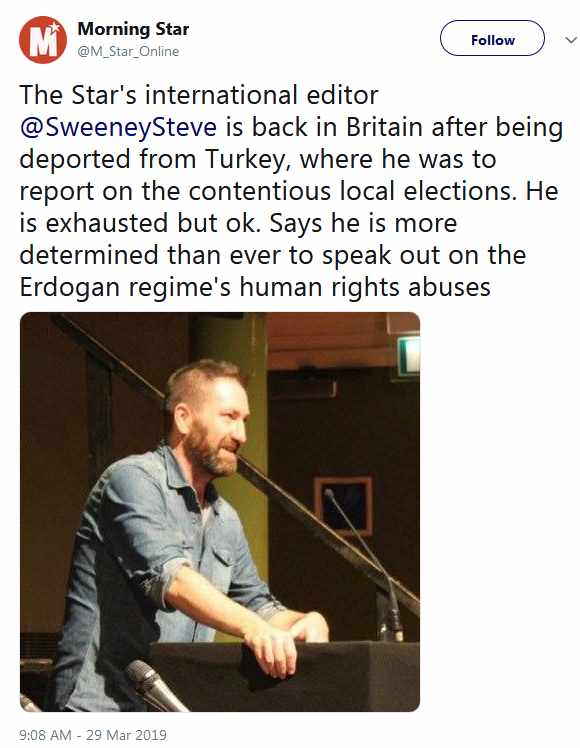
Below is an important article from Canary and another from Al Jazeera. Last Thursday I went to a meeting and heard the description, by the Morning Star's International Editor Steve Sweeney, of Turkey’s reign of terror in the Kurdish parts of Turkey.  Steve spent a harrowing time in Turkey reporting what was happening in Turkish Kurdistan.  By all accounts he was lucky to escape with his life.
All the elected parliamentary representatives of the HDP, a mainly Kurdish  party, are in  prison.  Some 60 mayors of Kurdish towns have been replaced by hand picked Erdogan representatives.
On June 23 there will be a rerun of the Mayoral election that was held on March 31st in Istanbul.  Erdogan's AKP party lost in March but he ‘persuaded’ the Supreme Court to annual the elections and hold them again.
The story of what happened in Cizre in Kurdistan is sickening.  After a siege of the city, Turkish troops entered and poured petrol into basements where civilians were hiding burning 176 people – men, women and children - alive.
Child searching in what is left of his home
No principled supporter of the Palestinians can do anything other than condemn Turkey’s genocidal attacks on the Kurds, both within Turkey and in Syria.
Many Palestinians turn a blind eye to what Turkey does because of the rhetorical attacks from Erdogan on Netanyahu.  However this ignores the reality of Israel’s economic relationship with Turkey for example Turkey’s agreement with Israel on the gas reserves in the Mediterranean.
The devastation in Cizre matches anything in Gaza
One thing is for certain. The existence of dictatorial and repressive regimes like Turkey, which oppress their own people and deny self-determination to the Kurds, cannot be of any benefit to the Palestinians. This should be one of the lessons that should be drawn from the PLO's relationship with repressive Arab regimes before and after Oslo.
What is equally disgraceful is the fact that Britain, the European Union and the United States have declared the PKK, the Kurdish Workers Party, which is fighting Erdogan’s murderous army ‘terrorists’.  If ever there was proof that one man's freedom fighter is another man's terrorist, this is it.
Tony Greenstein 
Turkish 'pacification' in Sizre


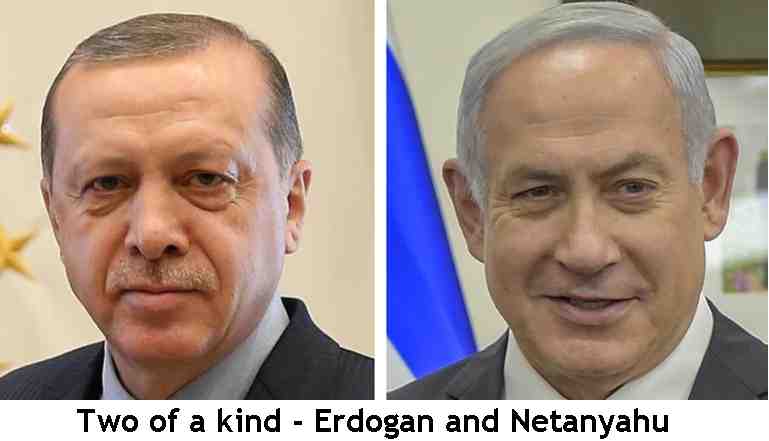
Turkish president Recep Tayyip Erdoğan and Israeli prime minister Benjamin Netanyahu continue their familiar feud, using social media and public speeches to blast each other. Meanwhile, #WeAreErdoğan trends on Twitter, as thousands of people claim to stand with the authoritarian Turkish president, while at the same time supporting Palestinians in their struggle.

As Palestine solidarity activists, it is vital to remind ourselves of the similarities between Turkish and Israeli state policies. If we stand for the liberation of Palestinians, we must also stand for the liberation of Kurdish people against their Turkish oppressor.
Palestine as propaganda        
For years, Erdoğan has used the occupation of Palestine as a propaganda tool to increase his popularity and to mobilise grassroots Muslim supporters. It’s no coincidence that Erdoğan took the opportunity to insult Netanyahu at an election campaign rally this week.
Portraying himself as an anti-colonialist with decent moral values, Erdoğan succeeds at his task of winning over supporters. Turkish flags can be seen in some houses and shops in the West Bank, while Palestine solidarity activists retweet Turkish state propaganda.
In 2017, US congresswoman Ilhan Omar tweeted about meeting with the Turkish president. While in 2018, Rachel Corrie’s parents accepted an award from Erdoğan on behalf of their daughter. Corrie was murdered in Gaza in 2003 by the Israeli military. At the ceremony, her parents thanked Turkey and stated that “world citizens needed to reject destructive nationalism and racism more than ever.”
Palestine solidarity activist Benjamin Ladraa, who inspired lots of us when he walked from Sweden to Palestine, attended the same awards ceremony in Istanbul, meeting the dictatorial president and his wife.
These meetings occurred after Turkey, under the leadership of Erdoğan, committed the biggest massacre of its Kurdish population since the 1990s, displacing thousands and killing hundreds, including children. Meanwhile this week, Erdoğan called Netanyahu a “tyrant who slaughters 7-year-old Palestinian kids.”
So, let’s look at the similarities between Erdoğan and Netanyahu and the countries they’re leading.
Part of the pathetic repartee between 2 dictators
Murders
Between 2009 and 2019, Israeli occupation forces murdered 3396 Palestinians, of whom 774 were children. Despite this, Netanyahu had the audacity this week to tweet in reply to Erdoğan:
Similarly, Turkey has killed hundreds of its Kurdish citizens since 2015, including 176 people who were murdered when they were trapped in basements in the city of Cizre in early 2016. Many of them, including children, were burnt alive by Turkish soldiers. The government branded all those killed as “terrorists”.
The Sur part of the city of Diyarbakir
Satellite photos taken before and after Turkey's bombardment
Razing homes
In 2018, the Israeli occupation demolished 460 Palestinian structures, displacing people who had nowhere else to live. The state continues to ethnically cleanse Palestinian areas in its relentless pursuit of Zionist expansion. As armed forces bulldoze homes, villages are in danger of disappearing completely off the map. So far in 2019, demolitions continue on an almost daily basis.
In Turkey, between 2015 and 2016, armed forces displaced around 500,000 majority-Kurdish people as they terrorised and flattened whole neighbourhoods in Kurdish cities. Many of these people were not able to return to their homes. Turkey has also ethnically cleansed and currently occupies the majority-Kurdish region of Afrin in Syria.
Imprisonment
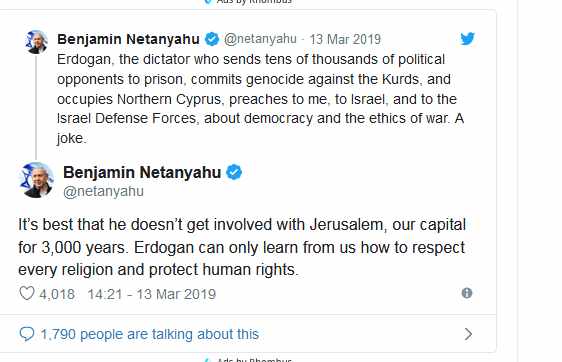
This week, Netanyahu tweeted again:
Indeed, Turkey imprisons and tortures political opponents, and is the number one country in the world for imprisoning journalists critical of the government.
But Israel, too, continues to imprison Palestinian citizens. There are currently 5,440 political prisoners languishing in Israeli jails, including 209 child prisoners. 493 prisoners are serving sentences of more than 20 years.
Punishing human rights observers

As Netanyahu talks nonsense on social media about protecting human rights, the Israeli state continues to target and punish those who attempt to document its crimes against Palestinians. The international observation group, Temporary International Presence in Hebron (TIPH), was permanently expelled from the West Bank in February 2019. At the same time, international group Ecumenical Accompaniment Programme Palestine Israel (EAPPI) was forced to leave Hebron due to Israeli settler harassment. The lack of international observers means that Israel can act with total impunity as its armed forces terrorise the streets of Hebron.

Meanwhile in Turkey, human rights defenders continue to be locked up and charged for ‘membership of a terrorist organisation‘, and international journalists are expelled under the same charge. In 2015, Turkish police murdered prominent human rights lawyer Tahir Elçi. He was shot in the head.
Shooting protesters
Both Israel and Turkey crack down heavily on protesters. There are numerous reports about the Israeli forces’ barbaric shooting of Palestinian protesters at Gaza’s Great March of Return. Israel frequently fires at demonstrators in the West Bank, too. The military uses live bullets, rubber-coated steel bullets and stun grenades on protesters, as well as drones to fire tear gas canisters at them.
Meanwhile, Turkish forces fire tear gas at mothers holding demonstrations for their children who were disappeared by the state. Turkish police fire rubber bullets and pepper spray at women demonstrating on International Women’s Day. And in 2013, much was written about police violence and the weaponry used during Istanbul’s Gezi Park protests.
Racism
Netanyahu recently stated on social media that:
Israel is the nation state of the Jewish people – and only it.
He too is hoping to rally support for the upcoming April election by stoking racism among citizens. His comment comes after the passing of Israel’s ‘nation-state’ law, which declares that ‘the right to exercise national self-determination in the State of Israel is unique to the Jewish people.’ The law also axes Arabic as an official language of Israel.
In Turkey, Kurdish has never been an official language, despite around 25 million Kurdish people living in the country. Turkey’s policy is to attempt to stamp out Kurdish culture and assimilate people into being ‘Turkish’. Those who won’t be assimilated face imprisonment.
War crimes
In 2018, Human Rights Watch stated that Turkey’s attacks on Afrinmay be unlawful“. And the Permanent Peoples’ Tribunal found Turkey guilty of war crimes against the Kurdish people.
Similarly, in February 2019, the UN admitted that Israel’s murder of protesters in Gaza “may constitute war crimes.”
Despite these allegations, both countries continue to act with impunity, safe in the knowledge that western states need them as allies. And besides, there’s money to be made in selling both countries weapons.
So while both Netanyahu and Erdoğan yell virtual insults at each other, it’s important to remember that both leaders have blood on their hands. Don’t naively believe the pro-Palestine propaganda coming from Turkey’s power-hungry president. Stand in solidarity with both Kurdish and Palestinian peoples as they struggle against those who want to wipe them from existence.
Featured images via the Wikimedia Commons / US State Department
Get involved
  • Both Turkey and Israel need to buy their weapons from international arms companies. These arms companies are coming to London in September to make deals and sell weapons at one of the world’s biggest arms fairs. Visit Stop The Arms Fair to find out how to get involved.
  • Turkey is a member of NATO. This December, leaders of the NATO-member states will be coming to London for a NATO summit. On 24 March, you can attend a meeting among activists in London, discussing how to oppose the summit.

Cizre in ruins as Turkey lifts curfew on Kurdish towns

Kurdish civilians returned to widespread destruction after months of fighting between Turkish forces and the PKK.

13 Mar 2016
Cizre in ruins as Turkey lifts curfew on Kurdish towns
Rows of houses and apartment buildings in Cizre have collapsed, and the structures that are still standing have broken pillars and parapets, burned bricks and bullet-scarred walls [Kiran Nazish/Al Jazeera]

Cizre, Turkey - Shop owner Emre Tatlisoz's home was once three stories high. Today, it is nothing more than a pile of rubble.
The house next door is equally unrecognisable, as is the next one, and the one after that. The streets of Nur Mahallesi, a neighbourhood in Cizre in southern Turkey, have been hard-hit by clashes between Turkish government forces and Kurdistan Workers' Party (PKK) fighters.
A 24-hour curfew was imposed on the town of about 130,000 people last December, and was only lifted this month. Residents who had fled the violence were allowed to return to Cizre on March 2, but many quickly discovered they had little to come home to.
"This was not sudden. It is hard see it, but we had imagined this in our fears," Tatlisoz said as he surveyed the destruction. "This is why we were asking the world to look at us, but we were ignored by the media."
He told Al Jazeera that he first planned to stay in Cizre despite the curfew, but left after his neighbour's home was hit by shelling, and he saw a sniper shoot and kill a man in front of his house.
"Fleeing was a risk, too, with my young children … and we left under constant shooting over our heads," Tatlisoz said.
Turkey launched a widespread security operation against the PKK, a Kurdish nationalist group that Ankara, the United States and the European Union consider a terrorist organisation, in July 2015.
PKK fighters have taken responsibility for deadly attacks on Turkish forces and police after a recent ceasefire between the group and the Turkish government collapsed last summer. The decades-long conflict between the Turkish state and the PKK has killed at least 30,000 people.
The recent operation was focused largely on Kurdish-majority areas in southern Turkey.
The Turkish army claimed that more than 600 PKK fighters were killed in Cizre alone. Turkey also informed the United Nations that 205 members of the police, gendarmerie and military were killed between July 20 and December 28, 2015.
A Turkish police official, who spoke on condition of anonymity because he was not authorised to speak to the media, told Al Jazeera that the goal of the recent operation was "to kill PKK terrorists and anyone who will support their ideology.'' Turkish officials say the fighting was focused on neighbourhoods that housed barricades built by local fighters.
But Ali Ihsan Su, the governor of Sirnak province where Cizre is located, said the Turkish authorities did not distinguish between civilians and fighters.
They attacked callously and mercilessly, without distinguishing between military, police, women, men, old or young.
Ali Ihsan Su, governor of Sirnak province
"They destroyed houses by placing explosives from the kitchens to the bedrooms," Su said. "They attacked callously and mercilessly, without distinguishing between military, police, women, men, old or young." 
Earlier this month, Tesmeen Yildiz, a woman in her 60s, stood outside her home waiting for neighbourhood boys to bring her son's charred remains up from the basement. Her son insisted on staying to watch over the house, she said, and he died when the home was attacked by Turkish forces. Yildiz maintained that her son was not a member of the PKK.
Videos and images shared by Cizre residents showed Turkish forces opening fire on civilians. A video shot by local journalist Refik Tekin - in which a group of civilians carrying white flags are fired upon - went viral in late January, and led the UN High Commissioner for Human Rights, Zeid Raad Al Hussein, to call on Turkey to investigate the shooting of unarmed civilians.
"The authorities must take great care to protect human rights when conducting military or security operations. If state operatives commit human rights violations, they must be prosecuted," Al Hussein said in a statement.
Amnesty International also warned that "the Turkish government's onslaught" in Kurdish towns and neighbourhoods put 200,000 lives at risk and amounted to collective punishment.
Despite being able to return home, many residents of Cizre said they were planning to relocate to nearby towns, or seek shelter with relatives elsewhere in Turkey. Those who do plan to remain will face an uphill battle to rebuild. 
An official with the Turkish prime minister's office told Al Jazeera that the government has "pledged to launch public housing projects and provide financial assistance to communities affected by terrorism", but he did not provide further details. Asked about allegations of human rights violations by the Turkish government, the official did not directly respond, instead noting that the PKK's violence "did more harm to the Kurds" than anybody else.
Some neighbourhoods, including Sur Mahallesi, Cudi Mahallesi and Nur Mahallesi, have become virtually uninhabitable. Rows of houses and apartment buildings have collapsed, and the structures that are still standing have broken pillars and parapets, burned bricks and bullet-scarred walls. A large school near the city centre, which locals said was used by Turkish security officers, has been reduced to rubble, while a garden near the building is filled with ash.
"We have no money, no furniture, no income. How will we feed ourselves? Where will we sleep?" asked Cihan Zaman, a pharmacist who lived in Cudi Mahallesi. "We have travelled back in time."
SOURCE: Al Jazeera

Photos show devastation after Turkey ends two-month anti-PKK operations in Cizre