The Death of Searchlight’s Gable Represents the Death of Bourgeois Anti-Fascism

Gerry
Gable, the Editor of Searchlight Anti-Fascist Magazine from 1981 onwards, died
recently. What is remarkable is that all the obituaries, from the Morning
Star to The
Telegraph and Times
were both completely uncritical and almost identical.
According
to Andrew Bell, a former Searchlight Editor
in the Guardian
Gable
was one of the most formidable and persistent figures in the postwar fight against fascism and the extreme right in the UK.

The
genocide supporting, anti-Palestinian Jewish Chronicle said
that Gable
remained consistent in his efforts to defend democracy and expose the dangers of far-right extremism.’

According
to Steve Silver, former Campaigns Officer for the Israeli funded Union of Jewish Students, in the Communist Morning
Star, Gable was ‘the most tenacious post-war anti-fascist
Britain ever produced’.

The Telegraph described Gable
as having ‘waged a 50-year war on British neo-Nazis’.
It is not often that someone can receive almost identical praise from the papers of the Communist Party and the Tory Party. And still they got it wrong. Not a hint of the criticism Gable received found a space in their eulogies. Although one must not speak ill of the dead it is also important to speak the truth.

Perhaps the reason for their
praise is that Gable’s work against Britain’s neo-Nazi right not only posed no
challenge to the British state but was often carried out in collaboration with
it. These tributes tell one side of the story. There is another, darker and
murkier side.

Part of the reason is that
Gable was a racist not an anti-racist, a Zionist not an anti-Zionist. The real
credit for Searchlight’s work during the 1970s when it played a key role in destroying the National Front as a political force should go to Maurice Ludmer, its Editor between 1975 and 1981, and not Gable.
Unfortunately Ludmer died an untimely death in 1981 at the age of only 54
leaving Gable to align Searchlight’s political
direction with his own.

Maurice Ludmer, unlike Gable, was an anti-imperialist
Whereas Ludmer resigned from
the Communist Party because it was not sufficiently devoted to the fight
against racism in the working class Gable resigned in 1962 because
‘it had begun to adopt an anti-Israel line’
[Jewish Chronicle 23.10.87]. Gable
explained that:
Israel was a democracy and these (Arab) countries were not. I have always supported Israel on those grounds first and foremost because I have always been a Jewish trade unionist.
Therein lies the difference
between Ludmer and Gable. According to David Edgar’s obituary
for Ludmer
Maurice believed passionately that fascism could not be effectively fought without attacking racism as well; he believed, too, that black workers must play their full part in the struggle against the most extreme and virulent form of racism, the National Front and its allies.
Gable’s lack of socialist
politics led to his collaboration with a British state that was racist to the
core. This was also why the Anti-Fascist movement lost its trust in him.
Gable’s relationship with
the British state and his trading information on neo-Nazis with Special Branch
and MI5 in exchange for information on the Left led to a breakdown in relations.

Gable’s Memorandum to London Weekend Television
In 1977 Labour Home Secretary, Merlyn
Rees proposed
deporting American journalist Mark Hosenball and ex-CIA agent Phil
Agee. Agee and Hosenball were targeted because they
were exposing CIA activities and the existence of Britain’s electronic
intelligence agency, GCHQ, which was then a secret.

From Left to Right - Campbell, Aubrey and Berry
While researching to defend Agee and Hosenball against deportation, Time
Out journalists Crispin Aubrey and Duncan Campbell met with John Berry, a
former Signals Intelligence employee, a whistleblower, to discuss the
operations of GCHQ.

Hosenball and Campbell, had co-written an article for Time Out
magazine titled "The
Eavesdroppers" which detailed the work of GCHQ. This, along with
Agee's work, led to them being deemed threats to national security.

The ABC trial arose from the government's attempt to silence
investigations into its intelligence activities. Aubrey, Berry and Campbell (ABC)
were arrested on February 20, 1977, days after the deportation order was
finalised, under the Official Secrets Act for collecting and passing on
information regarding signals intelligence.
In November 1978 this trial collapsed with token
sentences being handed out. During the trial and the campaign that preceded it,
the security services had done their best to poison the media via corrupt and
tame journalists. One such was Gerry Gable, a researcher with London Weekend Television.

On 2 May 1977, Gable sent
a memo to his superiors at LWT regarding Phil Kelly who was active in the
campaign to support the ABC defendants. Kelly later became editor of Tribune and an Islington Labour councillor.
The memo confirmed that
Gable was working hand in glove with the British and Israeli secret services to
smear the campaign to support Hosenball and Agee.
Gable alleged that Kelly had
taken part in a PLO terrorist training camp. There was no truth in this allegation
but lies came easily to Gable. According to
the New Statesman (15.2.80):
The wording of Mr
Gable's memo suggests clearly that he was engaged in a 2-way transaction with
his security sources... The nature of the official material received and
recorded by him suggests that much of it was coloured by phone-tap info and
informer reports.
As Time Out observed,
the memo caused those who Gable mentioned, like Hosenball, who had previously
considered Gable as a friend, to feel betrayed. (22.2.80)
It is something that people in anti-fascist
politics have also experienced. There is
reason to believe that Campbell was also being monitored by Gable.

Brian Gentleman
Nine years later and Gable was up to his old
tricks, this time for Channel 4's 20/20 Vision. Gable befriended,
and took advantage of, a lonely low-level civil servant in the DTI, Brian Gentleman.
One day Gentleman found himself accused,
live on TV, of being a Czech agent.
However the Police refused to prosecute. Gentleman
was considered a Walter Mitty character whom Gable had entrapped. The
Broadcasting Complaints Commission delivered a stern rebuke. It was also the subject
of a question in the House of Commons from Gerald Howarth MP.
The Role of Searchlight
Searchlight Magazine played a crucial role in exposing the National Front in the
70s as a neo-Nazi organisation. Under Ludmer it was an effective weapon for the
anti-fascist movement. In the words of
Unmesh Desai, now a right-wing Labour councillor but at the time an
anti-fascist activist, ‘Searchlight
was our bible’.

Once Ludmer had died Gable
took the magazine in an overtly pro-imperialist direction. For years I helped
sell the magazine but I stopped doing so when it became overtly pro-Zionist. One
particularly absurd front page was the September 1987 issue ‘The New Axis’ featuring Ghadffi, Khomeini,
Patrick Harrington and Louis Farrakhan. It was a precursor of George Bush’s
‘evil axis’.

This was followed up by the
January 1989 issue ‘The Year of the Mad Dogs’ featuring Ghadaffi again. This fitted
in with Reagan’s rhetoric against the Libyan regime. An equally demented graphic
on the State of the British Right in January 1989 included Muslim
fundamentalists, Black British activists, Arabs a plenty but curiously no
mention of Zionist organisations such as the Jewish Defence League.

Searchlight had became a pro-Zionist rag and a mouthpiece for British
Intelligence. It is little wonder that the Telegraph,
not normally sympathetic to the fight against fascism or racism, gave such an
adulatory obituary to Gable.

Anti-Fascist Action (AFA)
It is in his effect on the anti-fascist movement
that Gable and Searchlight were most
destructive. AFA was formed in February 1985 to take on a resurgence of violent
fascism and groups like Blood & Honour, C18 and the British Movement.
Not only was Searchlight trading information with MI5/Special Branch
but it was actively trying to split and destabilise the anti-fascist movement.
When Zionist Board of Deputies attacked the newly formed Anti-Nazi League [ANL]
Ludmer didn’t hold back in attacking the BOD:
‘In the face of mounting attacks against the Jewish community, both ideologically and physically, we have the amazing sight of the Jewish Board of Deputies launching an attack on the Anti-Nazi League with all the fervour of Kamikaze pilots.’ [Searchlight November 1978]
Guardian journalist David Rose, described
by Larry O’Hara as a ‘journalistic mouthpiece’ for the Met Police and Searchlight, smeared
Class War as a fascist
organisation. Allegations were
made by Gable that their leadership, in particular Ian Bone, were supporters of
the NF, that racism was endemic in CW, that they were police agent-provocateurs on demonstrations and
that the NF & CW jointly planned the Stop the City demonstrations targeting
Jewish businesses.
CW were never popular on the Left, their paper was often
crude politically but no one doubted that they were anti-fascists. They
attracted a young, punk periphery. They also appealed to a section of the
working class including many miners during the 1984-5 strike. They were the
perfect foil for Gable and MI5.
At its Manchester conference in 1986, AFA narrowly took a decision to suspend CW from membership until an Inquiry looked into Searchlight’s allegations. When the Inquiry asked for evidence
Searchlight was unable to supply any to support its allegations.
At this, AFA’s second conference I was
elected onto AFA’s Executive. When a Commission
of Enquiry reported, CW were exonerated but the damage to AFA had been done. The
1986 AGM nearly broke up in turmoil as a result of the allegations.

As the AFA Report into Searchlight Allegations Against Class War concluded:
Despite the leading role of Searchlight magazine in the affair, and despite many approaches to the magazine for evidence, the sum total of material from Searchlight to the enquiry was nil. We are bemused by Searchlight's role in this affair.
In the course of the inquiry Gable had admitted to
monitoring anarchists. For whom he didn't say. He had engaged in the destabilisation
of AFA on behalf of the British state and his Special Branch and MI5 friends.
None of his obituaries have even mentioned Gabel’s role as an informer for the
British state.

Brighton AFA Letter to AFA Groups (24.6.93) and to Gable (16.7.93) and Gable Letter to Greenstein (13.7.93)
On 24 June 1993 I wrote on behalf of Brighton AFA to other AFA groups warning them about Gable and Searchlight. I referred to his targeting of Malcolm Astells, a member of Midlands AFA as a neo-Nazi infiltrator on the basis that:
‘every time he takes charge something goes wrong: either people get arrested or are led away from confronting the nazis on wild-goose chase.’
I referenced similar allegations against Class War and made the point that when false allegations are made against people
the result can only be to sow confusion and suspicion in our ranks. lt is a classic tactic of the secret state, the purpose of which is to destabilise and demoralise its enemies. It also means... that it is that much easier for genuine fascists to infiltrate our ranks.’
My letter stung Gable into sending me a rebuttal on 13 July 1993. Gable disguised his real reason for writing with the pretence that I owed Searchlight money for copies of Searchlight that he had sent me to distribute. In fact I never heard again of his legal threats.
The rest of his letter was mere bluster, repeating claims that he had supplied evidence to AFA’s CW Inquiry. In the course of his rant, Gable accused me of being a ‘self-hating Jew’. Gable, also resented my comparison to Maurice Ludmer who had always taken the position that the issue of Zionism should not be allowed to divide the anti-fascist movement.
This was a time when some supporter of Israel, such as Miriam Karlin and Professor Geoffrey Alderman, had broken ranks with the Board of Deputies to sponsor the Anti-Nazi League. Today when the Zionists are holding hands with Tommy Robinson and supporting Genocide, such a position is clearly untenable.
In my response three days later I explained that the term ‘self-hater’ has a Nazi lineage. That was what anti-fascist Germans were accused of before going on to make the point that:
I have always found it difficult to oppose racism and fascism in Britain and then turn a blind eye to racism and fascism directed against Palestinians simply because the perpetrators are Jewish. You have no such qualms. Therein lies the reason for your political degeneration.

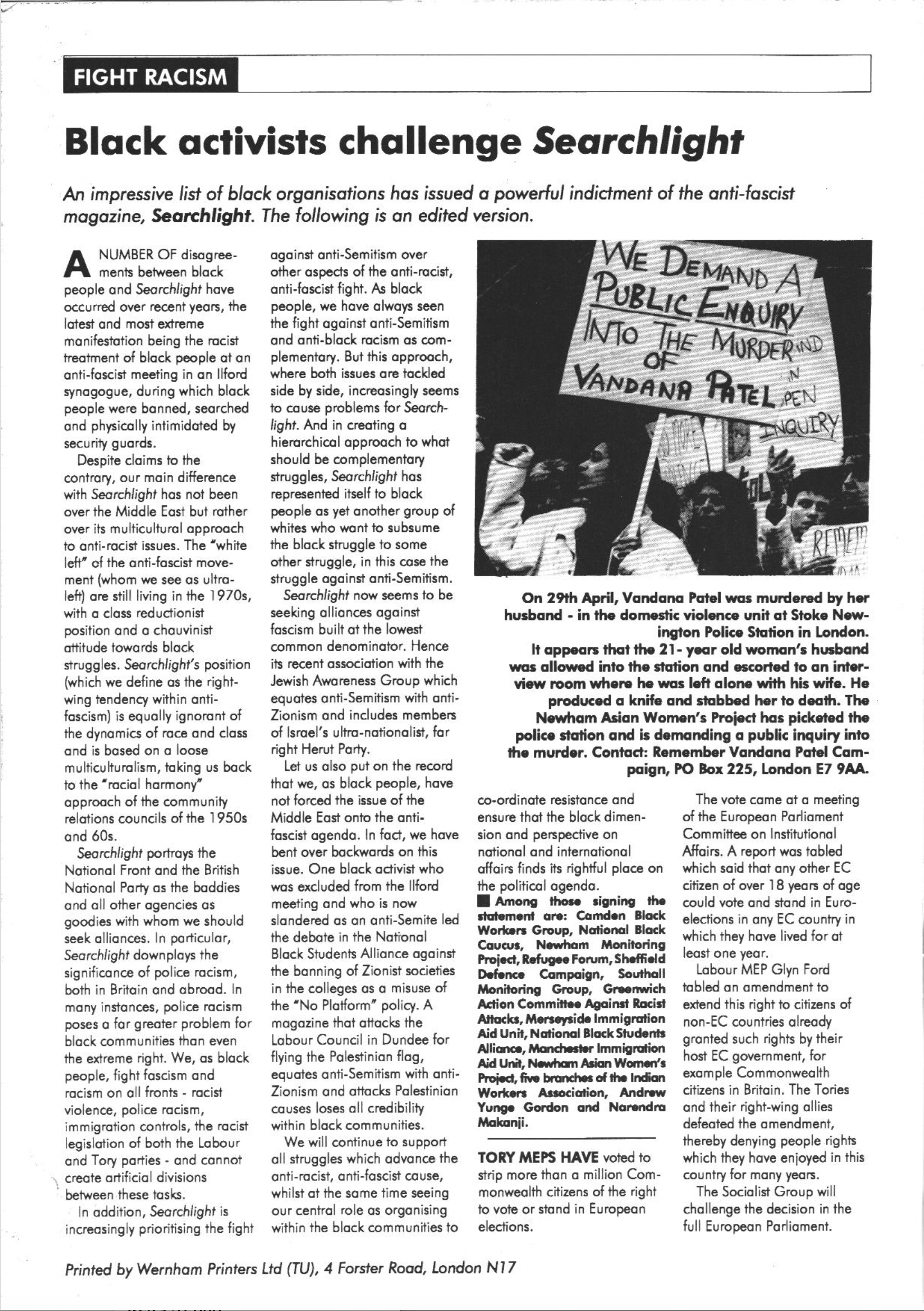
Black Activists Challenge Searchlight’s Racism
In July 1991, a coalition of black-led anti-racist groups published an OpenLetter in Labour Briefing that publicly criticised Searchlight. Searchlight of course had refused to print the letter.
This letter was driven by a series of long-standing disagreements,
culminating in allegations of racist treatment of black anti-racists at an
Ilford synagogue meeting.
At the meeting Black attendees, were banned, searched, and physically
intimidated by security guards. Newham Monitoring Group Secretary, Jasbir
Singh, reported being subjected to a body search. All this was directed by
Gerry Gable.
The letter represented a major public rift between Searchlight
and Black anti-racist groups. It led to the formation of the Anti-Racist
Alliance in November of that year.
Black activists questioned the magazine's methods and its collaboration
with the state. This highlighted a rift between Searchlight and grassroots Black-led groups, such as NMP.
The Briefing letter alleged that Searchlight had fostered
a hostile environment for black activists. Whilst Searchlight worked with the Police Black people were suffering from
police racism. Searchlight was seen
as the right-wing of the movement.
These tensions were exacerbated by the association with Herut, the
political party that founded Israel’s Likud party led by Netanyahu. Although
the letter said that their main differences were not over the Middle East it
was inevitable that Searchlight’s support
for Zionism had an effect on relations with Black activists.
The letter’s authors took issue with Searchlight’s
approach to racism which emphasised cultural differences rather than seeing
economic and political discrimination as being at the heart of state racism, a
term that Searchlight barely
recognised.
The signatories also took issue with the equation by Searchlight of anti-Semitism with anti-Zionism
given that many Black people oppose Zionism because it is an apartheid
ideology. Most prominent Black anti-racist groups in Britain signed
this letter.
There followed a heated correspondence in Briefing itself. This clearly
angered Searchlight which had always
taken care not to print critical letters in the Magazine.

When the Campaign Against Racism & Fascism [CARF], which had produced its own separate section in Searchlight from 1979 until 1990 split over political differences such as the magazine’s pro-Israel stance and its prioritisation of anti-Semitism over state racism and its pro-imperialist politics, they sent in a letter explaining why they were parting. Searchlight refused to print it despite CARF having produced a section of the magazine for 11 years. See Powerbase for a timeline of the split.
Searchlight however could not
ignore the letter that was printed in Labour Briefing given the support it had in
the Labour Movement and from several MPs like Corbyn and McDonnell. Searchlight
acolytes had no option but to defend it but Gable stayed silent.
In the September 1991 issue Ray Hill, a former Searchlight mole in the British Movement, who had become Deputy Leader,
penned a letter which avoided virtually all the accusations. He did though
insult the Black organisations who had signed the letter as ‘three men and a dog’. Daphne Liddell, of
the New Communist Party, contributed a more emollient letter.

In the October issue Larry O’Hara, an independent anti-fascist researcher
penned an article which I am told made Gerry Gable spit blood. O’Hara rehearsed
all the allegations of Searchlight’s links
and work for the secret State. O’Hara, although he didn’t always get things
right, had been a thorn in Searchlight’s side
for years. Gable had become obsessed with him.

In the February 1992 issue Graeme Atkinson, Searchlight’s European Editor, contributed an article but added
little that was new, referring to the ‘hoary
old 1977 ‘Gable Memorandum’. That was the best he could do because it was difficult to explain Gable’s admission of
working for the security services. Graeme accused Briefing of using ‘knife in
the back’ tactics in printing O’Hara’s article. Graeme has since broken with
Searchlight.

Finally in March 1992 I had a long letter in Briefing responding to Atkinson and also explaining the political
problems that anti-racists and anti-fascists now had with Searchlight. The full correspondence can be found here.

It was not therefore surprising that Searchlight
and Gable would lend their support to the ‘anti-Semitism’ witchhunt of
socialists and anti-Zionists in the Labour Party. In its Winter 2015 issue there
was an item ‘Anti-Semitism’ which asked
‘How is it that nobody appears to have looked into the background of Tony Greenstein, a Brighton antifascist and pro-Palestinian activist’ before going on to call me a ‘Jewish Hater’.
In fact I was suspended in March 2016 and I was the first Jew to be suspended and then expelled from the Labour Party as part of the ‘anti-Semitism’ witchhunt. The article makes it clear that it thoroughly approved of this right-wing attack on socialists and anti-Zionists in the Labour Party.
Below are links to a number of documents
referred to in this blog.
Tony Greenstein
AFA Report into Searchlight Allegations Against Class War
Black
activists challenge Searchlight July 91 and here
Gerry
Gable Again – Black Flag – the Brian Gentlemen Affair and here
Spy
Trial By Television and here
The
Eavesdroppers – Duncan Campbell and Mark Hosenball, Time Out and here
Powerbase Article on
Searchlight
Searchlight 'anti-fascist magazine joins forces with
Labour’s ‘anti-Semitism’ witchhunt
The
Death Agony of Searchlight Anti-Fascist Magazine
Searchlight & the State
– Kate Sharpley
Destabilising
the Decent People – Duncan Campbell,
Bruce Page, Nick Anning
Searchlight
Obituary for Gerry Gable
Morning
Star Obituary for Gable
Gable Memorandum transcript
Our Searchlight Problem – Lobster Magazine
Letter
– Tony Greenstein, Brighton AFA to supporters 24 June 1993
Letter
– Gerry Gable to Tony Greenstein 13 July 1993
Letter
-Tony
Greenstein to Gerry Gable 16 July 1993
Obituary
-:Gerry Gable (1937-2026), architect of modern British anti-fascism – Andy
Bell

Thanks for this expose on Gable. Indeed a rat must be smelt when an 'anti-fascist' gets accolades from the Right and supporters of Zionism. After learning that Gable desribed Israel as a 'democracy' which he always supported I won't be joining those saying 'may he rest in peace'.
ReplyDeleteAnother monumentally informative article. Can you not try and get an article or even a letter into the Morning Star?
ReplyDelete