Showing posts with label Sinai. Show all posts

24 June 2015

New Film about Israeli War Crimes in 1967

In peoples’ understandable determination to uncover the truth of the Nakba and what happened in 1947-8, the massacres of the 1967 War have barely been covered. 

Still from the film Censored Voices shows a former Israeli solider listening back to an interview, censored by the military after the 1967 war.
Palestinian refugees from the 1948 War
A new Israeli film from Mor Loushi delves into some of the detail.  The execution and mass graves of Egyptian soldiers in the Sinai have been known about for some time and the deliberate sinking by Israel of the USS Liberty, an American spy-ship has also been well documented, as has the joint US/Israeli cover-up.
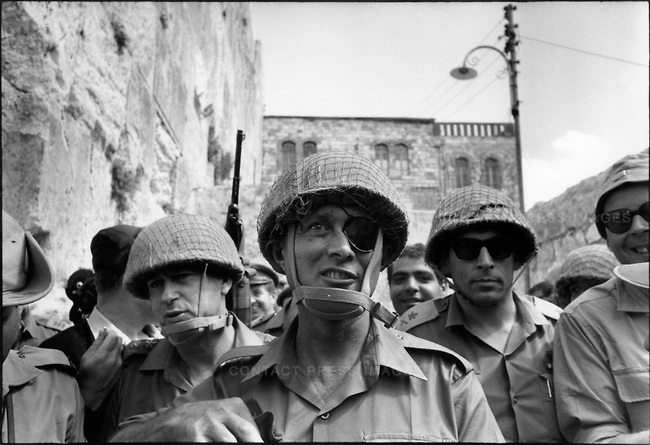
The iconic photo that the Zionists used to whitewash the invasion  - 3 soldiers at Jerusalem's Wailing Wall
Israeli Generals Yitzhak Rabin, Moshe Dayan and Uzi Narkis in Jerusalem
The 1967 war occurred because the bluster of Nasser allowed Israel a golden opportunity.  Having blocked Israeli ships from the Gulf of Aquaba Nasser foolishly ordered the UN troops in the Sinai to withdraw.  Israel of course took full advantage of this in order to conquer the Sinai, Golan and West Bank.

Tony Greenstein
The Zionist soldier's eternal dilemma

New evidence from 1967 war reveals Israeli atrocities


“In the operation we had to cleanse the inhabitants. This uprooting of a villager, rooted in his village and turning him into a refugee, by simply expelling him, and not one, two or three of them but a real eviction. And when you see a whole village is led like lambs to the slaughter without any resistance you understand what is the Holocaust.” — An Israeli soldier’s testimony in the documentary Censored Voices, directed by Mor Loushi (2015)
The USS Liberty, a spy ship, was attacked and nearly sunk by Israel because they didn't want the US knowing what their plans were.  US President Johnson covered it up.  It was only when the US sent planes to defend it that Israel called off the attack
In the wake of the June 1967 war, the Israeli author Amos Oz, then a reserve soldier in the Israeli army, together with a friend collated interviews with Israeli soldiers who participated in the war and asked them about the emotions the fighting triggered in them. The interviews were published as a book titled Conversations with Soldiers, more popularly referred at the time by my generation as the ”shooting and crying” book.
General Ariel Sharon at the battle of Abu-Ageila
The military censor (a function that still exists today, held recently by the present minister of culture, Miri Regev), erased 70 percent of the evidence since he claimed it would have harmed Israel’s international image.
An over confident Nasser laughing with Airforce pilots
This month an industrious Israeli filmmaker, Mor Loushi, is showing her new documentary based on most of this erased material. The atrocities reported by the soldiers include forced expulsions, like the one quoted above, graphic descriptions of summary executions of prisoners of war and hints of massacres of innocent villagers.

Evil repertoire

This 48th commemoration of the 1967 war coincided with the 67th commemoration of the Nakba, the ethnic cleansing of Palestine before and after Israel’s founding in 1948. There is more than a symbolic connection here. The evil repertoire confessed by the soldiers in the new film reminds us of the atrocities perpetrated 67 years ago on a much larger, though similarly horrific, scale.


The 1948 atrocities were ignored by the international community and for a long time the entire Nakba was denied while the Holocaust memory seemed to provide carte blanche to Israel to continue the ethnic cleansing of Palestine.

No wonder then, when in 1967 Israel’s territorial appetite was satisfied with the occupation of the whole of historic Palestine, as well as large territories from Egypt and Syria, it was achieved with the help of similar inhumane ethnic cleansing operations of expulsions and massacres.

There was one difference between the two chapters of atrocity committed in the two wars. In 1967, Israel was less secure about possible global, and even American, complacency in the face of its cruel methodologies on the ground and therefore attempted to hide them from prying eyes. The wall of secrecy Israel built, however, nearly cracked, when the US navy ship USS Liberty eavesdropped on the communications between the troops in the Gaza Strip on 8 June 1967, revealing probably both the summary execution of Egyptian prisoners of war and Palestinian civilians. The ship was destroyed on the same day from the air by the Israeli air force.

Later on, the atrocities were substantiated by eyewitnesses and came to the fore when mass graves were exposed in 1995 in the al-Arish area in Sinai, straining Egypt’s relations with Israel, as CNN reported at the time.

The network interviewed, for the first time, relatives and survivors of these war crimes who recalled the massacre of hundreds. The link between the unprovoked assault on the USS Liberty and the wish to hide the massacres and executions was thoroughly investigated by James Bamford in his 2001 book Body of Secrets.

Thus, the newly released tapes corroborate atrocities already known and told by those who were their victims (in this case, including 34 American navy personnel). This was very much in the same way as Israeli documents declassified in the 1980s corroborated the Palestinian oral history and testimonies of the Nakba.

Purifying the perpetrators

In both cases, it took a while for the victims’ version to be heard after years of being brushed aside by Western academia and the media as a figment of an oriental imagination.

The Israeli eyewitnesses in the new film do not mention names of places or dates — neither do we know who the Palestinian or Egyptian victims were. De-naming and dehumanization are two sides of the same coin and thus the new harrowing testimonies are cautiously presented as an act purifying the perpetrators rather than honoring the victims.

It is another case of “shooting and crying”: namely the problem is not that a girl lost her eye, a man’s house was demolished or an unarmed prisoner of war was executed. The aim is to cleanse the tormented soul of the victimizer and there is nothing like a good confession to make it all go away.
Names and dates, and even more so real human beings, require not only acknowledgement but also accountability. Saying sorry is not always enough, especially when the lesson is not learned. And, thus, year after year since 1967, including in recent weeks, Palestinians, with faces and names, are still expelled, imprisoned without trial and killed.

Permanent reality

This new film gives the impression that these crimes were the inevitable outcome of the June 1967 war. But in fact the crimes committed after the war were much worse in every aspect. The atrocities were not the outcome of the war, they were part of the means used by Israel to solve the predicament the new territorial achievement produced for the Jewish State: it incorporated in 1967 almost the same number of Palestinians it had expelled in 1948.

After the war, other means were added in the search for reconciling this predicament. The aim was still the same: to have as much of Palestine as possible with as few Palestinians in it as possible. The new strategy, after the war, was based on the logic that if you cannot uproot people you root them deeply in their areas of living without any outlet or easy access to the world around them.

The Palestinians all over Palestine were, since 1967, incarcerated in small enclaves surrounded by Jewish colonies, military bases and no-go areas that bisect their geography. In the occupied territories, Israel created a matrix of control many African National Congress leaders regard as far worse than the worst of apartheid South Africa. The Israelis marketed this method to the world as a temporary and necessary means for maintaining their rule in the “disputed” territories. The “temporary” means became a way of life and transformed into a permanent reality on the ground, for which Israel sought international legitimacy through the 1993 Oslo accords – and nearly got it.

This month as we commemorate the 48th year of the 1967, war we should remind ourselves once more that this was a chapter in a history of dispossession, ethnic cleansing and occasionally genocide of the Palestinians.

The “peace process” that began more than two decades ago was based on the assumption that the “conflict” began in 1967 and will end with Israeli withdrawal from the West Bank and the Gaza Strip.
The “conflict” had actually begun in 1948, if not before, and the worst part of it was not the 1967 military occupation of those parts of Palestine that Israel had failed to take over in 1948, but rather that the international immunity for these crimes still continues today.

One can only hope that those with the power to effect change in the world will understand, as did the soldier quoted in the opening of this piece, that there is more than one holocaust and that everyone, regardless of their religion or nationality, can be either its victim or its perpetrator.

The author of numerous books, Ilan Pappe is professor of history and director of the European Centre for Palestine Studies at the University of Exeter.

Israelis admit war crimes

Six Day War atrocities: Veteran's account of captives in Egyptian uniforms being shot in the desert adds fuel to scandal; 'A prisoner was given a shovel and started to dig. Then he was fired at'

Jerusalem

Gabriel Brun, a Jerusalem journalist who served as a signals sergeant- major in the 1967 Six-Day War, described yesterday how he saw fellow Israeli soldiers shoot dead five prisoners of war in Egyptian uniforms.

His story added fuel to an escalating scandal sparked by a retired brigadier-general, who confessed to executing 49 Egyptian prisoners during the 1956 Suez war. Egypt, with whom Israel signed a peace treaty in 1979, has demanded a full account. The Israeli Prime Minister, Yitzhak Rabin, who was chief of staff during the 1967 war, has ordered an investigation.

"What I saw happened on the morning of 7 June, the third day of the war," Mr Brun, who was then 24, told the Independent.

"I was at El Arish airfield in the Sinai desert, attached to the headquarters of an armoured division. I saw 120 to 150 Egyptian soldiers sitting with their hands tied behind their backs in a makeshift hangar made of sandbags. About 20 yards away I saw a trestle table with two men sitting behind it, their faces masked with khaki handkerchiefs. Individual prisoners were pushed out of the group, brought before this table and apparently interrogated. Some were sent back.

"I was about 30 or 40 yards away, so I couldn't hear what was said. I saw one man questioned, then marched about 200 yards into the desert by two military policemen.

"He was given a shovel and started to dig. After about 15 minutes, I saw the shovel thrown out. Then each of the two soldiers fired a round into the hole. Another guy was brought and shot, falling into the same hole. A third prisoner was brought to cover up the grave, then was marched back.
"I saw five prisoners killed in this way. Earlier I had heard 10 similar shots. I interpreted those to mean that another five were executed."

Mr Brun said an officer explained to him afterwards that the victims were Palestinian "terrorists", who were wanted for murdering Israelis and had tried to get away by merging with the fleeing Egyptians. The interrogators were officers in army intelligence.

Arye Biro, 69, the retired brigadier who admitted killing 49 Egyptian PoWs in the 1956 war, said on Wednesday he was not proud of what he had done, but did not feel like a war criminal. "I have ached over what I did," he said, "but under the same circumstances I think I would do it again."
Mr Biro commanded a paratroop company which dropped in the Mitla Pass, one of the two main routes from central Sinai to the Suez Canal.

"We were hundreds of kilometres behind enemy lines," he said. "Egyptian planes were flying over us unhindered. Egyptian troops were pouring into the area, and the prisoners were shouting, 'Just you wait, the Egyptian army will slaughter you'."

The paratroops were ordered to head south. According to Mr Biro, they had no transport for the prisoners and feared they would reveal the Israelis' position. So he and a lieutenant ordered the prisoners to lie face down, then shot them.

"They didn't cry out," he said dispassionately. "It was all over in a couple of minutes."

The paratroops' brigade commander was General Ariel Sharon, now an opposition Likud MP. He was not in the Mitla Pass at the time of the executions. But the battalion commander, Rafael Eitan, was. Mr Eitan, who rose to chief of staff, is now a hard-right candidate for prime minister. Asked if Mr Eitan ordered the killings, Mr Biro replied: "Ask him."

According to Meir Pa'il, a military historian and retired colonel, Moshe Dayan, who was chief of staff in 1956 and defence minister in 1967, reprimanded Mr Eitan for the killings during a meeting with battalion commanders.

Michael Bar-Zohar, an author and former Labour MP who handled Dayan's public relations after the 1967 war, said: "In every one of our wars, Israeli soldiers have killed PoWs. The high command did not want it, but it was tolerated up to a point. I know of only one case - in the 1982 Lebanon War - where an officer was court-martialled for killing a prisoner.

1 April 2013

The Muslim Brotherhood continues where Mubarak left off – maintaining Israel’s Blockade

The Muslim Brotherhood continues where Mubarak left off – maintaining Israel’s Blockade

Egyptian women in Cairo march in protest at the military's use of excessive force against women and unarmed protesters. Photograph: Mohamed Omar/EPA
Hamas keeps silent about the betrayal of its fellow Egyptian Muslim Brotherhood
Egypt’s Muslim Brotherhood has always been a conservative, clerical organisation, representing the interests of the small businessman and capital, whilst being bitterly hostile to the Left.  It played a contradictory role with British imperialism until independence and supported the nationalist revolution led by army officers in 1952 only to end up being banned for allegedly trying to murder Gamel Abdel Nasser.

But what is important to understand is that this ‘party of god’ is in reality a reflection of the particular societies in which it operates.  So today in Egypt, under MB, it continues the policy of  Hosni Mubarak in enforcing the Israeli siege.  Indeed in flooding dozens of  tunnels  in Rafah it is going one step worse than even Mubarak in enforcing Israel’s siege of Gaza. 

In the meantime we see the Brotherhood’s commitment to democracy in the assumption by Morsi of dictatorial powers and the continuation by the Police of torture of opponents and the role of the army in upholding the present subservience to the US.

It must therefore be an embarrassment to Hamas, an Israeli created offshoot of Egypt’s Muslim Brother hood, for its sister party to be doing Israel’s work.  But then Hamas has only itself to blame.  When demonstrators took to the streets in the Arab spring in Tahrir Square, many Gazans came out in the streets to demonstrate in their support.  Hamas, just like Fateh and Abbas in Ramallah, used its thugs to drive people back into their homes.

The major conclusion from this is that the Muslim Brotherhood is incapable of leading a revolution against Western imperialism without at the same time seeking to enslave their own people.

Tony Greenstein

Egypt’s Muslim Brotherhood has reneged on promises to Palestine

Egypt's new dictator -  the Muslim Brotherhood's Mohammed Morsi
 Amira Howeidy
The Electronic Intifada, Cairo - 21 March 2013

The euphoria that erupted in Gaza minutes after Hosni Mubarak stepped down on 11 February 2011 probably came second only to Egypt’s. The ousted dictator was Israel’s “strategic asset” for good reason. He secured the blockade of the Gaza Strip from the Egyptian side, sided against Hamas and proved a reliable ally.

Even during the 22-day Israeli war on Gaza at the end of 2008, Mubarak kept the Rafah border crossing firmly shut, in violation of the Fourth Geneva Convention which binds Egypt, as a signatory, to protect civilians during times of war and foreign occupation.

Egypt’s dictator was removed but his legacy continues to influence realities on the ground in Gaza and around the Palestinian question in general. It does not help that his successor, the Muslim Brotherhood’s Muhammad Morsi, has done little to prove — thus far — that his policies will change course. Of course nothing is that simple. Morsi, willingly, inherited a difficult legacy of a mammoth, corrupt bureaucracy and questionable sovereignty after decades of subservience to the United States.

But judging from their discourse and performance during the past year, it’s evident that the Brotherhood — including their Freedom and Justice Party and the president — are too eager to prove their power-worthiness by demonstrating “pragmatism” and flexibility to the international community.

Some Brotherhood figures and sympathizers argue that this is vital to securing their ascendance to power in a shaky transition and to quell the fears of skeptics. This might be valid in some cases (where the regional balance of power isn’t in their favor) but it poses compelling questions on how far Morsi will go in Mubarak’s shoes under the pretext of realpolitik — and if he’ll eventually find himself trapped there.
Morsi - represents a different wing of Egyptian capitalist interests

Gaza is the barometer


Gaza, which shares a 14-kilometer-long border with Egypt, is probably one of the best barometers for Cairo’s foreign policy independence — or lack thereof.

It’s where Egypt is forced to be involved in the Palestinian question especially since Hamas’s takeover of the strip in 2007 and Israel’s subsequent land, sea and air siege. Under an expired one-year agreement (2005-2006) between Israel, the Palestinian Authority and the European Union, only people (those who are not on Tel Aviv’s blacklist) are allowed though the Egyptian-controlled Rafah border crossing, not goods.

“Approved” commodities are permitted though the Israeli-controlled Karem Abu Salem (Kerem Shalom) crossing. While Egypt wasn’t party to this agreement, it continues to hold it, seven years after it became invalid.

In the language of the Egyptian-Israeli peace agreement, the Egyptian town of Rafah is in Area C — the demilitarized zone in the Sinai peninsula, which strictly limits Egyptian forces to a lightly armed police presence. It’s also the site of hundreds of underground tunnels that link the Palestinian and Egyptian sides of Rafah, which have mushroomed since the Israeli siege of Gaza and provide a lifeline for the strip.

It’s no exaggeration to say that without the tunnels, Gaza’s 1.7-million strong population will suffer, not just because Israel allows only one third of the strip’s needs in via the goods crossings, but also because the vast majority of Gazans can’t afford Israeli products and depend on cheaper Egyptian ones. The resistance also relies on these tunnels (amongst other channels) for much-needed arms.

Because of this and the fact that a largely unmonitored underground world intertwines Gaza with Egypt, the tunnels opportunely surface as a security and political issue for Cairo.

Since the killing of sixteen Egyptian border guards last August in Rafah by still-unknown assailants, the military retaliated by launching “Operation Eagle 2” to purge Sinai of “criminal elements.” None were identified, but the media, in typical Mubarak-era fashion, was quick to blame Palestinians. After shelling mainly desert areas in northeast Sinai the army demolished dozens of tunnels and rounded up “suspects.”

Changes at Rafah crossing

It was the first time that the tunnels were targeted since Morsi came to power. But the impact of the demolitions wasn’t detrimental and the policy was reversed when, after Morsi sacked the military’s top brass, the Rafah border crossing was opened on a daily basis for the first time since the Israeli siege began.

While this was attributed to Morsi’s influence, Hamas officials say that since Mubarak’s ouster and the military’s takeover, the number of Palestinians allowed passage — in the days that the border was open — had increased from approximately 350 or 450 to 1,000, a sign that the generals were slightly less stringent than Mubarak on this issue.

Moreover, the military leadership had given deputy leader of the Hamas politburo Mousa Abu Marzook (previously based in Damascus, along with other with exile resistance factions) permission to live in Cairo, which was unthinkable before the revolution.

The difference since Morsi assumed office has been the daily opening of the crossing, which, by all accounts is a significant development and a far cry from the weeks-long closures that would happen in Mubarak times. Not only is Egypt and thus the rest of the world accessible to most Gazans, Palestine-solidarity delegations from all over the world and high-level state envoys have been visiting the strip regularly, many for the first time, in defiance of the siege and ultimately giving recognition to the Hamas rulers. It’s not what Israel had in mind when it imposed its blockade — which is precisely why Mubarak preserved the siege.

The changes at the crossing are one of the few developments that offer some insight into how Egypt under a Brotherhood president is managing the Palestinian file. There is a difference in modus operandi, but the outcome shows no signs of shaping a new reality. Instead of equating it with Egypt’s other international border crossings, Rafah is still hostage to the Mubarak-era’s calculations and commitments to Israel. It might be open daily, but as per Israel’s demands, Egypt will not allow even a cement bag through, directing goods onto Israeli-controlled Karem Abu Salem.

In the Mubarak continuum, Egypt-Gaza relations and the Palestinian file are still controlled by Egyptian intelligence, who are also involved in the military’s strategy in Sinai and Rafah. The management of the Rafah crossing is completely under the intelligence’s control and run by their mentality and calculations. While Morsi is kept informed, it is unlikely that his views, if any different, will be heeded.

But the Muslim Brotherhood’s media spokesman Gehad El-Haddad claimed to me two weeks ago that the Egyptian intelligence services are “fully under the command” of the president, and executing his orders and vision (“‘We will not let Egypt fall’,” Al-Ahram Weekly, 6 March). And so Morsi “is responsible for what happens on the ground in Rafah.”

Flooding Gaza’s tunnels with sewage

Last month “Operation Eagle 2” resumed tunnel demolitions aggressively, flooding many of them with sewage. More than 400 have been destroyed so far according to military sources cited by the local media. No one will say how far the military is going to go but given previous tunnel demolitions under Mubarak, the operation should be well calculated to leave enough tunnels to smuggle most of Gaza’s needs.

It’s still a disappointing development for Hamas’s leaders who, because of their sensitive situation, will not go on record criticizing Egypt or Morsi. Mousa Abu Marzook would only go as far as saying “We don’t want the tunnels at all, we want the strip’s provisions to go through the Rafah border crossing, which is not happening,” he told me last week.

The only exception, unsurprisingly, is Qatar’s building material, which is allowed passage for the several multi-million dollar reconstruction projects the Gulf state’s Emir Hamad bin Khalifah pledged during his visit to the strip last October. That the first visit by a head of state to the strip is from Qatar reveals more about post-revolution Egypt under a Brotherhood president, than it does about Doha. Qatar is consolidating its already-outsized regional role, while Egypt is treading cautiously within the boundaries placed by Mubarak’s three-decade rule.

Brotherhood spokesman El-Haddad calls this the responsibility of moving from the back seat of the car to the driver’s seat: “When you take the responsibility a lot of calculations happen.” And thus the Camp David peace agreement with Israel that the Brotherhood consistently rejected up to and including their 2010 election platform (which demands under chapter four annulling “all” normalization agreements with Israel and supporting the resistance) will not be broken, or even modified by them (“The electoral platform of the Muslim Brotherhood’s candidates for the 2010 parliament,” Egypt Window, 4 November 2010 [Arabic]).

This is the same statement made by the presidential spokesman last year. Now, in El-Haddad’s words, Camp David is “serving” Egypt’s interests. In the same vein, speaking to Reuters, Essam El-Haddad, Morsi’s aide on foreign relations, justified the flooding of tunnels to stop arms smuggling (“Egypt flooded tunnels to cut Gaza arms flow: aide,” 18 February 2013).


Brotherhood’s shifting position on Palestine

This post-revolution discourse is consistent with the Brotherhood’s new positions, that of its Freedom and Justice Party and Morsi himself. It’s true that the Palestinian question was central to the group’s existence since its early years (their volunteers resisted Zionist gangs in Palestine since 1947) and for decades since. But it’s fair to say that the profile of the Brotherhood’s leadership — a combination of wealth and power — in the past decade is new to the organization’s history.

Their calculations and political priorities are the outcome of their experiences under Mubarak’s rule and should be assessed within that context. In contrast, the group’s base and supporters hail from the middle and lower classes and might not necessarily accept or relate to this level of pragmatism on a central issue like the Palestinian question.

This was partially put to test when Israel launched its brief war on Gaza on 14 November 2012. Morsi first responded by recalling Egypt’s ambassador to Israel on the same day. Facing mounting public pressure, he sent his prime minister in an unprecedented, high-level state delegation to the strip 48 hours later, with the message that official Egypt is taking Gaza’s side.

When compared to Cairo’s accomplice role in the 2008 Gaza war, this development cannot be undermined. So was the direct involvement of both Hamas and Islamic Jihad leaders in the ceasefire discussions with Morsi. Palestinian Authority chairman Mahmoud Abbas was conspicuously absent from the scene.

Morsi wanted to convey to Israel that “today’s Egypt is different from yesterday’s.” That pre-election Israel didn’t want a long war or the long-range missiles which Gaza fired at Tel Aviv and Jerusalem, might have played in Morsi’s favor and driven his point home, not just to Tel Aviv but more importantly his constituency and supporters.

The effect of this test war has since subsided and overshadowed by the aggressive tunnel demolitions and more recently the intense anti-Palestinian, specifically anti-Hamas campaign raging in Egypt for the past week.

On the surface it might seem as a continuation of the Mubarak era demonization of Palestinians in Gaza since Hamas’s takeover of the strip. While military gags were issued to prohibit the press from reporting the numerous times trigger happy Israeli soldiers killed Egyptian border guards, supposedly by mistake, the media seized every opportunity to feed into public opinion that Sinai is Gaza’s aspired alternative state.

Today most media outlets are citing anonymous “military sources” accusing Hamas of murdering the 16 Egyptian border guards last August.

Reports on the confiscation of rolls of fabric used to make the military’s uniform in one of the tunnels is provided as evidence of Hamas or Gaza “elements” involvement in national security threatening activity.

The lack of evidence to substantiate these allegations and the armed force’s deafening silence suggest a deliberate strategy to incite against Hamas, Gaza and the tunnels while linking their alleged transgressions to Morsi and his Brotherhood, the mother organization that inspired the founding of Hamas in 1987. In other words, Morsi’s professed laxity towards his Hamas friends is compromising Egypt’s national security.

This is an oxymoronic situation: Hamas, Gaza and perhaps the Palestinian question as a whole are paying the price for the Brotherhood’s rise to power, when in fact the group, in the name of “pragmatism,” has reneged on previously declared stances related to the Palestinian question.

It’s tempting to assume that Morsi and the Brotherhood are applying a gradual, tactual strategy that will eventually lead to bolder positions. But this is conditional upon guaranteeing, against all odds, that Morsi will at least complete his four-year term and that the conservative reformist mentality of the Muslim Brotherhood will adopt a revolutionary approach towards the issue. The improbability of both is high and like Hamas, the Muslim Brotherhood’s ascendance to power has put to question its raison d’être.

Amira Howeidy is deputy editor of the Cairo-based Al-Ahram Weekly.