We should not forget that the Blockade of Gaza could not continue but for Egypt’s Collaboration with Israel

40 years ago Alexander Haig, Reagan’s Secretary of State described
Israel as "the largest American
aircraft carrier in the world that cannot be sunk". Given that central
to US military doctrine has been the creation of unsinkable island aircraft
carriers, from Pacific atolls to Iceland and even Britain, this explains more
than anything why the United States funds Israel’s military to the tune of $4
Billion a year.
Of course there are a handful of anti-Semites like Michael
Rabb, Jeff Blankfort and Gilad Atzmon, who will insist that it’s all because of
Jewish Power and a Jewish stranglehold over the US government. Quite how a
community of 6 million has come to overwhelm the US Congress and Presidency is
one of the miracles of our time.

But for those of us who live in the real world of imperialist
realpolitik, United States support for Israel is dictated by material interests
not an affection for Jews.

Former Israeli Ambassador Ron Dermer
There was a time when the United States was not that close to
Israel and that was when the Jewish community in the USA was itself lukewarm about
Zionism. It was only when, after the 6 Day war in 1967, the US concluded that Israel was a reliable partner
in an unstable oil rich region of the
world, that US Jews became enthusiastic about being seen to support Zionism.
They had been given permission to become supporters of the United States’s
rotweiller in the Middle East.
That was then, Today the American Jewish community is far
from happy at events in Israel and in particular the election of a nakedly
far-right, neo-fascist government. One quarter believe
that Israel is an apartheid state. 38% of American Jewish youth believe
this and 20% of Jews under 40 believe Israel has no right to exist.

Under the influence of the Ultra Orthodox and Religious Zionism
parties, a proposal is being made to remove non-Jewish grandchildren of Jews from
an entitlement to ‘return’ to Israel under the Law of Return as amended in
1970. This can only widen the chasm between Israel and American Jews. 43% of
young Jews see
in Israel a replication of the United States’s own racism against Black people
Most Americans are either from Conservative or Reform synagogues
and to the Orthodox they are not really Jews. My own rabbi father had more
contempt for them than for Christians! When the murder of 11 Jews in
Pittsburgh, at the hands of a far-right Trump supporter took place, the Chief
Rabbi in Israel David Lau refused
to acknowledge that those who had died were Jewish. He merely said that they
had a ‘profound Jewish flavour’!!
Today, it is Evangelicals who form
the backbone of political support in the US for Israel. Israel though should
not be complacent because the evidence from 3 surveys – in 2015, 2018 and 2021
is of a dramatic
switch in allegiances among young Evangelicals to the point where they are
almost equally divided between support for Israel and Palestinians.
The notion that the United States supports Israel out of some
kind of affection for Jews is not only infantile but assumes that foreign
policy is dictated by sentiment. As Alexander Haig explained, US military
support for Israel is due to its stability as a settler colonial state with an
extremely right-wing Israeli Jewish population, virtually the only Trump loving
population in the world.
What then is Israel’s mission? In a nutshell watching over
the Arab regimes, the United States’s junior clients, almost all of whom are in
hock to the Americans. In 1970 Israel intervened
in Black September to threaten the Syrian regime if it invaded Jordan. In 2011 Israel
champed at the bit when Mubarak was overthrown.
Israeli leaders were in shock at what they saw as Obama’s
abandonment of Mubarak at the height of the Arab spring. Reuters reported:
Political commentators
expressed shock at how the United States as well as its major European allies
appeared to be ready to dump a staunch strategic ally of three decades, simply
to conform to the current ideology of political correctness....
According to Shimon Peres of the Israeli Labor Party
“We always have had and
still have great respect for President Mubarak,” he said on Monday. He then
switched to the past tense. “I don’t say everything that he did was right, but
he did one thing which all of us are thankful to him for: he kept the peace in
the Middle East.”
As DW explained
in 2011
With Egypt's opposition movement gaining momentum
and President Hosni Mubarak under increasing pressure, Israel is watching
developments with concern as one its few Arab allies in the Middle East teeters
on the brink.
Israel has been in de facto alliance with the Saudi,
Jordanian and Egyptian regimes for decades. Today with the Abraham Accords Israel
has established formal diplomatic ties with most Arab regimes, particularly
those in the Gulf. It is Israel’s role above all else to guard and protect the Arab
regimes and to ensure that radical nationalist or socialist movements are
quashed.
We can be certain that there is
close military and intelligence coordination with the Arab states and
furthermore that this relationship is not of recent origin. This should give a
clue as to how Zionism can be brought to an end and with it a state I once described
as Hitler’s bastard offspring.
The major political mistake of the
PLO, apart from accepting the idea of a two state solution was its belief that
it could triumph with the support of and in alliance with the Arab regimes. The
PLO turned its face away from the brutal, repressive nature of these
regimes. Regimes that were otherwise in
alliance with the United States, the main supporter of the Zionist state.
For the sake of money to fund its
activities, including its diplomatic missions, the PLO gave legitimacy to
regimes which were illegitimate in the eyes of their people. Today it is, or should
be, clear to all that these regimes are not only enemies of their own people
but the Palestinians too.

The Egyptian regime is a
particularly brutal regime with torture and executions common. Al Sisi seized
power in 2013 and overthrew the Muslim Brotherhood’s Mohammed Morsi. The
Muslim Brotherhood, which had refrained from even supporting the movement to
overthrow Mubarak until late in the day, then destroyed the movement that had
overthrown Mubarak by proposing an authoritarian constitution, attacking
peaceful demonstrators and prosecuting journalists. The Muslim Brotherhood, of
which Hamas is the Gazan wing, has a history
of betrayal and support for imperialism.

Without the support of the Egyptian
regime Israel could not maintain a 15 year old siege and blockade of Gaza.
Unfortunately people forget this all too often. The articles below describe the
extreme humiliation and indignities that Palestinians face when they travel to
and from Gaza. This deliberate cruelty is carried out on behalf of the Israeli state
and demonstrates the contempt that this illegitimate regime has for the Palestinians.
Below are some articles and
extracts detailing the repressive, corrupt nature of the Egyptian regime which
ranks among the most barbaric in the world.
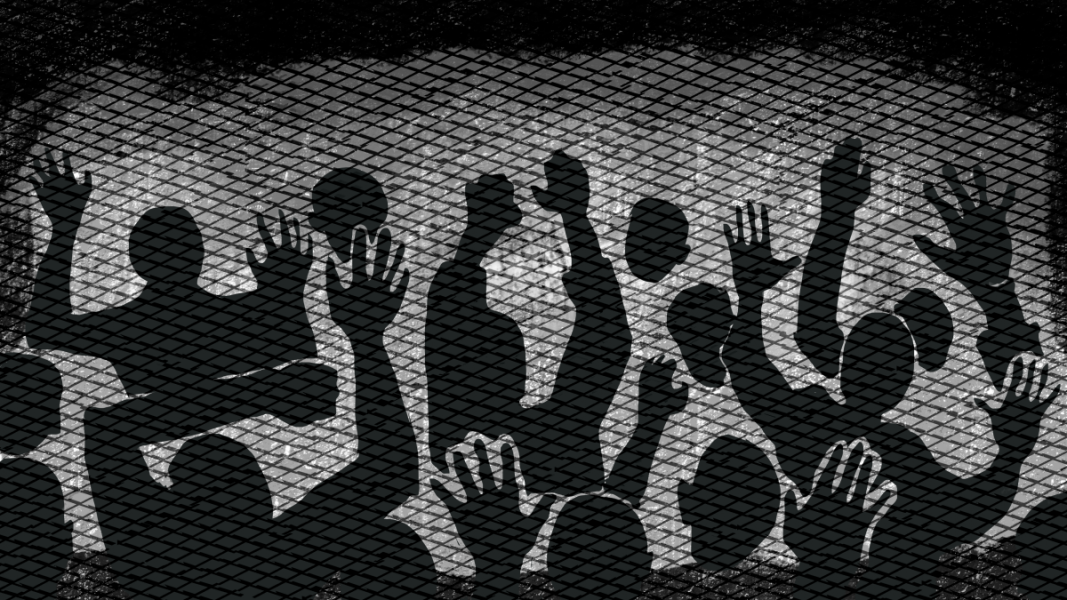
On
the other side of the bars: the broken families of el-Sisi's Egypt
Egypt - Land of Broken Families
Since the beginning of el-Sisi’s
presidency in 2014, the number of prisoners in Egypt has surged. The
authorities refuse to disclose the exact number, but the UN puts it at 114,000,
which is double the capacity of 55,000. Human Rights defenders say that at
least 60,000 of these are imprisoned for political reasons, helping Egypt to
earn the 161st place on the Human Freedom Index.
Mona Seif vocalized
the general feeling of skepticism among Egyptian Human Rights Defenders
regarding the promises of the Egyptian Authorities in front of a European
Parliament panel on Human Rights in October 2021:
‘The new strategy for human rights of Egypt doesn’t
change anything in Egypt … It’s only made for you. Stop using it as a positive
example of change.’

families visiting gaol
February 1 2021 marks the date of Santawy’s forced
disappearance. This term is used to describe the period in which a
person is held at a police station without being officially arrested yet,
leaving the family ignorant of their location. During this time, Santawy was
subjected to torture, Amnesty later reported. Officers beat him and kept him
blindfolded.
Officers interrogated him about his academic research on
women’s reproductive rights in Egypt. He reappeared five days later before the
Supreme State Security Prosecution, the legal institution charged with
investigating crimes related to national security.
‘Ahmed hardly
was an activist. He was just really unlucky to be picked out by the regime.’
Five months later, Santawy received a four-year-sentence, for
‘publishing false news to undermine the
state, its national interests and public order and spread panic among the
people’.

Egyptian prison
Prison food is very problematic and
medical care is almost non-existent, Baoumi describes the situation.
‘So Prisoners, or rather: their families, are
expected to provide for their basic needs. The prisoners thus form a financial
burden which many families can’t afford, especially not if their most important
breadwinner is behind the bars.’
Medical negligence has led to
severe health complications and in some instances even death. The fate of
deposed president Mohamed Morsi speaks volumes. After six years of
imprisonment, he finally succumbed at the age of 67 from a heart attack in
court.
When I drive past an empty branch of the El-Tawhid &
El-Nour Department Stores, a friend remarks that the chain — as many
others — had to close down: its owner, Sayed el-Sewerky, was arrested for
allegedly financing a terrorist group (read: the Muslim Brotherhood).
According to Human Rights Watch, the detention of businessmen
like him ‘exposes how the government is
using Egypt’s flawed terrorism law to punish successful businessmen who refuse
to surrender their property to the state’, thereby further tightening the
Army’s grip on the Egyptian economy
There is a red line connecting most of the cases. The same
three accusations keep popping up: ‘joining a terrorist group’, ‘spreading
false news that harms the security of the State’ and ‘misusing social media’.
Furthermore, many gaolings are preceded by forced disappearances which lasts
weeks to months.
The duration of the pre-detention is often lengthened by tadweer,
the rotating of the detainee through existing legal cases. Once a case is
handled, the detainee is kept in custody by trying him or her for a new case.
Most detainees are subject to torture or other forms of inhumane or degrading
treatment and there is a consistent policy of medical negligence. Many
prisoners are punished by denying them the right to family visits or other ways
of communicating with the outside world.
Over the years, the circumstances have gradually deteriorated
for associations like the ECRF. In 2019, the parliament passed a new NGO law,
requiring all organizations to register with the government by January 2023 and
have their activities monitored by the State, a concession many organizations
are not willing to make.
‘The first
massive wave of arrests came in 2013,’ Mohamed Lotfi tells me, ‘when Sisi cracked down upon supporters of
the ousted president and members of the Muslim Brotherhood.’ Over time, the
scope was broadened to liberals, socialists, pan-Arabists and other
non-Islamist political members.
‘The
international community only noticed this big elephant in the room with the
death of Giulio Regeni in January 2016,’ Lotfi states. Regeni was an
Italian PhD-student conducting research on Egyptian independent trade unions, a
sensitive subject in the country. He was abducted, tortured and eventually
killed. In October 2021, a court in Rome opened the trial against four Egyptian
police officers in their absence, accused of being responsible for the murder.
‘One cannot
underestimate the effects of this mass imprisonment on Egyptian society,’ Lotfi
says.
‘There are
thousands and thousands of prisoners. That means thousands and thousands of
families, friends, colleagues and acquaintances of prisoners who know about the
plight and who think this is unfair. So the authorities are giving a signal to
society in general that if they open their mouth, they could end up in the same
situation.’

Egypt's Expatriation Room
Egypt’s
“expatriation” policy is meant to humiliate travelers from Gaza
Hundreds of Palestinians spend long hours waiting inside a
huge hall packed with people. Everyone waits for the Egyptian officers to call
their names, at which point they will undergo another security check, before
being put on buses to head to the Cairo International Airport.
When we
arrive at the airport in Cairo at 3 a.m., we are forced into another line and
made to stand again despite the hundreds of empty chairs surrounding us.
During this time, we are not allowed to leave the room or
enjoy the airport’s facilities and amenities like the other travelers.
Cairo
Airport, expatriation room, 6 a.m. (Photo: Tareq Hajjaj/Mondoweiss)
We are not
allowed to sit, a rule made specially for Gaza residents. We’re then sent to
another waiting hall — again, made specially for Gazans — where our passports
are taken from us as we wait for our flights.

Feeling less than human:
The hell of crossing into Gaza
Yet I, like any Palestinian who wants to travel to Gaza with
a hawiyya, had to forgo any expectation of having my
basic human rights respected. Instead, I experienced consistent humiliation,
utter exhaustion, and total confusion. What should have taken hours took days,
slowed down by uninterested and scornful Egyptian border agents, purposefully
mismanaged crowds, and a sweeping attitude of dehumanization toward the
Palestinians trying to reach their homeland.
The
relief, however, lasted about 500 meters, after which we were confronted with
yet another meaningless attempt to humiliate Palestinians: a further checkpoint
mere minutes away from the last one. My mother in law, who suffers from severe
asthma, had almost collapsed from the previous wait. Knowing this, our driver
decided to cut the line to ask if we could go through, since we also had my
five-month-old son. Unwilling to hear his plea, the soldier raised his gun and
threatened to take his driver’s license if he said another word.

‘We are apparently not human’
I counted over 15 checkpoints
from El Ferdan to the Arish, which sits on the Egypt-Gaza border and is the
largest city in the Sinai Peninsula. At one point all the checkpoints seemed to
blend together — there was no distinction between any of them except that they
added to the suffering of Palestinian travelers with no regard for women,
children, or the elderly.
The Al-Midan checkpoint outside
Arish, however, was an exception. We arrived, hungry and tired, very late at
night, and were forced to wait over six hours at an arbitrary barrier. We once
again left the car and sat on the dirt roads as we waited. Every time we tried
to seek comfort or entertain ourselves with fellow Palestinians waiting
alongside us, a soldier ordered us back into our cars, with one telling us: “It looks like you like the situation you’re
in, don’t you!”.
The
Egyptian soldiers who were supposed to inspect the cars were on their phones.
One was scrolling through TikTok and another was messaging on WhatsApp, while
hundreds of Palestinians were waiting in the middle of the night with nowhere
to seek shelter or even a bathroom to relieve themselves. I recall one woman
begging a soldier to let her car through, as she had an infant who had soiled
herself and developed an intense rash, because the mother had no more diapers
left. He brushed her off. Egyptian soldiers looked on, wordlessly. They allowed
chaos to ensue. In fact, chaos seemed to be the policy that the Egyptian
military had adopted, leading Palestinians to their breaking points. We hated
the situation we were in. In these moments, some even hated the fact they were
Palestinian. One woman swore she would never repeat this journey ever again.

Trapped like
cattle
The hell we were in was not over,
however. Inside the Rafah crossing hall, absolute chaos unfolded. Hundreds of
Palestinians were lining up to hand over their hawiyyas and passports
that Egyptian officials simply needed to stamp. Except this act was far from
simple.
The border hall looked like a
snapshot from the past, with filthy floors, no trash can in sight, ancient
computers, and electricity that cut off every few minutes. In the prayer room
there was actual shit on the floor, while the ceiling looked like it was about
to collapse on you.
Yet for a
select few, the travel to and from Gaza can be easier, maybe even luxurious.
While sitting on broken metal chairs, a room adjacent to the border hall was
left ajar. Inside I could see leather couches in a nice air conditioned room
and people serving drinks to those seated. These very few Palestinians traveled
with a VIP travel service called Ya
Hala and were sitting in its refurbished lounge away from the chaos and
humiliation.
Ya Hala
has links
with the Egyptian government and security establishment and profits off of the
siege by charging anywhere from $700 to $5,000
dollars per person to travel with the company which skips the checkpoints, the
inspections, and the days-long waits. Palestinians without that kind of money,
like the hundreds on the journey with my family, have to wait months or even
years on waitlists in order to travel.

Abdel al Fattah after father's funeral
Alaa
Abd El-Fattah and Egypt’s Climate of Repression at COP27
November 10, 2022
An example of al-Sisi’s brutality is the imprisonment of
40-year-old writer and organizer Alaa Abd El-Fattah. Alaa, who holds joint
Egyptian/British citizenship, has been imprisoned for most of the last ten
years, targeted for eloquently advocating for democracy and liberation. Alaa
was key during the Arab Spring, inspiring people with his words and creating
free speech tools on the internet. In the violent Egyptian police state with
pervasive surveillance and omnipresent secret police, though, advocating for
freedom is a crime. Desperate after a decade of arbitrary and abusive
detention, Alaa Abd El-Fattah began a hunger strike over 220 days ago. On
November 6th, as COP27 opened and world leaders descended on Sharm el-Sheikh,
Alaa escalated his fast, refusing water as well. Without immediate
international intervention, Alaa will likely die before the final gavel drops
on COP27.
Alaa’s mother, Laila Soueif, has been waiting every day
outside the prison where her son is locked up, demanding proof he is still
alive. A mathematics professor, she is a renowned human rights activist
herself. On Thursday, she was told that her son had received an unexplained
“medical intervention.” Human Rights Watch has warned Egypt against “imposing
cruel, inhuman and degrading treatment,” and that “hunger striking is a
political act.”

Alaa’s lawyer was informed that he could visit Alaa, but,
upon arriving at the prison gate, was denied entry.
Alaa’s two sisters, Mona and Sanaa, staged a sit-in at the
British Foreign Office in London, calling on the government of newly-installed
Prime Minister Rishi Sunak to intervene on Alaa’s behalf, and to bring him to
the UK. Sunak, who is attending COP27, wrote to the family, “I will continue to
stress to President Sisi the importance that we attach to the swift resolution
of Alaa’s case, and an end to his unacceptable treatment.” Sanaa, 28, is now at
COP27, and has helped bring human rights front and center onto the climate
justice agenda. Sanaa, who has spent three years in prison herself, has been
threatened with arrest.
President Biden has enormous leverage over the Egyptian
government, and is attending COP27. Fifty-six Congressmembers have urged him to
demand Alaa’s release. While campaigning in 2020, Biden actually tweeted in
support of other imprisoned Egyptian dissidents, writing, “Arresting,
torturing, and exiling activists…or threatening their families is unacceptable.
No more blank checks for Trump’s ‘favorite dictator.’”

Egypt's Crowded Cells
Instead of fist-bumping the US-backed dictator al-Sisi, the
way he did with the autocratic head of Saudi Arabia, Mohamed bin Salman, Biden
should demand the immediate release of Alaa and all other political prisoners.
Laila Soueif wrote to Biden and other world leaders attending COP27, “If Alaa
dies you too will have blood on your hands.”
In 2019, Mada Masr, one of Egypt’s last remaining independent
news organizations, published a piece by Alaa, addressing the climate. It also
appears in Alaa’s book, “You Have Not Yet Been Defeated”:

World Leaders at COP27
“The crisis,
for certain, is not a crisis of awareness, but of surrendering to the
inevitability of inequality. If the only thing that unites us is the threat,
then every person or group will move to defend their interests. But if we meet
around a hope in a better future, a future where we put an end to all forms of
inequality, this global awareness will be transformed into positive energy.
Hope here is a necessary action. Our rosy dreams will probably not come to
pass. But if we leave ourselves to our nightmares we’ll be killed by fear
before the Floods arrive.”
Alaa Abd El-Fattah should be attending COP27, addressing
world leaders – not on the edge of death in an Egyptian prison.


