Showing posts with label Princess Diana. Show all posts

19 September 2022

Charles III is not our King – he is the King of Truss, Starmer and the British Establishment

 Charles is Booed in Cardiff and Celtic Fans Chant ‘If you hate the Royal Family Clap your Hands’ as the Wheels Begin to Come Off the Royal Pantomime

UPDATE

A loyal tribute to Elizabeth Windsor by British singer song writer Leon Rosselson


If you hate the Royal Family clap your hands – Glasgow Celtic fans

It is often said of the Queen that she did a good job. And in one sense that is true.  She did do a good job but the question is for whom did she work? Certainly no one who lived in the colonies benefited and it is difficult to see how anyone who is poor, on the streets or working class is any the richer.

On the other hand there is no doubt, judging by the million or so fools who spent 24 hours or more to see her coffin, that the late Queen performed a very useful function for the class that she came from. A role not dissimilar to that of religion.

Marx didn’t simply describe religion as the opium of the masses but also as the heart of a heartless world, the soul of a soulless world. Royalty performs a vital political and social function in binding the poor and oppressed to their oppressors in a sham show of national unity that is underpinned by the honours system.

The honours system itself is divided into ordinary and common OBEs, CBEs and MBEs (all of which refer to the Empire) up to the the Most Nobel Order of the Garter, of which there are only 34 at any one time, all of whom are chosen personally by the sovereign. In this way, however rich or poor you are you can identify with the monarch.

That is why virtually every business of any size adorned itself with the image of Elizabeth Windsor. The Monarchy provides social stability as well as a back stop against revolution.

Republican demonstrators greet Charles in Cardiff

Despite all this there is a growing mood of republicanism amongst the young in particular who are almost equally divided on whether or not to have a republic. However much the BBC rams the idea of an unelected monarchy down our throats it offends against democratic instincts and reeks of class snobbery and contempt.

The Monarchy is depicted as the ideal family, just like you and me however there is nothing ordinary about the monarchy from the past-times they indulge in (hunting, shooting) to the company they keep.

Despite being told that the Monarchy has no influence politically this is not true. The royals vetted at least 1,062 laws during Elizabeth’s reign in order to ensure that they didn’t hurt her interests.

Whereas it is well known that Royal Assent is needed when a bill becomes law very few people know that the Monarch’s consent is needed before legislation can be approved by parliament. The website of the royal family describes it as “a long established convention”. 

Documents in the National Archives suggest that the Consent Process enabled Elizabeth Windsor to lobby for changes before legislation was tabled. Thomas Adams, a constitutional law expert at Oxford University said that these documents revealed “the kind of influence over legislation that lobbyists would only dream of”. It gave Liz “substantial influence” over draft laws that could affect her. See Revealed: Queen lobbied for change in law to hide her private wealth

We can see their results. The Queen’s Estate will pay no Inheritance Tax unlike ordinary mortals, saving them hundreds of millions of pounds.  But there is more to this than mere corruption although there is that too.

The Monarchy in the form of Prince Charles played a large part in the canonisation of Jimmy Savile.  He was also knighted. In a memo addressed to the royals in 1989, and titled ‘Guidelines for members of the Royal Family and their staffs’, Savile claimed he was “in the palaces on a regular basis”.

Under  ‘personal observations’, Savile stated that he was ‘well-placed’ to make observations and comment on the Royal Family’s image due to the access he had inside their residences writing:

“Because I get into St James’s Palace and Buckingham Palace on a regular basis, one thing is becoming quite obvious. There is a strong movement now towards some members of the family and their staff towards an… attitude.”

The Netflix documentary Jimmy Savile: A British Horror Story showed how  

Charles had gone out of his way to seek out Savile’s advice and help in repairing the monarchy’s image and reputation. Because if there is one thing the ‘firm’ is careful about is its image.

A British horror story

In Imposed Insanity – Royalty, Propaganda And The Coming Catastrophe Media Lens remind us that

‘wherever there is royalty, there is militarism, organised religion, bipartisan political agreement, patriotism and, of course, concentrated wealth.’

The Monarchy is the symbol of all that is rotten in society. Its function being to hide the nexus of power in pageantry, pomp and mystique. It’s secret weapon is its insincerity.


A leaky pen

As Walter Bagehot argued the monarchy needed mystique. “Its mystery is its life. We must not let in daylight upon magic.” Charles has done quite the opposite. He allowed cameras into the accession council, where he made his oaths. He has already had two public hissy fits involving malfunctioning pens, which have gone viral. Charles finds it difficult, unlike his mother, to keep his mouth shut.

Power is exercised most effectively behind closed doors not in public. As Media Lens pointed out we are quick to ridicule countries where there is a cult of the personality –

‘those poor lost souls who glorify leaders with hagiographic portraits and statues; and militarised patriotic festivals and grand commemorative events’.

This type of thing happens in Putin’s Russia, Xi Jinping’s China and Kim Jong-un’s North Korea not in Britain. Yet how does one describe hundreds of thousands of people queuing for over a day to catch a glimpse of the coffin of a woman they never knew?

The BBC naturally was determined not to be outdone in its servile, sycophantic prose. Royal correspondent Jonny Dymond wittered:

‘This is the moment history stops; for a minute, an hour, for a day or a week; this is the moment history stops.

If history stopped, then time itself must have stopped! A quite remarkable feat, even for a monarch.

The Leaky Pen and why Charles is angry with his manservant

Newspapers ran full, front-page portraits with forelock-tugging headlines:

  • ‘A life in service’ (The Times)
  • ‘Our hearts are broken’ (Daily Mail)
  • ‘Grief is the price we pay for love’ (Daily Telegraph)
  • ‘Thank you’ (Daily Mirror’)
  • ‘Our beloved Queen is dead’ (Daily Express)
  • ‘We loved you Ma’am’ (The Sun)

As Media Lens asked ‘Does The Sun have any idea what the word ‘love’ means?’ This is the paper that marked the death of 96 football fans at the Hillsborough Stadium with the headline ‘The Truth’ alleging that fans picked the pockets of the victims whilst urinating on the ‘brave cops’.

Nor was the Guardian any better. The day after Windsor’s death it led with 19 pages on the Queen plus a 20-page supplement. Columnist, Gaby Hinsliff, wrote a piece referring to Elizabeth Windsor’s ‘grandmotherly manner’, ‘female power’, ‘rare trick for a woman’, ‘a woman in charge’, ‘“ultimate feminist”’, ‘a legacy for women’, etc.

Hinsliff’s unctuous prose managed 14 retweets and 72 likes.

Not to be outdone Sir Keir Starmer, Knight Commander of the Order of Bath and Leader of the ‘Opposition’, declared:

‘For seventy years, Queen Elizabeth II stood as the head of our country. But in spirit, she stood amongst us.’

One wonders just how many homeless people felt her spirit as they bedded down for the night. Perhaps those weighing up how to heat their home immediately felt her presence besides them?

Not content with this nonsense Starmer told us that:

‘as the world changed around her, this dedication became the still point of our turning world.’

How many of you felt that your world revolved around Liz Windsor?

But all this servile nonsense aims to enable the new King to emerge, as if by magic, like a butterfly from its chrysalis. And history therefore has to be rewritten. It is no accident that the BBC Panorama Interview with Princess Diana has been suppressed. 


The BBC have pretended that Diana was tricked into the interview, even though she herself declared at the time that she was happy with it. The BBC is asserting its copyright to prevent it being shown anywhere. There is nothing like censorship to help change the narrative. However you can still see it on my blog, at least for the moment!

As Andrew Morton, whose 1992 book Diana: Her True Story exposed Charles adultery with ‘Queen’ Camilla said:

"It is a supreme irony that it is her son who has led the calls to posthumously muzzle Diana, to silence her, to prevent her from being heard, from saying what she spent her life trying to articulate"

As the BBCs former Director-General Tony Hall admitted:

The first investigation we did before Christmas under Tim Gardam talked to all the people concerned and produced a letter where she said very clearly that she had been shown no documents by Martin Bashir, she was not made aware of anything by Martin Bashir that she didn’t already know and she had no regrets, underlined, by the interview. It is quite interesting that Lord Dyson himself says that an interview of some sort would probably have taken place anyway. At that point in our inquiries, in our investigations with Tim Gardam, we came to an end that there was no case to answer.

In now trying to silence what her mother wanted to reveal, Prince William is acting with contempt for her. But that too is part of the price to be paid for keeping the royal show going.

See The reason the BBC wants to bury Diana’s Panorama Interview has nothing to do with fake bank statements – it’s about protecting Charles

As for Andrew, the death of Elizabeth Windsor has been quite fortuitous in his attempt to achieve rehabilitation. Instead of mourning in private, Andrew was one of the 4 royals who formed the vigil around her coffin. In full military uniform it might be added.

Expunged from memory are the stories of Prince Charles with carrier bags full of notes donated by a kind Qatari politician. And why, in this age of Internet banking, did Charles not have the money sent electronically?  Guess it was his addiction to all things old-fashioned!

Also forgotten is how Charles protected the serial child abuser Peter Ball, Bishop of Lewes, who eventually served half of a 32 month prison sentence after the Police originally let him off with a Caution. Charles wrote to him after he had been cautioned saying that

“I wish I could do more. I feel so desperately strongly about the monstrous wrongs that have been done to you and the way you have been treated.”

There is no record of Charles having expressed any sympathy for Neil Todd, one of Ball’s victims, who killed himself in 2012.

In classic Establishment understatement, the Official Inquiry into Child Sexual Abuse described Charles’ support for Ball and the Duchy  of Cornwall buying a house for him to rent as ‘misguided’.

Why are you strangling me?

Charles maintained a correspondence with Ball for more than two decades after Ball’s 1992 caution for gross indecency. Charles told the inquiry that he did not realise the truth behind allegations against Ball. Most people understand that accepting a Caution means accepting one is guilty. But not Charles. That child abuse offences were dealt with by a Caution suggests Police complicity and cover up.

Charles explanation as to why he corresponded with Ball was that it was the “polite” thing to do but the inquiry found the replies were “suggestive of cordiality rather than mere politeness”. Charles explanation, that he did not know the exact details of the allegations, was not believed by the inquiry which found that he did not try to find out.

All this however will be hushed up and forgotten because it’s now a case of ‘God Save the King’ and the Establishment of which he is such an integral part.

Or as the old saying goes ‘Hypocrisy is the homage that vice pays to virtue.’

Tony Greenstein


11 August 2022

Why is it 27 years later, later, the Queen of Hearts strikes fear into the Monarchy & the British Establishment?

 The reason the BBC wants to bury Diana’s Panorama Interview has nothing to do with fake bank statements - it’s about protecting Charles

Martin Bashir Interviews Princess Diana for Panorama 20.11.95.

I don't expect the interview to remain up for long as Youtube has already placed this warning

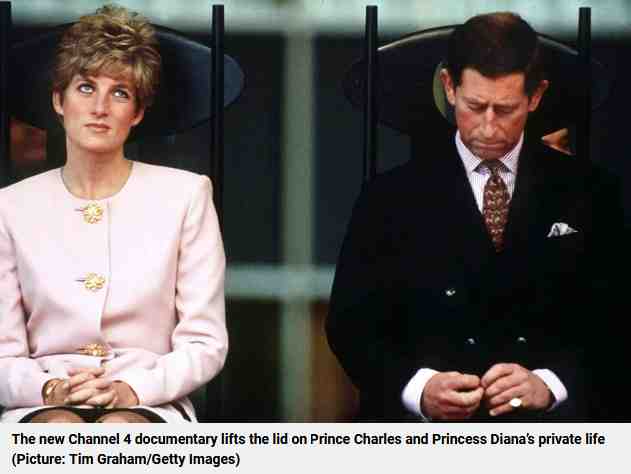
Recently there was been quite a campaign about that famous Panorama interview that Martin Bashir conducted with Princess Diana on 20 November 1995. As the day of the Queen’s death approaches and Charles becomes King and Camilla ascend to the throne (assuming the people don’t rebel), determined efforts are being made to rewrite the history of Charles divorce with Diana and the fallout from that interview.

The BBC, whose film it is, might be expected to defend the interview. However, ever loyal to the British Establishment, the BBC has rolled over and issued an abject apology because Bashir apparently used forged bank statements to gain access to Diana via her brother Lord Spencer:

‘This led to a full-scale independent investigation by Lord Dyson, published in 2021, after which the BBC officially apologised for the way in which the interview had been obtained and the unacceptable standards of its journalism.’

We can expect no better of the BBC than this fawning apology for what was one of the best examples of BBC journalism. For ‘unacceptable’ journalism one need only look at its coverage of Palestine or its uncritical coverage of US imperialism in the Pacific.

The interview by the Digital, Culture, Media and Sport Committee of Tony Hall and John Birt, two former BBC Director Generals about the Diana interview

Diana was not the first woman to enter the British Royal Family and be repelled by its archaic traditions and protocols, to say nothing of what she saw and experienced in this dysfunctional family. Nor was she the first woman to reject the role that she was expected to play as the bearer of a future king’s children.

That honour belongs to Princess Caroline of Brunswick who was Princess of Wales from 1795 to 1820 and Queen and wife of King George IV from 29 January 1820 until her death on 7 August 1821.

George IV was already illegally married to Maria Fitzherbert when he married Caroline. Theirs was not a happy marriage. In 1814, Caroline moved to Italy, where she was reputed to have taken a lover. In 1817 her only child Charlotte died in childbirth. Caroline heard the news second hand as George had refused to write and tell her.

Caroline refused George’s demand for a divorce and returned to Britain to assert her position as queen. George attempted to divorce Caroline by introducing the Pains and Penalties Bill 1820 to Parliament.

Caroline however was very popular with the London ‘mob’ whilst George was not. They surrounded the House of Lords every day; her coach was escorted by the cheering mob whenever she had to appear there. The evidence against her was that during a cruise she slept on deck in a tent with her servant Bergami and took her baths with him in full view of the other servants. In Italy she was in the habit of wearing dresses open to the waist!

Tim Davie, current BBC Director-General disowns Diana Interview

George lived a hugely extravagant life on the taxes collected by Parliament, whereas Caroline appeared to live modestly. Satirists and cartoonists published prints in support of Caroline and depicted George as debauched and licentious. She received messages of support from all over the country.

Caroline was a figurehead for the growing radical movement that demanded political reform and opposed the unpopular George. By August, Caroline had allied with radical campaigners such as William Cobbett, and it was probably Cobbett who wrote these words of Caroline's:

If the highest subject in the realm can be deprived of her rank and title—can be divorced, dethroned and debased by an act of arbitrary power, in the form of a Bill of Pains and Penalties—the constitutional liberty of the Kingdom will be shaken to its very base; the rights of the nation will be only a scattered wreck; and this once free people, like the meanest of slaves, must submit to the lash of an insolent domination.

The day before the trial was due to start, an open letter from Caroline to George, again probably written by Cobbett, was published widely. In it, she decried the injustices against her, claimed she was the victim of conspiracy and intrigue, accused George of heartlessness and cruelty, and demanded a fair trial. The letter was seen as a challenge, not only to George but to the government and the forces resisting reform.

After 52 days the Lords decided to drop it. George IV’s Coronation was to on 29 April 1821. Caroline asked the Prime Minister what dress to wear for the ceremony and was told that she would not be taking part.

In January 1820, George became King and Caroline was nominally queen. However when Caroline arrived at the door of Westminster Abbey demanding to be admitted she was refused entrance. She shouted “The Queen…Open” and the pages opened the door. “I am the Queen of England,” she shouted and an official roared at the pages “Do your duty…shut the door” and the door was slammed in her face.

Caroline died 19 days later and was buried in Brunswick, and on her coffin was inscribed… ‘CAROLINE THE INJURED QUEEN OF ENGLAND’.

See Queen Caroline of Brunswick, wife of George IV

Another unhappy princess was Empress Elisabeth of Austria, (Sisi) consort of Emperor Franz Josef. Elisabeth was a 19th-century Diana: both were beautiful and charismatic, had unhappy royal marriages and met violent deaths.

Both married very young after what were portrayed as fairytale romances. Both felt ill at ease in their husband’s families – especially Elisabeth who found the rigid protocol of the Austrian court difficult after her informal upbringing – and disliked many of her royal duties.

Both women shared a love of fashion and beauty. Elisabeth’s obsession with keeping slim led to an extreme diet regime which some modern commentators have interpreted as a form of eating disorder, akin to Diana’s bulimia.

Both were also famous for the causes they espoused.  Elisabeth was a strong advocate for the rights of her Hungarian subjects. Diana was famous for the campaign to ban landmines and also her association with gay people and open espousal of the victims of aids.

See The Little-Known Empress with Striking Similarities to Princess Diana

See Elisabeth of Austria - the Hapsburg Princess Diana

ABC - Allegations that Special Forces killed the princess surfaced during a court-martial.

There have been repeated suggestions that Diana was murdered by the British state on 31 August 1997. However proving this has always been difficult since British intelligence are rather coy about what they do! Certainly the father of Diana’s boyfriend, Dodi, Mohamed al-Fayed believed that she and his son were murdered.

However what is not in dispute is that the Royal Family were not exactly saddened by what had happened. Diana had been a running sore and embarrassment while she was alive. She cast a shadow over the future king Charles and his adulterous relationship with Camilla.


3 in a marriage was ‘a bit crowded’

Diana had openly embraced causes such as landmines and Aids that the royals steered clear of but then there was that interview with Martin Bashir and the accusation that there had been 3 in what was a ‘crowded’ marriage.

The reaction of the Queen to Diana’s death was to carry on as normal. The Royal Standard could not be flown at half mast at Buckingham Palace because the Queen was not in residence. Their reaction was very much out of cync with the popular mood and we had the spectacle of the likes of the Mail and Express, who saw popular support for the monarchy draining away, beseeching the monarchy to make it clear that they weren’t celebrating Diana’s demise (at least not openly).

The Queen had apparently been initially opposed to the use of an aircraft of the Queen's Flight to bring Diana's body home, much to the alleged frustration of her advisers. Her deputy private secretary, Sir Robin Janvrin, is said to have asked the Queen: 'What would you rather, Ma'am, that she came back in a Harrods van?' (Harrods was then owned by Al-Fayed.)

Journalists were also briefed that the Prince of Wales had decisively countermanded the original decision for Diana to remain in a public mortuary in Fulham, West London. Instead, according to his aides, he'd ordered that the princess should rest in the Chapel Royal.

But Andrew Morton, whose 1992 book Diana: Her True Story began the whole drama, (revealing in a later version that Diana had been the main source for the book) wrote:

public anger was also directed at the Royal Family, not only for their slow and muted response to the tragedy but also for their indifference to her during her lifetime. Downing Street officials feared that rioting could break out.

Courtiers tried in vain to convince the Queen and Prince Philip to recognise the increasingly precarious situation and fly back from Balmoral.

After the Queen had realised the public mood

she travelled back to London a day earlier than planned and, for the first time in history, allowed the Union Flag to fly at half-mast at the palace.

As a senior aide explained:

At Balmoral, she hadn't taken it in. You never know what it is like until you are actually there.

All the remarks and people hugging each other, sobbing — the whole nation seemed to have gone bananas. The Queen and Prince Philip felt utterly bewildered.

Nor did they fully appreciate the impact of Diana's death on the national psyche. Along with her family, the Queen was mourning the flawed individual she knew rather than the saintly icon.

In only the second special televised address of her reign and

‘With a nod to the criticism of herself and her family, the Queen conceded: 'I for one believe there are lessons to be drawn from her life and from the extraordinary and moving reaction to her death.'

It cannot be denied, however, that she'd been slow to change direction when it became clear she was out of step with the nation.

What then explains the public reaction to Diana, who was hardly a radical figure? Compare the reaction to her death to that of Prince Philip, the husband of Elizabeth. When he died last year the BBC was flooded with complaints because it had decided to stage the same tributes to him on every TV channel! 

Viewers switched off their TVs in droves after broadcasters aired blanket coverage of Prince Philip’s death, audience figures revealed on Saturday, and the BBC received so many complaints it opened a dedicated complaints form on its website.

Phillip was hardly a figure of adoration. I suspect that when the Queen dies that the BBC will go in for more overkill and thoroughly alienate the one-third of the British people who aren’t take in by all the nonsense about the Royal family.

Why then did Diana and before her Caroline and Elisabeth of Austria attract such adoring crowds and mass popular affection? Why did so many people identify with Diana?

To understand this one has to understand the role of the monarchy itself. For the ruling class it has immense benefits in symbolising in their person the British state itself. It acts as a unifying force. However rich or poor you are you can identify with the monarch.

However the monarchy, by its very nature, must retain its distance from the masses if it is to command their respect. As Walter Bagehot, wrote in The English Constitution (1867) ‘mystery is its life. We must not let in daylight upon magic.’

So people are encouraged to identify with the royals at the same time as the monarchy must keep its distance from them. And in these days when the popular press go over every aspect of their lives it is difficult to retain much mystery. For most people the royals are aloof and  remote. In the case of Andrew Windsor there is mass loathing and contempt for what is reputed to be the Queen’s favourite son!

In the case of Diana, as her own personal situation worsened with the breakdown of relations with her husband she increasingly took on a public persona of her own. The sheer volume of press coverage of her private life, a coverage that she both detested and courted, increased peoples’ identification with her as the embodiment of what they would like to be. When it was revealed that Charles had been carrying on an adulterous relationship with Camilla when Diana was supposed to be faithful (to the extent of having been tested for her virginity prior to marriage) then many women in particular identified with her.

It was all very well Charles telling Diana that ‘I refuse to be the only Prince of Wales who never had a mistress.’ but the public was more likely to sympathise with the wronged woman. In fact Charles seems to have had a string of mistresses. Spare Rib in the week of their marriage carried the headline ‘Don’t Do it Di'!

In some ways the Royal Family, which is the icing on the cake of a very ugly class riven society, functions as religion, a source of consolation or in Marx’s words the ‘soul of a souless world.’ People are encouraged to identify with what is a protocol riven, parasitic bunch of sociopaths and to imagine that they have something in common. When someone like Caroline or Diana comes along they can create a mass following because people see in them a reflection of themselves.

That is another reason why the Establishment and the BBC want to bury the Panorama interview. According to John Birt, the former BBC Director-General, it was ‘an absolute horror story’. If Charles is to gain the support of his ‘subjects’ then it is necessary that people are taught to forget Diana and pretend that that interview was not what it seemed at the time. Diana had been tricked into it and her paranoia fed by tales of malfeasance by the rest of the royals.

The fact is though that Diana never expressed any regrets over the interview, quite the contrary. She made it clear that she approved of the fact that she had been allowed at last to tell her side of a marriage in which she had been expected to produce an heir and a spare but otherwise to keep quiet.

So her eldest son and second in line to the throne, Prince William, comes out with the statement that the BBC had used ‘deceitful behaviour’ to obtain the interview and that the 1995 Panorama interview led to Diana's “fear, paranoia and isolation”.

Martin Bashir attacked by the fawning, forelock tugging MPs with their synthetic outrage at his 'methods'

Interview Digital, Culture, Media and Sport
Committee 15 June 2021

Chair: Without the benefit of hindsight, but considering what you knew at the time, why did you report to the BBC board of governors that you believed that Mr Bashir was an honest and honourable man?

Lord Hall: Uppermost in our minds then was: had the interview with Princess Diana, the decision that she made to be interviewed, been done fairly or not? That was absolutely uppermost in our minds. The first investigation we did before Christmas under Tim Gardam talked to all the people concerned and produced a letter where she said very clearly that she had been shown no documents by Martin Bashir, she was not made aware of anything by Martin Bashir that she didn’t already know and she had no regrets, underlined, by the interview. It is quite interesting that Lord Dyson himself says that an interview of some sort would probably have taken place anyway. At that point in our inquiries, in our investigations with Tim Gardam, we came to an end that there was no case to answer.

For oral interview see here

To download the Diana interview click here