The Contrast Between the BBC’s Treatment of Russia’s Banning of Memorial Whilst Ignoring Israel’s Banning
of Six Palestinian Human Rights Groups is Striking
I was
watching the midnight
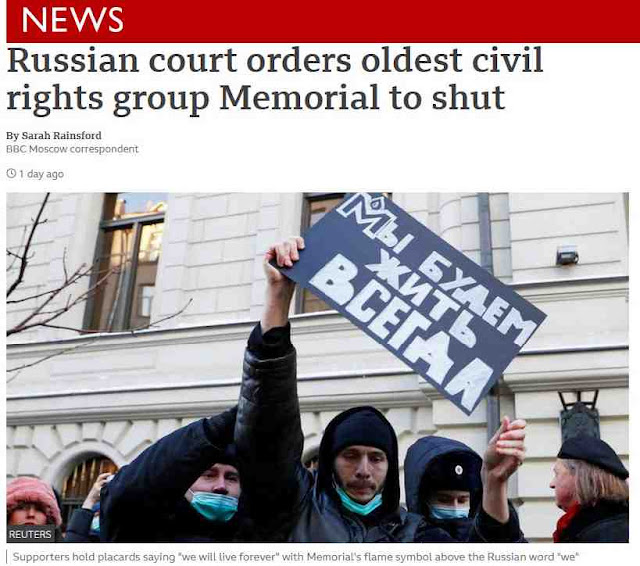
edition of BBC News 24. The top story was Russia’s banning of human rights
group, Memorial. Fiona Bruce and the
BBC’s Russia correspondent Steve Rosenberg didn’t even bother to give Russia’s
reasons for the ban. It was taken as given that this was an egregious and
indefensible act.
Bruce told
us that it had come ‘at the end of a year
when the Kremlin has cracked down vigorously on its critics.’ Rosenberg
told us that
‘more and more it feels as if Russia is turning the
clock back. ‘Liquidate’ the judge
says.... The organisation was found to have broken Russia’s draconian foreign
agents law. ‘Disgraceful decision’
was the reaction from the gallery.’
Grigory
Yavlinky of the Yabloko Party was then interviewed who stated that it’s just ‘one more step from an authoritarian,
totalitarian regime’ with an extended description of how Memorial was shining a light on ‘one of the darkest chapters of Russian
history’ namely Stalin’s terror.’
Rosenberg
told us that the founding of Memorial
30 years ago was a ‘symbol of the Soviet
Union opening up, facing up to its past’. But the ‘shutting down of Memorial is a symbol also of how the past is being
reshaped, rewritten and how civil society is under attack.’
BBC 24 Hours makes the banning of Memorial a Russian Human Rights Group
the lead news item
We were
then shown a picture of Putin and the military, as a backdrop to the decision
and we were told that Putin has been ‘using
history to try to foster patriotism’.Of course this is not something that would happen in the West! Clearly the competition between Boris Johnson
and Keir Starmer as to who can fit most Union Jacks into one photo shot is
about something entirely different.
The BBC’s
concern with human rights, be it in Russia, China or Hong Kong is selective and
runs in tandem with British and Western Foreign Policy. When do we have similar
reports on America’s client regimes such as Colombia or US support for coups
against popular regimes that threaten its interests? When was the last BBC
documentary on Saudi Arabia’s bombing of Yemen’s civilians or the threat that Israel
poses to its neighbours?
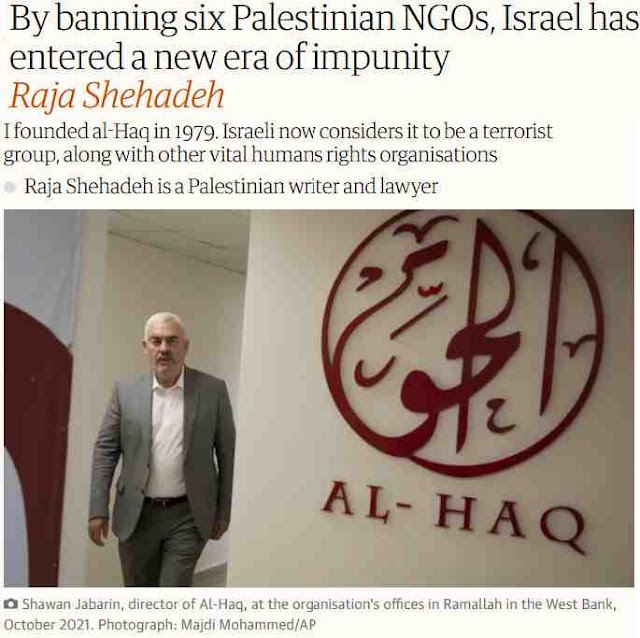
In October
Israel banned
not 1 but 6 Palestinian human rights groups. One of them, Al Haq, was founded in 1979, some 43 years ago. Nearly half as long
again as Memorial.Did the BBC give us an insight into its work
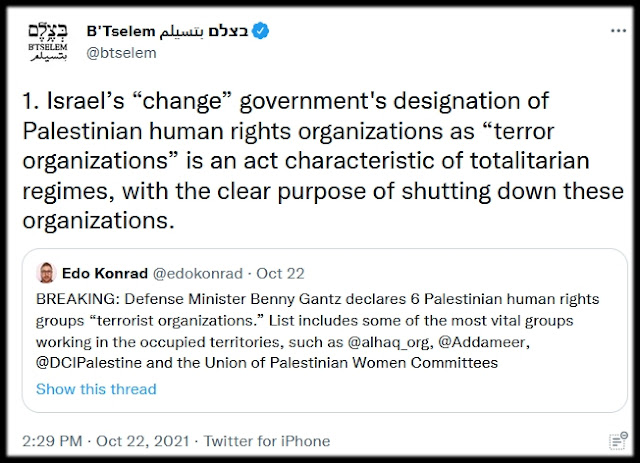
and film its staff at work?B’Tselem,
the main Israeli human rights group described
Israel’s banning as ‘an
act characteristic of totalitarian regimes’. Did the BBC interview anyone
who described Israel’s actions in these terms? Of course not.
Memorial was banned by order of Russia’s Supreme Court, which is
about as independent of government as our own Court of Appeal when it decided
to hand over Julian Assange to the tender mercies of America’s judicial and
prison system. Yet Israel didn’t even bother with the fig leaf of an order from
Israel’s Colonial Courts. It was banned by edict from Israel’s War Minister Benny Gantz. On this the BBC also had no comment
What limited coverage the BBC gave to Israel's banning of 6 human rights groups gave prominence to the accusations of 'terrorism' not the attack on the freedom of Palestinians
Who
were the groups which Israel described as a front for the Marxist Popular
Front for the Liberation of Palestine?
1.Al-Haq, Law in the Service of Man,
2.Addameer Prisoner Support and Human Rights Association, Bisan
3.Center for Research and Development,
4.Defence for Children International-Palestine (DCI-Palestine),
5.the Union of Agricultural Work Committees (UAWC) and
6.the Union of Palestinian Women’s Committees (UPWC).
Anyone
who has any acquaintance with the work of these organisations knows that
Israel’s motives in banning the groups was political and related to their
opposition to the Occupation. The allegations were made without a shred of
evidence.
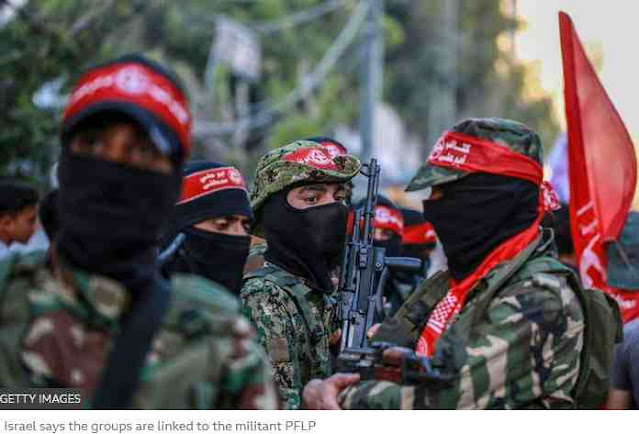
The BBC included a picture of
PFLP guerillas as part of its McCarthyist guilt-by-association techniques - not
once did it ask where the proof was that PFLP military operations were funded
by groups like Defence of Children International-Palestine
The
idea that these organisations cannot employ members or supporters of the PFLP
is preposterous. The PFLP is a legitimate Palestinian organisation. Settler
groups that regularly terrorise Palestinian farmers are described
by Israeli Interior Minister Ayelet Shaked as the ‘salt of the earth’ but Palestinian civil society groups or indeed
any group opposing Israel’s occupation are ‘terrorist’.
The
background to the BBC’s bias, in which every Israeli attack on the Palestinians
is ‘retaliation’ whereas Palestinian attacks on settlers or the military is
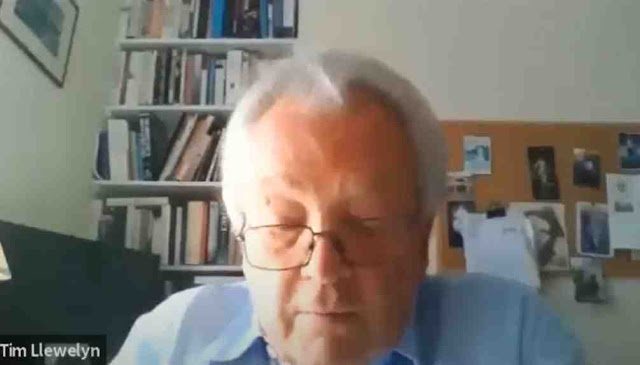
‘terrorist’ is laid out in Tim Llewellyn’s excellent talk which the Balfour
Project hosted in
August.
Tim
Llewellyn, a former BBC Middle East reporter, described how the BBC has adopted
the viewpoint of the British and American Establishment on Israel and how it
systematically distorts its news output in favour of Israel. Of course if the
Palestinians lived in Hong Kong or Tibet then the BBC would be all over them
like a rash.
We can get some measure of the BBC’s attitude by its response to Tim’s
article in the Guardian where it says that:
Although
Tim Llewellyn was indeed a BBC correspondent some years ago, we note that he
subsequently was active for a period with the Council for Arab-British
Understanding (CAABU).
Having nothing to say to rebut the substance of Tim’s article the BBC resorted
to attacking him personally because he is a member of CAABU, an organisation
devoted to fostering British-Arab understanding.
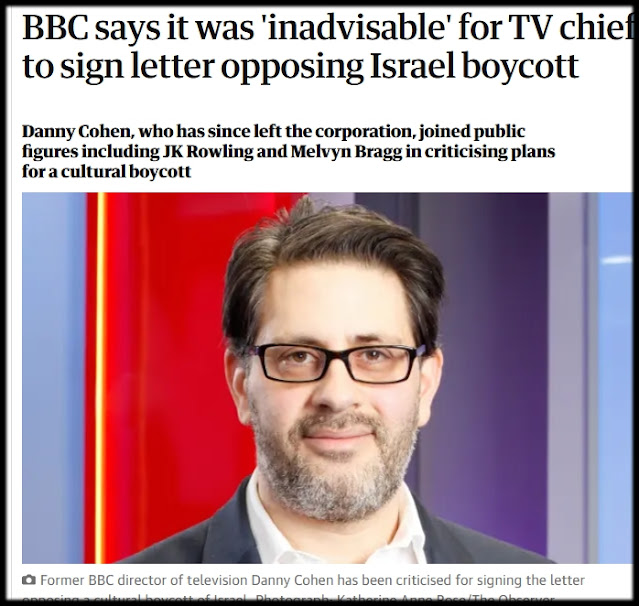
But when Danny Cohen, a former
BBC Director of Television signed a letter
in the Guardian opposing a cultural boycott of Israel, the BBC merely said
it was ‘inadvisable’. There was no
condemnation.
The BBC was born in the womb of the
British state. It has a record of racism, support for colonialism and hostility
to the working class and trade unions. I expect no different from it which is people
should not pay the TV Licence fee.There
is no reason why ordinary people should pay to fund this anti-working class
organisation.
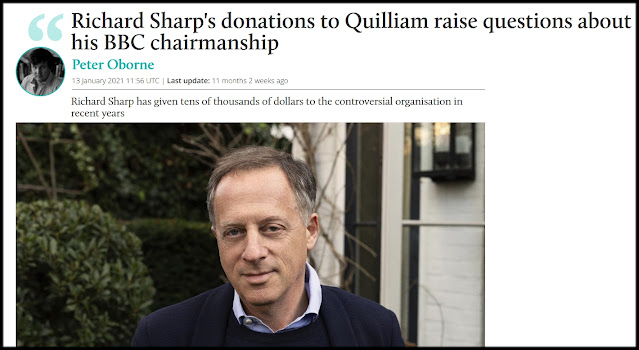
The BBC’s present Chairman Richard
Sharpe, has donated £400,000 to the Tory Party over the last 20 years. As
Richard Oborne detailed
Sharpe donated a further £35,000 to the Islamaphobic charity Quillam, which itself was funded by some
of the most virulent ‘counter Jihad’ organisations
such as the John Templeton Foundation.
I disagree with Tim’s suggestion in
the Guardian article that the responsibility for complaints should be taken out
of the hands of the BBC Trust (which has been abolished) and handed to Ofcom,
the state regulator.Why? Because this
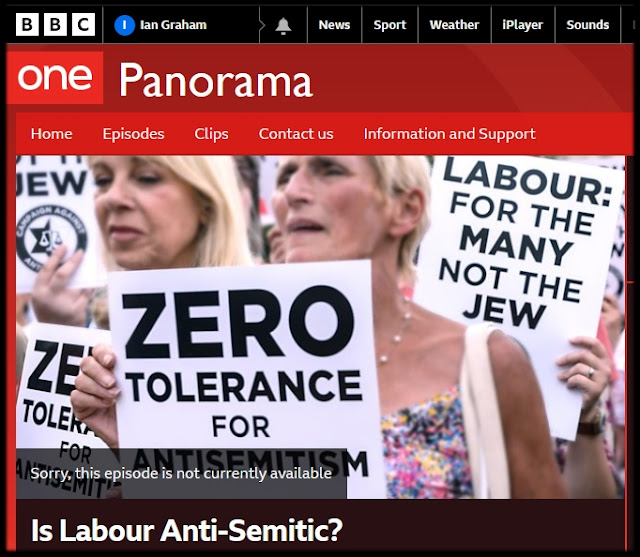
has already been done and we saw how effective Ofcom was when it refused
to investigate last year’s BBC Propaganda Film by John Ware, Is Labour Anti-Semitic?
I
include below two previous articles that Tim Llewellyn wrote for the Guardian
in 2009 and 2011 before Jonathan Freedland seized control of the Comment
columns and before the Guardian’s dire editor, Freedland Kath Viner, gave the MI5
a veto over what the Guardian is allowed to print on Britain’s security state.
Below
is Tony Benn’s interview
on BBC Today programme where he defied the edict of BBC Director General Mark
Thompson, who had banned an Appeal by the Disaster Emergency Committee. In 2008
Israel launched Operation
Cast Lead in the course of which it killed 1400 people, 85% of whom were
civilians, including 288 children.
British broadcasters' coverage of the Arab awakening over
recent months has been brave and honest. These are difficult and dangerous
stories. But the BBC – and
in this article I am going to concentrate on the BBC, because it is the
broadcaster we are taxed to enable and sets worldwide standards of fairness –
and its teams have made every effort to report with balance and application.
However, the BBC coverage of Israel and Palestine,
where another state continually kills and oppresses Arabs, is replete with
imbalance and distortion.
I covered the Middle East for the BBC from the
mid-1970s to the early 1990s, and am aggrieved by my ex-employer's continuing
inability to describe in a just and contextualised way the conflict between
military occupier and militarily occupied. There is no attempt to properly
convey cause and effect, to report the misery, violence and pillage that demean
and deny freedom to the Palestinians and provoke their (limited) actions.
Greg Philo and Mike Berry, in their book More Bad News from Israel, prove by
textual analysis and follow-up interviews with viewers and listeners that I am
right – and so are an increasing number of people who are becoming aware that
the BBC sells them short on Israel. Philo and Berry's book, an updated edition
of Bad News From Israel (2004), examines coverage of the Israeli blitz on Gaza,
analysing BBC TV and ITV early evening bulletins between its beginning on 27
December 2008, and the ceasefire on 17 January 2009.
Siege and blockade
They find that the Israeli explanation of why it went
to war on a mainly defenceless Gazan population is the one broadly accepted by
the BBC. It was a "response" to Palestinian rockets. The Palestinian
case, that the Israelis violated a ceasefire that had held for nearly five
months in November 2008, and that the Gazans had endured many years of
intensifying siege and blockade, which had reduced them to stagnation and
penury, was rarely put, if at all. "The
story was unpacked," the authors write, "in the manner of the Israeli view."
In the bulletins they examined, the BBC gave 421.5
lines of text to Israeli explanations of why they attacked Gaza: the "need
for security", "enemy rockets", "to stop the smuggling of
weapons". The BBC devoted 14.25 lines to references to the Israeli
military occupation of the Palestinian
territories and 10.5 lines to the blockade. The BBC repeatedly stressed the
word [Israeli] "retaliation",
and also implied that police stations bombed by the Israelis were military
targets, describing other casualties as "civilian". It described these civilian installations as "targets". Newspapers such as the
Guardian did point out the distinction.
"The
offer that Hamas was said to have made, to halt this exchange [rockets v shells
and air strikes] … was almost completely absent from the coverage,"
say the authors. They cite a BBC reporter saying: "Israel feels itself surrounded by
enemies, with reason." They add: "We
have not found a commentary noting that 'Palestinians feel themselves to be
subject to a brutal military occupation, with reason.' Israel's official
view is given as fact, they say, but the Palestinian view, on the rare
occasions it is found at all, is not. Israelis "state", Palestinians "claim".
When the BBC and ITV did start reporting the horrific
civilian casualties in Gaza and the use of phosphorus, Israeli spokespersons
were immediately on hand to deny, explain or obfuscate. The Palestinians,
especially Hamas, were rarely able to answer allegations. The Palestinians in
situ usually lacked the resources or opportunity to make their case. The many
articulate Palestinians in London available to help were rarely called on,
whereas, as one BBC insider said, "the
Israeli ambassador was practically camped at TV Centre".
More than two years on, the BBC continues to confuse
cause and effect – Israeli attacks are always reported as retaliation to
Palestinian violence or rockets, and the idea that Palestinian rockets, however
ineffective, are armed resistance to Israel's hammering from land, sea and air
is rarely broadcast. The daily indignities and brutalities of the siege and the
occupation and the shelling and shooting of civilians are virtually absent from
BBC consciousness unless an attack on Israel sparks interest.
Headline news
Philo and Berry quote the BBC correspondent Paul
Adams, a Middle East expert: what is missing from the coverage, he says, is the
view that the Palestinians are engaged in a war of national liberation, trying
to throw off an occupying force. Any Israeli casualty is headline news, shown
in high quality images. BBC teams are based in West Jerusalem, de facto Israeli
territory, and are on hand. Arab casualties may be shown in reports of a
funeral, usually agency film, the victim anonymous. The Israelis, it seems, are
for the BBC "people like us". The Arabs are "the other".
Philo and Berry go on to interview viewers and
listeners, all in higher education. They find that these focus groups were
largely unaware of the Israeli occupation, often believing the Palestinians are
the occupiers. Few knew that Hamas had been democratically elected in January
2006. "I had the impression they
were a terrorist group from watching the BBC," said one respondent. In
most cases, the assumption was that Palestinian rockets brought the invasion
onto their own people's heads.
To complain means the official complaints procedure
and dealing with the army of lawyers and layers of bureaucracy the BBC now
deploys to see off all but the most assiduous. Editors and producers rarely
respond individually to complaints and, if they do, do so with question-raising
answers and self-justification.
For example, the BBC consistently describes illegal
Israeli settlements as "held to be
illegal". But they are illegal. Even the Foreign Office says so. The
BBC always adds "Israel disputes
this." Well it would, wouldn't it? Why these caveats? Why this
reporting of a shout of denial from the convicted prisoner in the dock?
The BBC still
has explained why it interviewed members of the Zionist Jewish Labour Movement
without once revealing their identity
More than a month after I made an official complaint
about this I have had no reply or acknowledgement. People who complained about
Panorama's travesty of a documentary on the deaths caused when Israeli
commandos boarded the Mavi Marmara, part of the Gaza aid flotilla, had to go
through an obstacle course of form-filling and stonewalling.
The BBC Trust found the programme guilty on some
counts but said it had not breached BBC guidelines of accuracy and
impartiality. Why negotiate all this to end up with such contortionist,
self-serving judgments?
Final arbiter
The BBC is on the defensive: the castle wall is the labyrinthine
complaints procedure. It must be time for an independent body like Ofcom to be
the final arbiter on BBC journalism, not the BBC itself. The BBC Trust, the
highest court of appeal in these matters, is now chaired by Lord Patten, who
has told us all how closely he intends to work with the director general, Mark
Thompson: judge and potential defendant.
Why is BBC reporting like this? The book addresses this in Chapter 4. In
my view, the rot set in during 2001, after 9/11. Israel and its friends were
quick to capitalise on "terror" and "Arabs" and massively
enhanced their propaganda effort here, gaining access to BBC staff at all
levels. BBC managers and editors do not like being shouted at, and they are
soft toys when someone makes a loud and apparently convincing case. The
Palestinians have no such machinery. As one BBC producer says in More Bad News:
"We all fear the phone call from the
Israeli embassy."
The BBC's main Middle East bureau in west Jerusalem is liable to Israeli
pressure, and it is in Israel that the BBC perspective on the regional conflict
is formed.
Editorially, Israeli spokesmen are easily available and producers love
that. As Peter Oborne pointed out on Channel 4 in late 2009, each of our three
main political parties is amenable to the "Friends of Israel" lobby.
Our coalition leadership duo have both pledged themselves publicly to Israel.
So did Tony Blair and Gordon Brown.
The BBC, like a well-kicked hound, does not in its post-Hutton malaise
wish to antagonise politicians. It goes with reporting that's as low-profile as
possible on this most sensitive of issues. It lives in horror of being accused
of anti-semitism, Israel's ultimate smear. Reporters and editors know they have
to pitch the Israel story in a certain manner to get it on the air – in effect,
self-censorship.
Perhaps the most overwhelming distortion of the BBC in its coverage of
Israel and Palestine is what I term "spurious equivalence": that the
Palestinians and Israelis are two equal sides "at war" over
"disputed" territory and may the best man win. Or, come on chaps,
shouldn't reason prevail? The BBC knows that the Palestinians are a people
fighting for independence, but its coverage does not tell it like it is.
In 2006, an independent panel appointed by the BBC governors assessed
impartiality in coverage of the Israel-Palestine conflict. Their review came
after many complaints and the first edition of this book, which examined in
similar form the BBC's distorted reporting of the Al-Aqsa (second) intifada and
the subsequent Israeli bombardments and invasion of the cities of the West
Bank.
The commission confirmed many of the Philo/Berry criticisms:
"BBC output does not consistently give a full and fair account of the
conflict. In some ways the picture is incomplete and, in that sense,
misleading."
Five years on, it remains so, and the BBC has put the commission's report
under "File and Forget".
Tim Llewellyn was BBC Middle
East correspondent from 1976-80 and 1987-92. More Bad News from Israel, by Greg
Philo and Mike Berry, is published in paperback by Pluto Press at £15
BBC response to Tim Llewellyn's
story
BBC
News endeavours to report on all matters in the Middle East – as elsewhere –
impartially, objectively and accurately.
We
have extensive editorial guidelines which all reporters and producers are
required to observe.
In a
highly charged political atmosphere any impartial and accountable broadcaster
will rightly find itself under scrutiny by all shades of opinion.
In
the Middle East debate there are organised, motivated and effective lobby
groups on both sides of the argument.
We
listen to their concerns and act on them where we think they are justified, but
in doing so we bear in mind that our audiences expect us to remain independent
of political pressure.
Although
Tim Llewellyn was indeed a BBC correspondent some years ago, we note that he
subsequently was active for a period with the Council for Arab-British
Understanding (CAABU).
On Tuesday, speaking from a pulpit in Westminster Abbey, the
director general of the BBC,
Mark Thompson, paid tribute to one of the corporation's greatest journalists
and broadcasters, Charles Wheeler, who died last summer at the age of 85.
Thompson spoke in reverential terms of Wheeler: his
independence; his dislike of authority, any authority; his relentless search
for the truth, in postwar Germany, in the United States of the 1960s and 1970s,
LBJ, Vietnam, Nixon; in India, Kuwait, Kurdistan. Thompson was right. Wheeler
was a giant among BBC journalists, rightly hailed as one of the best of his
generation.
But even as Thompson spoke, the corporation was
traducing every tradition that Wheeler, and many of us who still work for the
BBC, have tried to live by. The corporation's chief operating officer, Caroline
Thomson, had refused to allow it to broadcast an appeal on behalf of the
Disasters Emergency Committee for Gaza. She said that one
reason was that "the BBC's
impartiality was in danger of being damaged". Could the BBC be sure,
she added, that money raised for this cause would find its way to the right
people?
How is the BBC's impartiality to be prejudiced by
asking others to raise money for the victims of an act of war by a recognised
state, an ally of Britain, using the most lethal armaments it can against a
defenceless population? What sly little trigger went off in her head when
Thomson questioned whether the aid would reach the right people? What right
people? Hamas, the elected representatives of the Palestinian people? The
hospitals and clinics run by private charities and the United Nations Relief
and Works Agency? The mosques? The citizens of Gaza, persecuted beyond measure
not only by their Israeli enemies but by the western powers who arm and sustain
Israel and defy the
democratic vote of the Palestinian people?
Is Thomson more fussed about some imaginary "war
on terror" that even the new White House is shying away from than she is
about upholding the free speech and freedom of action of the corporation?
This pusillanimous obeisance to some imagined
governmental threat has aroused unprecedented anger across the BBC. Reporters
and correspondents still on the staff, and who will not name themselves, are
beside themselves with rage against a corporation that is traducing the very
ideals it is supposed to uphold, and for which the director-general seemed to
speak in Westminster Abbey.
This is what one former BBC World Service current
affairs producer wrote to his colleagues yesterday:
"...
I am rarely moved to comment on aspects of the BBC I can no longer influence.
But I confess I am deeply saddened and confused - and frankly pleased to be
distanced from such decisions - after listening to Caroline Thomson's
obfuscating defence on Today of the refusal to broadcast the joint charity
appeal on behalf of the suffering in Gaza. The question of partiality is a red
herring. It is for the general public to respond to a humanitarian disaster as
they choose."
Having dealt with different news managers at the BBC
over the past 30 years or so, I can safely say that the modern BBC has become a
body of lions led by donkeys. Reporters of the calibre of Jeremy Bowen, David
Lloyn, Lyse Doucet, experts in their field and brave people all, will be
appalled by the directions they are being given. Edward Stourton and the Today
programme rightly produced Tony Benn yesterday morning because they knew he
would articulate what their bosses have failed to: reason and humanity.
The big question that remains is this: what are the
suits scared of? Why do BBC managers try to second-guess our government and
even outreach it in grovelling to the United States and Israel?
BBC journalists, extant and retired, not the
"usual suspects", not disaffected radicals and high-octane lefties,
are incandescent with rage over this extraordinary piece of institutional
cowardice.
The episode makes a travesty of the institution's
posturing in Westminster Abbey last week, and discredits the honest reporters
the BBC still has on its books and in the field.
Tim Llewellyn is a former BBC Middle East
correspondent
This is such an excellent article by Aly
Renwick of Veterans for Peace (UK) that I just had to publish it.It deserves a much wider hearing.
For me what is interesting is the connection
between Ireland and Palestine. As the article quite correctly says, the hated
Black and Tans, when they were finished with Ireland were promptly sent to Palestine
to repress Arab nationalism. In the words of the first Military Governor of Jerusalem,
Sir Ronald Storrs (Orientations) A Jewish
State will be for England a little, loyal Ulster in a sea of potentially
hostile Arabism.’
The links between Ireland and Palestine are symbolised in the figures of Winston Churchill and Lloyd George. Churchill was the Colonial Secretary who presided over Partition in Ireland and the implementation of the Mandate in Palestine. Lloyd George, who welcomed Hitler to power in 1933, was the Prime Minister who presided over the negotiations that led to Partition, threatening the whole of Ireland with unparalleled violence unless the Irish delegation to Britain gave way. Michael Collins reluctantly accepted partition and was soon after assassinated.
The connections between a Protestant settler
state in the North of Ireland and a Jewish state in Palestine were immediate
and obvious to British imperialism. In both states settlers dependant on British
firepower, created their own society amidst the indigenous population – Irish Catholics
and Palestinian Arabs. In Ireland an artificial majority was created by
confining the Ulster statelet to the 6 Counties. In Palestine the Zionists used
the simple expedient of expelling the majority of the population. In both cases
a combination of ethnic cleansing and partition achieved the objectives of
imperialism.Divide and rule paid
handsome dividends, whether it was in Palestine, Ireland or India and in all
three countries it was achieved with massive bloodshed.
On November 2nd 1917 British
imperialism promised the land of the Palestinians to the Zionist settlers,
despite the fact that it was not theirs. The document encompassing this
strategy was the Balfour
Declaration named after the then Foreign Secretary Arthur J Balfour. In
1905 as Prime Minister he had introduced the Aliens Act aimed at keeping Jewish
refugees out of Britain. Balfour combined in himself both anti-Semitism and Zionism,
which is a combination that has reared its head repeatedly since then.
Balfour first saw service in Ireland where he
was known as ‘Bloody Balfour’. From 1887 to 1891, Balfour headed
Britain’s administration in Ireland. On his appointment to that post, Balfour
proposed to combine repression and reform.
The repression he advocated should be as “stern” as that of Oliver
Cromwell, the English leader who invaded Ireland in 1649. Cromwell’s troops are
reviled in Ireland for the massacres
they carried out in the towns of Wexford and Drogheda.
Siding with the gentry against what he called the “excitable peasantry,” Balfour prioritized repression over reform.
When a rent strike was called in 1887, Balfour authorized the use of
heavy-handed tactics against alleged agitators.
Three people died after police fired
on a political protest in Mitchelstown, County Cork. The incident earned him
the nickname of “Bloody Balfour.” [see The
racist worldview of Arthur Balfour by David Cronin].
We also see, in both colonies, how resistance to British colonialism was criminalised. The use of paramilitary police was used to reinforce this. In other words the natives weren't rebelling against the British, it was simply 'criminal elements' amongst them who objected to British policies of exploitation and starvation. The Nazis also termed their opponents 'bandits' and sought reprisals against innocent civilians and hostages. No one should think that Nazi imperialism in Eastern Europe was that different from the horrors of European imperialism in its mindset.
Which was
why, when Ireland’s Fine Gael Party, descended from those in the South who
supported the British, intended to commemorate the Royal Irish Constabulary
there were protests and boycotts and eventuall Leo Varadkar, the Taoiseach was forced
to call the whole thing off although he still defended
his decision to honour these murderers and rapists. That might be why Varadkar
polled fewer votes than Sinn Fein in his constituency.
The article below is excellent. It puts British policing into
context.Although based on consensus it
always has at its back, as we saw in the 1984-5Miners’ Strike, the armed fist in a velvet glove.There were repeated reports in 1984-5 that
soldiers were present dressed as police. Then the power of the state and the
magistrates and judges all bent over backwards to help defeat the state.
In other words the capitalist state is not and never has been neutral.It is a lesson that socialists inside and
outside the Labour Party need to take to heart. The Police are not your friends
and aren’t neutral. It is the question of the state that divides socialists
from social democrats.
Tony Greenstein
COLONIAL POLICING by Aly Renwick
Last year, in 2019, there was in Britain a considerable amount of media
coverage of the anti-government protests in Hong Kong. Usually the protesters
were praised, while the police who faced them were criticised as oppressive,
but fifty-two years before, in 1967, there had been similar protests and
repression. At that time, however, Hong Kong was run as a British colony and
then it was the protesters who were condemned and the police who were praised.
Hong Kong Island was ceded to Britain after the First Opium War in 1842
and the Hong Kong Police Force was established two years later, with upholding
British control as its main task. In 1966 a number of labour disputes escalated
into large-scale protests against British colonial rule, which lasted throughout
the next year and, after 51 deaths and over 800 injured, a number of social
reforms were introduced and the protests gradually ended. Two years later, for
their role in curbing the protests, Queen Elizabeth bestowed the ‘Royal’ title
on the police – making them the Royal Hong Kong Police Force (RHKPF).
From Tudor times the state in Britain had gradually been constructed
into a fiscal system capable of financing the building of an empire on a world
scale. Later, global profiteering, including the slave trade and going to war
to force drugs (opium) on China – aligned with commerce and taxes, especially
on income – provided the surplus money that financed the technological advances
of the industrial revolution and led to the expansion of the British Empire.
Adam Smith’s ‘The Wealth of Nations’, published in 1776, had argued for
a policy of government non-interference in economic affairs and for giving free
rein to the ‘magic hand of the market’, which was to be applied ruthlessly both
at home and abroad. The administration of government, centred in Whitehall
since the 16th century, was modernised after the Northcote-Trevelyan Report of
1845, which extensively increased the number of civil service mandarins and
their departments.
In Britain and Ireland, the suppression of the democratic ideals thrown
up by the French Revolution had culminated in the defeat of the United
Irishmen. On the first of January 1801 the 500 year-old Irish parliament was
dissolved and the Act of Union came into effect. A new flag, the Union Jack,
was unfurled – which added the cross of Saint Patrick to those of Saint George
and Saint Andrew. The Armed Forces of Britain would take this new symbol of
empire to the far corners of the world, as they were used in a long series of
engagements to extend the boundaries of British control.
The moves toward a laissez-faire (market-led and regulation-free pure
capitalism) economic policy led to the Reform Acts, from 1832, which
consolidated the hold of private enterprise over parliament, strengthening the
middle class and gave ever-increasing power to the entrepreneurs. In Britain
the rural poor and Irish emigrants, flocking into the greatly expanding
industrial cities, worked long hours on starvation wages to facilitate the
factories prolific output:
Divide and
rule, both in Britain and overseas, was used to keep the masses divided and,
while the rulers exploited cheap labour at home, plunder, combined with trade
monopolies, became the order of the day abroad. At the height of the Empire,
Britain, a small island, was ruling nearly a quarter of the world’s land
surface and populations numbered in their hundreds of millions. Therefore, a
system of enforcing control was initiated that was to include, not only the
Army and Navy, but also a local force of colonial armed police – that later
would include in Hong Kong the RHKPF.
The Testing Ground
Ireland, as
was often the case, became the testing ground for this type of repressive rule
and in 1812, Sir Robert Peel, after being appointed the Chief Secretary of
Ireland, arrived in Dublin. At that time all of Ireland was a part of the
United Kingdom, but there were frequent political protests and actions. Unlike
Scotland and Wales, Ireland had never accepted English rule, or its
incorporation into the UK, and the country was filled with barracks full of
British soldiers.
Peel, a
devotee of markets and the Empire, had become an MP in 1809 during the Napoleonic
Wars, which were to end with the battle of Waterloo in 1815. Four years later,
the Peterloo Massacre in Manchester, saw voices for a more democratic society
at home repressed. Peel was also a supporter of law and order having served
part-time as a captain in the Manchester Regiment of Militia in 1808.
In Ireland
the Army’s direct use of brute force was often proving to be counter-productive
and hard to explain away. The troops were anyway continually required for wars
in far off places and all this suggested that a new ‘policing force’, mainly
drawn from the indigenous population, was required. An armed constabulary,
which like the army would operate from fortified buildings and be under central
control, but one that would be precise, disciplined and more politically
acceptable than soldiers.
As
communications improved, the truth was becoming harder to hide and greater
efforts were required to provide explanations for the seemingly never-ending
outbreaks of anti-government violence in Ireland. The British authorities, who
were attempting to attribute all violent acts to ‘bandits’ and ‘outlaws’,
considered that making a constabulary the prime upholders of ‘law and order’,
rather than the army, could help to maintain this fiction. And therefore
diminish potentially embarrassing political protests to issues of crime and
criminality.
Peel, who
was later to become the UK’s Prime Minister first in 1834/5 and again in
1841/6, initiated the first police service in both Ireland and England. There
were, however, major differences in the set-up and running of the constabulary
in each country. In Ireland Peel advocated setting up a countrywide police
force and two years later the Peace Preservation Force was used for the first
time in Middlethird, County Tipperary.
A county
constabulary was later added, but the two forces were amalgamated as the Irish
Constabulary (IC) in 1836 and brought under central control. Throughout this
period, political developments often followed a familiar path, as
constitutional politicians like O’Connell and Parnell waged campaigns for land
reform and national rights. When peaceful requests, then protests, came up
against a wall of hostility, intransigence and repression from the landlords
and the British establishment, underground movements like the Young Irelanders
and the Fenians emerged to carry on the struggle by violent means.
In 1867
Queen Victoria granted that the prefix ‘Royal’ be added to the name of the
Irish Constabulary in recognition of the part the force had played in suppressing
the Fenian movement:
‘For the Irish Constabulary, the
Fenian uprising brought them unparalleled fame … In Adam’s Police Encyclopaedia
the author had this to say: “On Friday, September 6, 1867, at the Constabulary
Depot in Phoenix Park, in the presence of the Lord Lieutenant, the Marchioness
(afterwards Duchess) of Abercorn attached with her own hands the medals, which
were specially struck for the occasion, upon the breasts of those who had
specially distinguished themselves. In addition to a medal some were given a
sum of money, or a chevron” … Her majesty was “graciously pleased to command”
that the force “be hereafter called the Royal Irish Constabulary” and “that
they shall be entitled to have the harp and crown as badges of the force”.’ [The Irish Police,
by Séamus Breathnach, Anvil Books 1974].
Operating
from fortifications and under strict central control, the Royal Irish
Constabulary (RIC) was developed as an armed coercive force furnishing the
public face of colonial authority:
‘The RIC was from its outset to
be controlled by Irish Protestants. It was responsible to the Irish authorities
in Dublin who were Protestants or Anglo-Irish. Presumed to be the RIC’s chief
challengers were Irish nationalists – mostly (though eventually not
exclusively) Catholic – that is, not criminals but political militants.
By making control of Irish
nationalism a police rather than a military affair, officials in Dublin and
London could relegate the nationalists to the category of mere “bandits”. The
challenge to state security could thus be understated. The use of “bandits” to
describe insurgents so long as they were a matter for the police, became
conventional in many British colonies which adopted the RIC model…’ [Ethnic
Soldiers, by Cynthia H Enloe, Penguin Books 1980].
The Police
in England
In 1829,
after Peel had moved back to Westminster to become the Home Secretary, he
initiated a Metropolitan Police force for London. And from the capital of the
Empire, ‘British democracy’ was manifested as the model for any legitimate
government. The ruling class, however, sought to maintain their dominance at
home and abroad, so there was a crucial difference in Britain and Ireland
between the ‘force and consent’ (using Gramsci’s characterization) needed to establish
the ruler’s hegemony – and consequently how ‘law and order’ was applied.
Inside
Britain, while the establishment ensured their interests predominated,
Westminster promoted the concept that the state forces were neutral and acted
in the interests of all the people. In fact, dissident voices and actions were
categorised as being against the ‘national interests’ and ignored or crushed,
but as the ruling elite established their dominance and authority, they did
create a cohesive state system which most people gradually adhered to.
Following
this pattern, the police in Britain developed as an area-based unarmed force
which sought the consent of the people among whom they operated. There was a
measure of local control over the police, who carried truncheons instead of
firearms and whose main task became the prevention of crime (law). In the
background were units like the Special Branch – initially formed in 1883 to
combat Fenian bombings – and other paramilitary units with access to arms,
whose main task was upholding the status-quo (order).
In Ireland,
where the legitimacy of British rule was always suspect and never carried the
moral authority of state rule back home, the emphasis between force and consent
was very much the other way around. The RIC were centrally controlled, armed
and acted mainly as a repressive force upholding British rule (order), with the
prevention of crime (law) a secondary role.
In 1839, a
Commission of Inquiry was looking into the setting up of a police force for
England and Wales. After examining the police in Ireland the commission
reported that:
‘The Irish constabulary force is
in its origination and action essentially inapplicable to England and Wales. It
partakes more of the character of a military and repressive force, and is consequently
required to act in greater numbers than the description of force which we
consider the most applicable, as a preventive force …’ [First
Report of the Commissioners appointed to inquire as to the best Means of
Establishing an Efficient Constabulary Force in the Counties of England and
Wales, 1839].
Views of Colonial Policing
In Ireland,
the IC / RIC were recruited from areas outside of the populace they patrolled
and they had more than double the numbers of personnel for the density of
population than police forces in England. In 1847 an army veteran, Alexander
Somerville, who had been flogged for writing a ‘seditious letter’ to a
newspaper while serving with the Scots Greys, visited Ireland. Somerville, who
came from a poor working class background, was especially incensed by the
landlords:
‘A large number of the worst
Irish landlords, Somerville believed, had “brought Ireland to a condition
unparalleled in the history of nations.” As a class, he thought that they stood
“at the very bottom of the scale of honest and honourable men.” Indeed, “the
Irish landlord is only a rent eater, and his agent a rent-extractor, neither of
them adding to the resources of the farm – not even making roads or erecting
buildings”. While in England, rural depopulation was said to be due to the
attractions of urban industrial employment, in Ireland such employment was
unavailable, and “clearances” were forced, coercive and intolerable. Somerville
complained of how the present time was an opportunistic one for evictions: “We
have England paying out of English taxes all those armed men, and providing
them with bullets, bayonets, swords, guns and gunpowder, to unhouse and turn to
the frosts of February those tenants and their families”.’ [Letters
from Ireland during the Famine of 1847, by Alexander Somerville – edited by K.
D. M. Snell, Irish Academic Press 1994].
Somerville,
noting that many of these armed men were police, wrote that:
‘One of the
first things which attracts the eye of a stranger in Ireland … and makes him halt
in his steps and turn round and look, is the police whom he meets in every part
of the island, on every road, in every village, even on the farm land, and on
the seashore, and on the little islands which lie out in the sea.’ Somerville
continued:
‘These
policemen wear a dark green uniform and are armed; this is what makes them
remarkable, armed from the heel to the head. They have belts and pouches, ball
cartridges in the pouches, short guns called carbines, and bayonets, and
pistols, and swords.’ [Letters from Ireland during the Famine of 1847, by
Alexander Somerville – edited by K. D. M. Snell, Irish Academic Press 1994].
1.Garrow Green, an RIC cadet, wrote about his
training and explained how it was like being in an army unit:
‘To readers unacquainted with the
corps, I may say that it is a military police peculiar to Ireland, and
officered in much the same way as the Army … I may say that the Royal Irish
Constabulary Depot differs in no respect from an army infantry barracks …’ [In the
Royal Irish Constabulary, by G. Garrow Green, Dublin 1905].
Continually
fed information from a network of spies and informers the IC / RIC used this
intelligence – combined with their local knowledge, which they augmented during
policing (law) – to great effect during counter-insurgency offensives (order)
against political opponents:
‘The fact is that the really
effective influence upon the development of the colonial police forces during
the nineteenth century was not that of the police in Great Britain, but that of
the Royal Irish Constabulary … From the point of view of the colonies there was
much attraction in an arrangement which provided what we should now call a
“paramilitary” organisation or gendarmerie armed and trained to operate as an
agent of the … government in a country where the population was predominantly
rural, communications were poor, social conditions were largely primitive, and
the recourse to violence by members of the public who were “against the
government” was not infrequent. It was natural that such a force, rather than
one organised on the lines of the purely civilian and localised forces of Great
Britain, should have been taken as a suitable model for adaptation to colonial
conditions.’ [The Colonial Police, by Sir Charles Jefferies, Max Parrish 1952].
Army Barracks, Police Forts & Famine
Throughout
the nineteenth century there were barracks for British soldiers all over
Ireland. Fermoy, built overlooking the Blackwater River in County Cork, was a
huge barracks around which the town was built to service it. The largest
garrison, the Curragh, was first established in 1646, built on a large plain
near Kildare, the barracks occupied one side of the Dublin road with the
race-track on the other.
Ireland
became crisscrossed with large army barracks situated at strategic locations,
and the smaller, but much more numerous, fortified buildings of the police.
During the period of the famine there were 1,600 fortified IC bases throughout
the country, situated in villages, towns and cities. Backed by soldiers when necessary,
armed IC men assisted in enforcing evictions, protected landlords and their
agents, and guarded the foodstuffs that were still being shipped abroad for
profit.
An extensive
prison network was also constructed, as the system of transporting prisoners
was ending and by the time of the famine 26 new prisons had been built to
augment the 18 already in existence. In these buildings political prisoners,
especially, faced a harsh regime of control, punishments and forced-labour. In
1856, Frederick Engels visited Dublin and gave his view of the country:
‘Ireland may be regarded as
England’s first colony … the so-called liberty of the English citizen is based
on the oppression of the colonies. I have never seen so many gendarmes in any
country and the sodden look of the Prussian gendarme is developed to its
highest perfection here amongst the constabulary, who are armed with carbines,
bayonets and handcuffs.’
Thirty years
later, in 1887, the poet Francis Adams also visited Dublin and recorded this
image of the city in his poem: ‘Dublin At Dawn’:
In the chill
grey summer dawn-light
We pass through the empty streets;
The rattling wheels are all silent;
No friend his fellow greets.
Here and
there, at corners,
A man in a great-coat stands;
A bayonet hangs by his side, and
A rifle is in his hands.
This is a
conquered city,
It speaks of war not peace;
And that’s one of the English soldiers
The English call “police”.
Throughout
the British Empire there were corrupt and immoral political system and coercive
rule. In both India and Ireland there were famines, brought on by the strident
use of a market-led economic policy – during which the use of Colonial Police
allowed acts of political protest to be depicted as ‘crime’. As over a million
Irish people were dying from starvation and subsequent diseases, ships still
left Irish ports laden with meat, flour, wheat, oats and barley – to sell for
great profits on the market.
This pattern
of the army, acting as back-up to a paramilitary police force, became the
prototype for maintaining British rule in other parts of the Empire. Sir Robert
Peel, who instigated the first police forces in Ireland and Britain, was later
the British Prime Minister at the start of the Famine and the starving Irish
people who received the attentions of Britain’s armed forces made little
distinction between his police, who they called ‘Peelers’, and British
soldiers. The nationalist leader Daniel O’Connell called him ‘Orange Peel’ and
commented that Peel’s smile was ‘like the silver plate on a coffin.’
The Market & Coercive Policing
Located just
a narrow strip of water away, it was inevitable that Ireland would become an
early victim to English expansionism. While land and exploitation were the main
motive behind the drive to subdue the Irish, there was also a second reason. In
the past, O’Neill and Tone had forged links with England’s enemies, Spain and
France, who had both landed troops in Ireland. This had fuelled England’s
determination to subdue and control Ireland, to ensure it could never again
pose a military threat.
William
Cobbett, an ex-army sergeant-major, also thought that Britain’s security should
be protected, but he knew that the use of repressive laws and military might in
Ireland was wrong and counterproductive. He believed that ‘a real union of the
hearts’ could be achieved between the people of Britain and Ireland if reason
was used instead of force:
‘It is not by bullets and
bayonets that I should recommend the attempt to be made, but by conciliation,
by employing means suited to enlighten the Irish people respecting their rights
and duties, and by conceding to them those privileges which, in common with all
mankind, they have a natural and legitimate right to enjoy.’
[Not by Bullets and Bayonets – Cobbett’s Writings
on the Irish Question 1795-1835, by Molly Townsend, Sheed and Ward Ltd 1983].
Cobbett,
after leaving the British Army, had become a leading voice against injustice
and for reform:
Cobbett’s
appeals about Ireland fell on deaf ears and even a tragedy like the famine
brought no change in policy. In 1846, a new Coercion Act designed to control
possible insurrection by the starving Irish people was enacted. It was the
eighteenth Coercion Act to be brought in since the 1801 Act of Union. As Lord
Brougham remarked, the new bill: ‘Possessed
a superior degree of severity’.
Pro-imperialist
historians often brag that, at its height, the British Empire covered a quarter
of the world’s land surface and contained a population of over 400 million.
They neglect to tell us, however, that it was drug trafficking and the slave
trade that helped put the ‘Great’ into Great Britain; or that the famines in
Ireland and India, which caused millions of deaths, were the result of official
callousness and subjugation, during the application of an unyielding political
and economic ideology.
Under the oppressive
control exercised through Britain’s Armed Forces and centrally controlled
colonial Police Forces, profits had multiplied in the City of London during the
Victorian heyday of the British Empire. While at home and abroad many ordinary
people faced slavery, misery, starvation and death.
The Veterans of WW1
The last
days of the Victorian era had seen Britain’s standing, as the premier world
power, starting to decline – and it was the resulting rivalry between the core
capitalist nations that led to two world wars. All over Europe, at the end of
WW1, there were young men who had gone straight into the trenches and who knew
no life save that of soldiers. Most of these demobbed veterans had served at
the front and many of these men were left traumatised and brutalised by their
experiences.
In Germany,
some of these disillusioned veterans were recruited into the anti-revolutionary
Freikorps (Free Corps) by their former officers, who now used these ex-soldiers
to help crush the political left:
George L.
Mosse, a Professor of History at the University of Wisconsin, wrote about these
WW1 veterans:
‘There was no doubt a
ruthlessness, a feeling of desperation, about some of these men who were unable
to formulate effective political goals and who rightly or wrongly thought
themselves abandoned by the nation whose cause they championed. The suppression
of revolution in Berlin or Munich was accompanied by brutal murders, and such
murders continued even after the Free Corps had been disbanded, most often
committed by former members of the corps. … The 324 political assassinations
committed by the political Right between 1919 and 1923 (as against twenty-two
committed by the extreme Left) were, for the most part, executed by former
soldiers at the command of their one-time officers…’
[Fallen Soldiers, by George L Mosse, Oxford
University Press 1990].
These
veteran ‘new men’ saw themselves as continuing the comradeship established
among the fighting men at the front. In Germany many demobbed veterans were
later to join the Nazi Brownshirts of Hitler, himself a WW1 veteran. In Italy
they marched on Rome with Mussolini and in Russia they fought on both sides in
the civil war.
In 1916,
during WW1, British Army firing squads had been busy in Ireland after
frustrated Nationalists in Dublin had rebelled against British rule. Martial
law was declared, the Easter Rising was crushed and military courts-martial
sentenced 15 of the Irish leaders, including Pearse and Connolly, to be shot.
Many of the other prisoners were deported to Britain and confined in special
prison camps.
After the
ending of WW1, in India and Ireland, the mass of the population had become
increasingly hostile to British rule. In the UK there was a general election
and the Sinn Féin party in Ireland won by a landslide there and started to set
up a republican administration. This was banned by the British and many of the
new Sinn Féin MPs were arrested and jailed.
The Irish
Republican Army (IRA) then began a campaign of armed resistance. Republicans,
however, knew that they could not defeat Britain’s forces in battle – but set
out to make the country un-governable instead. Michael Collins, using
information from a network of agents inside the colonial administration,
directed a ruthless and highly efficient campaign of guerrilla warfare – that
proved difficult for the British forces to defeat.
As the
conflict attracted international attention Britain realised that it was in
danger of losing the propaganda battle, especially after the ‘Great War’ in
which they had claimed to fight for ‘the rights of small nations.’ So, Britain
refused to recognise the conflict as a war and, in an attempt to criminalise
the freedom struggle, the RIC was increasingly used as the front-line force –
with British soldiers, except in areas of high IRA activity, kept in the
background.
In Ireland
non-cooperation, coupled with small acts of sabotage, took place on a daily
basis and the country became an armed camp. Dublin and other cities were
patrolled by troops with fixed bayonets; many of the soldiers had fought in the
‘Great War’ and some said that service in Ireland caused them greater stress
than life in the trenches. But within the RIC there were signs of even greater
strain, both from moral pressure and the armed IRA attacks, which had caused
heavy police casualties with 400 RIC men killed by the end of 1921, compared to
160 soldiers.
In Britain
the politicians’ promises ‘to create a land fit for heroes’ for the returning
fighting men had not materialised. As in the rest of Europe, they were left to
cope on their own, as WW1 front-line veteran George Coppard explained:
‘I joined the queues for jobs as
messengers, window cleaners and scullions … Single men picked up twenty-nine
shillings per week unemployment pay as a special concession, but there was no
jobs for the “heroes” who haunted the billiard halls as I did. The government
never kept their promises.’
Instead,
like in Germany and Italy some of Britain’s WW1 veterans were recruited again,
but this time to fight against the Irish people who were seeking their
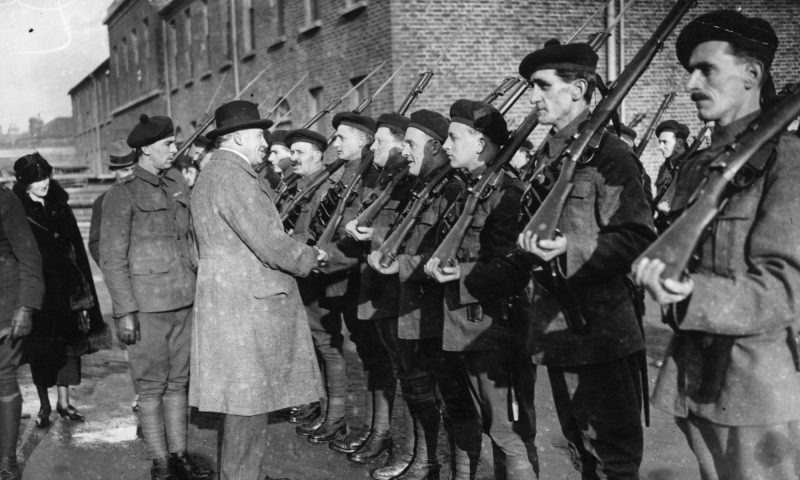
independence. Rank and file ex-soldiers joined a unit nicknamed the Black and
Tans, while a number of their former officers joined a more formidable force,
the Auxiliaries. They were both ordered to serve in Ireland with the RIC, to
add an extra-brutal physical-force element to their colonial policing
operations.
The Black
& Tans
The
Auxiliaries and the Black and Tans, once recruited and trained, were shipped to
Ireland and billeted in RIC barracks – to provide a cutting-edge for repressive
operations. Before their arrival the RIC Divisional Commissioner for Munster,
Gerald Bryce Ferguson Smyth, had called his men to a meeting at the Listowel
police barracks and told them that the British Government had instructed him to
implement a new policy, which he enthusiastically outlined:
‘I am getting 7,000 police from
England.
If a police barracks is burned,
the best house in the locality is to be commandeered.
The police are to lie in ambush
and to shoot suspects. The more you shoot the better I will like you … No
policeman will get into trouble for shooting any man.
Hunger strikers will be allowed
to die in jail – the more the merrier.
We want your assistance in
carrying out this scheme and wiping out Sinn Féin.’
Some
policemen were against the coming of the Black and Tans and this new aggressive
policy. About 500 RIC men tendered their resignations and some walked out after
incidents in their barracks. Daniel Francis Crowley, who served in the RIC from
1914 to 1920, explained what happened at the Listowel barracks after
Commissioner Smyth had given his men their new orders:
‘Sergeant Sullivan spoke
immediately and said that they could tell Colonel Smyth must be an Englishman
by his talk, and that they would not obey such orders; and he took off his coat
and cap and belt and laid them on the table. Colonel Smyth and the Inspector,
O’Shea, ordered him to be arrested for causing dissatisfaction in the force,
but nineteen of them stood up and said if a man touched him, the room would run
red with blood. The soldiers whom Colonel Smyth had with him came in, but the
constables got their loaded rifles off the racks, and Colonel Smyth and the
soldiers went back to Cork. The very next day they [the RIC men] all put on
civilian clothes and left the barracks.’ [The Irish Police by Séamus Breathnact, Anvil Books
1974].
Many of the
RIC men who tried to resign were intimidated, threatened and some were even
whipped by the Black and Tans after they arrived. Crowley, who resigned ‘because of the misgovernment of the English
in Ireland’, fled the country under Black and Tan threats after his friend
Constable Fahey was shot by them. Despite the disaffection within the RIC the
‘new policy’ was quickly put into operation and aggressive actions were
launched against the Irish people, with ‘martial law’ declared in areas thought
to be sympathetic to the IRA and Sinn Féin:
‘Perhaps the biggest single act
of vandalism committed in Ireland by British forces, including the police, took
place on 11-12 December 1920, when Cork city’s centre was sacked and burned …
Cork, of course, was only one of many areas to suffer under the policies which
motivated police and military excesses. Florence O’Donoghue noted that in ‘one
month these “forces of law and order” had burned and partially destroyed
twenty-four towns; in one week they had shot up and sacked Balbriggan,
Ennistymon, Mallow, Miltown-Malbay, Lahinch and Trim …’ [The Irish
Police by Séamus Breathnact, Anvil Books 1974].
The Black
and Tans and the Auxiliaries became a law unto themselves and went on to gain
notorious reputations for waging a campaign of British state-terrorism against
the Irish people. Their activities are still remembered in Ireland and rebel
songs are still sung about them:
During
Victorian times, as more and more soldiers had been required to conquer and
subdue for the ever expanding Empire, many had came from previously colonised
peoples – including the Welsh, Scottish and Irish. Thomas Macaulay, an
historian and Whig politician, writing about the pay of the British soldier
said that:
‘it does not attract the English
youth in sufficient numbers; and it is found necessary to supply the deficiency
by enlisting largely from among the poorer population of Munster and Connaught.’
Most of the
British Army’s Irish regiments were named after their unit’s catchment areas,
like the Connaught Rangers, the Munster Regiment, the Dublin Fusiliers and the
Leinster Regiment etc. In India in 1920, the 1st Battalion of the Connaught
Rangers were serving at Wellington Barracks at Jullundur in the Punjab. Most
men of this Irish regiment of the British Army were WW1 veterans and some
became disturbed by accounts of the Anglo / Irish conflict – the activities of
the Black and Tans and Auxiliaries, reported by family and friends back home,
became especially resented.
These
feelings came to a head when a number of the troops refused to ‘soldier on’
till the Black and Tans were removed from Ireland. The colonel called a parade
and made an emotional appeal to the mutineers, recounting the many battle
honours won by the regiment, who were nicknamed the ‘Devil’s Own.’ At the end
of his speech Private Joseph Hawes stepped forward and spoke:
‘All the honours on the Colours
of the Connaught Rangers are for England. There is none for Ireland, but there
is going to be one today, and it will be the greatest honour of all.’
It was just
over a year since the Amritsar Massacre and some of the men were sympathetic to
the Indian independence movement. They felt that they were being used to do in
India what other British forces were doing in Ireland. To ensure that their
protest would be noticed, the men took control of their barracks. Some wore
Sinn Féin rosettes on their army uniforms and the Union Jack was lowered and an
Irish tricolour, made from cloth some soldiers had purchased from the local
bazaar, was flown instead. The first time the flag of the Irish Republic had
been raised abroad.
The
Connaught Rangers’ mutiny was put down when the men were surrounded by other
army units, arrested and then court-martialled. During the trial Sergeant Woods
from England, who had joined in with the men, was asked why events in Ireland
should have affected him. Woods, who had won the DCM in France, replied, ‘These boys fought for England with me, and I
was ready to fight for Ireland with them.’
Sixty-one
men were convicted of mutiny and fourteen were sentenced to death – only one
was executed, however, and the sixty other soldiers received long terms of
penal servitude. On 2nd November 1920, 22 year-old Private James Daly, who had
led an unsuccessful assault on the armoury at Solon in which two of his
comrades had been killed, was shot by an army firing squad. He is still
remembered in Ireland:
While in
India, some of the veterans convicted of mutiny were savagely beaten by NCOs of
the Military Provost Staff Corps while in military prison. Then, handcuffed and
in leg-irons, they were sent by train to the coast, to await a ship to England
where they were expected to complete their sentences. As they boarded a
troopship:
‘A curious crowd of both Indians
and Europeans watched their embarkation from the quay side, and to these, the
men of The Rangers addressed ironic shouts of: “Freedom for small nations? See
what you get for fighting for England”!’ [Mutiny for the Cause, by Sam Pollock, Leo Cooper
Ltd 1969].
From Dublin to Jerusalem
The British
authorities had thought that the policy of using the Black and Tans and
Auxiliaries was killing two birds with one stone. On the one hand it rid
British society of a possible source of trouble – disaffected veterans – and on
the other, pitched them into direct conflict with another more pressing problem
– the rebellious Irish. Their aggressive actions in Ireland, however, had
greatly increased IRA support, rather than removing it.
In the end,
as the war in Ireland ended in stalemate and compromise, the Black and Tans and
the Auxiliaries were pulled out in disrepute. In June 1922, the Connaught
Rangers and three other Irish British Army regiments, recruited from areas that
were now part of the new Irish Free State, were disbanded. The mutineers were
released from jail a year later. Joseph Hawes, a Connaught Rangers WW1 veteran,
who was one of those imprisoned for mutiny, later said:
‘When I joined the British Army
in 1914, they told us we were going out to fight for the liberation of small
nations. But when the war was over, and I went home to Ireland, I found that,
so far as one small nation was concerned – my own – these were just words.’
Britain was
forced to withdraw from most of Ireland, but held on to six of the nine
counties of Ulster – by partitioning Ireland and creating Northern Ireland. In
which, after 1969, several new decades of ‘The Troubles’ were to reoccur. The
use of the Auxiliaries and the Black and Tans in Ireland was an early example,
in the modern age, of an imperial powers using special units, outside of the
usual command structure, in an attempt to intimidate a population. Foolishly,
rather than learn the lesson from Ireland – that oppression often breeds
resistance – this practice, of using special units to carry out
state-terrorism, would be used more and more in future conflicts.
After being
used as fodder for the guns in the ‘Great War’ and then sent to Ireland to
fight the Irish, many former veterans and next Black and Tans, or Auxiliaries,
were then re-recruited again and sent to Palestine to reinforce the Colonial
Police there. Operating under Britain’s Palestine Mandate and the Sykes / Picot
Agreement of 1916, from which Britain and France had carved up the territories
of the former Ottoman Empire.
Douglas
Valder Duff was a WW1 navy veteran, who served with the Black and Tans in
Ireland. Afterwards, in 1922 Duff joined up for the Palestine Police Force and,
following his promotion to Inspector, he gained a fearsome reputation for
applying excessive brute force against the local inhabitants, which became
known as ‘duffing-up’ among his fellow members in the Security Forces. Many of
today’s upheavals in this area of the world can be traced back to this period
and the colonial political double-dealing, coupled with the brutal armed
actions of Britain’s colonial police and soldiers at that time.
Forging our Own Chains
Just over
two decades after the end of the ‘War to end all Wars’ the world was at war
again. The great shock and loss felt by many people after WW1, plus the
economic ‘Great Depression’ a decade later, had led to attempts to moderate the
effects of aggressive market-led capitalism. In the US Franklin D. Roosevelt’s
New Deal and the Keynesian Welfare State, implemented by the Labour Government
in the UK after WW2, were examples of this.
This more
caring form of capitalism, with its NHS in Britain, started to create a more
equal society at home, but it was never applied overseas. By the end of WW2 the
USA was established as the world’s leading capitalist power and, after
unleashing a ‘Cold War’ against the communists, they also undertook many
actions to dominate global resources. Across the world numerous democratically
elected governments were ousted by US organised coups d’état, including Iran in
1953, the Democratic Republic of Congo in 1961, Brazil in 1964, Indonesia in
1967, Bolivia in 1971 and Chile in 1973.
Meanwhile, a
subordinate and almost bankrupt UK was squeezing its remnants of Empire for
more profit, while trying to combat, or at least control, the mounting demands
for freedom from colonial rule. Alongside the British Army, colonial Police
Forces played a major suppressive role in places like Malaya, Cyprus, Kenya and
Aden. Although Westminster claimed their forces were ‘peace keepers’ amid
‘bandits,’ ‘extremists’ and ‘terrorists’, in reality it was a callous process –
red in tooth and claw – with free-fire zones, shoot-to-kill squads, brutal
prison camps and massacres.
Throughout
the ‘Emergency’ in Malaya, for instance, the build up of the Security Forces
was on such a large scale that the British Survey of June 1952 stated that:
‘In some areas there is an armed
man to police every two of his fellows, and more than 65 for every known
terrorist …’
At that time
Malaya was producing over a third of the World’s natural rubber and, in 1948,
soldiers of the Scots Guards had rounded-up and killed 24 unarmed villagers on
a rubber plantation near Batang Kali. As news of the massacre leaked out, the
authorities claimed that the victims were ‘bandits’ and ‘terrorists’, who had
been shot trying to escape.
In 1953 the
High Commissioner of Malaya, General Sir Gerald Templer, stated in his yearly
report that a ‘main weapon in the past
four years has been … the sevenfold expansion of the Police …’ And Victor
Purcell, a former colonial civil servant, observed:
‘There was no human activity from
the cradle to the grave that the police did not superintend. The real rulers of
Malaya were not General Templer or his troops but the Special Branch of the
Malayan Police.’
In 1969, two
years after the last British troops were withdrawn from Aden, soldiers were
ordered out onto the streets of Derry in Northern Ireland and another round of
‘The Troubles’ started. The colonial policing role had been passed on from the
RIC to the Royal Ulster Constabulary (RUC), with King George V, in 1922,
granting the force the ‘Royal’ prefix. The RUC were armed and operated from
fortified buildings and their personnel were nearly 100% Protestant.
In 1969 the
RUC had numbered around 3, 000, a decade later they had a combined strength of
11,500 with 7,000 regulars and reserves of 4,500. A number of RUC special units
were also set up, with some being trained for shoot-to-kill operations by the
SAS. Others, like the Black and Tans before, became a law onto themselves –
with some colluding covertly with Loyalist paramilitaries.
Back in
Britain, during the Miners Strike in 1984, police from various areas of the
country were organised as a militia against the strikers – in a modified form
of what was already occurring in the North of Ireland. Many of the Security
Services other covert procedures from ‘Ulster’ were also used, like
surveillance, phone tapping and the use of agents, informers and provocateurs.
Combined with the media smearing the strikers and the justice system
criminalising them, all of this helped to ensure the downfall of the Miners.
A century
before, Karl Marx had been a critic of British rule in Ireland and in 1870 he’d
observed that:
‘Ireland is the only excuse of
the English Government for maintaining a big standing army, which in case of
need they send against the English workers, as has happened after the army
became turned into praetorians in Ireland …’
Marx meant
this as a warning and his words were later shortened into: ‘A nation that oppresses another forges its own chains’.
Once again,
over a century later in the 1980s, the conflicts in Northern Ireland and the
Falklands, plus the defeat of the mineworkers, were key elements in enabling
the ‘Iron Lady’ and her Tory Government to establish Neoliberalism in the UK.
The downfall of the Miners was aided by methods and stratagem developed during
military operations in the North of Ireland and the defeat of the strike
weakened the power of the Trade Unions. All of which was used to facilitate the
overthrow of the Keynesian economic system and see it gradually replaced by
market-led and regulation-free pure capitalism.
Thatcher’s
coming also saw individualism lauded, while communities and unions were
denigrated, as this new, more virulent, form of capitalism was established:
Neoliberalism
has seen a return to an exploitative word-wide market-led system, which is
every bit as immoral and vicious as laissez-faire was in the past. Removing the
regulations from financial businesses caused the banking crisis in 2008, which
affected – and with its accompanying austerity still affects – everywhere and
everyone. In both rich and poor countries divide and rule has returned in full throttle,
setting ‘us’ against ‘them’ and vice versa – causing disarray among the many,
to the benefit of the few.
Across the
world raw materials are extracted and used solely for profit, with no thought
given to people, or the environment. The inhabitants of poorer countries find
themselves trapped by corrupt governments with starvation wages and adverse
working conditions. Many die every year trying to migrate to the richer west,
with some trying criminal traffickers – only to find they are enslaved for the
sex-trade, or labour gangs.
To uphold
the retrenchment of a market-led system, new forms of imperialism are used and
the use of the Armed Forces and coercive policing has again become the norm.
And now, around the world, strongman leaders abound, often turning to
neo-fascist traits and a revived nationalism to stay in power. However, those
in whose interests Neoliberalism is imposed are in numbers very much lesser
than those it is inflicted on.
So, perhaps
the biggest question we all need to ask ourselves is: ‘Why do we allow this
type of political and economic system to be dumped on us over and over again?’
Neoliberalism, like laissez-faire in the past, is elitist and un-democratic and
seeks to control our lives. It requires repressive policing just to keep it
afloat and while it remains, although profits multiply in the pockets of the
few, for the rest of us – the vast majority both at home and abroad – we
continue to face conflicts, declining living standards, environmental
destruction, subjugation, misery, starvation and death.
…………………………
Information
compiled and written by VFP member Aly Renwick, who served in the British Army
for 8 years in the 1960s.
For a fictionalized
account about how the Neoliberal economic and political system came to
dominance in the UK read ‘Gangrene’, which can be obtained from VFP at: