Showing posts with label Yitzhak Laor. Show all posts

28 May 2023

Welding the Gates of Dachau or Jewish Exceptionalism? Rachel Mars, Vashti and The Politics of Cultural Banality

Roger Water’s Berlin Concert demonstrates how Political Culture can be subversive
Pickle is the weekly newsletter of alternative Jewish cultural group Vashti, which was founded in 2019 by Rivka Brown of Novara Media which supported the 'anti-Semitism' witchhunt. The group claims that it stands in opposition to the existing leadership of British Jews but does it?

Vashti  is one of a number of groups which have come about as a result of the Israel right or wrong, leadership of Britain’s Jews. Anything that weakens the Zionist consensus should be welcomed. However in their attempts to bridge the divide between anti-Zionism and Zionism there is a danger of Vashti reinforcing the very forces that caused them to form in the first place.

Jewish cultural politics can degenerate into self-indulgence and an identity politics which celebrates being Jewish for its own sake. It is but a short road to Zionism

A Jewish cultural politics that is not aware of this can end up reflecting rather than challenging the Zionist grip on British Jews. Any alternative Jewish political culture has to have as its focal point the Palestinians.

Identity politics carries with it the danger of counterposing the identity of the oppressor against the oppressed, given the Zionist context of Jewish politics today. Zionist feminism is a good example.

How Identity Politics Turned the Victims of Sabra & Chatilla into the Antisemitic Oppressors of Zionist Feminists - A Reply to Erica Burman,

Ahed Tamimi Exposes the Refusal of Western Feminism to Come to Terms with Zionism and Imperialism,

White Women as Slave Owners and the Myth of Sisterhood – Stephanie E. Jones and Why Zionist Feminism is an Oxymoron.

The Board of Deputies, the BBC and Tory establishment led the false ‘anti-Semitism’ attack on the Labour Left. Yet both Rivka Brown and Novara Media supported the witchhunt of Chris Williamson, Jackie Walker and Ken Livingstone. For some reason I was excluded from their attacks. Perhaps that was because I was White unlike Jackie.

When Rivka Brown was invited to a meeting billed as “A celebration of Jewish Radicalism” which was co-sponsored by Jewish Voices for Labour, I immediately wrote to JVL, pointing out Rivka’s poisonous attack on Chris Williamson as a ‘Jew Baiter’. I asked them to take their name off. To their credit they did so. See Solidarity is the Bread and Butter of Socialism. In the end Brown withdrew entirely.

Pickle & the Rachel Mars Interview

In the current Pickle Emma Jude Harris interviews Rachel Mars, a performance artist, starring in The Forge at the Barbican. The Forge consists of Mars welding together a replica of the gate at Dachau concentration camp. The original was stolen in 2014. It bore the slogan arbeit macht frei (work makes you free). 

Dachau was the first Nazi concentration camp and it opened on 22 March 1933, not for Jews but for communists and trade unionists.

Performance art is about challenging the conventions of visual art and using one’s body as the medium to convey hidden meanings. The mind boggles at what Mars was hoping to communicate by recreating a sign that symbolised Nazi terror. It is clear from her interview that she was not challenging conventional norms. I can’t imagine anything more boring than watching someone welding a gate on stage.

The first question Harris asked was ‘What do you feel is your “inheritance” as a Jewish person?’ which in itself begs the question as to whether there is a common Jewish inheritance. Mars’ response that ‘this came up in therapy this week – so the need to go to therapy is the first one.’ speaks to class not ethnicity. Do more Jews than non-Jews go to therapy or is it a particular type of person?

Rachel Mars

 ‘As a Jewish person, I have inherited many things … a love of language, and argument, and disagreement, and debate, a certain type of love for a certain sense of humour, the need for a particular kind of community, and also a helpful feeling of otherness in Britain. But also an unnamed grief or sadness… because of Holocaust inheritance. I've inherited a big hole where there should be a lot of other people and their histories….’

The apotheosis of otherness is diversity and the depoliticisation of racism. The result is Lammy, Sunak and Braverman and the celebration of betrayal and collaboration.

Does being ‘othered’ give you a ‘helpful feeling’? What is Jewish otherness? It sounds very much like the Zionist desire to keep Jews separate from non-Jews. Otherness was forced on Jews by anti-Semitism. The response was unity with non-Jews. And do you miss people you’ve never seen or known?

Jewish humour came about as a result of oppression. It was a way of mocking authority and turning the tables. In the words of Saul Bellow ‘Oppressed people tend to be witty.’ Today Jewish people are not oppressed. This reference to Jewish humour is nothing more than pastiche, the romanticisation of a past that has long disappeared.

The interview goes from the bizarre to the banal as Emma asks ‘So what is your least favourite Holocaust memorial? And why?’ to which Rachel responds ‘Ooh. I've got quite a lot of favourite ones?’

Banal because there is no questioning of why the Jewish holocaust is memorialised when no other acts of genocide are treated in this way. Bizarre because it treats holocaust memorials as if she was a child choosing her favourite candies.

In 2013 the National Congress of American Indians petitioned for a National American Indian Holocaust Museum. It’s still waiting.

The Smithsonian’s National Museum of the American Indian depends on donations from American Indians themselves for support and this is not a Museum dedicated to the American Indian Holocaust.

The American Indian Genocide Museum in Texas is a voluntary organisation dependent on public donations. It does not receive the hundreds of millions of dollars that have been spent on the US Holocaust Memorial Museum [USHMM] in Washington.

What about a US National Slavery Museum? In 2001 a non-profit organization was founded in Fredericksburg, Virginia, to raise funds and campaign to establish a national museum on slavery. In 2008 the project died due to its inability to raise sufficient funds to pay property taxes, let alone begin construction. It has been abandoned.

The Legacy Museum in Montgomery, Alabama was established in 2018 at an estimated cost of $20 million raised from private donations and charitable foundations. It was established by the Equal Justice Initiative, a non-profit organisation. It costs $5 to enter.

Contrast this with the USHMM. In October 1980, Congress authorised the establishment of the USHMM in Washington. It received lavish funding from corporate America via tax deductible donations for its construction. It opened in April 1993. In the current year it will receive $65 million in Federal money. Entrance is free.

The USHMM commemorates just one holocaust. That of Jews. As a result of lobbying by Turkey, Israel, and American Jewish/Zionist organizations, there is no mention of the Armenian genocide in the museum. As I document in Zionism During the Holocaust, Elie Wiesel, who was instrumental in founding the USHMM, attempted to destroy an international conference on genocide in Tel Aviv in 1982 because it included sessions on the Armenian holocaust. Israel’s Foreign Ministry made strenuous efforts to sabotage the conference.

In December 2003, 67% of the USHMM’s budget was provided by federal funds. Its operating budget depends largely on US government funding. The Federal Government also donated 1.9 acres of land in the centre of Washington for its construction.

So I have a question for Rachel Mars and Vashti. Why does the US Government spend hundreds of millions of dollars maintaining a national holocaust museum for a genocide that took place in Europe yet it isn’t prepared to build or subsidise a national museum to remember slavery or the extermination of the Indians?

According to the National Congress of American Indians, the American Indian population was approximately 10 million in 1500 and barely 237,000 in 1900. Nearly 98% of Native Americans were wiped out through colonisation – be it by disease or extermination. Yet there is no federally funded museum to commemorate this.

It’s not just in America that the Jewish holocaust is commemorated. Virtually every European state has its memorials and museums. As I pointed out in my open letter (see below) to Vashti, a Holocaust Memorial Bill is currently being proposed by the very same government which describes the boat refugees as an ‘invasion’.

So while Rachel Mars picks and chooses which are her favourite memorials, as if she was a child choosing her favourite toy, the victims of other holocausts go unremembered. Emma Harris observers how

‘Germany did an amazing job of memorialising everything, and that it’s so incredible that they've had all these interventions’

to which Mars agrees. Not once does it occur to these two sages to ask why this is so and the relationship to the virtual outlawing of solidarity with the Palestinians. Could it be that the German state is memorialising the holocaust as a way of cementing its military relationship with Israel, the West’s strategic ally in the Middle East?

If these two empty heads, sated with their vapid identity politics, had any knowledge of the history of German imperialism they would know that genocide did not begin with the Jews but with the Herero and Namaqua people in South-West Africa between 1904 and 1907 where Darwinian theories of race supremacy were applied.

Eugenic experiments were conducted by Eugene Fischer, who became the leading racial hygienist under the Nazis and Director of the Kaiser Wilhem Institute of Anthropology. Fischer defined the Herero Africans as an “inferior race.”

Fischer came to Shark Island and other concentration camps to conduct medical experiments on the Herero prisoners, who were subjected to sterilisation and injections of smallpox, typhus and tuberculosis. 310 Herero and mixed-race children of Herero women and German men were made test subjects of “lesser racial quality.”

Fischer’s medical experiments were a testing ground for later medical experiments on Jews and others during the Holocaust. Fischer’s The Principles of Human Heredity of Race Hygiene,” was read by Hitler in Landsberg prison in 1924. Fischer became Chancellor of the University of Berlin, where he taught medicine to Nazi physicians including Josef Mengele. What happened in SW Africa and Shark Island became ‘a template for the Holocaust.’

German memorials to the Rhineland Bastards, and the victims of the Herero and Namaqua genocides are conspicuous by their absence. When Harris and Mars congratulate the German state on having ‘memorialised everything’ they fail to ask why not anyone else.

Mars referred to how ‘impactful’ the Jewish Museum in Berlin is yet failed to mention how the Israeli and German states forced the resignation of its previous Director, Peter Schaffer, in June 2019. Mars’ interview is an example of the triumph of form over substance.

Schafer had previously been criticised for inviting a Palestinian scholar to give a lecture at the museum. But it was a post to the museum’s Twitter account that cited an open letter signed by 240 Jewish and Israeli scholars which sparked the Zionist backlash.

The post concerned a parliamentary motion declaring the BDS movement antisemitic. The scholars said that “Parliament’s decision doesn’t assist the fight against anti-Semitism. On the contrary, it undermines it.” The museum used the hashtag #mustread in its retweet and added a quote from the letter.

The Jewish Museum in Berlin had, for a long time, been in the firing line for its independent political stance. It had come under attack in 2013 for having invited British Jewish scholar Brian Klug to give its annual Kristallnacht lecture and before that Judith Butler.

At the end of the interview Harris asks why Mars feels that her work is an ‘important intervention for you to be making right now’? Mars refers to a ‘picture of a small boat trying to make it to Dover…. We really need to make this about now – this is not going away.”

Yet there is no obvious connection between welding a replica gate and present day racism against refugees. On the contrary in praising the variety of different holocaust memorials, without ever asking why, she contributes to the legitimation of the very states that demonise refugees today. Mars refers to how

‘Britain is constantly trying to position itself as [the] only saviour for the Jewish community in the Holocaust. And if the Jewish community accepts that narrative, that is a major problem’

without any reference to what actually happened. It’s not only the ‘Jewish community’ i.e. its Zionist leaders but Mars and Harris themselves who fawn over the Holocaust Memorial Industry.

The USHMM obscures the role of the United States and the State Department under Breckinridge Long, in turning away Jewish refugees. As Albert Einstein wrote in a letter to Eleanor Roosevelt, the policy of erecting bureaucratic hurdles ‘makes it all but impossible to give refuge to the victims of fascist cruelty in Europe.’ A report to Treasury Secretary Henry Morgenthau on the ‘Acquiescence of This Government in the Murder of the Jews,’ concluded that ‘it takes months and months to grant the visa and then it usually applies to a corpse.’

You would look in vain in the interview for any mention of the policy of the State Department towards Jewish refugees from Nazi Germany. Likewise in Britain, the Holocaust memorial industry consciously avoids all mention of the role of the British government and Home Secretary Herbert Morrison in turning away Jewish refugees from Vichy France who were desperate to get out in the autumn of 1942 before the Nazis overran the territory.

Given the fake ‘anti-Semitism’ campaign in the Labour Party it is worth bearing in mind that in October 1942 Morrison received a delegation of eminent churchmen and public figures such as Eleanor Rathbone and Lord Astor, asking him for visas for 2,000 Jewish children and the elderly in Vichy France. Morrison refused.

On 31 December 1942 after the Allies had declared that Germany was exterminating Europe’s Jews Morrison made it clear that ‘he could not agree that the door should be opened to the entry of uncategorised Jews.’ Morrison believed that if the Jews were allowed to remain in Britain after the war ‘they might be an explosive element in the country, especially if the economic situation deteriorated.’

Morrison believed that most Jews were communists and feared that they would be prominent in any industrial unrest. Morrison was said to doubt that there was a holocaust. Morrison was also a supporter of Zionism so you won’t find any mention of this by the Zionists.

What Mars’ interview shows is that a Jewish cultural politics that concerns itself with form not substance, which reflects instead of questions, ends up supporting the Zionist holocaust narrative and whitewashing the role of the West. To fail to ask why there are memorials to the Jewish but not Gypsy or Disabled holocaust, still less the Native Americans or Slavery, is to collude in a narrative that uses the holocaust dead to oil the wheels of the West’s war machine.

Roger Waters in Berlin Shows How Political Culture Can Challenge Racism & Fascism

If you want to understand how Political Culture can be subversive then you only have to look at the concert Roger Waters has just held in Berlin. Judging by the reactions of the same Berlin police who banned Nakba Day demonstrations, Waters has scored a bullseye.

The German police are the linear descendants of the Nazi Security Police which united with the SS in September 1939, except now they claim to be anti-Nazi and opposed to anti-Semitism.

Roger Waters has challenged the Nazi-style behaviour of the German state for its suppression of solidarity with the Palestinians. The hypocrisy of the German Police who are alleging that comparisons between Israel and the Nazis are criminal ‘incitement’ is breathtaking.

Moshe Yalon calls Israeli Ministers Ben Gvir  & Smotrich ‘Mein Kampf in reverse’

Such comparisons are legion in Israel. Ex Likud Defence Minister Moshe Yalon calls out Ben Gvir and Smotrich as Jewish Nazis ‘Mein Kampf in reverse’. Today’s headline in Ha’aretz is Netanyahu’s Cabinet Ministers in Race to See Who Is Most Fascist.

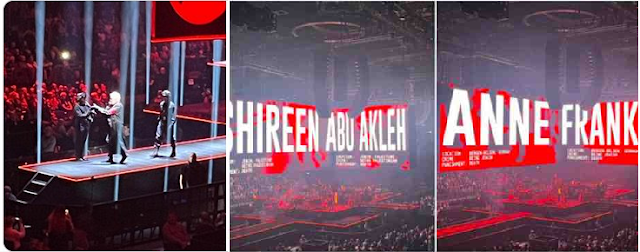
Roger donned an imitation fascist garb to draw a comparison between the suppression of anti-Zionism in Germany today and its suppression by Nazi Germany. This may be painful for those who pretend that they are now opposed to anti-Semitism but it is nonetheless true. The Times of Israel reported that Waters had ‘sparked outrage”

by projecting Anne Frank’s name at recent concerts to draw comparisons between Israel and Nazi Germany. Such comparisons are considered antisemitic under the widely-used IHRA definition of antisemitism.

If comparing Israel to Nazi Germany is anti-Semitic according to the IHRA then that only demonstrates how flawed the definition is!

Anne Frank, although only a teenager, never expressed Zionist sentiments and she considered Zionists freaks and oddities, as did most of Europe’s Jews. Anne wrote in her Diary (11.4.44) that

‘My first wish after the war is that I may become Dutch! I love the Dutch, I love this country…’

Palestine was not on her horizons. Zionism has colonised her name. Waters enraged the Zionists even further by linking Anne Frank’s name to that of Shireen abu Akleh, who was assassinated by Israel.

Vashti’s Cowardly Cultural Politics

The bravery of Roger Waters and his demonstration of how political culture can challenge bourgeois ideology is in contrast to the insipid and anaemic cultural politics of Vashti, who prefer to venerate a rusted Nazi gate than challenge the way that the holocaust has been used to underpin and legitimise the Palestinian genocide.

Vashti doesn’t dare make such comparisons because of the ‘offence’ it might cause to the Zionist leadership in Britain.

The Board of Deputies complained that it was “very concerning” that Waters will be performing in the UK, calling his concerts “political rallies.” Perish the thought. A concert that is political! Clearly Board members didn’t attend the Free Mandela concerts a generation ago.

Joe Biden’s ‘anti-Semitism’ Ambassador Deborah Lipstadt, a junk holocaust historian, was quick out of the stalls in condemning Roger Water’s as was her European counterpart Katharina von Schnurbein.

Death to the Arabs Demonstration in Jerusalem

We should take our hats off to Roger Waters. The comparisons between Israel and Nazi Germany are many and varied, from according different rights to different ethnicities to marches chanting ‘death to the Arabs.’ If the Zionists don’t like the comparison it’s because it’s true.

Tony Greenstein

Open Letter to Vashti

Dear Eli Machover/Vashti,

It was with a growing incredulity that I read your interview with performance artist, Rachel Mars. The focus was on ‘Holocaust memorialisation and the ways our inherited trauma shapes the art we create’.

What stands out most is the inability of Rachel or the interviewer, Emma Jude Harris, to place holocaust memorialisation in a political context. Simple questions such as why the focus and emphasis is on the Jewish holocaust and why the holocaust in the Belgian Congo and the Slave Trade attract so little attention were not even asked.

Not once does Rachel or Emma ask how and why the ruling elites in our society have co-opted the holocaust to imperialism, still less how Zionism has constructed an apartheid society using the holocaust as its justification. Such simple questions yet Emma did not feel the need to ask them and Rachel felt no need to mention them.

Questions such as why the German political establishment has taken on a particular interpretation of the holocaust as a justification for their integration into the NATO alliance and how their support for Israel and Zionism has cemented that integration.

To seek answers to such questions one would have to consult books such as Edith Zertal’s Israel’s Holocaust and the Politics of Nationhood, or Yitzhak Laor’s The Myth of Liberal Zionism or my own newly released Zionism During the Holocaust – The Weaponisation of Memory in the Service of Nation and State.

Projected holocaust memorial in Victoria Gardens

Questions such as why a rabidly racist government in Britain, that demonises asylum seekers crossing the Channel as an ‘invasion’ is so keen on holocaust memorialisation that only three days ago it introduced a Holocaust Memorial Bill which will enable the erection of a holocaust memorial in Victoria Gardens next to Parliament despite strong local opposition.

Rachel mentions the abundance of holocaust memorials in Germany yet fails to mention the virtual outlawing of any manifestation of solidarity with the Palestinians in Berlin or other parts of Germany.

My young Israeli friend, Stav, is facing two weeks in a Berlin prison for taking part in Palestine solidarity action. She refuses to pay on principle the fine that was imposed by the German state for daring to express solidarity with the Palestinians and she also faces being gaoled in Britain for taking part in actions against Elbit. None of this was allowed to intrude on your arty-farty interview.

This is the real Jewish trauma that Rachel Mars ‘forgot’ to mention as opposed to the synthetic trauma that Israel and its diaspora Jewish offshoots have helped inflict on Jews as a way of generating support for the ‘Jewish’ state. Emma mentions ‘intergenerational trauma’ among Jews but Zionism has deliberately out to recreate and invent trauma as a means of solidifying support for its racist enterprise.

As I noted in Zionism During the Holocaust if the behaviour and attitude of non-Jews in Europe towards Jews had replicated that of Israeli Jews towards the Palestinians, then not 6 but 7 or even 8 million Jews would have died in the Holocaust.

This is the irony that escapes not only Emma and Rachel but Vashti too. The most pro-Zionist party today in Germany is Alternative for Germany which in the debate 3 years ago in the Bundestag wanted to make BDS illegal, is riddled with neo-Nazis and holocaust deniers.  

It was less than a month ago that two parliamentary representatives of AfD followed, in what has become a long tradition of neo-Nazis and the far-Right paying homage to the holocaust, when they paid a visit to Israel’s propaganda museum, Yad Vashem.

There is no mention of how, in attacking Jewish anti-Zionists, the German state today is repeating the actions of the Nazi state before 1939 against Jews who were not Zionists.

On 28 January 1935 Reinhard Heydrich issued a directive stating:

‘the activity of the Zionist-oriented youth organisations that are engaged in the occupational restructuring of the Jews … lies in the interest of the National Socialist state’s leadership…. (they are) not to be treated with that strictness that it is necessary to apply to the members of the so-called German-Jewish organisations (assimilationists).

In May 1935 Schwarze Korps, paper of the SS, wrote that:

the Zionists adhere to a strict racial position and by emigrating to Palestine they are helping to build their own Jewish state.... The assimilation-minded Jews deny their race and insist on their loyalty to Germany or claim to be Christians because they have been baptised in order to subvert National Socialist principles

None of this appears in your interview, even as background.  No mention of how it is the Palestinians who are now the real victims of the European Holocaust and how the 'intergenerational trauma' of Jews is relieved by supporting neo-Nazis in the Israeli government, as they cry 'death to the Arabs'.’ The interview with Mars referred to there being no state sponsored memorials to the victims of slavery or lynching in the USA, in comparison with a holocaust which didn't occur in America. Mars says:

There's a new-ish memorial to lynching [in Alabama]. And that was not state money. It was an individual pursuit, and it is incredible in terms of design and impact.

Mars and her interlocutor don’t ask why it is that a memorial to lynching is not sponsored by the state where it took place or indeed by the Federal Government. It’s simply taken as an act of god.

Not once do they ask why were hundreds of millions dollars spent on the US Holocaust Museum in Washington yet the American state does not see fit to memorialise the Holocaust of Native Indians and Africans that took place on its shores?

Nor did this interview venture to ask why it is that holocaust memorialisation conveniently omits Britain and America’s record in turning away Jewish refugees from the Nazi holocaust. There are some lessons from the holocaust that are best forgotten.

Mars witters on about the ‘sonic experience’ of the Jewish Museum in Berlin and how ‘impactful’ it is yet she fails to mention how the Israeli and German state took out the previous Director of the Museum, Peter Schaffer, in June 2019.

Schaffer’s ‘crime’ was having retweeted a report referring to a letter signed by 240 Israeli and Jewish scholars rejecting the parliamentary motion condemning BDS as anti-Semitic. The museum used the hashtag #mustread in its retweet and added a quote from the letter: “Parliament’s decision doesn’t assist the fight against anti-Semitism.”

The Jewish Museum in Berlin had, for a long time, been in the firing line of the Israeli and German states for its independent political stand on anti-Semitism. It had come under attack in 2013 for having invited British Jewish scholar Brian Klug to give its annual Kristallnacht lecture and before that Judith Butler.

The saccharine cultural politics that Vashti offers has not questioned how Israel and the Zionist movement, aided and abetted by the British and European states, has colonised diaspora Jewish institutions. Why is it that everything that Vashti touches has to be so superficial?

When I offered to write an article about the weaponisation of the memory of the Holocaust, the theme of my recent book, you didn't even acknowledge it. You must have taken fright at the very thought of debating the uses to which the Holocaust has been put.

As for 'intergenerational trauma' - I think there are other words for it like exploitation of past injustice in order to perpetrate present injustices.  But do tell me. Is this a psychological or a political ailment? Or just schmaltz dressed up as a pathology?

On a brighter note this will make for an excellent blog on how the Zionist narrative of the holocaust persists, even amongst those who claim not to be Zionist. Instead of creating a political culture which asks searching questions what you are doing is engaging in a cultural politics which simply reflects rather than questions existing culture and assumptions surrounding holocaust and how memory is manipulated to serve nation and state today.

I do not expect a reply to this letter since I doubt that you are capable of one. With that in mind I am blind copying it pending a blog.

Tony Greenstein

24 December 2018

The Holocaust in the Service of Zionism - the Apostles of Fascism Intrude upon the Ghosts of Auschwitz

Yad Vashem, Israel’s Holocaust Museum, betrays the memory of those who died in Auschwitz & Treblinka

In April 1976 Israel's Labor Government under Yithzak Rabin, invited John Vorster, Prime Minister of South Africa to pay a state visit to Israel. 

‘South Africa became Israel's sole substantive supporter on the continent and one of the few governments anywhere not calling for her withdrawal from occupied Arab territory.’
John Vorster with Israeli Labour Govt. Ministers Yitzhak Rabin (right) and Moshe Dayan (with eyepatch) and Menachem Begin future Likud PM (left)
South Africa and Israel already had a strong commercial and military (including nuclear) relationship. Israel and South Africa were ideological and political twins. As the architect of Apartheid, Prime Minister Dr Hendrik Verwoerd observed in 1961
‘The Jews took Israel from the Arabs after the Arabs had lived there for a thousand years. Israel, like South Africa, is an apartheid state.’
By 1976, at a time when most Western states were reducing their military relationship with South Africa, Israel was strengthening theirs. In 1977 the voluntary UN arms embargo on South Africa was made compulsory. This merely proved an incentive for Israel to intensify its military relationship with South Africa and break the arms embargo. This was done under an Israeli Labor Government. Brothers in arms - Israel's secret pact with Pretoria
During the war Vorster had been a General in the para-military wing of the  Ossewabrandwag, which conducted sabotage operations against the British war effort. In 1942 Vorster was interned for his pro-Nazi sympathies. None of this prevented Vorster from paying the obligatory visit to Yad Vashem, [YV] Israel’s Holocaust memorial museum and laying a wreath in memory of the victims of those whom he had supported.
The late Professor Israel Shahak of the Hebrew University in Jerusalem, who was a child survivor of the Warsaw Ghetto and Belsen-Bergen concentration camp, wrote:
‘Of the Yad Vashem… theatre, I do not wish to speak, at all. It, and its vile exploiting, such as honouring South Africa collaborators with the Nazis are truly beneath contempt. [Kol Hair, 19 May 1998, Jerusalem].
YV is situated adjacent to the site of Deir Yassin, a village where in April 1948 the Zionist terror groups Irgun and Lehi carried out a horrific massacre killing up to 254 men, women and children. In 2009 YV fired a guide, Itamar Shapira, who had dared to mention to visitors the proximity of YV to Deir Yassin.
Any independent or reputable academic institute or museum connected with the Holocaust, both of which YV purports to be, would have welcomed someone who drew parallels between what happened to the Jews under the Nazis and other victims of racism and fascism. If YV retained an ounce of independence or autonomy it would have refused to welcome those who still cling to the ideas neo-Nazism and racial supremacy.
However YV cannot do that because it was set up as a specifically Zionist institute. It depends for 40% of its income from a government which officially believes in the segregation of Arabs and Jews and which has, within the past month, increased the number of Jewish communities entitled to reject Arabs as members. It is verboten therefore to draw any parallels between the treatment of Jews under anti-Semitic regimes and that of non-Jews, especially the Palestinians, under Israel’s racist regime.
YV’s absurd position is that ‘the Holocaust cannot be politicized or equated with any other event.’ as if the Holocaust wasn’t itself a product of the political situation in Europe in the last century. If the Holocaust is unique then there are no universal lessons that can be drawn from it other than that Jews will always be the victims of anti-Semitism whilst they live among non-Jews. Thwe uniqueness of the Holocaust is very convenient because it means that growing Israeli fascism and Zionist racism is immune from any historical study or comparison. It is a 'get out of gaol free' card for Israel's treatment of the Palestinians. Itamar Shapira said of YV that
"It is being hypocritical. I only tried to expose the visitors to the facts, not to political conclusions. If Yad Vashem chooses to ignore the facts, for example the massacre at Dir Yassin, or the Nakba ["The Catastrophe," the Palestinians' term for what happened to them after 1948], it means that it's afraid of something and that its historic approach is flawed."
YV was established by the Martyrs' and Heroes Remembrance (Yad Vashem) Law 5713-1953.  In Israel the Holocaust is highly politicized. It is not a neutral academic subject but a propaganda weapon in the hands of the State. It is the justification for Israel’s very existence and also for every Israeli war crime. According to the myth of Israel’s victimhood, every crisis it faces is an existentialist one, comparable to the Holocaust. Israel’s enemies are always compared to Hitler and the Nazis. Israel’s conflicts with the Palestinians are not those of a settler colonial state stealing the land of the natives but a rerun of the Nazi destruction of the Jews. As Israeli Professor Edit Zertal observed [Israel’s Holocaust and the Politics of Nationhood, p.100, CUP, 2011]:
‘The transference of the Holocaust situation on to the Middle East reality… not only created a false sense of the imminent danger of mass destruction. It also immensely distorted the image of the Holocaust, dwarfed the magnitude of the atrocities committed by the Nazis, trivializing the unique agony of the victims and the survivors, and utterly demonizing the Arabs and their leaders.’
Zertal wrote that there hasn’t been a war involving Israel ‘that has not been perceived, defined, and conceptualized in terms of the Holocaust.’ Israel has mobilised the Holocaust ‘in the service of Israeli politics.’ [pp. 4, 91]
Yet this is not about the Holocaust but about the Zionist exploitation of the Holocaust. That is why Israel’s concern for the sanctity and uniqueness of the Holocaust contrasts with its shameful treatment of the Holocaust survivors who live in Israel. When Holocaust survivors began arriving in Palestine after 1945 they were treated with contempt and called 'sapon' (soap) after the myth that the bodies of those the Nazis murdered had been turned into soap. [Tom Segev, The Seventh Million, p.183]. Hanzi Brand wrote of how, when she settled on Kibbutz Gvata Haim, the other members ‘talked about their war to avoid hearing about hers. They were ashamed of the Holocaust.’  [Segev p. 471]
Today, when the word 'anti-Semitism' is on the lips of every Zionist propagandist, it is forgotten that when anti-Semitism was a dominant form of racism, Zionism was not interested in opposing it. That is what distinguished Zionism from every other Jewish political movement. Zionism began from the perspective that anti-Semitism was impossible to fight. Antisemitism was held to be ingrained in non-Jews. In the words of Zionism's founder, Theodor Herzl, it was 'futile' to oppose anti-Semitism.
Although the Holocaust is mercilessly exploited by Zionist propaganda today, when the Holocaust was happening the Zionist leaders were indifferent to what was happening. Indeed they denied there was a Holocaust. As Israeli historian, Yigal Elam wrote:
When the demonstrations and protest actions against the Nazi regime of terror reached their climax, the voice of Zionism was not to be heard. [Introduction to Zionist History, Tel Aviv, 1972, pp. 113, 122]
Tom Segev, a journalist and one of the new Israeli historians wrote in The Seventh Million that the Zionist leadership of the Jewish Agency and Mapai, the Israeli Labour Party

'instead of thinking of the Holocaust in terms that would require effective and immediate action, exiled it from real time into history. Thus the first press report of the murder of Jews in mobile gas chambers was worded as though it were a story that happened long ago:... With the Holocaust still raging, the leaders of the yishuv and opinion makers indicted themselves for apathy and for their failure to rescue the Jews.' (p.103)
Despite his role as an apologist for all manner of Zionist atrocities, Ellie Wiesel, who survived Auschwitz and the Hungarian Holocaust, praised Segev's book in a review in the Los Angeles Times (The Land that Broke its Promise, LA Times 23rd May 1993)
In October 2016 there was one of these artificial Zionist furors when a Rabbi stated, at a meeting chaired by Baroness Jenny Tonge, that the Holocaust was a punishment from God. This was the purest hypocrisy. [Party suspends UK baroness after meeting where Jews were blamed for Holocaust] On 27th November 1942 the Histadrut paper Davar published an article 'describing the extermination of the Jews as "punishment from heaven" for not having come to Palestine.' (Segev p.98). Which is almost a mirror image of the sermon by Pastor John Hagee of Christians United for Israel that Hitler was an agent of God sent to drive the Jews to Palestine.
Untold millions of shekels which Germany paid in reparations to Israel and the Zionist movement for the benefit of the Holocaust survivors has been stolen by the Israeli state and Zionist organisations such as the Jewish Claims Conference, which has been the centre of repeated scandals. See Fraud at the Jewish Claims Conference Spiegel online, 15.11.10. and Holocaust Claims Conference Fraud Likely ‘Much Higher’ Than $57 Million Yardena Schwartz describes in The Tablet how a report by Israel’s Welfare Minister Haim Katz in April 2016 revealed that 20,000 Holocaust survivors had been defrauded by the State of more than $30 million, yet it was:
a testament to how invisible survivors are in Israeli society, and how apathetic the public is to their plight, Katz’s report made absolutely no waves in the Israeli media. It should be news that Holocaust survivors are being left to die in poverty, all while their legacy is used as a justification for the existence of the nation that has so badly neglected them.
Since the end of WWII, Germany has paid more than $78.4 billion in reparations and compensation for survivors of Nazi persecution. 40% of those funds, or about $31 billion, were allocated to Holocaust victims in Israel. Yet rather than going solely to individual Holocaust survivors, these funds have been primarily funneled through the Israeli government and the Jewish Claims Conference, an agency founded in 1951. According to the Holocaust Survivors Rights Authority, the Israeli governmental agency entrusted with the issue of Holocaust survivors, there are about 200,000 Holocaust survivors living in Israel, nearly a third of whom live below the poverty line.
This should be no surprise. The Holocaust is not about what happened to the Jews of Europe and the destruction of the Jewish communities of Europe, the actual victims, but about the creation of a myth of the Holocaust and Jewish peoplehood. The Holocaust has been used ideologically by Israeli and the West to justify racism against the outsider - Muslims and others.
Italy's Matteo Salvini and his ideological 
How else can one explain the fact that the Roma, who were also victims of the Holocaust, in proportions similar to those of the Jews, are never mentioned? Matteo Salvini, the Deputy Prime Minister of Italy and member of the far-Right Northern Leagues, promised to expel thousands of non-Italian Roma from Italy. This is the same Matteo Salvini whom Netanyahu described as “a great friend of Israel.” at their meeting this week. [Times of Israel, 12.12.18.]
The Zionist attitude to the Holocaust was summed up by Gerhard Riegner, World Jewish Congress representative who was based in Switzerland during the War. It was Riegner's telegram, which was sent to London and Washington in August 1942, which confirmed that the the deliberate extermination of European Jewry had begun in earnest. The telegram was sat on by Rabbi Stephen Wise, leader of American Zionism, at the request of the State Department until November 1942. In that 3 months probably 1 million Jews were murdered. Riegner was of the opinion that '
Auschwitz was not only a national memory belonging to the Jewish people that should not be taken by anyone else; it was also an important political asset. Among other things it served the diplomatic efforts of both the World Jewish Congress and Israel.' [Interview with Riegner, Segev, p 474]
Below is an article by Daniel Blatman, Professor in Holocaust Studies at the Hebrew University, Jerusalem. Blatman has repeatedly warned that Israel is heading down the same road that Germany and other European states took in the 1930’s. He wrote of Bezalel Smotrich, a Knesset member for Habayit HaYehudi (Jewish Home), that:
Smotrich’s admiration for the biblical genocidaire Joshua bin Nun leads him to adopt values that resemble those of the German SS.
Blatman has himself transgressed, a number of times the stipulations in the intellectually bankrupt IHRA definition of anti-Semitism by comparing Israeli politics to those of Nazi Germany, for example The Rights and Wrongs of Comparing Israel to Nazi Germany
Blatman has been appointed as the Chief Historian to the proposed Holocaust museum in Warsaw. The Israeli Holocaust Establishment centred around YV are up in arms. Professor Hava Dreifuss has raised the question of political interference from the Polish government. Blatman retorted that people in glass houses  should not throw stones.  Blatman describes YV, for whom Dreifuss works as a 
hard-working laundromat, striving to bleach out the sins of every anti-Semitic, fascist, racist or simply murderously thuggish leader or politician like Hungary’s Viktor Orban, the Philippines’ Rodrigo Duterte and Italy’s Matteo Salvini.
YV has committed all the sins that Dreifuss attributes to the putative Warsaw Ghetto museum. It has hosted a whole swathe of far-Right leaders, some of whom like Viktor Orban have dabbled in pro-Nazi politics. Orban, who paid a state visit to Israel in July also visited YV. He was greeted by a demonstration which included survivors of the Holocaust. Orban has gone on record as describing Admiral Horthy, the war-time pro-Nazi ruler of Hungary, who oversaw the deportation of 437,000 Jews to Auschwitz, as an ‘exceptional statesman.'
There is a political irony here because when Poland's far-Right Law and Justice Party passed a Holocaust law at the end of January making it a criminal offence to say that Poles took part in the Holocaust, Netanyahu rushed to reach an agreement with the Polish Government. In exchange for dropping the penalty of imprisonment, the Israeli state accepted the law despite vigorous condemnation even by Yehuda Bauer, the Dean of Israel's holocaust historians. Bauer, who is an appalling apologist for the role of Zionism during the Holocaust called the Israeli State's agreement with the far-Right holocaust revisionists of the Polish Government a 'betrayal':
Bauer said that by signing the declaration, Israel had betrayed Polish historians who had been persecuted by the Polish government because they “tell the truth.” He was referring to scholars such as Prof. Jan Tomasz Gross and Jan Grabowsky, who have researched Polish involvement in the murder of Jews during the Holocaust.
Yet who was it who signed up to Netanyahu’s agreement? Dina Porat, YV's Chief historian. This agreement was savaged by YV's other historians thus demonstrating the disarray in YV today at Netanyahu's courting of Europe's far-Right.
Daniel Blatman
Blatman cites an article in the New York Times by Matti Friedman describing the atmosphere among workers at YV. [What Happens When a Holocaust Memorial Plays Host to Autocrats] They are afraid that the Israeli government, in the form of far-Right Education Minister Naftali Bennett, is about to impose a new Director at YV in the place of the current 80 year old Avner Shalev .
Friedman described a mood of frustration, fear and demoralization among the employees because the current nationalist government has turned YV into a political tool reminiscent of history museums in totalitarian countries.
In what is a devastating critique of how YV has acted as a propaganda organisation, fine tuning the Holocaust to Israel’s current political needs, Blatman writes that:
Yad Vashem is now paying the price of the many years in which it nurtured a one-dimensional, simplistic message that there’s only one way to explain the Holocaust. Today, the institution is apparently willing to place its reputation for Holocaust research, which it has built over many years, at the service of a government that has recruited it to accuse anyone who criticizes Israel of anti-Semitism. So it’s no wonder that its researchers have become partisan explainers of the Holocaust.
YV historians, from Yehuda Bauer down were always politically partisan putting forward a view of the Holocaust that chimed with Zionism’s political needs. For example they defended the Judenrat (Jewish Councils) in the Nazi ghettos, two-thirds of whom were Zionists and criticised Raul Hilberg, the most eminent of all Holocaust historians, for his assertion that the Judenrate were an essential cog in the Nazi destruction process.
Likewise YV has all but written out of its historical accounts the anti-Zionist and non-Zionist contributions to resistance to Nazism, for example that of the Bund, who led the Warsaw ghetto resistance. For years YV, under Yehuda Bauer, even erased the very names of the two Jewish escapees from Auschwitz in April 1944, Rudolph Vrba and Alfred Wexler. [See Ruth Linn, Escaping Auschwitz - A Culture of Forgetting, 2004] The reason was that the leader of Hungarian Zionism, Rudolf Kasztner, who was the subject of a 4 year trial in Israel (1954-58) for collaboration, had suppressed the Auschwitz Protocols that Vrba and Wexler wrote which told of the preparations the Nazis were making to exterminate Europe's last major Jewish community. Vrba and Wexler were not Zionists. See Hungary, Auschwitz and Rewriting the Holocaust
Not once have YV's historians, from Bauer to Porat to Dreifuss  protested about visitors like Viktor Orban or Austrian Chancellor Kurz, who is in a coalition government with the neo-Nazi Freedom Party. Or indeed Philippines dictator Rodrigo Duterte who has openly compared himself to Hitler. A Hitler Admirer at Yad Vashem
YV is, in essence, complaining that Israel’s monopoly on the Holocaust is being broken. The Holocaust has become part of the new Western political identity.
First a Holocaust Museum was initiated by Jimmy Carter in Washington DC. Israel could hardly object because the USA is Israel’s main benefactor. But now Hungary’s Orban and Poland’s Law & Justice Government are establishing their own Holocaust museums. Even worse they are not prepared to allow Israel to define their message as they too wish to harness the Holocaust to their own nationalist narrative. The Holocaust does not simply belong to Zionism and Israel but to all sorts of reactionary regimes, all of whom Israel has close relationships with.
It remains to be seen how a Holocaust revisionist like Viktor Orban handles the Holocaust with his new Museum, the House of Fates. The dilemma is such that the Museum has had its brand new building lying empty for three years whilst this dilemma is resolved.
What is clear is that Poland is not willing to be dictated to by Israel. Although the Polish government professes otherwise, the Holocaust is clearly being summoned in aid of a Polish nationalist narrative, albeit one in which the Poles also suffered grievously under the Nazis (up to 3 million Poles were murdered). Poland's government has hired a dissident Israeli historian, Daniel Blatman, to be the chief historian of the Museum of the History of Polish Jews.  This has produced a furious reaction by YV's historians and their Polish apologists. Why Is This Israeli Jewish Scholar a Willing Poster Boy for Poland's Brutal Distortion of the Holocaust?
The problem that faces the Museum is that Poland before WW2 was a byword for anti-Semitism. In the universities there were ghetto benches for Jewish students. Pogroms led by the Endeks (National  Democratic Party) and the National Radical Camp were a regular occurrence. E.g. Poland Does Nothing to Check Anti-semitic Drive of the Endeks, Jewish Telegraph Agency, JTA 7.8.1934.
It was in this situation that Zionism, which had a mass base in the 1920's declined as the Bund, an anti-Zionist Jewish party came to the fore. It was the Bund who led the Warsaw Ghetto Resistance despite the best efforts of Israel and YV to erase the Bund from history. In the last free elections in Poland in 1938, the Bund won 17 out of the 20 Jewish council seats in Warsaw compared to just one for the Zionists.
The last Commander of the Jewish Resistance in the Warsaw Ghetto, Marek Edelman died a non-person in Israel. He received a 15 gun state funeral in Poland but not one Israeli government representative, not even the lowliest clerk at the Israeli Embassy attended. Zionism Boycotts the Funeral of Marek Edelman This year was the 75th anniversary of the Warsaw Ghetto Resistance. You would be forgiven for having missed Israel's commemoration of the event, but then the last desperate fight of the Jewish diaspora against the Nazi beast doesn't accord with the Zionist view that the Diaspora is doomed anyway. The 75th Anniversary of the Warsaw Ghetto Uprising Passed Unnoticed – It is not on the Zionist Calendar
Poland, unlike Hungary, was not an ally of Nazi Germany. It was either occupied or annexed outright. There was no Polish Quisling. Up to 3 million Polish citizens died under the Nazis. The Catholic Church in particular saw hundreds of its priests murdered. Although the Polish middle classes were horrifically anti-Semitic the working class and its party, the socialist PPS allied with the Jewish Bund.
Whereas Hungary was an ally of Nazi Germany Poland was a victim. Israel's foremost poet Yitzhak Laor put his finger on the problem when he asked
Why now. Why the contemporary concern with the Jewish genocide… compared to its treatment in the period immediately after the Second World War?’ [Yitzhak Laor, The Myths of Liberal Zionism, Verso, London, 2009, p. 19].
His answer was that this was about ‘consolidating a new ideology of exclusion. Now it is the Jews who are the insiders… the genocide and the Jews served in the construction of a European identity…’ [Laor, pp. 19,24, 35-6] Today it is the Muslims, the Arabs and the Roma who are the outsiders in Europe.
The Holocaust has become an integral part of the ideology of the identity of exclusion in Europe. It no longer simply belongs to the Zionists. The Holocaust has been stripped of its universal lessons, first by the Zionists and now by the Polish and Hungarian rulers. Ideas such as that refugees should be welcomed and not turned away, have been turned on its head by an ethnically exclusive Israeli state with the silence if not support of YV. It is no wonder that this has been absorbed by the anti-Semitic regimes of Europe. Daniel Blatman, who is a sincere anti-racist will have his work cut out if he is to retain his independence.
Yad Vashem is now paying the price of the many years in which it nurtured a one-dimensional, simplistic message that there’s only one way to explain the Holocaust
Dec 18, 2018 11:44 AM
File photo: Hungarian Prime Minister Viktor Orban, center, and his wife Aniko Levai visit the Hall of Names at the Yad Vashem Holocaust Memorial in Jerusalem, July 19, 2018. AP Photo/Oded Balilty

The Warsaw Ghetto Museum, which the Polish government decided to establish eight months ago, is now at the center of a debate.
This debate has political elements, but it’s mainly a clash between two views of what should be stressed when researching and remembering the Holocaust, and above all of what educational messages should be sent – what Israelis like to call “the lessons of the Holocaust.”
Haaretz’s Ofer Aderet, in his article about the Warsaw museum, mainly discussed the political perspective, giving considerable space to the criticisms by Prof. Hava Dreifuss, a YV historian. Dreifuss assailed the Warsaw museum and those who decided, despite all the problems, to take on a project whose importance is hard to overstate. This criticism deserves a response.
First, the political context. There’s no more appropriate response to Dreifuss’ criticism than the old saying that people who live in glass houses shouldn’t throw stones.
Dreifuss works for an institution that in recent years has functioned as a hard-working laundromat, striving to bleach out the sins of every anti-Semitic, fascist, racist or simply murderously thuggish leader or politician like Hungary’s Viktor Orban, the Philippines’ Rodrigo Duterte and Italy’s Matteo Salvini.
My heart breaks when I see my colleagues, honest and faithful researchers of the Holocaust, giving tours of this historic museum, apparently under compulsion, to the evildoers the Israeli government sends to YV to receive absolution in the name of Holocaust victims in exchange for adding a pro-Israel vote at international institutions. For some reason, Dreifuss has no criticism about this.
But for the Polish government (every Polish government, both the current one headed by the nationalist Law and Justice party and the previous one headed by a liberal centrist coalition), which is spending tens of millions of zlotys every year to preserve historical Jewish sites, Jewish graveyards and countless memorials, she has scathing criticism.
Fear and demoralization
A week and a half ago, Matti Friedman published an opinion piece in The New York Times about what’s happening at Yad Vashem, and it made for difficult reading. When you read his conclusions, your hair stands on end. He doesn’t quote a single Yad Vashem employee by name, because no one wanted to be identified. After all, they have to earn a living.
Friedman described a mood of frustration, fear and demoralization among the employees because the current extremist, nationalist government has turned Yad Vashem into a political tool reminiscent of history museums in totalitarian countries.
But the most astonishing thing Friedman reported is that the institution’s chairman, Avner Shalev – who turned the museum into an international remembrance empire, and who for years has viciously fought every attempt to present a different conceptual or research approach than that of Yad Vashem – is reluctant to retire, despite having reached the age of 80.
The reason for his reluctance is that many people at the institute fear that when he leaves, his place will be taken by someone nominated by the relevant minister, Education Minister Naftali Bennett, who will turn Yad Vashem into a remembrance institute in the spirit of Bennett’s Habayit Hayehudi party. It would be interesting to know what Dreifuss thinks about that.
Yad Vashem is now paying the price of the many years in which it nurtured a one-dimensional, simplistic message that there’s only one way to explain the Holocaust. Today, the institution is apparently willing to place its reputation for Holocaust research, which it has built over many years, at the service of a government that has recruited it to accuse anyone who criticizes Israel of anti-Semitism. So it’s no wonder that its researchers have become partisan explainers of the Holocaust.
It’s one thing when, at dubious conferences with political leaders whose governments include former neo-Nazis, Prime Minister Benjamin Netanyahu tries to pass resolutions calling criticism of Israel the new anti-Semitism. It’s another when a research and remembrance institute doesn’t stand courageously against all such attempts.
Thus Yad Vashem would do better not to look for evidence that other governments are attempting to distort history and dictate nationalist content – not to mention engaging in Holocaust denial, as Dreifuss charges.
The Polish angle
Does any of the above justify the current Polish government’s position on the Holocaust? Obviously not. The Polish government has a problematic agenda in explaining the past, which we aren’t obligated to accept and in fact should even criticize.
But Poland’s government hasn’t interfered with the work of the museum’s employees, who have now started working, and certainly not with the development of the museum’s narrative. Had Dreifuss and her colleagues gotten involved in this effort, as they were invited to do, they would have been welcomed. Had Yad Vashem offered its help and support instead of giving the project the cold shoulder, nobody would have been happier than we at the museum.
And now we come to the historical issue. To take part in the effort to establish the Warsaw Ghetto Museum, one has to agree that the Holocaust can be presented and explained from perspectives other than an ethnocentric Jewish, Zionist and nationalist one.
One has to accept that the Holocaust can be studied in a way that sees Jewish history during this period as an integral part of Poland’s history under the Nazi occupation. One has to agree that the horrific Jewish tragedy that occurred during World War II can and should be understood in part by simultaneously examining – while noting both the differences and the common elements – what befell Poles, Roma, Soviet prisoners of war and others who were murdered alongside Jews in the vast genocidal expanse that occupied Poland became.
To set up a museum with a humanist, universal and inclusive message about the Holocaust, one has to accept an approach that sees the Warsaw Ghetto – a horrific terror zone that caused the deaths and physical and spiritual collapse of hundreds of thousands of Jews – as one element of a much bigger terror zone in which hundreds of thousands of other people suffered and fought for their existence: the Poles who lived on the other side of the wall.
The obvious differences between the fates of these two peoples don’t absolve the research historian, or a museum depicting the history of this period, from presenting this complex message and demanding that visitors to the museum grapple with its lessons.
Therefore, the new Warsaw Ghetto Museum won’t be Yad Vashem. It will be a Holocaust museum in the heart of the Polish capital that remembers the fate of the 450,000 Jews, Warsaw residents and refugees brought to the ghetto.
After all, the vast majority of them were Jewish citizens of Poland. That’s how they lived, that’s how they suffered, and that’s how they should be remembered after being murdered by the Nazis.

What Happens When a Holocaust Memorial Plays Host to Autocrats

Yad Vashem is both a memorial of a genocide, and a tool of Israeli realpolitik.
By Matti Friedman
New York Times, Dec. 8, 2018

Prime Minister Viktor Orban of Hungary in the Hall of Names at the Yad Vashem Holocaust museum in Jerusalem. An Israeli politician called his visit to the memorial a “disgrace.”CreditGali Tibbon/Agence France-Presse — Getty Images


JERUSALEM — The quiet campus of Yad Vashem, Israel’s official Holocaust memorial and museum, sits atop a wooded hill on the outskirts of Jerusalem, removed from the rush of the city. It can feel like a secluded shrine, a place not quite of this time. But the famous institution now finds itself at the center of a very 21st-century storm, a barometer of a political climate changing in the world outside its walls.
Yad Vashem, and the state that houses it, were founded by Jews forced from their homes by chauvinistic nationalism and survivors of the European genocide that was the logical conclusion of those ideas. The museum and Israel flourished in years when those ideas were assumed to have been conclusively discredited.
Today, however, some of those beliefs are rising once again across Europe and in the United States, and Israel finds itself courted by some of their practitioners: right-wing politicians who might stoke animosity to Jews and other minorities at home but who also admire the state of Israel.
The Israel they see is not a liberal or cosmopolitan enclave created by socialists, but the nation-state of a coherent ethnic group suspicious of super-national fantasies, a tough military power and a bulwark against the Islamic world. And these leaders have sought and found good ties with the right-wing coalition currently in power here.
For a sense of this political shift, one need only look at the guest book at Yad Vashem. The memorial is an important stop on the tour for visiting dignitaries, and in the past half-year they have included the nationalist Hungarian prime minister, Viktor Orban, one of the most prominent faces of the new political wave, which Mr. Orban calls “illiberal democracy.” Another was President Rodrigo Duterte of the Philippines, who once compared himself to Hitler and meant it as a compliment to Hitler and to himself. Brazil’s new populist president, Jair Bolsonaro, has said one of his first foreign trips will be to Israel, which means that Yad Vashem can expect him soon. Matteo Salvini, the nationalist deputy prime minister of Italy, is expected in Jerusalem this month.
Employees at Yad Vashem aren’t allowed to speak to the media without permission, and permission to discuss these sensitive matters hasn’t been forthcoming. One senior researcher cut off our conversation as soon as I explained what interested me. The institution’s chairman was not made available for an interview and a spokeswoman simply emailed: “Yad Vashem is not party to the formulation or implementation of Israeli’s foreign policy.”
But inside the offices and archives at Yad Vashem, the argument is getting louder.
“There is distress here, and even anger,” a staff member told me, “because many of us see a collision between what we believe are the lessons of the Holocaust and what we see as our job, and between the way Yad Vashem is being abused for political purposes.”
Staffers at Yad Vashem, which receives 40 percent of its budget from the government, are asking themselves and each other questions like: What role should they be playing in the realpolitik practiced by their state? At what point does that role damage their other roles in commemorating and teaching the Holocaust? And how should a memorial to the devastation wrought in part by ethnic supremacism, a cult of personality and a disregard for law handle governments flirting with the same ideas?
The tension inside Yad Vashem broke into public view in June, in the part of the memorial known as the Valley of the Communities, where stone walls commemorate towns whose Jews were murdered by the Nazis and their collaborators. The Austrian chancellor, Sebastian Kurz, was passing the names of Austria’s lost communities when his guide mentioned that some of these very places had recently seen anti-Jewish incidents involving members of the Austrian Freedom Party. That party, whose first two leaders were former S.S. officers, is a coalition partner in Mr. Kurz’s own government.
Mr. Kurz’s Yad Vashem guide, Deborah Hartmann, herself Austrian-born, said to the chancellor that some of his allies were people who “need to be informed what the Holocaust was.” After he left the site, the Austrian embassy reportedly made a rare official complaint, saying Ms. Hartmann had strayed inappropriately into politics. The incident was resolved with an apology from the museum administration.
That episode had barely subsided a month later, when a motorcade arrived carrying Mr. Orban. The Hungarian’s visit drew vocal criticism not just from the Israeli left but also from centrist politicians like Yair Lapid, who recalled Mr. Orban’s praise last year for Miklos Horthy, the World War II leader who allied Hungary with Nazi Germany and collaborated in the murder of the country’s Jews. Mr. Lapid, the son of a Hungarian survivor and the grandson of a victim, said the visit was a “disgrace.”
Before Mr. Orban’s arrival, the administration of Yad Vashem saw fit to issue an unusual reminder that it was the Foreign Ministry that decided the itinerary for visiting officials. In other words: the memorial has no say over who comes. The message suggested an awareness of the rebellious mood brewing in parts of the institution. Mr. Orban’s visit to the memorial went off without incident, though upon departure he was delayed by a group of protesters outside the gates.
President Rodrigo Duterte of the Philippines, who once likened himself to Hitler, and his daughter Sara at Yad Vashem in September.CreditAbir Sultan/EPA, via Shutterstock
Nearly seven weeks later, on Sept. 3, came Mr. Duterte, who cultivates a thuggish persona and, like other members of the current crop of populist leaders, employs a style of outrageous rhetoric and verbal attacks on the press. Like Prime Minister Benjamin Netanyahu of Israel, he sees President Trump as a “good friend.” As this shift in global politics continues to play out, the challenge to Yad Vashem will only grow.
“There’s something going on in the world, and it seems very important,” a second staff member told me. “Trump is part of it, and these leaders are part of it.” The directives to steer clear of present-day politics, this staffer said, were not just unrealistic but also dangerous, ignoring the ways Yad Vashem is used by Mr. Netanyahu, in pursuit of his foreign policy, and by canny politicians from the outside who grasp the value of a photo-op here.
Israel’s first Holocaust researchers were people for whom the subject wasn’t academic, such as Dr. Sarah Friedlander of Budapest, who’d just come out of the concentration camp at Bergen-Belsen when she and a few others began Yad Vashem in a three-room apartment in the center of Jerusalem right after the war.
In 1953, when Israel was five years old, Parliament enshrined Yad Vashem’s status and funding in law. After a quarter-century under the stewardship of Avner Shalev, a widely admired former paratroop officer, the sprawling campus now includes numerous memorial sites, an immense archive and a heartbreaking museum designed by the Israeli-Canadian architect Moshe Safdie, which draws about one million visitors every year.
The tension among Yad Vashem’s various roles is as old as the institution itself. “We Jews cannot afford the luxury of mere research work — the awful danger has not passed yet, as we have witnessed in recent years,” the scholar Aryeh Tartakower told the first conference on Holocaust study in Jerusalem in 1947. “It is quite possible — if only I were wrong — that these things could return, and we have to know what to do in order to prepare for the terrible days that are likely to come back.”
For Israelis, Holocaust study has always meant reading the genocide as a warning — and as a compass to direct our actions now.
The problem with lessons from the Holocaust is that many can be drawn and they often clash. An American liberal, for example, might say the lesson is universal humanist values — the kind of values that many of us assumed, mistakenly, were permanently ascendant in the world after the war. The Zionist approach has traditionally been that while those values are desirable, they won’t protect Jews after the Holocaust any more than they did when it was going on, and there must be a state with enough power to protect Jews in a brutal world.
That means alliances with other countries that have common interests, whatever their attitude toward liberal values and even toward Jews. Israel signed a peace agreement with the Egyptian leader Anwar el-Sadat, for example, even though Sadat was an authoritarian who’d once been a supporter of Nazi Germany.
The threat to Israel’s Jews in 2018 doesn’t come from rightists in the West but from the Islamic world, and chiefly from the theocratic regime in Iran, which has “Death to Israel” as one of its slogans and whose soldiers and proxies now sit on three of Israel’s borders. Israelis might prefer liberal allies, but liberal leaders in the West have generally been willing to do business with the Iranians and to join dictatorships in isolating Israel at the United Nations. Israel needs all the allies it can get, and leaders like Mr. Orban and Mr. Trump, who share a suspicion of Israel’s enemies, are logical options.
The political calculus is legitimate and one legitimate interpretation of what the Holocaust teaches. The question is where this leaves Yad Vashem.
The conundrum was best illustrated earlier this year in the imbroglio surrounding a law advanced by Poland’s nationalist government to restrict accusations of Polish complicity in the killing of Jews under Nazi occupation. Those most affected are Polish historians, many of whom are colleagues and friends of the historians at Yad Vashem. The same Polish government, however, has become an important ally of Israel.
After an uproar, the Poles watered down the law, and the Israeli and Polish governments issued a joint statement on Poland’s Holocaust history — a strange document of utilitarian historical revisionism aimed at preserving an important alliance in the present.
Yad Vashem’s chief historian, Dina Porat, said she could “live with” the draft with some reservations. For this, she incurred the fury of the institution’s other historians, who publicly excoriated the Israeli-Polish document for inflating Polish efforts to save Jews, for suggesting a parallel between anti-Semitism and “anti-Polonism” and for other instances of “highly problematic wording that contradicts existing and accepted historical knowledge” — or, in less diplomatic language, lies.
In a similar episode, a new Hungarian Holocaust museum called the “House of Fates” under construction by the Orban government has drawn sharp criticism from Yad Vashem because it appears to play down the role of Hungarians in the genocide. Robert Rozett, one of Yad Vashem’s historians said the project involves “a grave falsification of history.” Dr. Rozett had been given the job of guiding Mr. Orban on his visit earlier in the year.
Then, just this week, Israel’s Channel 10 reported that senior Hungarian and Israeli officials were meeting to come to a “consensus regarding the museum’s narrative,” drawing accusations that the Netanyahu government was again using Holocaust history, and Israel’s perceived role as an arbiter of that history, as currency in the marketplace of international politics.
One of the scholars behind Yad Vashem’s response to such matters is Yehuda Bauer, the dean of Israeli Holocaust scholars. Mr. Bauer escaped Czechoslovakia as a child with his family in 1939, and his sharp intelligence is undimmed at 92.
Yad Vashem, he told me, has long done an admirable job of walking a tenuous political line, remaining faithful to history while navigating the politics of this country. While Mr. Bauer agreed that Yad Vashem is being used both by the Israeli government and by visitors like Mr. Orban and Mr. Duterte, he said the memorial had no choice: The Foreign Ministry sets the guest list, and the memorial’s policy as an educational institution has always been that anyone who wants to come can come. “It’s important to us to show them these things, even if it’s people we wouldn’t invite to dinner,” he told me. When in the 1990s the possibility arose that Yasir Arafat of the Palestine Liberation Organization might visit, he recalled, the memorial was in favor: “We said, if he wants a guide, no problem, we have enough Arabic speakers.” (Mr. Arafat never came.)
While the welcoming of controversial leaders might draw criticism from the public or unhappy staff members, refusing them or confronting them could draw the ire of the Israeli government, which is a far greater concern for a practical reason not necessarily apparent to outsiders. Yad Vashem’s chairman, Mr. Shalev, will be 80 next year. The job is a political appointment. Mr. Shalev, put in place under a Labor government in 1993, is understood to be a man of Israel’s old moderate establishment. His replacement could bring the institution more closely in line with Mr. Netanyahu’s political program. Insiders at Yad Vashem understand that this is both a reason that Mr. Shalev isn’t retiring and a reason for extreme caution in handling these current controversies and those sure to come.
The idea of bringing dignitaries to pay respects at Yad Vashem is related to the tradition in other countries of laying a wreath at the Tomb of the Unknowns — an uncontroversial recognition of a piece of history important to the host country. Yad Vashem might want to be a memorial of that kind, but it can’t be, for the same reason its historians are constantly engaged in wars in the present: because this history still isn’t in the past.
Matti Friedman, a contributing opinion writer, is the author of the memoir “Pumpkinflowers: A Soldier’s Story of a Forgotten War” and the forthcoming “Spies of No Country,” about four Israeli agents in the 1948 war.

Warsaw's Controversial New Holocaust Museum to Present 'Polish Narrative'

Critics say the appointment of an Israeli, Daniel Blatman, as chief historian of the planned Warsaw Ghetto Museum provides a fig leaf for an attempt to distort history
Ofer Aderet Dec 14, 2018 6:29 Prime Minister

In ordinary times, the appointment of an Israeli historian to a top position abroad would be a source of pride in Israeli academia. But in recent weeks, Prof. Daniel Blatman of Hebrew University has had to deflect criticism for becoming the chief historian at the Warsaw Ghetto Museum, which is being built in the Polish capital.
“Some of the critics are my colleagues who once were my friends and maybe no longer are,” Blatman, a member of Hebrew University’s Jewish History and Contemporary Jewry Department, said this week.
The Warsaw Ghetto Museum is due to open in 2023, 80 years after the Warsaw Ghetto Uprising. It will be housed in a building that served as a Jewish children’s hospital and operated inside the ghetto.
Children in the Warsaw Ghetto
“It sounds very strange, but it will be the first Polish museum dealing with the Holocaust, even though Poland has an endless number of Polish commemoration sites,” Blatman notes.
Privately, Blatman’s critics are hurling accusations at him. In Polish, English and Hebrew they talk about his appointment as serving as a fig leaf, or, using another metaphor, they say he has sold his soul. The more moderate critics suffice with the view that he’s simply naive and being used by the Polish government.
In recent years, critics have viewed with concern the right-wing government’s efforts to shape Poland’s national memory, an effort centered around a new narrative that draws parallels between Polish and Jewish suffering in World War II. It also exalts the role of Poles in saving Jews and minimizes their responsibility in the persecution of Jews.
Prof. Daniel Blatman, a history professor at the Hebrew University of Jerusalem, Warsaw Ghetto Museum
Those critics, who were shocked this year by Poland’s new “Holocaust law” – which condemns the claim that the Polish nation was involved in the Nazis’ crimes – are now worried that this government line will also be reflected in Poland’s first Holocaust museum.
Tel Aviv University’s Hava Dreifuss, the history professor who heads Yad Vashem’s Center for Research on the Holocaust in Poland, rebuffed the Polish museum’s efforts to court her last summer.
“They requested my help as an expert on the history of the Warsaw Ghetto,” she says. “I didn’t want my name to serve an enterprise led by officials distorting the Holocaust and attacking historians, and I didn’t want to help a museum being established to further goals that aren’t necessarily related to history.”
Dreifuss, whose Hebrew-language book on life in the ghetto, “Warsaw Ghetto – the End,” was published this year, fears that the new museum will obscure events from the past that the Poles would prefer to forget.
“The Polish government is trying to advance research and commemoration of the Holocaust as long as it involves Jews who were killed by the Germans,” she says. “But during the period of the Holocaust there were also many Jews who were lost as a result of direct or indirect Polish involvement. And an exploration of these matters is something the regime is trying to limit, despite the existence of a great deal of documentation and research.”
Jews at one of the walls of the Warsaw Ghetto during World War II.
‘Mutual love’
Blatman says he has been granted full academic freedom in his new post. “I haven’t encountered the slightest hint of political involvement,” he says. “I wouldn’t have agreed to work as a historian in a place where I’d be required to bend my professional approach to political considerations.”
Polish Culture Minister Piotr Glinski articulated the “spirit of the museum” at the beginning of this year. “I would like this institution to speak of the mutual love between the two nations that spent 800 years here, on Polish land. Of the solidarity, fraternity, historical truth too, in all its aspects,” he told reporters.
Dreifuss doesn’t like this.
“From statements by the current Polish government, one can infer that the new museum has aims beyond the presentation of life in the ghetto and the treatment of the Holocaust of Polish Jewry,” she says.
“The statement about strengthening 800 years of Jewish-Polish fraternity and closeness is fundamentally ahistorical. The ghetto wasn’t in existence for 800 years, there wasn’t any Jewish-Polish fraternity there, and there's a suspicion that the new museum will be subordinated to just such a narrative.”
As she puts it,
“It must be remembered that the current administration in Poland is promoting what is called a ‘historical policy,’ and in that context it’s trying to shape a narrative different from what’s emerging in the current research.”
Her qualms join those of other historians, who note, for example, commemorations of Poles who saved Jews while endangering or sacrificing their own lives. The most important of these is a museum established in 2016 in the southeastern town of Markowa dedicated to the Ulma family – Polish farmers who were killed by the Germans after they hid Jews.
Children in the Warsaw Ghetto

“The museum at Markowa is devoted to an important topic, Righteous Gentiles,” Dreifuss says. “But actually it blurs the issue because it attributes to Polish society as a whole the help that was given by these noble Poles, who acted in a way that was counter to the social norms.”
The establishment of the World War II Museum in Gdansk, which opened in 2017, also stirred controversy. At its height, the director was fired and a new one was appointed “to give greater emphasis to the Polish narrative.”
Blatman isn’t the first Israeli to take part in a Polish commemoration project in the heart of Warsaw. He was preceded by Israel Prize laureate Dani Karavan, who is currently at work on a monument honoring the Polish Righteous Gentiles being built next to the POLIN Museum of the History of Polish Jews. That museum was dedicated in 2013, marking the 70th anniversary of the Warsaw Ghetto Uprising.
There has been criticism of the site chosen for the monument – the neighborhood where the ghetto stood. Critics say the monument to Poles who rescued Jews shouldn’t be in a place where so many Jews were killed.
Warsaw under the Nazis
When asked about the vision for the new museum, Blatman presents a view that some historians find controversial. “The Holocaust of Polish Jewry should be located in the Polish historical space, not in an exclusively Jewish space,” he says.
The building in Warsaw that will house the Warsaw Ghetto Museum.Adrian Grycuk
In other words, Blatman wants to tell the story of the Warsaw Ghetto in the local context, including “the city of Warsaw and the Polish population, which were under the same Nazi occupation and were also subjected to the terror.”
He’s aware of the inflammatory potential of the comparison between the sufferings of the two peoples during World War II. “I’m not saying that their fate was similar or identical, but they lived under the same occupation and not on some other planet,” Blatman says.
“We tend to forget a bit that the Jews in the Warsaw Ghetto continued to see themselves as Polish citizens who belonged to the place where they lived. Very often they were disappointed with Poland or were hurt by the attitude of Polish society toward them, but they still were Polish. Only after the war did we turn them solely into Jews.”
Albert Stankowski, a Polish Jew who previously worked at the POLIN Museum in Warsaw, has been appointed director of the new museum. “As I took the position of the Warsaw Ghetto Museum director, I was granted complete autonomy in the recruitment of the museum team,” he says. “We are open to cooperation with everyone who can assist us in ensuring an objective presentation of the facts.”
When he began his new job, he tried to recruit Polish historians to work at the new museum, but they declined. As Dreifuss puts it:
 “Precisely in light of the Polish researchers’ refusal, it seems to me that the approach to foreign historians isn’t a technical matter. As I see it, this was a way of trying to acquire international approval, and perhaps even more importantly, Jewish and Israeli approval for the museum and its narrative, at the expense of the Polish researchers.”
Prof. Daniel Blatman, left, and Prof. Albert Stankowski at the building that will house the Warsaw Ghetto Museum, 2018. Warsaw Ghetto Museum
Some of Blatman’s articles for Haaretz show that he presents a complex picture of the Polish government. He believes that in recent decades historical research has focused on Polish aggressiveness toward Jews while ignoring the suffering of the Poles.
“The historical picture is not complete if one tells about the killing of Jews by their Polish neighbors without also mentioning, for example, the labor camps that were in operation in those same areas, and in which many Poles found their deaths,” he wrote in 2016. “The new museum,” he says now,
“will try to grapple with issues that have been neglected in various exhibitions, both at Yad Vashem and in other countries. We’re definitely thinking about incorporating a reminder about other victims of the Nazi genocide.”
That said, Blatman’s articles also reveal that he hasn’t gone easy on criticism of the Polish government in recent years; he has often linked it to his harsh criticism of the Israeli government.
As he wrote in April, what he calls National Zionism
“is a branch of European neo-fascism, which contains elements of xenophobia and ultranationalism, subordinating democracy to other values and restricting individual rights and the freedom and independence of the law.”
This week, he disagreed that there was something improper about taking a top position at a museum being established by a Polish government that he has criticized so severely.
“Following that line, I also mustn’t cooperate with Yad Vashem because it’s under the aegis of a minister whose policy I’m very critical of,” he said, referring to Education Minister Naftali Bennett.