Showing posts with label Liverpool. Show all posts

28 October 2020

The Hidden Cruelty of Trump’s Executions

Not only is Trump a Narcissist, a Zionist, a Clown and a Rapist but he is a Sadist too


In this article in The Intercept we learn that one more achievement of the, hopefully, one-term President Trump, is to restart Federal executions. In the United States not only individual states but the Federal Government carries out executions. Except that until now there had not been an execution in 17 years.

The last person was executed in 2003 under George Bush’s administration and before that under Clinton. It was Bill Clinton’s crime bill in 1994 and his 1996 Effective Death Penalty Act which mandated the disregarding of errors in the courts below, such as the exclusion of Black jurors. Clinton himself had won the Presidency on the back of executing 3 men in his native Arkansas. This is the man whom Tony Blair found so congenial.

The death penalty in civil society is an act of barbarism, designed to instil terror in the poor and working class. It is almost unheard of for rich white men to be executed in America. It and the prison system is the only place where Black men are overrepresented. That is why the death penalty is not just a humanitarian issue but a class issue.  Giving the state the power to deliberately kill people is to give power to the ruling class.

A view of the Terre Haute prison in Indiana where Federal executions are carried out

I don’t need to rehearse the arguments about the death penalty, such as the danger of killing someone who is innocent. In the United States, because of poor representation of Black and poor White people, a remarkably large percentage of those convicted of murder are innocent.  This is a testimony to a racist and corrupt police force. There are other arguments, prime amongst which are the fact that the death penalty demeans a civilised society. It reduces society to the level of the murderer. Far from bringing closure to the relatives of the victim, it simply fills them with the desire for vengeance.

Politically the death penalty is racist, a legacy of slavery and lynchings, inhumane in that it involves the slow and deliberate killing of an individual. 

You are 17 times more likely to be executed for killing a White person than a Black person in the United States. In 1987 in McCleskey v. Kemp the Supreme Court voted by 5-to-4 that even solid statistical evidence of race discrimination in the capital justice system did not offend the Constitution. In 1991, after he retired, Justice Lewis F. Powell Jr., the author of the majority opinion, was asked whether there was any vote he would like to change. “Yes,” he told his biographer. “McCleskey v. Kemp.”  As one of the dissenters in the case, Justice John Paul Stevens, wrote after his retirement in 2010.

“That the murder of Black victims is treated as less culpable than the murder of white victims provides a haunting reminder of once-prevalent Southern lynchings,”

he wrote that year in The New York Review of Books. Opponents of the death penalty have been deeply critical of the decision, comparing it to the Dred Scott case, the Supreme Court’s 1857 ruling that enslaved Black people were property and not citizens.

“McCleskey is the Dred Scott decision of our time,” Anthony G. Amsterdam, a law professor at New York University, said in a 2007 speech.

“It is a declaration that African-American life has no value which white men are bound to respect. It is a decision for which our children’s children will reproach our generation and abhor the legal legacy we leave them.”

The argument that the death penalty is a deterrent is an obvious logical fallacy. I figured that one out as a child. I remember the last hangings, of 2 men in Liverpool and Manchester in 1964. In my childish innocence I wondererd why, if the death penalty was such a great deterrent why, did they ever have to use it?

There is only one exception where the use of the death penalty is justified and that is the case of war crimes against civilians.  Those who order or are responsible for genocide, the mass murder of people for no other reason than who they are or are not, are making political decisions that whole categories of people are no longer fit to live. Those tempted to make such decisions should be in no doubt that they will pay the ultimate price. 

They are not suffering from mental illness, temporary madness, blind love or even greed.  Nor are they psychopaths.  They took decisions for political decisions and should be accountable for those decisions. The military in Burma should be accountable for its crimes against the Rohinga. ISIS for its genocide of the Yazidis. 

It is the Bill Clintons, George Bushs and Tony Blairs of this world who deserve the ultimate penalty.  Why?  Because that is how society makes it clear that war crimes are literally beyond the pale. Hence I would defend the decision of the Nuremberg courts to execute the Nazi defendants. But war crimes apart, the use of the death penalty is indefensible.

In other words it is those who are most in favour of the death penalty who are most deserving of it.

It is no accident that at a time when the death penalty in the United States is decreasing and even the Republican state of Nebraska abolished it (only to reverse its decision) that Trump has decided to reintroduce it on the federal level.

It is also no coincidence that those who describe themselves as ‘pro-life’ i.e. anti-abortion in the United States are the most vociferous supporters of the death penalty.  It is the Christian Bible Belt which uses the death penalty most, led by Texas. We can assume that Amy Coney Bennett would have no compunction in supporting the conservative majority on the Supreme Court in favour of the death penalty.  Despite being a rigid Catholic she voted in favour of the execution of Daniel Lewis Lee, the first person executed on a federal level since 2003. Coney is a good example of the hypocrisy of pro-lifers.

Of course we should not be surprised at the actions of Trump. In 1989 he took out full page ads in 4 New York newspapers calling for the execution of 5 Black teenagers who were convicted of raping and killing a young woman. In 2002  DNA tests proved they were innocent and the actual culprit confessed.  Trump has still refused to apologise to those whose death he demanded. It says something about the United States and the American people that he is in contention for the post of President when he is unfit to be a dog catcher.

Below is an excellent article from The Intercept and links to a series of similar articles.

Tony Greenstein

Less than a week after executing Christopher Vialva in front of his mother and aunt, the DOJ announced it will kill Orlando Hall next.


October 17 2020, 12:00 p.m.

 On the morning she buried her son Christopher Vialva, Lisa Brown arrived at Affordable Burial and Cremation Service, a small funeral home in a strip mall in Killeen, Texas. Her older sister was waiting, along with the funeral director, who wore a suit and a mask. The last time Brown had seen her son, he was lying under a blanket on a gurney in Terre Haute, Indiana, where a federal official had declared his time of death. Now he lay in a casket in a blue pinstripe suit, a prayer shawl, and a kippah he crocheted himself.

“I walked over to the casket and put my hand on his chest,” Brown recalled. It was the first time she had touched her son in more than 20 years. Looking down, she saw something she’d noticed inside the execution chamber. “The whole back of his hand was bruised,” she said. The funeral director said it was probably where they had inserted his IV. “And I said, ‘I know it was.’”

Brown moved her hands to Vialva’s hands and face. She touched him all over, so eagerly, the funeral director “probably thought I was mauling my son,” she chuckled. “I was thankful that he said he was an understanding man.” Brown’s sister did the same thing. “She was hugging on him and she was touching his chest. She kissed him on the forehead.”

A portrait of Stacie and Todd Bagley on the tombstone of Stacie Bagley’s grave in Dyersburg, Tenn., on Sept. 18, 2020 - Photo: Liliana Segura/The Intercept

Vialva had been executed one week earlier, on September 24, for the carjacking and murder of two youth ministers from Iowa in 1999. He was 19 years old when he shot Stacie and Todd Bagley on the grounds of Fort Hood, not far from the funeral home. Vialva’s co-defendant, Brandon Bernard, was only 18 at the time. Both were sentenced to death. After the Trump administration restarted federal executions following a 17-year pause, Vialva became the seventh man killed in the Terre Haute death chamber since July.

Even to those paying close attention, the loved ones of the condemned had remained largely invisible in Terre Haute. Although the Bureau of Prisons books travel and accommodations for the families of the victims — and arranges for them to address reporters following the executions — no such help is given to relatives of those facing execution. Until Vialva, none of the condemned had arranged for family to attend.

Brown was disturbed by the lack of communication from prison officials. After confirming that she would be in attendance, they did not speak to her until the day before he was to die. Brown was on an elevator leaving the prison after her last visit with her son when Vialva’s case manager told her that the Crisis Support Team was waiting to brief her. Answering her questions in the lobby, they were courteous, almost overly polite. “They almost seemed nervous. You know, like it was a new thing for them. Which it probably was.”

By the time she woke up on the morning of her son’s death, Brown had done as much as she could to prepare herself. She had even read the filings in a lawsuit over lethal injection, which warned that autopsies from executions carried out using pentobarbital showed clear evidence that the condemned had experienced pulmonary edema: the filling of their lungs with fluid. “For me, knowledge is power,” Brown said. “The more I’m aware of what can go wrong, the more comfortable I am.” Still, it wasn’t easy to read that Vialva might suffer a sensation akin to being waterboarded — “that same panic, suffocating, drowning feeling.”

Ron Kaz of Charleston, S.C., helps organize the Abolitionist Action Committee’s annual protest and hunger strike against the death penalty outside the U.S. Supreme Court on July 1, 2019, in Washington, D.C. Photo: Chip Somodevilla/Getty Images

A Well-Oiled Death Machine

Amid a global pandemic, national protests, and the impending presidential election, news of the federal executions had been largely eclipsed since they began this summer. Vialva had been dismayed by the lack of national media attention as the men around him went to their deaths. After the execution of Lezmond Mitchell on August 26, he wrote to a friend that they had mentioned him on the CNN crawl, but that was it. “A man’s life is taken by the government but not even a segment to talk about it,” he said.

They are a well-oiled death machine now,” he went on. “It was sad watching them walk Mitchell right past me so they could drive him to the death house. Everything was so clinical.”

Vialva’s execution was a painful blow to those who knew and worshipped with him on death row. “I just want everyone to know that Chris was the real deal when it came to his faith and being sorry for all he had done,” one neighbor wrote to his own supporters in late September. As with every round of executions, a wave of anxiety spread across the Special Confinement Unit after Vialva died. “We don’t know when they will pick someone else, but we believe it will be 3-5 more people in the coming months.”

On September 30, the Department of Justice announced the next execution date. Orlando Hall, 49, is scheduled to die on November 19. He would be the second Black man killed in the federal execution chamber this year. In a media release, his lawyers noted that Hall was sentenced to death by an all-white jury, one of myriad ways in which the federal death penalty mirrors the same flaws and inequities of state systems. On October 16, the DOJ announced execution dates for two more people. One is Lisa Montgomery, the only woman on federal death row. The other is Vialva’s co-defendant, Brandon Bernard.

Politicians on both sides have remained almost completely silent about the federal executions. Although it was the Trump administration that was preparing to take his life, Vialva was particularly critical of the Democrats before he died. The party has enshrined opposition to the death penalty as part of its platform, yet ignored the issue during the Democratic National Convention. Presidential candidate Joe Biden, who was instrumental in the expansion of federal death row but now claims to disavow capital punishment, has said nothing about the executions. Neither has vice presidential candidate Kamala Harris, despite touting her opposition to the death penalty.

Two days before Vialva’s execution, as the DOJ prepared to kill William LeCroy on September 22, activists with Death Penalty Action gathered for a press conference in front of the United States Capitol in Washington, D.C. Faith leaders were present from different religious denominations. They spoke out against the executions and called out Attorney General Bill Barr, who was scheduled to be honored the next day during the National Catholic Prayer Breakfast.

The event featured New York Rep. Adriano Espaillat, the sponsor of a bill to abolish the federal death penalty introduced last summer. A parallel bill was brought forward by Rep. Ayanna Pressley, who last year called for an investigation into the federal government’s lethal injection plans.

“We’ve gotta be louder about this,” Espaillat said. He echoed a new report by the Death Penalty Information Center, linking the death penalty to the legacy of slavery and lynching in the United States. Not only are Black people overrepresented on death row today, he said, “defendants convicted of killing white victims are executed at a rate 17 times greater than those convicted of killing Black victims.” Indeed, of the seven men executed in Terre Haute, almost all of their victims were white.

Activist and attorney Ashley Kincaid Eve leads a vigil across from the federal penitentiary in Terre Haute, Ind., moments before the execution of Christopher Vialva on Sept. 24, 2020. Photo: Liliana Segura/The Intercept


Later that day, activists under the banner of the Terre Haute Death Penalty Resistance returned to the grassy field next to the Dollar General on Route 63, directly across from the federal penitentiary. Ashley Kincaid Eve, a lawyer and activist from Indianapolis, was leading the protests that week, although she still harbored hope that Vialva’s execution would not go forward. Eve had developed a close friendship with Vialva after he saw her on the news and wrote to thank her for caring enough to protest the executions. “We are here because people decided that we are trash to be thrown in the dumpster,” he said in his first letter. But over the years, 

I have listened to men sing the praises of their children, mourn the loss of their loved ones, talk about their ambitions while knowing they will not come to fruition, discuss their spiritual journey, and lament the decisions that put them here.”

Eve had previously spearheaded a successful lawsuit against the Indiana State Police, who barred the activists from the area across from the prison during the first round of executions in July. It was one of many ways in which authorities tried to tightly control what the public was able to see. In a nod to the First Amendment, the BOP had designated two spots in the fields along Route 63 for protesters on either side of the issue, but required participants to be transported by government buses hours in advance. No phones or electronic devices would be allowed. In the briefings for press before each execution, BOP spokespersons have repeatedly told reporters that no one has shown up to protest the executions.

While in prison Vialva crocheted a number of stuffed animals and blankets for his mother, Lisa Brown, which she keeps at her home in Killeen, Texas - 16.9.20.

BOP officials have been tight-lipped with journalists. For media witnesses, who have waited long hours on prison grounds to carry out their assignments, there are few explanations or updates. In contrast to death penalty states where prison officials routinely provide detailed descriptions about the last meals of the condemned, the BOP refuses to disclose even such trivial information. But Vialva had told Eve about LeCroy’s last meal. He had asked for KFC but his request had been rejected, she told me. The bones in the chicken presented a security risk, he was told. So, like Vialva, he requested Pizza Hut instead.

Photographs of Lisa Brown, now 61, and her son Christopher Vialva, now 41, when Christopher played football at Ellison High School, photographed at her home in Killeen, Texas, on Sept. 16, 2020. Photo: Matthew Busch for The InterceptAdd caption

Victims on Both Sides

LeCroy’s execution went later than planned. Although it was scheduled for 6 p.m., he was not declared dead until after 9 p.m. LeCroy had been sentenced to death for the brutal killing of a nurse practitioner named Joann Lee Tiesler. Court records showed that LeCroy, who had a history of mental illness, said he had killed her in the mistaken belief that she was a former babysitter who had molested him when he was a child. In a clemency application for LeCroy, according to the Atlanta Journal-Constitution, his attorneys pointed out that LeCroy’s own family had lost his brother, a Georgia state trooper, to murder in 2010. “The pain and sorrow felt by the LeCroy family at potentially losing two of their sons is unimaginable,” they wrote.

Lisa Brown visiting her son Christopher Vialva on federal death row in August 2020. Photo: Courtesy of Lisa Brown

Tiesler was engaged to be married when she was murdered; her fiancé witnessed LeCroy’s execution, as did her father, Tom Tiesler. In a written statement, Tom Tiesler thanked Trump and Barr for restarting federal executions. LeCroy “died a peaceful death in contrast to the stark horror he imposed on my daughter Joann,” he wrote. 

“He was allowed to live nineteen years longer than Joann, with us taxpayers paying for his food, shelter and medical care. I am unaware that he ever showed any remorse for his evil actions, his life of crime, or the horrific burden he caused Joann’s loved ones.”

LeCroy had prepared a lengthy statement of his own, which he mailed to Sister Barbara Battista, a Catholic nun who served as his spiritual adviser, to read at his execution. But it did not arrive on time. Two days later, on the morning of Vialva’s execution, Battista brought the letter to a press conference outside the Dollar General. It began with a quote from the poet W. H. Auden. “‘Those to whom evil is done do evil in return,’” it read. This was not an excuse, he said.

“Yet it describes many of us human beings in our primitive emotional states as children. It is a fact that some abuse — physical, emotional, and/or sexual — can stunt emotional growth. … We feel that we are what happened to us, that we cannot be that which we desire to become. And we lash out in anger. … We did things that we were unable to take back, harmed another human being, ourselves, and so many who loved us.”

Activists stood behind Battista as she read the letter, holding signs and wearing masks. They were joined by Lisa Brown. In a purple mask, a black headscarf, and a gold Star of David pendant, she came forward after Battista was done, to say a few words about her son. “This is really hard,” she said, her voice breaking. “This is the first venue that I’ve had in which I could say to Todd and Stacie’s family, I am so sorry for your loss. I’ve never been able to tell you that because I was told I could not have access to you.”

Lisa Brown addresses reporters on the morning of her son’s execution. Christopher Vialva was executed on Sept. 24, 2020, at the federal penitentiary in Terre Haute, Ind. He was the seventh person executed by the Trump administration. Photo: Liliana Segura/The Intercept

Brown emphasized that her son was remorseful for his crime. But she also shared a story she told me the first time we spoke. Like LeCroy’s family, she had experienced the legal system from both sides of the courtroom. “In 2009, my daughter’s ex-husband attempted to murder her,” she said. 

“He bludgeoned her in the head with a hammer, poured gasoline over her and set her on fire. She survived with second and third degree burns over 80 percent of her body. And she forgave her attacker shortly after it happened. … And she taught me that I had to forgive. And it changed my life from being in a perpetual state of victimhood to a life that I can put that behind me, and see that there is peace in that.”

Later that day, as Brown reported to the parking lot of the Vigo County Sheriff’s Office, Eve returned to the same spot at the Dollar General to set up for the protest against Vialva’s execution. She had said goodbye to Vialva on the phone the night before, hoping to convince him to let her file a last-minute challenge to his execution. But he asked her not to. Everyone on death row had seen what happened to Daniel Lewis Lee, the first man to be executed in Terre Haute this year: Lee was lying on the gurney for four hours before the government took his life, as lawyers fought over his fate. Vialva did not want that to happen to him.

“He’s lost faith in our courts and I don’t blame him,” Eve said. “I’ve lost faith in our justice system. But I haven’t lost faith in humanity.” In the last several weeks, she had heard from people all over the world who were moved by his story.

It was just after 6 p.m. when Eve introduced the final speaker, a woman named Katie, who had traveled to Terre Haute from Minnesota. “I don’t know Chris personally,” Katie said. But she knew Vialva’s younger sister, Audrey. The two had met at a retreat for survivors of domestic violence, where Audrey had shared the story of how her ex-husband tried to kill her. “I am at risk of being a murder victim,” Katie said. Before going to prison for violating a restraining order, her own abuser beat, choked, and sexually assaulted her, she said. He is no longer incarcerated — and he could still kill her one day, she said. But she does not want his life.

Katie pointed to the penitentiary complex behind her. “Do you think that what’s going on behind us right now is going to save my life?” she asked. “Do you think he knows that this is happening and it’s going to deter him from anything he wants to do? It’s not.”

At 6:48 p.m., a BOP spokesperson sent out an email to reporters. “Please report back to the Media Center at this time if you choose to,” he wrote. The execution had been carried out. At the media center, officials handed out a statement from the mother of Todd Bagley. She said she was “hurt and disappointed” by the coverage of the case that morning, which focused on Vialva and how he had changed. Todd and Stacie also touched many lives, she wrote. “We will never know how many people they could have influenced for good if they had been given the chance.” She was heartened by the fact that they were in Heaven, she said. “I know without a doubt we will have a glorious reunion with them one day!”

Lisa Brown with her son Christopher Vialva and his younger sister, Audrey, in 1988. Photo: Courtesy of Lisa Brown

The Ultimate Price

On October 1, a few dozen guests gathered at the Killeen City Cemetery for Vialva’s funeral. His gray casket was covered in white lilies and chrysanthemums. His mother and sister sat in the front row. Eve, who drove down from Indianapolis, sat behind them under the tent.

Vialva’s 11-year-old nephew read a tribute from Vialva’s best friend on death row. Then Vialva’s sister Audrey delivered his eulogy. She shared childhood memories: how they would break the rules and ride their bikes to Walmart; how he would tickle her, play freeze tag with her, and have water balloon fights with her every summer. As he got older, she said, Vialva started spending more time playing video games and listening to music with his friends. But she remembered the time they stayed up all night memorizing the lyrics to the 1994 song “Funkdafied” by Da Brat. “He kept hanging his head off the top bunk asking why it was taking so many playbacks for me to get it,” she said. “His memory was always better than mine.”

Brown read the letter Vialva had written for his funeral. He was no longer the angry 19-year-old he had been, he wrote.

“If you have written me a thousand letters or only just sat and thought about me from time to time, I appreciate it. If you came to visit me once a year or just saw my mother in passing and told her to tell me hello, I appreciate it. … If anyone here feels they could have done more, don’t. You did what you could and that is all that matters. So, thank you for those mercies and for your attendance today.”

The funeral director, Robert Falcon, was moved by the service. It was not the first time he had presided over the burial of a man executed by the state. Often times, he told me, such families “want to arrange something very private, something very, very quiet,” he said.

“I’ve had services where nobody shows up. … There may be a representative from the family, a minister, and the funeral director. And that’s it. And Christopher’s situation was quite unique in that there was about 40 people present. And I’ve never seen that.”

Falcon did not minimize the pain of the victims in cases like Vialva’s. In his decades helping families bury their loved ones, he had seen his share of murder victims. He knew that their families continued to hurt after an execution, he said. But “sometimes we forget that the person has now paid the ultimate price for their crime, and now that family is left to hurt.”

Five days after her son’s funeral, Brown spoke to the mother of Orlando Hall, the next man in line to die in Terre Haute. She learned that he has six children and a number of grandchildren. Hall’s mother is in poor health and was not sure whether she will attend the execution, Brown said. “I told her, I want to be able to help facilitate their peaceful transition through this process,” Brown said. “And she said, ‘Oh thank you, Jesus.’ She says, ‘You just made my day, Miss Lisa.’ That blessed me.”

Brown has not yet spoken to the mother of Brandon Bernard. But she feels called upon to support other families as their loved ones get execution dates. “There are so many more like me,” she said. It is also what her son would have wanted. Over the phone, she read from a card that was waiting in the mail when she returned from Terre Haute. “I know this is hard for you,” he had written. “I would even go so far as to say that it’s harder on you than me. … I just want you to stay strong. I need you to do that for me. If they do take me away, then you can let them know how much it hurts. Maybe one day your love will change things.”


See also

Trump’s Execution Spree Continues at Federal Killing Ground in Indiana - More federal executions have been carried out in 2020 than in the past 57 years combined.

Blood in the Water - Disregarding the Virus and Victims’ Families, Trump Rushes to Execute as Many People as Possible

The Life and Death of Jerry Givens, Virginia’s Executioner-Turned-Abolitionist - After killing 62 people in the death chamber, Givens became an activist against the death penalty. Then Covid-19 took his life.

The Life and Death of Jerry Givens, Virginia’s Executioner-Turned-Abolitionist

Executions Are On Hold, but States Are Still Pushing for Death Amid the Coronavirus Pandemic

The Abolitionists - A Push to Repeal the Death Penalty Gains Ground Across the Western United States

Trump Prepares to Execute Christopher Vialva for a Crime He Committed as a Teenager


1 August 2016

Thousands Queue 4 Corbyn In Liverpool

Owen Smith Struggled to get 200 even with Free Ice-Cream!


I spent most of my childhood in Liverpool.  It was always known as a red, militant city.  The workers – dockers, carworkers, shipyard workers – were the most militant of all.  It was probably the Irish heritage – Liverpool used to be known as the capital of Ireland because of the large number of Irish immigrants.  But Liverpool has always been a city of immigrants.  It has the oldest Chinese community in Britain and a Somali community in Liverpool 8.  At the beginning of the Thatcher reign, some of the fiercest riots were in Liverpool 8 as a result of the notoriously brutal, violent and racist police.
In the 1980’s it was Liverpool City Council under Militant that led the fightback against Tory cuts until it was defeated under Derek Hatton.  Kinnock hypocritically made his famous speech decrying a Labour Council that sent redundancy notices by taxi to its workers, whilst arguing for a ‘dented shield’ policy that would ensure that all Labour Councils conformed without question to central government cuts.  .

After the first world war the government sent the troops into Liverpool against strikers (who included the Police force!) and two workers were killed.  The old traditions haven’t died.  This photograph of a rally for Jeremy Corbyn by the famous St George’s Hall is quite amazing.  I’ve never seen a demonstration that big in the City.  And to think that Owen Smith also had a rally at the weekend.  Even with a free ice cream van he could only muster 200 people at most!

31 January 2015

WINSTON CHURCHILL - An Anti-Communist Who Put Nazi Collaborators in Power in Greece

 The Greatest Briton or a Ruling Class Racist and Imperialist?

BBC Sycophancy and Bias at its best (or worst!)


When I lived in Merthyr Tydfil in 1963, I was only 10 but I was taken aback by the hostility of the people to Winston Churchill.  Merthyr of course was at the centre of the mines of the Rhonda valley. None of this has come out in the BBC's usual sycophantic coverage of ruling class 'heroes'.

On the 50th anniversary of his state funeral, there has been a plethora of mush about the great person to live in the British Isles since Alfred burnt the cakes.  The truth however has been conveniently omitted, another casualty of Churchill’s many wars.  In Ireland he oversaw Partition, in Palestine he gave unstinting support to the Zionists whilst doing nothing for the Jews of Auschwitz and the Extermination Camps.  In Wales and Liverpool he sent troops in to do battle against working-class strikers.  In other words he was a thorough racist and imperialist (as the cutting from the Guardian demonstrates) but he made a few rousing speeches in WWII.
Always a racist - being a Zionist was therefore natural
In 1931 he had resigned from the Conservative Shadow Cabinet because of his disagreement with even the most limited concessions to Indian nationalism and support for the Government of India Act. His primary reason for fighting Hitler was to defend the British Empire and he came into conflict with Field Marshall Wavell over this.  He was quite open about his belief that the 'half naked fakir' Ghandi should be murdered and presided over the death by starvation of at least 2 million Indians in Bengal during WW2.

In Greece Churchill was responsible for putting the collaborators with the Nazi occupation back in power in order to defeat the Communists.  A Channel 4 programme on this was shown about 25 years ago and was then promptly banned and never shown again.  Part of the film can be seen here.


Tony Greenstein

“One may dislike Hitler’s system and yet admire his patriotic achievement.  If our country were defeated I hope we should find a champion as indomitable to restore our courage and lead us back to our place among the nations.”  Winston Church, Step by Step, p.143.
Regarding the Iraqi Kurds, Churchill beat Saddam Hussein to it by nearly 50 years.  As Colonial Secretary he explained:
'I do not understand this squeamishness about the use of gas. We have definitely adopted the position at the Peace Conference of arguing in favour of the retention of gas as a permanent method of warfare. It is sheer affectation to lacerate a man with the poisonous fragment of a bursting shell and to boggle at making his eyes water by means of lachrymatory gas.
I am strongly in favour of using poisoned gas against uncivilised tribes. The moral effect should be so good that the loss of life should be reduced to a minimum. It is not necessary to use only the most deadly gasses: gasses can be used which cause great inconvenience and would spread a lively terror and yet would leave no serious permanent effects on most of those affected.
But Churchill did not believe in discrimination when it came to meting out ruling class ‘justice’.  The socialist newspaper Justice laid the responsibility for the deaths at Churchill’s feet, and said:

“For the fourth time in five years, British people have been murdered in the streets by the forces of law and order on the instruction of a Liberal Government. Belfast, Tonypandy, and now Liverpool and Llanelly… Their hatred of our class is only modified by their contempt, as witness the alacrity with which middle-class hooligans rushed forward to be enrolled as special constables in the hope of an opportunity of breaking the heads of the ‘mob.’”
The Rhonda Riots
In the First World War the Gallipolli disaster cost tens of thousands of lives and achieved nothing.  In the Second World War, apart from a few rousing speeches what was his contribution?  Wasting a year fighting all the way up Italy instead of launching the second front in France in 1943. 
Communist fighters
After WWI he strongly favoured intervention in Russia to depose the revolutionary government there. The following passage, from an article Churchill wrote in 1920, might sound familiar to anyone who has ever read any material from the far-right:
“In violent opposition to all this sphere of Jewish effort rise the schemes of the International Jews …. There is no need to exaggerate the part played in the creation of Bolshevism and in the actual bringing about of the Russian Revolution by these international and for the most part atheistical Jews.”
Churchill was an avid supporter of the Zionist movement and in Ireland was responsible, as Colonial Secretary, for the implementation of the Anglo-Ireland Treaty of 1920, including the Partition of Ireland.  He was also responsible for the creation of the death squads of the Black and Tans and the incorporation of Protestant para-military groups into the Royal Ulster Constabulary. 

In later years he expressed his admiration for fascism in Italy, publicly praising it on a visit to Italy in 1927, but also praising Mussolini’s labour policies during the British General Strike in 1926. Franco, meanwhile, was a “great man” who had “united his country.”

Churchill wasn’t so keen on people fighting to attain their liberty. Gandhi, for example, was a “half-naked fakir” who should be “lain bound hand and foot at the gates of Delhi and then trampled on by an enormous elephant.” See 

Even worse if you were a rebellious Kurd in British-governed Iraq in the 1920s:

Below is a history of British involvement in Greece and how we put Nazi collaborators back in power. That has many lessons for today and the base of Golden Dawn's support.

The Observer 30.11.14.

When 28 civilians were killed in Athens, it wasn’t the Nazis who were to blame, it was the British. Ed Vulliamy and Helena Smith reveal how Churchill’s shameful decision to turn on the partisans who had fought on our side in the war sowed the seeds for the rise of the far right in Greece today


A day that changed history: the bodies of unarmed protestors shot by the police and the British army in Athens on 3 December 1944. Photograph: Dmitri Kessel/Time & Life Pictures/Getty Images

Greek demonstrators shot dead by Nazi collaborator regime
And then came the defining moment: the recklessness of youth, the passion of belief in a justice burning bright: “I jumped up on the fountain in the middle of the square, the one that is still there, and I began to shout: “Comrades, don’t disperse! Victory will be ours! Don’t leave. The time has come. We will win!”

“I was,” he says now, “profoundly sure, that we would win.” But there was no winning that day; just as there was no pretending that what had happened would not change the history of a country that, liberated from Adolf Hitler’s Reich barely six weeks earlier, was now surging headlong towards bloody civil war.

Even now, at 86, when Patríkios “laughs at and with myself that I have reached such an age”, the poet can remember, scene-for-scene, shot for shot, what happened in the central square of Greek political life on the morning of 3 December 1944.

This was the day, those 70 years ago this week, when the British army, still at war with Germany, opened fire upon – and gave locals who had collaborated with the Nazis the guns to fire upon – a civilian crowd demonstrating in support of the partisans with whom Britain had been allied for three years.

The crowd carried Greek, American, British and Soviet flags, and chanted: “Viva Churchill, Viva Roosevelt, Viva Stalin’” in endorsement of the wartime alliance.

Twenty-eight civilians, mostly young boys and girls, were killed and hundreds injured. “We had all thought it would be a demonstration like any other,” Patríkios recalls. “Business as usual. Nobody expected a bloodbath.”


Britain’s logic was brutal and perfidious: Prime minister Winston Churchill considered the influence of the Communist Party within the resistance movement he had backed throughout the war – the National Liberation Front, EAM – to have grown stronger than he had calculated, sufficient to jeopardise his plan to return the Greek king to power and keep Communism at bay. So he switched allegiances to back the supporters of Hitler against his own erstwhile allies.
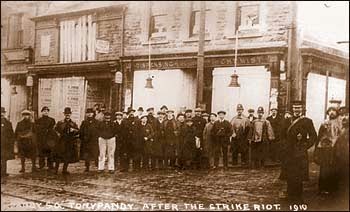
Tonypandy 1911 when Police and Miners were called in to attack Miners
There were others in the square that day who, like the 16-year-old Patríkios, would go on to become prominent members of the left. Míkis Theodorakis, renowned composer and iconic figure in modern Greek history, daubed a Greek flag in the blood of those who fell. Like Patríkios, he was a member of the resistance youth movement. And, like Patríkios, he knew his country had changed. Within days, RAF Spitfires and Beaufighters were strafing leftist strongholds as the Battle of Athens – known in Greece as the Dekemvriana – began, fought not between the British and the Nazis, but the British alongside supporters of the Nazis against the partisans. “I can still smell the destruction,” Patríkios laments. “The mortars were raining down and planes were targeting everything. Even now, after all these years, I flinch at the sound of planes in war movies.”

And thereafter Greece’s descent into catastrophic civil war: a cruel and bloody episode in British as well as Greek history which every Greek knows to their core – differently, depending on which side they were on – but which remains curiously untold in Britain, perhaps out of shame, maybe the arrogance of a lack of interest. It is a narrative of which the millions of Britons who go to savour the glories of Greek antiquity or disco-dance around the islands Mamma Mia-style, are unaware.

The legacy of this betrayal has haunted Greece ever since, its shadow hanging over the turbulence and violence that erupted in 2008 after the killing of a schoolboy by police – also called the Dekemvriana – and created an abyss between the left and right thereafter.

“The 1944 December uprising and 1946-49 civil war period infuses the present,” says the leading historian of these events, André Gerolymatos, “because there has never been a reconciliation. In France or Italy, if you fought the Nazis, you were respected in society after the war, regardless of ideology. In Greece, you found yourself fighting – or imprisoned and tortured by – the people who had collaborated with the Nazis, on British orders. There has never been a reckoning with that crime, and much of what is happening in Greece now is the result of not coming to terms with the past.”

Before the war, Greece was ruled by a royalist dictatorship whose emblem of a fascist axe and crown well expressed its dichotomy once war began: the dictator, General Ioannis Metaxas, had been trained as an army officer in Imperial Germany, while Greek King George II – an uncle of Prince Philip, Duke of Edinburgh – was attached to Britain. The Greek left, meanwhile, had been reinforced by a huge influx of politicised refugees and liberal intellectuals from Asia Minor, who crammed into the slums of Pireaus and working-class Athens.

Both dictator and king were fervently anti-communist, and Metaxas banned the Communist Party, KKE, interning and torturing its members, supporters and anyone who did not accept “the national ideology” in camps and prisons, or sending them into internal exile. Once war started, Metaxas refused to accept Mussolini’s ultimatum to surrender and pledged his loyalty to the Anglo-Greek alliance. The Greeks fought valiantly and defeated the Italians, but could not resist the Wehrmacht. By the end of April 1941, the Axis forces imposed a harsh occupation of the country. The Greeks – at first spontaneously, later in organised groups – resisted.

But, noted the British Special Operations Executive (SOE): “The right wing and monarchists were slower than their opponents in deciding to resist the occupation, and were therefore of little use.”
Britain’s natural allies were therefore EAM – an alliance of left wing and agrarian parties of which the KKE was dominant, but by no means the entirety – and its partisan military arm, ELAS.

There is no overstating the horror of occupation. Professor Mark Mazower’s book Inside Hitler’s Greece describes hideous bloccos or “round-ups” – whereby crowds would be corralled into the streets so that masked informers could point out ELAS supporters to the Gestapo and Security Battalions – which had been established by the collaborationist government to assist the Nazis – for execution. Stripping and violation of women was a common means to secure “confessions”. Mass executions took place “on the German model”: in public, for purposes of intimidation; bodies would be left hanging from trees, guarded by Security Battalion collaborators to prevent their removal. In response, ELAS mounted daily counterattacks on the Germans and their quislings. The partisan movement was born in Athens but based in the villages, so that Greece was progressively liberated from the countryside. The SOE played its part, famous in military annals for the role of Brigadier Eddie Myers and “Monty” Woodhouse in blowing up the Gorgopotomas viaduct in 1942 and other operations with the partisans – andartes in Greek.

By autumn 1944, Greece had been devastated by occupation and famine. Half a million people had died – 7% of the population. ELAS had, however, liberated dozens of villages and become a proto-government, administering parts of the country while the official state withered away. But after German withdrawal, ELAS kept its 50,000 armed partisans outside the capital, and in May 1944 agreed to the arrival of British troops, and to place its men under the officer commanding, Lt Gen Ronald Scobie.

On 12 October the Germans evacuated Athens. Some ELAS fighters, however, had been in the capital all along, and welcomed the fresh air of freedom during a six-day window between liberation and the arrival of the British. One partisan in particular is still alive, aged 92, and is a legend of modern Greece.
Commanding presence: Churchill leaving HMS Ajax to attend a conference ashore. Athens can be seen in the background. Photograph: Crown Copyright. IWM/Imperial War Museum
In and around the European parliament in Brussels, the man in a Greek fisherman’s cap, with his mane of white hair and moustache, stands out. He is Manolis Glezos, senior MEP for the leftist Syriza party of Greece.

Glezos is a man of humbling greatness. On 30 May 1941, he climbed the Acropolis with another partisan and tore down the swastika flag that had been hung there a month before. He was arrested by the Gestapo in 1942, was tortured and as a result suffered from tuberculosis. He escaped and was re-arrested twice – the second time by collaborators. He recalls being sentenced to death in May 1944, before the Germans left Athens – “They told me my grave had already been dug”. Somehow he avoided execution and was then saved from a Greek courtmartial’s firing squad during the civil war period by international outcry led by General de Gaulle, Jean-Paul Sartre and the Archbishop of Canterbury, the Rev Geoffrey Fisher.”

Seventy years later, he is an icon of the Greek left who is also hailed as the greatest living authority on the resistance. “The English, to this day, argue that they liberated Greece and saved it from communism,” he says. “But that is the basic problem. They never liberated Greece. Greece had been liberated by the resistance, groups across the spectrum, not just EAM, on 12 October. I was there, on the streets – people were everywhere shouting: ‘Freedom!’ we cried, Laokratia! – ‘Power to the People!’”

The British duly arrived on 18 October, installed a provisional government under Georgios Papandreou and prepared to restore the king. “From the moment they came,” recalls Glezos, “the people and the resistance greeted them as allies. There was nothing but respect and friendship towards the British. We had no idea that we were already giving up our country and our rights.” It was only a matter of time before EAM walked out of the provisional government in frustration over demands that the partisans demobilise. The negotiations broke down on 2 December.

Official British thinking is reflected in War Cabinet papers and other documents kept in the Public Record Office at Kew. As far back as 17 August 1944, Churchill had written a “Personal and Top Secret” memo to US president Franklin Roosevelt to say that: “The War Cabinet and Foreign Secretary are much concerned about what will happen in Athens, and indeed Greece, when the Germans crack or when their divisions try to evacuate the country. If there is a long hiatus after German authorities have gone from the city before organised government can be set up, it seems very likely that EAM and the Communist extremists will attempt to seize the city.”

But what the freedom fighters wanted, insists Glezos “was what we had achieved during the war: a state ruled by the people for the people. There was no plot to take over Athens as Churchill always maintained. If we had wanted to do that, we could have done so before the British arrived.” During November, the British set about building the new National Guard, tasked to police Greece and disarm the wartime militias. In reality, disarmament applied to ELAS only, explains Gerolymatos, not to those who had collaborated with the Nazis. Gerolymatos writes in his forthcoming book, The International Civil War, about how “in the middle of November, the British started releasing Security Battalion officers… and soon some of them were freely walking the streets of Athens wearing new uniforms... The British army continued to provide protection to assist the gradual rehabilitation of the former quisling units in the Greek army and police forces.” An SOE memo urged that “HMG must not appear to be connected with this scheme.”
Archbishop Damaskinos. Churchill had previously described Damaskinos as a 'pestilent priest' and a 'survivor of the middle ages'
In conversation, Gerolymatos says: “So far as ELAS could see, the British had arrived, and now some senior officers of the Security Battalions and Special Security Branch [collaborationist units which had been integrated into the SS] were seen walking freely in the streets. Athens in 1944 was a small place, and you could not miss these people. Senior British officers knew exactly what they were doing, despite the fact that the ordinary soldiers of the former Security Battalions were the scum of Greece”. Gerolymatos estimates that 12,000 Security Battalionists were released from Goudi prison during the uprising to join the National Guard, and 228 had been reinstated in the army.

Any British notion that the Communists were poised for revolution fell within the context of the so-called Percentages Agreement, forged between Churchill and Soviet Commissar Josef Stalin at the code-named “Tolstoy Conference” in Moscow on 9 October 1944. Under the terms agreed in what Churchill called “a naughty document”, southeast Europe was carved up into “spheres of influence”, whereby – broadly – Stalin took Romania and Bulgaria, while Britain, in order to keep Russia out of the Mediterranean, took Greece. The obvious thing to have done, argues Gerolymatos, “would have been to incorporate ELAS into the Greek army. The officers in ELAS, many holding commissions in the pre-war Greek army, presumed this would happen – like De Gaulle did with French communists fighting in the resistance: ‘France is liberated, now let’s go and fight Germany!’

“But the British and the Greek government in exile decided from the outset that ELAS officers and men would not be admitted into the new army. Churchill wanted a showdown with the KKE so as to be able to restore the king. Churchill believed that a restoration would result in the return of legitimacy and bring back the old order. EAM-ELAS, regardless of its relationship to the KKE, represented a revolutionary force, and change.”

Meanwhile, continues Gerolymatos: “The Greek communists had decided not to try to take over the country, as least not until late November/early December 1944. The KKE wanted to push for a left-of-centre government and be part of it, that’s all.” Echoing Glezos, he says: “If they had wanted a revolution, they would not have left 50,000 armed men outside the capital after liberation – they’d have brought them in.”

“By recruiting the collaborators, the British changed the paradigm, signalling that the old order was back. Churchill wanted the conflict,” says Gerolymatos. “We must remember: there was no Battle for Greece. A large number of the British troops that arrived were administrative, not line units. When the fighting broke out in December, the British and the provisional government let the Security Battalions out of Goudi; they knew how to fight street-to-street because they’d done it with the Nazis. They’d been fighting ELAS already during the occupation and resumed the battle with gusto.”

The morning of Sunday 3 December was a sunny one, as several processions of Greek republicans, anti-monarchists, socialists and communists wound their way towards Syntagma Square. Police cordons blocked their way, but several thousand broke through; as they approached the square, a man in military uniform shouted: “Shoot the bastards!” The lethal fusillade – from Greek police positions atop the parliament building and British headquarters in the Grande Bretagne hotel – lasted half an hour. By noon, a second crowd of demonstrators entered the square, until it was jammed with 60,000 people. After several hours, a column of British paratroops cleared the square; but the Battle of Athens had begun, and Churchill had his war.

Manolis Glezos was sick that morning, suffering from tuberculosis. “But when I heard what had happened, I got off my sick bed,” he recalls. The following day, Glezos was roaming the streets, angry and determined, disarming police stations. By the time the British sent in an armoured division he and his comrades were waiting.

“I note the fact,” he says, “that they would rather use those troops to fight our population than German Nazis!” By the time British tanks rolled in from the port of Pireaus, he was lying in wait: “I remember them coming up the Sacred Way. We were dug in a trench. I took out three tanks,” he says. “There was much bloodshed, a lot of fighting, I lost many very good friends. It was difficult to strike at an Englishman, difficult to kill a British soldier – they had been our allies. But now they were trying to destroy the popular will, and had declared war on our people”.

At battle’s peak, Glezos says, the British even set up sniper nests on the Acropolis. “Not even the Germans did that. They were firing down on EAM targets, but we didn’t fire back, so as not [to harm] the monument.”

On 5 December, Lt Gen Scobie imposed martial law and the following day ordered the aerial bombing of the working-class Metz quarter. “British and government forces,” writes anthropologist Neni Panourgia in her study of families in that time, “having at their disposal heavy armament, tanks, aircraft and a disciplined army, were able to make forays into the city, burning and bombing houses and streets and carving out segments of the city… The German tanks had been replaced by British ones, the SS and Gestapo officers by British soldiers.” The house belonging to actor Mimis Fotopoulos, she writes, was burned out with a portrait of Churchill above the fireplace.

“I recall shouting slogans in English, during one battle in Koumoundourou Square because I had a strong voice and it was felt I could be heard,” says poet Títos Patríkios as we talk in his apartment. “‘We are brothers, there’s nothing to divide us, come with us!’ That’s what I was shouting in the hope that they [British troops] would withdraw. And right at that moment, with my head poked above the wall, a bullet brushed over my helmet. Had I not been yanked down by Evangelos Goufas[another poet], who was there next to me, I would have been dead.”

On their knees: women protest against the shootings, which led to more than a month of street fighting in Athens. Photograph: Dmitri Kessel/The LIFE Picture Collection/Getty

He can now smile at the thought that only months after the killing in the square he was back at school, studying English on a British Council summer course. “We were enemies, but at the same time friends. In one battle I came across an injured English soldier and I took him to a field hospital. I gave him my copy of Robert Louis Stevenson’s Kidnapped which I remember he kept.”

It is illuminating to read the dispatches by British soldiers themselves, as extracted by the head censor, Capt JB Gibson, now stored at the Public Record Office. They give no indication that the enemy they fight was once a partisan ally, indeed many troops think they are fighting a German-backed force. A warrant officer writes: “Mr Churchill and his speech bucked us no end, we know now what we are fighting for and against, it is obviously a Hun element behind all this trouble.” From “An Officer”: “You may ask: why should our boys give their lives to settle Greek political differences, but they are only Greek political differences? I say: no, it is all part of the war against the Hun, and we must go on and exterminate this rebellious element.”

Cabinet papers at Kew trace the reactions in London: a minute of 12 December records Harold Macmillan, political advisor to Field Marshal Alexander, returning from Athens to recommend “a proclamation of all civilians against us as rebels, and a declaration those found in civilian clothes opposing us with weapons were liable to be shot, and that 24 hours notice should be given that certain areas were to be wholly evacuated by the civilian population” – ergo, the British Army was to depopulate and occupy Athens. Soon, reinforced British troops had the upper hand and on Christmas Eve Churchill arrived in the Greek capital in a failed bid to make peace on Christmas Day.

“I will now tell you something I have never told anyone,” says Manolis Glezos mischievously. On the evening of 25 December Glezos would take part in his most daring escapade, laying more than a ton of dynamite under the hotel Grande Bretagne, where Lt Gen Scobie had headquartered himself. “There were about 30 of us involved. We worked through the tunnels of the sewerage system; we had people to cover the grid-lines in the streets, so scared we were that we’d be heard. We crawled through all the shit and water and laid the dynamite right under the hotel, enough to blow it sky high.

“I carried the fuse wire myself, wire wound all around me, and I had to unravel it. We were absolutely filthy, covered [in excrement] and when we got out of the sewerage system I remember the boys washing us down. I went over to the boy with the detonator; and we waited, waited for the signal, but it never came. Nothing. There was no explosion. Then I found out: at the last minute EAM found out that Churchill was in the building, and put out an order to call off the attack. They’d wanted to blow up the British command, but didn’t want to be responsible for assassinating one of the big three.”

At the end of the Dekemvriana, thousands had been killed; 12,000 leftists rounded up and sent to camps in the Middle East. A truce was signed on 12 February, the only clause of which that was even partially honoured was the demobilisation of ELAS. And so began a chapter known in Greek history as the “White Terror”, as anyone suspected of helping ELAS during the Dekemvriana or even Nazi occupation was rounded up and sent to a gulag of camps established for their internment, torture, often murder – or else repentance, as under the Metaxas dictatorship.

Títos Patríkios is not the kind of man who wants the past to impinge on the present. But he does not deny the degree to which this history has done just that – affecting his poetry, his movement, his quest to find “le mot juste”. This most measured and mild-mannered of men would spend years in concentration camps, set up with the help of the British as civil war beckoned. With imprisonment came hard labour, and with hard labour came torture, and with exile came censorship. “The first night on Makronissos [the most infamous camp] we were all beaten very badly. 

“I spent six months there, mostly breaking stones, picking brambles and carrying sand. Once, I was made to stand for 24 hours after it had been discovered that a newspaper had published a letter describing the appalling conditions in the camp. But though I had written it, and had managed to pass it on to my mother, I never admitted to doing so and throughout my time there I never signed a statement of repentance.”

Patríkios was among the relatively fortunate; thousands of others were executed, usually in public, their severed heads or hanging bodies routinely displayed in public squares. His Majesty’s embassy in Athens commented by saying the exhibition of severed heads “is a regular custom in this country which cannot be judged by western European standards”.

The name of the man in command of the “British Police Mission” to Greece is little known. Sir Charles Wickham had been assigned by Churchill to oversee the new Greek security forces – in effect, to recruit the collaborators. Anthropologist Neni Panourgia describes Wickham as “one of the persons who traversed the empire establishing the infrastructure needed for its survival,” and credits him with the establishment of one of the most vicious camps in which prisoners were tortured and murdered, at Giaros.

From Yorkshire, Wickham was a military man who served in the Boer War, during which concentration camps in the modern sense were invented by the British. He then fought in Russia, as part of the allied Expeditionary Force sent in 1918 to aid White Russian Czarist forces in opposition to the Bolshevik revolution. After Greece, he moved on in 1948 to Palestine. But his qualification for Greece was this: Sir Charles was the first Inspector General of the Royal Ulster Constabulary, from 1922 to 1945.

The RUC was founded in 1922, following what became known as the Belfast pogroms of 1920-22, when Catholic streets were attacked and burned. It was, writes the historian Tim Pat Coogan, “conceived not as a regular police body, but as a counter-insurgency one… The new force contained many recruits who joined up wishing to be ordinary policemen, but it also contained murder gangs headed by men like a head constable who used bayonets on his victims because it prolonged their agonies.”

As the writer Michael Farrell found out when researching his book Arming the Protestants, much material pertaining to Sir Charles’s incorporation of these UVF and Special Constabulary militiamen into the RUC has been destroyed, but enough remains to give a clear indication of what was happening. In a memo written by Wickham in November 1921, before the formation of the RUC, and while the partition treaty of December that year was being negotiated, he had addressed “All County Commanders” as follows: “Owing to the number of reports which has been received as to the growth of unauthorised loyalist defence forces, the government have under consideration the desirability of obtaining the services of the best elements of these organisations.”

Coogan, Ireland’s greatest and veteran historian, stakes no claim to neutrality over matters concerning the Republic and Union, but historical facts are objective and he has a command of those that none can match. We talk at his home outside Dublin over a glass of whiskey appositely called “Writer’s Tears”.

“It’s the narrative of empire,” says Coogan, “and, of course, they applied it to Greece. That same combination of concentration camps, putting the murder gangs in uniform, and calling it the police. That’s colonialism, that’s how it works. You use whatever means are necessary, one of which is terror and collusion with terrorists. It works.

Wickham organised the RUC as the armed wing of Unionism, which is something it remained thereafter,” he says. “How long was it in the history of this country before the Chris Patten report of 1999, and Wickham’s hands were finally prised off the police? That’s a hell of a long piece of history – and how much suffering, meanwhile?”

The head of MI5 reported in 1940 that “in the personality and experience of Sir Charles Wickham, the fighting services have at their elbow a most valuable friend and counsellor”. When the intelligence services needed to integrate the Greek Security Battalions – the Third Reich’s “Special Constabulary” – into a new police force, they had found their man.

 ‘I carried the fuse wire myself: Manolis Glezos, senior MEP and ‘a man of humbling greatness’ in Brussels. Helena Smith Photograph: Helena Smith/Observer

Greek academics vary in their views on how directly responsible Wickham was in establishing the camps and staffing them with the torturers. Panourgia finds the camp on Giaros – an island which even the Roman Emperor Tiberius decreed unfit for prisoners – to have been Wickham’s own direct initiative. Gerolymatos, meanwhile, says: “The Greeks didn’t need the British to help them set up camps. It had been done before, under Metaxas.” Papers at Kew show British police serving under Wickham to be regularly present in the camps.

Gerolymatos adds: “The British – and that means Wickham – knew who these people were. And that’s what makes it so frightening. They were the people who had been in the torture chambers during occupation, pulling out the fingernails and applying thumbscrews.” By September 1947, the year the Communist Party was outlawed, 19,620 leftists were held in Greek camps and prisons, 12,000 of them in Makronissos, with a further 39,948 exiled internally or in British camps across the Middle East. There exist many terrifying accounts of torture, murder and sadism in the Greek concentration camps – one of the outrageous atrocities in postwar Europe. Polymeris Volgis of New York University describes how a system of repentance was introduced as though by a “latter-day secular Inquisition”, with confessions extracted through “endless and violent degradation”.

Women detainees would have their children taken away until they confessed to being “Bulgarians” and “whores”. The repentance system led Makronissos to be seen as a “school” and “National University” for those now convinced that “Our life belongs to Mother Greece,’ in which converts were visited by the king and queen, ministers and foreign officials. “The idea”, says Patríkios, who never repented, “was to reform and create patriots who would serve the homeland.”

Minors in the Kifissa prison were beaten with wires and socks filled with concrete. “On the boys’ chests, they sewed name tags”, writes Voglis, “with Slavic endings added to the names; many boys were raped”. A female prisoner was forced, after a severe beating, to stand in the square of Kastoria holding the severed heads of her uncle and brother-in-law. One detainee at Patras prison in May 1945 writes simply this: “They beat me furiously on the soles of my feet until I lost my sight. I lost the world.”

Manolis Glezos has a story of his own. He produces a book about the occupation, and shows a reproduction of the last message left by his brother Nikos, scrawled on the inside of a beret. Nikos was executed by collaborators barely a month before the Germans evacuated Greece. As he was being driven to the firing squad, the 19-year-old managed to throw the cap he was wearing from the window of the car. Subsequently found by a friend and restored to the family, the cap is among Glezos’s most treasured possessions.

Scribbled inside, Nikos had written: “Beloved mother. I kiss you. Greetings. Today I am going to be executed, falling for the Greek People. 10-5-44.”

Nowhere else in newly liberated Europe were Nazi sympathisers enabled to penetrate the state structure – the army, security forces, judiciary – so effectively. The resurgence of neo-fascism in the form of present-day far-right party Golden Dawn has direct links to the failure to purge the state of right-wing extremists; many of Golden Dawn’s supporters are descendants of Battalionists, as were the “The Colonels” who seized power in 1967.

Glezos says: “I know exactly who executed my brother and I guarantee they all got off scot-free. I know that the people who did it are in government, and no one was ever punished.” Glezos has dedicated years to creating a library in his brother’s honour. In Brussels, he unabashedly asks interlocutors to contribute to the fund by popping a “frango” (a euro) into a silk purse. It is, along with the issue of war reparations, his other great campaign, his last wish: to erect a building worthy of the library that will honour Nikos. “The story of my brother is the story of Greece,” he says.

There is no claim that ELAS, or the Democratic Army of Greece which replaced it, were hapless victims. There was indeed a “Red Terror” in response to the onslaught, and on the retreat from Athens, ELAS took some 15,000 prisoners with them. “We did some killing,” concedes Glezos, “and some people acted out of revenge. But the line was not to kill civilians.”

In December 1946, Greek prime minister Konstantinos Tsaldaris, faced with the probability of British withdrawal, visited Washington to seek American assistance. In response, the US State Department formulated a plan for military intervention which, in March 1947, formed the basis for an announcement by President Truman of what became known as the Truman Doctrine, to intervene with force wherever communism was considered a threat. All that had passed in Greece on Britain’s initiative was the first salvo of the Cold War.

Glezos still calls himself a communist. But like Patríkios, who rejected Stalinism, he believes that communism, as applied to Greece’s neighbours to the north, would have been a catastrophe. He recalls how he even gave Nikita Khrushchev, the Soviet leader who would de-Stalinise the Soviet Union “an earful about it all”. The occasion arose when Khrushchev invited Glezos – who at the height of the Cold War was a hero in the Soviet Union, honoured with a postage stamp bearing his image – to the Kremlin. It was 1963 and Khrushchev was in talkative mood. Glezos wanted to know why the Red Army, having marched through Bulgaria and Romania, stopped at the Greek border. Perhaps the Russian leader could explain.

He looked at me and said, ‘Why?’

“I said: ‘Because Stalin didn’t behave like a communist. He divided up the world with others and gave Greece to the English.’ Then I told him what I really thought, that Stalin had been the cause of our downfall, the root of all evil. All we had wanted was a state where the people ruled, just like our [then] government in the mountains, where you can still see the words ‘all powers spring from the people and are executed by the people’ inscribed into the hills. What they wanted, and created, was rule by the party.”

Khrushchev, says Glezos, did not openly concur. “He sat and listened. But then after our meeting he invited me to dinner, which was also attended by Leonid Brezhnev [who succeeded Khrushchev in 1964] and he listened for another four and a half hours. I have always taken that for tacit agreement.”

Taking charge: Lt Gen Ronald Scobie (centre) who, on 5 December 1944, imposed martial law and ordered the aerial bombing of the working-class Metz quarter of Athens. Photograph: Dmitri Kessel/The LIFE Picture Collection/Getty

For Patríkios, it was not until the Soviet invasion of Hungary in 1956, that the penny dropped: a line had been drawn across the map, agreed by Churchill and Stalin. “When I saw the west was not going to intervene [during the Budapest uprising] I realised what had happened – the agreed ‘spheres of influence’. And later, I understood that the Dekemvriana was not a local conflict, but the beginning of the Cold War that had started as a warm war here in Greece.”

Patríkios returned to Athens as a detainee “on leave” and was eventually granted a passport in 1959. Upon procuring it, he immediately got on a ship to Paris where he would spend the next five years studying sociology and philosophy at the Sorbonne. “In politics there are no ethics,” he says, “especially imperial politics.”

It’s the afternoon of 25 January 2009. The tear gas that has drenched Athens – a new variety, imported from Israel – clears. A march in support of a Bulgarian cleaner, whose face has been disfigured in an acid attack by neo-fascists, has been broken up by riot police after hours of street-fighting.

Back in the rebel-held quarter of Exarcheia, a young woman called Marina pulls off her balaclava and draws air. Over coffee, she answers the question: why Greece? Why is it so different from the rest of Europe in this regard – the especially bitter war between left and right? “Because,” she replies, “of what was done to us in 1944. The persecution of the partisans who fought the Nazis, for which they were honoured in France, Italy, Belgium or the Netherlands – but for which, here, they were tortured and killed on orders from your government.”

She continues: “I come from a family that has been detained and tortured for two generations before me: my grandfather after the Second World War, my father under the Junta of the colonels – and now it could be me, any day now. We are the grandchildren of the andartes, and our enemies are Churchill’s Greek grandchildren.”

The whole thing”, spits Dr Gerolymatos, “was for nothing. None of this need have happened, and the British crime was to legitimise people whose record under occupation by the Third Reich put them beyond legitimacy. It happened because Churchill believed he had to bring back the Greek king. And the last thing the Greek people wanted or needed was the return of a de-frocked monarchy backed by Nazi collaborators. But that is what the British imposed, and it has scarred Greece ever since.”

“All those collaborators went into the system,” says Manilos Glezos. “Into the government mechanism – during and after the civil war, and their sons went into the military junta. The deposits remain, like malignant cells in the system. Although we liberated Greece, the Nazi collaborators won the war, thanks to the British. And the deposits remain, like bacilli in the system.”

But there is one last thing Glezos would like to make clear. “You haven’t asked: ‘Why do I go on? Why I am doing this when I am 92 years and two months old?’ he says, fixing us with his eyes. “I could, after all, be sitting on a sofa in slippers with my feet up,” he jests. “So why do I do this?”

He answers himself: “You think the man sitting opposite you is Manolis but you are wrong. I am not him. And I am not him because I have not forgotten that every time someone was about to be executed, they said: ‘Don’t forget me. When you say good morning, think of me. When you raise a glass, say my name.’ And that is what I am doing talking to you, or doing any of this. The man you see before you is all those people. And all this is about not forgetting them.”


Timeline: the battle between left and right

Late summer 1944 German forces withdraw from most of Greece, which is taken over by local partisans. Most of them are members of ELAS, the armed wing of the National Liberation Front, EAM, which included the Communist KKE party


October 1944 Allied forces, led by General Ronald Scobie, enter Athens, the last German-occupied area, on 13 October. Georgios Papandreou returns from exile with the Greek government
2 December 1944 Rather than integrate ELAS into the new army, Papandreou and Scobie demand the disarmament of all guerrilla forces. Six members of the new cabinet resign in protest
3 December 1944 Violence in Athens after 200,000 march against the demands. More than 28 are killed and hundreds are injured. The 37-day Dekemvrianá begins. Martial law is declared on 5 December
January/February 1945 Gen Scobie agrees to a ceasefire in exchange for ELAS withdrawal. In February the Treaty of Varkiza is signed by all parties. ELAS troops leave Athens with 15,000 prisoners
1945/46 Right-wing gangs kill more than 1,100 civilians, triggering civil war when government forces start battling the new Democratic Army of Greece (DSE), mainly former ELAS soldiers
1948-49 DSE suffers a catastrophic defeat in the summer of 1948, with nearly 20,000 killed. In July 1949 Tito closes the Yugoslav border, denying DSE shelter. Ceasefire signed on 16 October 1949
21 April 1967 Right-wing forces seize power in a coup d’état. The junta lasts until 1974. Only in 1982 are communist veterans who had fled overseas allowed to return to Greece
  • A group of Greek historians writes concerning this article. It was reported that British troops opened fire on the Greek demonstrators from the Grande Bretagne hotel in Athens on December 3 1944. The hotel was British military headquarters, but the fire from it could also have come from Greek police. We also said that the Greek anti-Nazi resistance, ELAS/EAM, agreed not to oppose the landing of British troops in May 1944. The historians point out that the agreement was formalised at Caserta in September.
  • See also 

Winston Churchill the terrorist: His hunger to take the fight to Hitler made him send thousands of heroes to needless death