It was during the fiercest repression of the Greek people that Zionism formed an alliance with their fascist oppressors

The Greek
Junta (1967-1974), whose coming to power was backed by the United States
and Henry Kissinger, set the scene for the coming to power of similar pro-American military
juntas, like that of Pinochet in Chile. Israel at the time was ruled by an
Israeli Labour government coalition, not Likud, not Religious Zionism not the
right-wing of the Zionist movement. It included Mapam, the so-called left
Zionist party which in 1969 formally joined what became the Israeli Labour
Alignment.
As Eitay Mack shows in The suppressed history of
Israel’s support for the brutal Greek junta the Israeli government’s had extremely friendly relations
with the Junta and this
‘relationship blossomed during the dark days of the military junta that
ruled Greece from 1967 and 1974 — a period marked by the brutal repression,
imprisonment, torture, and murder of opponents of the regime, and a period that
was deliberately omitted from the celebratory narrative Israel promotes.’
Despite knowledge of the
torture, murder and disappearance of its political opponents, the Israeli
government had a closer relationship with the Junta than with previous civilian
governments. The Israeli government was concerned with winning the support of
the Junta for Israel in the United Nations and international forums.
From October 1968 onwards
close military and economic ties developed between Israel and the Greek Junta.
Israel’s only concern was with the fact that their budding relationship might
receive undue publicity.
The head of the office of
the Director General of Israel’s Foreign Ministry, Hanan Bar-On, asked the
Israeli Ministry of Foreign Affairs to “try
as much as possible to be modest in publicizing the progress of our practical
relations with Greece, be they in commerce or in other areas.” When members of the Junta’s air force
delegation later visited Israel for negotiations on the renovation and
maintenance of aircrafts, they arrived in civilian clothes.
Mack reports that the Junta
was becoming ever more oppressive inside its borders. On November 17, 1973, in
response to a student strike, an attack was made by the military on the
National Technical University of Athens with tanks, killing dozens of
civilians. Although news of the atrocity was reported all over the world,
including in Israeli newspapers, ‘the
State of Israel did not waver in its support of the junta or take a step back
in its economic relationship.’
Israel’s response was to
double down on its support for the Junta and its military and economic trading
relationships. As Mack notes:
The story of Israel’s support for the military junta in Greece offers insight into the nature and logic of Israel’s relations with dozens of dictatorships around the world during the 1960s and ’70s. Israel was not interested in the fate of the opposition and left-wing activists who were tortured and murdered by the security forces, nor did it seem to care that its diplomacy, military, and economy were directly aiding in the oppression of millions. This history suggests that the State of Israel was not merely a passive player, following only the will of the great powers; it was and remains a powerful and autonomous promoter of its own interests first and foremost, willing to compromise on values like democracy and human rights in order to gain international support in its own oppression of the Palestinian people.
Nowhere was this more evident in Israel’s relationship
with the Argentinian Military Junta (1976-83) which tortured and ‘disappeared’
up to 3,000 Argentine Jews. Once again Israel’s own interest in supplying the
Junta with weapons and military training trumped any concern for Argentine’s
Jews. So much so that in the case of
Argentina Israel actually denied visas to Jews who were deemed subversive of
the Junta. See Jews targeted in
Argentina's dirty war
The suppressed history of
Israel’s support for the brutal Greek junta
Declassified files reveal the extent of Israel’s
ties with the regime known for torturing and murdering thousands of its citizens
in the 1960s-70s.
By Eitay Mack April 28, 2023

The leaders of the 1967 Greek coup d'état:
Brigadier Stylianos Pattakos, Colonel Georgios Papadopoulos and Colonel
Nikolaos Makarezos. (Unknown/CC BY-SA 4.0)
Greece is
one of the few countries in Europe today that openly embraces the Israeli army,
holding joint military exercises with Israel and acting as
an enthusiastic partner for Israeli arms and surveillance companies. Against
the background of Israel’s current constitutional and political crisis, Greece
has also reportedly been trying to attract more Israeli hi-tech companies, many of
which build military or dual-use products, by offering them extremely generous
incentives.
This close
relationship has also had a major impact on Greek domestic politics. Last year,
for example, it was revealed that an Israeli former intelligence general named Tal
Dilian, who runs a spyware company from
an office in Athens, was involved in a political and legal scandal over the
spyware’s use against Greek politicians and journalists; both
the head of intelligence and the adviser to the prime minister of Greece were
forced to resign.

How did this
unique relationship form? Publicly, Israel and Greece trace their strong ties
back only to 1990, when full diplomatic relations were established and an
Israeli embassy opened in Athens. On May 21, 2015, the 25th anniversary of that
milestone, the Israeli Ministry of Foreign Affairs published a celebratory statement explaining its narrative of Greek-Israeli
diplomacy, according to which the period between 1952 and 1990 saw only
low-level relations between the two countries.
In recent
years, the statement continues,
“a strategic partnership has developed between the
two countries … based on democratic values and common interests shared by the
two countries, which face challenges in the Eastern Mediterranean region … The
two countries, Greece and Israel, are modern and democratic scions of ancient
nations … The bilateral cooperation between the two countries promotes common
values, progress and stability in the region. Both countries strive to continue
to promote peaceful and good neighborly relations with peoples and nations in
the region.”
This account
of the military relations between Israel and Greece is, however, untrue.
Telegrams in the files of the Ministry of Foreign Affairs in the Israel State
Archives, which were opened to the public between 2019-2020, show that the two
countries’ special relationship was in fact born much earlier than 1990, and
had nothing to do with the “democratic values” of either Greece or Israel. The
relationship blossomed during the dark days of the military junta that ruled
Greece from 1967 and 1974 — a period marked by the brutal repression,
imprisonment, torture, and murder of opponents of the regime, and a period that
was deliberately omitted from the celebratory narrative Israel promotes.

Israeli
Prime Minister Benjamin Netanyahu meets with Greek Foreign Minister Nikos
Dendias at the prime minister’s office in Jerusalem, January 31, 2023. (Marc
Israel Sellem/POOL)
Before the
junta came to power, Greece’s relations with Israel were cold: it preferred to
build diplomatic and economic ties with Arab countries, and even voted against
the 1947 UN Partition Plan. Then, under the pretext of dealing with the
“communist threat,” a group of generals staged a military coup in Greece in
April 1967. Immediately upon seizing power, the military junta began a campaign
to eliminate its real and imagined opponents, an effort embraced or tacitly
supported by most Western European countries and the United States.
Although
there is disagreement regarding the exact number of victims of the junta, several
thousand activists, students, artists,
writers, actors, journalists, and even World War II veterans were arrested,
subjected to severe torture, and murdered. Some were held in detention and torture camps for many years,
with little food and water and no medical treatment. The torture practices included whipping the feet with sticks
and plastic tubes, inserting a tube into the detainee’s body and pouring water
inside, banging the head against the wall or the floor, the torturers jumping
on the detainee’s stomach, pulling out nails, causing burns and extinguishing
cigarettes on the body, electrocution, and even sexual torture.
Although
most of the files and documents of Israel’s Ministry of Foreign Affairs remain
classified, the telegrams in the archives that have been made available to the
public reveal that Israel was well aware of these human rights violations and
nevertheless continued its close military and political ties with the military
junta and even considered it more friendly to Israel than the civilian regimes
that preceded it. And yet, cognizant of diplomatic optics, Israel sought to
hide the nature of its relations with Greece — a practice that continues to
this day.
Establishing the relationship
A telegram
sent by the head of the Israeli mission in Athens, Yehoshua Nissim Shai, only
two months after the coup, demonstrates Israel’s awareness of the political
repression in Greece at the time. In June 1967, Shai complained that it was not
possible to carry out Israeli PR activities in Greece because the locals were
afraid to engage in any political matters:
“It is … absolutely forbidden for an individual to
engage in political matters in the severe military regime that prevails in this
country … It is enough for a person to express any political opinion without
the approval of the authorities for him to find himself arrested the next day.”
Despite
Shai’s awareness of these political crimes and apparent personal discomfort
with them, a series of communications and meetings that took place in the
immediate aftermath of the junta’s coup are indicative of the quickly warming
relations between the two countries.

A military tank seen on the street during the coup
that brought the Greek junta to power, 21 April 1967. (CC BY 2.0)
Less than
one month after sending the telegram, Shai reported in another telegram on his
meeting with the junta’s foreign minister and his effort to motivate the junta
to take a more sympathetic and understanding stance toward Israel. The foreign
minister responded that the junta, and even he personally, had a very positive
attitude toward Israel and “is happy
about the glorious victory of the IDF” in the 1967 war, which had ended
just a few weeks earlier. According to the minister, because of the junta’s
diplomatic interests in the Arab world, he could not take a public pro-Israel
line as he wanted, but he promised to do everything possible to soften the
position of the Greek representative at the UN toward Israel.
In another
telegram describing a subsequent meeting with General Nikolaos Makarezos, one
of the leaders of the coup, Shai reported:
“The conversation revolved around his visit to
Israel at the beginning of this year. The minister mentioned his contacts with
Mossad personnel and spoke highly of Israel’s achievements.”
On Sept. 17,
the relationship developed further. The deputy speaker of the Knesset at the
time, Yitzhak Navon, visited Greece and met with Constantine Kollias, the prime
minister appointed by the military junta. According to the summary of the
meeting, Navon tried to convince Kollias to vote with Israel in international
forums such as the United Nations. Kollias expressed appreciation and
admiration for the State of Israel, saying that he saw Greece and Israel as
fighting “against the common enemy —
communism” and added that “your hopes
[are] our hopes.” Kollias later explained that he was upset with “attacks … in the press by Jews on the Greek
government and police.”
Instead of
calling out Kollias’s complaint for being tinged with the antisemitic trope
that Jews control the media, Navon tacitly validated his concern and said,
“The government of Israel has no control over the
press in the world, not even in Israel itself. But it is possible to ‘soften’ this
attitude in certain cases. Greece’s support for Israel may bring it sympathy in
the free world.”
A market for modern and cheap weapons
A year
later, the nascent diplomatic ties between Greece and Israel crossed over into
military cooperation. In October 1968, Yaakov Ben-Sher, Israel’s commercial
attaché in Greece, wrote that he met with Makarezos to discuss a visit by a
delegation of Greek military officers to Israeli Military Industries, the
state-owned weapons manufacturer, at Israel’s invitation. It was agreed that
the delegation would not arrive in uniform and that the visit would not be
publicized. The next month, Ben-Sher wrote that among the goals of the visit
were “establishing a maintenance plant
for aircraft in Greece, Israel Aerospace Industries, [and] the presentation of
weapons and military equipment produced in Israel.”

Workers at
an IMI factory manufacturing gun barrels in 1955. (GPO)
The junta’s air force delegation visited Israel between Nov. 25 and Dec. 3, 1968. A report prepared by the Greek delegation after the trip outlined their activities in Israel: the group visited Israeli Military Industries’ factory; was interested in Uzi submachine guns, lighting bombs, and smoke grenades; and discussed the possibility of Israel maintaining the junta’s air force aircrafts, and even Israeli assistance in the establishment of an arms manufacturing industry in Greece.
The Greek
military delegation wrote that
“due to the constant development of the Greek army
and due to the reduction of the U.S. military aid program, Greece is dependent
on the international arms markets, since the supply of the necessary equipment
and weapons would not be immediately resolved by establishing a national arms
industry. From this perspective, Israel is a market for modern and cheap
weapons and is a site for extensive commercial exchanges and close economic
cooperation for the benefit of both sides.”
On Jan. 30,
1969, Ben-Sher reported that he met again with the junta’s minister of
coordination, Makarezos, and talked with him about the purchase of Gabriel
missiles, land army communication equipment from Tadiran (an Israeli company),
and even Israeli assistance in building a nuclear reactor in Greece. According
to a telegram from June 5, 1969, sent by the Israeli mission in Athens, the
chairman of the Greek Atomic Energy Commission visited Israel during the
previous month, but it is not clear from Israeli Foreign Ministry documents
disclosed to the public if and how Israel aided Greece’s nuclear development.
‘The rulers of today will also be the rulers of tomorrow’
As
diplomatic relations between the State of Israel and the junta tightened, so
did their economic ties. On Feb. 8, 1969, a new commercial agreement was
signed, revealing the inextricable link between each country’s military and
economy. In a telling symbol of the increasingly close ties, Yaakov Cruz, the
former deputy head of the Mossad, was appointed to the position of head of the
Israeli mission in Athens in early 1968.
During May
1969, preparations began for a visit to Greece by an Israeli economic
delegation, including representatives of the arms manufacturers. For reasons of
political sensitivity, Israel decided to downgrade the level of participants
in, and the visibility of, the delegation. In response, Cruz sent a telegram to
the Ministry of Foreign Affairs in which he tried to reverse the decision to
downgrade. “Our relations with the
current government have improved a lot compared to our relations with its
predecessors,” wrote Cruz.

Protest
against the junta by Greek political exiles in Germany, April 30, 1967.
(Bundesarchiv, Bild 183-F0503-0204-005/CC-BY-SA 3.0)
“Many of the Greek exiles were our most prominent
opponents when they were in power, led by Andreas Papandreou,” he continued. “All
Western countries, without exception, make great efforts, and often without
limits, to succeed in as many economic transactions as possible with Greece,
including the supply of military equipment.” Cruz concluded his telegram by
writing that, in his opinion, Israel should not be ashamed of its relations
with the junta, since it was equally clear to all Western countries, and in
particular to the USA, that the “the
rulers of today will also be the rulers of tomorrow.”
On May 16,
1969, Cruz reported on a meeting he and the CEO of Israel Aerospace Industries,
Al Schwimmer, held with the head of the military junta in order to “present the possibilities and proposals of
Israel Aerospace Industries.” Cruz wrote that he reviewed with the head of
the junta the progress that had taken place since his last visit: “Three agreements have been signed between
us, two military delegations have already visited, and a third will leave next
week to Israel. A goodwill delegation to promote economic ties is about to come
to Greece at the beginning of June, and the visit of the CEO of Israel
Aerospace Industries is also part of the effort to develop these ties.” The
head of the junta thanked Cruz for the explanations he received and emphasized
the need for cooperation between the two countries.
Keeping it a secret
At the
beginning of June 1969, another Israeli economic delegation visited Greece. In
several telegrams around that time, Cruz wrote that the members of the Israeli
delegation received important proposals such as “establishing a maintenance plant for aircrafts, overhauling aircrafts’
engines and selling weapons”; that the delegation met with the Greek
military’s chief of staff, the junta’s officers, and other senior officials;
and that the Israeli company Tadiran had signed a deal with the regime worth $2
million.
In a
telegram sent by economic attaché Ben-Sher on Oct. 30 of the same year, he
wrote that
“the Greek army ordered communication equipment
from Tadiran in the amount of $2,316,500. The order was finally approved by the
Israeli prime minister and the minister of defense. The contract will be signed
within a week to 10 days. The contract is to be executed in 1970.”
The close
relations with a military junta that had become infamous for its human rights
violations raised some concerns, however. “In
my conversations with various people, they expressed their regret at the
publicizing of the strengthening of our ties with Greece during this particular
period,” the deputy head of the Israeli delegation in Brussels wrote to the
director of the European division at the foreign ministry in 1969. “Last night, two friends told me that they
understand the need for realpolitik in the special situation that Israel is in,
and especially in what concerns our economic relations, but they wondered if it
is not possible to prevent, or at least to moderate, the publicizing of this
matter.”

Demonstration
against the Greek military junta in front of the White House, April 21, 1974.
(Reading/Simpson/CC BY-NC 2.0)
In a
telegram sent by the head of the office of the director general of the Foreign
Ministry, Hanan Bar-On, to the leadership of the Israeli Ministry of Foreign
Affairs a short time later, he asked to “try
as much as possible to be modest in publicizing the progress of our practical
relations with Greece, be they in commerce or in other areas.” In
accordance with this request, the members of the junta’s air force delegation,
who visited Israel for negotiations on the renovation and maintenance of
aircrafts, arrived in civilian clothes.
According to
a report prepared by the Ministry of Foreign Affairs in 1972, Israel sold
parachutes worth approximately $250,000 to the Greek military, and they
conducted negotiations regarding the sale of searchlights to the Air Force and
the Armored Corps. But the junta wanted more. “The Greek army is interested in buying other military equipment in
Israel, but we do not have political approval for this,” Dr. Yitzhak
Azouri, an Israeli diplomat stationed in Greece, wrote in 1972, “for example, rockets.”
The
following year, Israel went so far as to assist Greece in one of the most
sensitive areas of Israeli international relations. On Jan. 17, 1973, Azouri
reported that an agreement was signed with the junta to transport crude oil
from the Persian Gulf through the Eilat-Ashkelon oil pipeline, and from there
on to Piraeus, Greece. “A transport of
about 250,000 tons (in the amount of about $1.5 million) has already been
carried out,” Azouri reported. “It
was agreed in principle to transport around 1.5 million tons, that is, in the
amount of about $9 million.”
Azouri was
reprimanded for his reports on a sensitive issue like oil. “In your review of Israel-Greece economic relations, you mentioned the
matter of the oil pipeline, which is considered a top secret issue,” he was
told in a telegram sent by the economic department of the Foreign Ministry on
April 6 of that year. “Please inform the
recipients about the secret classification of the telegram.”
Undeterred by escalating brutality
As its
relations with Israel grew increasingly warm, Greece was becoming ever more
oppressive inside its borders. On Nov. 17, 1973, in response to a student
strike, junta forces raided the premises of the National Technical University
of Athens with tanks, killing dozens of civilians. Although news of the
atrocity was reported all over the world, including in Israeli newspapers, the
State of Israel did not waver in its support of the junta or take a step back
in its economic relationship.

Thousands
march outside the Athens Polytechnic against the military junta, November 1973.
(Unknown/CC BY-SA 4.0)
On March 12,
1974, Azouri reported that “according to
the estimate, the payments of Greece for transporting crude oil from the
Persian Gulf through the oil pipeline will amount to about $8 million.”
According to the same report, two Greek military delegations visited Israel in
1973, with the junta’s air force signing an arms deal with Israel Aerospace
Industries for hundreds of weapons and other military technology, including 466
units of Uzi submachine guns, worth well over $1 million, with other deals in
the works worth millions more.
Azouri also
noted that after a visit to Israel by the Greek Air Force delegation, the
Greeks decided to purchase bombs from Israel, subject to budgetary approval.
Israel won a tender worth approximately $750,000 for the supply of 81 mm
mortars, submitted proposals for the supply of hand grenades and the
establishment of a factory for the production of hand grenades in Greece, and
Tadiran signed an agreement for the supply of communications equipment worth
$300,000.
Azouri did
not raise the possibility of canceling or freezing these deals in light of the
massacre in Athens and other human rights violations. It seems, in fact, that
Israel doubled down on its military relations with Greece: Azouri, alongside
another Israeli diplomat named Yael Vered, negotiated a deal in which the
junta’s air force decided to purchase bombs and aircraft armament accessories
worth $4–5 million dollars. It was also agreed that within a month bomb models
would be transferred to the junta for testing in their planes, pending
budgetary approval.
At the time
these deals were being negotiated, the junta was involved in the violent
destabilization of Cyprus and supported the Greek nationalists who wanted the
island to be annexed to Greece –– in opposition to the wishes of the elected
government in Cyprus and the Turkish minority on the island. According to
documents from the Israeli Foreign Ministry, Israel was aware that the junta
was transferring military equipment to the forces it had stationed illegally on
Cypriot soil. For example, in discussing one of the recent arms deals between
Greece and Israel, Azouri said: “The
problem is more political, as some of the mortars are intended for the Greek
army in Cyprus.”
His solution
to the bad optics was to propose handing over the mortars without marking, and
he added that the Foreign Ministry “has
no objection to the Greek army in Cyprus receiving the mortars, and over time
this can be brought to the attention of [Cypriot President and Archbishop]
Makarios III, who has an interest in the Greek army’s activities on the
island.”
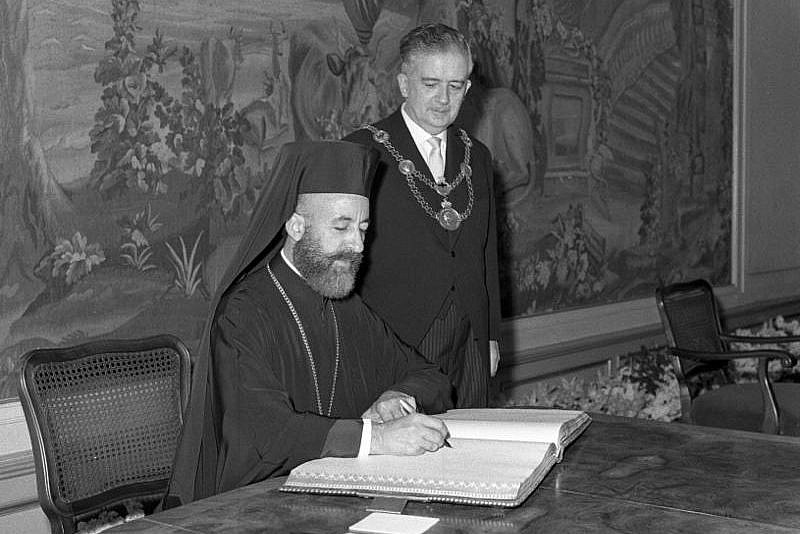
President
Makarios of Cyprus in Bonn during a state visit to West Germany, May 22, 1962.
(Bundesarchiv, B 145 Bild-F012969-0006/Patzek, Renate/CC-BY-SA 3.0)
Learning the wrong lessons
It was the
junta’s intervention in Cyprus — supporting a military coup that took place on
July 15, 1974 — that ultimately led to its downfall. The leaders of the coup
deposed Makarios, and announced their intention to annex the island to Greece.
Five days later, Turkey invaded the island in the name of protecting its
Turkish minority and occupied the northeast. Two hundred thousand Greek
Cypriots living in this area were deported or fled from the Turks, leading the
island to be divided along ethnic lines, which has lasted to this day.
Israel was
well aware of the junta’s involvement in what was happening. According to a
situation assessment prepared by the Israeli ambassador in Nicosia on July 18,
three days after the military coup on the island:
“There is no dispute that the coup was carried out
by the Greek officers of the Cypriot National Guard, in accordance with
instructions from Athens. The assessment is that the ruling sect in Athens
acted out of a lack of understanding of international affairs and from a
provincial perspective.”
On July 22,
a week after the coup, the exiled president of Cyprus, Makarios, asked Israeli
Prime Minister Yitzhak Rabin for assistance in preserving the island’s
independence. Instead of providing aid, however, the Rabin government simply
decided to send Makarios a nonchalant greeting from the former Israeli
ambassador to the island, Rachamim Timur, in which he hoped for his well-being,
wishing him health and all the best. Rage at the military junta’s intervention
in Cyprus led
to its collapse, and Greece
began the process of becoming a democracy once again.
Yael Vered,
the Israeli diplomat, prepared a summary of the lessons to be learned from the
recent Cyprus crisis. “Israeli conclusions: a. A minority of 18 percent can win
full political rights if it has military and political support fighting on its
behalf; b. 200,000 people can become refugees without the world being shocked;
c. The nullity of the guarantees of ‘world powers’ has been proven … d. The
impotence of the UN in finding an actual solution to crises has been proven
once again (if indeed this even needs to be proven).” In another telegram,
Vered wrote that “the Cyprus affair has
so far demonstrated the impotence of the UN and its inability to solve complex
problems such as the Cyprus problem (or, in the past, Vietnam, the Israeli-Arab
conflict, Kashmir, etc).”
Apparently,
Israel did not learn to be wary of future cooperation with other oppressive
military regimes, did not learn that using excessive force can cause a regime’s
downfall, and did not learn that upholding violent military rule is perhaps not
worth the devastation it inflicted on innumerable citizens. Israel did,
however, learn that refugees can be easily deported and that the UN is
powerless — though Israel likely knew this already.


