Showing posts with label ateret cohanim. Show all posts

8 March 2018

Israel’s War on the Church of the Holy Sepulchre forces it to close

From arson to tax – Israel wages war on the Church

UPDATE:  Since this article was written the Israeli authorities have backed down from their attempt to loot the Church of its funds.  The embarrassment of the closure proved too much to the Zionist state .

This is not to exonerate the church either though, as it has engaged in property sell offs and speculation at the expense of its own membership 
see Jonathan Cook's
Worshippers locked out of the traditional site of Jesus' crucifixion and resurrection AP Photo/Mahmoud Illean

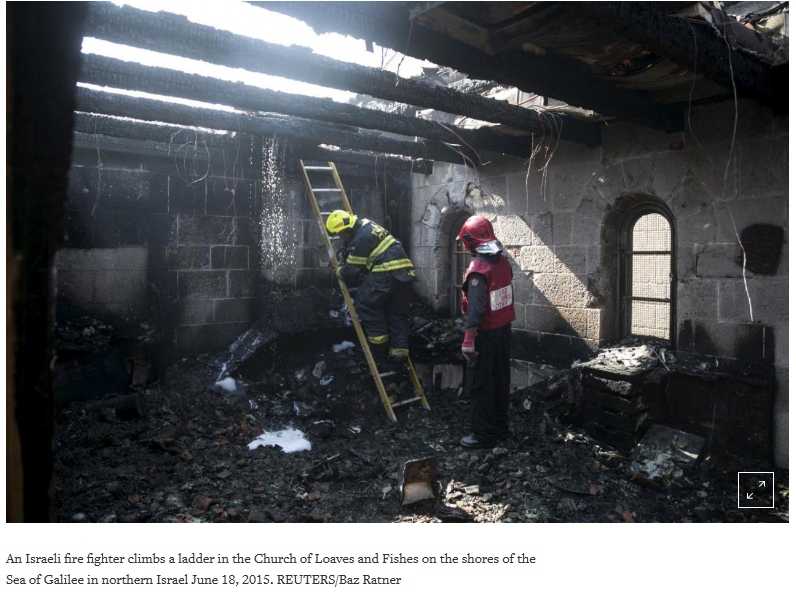
It used to be Israel’s proud boast that it guaranteed freedom of religion and worship.  Today, as Israel slides to the racist Right, this is no longer true.  Churches like the famous Church of the Fish and Loves was subject to arson 2½ years ago.  It was one of a number of such arson attacks that the authorities had turned a blind eye to.  The Israeli municipality under Mayor Barkat has a more sophisticated method of attack – the tax system – which is equally if not more deadly.

Couple this with the Muezzin Bill which outlaws the call to prayer for mosques early in the morning and we see the instrumentalisation of Israel’s chauvinist and racist attitude to other forms of worship than Judaism.
Tony Greenstein


Christian holy site in Jerusalem closes down over Knesset bill restricting sales of church land and Jerusalem move to charge millions of shekels in disputed back taxes
Adeeb Jawad, the custodian of the keys of the Church of the Holy Sepulchre (MARC ISRAEL SELLEM/THE JERUSALEM POST)
By Sue Surkes 25 February 2018, 

The Church of the Holy Sepulchre on Sunday closed its doors until further notice as church leaders angrily retaliated against what they see as a “systematic campaign” by Israel to harm the Christian community in the Holy Land.

Flanked by Franciscan Custos of the Holy Land Francesco Patton and Armenian Patriarch Nourhan Manougian, Greek Orthodox Patriarch Theophilus lll read out a statement and then locked the ancient doors of the church in Jerusalem’s Old City.

“We will decide when and how the church will re-open,” he said, likening Israeli policies to anti-Semitic laws enacted against Jews in Europe.
Believed to be the site where Jesus was crucified, buried and resurrected, the church localed in Jerusalem’s Old City is considered to be the holiest site for Orthodox and Catholic Christians. It was last closed briefly around 20 years ago in protest against Israeli policies.

The immediate trigger was the churches’ discovery that the Knesset’s Constitution, Law and Justice Committee was to discuss — and in all probability pass — a bill on Sunday allowing the state to confiscate land sold by the churches to private investors since 2010 and pay the new owners compensation.

It was also motivated by a recent decision by the Jerusalem Municipality to freeze churches’ assets until they cough up millions of shekels in what the city claims are unpaid taxes.

“We, the heads of churches in charge of the Holy Sepulchre and the status quo governing the various Christian holy sites in Jerusalem… are following with great concern the systematic campaign against the churches and the Christian community in the Holy Land, in flagrant violation of the existing status quo,” the patriarch said.

“Recently, this systematic and offensive campaign has reached an unprecedented level as the Jerusalem Municipality [has] issued scandalous collection notices and orders of seizure of Church assets, properties and bank accounts for alleged debts of punitive municipal taxes.

“These actions breach existing agreements and international obligations which guarantee the rights and the privileges of the churches, in what seems an attempt to weaken the Christian presence in Jerusalem. The greatest victims in this are those impoverished families who will go without food and housing, as well as the children who will be unable to attend school.”

Kulanu MK Rachel Azaria takes part in Knesset Finance Committee meeting on November 6, 2017. (Miriam Alster/Flash90)
Greek Orthodox Patriarch Theophilos III stands outside the closed doors of the Church of the Holy Sepulchre (AP Photo/Mahmoud Illean)
The patriarch then lashed out at what he called the “discriminatory and racist” bill that would confiscate former church land, sponsored by Rachel Azaria (Kulanu) whose spokesperson said it was supported by a majority of 61 lawmakers from across the political spectrum. The bill, which also has the backing of the foreign and justice ministries, was expected to be green-lighted on Sunday afternoon to go on to a preliminary reading in the Knesset plenum.

“This abhorrent bill is set to advance today in a meeting of a ministerial committee which, if approved, would make the expropriation of the lands of churches possible.

“This reminds us all of laws of a similar nature which were enacted against the Jews during dark periods in Europe.”

Azaria says she is seeking to protect hundreds of largely Jerusalem residents whose homes are located on land which, until recently, was owned and leased to them by the churches, principally the Greek Orthodox Church — in most cases under 99-year contracts signed in the 1950’s between the church and the state, via the Jewish National Fund.
The contracts state that when the leases run out, any buildings on them will revert back to the church. Residents expected that the leases would be extended. But in recent years, in order to erase massive debts, the Greek Orthodox Church has sold vast swaths of real estate to private investors, and nobody knows whether they will renew the leases, and if so, under what conditions.

Indicating that the main role of the bill is to get the new landowners to the negotiating table, Azaria said, “I hope that the buyers will come around and that we will succeed in arriving at a solution through negotiation and agreement. If that doesn’t happen, the law will transfer the rights to the land to the State of Israel.”

The residential buildings in question are located on church-owned land sold in the Jerusalem neighbourhoods of Givat Oranim (now owned by David Sofer, a Jewish Israeli businessman living in London and an American billionaire, Michael Steinhardt, through Oranim Ltd.); Abu Tor (where Sofer owns half a street, together with another Jewish Englishman, through a company called Kronty Investments Ltd); and in Talbieh, Rehavia, and Nayot (where Jerusalemite Noam Ben David has bought up real estate, together with an Australian and an American now living in Israel, via Nayot Komemiyut Investments).
Kulanu MK Rachel Azaria takes part in Knesset Finance Committee meeting on November 6, 2017. (Miriam Alster/Flash90)
 David Sofer (C) pictured with wife Cindy (L) at the opening reception of the Jewish Museum in London on March 16, 2010. (Desmond O’Neill Features Ltd)

For the churches, the bill constitutes an assault on their rights to buy and sell their one and only resource — investment properties.
David Sofer (C) pictured with wife Cindy (L) at the opening reception of the Jewish Museum in London on March 16, 2010. (Desmond O’Neill Features Ltd)
Over recent months, the Greek Orthodox patriarch, Theophilus III, with the backing of all the Holy Land churches, has traveled almost nonstop to seek the international community’s opposition to the move.

He has met with the pope, Russian President Vladimir Putin, the king of Jordan, the archbishop of Canterbury, and senior political figures in Greece and Cyprus.

The church’s protest also comes against a backdrop of other moves that the churches see as part of an all-out assault on long-running agreements to preserve the general status quo.

The Imperial Hotel at the Jaffa Gate, the lease to which was sold to the right-wing Ateret Cohanim organization and is the subject of an appeal by the Greek Orthodox Patriarch. (Shmuel Bar-Am)
These include an Israeli court’s August upholding of what the Greek Orthodox Church claims was a fraudulent deal carried out in its name to lease key properties in the Old City’s Christian Quarter to the right-wing Ateret Cohanim organization.

During the patriarch’s meetings, he also asked for intervention with Israel over the East Jerusalem lease deal – a deal so explosive that it led to the sacking of his predecessor. Palestinians see East Jerusalem as their capital should they reach any future peace agreement with Israel.

Fighting on a third front, the patriarchs and heads of all the main churches in Jerusalem boycotted their traditional annual meeting with the mayor and senior municipal staff 10 days ago to protest against bills of millions of shekels in back taxes that they say they should not be charged.

That dispute revolves around whether tax exemptions for the churches extend to properties, such as schools and residences, which are not used directly for worship.

Lawyers for the Greek Orthodox Patriarchate received a notice signed by a lawyer for the municipality that said a lien had been placed on the church’s assets due to an unpaid debt of NIS 30.6 million ($8.7 million). The debt was not explained. Attached was a form on which the lawyers were requested to detail church assets and to which they were invited to attach a check.

Greek Orthodox Christians call for the ouster of their patriarch, Theophilus lll, for selling church land to Jews, during the patriarch’s visit to the central city of Lod, November 16, 2017. The main banner says, “Not worthy.” (Courtesy)
Over recent months, a group called the Central Orthodox Council, which furthers an Arab nationalist agenda within the Greek Orthodox Church, has seized not only on the Old City deals but on all the church’s sales, throughout Israel, claiming that their church has sold off the family silver to Jews and alleging that the patriarch is corrupt.

A protest in support of Theophilus, took place a week ago.

See also:

Jerusalem's Church of the Holy Sepulchre closes in protest at Israeli 'Nazi-like persecution'

“This reminds us all of laws of a similar nature which were enacted against the Jews during a dark period in Europe,” say Christian leaders

12 January 2016

The Judaification of Jerusalem

Area in red shows 5 acres in middle Silwan targetted by Ateret Cohanim
This article from Ha’aretz shows how the Israeli government is working hand in hand with Ateret Cohanim, a group which  was established in 1978 with the express aim of the Judaification of Jerusalem.  It specialised in buying up property or ‘reclaiming’ Jewish property from before 1948.  Palestinians who live in buildings that used to be occupied by Jews are evicted to make way for settlers, but  the same principle never works in reverse.  Palestinians who want to return to properties they owned but now occupied by Jews have no such rights.  Racist laws like the Absentee Property Law prevent even those present in the State of Israel but temporarily absent because of hostilities from returning to their original homes.
Police guard on confiscated property
The Western powers are, of course aware of all this but prefer to turn a blind eye and pretend that there is still a peace process.

Tony Greenstein 

How Israel Helps Settler Group Move Jews Into East Jerusalem’s Silwan


Over the years, a government department has stood shoulder to shoulder with Ateret Cohanim in its struggles against Palestinian families who sought to remain in their homes.

Nir Hasson Jan 06, 2016 2:04 PM

In the mid-1990s, Ilan Shtayer, a research assistant at the Ben-Zvi Institute for the study of the Land of Israel, was asked, together with others, to conduct historical geographical research about the Yemenite Jewish section of the Arab village of Silwan near Jerusalem’s Old City. The team collected maps, aerial photographs and written sources and wrote their study of the neighborhood, where Yemenites lived from the 19th century until the riots of 1929. Among their tasks was to locate land purchased by Jewish philanthropists to build the neighborhood for the new immigrants from Yemen who arrived in 1882.

As far as Shtayer knew, the bodies commissioning the research were the Administrator General’s office, a Justice Ministry unit responsible for selling property of various kinds that is given to Israel, and Yad Ben-Zvi. Only after the report was completed and the researchers met with the research steering committee, did they realize that alongside Administrator General personnel, they found representatives of the right-wing Ateret Cohanim organization were sitting. “I remember I was very surprised to see them in the room,” Shtayer says.

The research Shtayer and his colleagues carried out was the first step in a long legal battle to make the Silwan neighborhood of Batan el-Hawa Jewish. But it was also the beginning of a close and unusual relationship between Ateret Cohanim and the Administrator General. Over the years, that government department has provided Ateret Cohanim with opinions and permits and sold the land to the association at a convenient price, and generally stood shoulder to shoulder with Ateret Cohanim in its struggles against Palestinian families who sought to remain in their homes.

After the 1990s research was used to map Jewish properties in Silwan, the next phase was for Ateret Cohanim to take possession of the historical hekdesh – the association that purchased the property in the 19th century and legally speaking is still the owner. The turning point was in 2001, when the Jerusalem District Court approved the appointment of three new individuals as trustees of the hekdesh: M., who works for Ateret Cohanim, taking care of details involving the evacuation of Palestinian families; A., a lawyer representing the association, and Y., a well-known rabbi in Jerusalem who is close to Ateret Cohanim. The Administrator General supported Ateret Cohanim’s application for their people to be appointed trustees.

Haaretz is still waging a legal battle, which went all the way to the Supreme Court, to have a gag order lifted on the names of the individuals in question; the court approved their request to keep their names confidential because revealing them could put them in danger.

A year after the District Court’s ruling, the new trustees asked the government’s administrator of properties to release land to the hekdesh. The administrator approved the request and transferred to the hekdesh 5.5 dunams (about 1.3 acres) in the heart of Silwan, where hundreds of Palestinians live. Ateret Cohanim then launched the legal process to evict the Palestinian families.

A year ago, in an effort to remove all doubt, the deputy head of the office of the administrator of absentee property, Sigal Ya’akobi, signed another document releasing the land to the three trustees. This time, the precise lots are mentioned: 95 and 96, according to official Israeli land records.

But the administrator’s most problematic decision was to sell four other lots to the hekdesh that were not part of its original land. This happened in 2005, when the administrator realized that the original owners could not be located. The land, almost 2,000 square meters, was sold for 995,825 shekels ($253, 240).

Why did a right-wing group receive the right to purchase the property in the densely populated heart of Silwan, at such a low price and without a tender? According to law, the administrator must give priority in selling property to individuals in possession of or living in nearby assets. But a glance at the map shows that two of the lots are not adjacent to the hekdesh and are surrounded on all sides by Palestinian lands. Two other lots owned by the hekdesh are adjacent to it only on one side, meaning that three or four neighbors other than the hekdesh could be potential purchasers – but they were not given the opportunity to do so because the administrator did not publish a tender.

Regular property costs in Silwan show what a low price Ateret Cohanim paid. According to records of the Tax Authority, an average apartment in Silwan goes for 1.2 million shekels. In 2005 prices were significantly lower, but according to experts, they have not changed as drastically as in the western part of town and the rest of the country.

According to a Justice Ministry statement released in the name of the Administrator General’s office, the price Ateret Cohanim paid is higher than the value determined by a real estate assessor.

The administrator did not deny that no tender had been issued and gave no explanation for this, or for the fact that preference was given to Ateret Cohanim.

The Duweik family, one of those living in hekdesh property, has been waging various legal battles against Ateret Cohanim. The family has so far lost in the Jerusalem District Court and the Supreme Court in a suit brought by Ateret Cohanim against illegal construction the family carried out, and Ateret Cohanim is now suing to have the family evicted.

One of the family’s attorneys, Hussam Siam, says the administrator’s conduct shows the close connections with Ateret Cohanim. The court had ordered the administrator to allow the family’s legal team access to all documents, Siam says. “But when we came to the administrator’s office, their representatives and Ateret Cohanim people were sitting there and every important document we wanted to see they said, ‘no, that’s forbidden, that’s confidential.’”

Jerusalem District Court Judge Aharon Farkash dismissed that argument, saying that the family should have subpoenaed the administrator’s employees to cross-examine them about it.

Attorney Mohammad Dahla, who represents Palestinian families in Silwan, and other lawyers have identified a number of ways to take over property in East Jerusalem that had belonged to Jews before 1948. Appointing trustees to hekdesh property is one way. Another, used in the East Jerusalem neighborhood of Sheikh Jarrah, is to locate the Jewish heirs to various properties, have them sign power of attorney over to the association and approach the administrator’s office in the name of the heirs with a request to release the property. The association then purchases it from the Jewish family, and moves people in. In most cases, right-wing activists play “matchmaker” between the heirs and donors from abroad who purchase it from them.

A third method is for right-wing activists to approach the administrator’s office directly to request that a property be sold to them. The Custodian of Absentee Property in the Finance Ministry and the Administrator General in the Justice Ministry have sold dozens of properties in East Jerusalem over the years, many of them to groups working to settle Jews in East Jerusalem.

“The deep involvement of the Administrator General and the authorities in transferring assets in Silwan to settlers pulls the rug out from under the government’s claim that these are merely private real-estate dealings,” says Hagit Ofran of Peace Now.

The Justice Ministry spokeswoman said the administrator general “does not manage documentation about the tenants. An amended release certificate was issued at the request of the hekdesh trustees based, among other things, on the opinion of a licensed surveyor… The matter received further validation from the District Court.”

In contrast to the Duweik family’s attorneys’ claim, the spokeswoman said that “in the framework of the legal proceedings the parties were given the opportunity to examine the administrator general’s file.”

As for the sale of properties to the hekdesh, the Justice Ministry spokeswoman said the lots were offered for sale “a decade ago in light of their planning and legal status… while maintaining the broader interests of the owners of the lots.”

Attorney Avraham Moshe Segal, who represents the hekdesh, said: “Haaretz readers should know that the Supreme Court issued a gag order prohibiting Haaretz from published details that could identify those involved in the purchases in Silwan. Haaretz should bow its head and respect the court’s verdict.”

Segal also noted that “four District Court judges noted that the hekdesh is the legal owner of the hekdesh land. This was approved by four Supreme Court justices. All claims by Haaretz were rejected in verdicts of the Supreme Court, a fact that does not stop the newspaper from thinking, mistakenly, that it is a judicial tribunal serving as a court of appeals over the Supreme Court.”
Nir Hasson

Nir Hasson
Haaretz Correspondent