Showing posts with label Susan Abulhawa. Show all posts

6 January 2019

From Alice Walker’s Color Purple to David Icke’s Shape Shifting Lizards

Susan Abulhawa’s toleration of anti-Semitism only helps the enemies of Palestine


 A controversy has broken out over an interview that Alice Walker, famous for the Pulitzer prize winning The Color Purple, did for the New York Times. In a written interview Alice Walker: By the Book, on the 13th December, Alice responded to the question What books are on your nightstand?’ by saying that one such book was “And the Truth Shall Set You Free,” by David Icke.
‘In Icke’s books there is the whole of existence, on this planet and several others, to think about. A curious person’s dream come true.’

When Black people and Palestinians start making excuses for anti-Semitism it has but one effect. It confirms the Zionist argument that Palestinian opposition to Israeli settler colonialism is motivated not by outrage at Israel’s behaviour but by hatred of Jews.
Of course the Zionists have leaped upon this. Zionist opposition to the anti-Semitism of people like Louis Farrahkan is not motivated by genuine outrage at his racism but by their own racism. When the Anti-Defamation League, a group that worked with the South Africa Secret Police BOSS and sends US Police for training Israel denounces Farrakhan we can smell the racist hypocrisy a mile off. [See Lenni Brenner, When Israel Was Apartheid’s Open Ally].
Anti-Semitism amongst Black people in the US is reflective racism. It is equivalent to the Jewish reaction to non-Jews and anti-Semites in Russia and Poland which was often chauvinist. When the ADL home in on Louis Farrahkan and ignores Trump, Bannon, Orban and all the other genuinely anti-Semitic white supremacists we can  be sure that what motivates them is not anti-Semitism but support for Zionism.
Nonetheless the apologetics of Alice Walker are deeply depressing. Walker is a brilliant novelist and anyone who has read her tale of racism, abuse and misogyny cannot help but be moved. 
Reactions to Alice Walker's comments
I don’t know what other planets Icke has visite but what is clear is that he is anti-Semitic. Icke isn’t dangerous in the way that the supporters of Tommy Robinson are or the supporters of Zionism are. He is more mad than bad. He believes that an inter-dimensional race of reptilian creatures control the world. His books, the Robots Rebellion and And the truth shall set you free endorse the anti-Semitic forgery The Protocols of the Elders of Zion. It is incomprehensible that Alice Walker has chosen to endorse Ike.
Reactions to Alice Walker's comments
Isaac Stanley Baker describes the book in the Washington Post thus;
“And the Truth Shall Set You Free,” which draws on the infamous anti-Semitic forgery “The Protocols of the Elders of Zion,” includes this judgment: “I strongly believe that a small Jewish clique which has contempt for the mass of Jewish people worked with non-Jews to create the First World War, the Russian Revolution, and the Second World War.” The Nazi extermination, he wrote, was “coldly calculated by the ‘Jewish’ elite.”
It is therefore doubly regrettable that Alice Walker, instead of reassessing what she said, dug herself further into a hole. On her own website she defends Icke, as a fellow victim of censorship and denies that he is an anti-Semite even though he holds that Jews in effect organised their own destruction. How would Alice Walker have described someone who said that Africans were responsible for the slave trade? The fact that some Africans collaborated with the slave traders and some Zionists collaborated with the Nazis does not therefore mean that either the Slave Trade or the Holocaust was a consequence of their victims’ actions. Alice Walker wrote:
I find Icke’s work to be very important to humanity’s conversation, especially at this time.  I do not believe he is anti-Semitic or anti-Jewish.  I do believe he is brave enough to ask the questions others fear to ask, and to speak his own understanding of the truth wherever it might lead.  Many attempts have been made to censor and silence him.  As a woman, and a person of color, as a writer who has been criticized and banned myself, I support his right to share his own thoughts.
Walker compares the ‘attempt to smear’ Icke with the attacks on her and supporters of BDS. It is a confused melange.
But if we can ignore the racist ravings and ramblings of her Zionist critics, whose attacks on Walker are motivated only by their own racism the same cannot be said of her Black Jewish critics.  One such is Nylah Burton in Alice Walker’s Terrible Anti-Semitic Poem Felt Personal — to Her and to Me. Nylah writes about the poem It Is Our (Frightful) Duty To Study The Talmud.

Reactions to Alice Walker's comments
It’s chilling to think that such an acclaimed novelist could regard Icke’s work as “a curious person’s dream come true,” but it turned out that Walker’s endorsement wasn’t an isolated deviation. Readers soon unearthed her poem “It Is Our (Frightful) Duty to Study the Talmud,” published on her website in 2017, which confirmed that Walker had been indulging in virulent anti-Semitism, and that it permeated not just her thinking but her work.

Nylah describes how hostility to others can be blinding to oneself yetit seems that Walker has willingly allowed herself to be blinded. “ She describes ‘Our (Frightful) Duty’ as
‘a terribly written poem filled with terrible things. It oozes deep paranoia, defensiveness, and rage. In every single way, it’s ugly.
The “poem” utterly fails as poetry. It isn’t lyrical. Its lines and stanzas are choppy and graceless. Each stanza seems to end with an aggressive exhale, the kind that a person expels when they finish purging the awful thoughts that consume them. In some places, it reads like a rambling lecture delivered by a tenured professor who isn’t afraid to offend her students anymore. At other times, it reads like a Breitbart article with line breaks. There is no artistry here, but there is plenty of trauma.

The most significant stanza is where Walker writes:
For the study of Israel, of Gaza, of Palestine,
Of the bombed out cities of the Middle East,
Of the creeping Palestination
Of our police, streets, and prisons
In America,
Of war in general,
It is our duty, I believe, to study The Talmud.
It is within this book that,
I believe, we will find answers
To some of the questions
That most perplex us.
Yet she couldn’t be more wrong.  The Talmud explains nothing. Attacks on the Jews in Europe often used selective quotes from the Talmud, a book of disputation and interpretation in just the same way as Zionist and Islamaphobes attack Muslim using the Quoran.

According to the sales pitch for Tommy Robinson’s Mohammed's Koran: Why Muslims Kill For Islam Islam is a religion of war and conquest, ... right up until thousands of innocent Americans were wiped out on 9/11.’

Today in Israel racist rabbis such as Yitzhak Shapira and Yosef Elitzur in Torat Hamelech use the Talmud to justify the right of Jews to murder non-Jews, yeah even their infants and suckling babes. Israel’s bloodthirsty Military Rabbinate likewise use the Talmud and the Torah to justify the slaughter and rape of Palestinians.  No doubt a similar exercise could be mounted with respect to the New Testament. It was Christians not Muslims who perpetrated the Holocaust.
But the point to make is that Israel’s murderous barbarities are not caused by the Talmud anymore than the Holocaust was a product of the New Testament or ISIS was the product of the Quoran.  Murderers often resort to religious texts to excuse their deeds but the same texts also exhort us to love thy neighbour as thy self.

Alice Walker and David Icke
We can of course expect the Zionists to denounce Alice Walker as an ‘anti-Semite’.  Although what Alice has done has provided fuel for the Zionist fire, we can disregard their criticisms of her as the ravings of hypocrites and racists. What is however more painful is the criticism from fellow anti-racists and friends and in this category I put the Israeli educationalist Nurit Peled-Elhanan. In A Letter From Nurit Peled- Elhanan, activist, educator, and friend from Israel and a Poem, she expressed her sorrow at what Alice had written:
Nurit Peled-Elhanan
Dear Alice,
I read your poem and the criticism of it and I must react.
The people who torture and kill Palestinian have never studied the Talmud. It is not studied in Israeli state schools. And no one can read it on their own. The ones who study it are the ultra-orthodox Jews such as the pro-Palestinian Neturei Karta in NY.
The quotes (whether true or false) are surely partial and do not characterize this 12 volume work (thousand pages in every volume) whose writing ended thousands of years ago.
The Talmud is not a prescriptive book. It is an endless interpretation of the Torah, always adapting the Torah to present times so that people can live by it. Ethiopian Jews never studied it and lived by the Torah as is.
In these volumes you read discussion and polemics between different sages about every tiny aspect of human life. And the discussions are brought as they happened, more or less because it was all discussed orally.
But the main thing is that each such discussion ends with: “and so they disagreed” and people would choose the interpretation they wanted. Every argument that is brought is immediately countered by an opposite argument and the discussion that ensued. It is always open ended.
In my time we learned a bit of it and I loved it, because it is Logic, like reading Plato. Today schools don’t teach it anymore.
So in order to know what is in the Talmud – which none of the non-orthodox Israelis or Jews know – you have to read at least a whole chapter, pros and cons etc.
One of the most discussed subjects in the Talmud as in the Torah is the treatment of foreigners, workers, slaves etc. Extremely human and enlightening.
I don’t want you to be trapped in superficial propaganda of ignorant people. And again: the reason for the ruthlessness and violence towards Palestinians is not to be found in ancient writings but in Modern ones. It is Modernity and European Enlightenment that brought slavery, colonialism, Fascism and Totalitarianism, national movements such as Zionism and the way to treat people as superfluous. Auschwitz was not prescribed in any ancient scripture, neither is Israeli colonialism.
Much love
Nurit
To which Alice replied:
Prof. Nurit Peled-Elhanan
***
Dear Nurit,
Thank you, Sister Nurit, for not letting go of my hand, while informing me of your views, which I welcome and respect. Though we may have areas still to discuss, and perhaps always will, given the differences in our backgrounds and cultures, my own grip is as strong.
Can you get my website: alicewalkersgarden.com where you are?  If so, please read the entire poem.  Also read a later poem, below, “Conscious Earthlings.” About the necessity of separating “Jews” from Zionist Nazis. I am including it here.
Also, would you mind if I published your letter to help with the discussion, which seems to be, from what I hear, more about shouting. I am open to continuing our dialogue, if you are.
Love,
Alice

This controversy has not been helped by Palestinian writer and novelist Susan Abulhawa, author of Mornings in Jenin who in the guise of supporting Alice has stumbled in with hobnail boots trampling all in her path. Her In defence of Alice Walker argues that Abulhalwa ‘Alice Walker's real 'offence' is not anti-Semitism; it is her unwavering support for the Palestinian cause.’
Alice Walker and Palestinian Women
Yes that probably is what motivates some, but by no means all, of the criticism of Alice Walker, but whose fault is that? Undoubtedly Alice Walker has been viciously attacked for her support for the Palestinians and that includes the routine cry that she is ‘anti-Semitic’
Alice Walker is a good example of how false accusations of anti-Semitism actually create anti-Semitism. In what must be rank as one of the most fatuous analogies Abulhalwa compares the reaction to Alice Walker’s comments to that of Israeli Palestinian poet Dareen Tatour whom the Israelis gaoled for 5 months for writing a poem:
I am reminded of Dareen Tatour, who was imprisoned by Israel for a poem she posted on Facebook, on the fanciful claim it called for violence against Jews; and Gunter Grass, whom Israel banned and lobbied to have his Nobel Prize in Literature rescinded because he wrote a poem arguing that Germany should stop supplying Israel with nuclear submarines. Even the work of Mahmoud Darwish, Palestine’s greatest poet, was denounced as the equivalent of Adolf Hitler’s Mein Kampf.
The Board of DYR still lists Lea Tsemel and Ilan Pappe

Unfortunately Abulhawa has kept company with some pretty dodgy people previously and it was only in 2014 with their attack on BDS that she parted company with the Board of Deir Yassin Remembered. DYR, which was formed about 10 years previously, had been taken over by a right-wing American Professor Daniel MacGowan together with an anti-Semitic Israeli/Swedish fascist Israel Shamir and a British holocaust denier Paul Eisen. Its original purpose was to build a memorial to the village of Deir Yassin in Palestine, where a terrible massacre of up to 254 people had occurred in April 1948, as a means of ‘encouraging’ the Palestinians to flee from their homes.
DYR had originally included people like Jeff Halper, Ilan Pappe and Lea Tsemel, all of them Israeli anti-Zionists.  One by one they all resigned from DYR. Yet if you go to the web page today you will still find some of them listed as members. As Halper remarked, “The Deir Yassin Remembered board is like Hotel California, you can check in any time you like, but you can never leave).” See, Jinjirrie, BDS Attacked by the Deir Yassin Remembered
Below is a very moving article by a Black Jewish American, Nylah Burton, about her feelings concerning what Alice Walker has written.

Alice Walker’s Terrible Anti-Semitic Poem Felt Personal — to Her and to Me

The Intelligencer, 26.12.18.
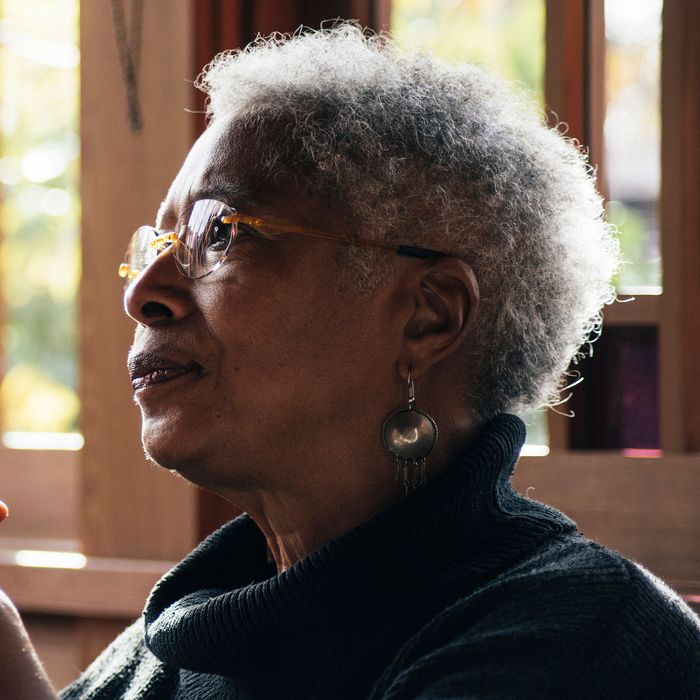
Photo: Peter Earl McCollough/The New York Times/Redux

When I first read Alice Walker’s The Color Purple, I leaned into every word, inhaling Celie’s tragic and triumphant story. In Celie, I felt the presence and pain of my female family members brought up in rural Alabama. In Walker’s unflinching descriptions of misogyny, domestic violence, homophobia, and incest, I saw an open accounting of issues buried deep within the larger southern black community — and within my own family.
Above all, I was drawn into The Color Purple because it was haunted by ghosts — the ghosts of Alice Walker’s past. Eloquently and bravely, she was able to confront generational trauma by telling a universal tale that still felt faithful to her own story. And it was Walker’s ability to throw open the shutters and allow her ghosts — our ghosts — into her writing that made it so revelatory. It cemented her standing as an acclaimed novelist, a civil-rights icon, and a formidable thought leader in the field of black feminism.
That changed abruptly two weeks ago, after the New York Times invited Walker to list her favorite books in its weekly “By the Book” column. She took the opportunity to promote David Icke’s And the Truth Shall Set You Free, which contains some of the most hateful anti-Semitic lies ever to be printed between covers. As excerpted in the Washington Post, Icke’s book alleged that a “small Jewish clique” had created the Russian Revolution and both World Wars, and “coldly calculated” the Holocaust to boot. Icke has also accused Jews (among others) of being alien lizard people. After a week of criticism, Walker doubled down in her assessment of Icke’s indefensible work, calling him “brave” and dismissing charges of anti-Semitism as an attack on the pro-Palestinian cause.

It’s chilling to think that such an acclaimed novelist could regard Icke’s work as “a curious person’s dream come true,” but it turned out that Walker’s endorsement wasn’t an isolated deviation. Readers soon unearthed her poem “It Is Our (Frightful) Duty to Study the Talmud,” published on her website in 2017, which confirmed that Walker had been indulging in virulent anti-Semitism, and that it permeated not just her thinking but her work.
The ghosts in The Color Purple helped me to better understand my own identity and the suppressed history of my ancestors — a journey I’m constantly engaged in as a black Jewish woman. But the ghosts in “It Is Our (Frightful) Duty” leave me with more questions than answers. How did Walker’s curiosity curdle into paranoia? How was her commitment to improving the human condition twisted into support for genocide apologists? How could the artist who helped America to better understand black women use her writing to promote the oppression of another group?


13 September 2017

What kind of state gaols its poets? The Israeli state (if they're not Jewish)


Below is the poem that has cost Dareen Tatour 3 months in prison so far and more than 18 months under house arrest, banned from even accessing the Internet.  Her crime?  Writing a poem of resistance.  ‘Resist the settler’s robbery and follow the caravan of martyrs... Resist my people, resist them.’ 

It speaks volumes about the insecurity of the settler mentality that they seek to gaol someone whose only weapon is the pen and the keyboard.  No matter how powerful the Zionists are they know that their existence as a settler colonial state is illegitimate.  Israel is only in existence as a ‘Jewish’ state because of the expulsion and dispossession of the indigenous population, hence why calls to resistance are considered ‘terrorism’ i.e. a threat to the legitimacy of the state itself.
For all the pretence that Israel is a normal Western state, can anyone imagine anywhere else in Europe, even Poland and Hungary, where a poem calling for resistance can merit arrest and gaol?  Underneath its democratic skin, which these days is almost invisible, Israel is a police state for its Palestinian citizens.
Of course if you are Jewish then no matter of abuse on social media will get you arrested.  Hence no-one got arrested or prosecuted when 16,000 Israelis joined a Facebook page ‘Kill a Palestinian every hour.’

The campaign in support of Dareen is however going from strength to strength as the settler state becomes embarrassed over its violence toward a female Palestinian poet.  Contrast this with the lack of any prosecutions of Lehava, whose founder Benny Gopstein called for the burning down of churches and mosques, or the failure to prosecute Rabbis Shapira and Elitzur over a delightful little book that they wrote called the King’s Torah (Torat HaMelech).  This compendium explained how, under Jewish law, one could legally kill non-Jews.  It was perfectly permissible to kill innocent non-Jews, including children and infants, in a war time situation without any come-back from the good Lord.  Suffice to say Israel’s legal authorities were nonplussed.  [See Jerusalem Post, 28.5.12.] A-G: 'TORAT HAMELECH' AUTHORS WILL NOT BE INDICTED]

But of course Israel is not a racist state and Zionism is not a form of racism. 

Tony Greenstein

Meet the Palestinian Israel put on trial for her poetry

+972 Magazine By Orly Noy
|Published August 28, 2017

Dareen Tatour at the Nazareth Magistrates Court. (Oren Ziv/Activestills.org)
Dareen Tatour has spent over a year and a half under house arrest for publishing a poem on her Facebook page. Since then, she has lost the ability to support herself, and cannot leave the house without a ‘chaperone.’ Orly Noy spoke to Tatour about the difficulty of living under constant surveillance, her love for Hebrew and Arabic poetry, and the need for Jews and Arabs to learn each other’s language. 

One day in the future, when they write the book on the belligerence and aggression of the State of Israel toward its Arab citizens, the story of Dareen Tatour — who has been under house arrest for nearly two years, including three months of jail time — will have its own special chapter dedicated to it.

Tatour was arrested in October 2015 for both a poem and Facebook post she published. Since then, the state has been waging a legal battle, which has included bringing in a series of experts on both Arabic and Arabic poetry, in order to dissect the words of a young poet who was nearly anonymous until her arrest. Her trial, and the state’s attempts to turn a poem into an existential threat, has been nothing short of Kafkaesque.

I spoke to Tatour from her home in the village of Reineh, near Nazareth. As part of the conditions of her house arrest, Tatour is not allowed to use the Internet or smart phones. “So I started using dumb phones,” she laughs. Soft spoken, Tatour maintains a reserved matter-of-factness even as she recalls those first knocks on her door and the moment everything changed.

Daren Tatour is seen in her home in the village of Reineh, near Nazareth, August 23, 2017. (Oren Ziv/Activestills.org)
It was on October 11, 2015. It was 3:30 a.m. when they suddenly they knocked on the door. I was sleeping, and I heard my mother and father coming to wake me up. There were many police officers, more than 10. They said nothing except that I had to come with them. My mother and father tried to ask what happened, what I did, but the officers only responded with ‘she knows.’ I know I did nothing wrong, so I didn’t understand what was happening. It was very frightening, I thought maybe it was a case of mistaken identity.”

They took me to the police station in Nazareth, where I waited in the yard until 6 a.m. As I waited, every officer who passed by said something hurtful. ‘You look like a terrorist,’ I got a lot of that. That word was repeated often. Afterwards they let me into the building where I was interrogated. I wasn’t shown a thing, I was only told that I was accused of incitement to violence, terrorism, and threatening to kill Jews on Facebook. I remember it was freezing, that I had walked into a morgue. At 9 a.m. I was taken to another interrogation, before I was taken to the court house at around 9 p.m., where they extended my detention.

“Later they asked to extend my detention until the end of the investigation, transferring me to Jalame Prison, and then to Damon Prison. I suffered greatly, since they allowed smoking in the rooms, and the place was not clean. After the third interrogation, when they brought the poem for the first time, it was like watching myself in a movie. I am going to sit in prison because of a poem.”

Since then, Tatour’s poem has kept the Israeli legal system busy. After spending three months in prison and six months in house arrest in Kiryat Ono, near Tel Aviv, she is now under house arrest in her parents’ home in Reineh. After over a year and a half, she was finally allowed to leave the home for a few hours a day, although she must be accompanied by one of eight “chaperones” who were approved by the court. “My eight prison guards,” she says, laughing again.
Dareen Tatour (left) and Professor Calderon (center) speak at the Nazareth Magistrates Court, March 19, 2017. (Yoav Haifawi)
The hardest part is that I can no longer support myself,” she says. Until her arrest, Tatour worked for five years as the manager at a beauty salon in Nazareth in charge of marketing. “I tried to find work from home, but it is very hard because everything is Internet-related. The condition from the beginning was that Internet or smart phones were forbidden anywhere I lived under house arrest.” Tatour’s parents and two brothers also live at home, which means they too cannot use a computer with Internet.

What are you doing at home these days?

Not much. I write and read a lot — poetry, literature, in Arabic and Hebrew. I read Amira Hess’ book of poetry, as well as poems by Alma Katz. In Arabic I love Nazik Al-Malaika, Mahmoud Darwish, Samih Al-Qasim, Khalil Gibran, as well as classic poetry such as Al-Mutanabbi.

At what age did you start writing poetry?

“More or less since I was seven. I remember my first grade teacher asking me what I wanted to be when I grew up, and I responded ‘I want to write.’ I don’t know where I got that answer from, but I do not forget it. My love for writing is not new. After learning the alphabet, I began doodling and writing — I’ve been journaling since I was very small.
Tawfik Tatour, father of Dareen, demonstrates for her release at Jaffa’s Clock Tower Square, June 26, 2016. (photo: Haim Schwarczenberg)
“As a child, words were something that kept me busy. I would drive my teacher crazy because I would ask her for the definition of all kinds of words. She would always tell me to go look it up in the dictionary. So that’s exactly what I did. I read the Arabic dictionary like a novel, from the beginning to the end. Then I did the same with the Hebrew dictionary.

“I always worked alongside Jews. I think it is important that both sides — Arabs and Jews — learn each others’ language.”

Tatour’s first collection of poems, titled The Last Invasion, in 2010. “When I arrested, the second book was almost done — even the cover was ready. I was getting ready to send the book to print. Let’s just say that a few new poems have been added to the book since,” she says.

Aside from issues of national identity, what other topics do you touch on in your poetry?

“I write about the status of women in Arab society. Women are at the center of my poetry — their hardships, the abuse they face. And children war. The weakest, most difficult aspects of life. These are things we cannot ignore. Even if they are difficult issues in Arab society.”

Was it strange sitting in the court room and listening to people interpret your poem?

“Yes, it was difficult to digest. The serious problem was that they mistranslated it. It isn’t even an issue of interpretation — the translation was wrong, and thus the police’s interpretation was completely off.”

What kind of responses have you received?

I have received incredible support from my friends, including from Jewish Israelis — support that has really surprised me. It has given me a lot of strength. They tried to put me in a place I didn’t want to be in; the first time they told me I was a terrorist, I felt a great deal of pain. This is a very harsh word. They tried to stigmatize me, but I am glad to say they were unsuccessful. There are people who know the truth and I am happy that they understand my words correctly. I want to thank all those who have supported me.

Are you optimistic?

She laughs again. “So-so. I am trying to remain optimistic. There is a poem in my book about handcuffs, which terrifyingly enough came true. They say that every poet is a prophet, and I feel that. In this country we cannot be too optimistic, but I am trying my best.”

This post was originally published in Hebrew on Local Call. Read it here.

US literary figures renew call for freedom for Palestinian poet Dareen Tatour


Dareen Tatour at the Nazareth Court House, September 2016. (Photo: Oren Ziv, Activestills)

Prominent U.S. poets, writers, playwrights and publishers issued statements today in support of imprisoned Palestinian poet Dareen Tatour ahead of her upcoming trial verdict on October 17.  The statements calling for her freedom, and demanding that Israel drop all charges against Dareen, released by Jewish Voice for Peace and Adalah-NY, come just as the Israeli government threatens to cut funding to a Yaffa Theater that agreed to host an artists’ solidarity event for Tatour on August 30th. Tatour, a Palestinian citizen of Israel, was arrested by Israeli authorities 22 months ago, in October 2015, and charged with incitement to violence primarily over a poem she posted online, “Resist, My People, Resist Them,” as well as two Facebook posts.
Following an initial three months of imprisonment after her arrest, Tatour has been held under house arrest for over a year-and-a-half. At her upcoming October 17 court date she expects to receive a verdict from an Israel court with high rates of conviction for both Palestinians living under Israeli military occupation as well as Palestinian citizens of Israel.

Numerous freedom of expression and literary organizations including PEN International, PEN America, and PEN South Africa have called for Tatour’s freedom, as have many Israeli artists and Israeli citizens. The 12 literary figures whose statements are being issued today are among 300 writers, including 11 Pulitzer Prize-winners, who signed a 2016 letter calling for freedom for Tatour after she was first arrested. These statements of solidarity with Dareen Tatour come from: Susan Abulhawa, Ben Ehrenreich, Deborah Eisenberg, Marilyn Hacker, Randa Jarrar, MJ Kaufman, Eileen Myles, Naomi Shihab Nye, John Oakes, Sarah Schulman, Ayelet Waldman and Jacqueline Woodson.
Six of the statements follow. All 12 statements are available below.
Ben Ehrenreich
Ben Ehrenreich, Writer:When one fights without fear—when one fights with love instead, fighting looks like something else entirely. Like poetry. Dareen Tatour resists without fear, with poetry and with love, and they will not silence her. Stay strong, Dareen—we are with you.”

Randa Jarrar, Writer:We must call on the international community to place pressure on Israel to release Dareen and other political prisoners whose ‘crimes’ are those of self-expression and resistance. No one should be forbidden from using the internet, publishing their writing, or attending events, whether they be political or not. The fact that writer Dareen Tatour continues to be placed under house arrest and only allowed out with a guardian is misogynist, racist, and unjust.

Eileen Myles, Poet: “Israel’s claim to be a democracy is roundly trounced by this attempt to silence Dareen Tatour. Language lives and dies in poetry and the human cry for freedom breathes in a poets utterance. A poet never stands alone and I’m proud to stand with the people of Palestine and globally who demand that Dareen Tatour’s voice and words are not criminalized, penalized and obstructed. As a human and a citizen of the earth it is her and all of our right to write and be heard.”
Naomi Shihab Nye
Naomi Shihab Nye, Poet and Writer:It’s an absolute outrage that poet Dareen Tatour has been treated this way by so-called democracy Israel for speaking truth and using the word Resist. We all resist. She deserves nothing but freedom and even bigger paper and more pens! We speak up for her in the name of justice and our own tax dollars channeled Israel’s direction for way too many years.”
Ayelet Waldman, Writer: “Two years ago Dareen Tatour was torn from her home in the middle of the night. A poet, incarcerated by Netanyahu’s right wing government for the crime of making her art. This must stop. She must be released.”

Jacqueline Woodson, Poet and Author: “I believe Dareen Tatour should be free to leave her home, to write what she needs to write for her own empowerment, to live her life as poet. Freely.”
Although the conditions of her house arrest were somewhat improved after the public outcry from the literary and international community in 2016, Dareen is still forbidden from using the internet, publishing any of her writings, or participating in any political events.

Dareen Tatour’s case represents just one of countless examples of Israel’s systematic suppression of Palestinian arts, culture and political expression. For example, Israel’s Minister of Culture Miri Regev continues to try to ban public readings of the poetry of the late, renowned Palestinian poet Mahmoud Darwish, and to shut down plays about Palestinian prisoners. Just recently, 67-year-old writer Ahmad Qatamesh was released by Israel after three months of imprisonment without charge. Dr. Qatamesh, named a prisoner of conscience by Amnesty International, has been jailed periodically for eight of the last 25 years.

Over 400 Palestinians, in both the occupied Palestinian territories and in Israel have been arrested for posts on social media in the last year alone. According to the Palestinian prisoners’ rights group Addameer, Israel currently holds 6,128 Palestinian political prisoners, including 450 Palestinian “administrative detainees” held without charge or trial, 320 child prisoners and 62 Palestinian women. Since 1967 more than 800,000 Palestinians from the occupied Palestinian territories (oPt) have been detained under Israeli military orders.

More statements of solidarity of leading literary figures:


Susan Abulhawa, Writer
Dareen Tatour is no Arab-Israeli. She was born Palestinian as all her ancestors were. She is a daughter of the land conquered and occupied by zionist foreigners, who thought that renaming the land, uprooting our lives and planting lies in the soil could make them take her place. But a nation built on lies is a lie itself. It has no bearings in truth, and stands on a web of fairy tales that fall apart by the true words of a native woman. That is why Dareen’s voice, her art, her defiance and her dignity are so dangerous. She holds moral and historic title to this place, and it holds title to her. And so, bereft of legitimacy, the lie-nation resorts to brute force, the only power they’ve ever had and ever will, but that, too, will fall apart, because ultimately, guns and oppression are no match for an indigenous song that cries for liberty.”

Deborah Eisenberg, Writer

Should I be elated that the People of the Book – my people – accord full recognition to the power of poetry? Or should I note, with great sorrow, that the state of Israel so fears a response equal in force, cruelty, and violence to the crimes it has committed against the Palestinian people that it is driven to eradicate the voices of resistance, even those of poets?  What do you think?”

Marilyn Hacker, Poet and Translator

Dareen Tatour is a poet, and a witness –that word is “shahid” also, just one long vowel shifted. That she should be tried, confined, attempts made to silence her, and those who support her,  in a country that vaunts its “democracy” is aberrant and grotesque.”
MJ Kaufman
MJ Kaufman, Playwright

“Poetry is not a crime, it is a powerful tool for revealing injustice. Dareen is being punished for writing her truth. As an American Jewish writer I think Dareen’s voice desperately needs to be heard. Efforts to imprison her and silence her writing only further an authoritarian agenda. Dareen and all Palestinians imprisoned for speaking out against the injustices of the Israeli state should be free.”

John Oakes, Publisher

“Dareen Tatour has a moral and legal right to give voice to her thoughts. Artists, poets, all of us must join together, follow her example and resist oppression, however, we can. I admire her courage, and am ashamed of the unique role Americans play in propping up the apartheid Israeli regime, which makes artistic freedom contingent on support for the state.”

Sarah Schulman, Novelist and Playwright


“I stand with people all over the world who are horrified by the ongoing persecution of Palestinian poet Dareen Tatour and call for immediate relief and an end to all forms of harassment of Dareen and her supporters. Poets are the voice of the human spirit and give us words for our experiences and feelings that help us imagine and strive for liberation. I send my warmest support to Dareen.