I’m not talking about the West Bank, but Israel behind the so-called
Green Line. Virtually every aspect of
life – education, employment, housing, welfare is segregated. Towns and villages are established that are Jewish
only – part of the programme to ‘Judaify’ the Galilee, Jerusalem or the Negev.
Of course none of this is actually stipulated in legislation. There are no signs saying ‘No Arabs’ but
there doesn’t need to be. In the West
Bank the army patrols under orders to prevent Arabs using ‘Jewish only’ roads.
 |
| Israeli Palestinian couple barred from renting a house in a Jewish village |
In Israel proper there is a
complex interconnection of adminstrative practices, Zionist organisations which
pursue of ‘Jews only’ policy and deceptively labelled legislation which
guarantees that Arabs and Jews will not mix and that Arab services such as
housing will remain eternally inferior.
As Ha’aretz explained in Segregation of Jews and Arabs in 2010 Israel Is AlmostAbsolute
‘Under the guise of the deceptively mundane name "Amendment to the
Cooperative Associations Bill," the Knesset's Constitution, Law and
Justice Committee this week finalized a bill intended to bypass previous
rulings of the High Court of Justice. If indeed this legislation is approved by
the Knesset plenum, it will not be possible to describe it as anything other
than an apartheid law.'
The legislation was passed, as the
Access to Communities Law and it enabled villages of communities in Israel to
block Arabs buying houses or renting land in their villages because they would
not ‘fit in’ to the social fabric. Below is an article describing this process in the US Jewish Forward magazine.
Israel's Virulent Housing Bias Runs Deep — and It's Not Only Aimed at Arabs
Naomi
Zeveloff December 29, 2015
AFULA,
Israel - From her backyard deck in Yafia, an Arab village west of Nazareth,
Iman Sharary, 53, pointed to a plot of land in the distance where her sons will
build their homes.
She
would have preferred her children stay in Yafia, but with land at a premium in
the village, she and her husband sought and won the tender to build in a less
expensive area. Afula Illit is a tree-lined suburb about 10 miles south of
Yafia. It’s also predominantly Jewish.
 |
| After demands from Jewish residents of South Tel Aviv, there are now separate kindergartens for African refugee children |
Now,
the Sharary family is at the center of a local controversy with national
proportions. One of dozens of Arab families from northern Israel that won
tenders to build 49 homes in Afula Illit, the Shararys and their fellow Arab
bidders face the fury of many of their potential Jewish neighbors.
 |
| Palestinian workers stand under a shelter to keep dry from the rain as they wait for transportation after crossing from the West Bank town of Qalqilya to work in Israel, at the Israeli army's checkpoint near Kibbutz Eyal in central Israel. Israeli Prime Minister Benjamin Netanyahu on Wednesday, May 20, 2015, called off a proposed plan to segregate Palestinians from Israelis on West Bank buses, overruling his defense minister amid a flurry of criticism in an attempt to avert the first crisis of his new government. (AP Photo/Oded Balilty, File) |
Days
after the tender process results were made public, a group of about 200 Afula
residents staged a protest, calling on Mayor Yitzhak Meron to revoke the tenders.
Demonstrators denounced him as a “traitor” and a “terrorist,” according to
press reports. “He wants to build a mosque,” one sign at the protest read.
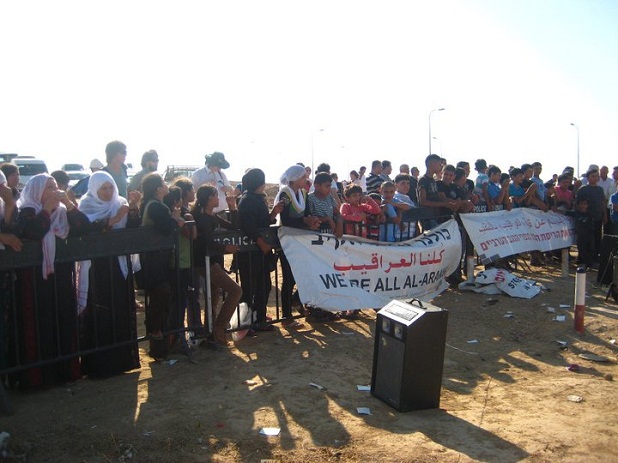 |
| Protesting Against the Demolition of Al Araqab, a Bedouin village in the Negev |
The
Afula episode is only the latest real estate controversy with a racial tinge in
Israel. According to the Walla news site, Jewish residents of Ofakim, a city
west of Beersheba, won tenders to build in the city but canceled the
transaction once they learned that 14 Bedouin residents were planning on
settling in the same area.
 |
| Image: Naomi Zeveloff, Not in My City: Adeil Eluz, a gas station manager in Afula, is protesting against the prospect of Arabs moving in nearby. |
And
in November, the Bemuna construction company posted a video advertisement of an
Ashkenazi family whose Hanukkah celebration was interrupted by Mizrahi
neighbors — Jews of Arab origin — depicted as raucously ignorant of their
Ashkenazi holiday traditions. The video, which the company later deleted, was
an advertisement for a new housing development in Kiryat Gat that presumably
would be free of Mizrahim. “Do you dream of owning your own home?” the
voiceover said. “Want neighbors after your own heart?”
Now,
Israel’s attorney general has demanded the Israel Land Authority to look into
the charge of racial discrimination at Bemuna in the sale of the apartments.
 |
| Just as with South Africa's pass system, so Israeli Police scrutinise a Palestinian's Identity Card before telling him that he can only walk on one side of the road |
These
incidents and others in recent years speak to the deep segregation in Israel.
With a few exceptions, like Haifa and Jaffa, Israel is a country split along
ethnic and religious lines, with different school systems and population
centers for each group. Officially speaking, “there is no legal basis in
creating the segregation” when it comes to housing inside the Green Line, said
Talya Steiner, a researcher at the Israel Democracy Institute. “It just kind of
evolved.”
But
the High Court has sanctioned such segregation in recent years by allowing
Bemuna, the company with the anti-Mizrachi advertisement, to build housing
explicitly marketed to Orthodox, so-called “national religious” Jews, who are
predominantly Ashkenazi, in an Arab section of Jaffa.
There
are other ways that the state maintains segregation and even helps to deepen
inequality between sectors. One has to do with the ultra-Orthodox. Because
Haredim, as they are known in Hebrew, have larger families and educate their
children in sex-segregated schools, the Housing Ministry acknowledges and
supports their need for separate neighborhoods to maintain their lifestyle. Yet
the Housing Ministry ran up against “not in my backyard” attitudes from several
municipalities when it tried to plan Haredi neighborhoods in cities with
secular and national religious majorities. Now there is a major housing
shortage for ultra-Orthodox Israelis.
Another
form of state-sanctioned segregation is seen in small communities in Israel,
such as kibbutzim or moshavim. These communities may screen new members based
on standards such as “unsuitability to the community’s social life” or its
“social-cultural fabric,” or to “unique characteristics of the community as
defined in its bylaws,” according to a law upheld by the high court in 2014.
Critics say this is actually code language to weed out Arabs, homosexuals or
anyone outside the community norm.
Beyond
the issue of segregation, Israel’s Arab villages and cities suffer from a lack
of planning, which exacerbates the housing shortage in these areas. In 2000,
after 13 Arab citizens were killed in demonstrations at the start of the second
intifada, a state commission found that inequality between the Jewish and Arab
sectors in the realms of planning and building was a central cause of the
unrest. The commission recommended new plans for Arab localities. But according
to a 2012 report by Bimkom, a planning rights organization, planning in Arab
cities still lags far behind that in Jewish areas, leading to “housing crises
and lack of public buildings for services.”
Poor
city planning in Arab areas is at least part of the reason that some Arabs are
moving out of their home communities and into Jewish towns. As Sharary said of
her family’s purchase in Afula, “Arabs need it very much.”
“The
story of Afula is a symptom of a much greater issue,” Steiner said. “There is a
socioeconomic development pushing young Arab couples to leave Arab cities and
find quality of life in adjacent neighborhoods.”
Many
of the Arab buyers in Afula — such as the Shararys, who are a family of
accountants — come from sturdier economic backgrounds than the Jews who are now
protesting their presence in the city.
“There
is a counterintuitive socioeconomic aspect here,” said Rachelle Alterman, a
planning expert at Israel’s Technion. “We are talking about an upwardly mobile,
upper-middle income, or certainly a higher-educated Arab population in Afula,
which is lower-middle income Jewish. There is this reverse disparity.”
Afula’s
Jewish protesters are expressing their opposition to these new neighbors loud
and clear. One anonymous activist posted a photo of Meron wrapped in a
keffiyeh, the Palestinian national scarf, on Facebook. Right-wing activists
mocked up similar images of Yitzhak Rabin before his murder, and also, more
recently, of President Reuven Rivlin for his outreach to Arab citizens.
According to a report on the Israeli website Mynet, the police are
investigating the picture’s provenance.
One
of the protesters, David Suissa, is chief of staff to Construction and Housing
Minister Yoav Galant of the center-right Kulanu party. Issawi Frej, an
Israeli-Arab member of the Knesset, called for his firing.
“The
Housing Ministry should campaign against racism in housing and not promote it,”
he said.
The
mayor’s spokesman, Moty Priel, said that the municipality is “unable to and
should not intervene” in the tender process. Because the land in question is
state owned, any citizen — regardless of race, religion or gender — may
participate in the auction, which is held by the ILA.
An
ILA spokesman told the Forward that the tender was conducted “according to the
rules.”
That
hasn’t placated the protesters. Adeil Eluz, manager of a gas station in Afula,
said that the tender should have first been open to locals in Afula and then to
people who have served in the army — a move that would exclude most Arab
Israelis, who are not drafted into the army.
 |
| Image: Naomi Zeveloff Working the Legal Front: Attorney Ilan Vaknin, who represents 10 Jewish families who lost an auction for tenders to build homes in Afula, says he and his clients ‘want to keep the Jewish character’ of the city. He is calling for an investigation into where the Arab families who won the bids got their money. |
“It’s
not against the Arab people,” he said. “It’s against the priority of the mayor
and his councilors to give land to outside people instead of local people.”
Ilan
Vaknin, an attorney representing 10 Jewish families who lost the auction, as
well as other Afula residents, is less guarded in his assessment.
“We
want to keep the Jewish character of the city,” he said. “And if we take in 50
[Arabs] in this little place, this will change the place from one side to the
other.” Afula’s total population is 41,000 residents.
Vaknin
said he suspects that some of the Arab buyers coordinated their bids, which
would run afoul of the ILA process.
“Maybe
an Islamist organization brought money to buy the Jewish land,” he said. “We
want the police to check it.” The mayor’s office said it would look into the
allegations.
Sharary
believes that the protesters are driven by fear. The uproar hasn’t prompted her
family to reconsider their bid. “It’s a good opportunity to make Afula another
mixed town,” she said.
Contact
Naomi Zeveloff at zeveloff@forward.com or on Twitter, @NaomiZeveloff


