Steve Bell's Cartoon Video about War Criminal Tony Blair
21 March 2013

20 March 2013
A member of the International Solidarity Movement with the Palestinians visits Yad Vashem – the Zionist Propaganda Museum
A member of the International Solidarity Movement visits Yad Vashem – the Zionist Propaganda Museum
 |
| Yad Vashem's attempt to use the agony of the holocaust to justify Palestinian agony |
An interesting take having visited Yad Vashem, the Zionist holocaust memorial museum in Jerusalem by an ISM member. Just a couple of comments.
ii. No mention of how the far-right today also pays homage at Yad Vashem whilst still denying the holocaust
 |
| Yad Vashem demonstrates why it is first and foremost a propaganda institute - the Mufti was a minor war criminal and his Muslim SS battalions were the only example among the SS to rebel against the Nazis |
iii. No mention of the special wall devoted to the British and Zionist appointed Mufti of Jerusalem, Haj al amin Husseini, who later collaborated with Hitler. He was a minor war criminal, but has a special section devoted to him nonetheless. The obvious linkage Yad Vashem’s Zionist historians are trying to create is between today’s Palestinians and neo-Nazi supporters.
Most of the rest of the essay I thoroughly agree with.Tony Greenstein
Yad Vashem, Power, and the Politics of History
 |
| Michal Kaminski MEP of Poland's Law & Justice Party - opposed any apology by Poland for Jedwabne, when anti-Semitic Poles burnt alive some 600 Polish Jews |
Feb 19 2013 / 10:43 pm
At Yad Vashem. (Photo: David Langstaff/supplied)
By David Langstaff
"I was like other men,
I fed on bread, and on dreams, and on
despair. I too
loved, I cried, I hated, I suffered…
But when you dry this bouquet of nettles,
that once was me, in a future time
when my story seems dated to you
remember that I was innocent
that like you, the bodied of your own day,
I too had a face
defined in anger, in pity, in joy
I had a man’s face." – Benjamin Fondane, who perished in the Nazi gas chambers (displayed inside Yad Vashem) (1)
"In the hymns that we sing, there’s a
flute
In the flute that shelters us
fire
In the fire that we feed
a green phoenix
In its elegy I couldn’t tell
my ashes from your dus." –
Mahmoud Darwish, who was exiled from his homeland by Zionist settler-colonialism (2)
As my friend and I made our way to Yad Vashem, the world-renowned Holocaust memorial museum in West Jerusalem, I couldn’t help but feel a sense of trepidation. I was nearing the end of a two-month stint working with the International Solidarity Movement (ISM) in the West Bank, and the experience had left me understandably sensitive to the eminently political character of all history-making. After nearly two months of being exposed time and again to the ways in which Zionism wields a particular version of history like a bludgeon against Palestinians, the questions running through my mind were somewhat less than hopeful: What kind of politic should I expect to undergird this museum’s framing of one of the twentieth century’s greatest tragedies? Would this framing be a worthy tribute to those millions whose lives were extinguished, or would it disgrace their memory by cynically exploiting it for political ends? Would its representation of history help us to deepen our understanding of the forces which generated the Nazi genocide (forces which can hardly be regarded as safely relegated to some fossilized past, but rather which are alive and well in the relations which constitute our present world) or would it instead turn history against us, constructing a portrait of the past which blinds us to the cruelties and perils of the present?
At Yad Vashem. (Photo: David Langstaff/supplied)
By David Langstaff
"I was like other men,
I fed on bread, and on dreams, and on
despair. I too
loved, I cried, I hated, I suffered…
But when you dry this bouquet of nettles,
that once was me, in a future time
when my story seems dated to you
remember that I was innocent
that like you, the bodied of your own day,
I too had a face
defined in anger, in pity, in joy
I had a man’s face." – Benjamin Fondane, who perished in the Nazi gas chambers (displayed inside Yad Vashem) (1)
"In the hymns that we sing, there’s a
flute
In the flute that shelters us
fire
In the fire that we feed
a green phoenix
In its elegy I couldn’t tell
my ashes from your dus." –
Mahmoud Darwish, who was exiled from his homeland by Zionist settler-colonialism (2)
As my friend and I made our way to Yad Vashem, the world-renowned Holocaust memorial museum in West Jerusalem, I couldn’t help but feel a sense of trepidation. I was nearing the end of a two-month stint working with the International Solidarity Movement (ISM) in the West Bank, and the experience had left me understandably sensitive to the eminently political character of all history-making. After nearly two months of being exposed time and again to the ways in which Zionism wields a particular version of history like a bludgeon against Palestinians, the questions running through my mind were somewhat less than hopeful: What kind of politic should I expect to undergird this museum’s framing of one of the twentieth century’s greatest tragedies? Would this framing be a worthy tribute to those millions whose lives were extinguished, or would it disgrace their memory by cynically exploiting it for political ends? Would its representation of history help us to deepen our understanding of the forces which generated the Nazi genocide (forces which can hardly be regarded as safely relegated to some fossilized past, but rather which are alive and well in the relations which constitute our present world) or would it instead turn history against us, constructing a portrait of the past which blinds us to the cruelties and perils of the present?

First, while Yad Vashem’s exhibits were not entirely devoid of historicity, the museum largely conformed to an understanding of antisemitism and the Nazi genocide which sees them not merely as unique but as exceptional historical phenomena. From this perspective, antisemitism is regarded as a transhistorical and essentially inexplicable product of some inherent Gentile hatred; it may have had distinct iterations, but has always been and will remain the irrational axis upon which the relations between Jews and non-Jews turn. Similarly, the Nazi genocide is treated as the face of evil itself, an event so (quantitatively) colossal and so (qualitatively) monstrous that no other episode in history can reasonably be compared to it. Second, the museum gave one the impression that the victims of the Nazi genocide were almost exclusively Jewish, in spite of the fact that millions of others perished in the Nazi death machinery.
The third concern with Yad Vashem is, in some regards, the gravitational center around which the museum’s other problematic dimensions revolve: namely its teleological representation of the relationships between the long history of antisemitism, the Nazi genocide, and the formation of the Israeli nation-state, whereby the Nazi genocide appears the inevitable culmination of Gentile hatred towards an allegedly "stateless" Jewry, just as the creation of Israel appears the exclusive means of Jewish redemption. The museum goes so far as to literally walk visitors through this historical sequence step by step, each exhibition of a particular place and time winding in a snake-like movement towards the next, culminating in the creation of Israel and the putative restoration of Jewish dignity. The experience reaches its climax in an unquestionably powerful display: the photos of victims peer down from the center of a circular room, suspended above a dark conical abyss that feels like a pit of despair. Along the walls of the room one can see folder after folder full of the names of those who have been killed (names which are being collected still). Consolation is to be found only upon exiting the museum, when one steps outside to find a scenic viewpoint showcasing a picturesque Jerusalem in all its grandeur, a not-so-subtle symbol of Jewish salvation on Earth.
In these ways, Yad Vashem proved a quintessential example of what the Jewish social critic Norman Finkelstein has called "the Holocaust Industry," a characterization of the agents and institutions which have produced a hegemonic ideological representation of the Nazi genocide in the service of their narrow interests. For Finkelstein, the development of this industry is essentially a post-1967 phenomenon, one that is closely tied to the US geopolitical alliance with Israel which developed in force after Israel quickly emerged victorious in the 1967 war (and in which Israel plays the role of a crucial, yet subordinate, US partner). The coincident interests were essentially three fold. First, US state and capitalist agencies recognized Israel as a vital outpost for the projection and reproduction of US political-economic power in Southwest Asia and North Africa (particularly as a bulwark against secular Arab nationalism), and came to rely upon the representation of the Nazi genocide as a symbol of the ever-present dangers of antisemitism in an effort to reduce virtually unwavering support for the Israeli state to some kind of absolute moral obligation. Second, in the US, Jewish elites (every ethnic group has its elites, and we Jews are no exception to the rule) saw an opportunity to advance their aspirations of assimilation and upward mobility by embracing Israel and Zionism with renewed vigor, now rationalized by depicting Israel as the only means of escaping an unparalleled and eternal victimhood (even if few had plans to actually emigrate). Finally, Israel was able to repeatedly invoke the Nazi genocide as the justification for the violent constitution of its settler-colonial state, for its original and ongoing ethnic cleansing and subordination of the Palestinian people. (4)
The Holocaust Industry has produced a seductive historical narrative, but it is one which, in my view, both degrades the memory of those who perished in the Nazi Genocide and leaves us incapable of drawing meaningful ethical, analytical, and political lessons from this momentous tragedy. Truly doing justice to all those who lost their lives in the Nazi genocide would mean remembering all of the victims (not only Jews) – and in a manner which does not cynically instrumentalize their suffering – as well as constructing a historical analysis which serves to illuminate the pitfalls and opportunities for advancing the struggle for collective liberation in the present. In order to be ethically viable, then, a Holocaust memorial museum would have to, at a minimum, differ from Yad Vashem in the following respects:
(1) Rather than representing the Nazi genocide as entirely exceptional, as an historical aberration which defies comparison, such a musuem would search out the Nazi holocaust’s commonalities with and differences from other historical events and processes. Incensed at just such exceptionalism in the wake of the Nazi holocaust, and especially the ways in which it ignored comparable European crimes in the colonial world, the Martiniquean poet and social critic Aimé Césaire exclaimed:
"People are surprised, they become indignant. They say: ‘How strange! But never mind-it’s Nazism, it will. pass!’ And they wait, and they hope; and they hide the truth from themselves, that it is barbarism, but the supreme barbarism, the crowning barbarism that sums up all the daily barbarisms; that it is Nazism, yes, but that before they were its victims, they were its accomplices; that they tolerated that Nazism before it was inflicted on them, that they absolved it, shut their eyes to it, legitimized it, because, until then, it had been applied only to non-European peoples; that they have cultivated that Nazism, that they are responsible for it, and that before engulfing the whole of Western, Christian civilization in its reddened waters, it oozes, seeps, and trickles from every crack."(5)
 |
| Hans Christian Strache of Austria's fascist Freedom Party - they might doubt the holocaust but they certainly support Israel |
"In fact, Hitler modeled his conquest of the East on the American conquest of the West…During the first half of this century, a majority of American states enacted sterilization laws and tens of thousands of Americans were involuntarily sterilized. The Nazis explicitly invoked this US precedent when they enacted their own sterilization laws…The notorious 1935 Nuremburg Laws stripped Jews of the franchise and forbade miscegenation between Jews and non-Jews. Blacks in the American South suffered the same legal disabilities and were the object of much greater spontaneous and sanctioned popular violence than the Jews in prewar Germany."(6)Furthermore, the Nazi legacy of racially delineated forced labor and systematic elimination ought to immediately recall the US history of slavery and the genocide of the Native American population. And while Israel’s sympathizers are quick to dismiss any comparison of the Israeli state with Nazi Germany as antisemitic ranting, it takes considerable intellectual acrobatics to avoid drawing any parallels whatsoever: as Nazi Germany directly and indirectly forced Jews to emigrate from or flee their countries, so too has the Israeli state been founded on the ongoing dispossession of Palestinians from their homeland; as Nazi Germany herded Jews into ghettos, so too has the Israeli state constructed militarized spatial enclaves in which Palestinians are confined (relatively or absolutely), exploited, and controlled; and just as Nazi Germany constructed a racist state which formally subordinated Jews, so too has Israel relegated its Palestinian citizens to third-class status and deemed the indigenous population of Palestine a "demographic threat,"going so far as to pass legislation banning thousands of Palestinian spouses of Israeli citizens from living in Israel proper, a political move which in some ways resembles the Nazi introduction of miscegenation laws.(7) It is not by any means my intention to equate the Nazi and Israeli states, which would merely be an exercise in intellectual dishonesty, but rather to say that they have some disturbing resemblances– such as the militarized geographical segregation of populations, the massive dispossession of communities from their homes, and the racist subordination of certain groups not only by way of the military and police but through the politico-juridical apparatus – which are in turn specific outgrowths of processes inherent in the modern world. We ought to take stock of such comparisons and ensure that our indignation over the Nazi genocide does not pass over present-day crimes just as worthy of condemnation. Such a comparative approach would also work to de-exceptionalize the history of antisemitism, and thereby ground the particular struggle against anti-Jewish racism in the more general struggle against racism in all its forms.
(2) Rather than emphasizing the victimization of Jews during the Nazi holocaust to the exclusion of all other communities, such a museum would identify the Nazi violence towards myriad groups, and refrain from situating each group’s suffering in some arbitrary hierarchy of worthiness. There were countless non-Jewish victims of Nazism, from communists to queers. As Finkelstein notes, both Romanis ("Gypsies") and those who were differently-abled were targeted for systematic elimination. Romani communities suffered causalities which were proportionately comparable to those suffered by European Jews, and there is evidence that the Nazi machinery of genocide was designed first with the differently-abled, rather than the Jews, in mind.(8) In addition to honoring the memory of these communities which similarly suffered a profound tragedy, this more holistic approach serves, like the de-exceptionalization of antisemitism, to open up greater possibilities for using the history of the Nazi holocaust to advance the cause of collective liberation.
(3) Finally, rather than situating the Nazi holocaust within a teleology which leads from the victimization of the European Jewish diaspora under antisemitism to national Jewish redemption within the Land of Israel, such a museum would be attuned to the role of historical contingency in both the development of Nazism and Israeli settler-colonialism. Such a museum would also recognize that Zionism was but one of many Jewish responses to antisemitism. The Nazi genocide was no more a historical inevitability than the bombing of Hiroshima and Nagasaki, and if we treat it as such, we are left unable to determine its actual roots and dynamics. Meanwhile, Zionism has by no means had the fealty of Jews since its inception. Zionism was and remains contested. In fact, when Zionism first emerged towards the end of the nineteenth century, few Jews identified with its obsession with national consciousness building and its aspirations for building a territorial nation-state as a "Jewish homeland." Alternative Jewish responses to antisemitism during the late nineteenth and early twentieth centuries included that of the Bund, a Jewish socialist organization which recognized the particularity of the Jewish struggle against racism and the need for some degree of Jewish autonomy and self-determination, but which simultaneously grounded this struggle in more universal aspirations for collective liberation. Even today, though Zionism is admittedly hegemonic within most Jewish communities, there are also those, such as myself, who regard Zionism as a deplorable and irredeemable enterprise, which shares more in common with Nazism (from its antisemitic precepts to its wider embrace of racism, militarism, authoritarianism, and colonialist expansionism) than it does with any genuine liberation struggle. By bringing contingency and contestation back into the analysis of the relations between antisemitism, Nazism, and the founding of Israel, it becomes possible to fundamentally question the Israeli project of state-building – to ask whether Israel has in fact provided an ethically viable answer to the so-called "Jewish question," or whether it has merely displaced this question, along with hundreds of thousands of Palestinians.
The moral weight of the Nazi genocide cannot be overstated, but let us work to ensure that our engagement with its memory advances the cause of collective liberation, rather than an illusory liberation for some gained only through the imposition of violence, indignities, and suffering upon others.
"The unspoken terror permeating our collective memory of the Holocaust (and more than contingently related to the overwhelming desire not to look the memory in its face) is the gnawing suspicion that the Holocaust could be more than an aberration, more than a deviation from an otherwise straight path of progress, more than a cancerous growth on the otherwise healthy body of the civilized society; that, in short, the Holocaust was not an antithesis of modern civilization and everything (or so we like to think) it stands for. We suspect (even if we refuse to admit it); that the Holocaust could merely have uncovered another face of the same modern society whose other, more familiar, face we so admire. And that the two faces are perfectly comfortably attached to the same body. What we perhaps fear most, is that each of the two faces can no more exist without the other than can the two sides of a coin." – Zygmunt Bauman(9)
"Although it is so often taught that Israel became a historical and ethical necessity for the Jews during and after the Nazi genocide, [Hannah] Arendt and others thought that the lesson we must learn from that genocide is that nation-states should never be able to found themselves through the dispossession of whole populations who fail to fit the purified idea of the nation. And for refugees who never again wished to see the dispossession of populations in the name of national or religious purity, Zionism and its forms of state violence were not the legitimate answer to the pressing needs of Jewish refugees. For those who extrapolated principles of justice from the historical experience of internment and dispossession, the political aim is to extend equality regardless of cultural background or formation, across languages and religions, to those none of us ever chose (or did not recognize that we chose) and with whom we have an enduring obligation to find a way to live. For whoever"we" are, we are also those who were never chosen, who emerge on this earth without everyone’s consent, and who belong, from the start, to a wider population and a sustainable earth. And this condition, paradoxically, yields the radical potential for new modes of sociality and politics beyond the avid and wretched bonds of a pernicious colonialism that calls itself democracy. We are all, in this sense, the unchosen, but we are nevertheless unchosen together. On this basis one might begin to think the social bond anew." – Judith Butler (10)Politics of Power: Burying Truth through Resolutions- David Langstaff is a Jewish-American radical organizer from Chapel Hill, North Carolina. He recently graduated from The Evergreen State College in Olympia, WA, where he studied political economy and global history. He is passionately committed to building a more just, equal, and democratic world, and has been a participant in movements for liberatory social transformation for a number of years, most recently in the Boycott, Divestment, and Sanctions (BDS) and Occupy movements. In late 2012 he spent two months working with the International Solidarity Movement (ISM) in the West Bank. This article was contributed to the PalestineChronicle.com. Visit:
Notes:
(1) Benjamin Fondane, "Preface in Prose," Exodus [1942-43].
(2) Mahmoud Darwish, Unfortunately, It Was Paradise: Selected Poems (Berkeley: University of California Press, 2003).
(3) On the relationship between modern beaucratic organization and the Nazi genocide, See Zygmunt Bauman, Modernity and the Holocaust (Ithaca: Cornell University Press, 1991).
(4) Norman Finkelstein, The Holocaust Industry: Reflections on the Exploitation of Jewish Suffering (London: Verso, 2003).
(5) Aimé Césaire, Discourse on Colonialism (New York, Monthly Review Press, 1972), 3.
(6) Finkelstein (2003), 145.
(7) Israel has also recently admitted to injecting migrants of Ethiopian origin with long-acting birth control, according to many Ethiopian women who received this treatment, against their will. See, e.g., Talila Nesher, "Israel admits Ethiopian women were given birth control shots," Haaretz (27 January 2013).
(8) Finkelstein (2003), 75, 76.
(9) Bauman (1991), 7.
(10) Judith Butler, Parting Ways: Jewishness and the Critique of Zionism (New York: Columbia University Press, 2012), 24-25.
Related posts:
Auschwitz Survivor Sees Nazi Acts in Israel
Beyond Chutzpah – Book Review
Museum in Gaza to Display Area’s Rich Cultural History
Forum for Living History: This Story Should Be Told
Study Says that Palestinian Textbooks Do NOT Incite Hate
It's not Palestinian but the Israeli Education system that Teaches Racism
 |
Palestinian schoolchildren studying at the UNRWA Gaza Elementary School in Gaza City in 2010. IRIN/Creative Commons |
Clearly Israel’s Education Ministry has a problem with elementary logic. The fact that a result is not to your liking doesn’t therefore mean that the process leading up to it was ‘biased, unprofessional’ etc. No proof is offered to support this allegation nor can there be. The obvious explanation for the Israeli government refusal to co-operate was that it knew its propaganda had no factual basis.
 |
| A new US-led study found that while Israeli and Palestinian schoolbooks contained bias, most don't resort to outright hatred as had been suggested previously. (Chip Somodevilla/Getty Images) |
I am not an expert in education or pedagogy, but it seems to me that research which simply involves the examination of texts, without taking into account the sub-culture and relationship between the two education systems is flawed. To ignore the occupation and to compare the education system of the occupier with the occupied is to indulge in the superficial. Indeed to hold that mentioning the occupation in Palestinian books is itself an example of bias is to demonstrate an enormous arrogance and inability to understand by the said academics. Is it seriously suggested that an education system under occupation should not mention the occupation? Would not that be not only biased but absurd and unrealistic? Should nothing have been mentioned to Jewish children in the ghettoes of Poland about why they were there? It demonstrates the stupidity of the colonial academic.
In particular, simply examining the written word without also examining how Arabs are portrayed in Israel school books, is certain to omit more than it includes. For example the fact that Arabs are regularly portrayed as villains, aggressors, whereas Jews are the victims, wouldn’t be picked up in a pure textual study. Professor Elahanan’s Nurit Elhanan-Peled, ‘Palestine in Israeli School Books: Ideology and Propaganda in Education’ Library of Modern Middle East Studies, 2012 is well worth reading. see How Zionism Tried to Portray the Arabs as Hitler's Successors
Tony Greenstein
The New York Jewish Week 02/05/13
Washington — An in-depth comparative study of Palestinian and Israeli school textbooks is offering some conclusions that already are making some Israeli government officials very unhappy: Palestinian textbooks do not have as much anti-Israel incitement as often portrayed.While this finding might appear to be welcome news for supporters of Israel, it also threatens to undercut one of the central elements of the official Israeli narrative. For years, the charge that Palestinians "educate to hate" has been an Israeli trump card in undermining claims that Palestinian statehood is overdue, and it is an article of faith among many lawmakers in Congress.
"This obviously cuts down one of the pegs and a linchpin in the argument that the Israel government makes, that the Palestinian Authority is teaching hatred to their kids," said an official who works closely with mainstream Jewish organizations in the United States. The official declined to be identified because of the sensitivity of the matter.
Titled "Victims of our own Narratives?" and funded by the U.S. State Department, the study finds both Israel and the Palestinians lacking in making the case for the other side’s presence in the Holy Land. It also scores Israeli books as better than Palestinian ones at preparing schoolchildren for peace.
But in the same pages it praises both Israel and the Palestinian Authority for publishing textbooks virtually free of "dehumanizing and demonizing characterizations of the other."
"Both the Israeli and Palestinian communities should be commended for this important positive aspect of their books," the study says. "Extreme negative characterizations of the other of his sort are present in textbooks elsewhere in the world."
The study was launched in 2009 by the Council of Religious Institutions in the Holy Land, a multifaith body that aims "to prevent religion from being used as a source of conflict, and to promote mutual respect," according to its website. It is comprised of the Israeli Chief Rabbinate, the Palestinian Islamic Waqf, and the heads of Christian churches in Israel and the West Bank.
The Israeli government did not formally cooperate with the study; Palestinian Authority officials did.
Yale University psychiatry professor Bruce Wexler convened the study team, which was headed by Daniel Bar Tal of Tel Aviv University and Sami Adwan of the University of Bethlehem. They assigned Hebrew-Arabic bilingual research assistants to plow through more than 3,000 passages from textbooks — 74 from the Israeli side and 96 from the Palestinian side.
The assistants assessed the passages based on criteria developed in part by an advisory panel that included Palestinian and Israel academics and outside experts, including those who have critiqued Palestinian books.
Most of the advisory panel, including several Israelis, signed onto a statement Sunday endorsing its findings.
"We agreed that the methods of the study were of the highest scientific standards and agreed on the main study findings," the statement said.
At least one Israeli member, Arnon Groiss, said he has reservations about the methodology and could not attach his name to the final report, which he said he has not seen.
It’s not clear whether the study will alter fundamentally the standard Israeli narrative about Palestinian schools laying the groundwork for future conflict with Israel, and the study does not absolve either side.
The study quantifies textbooks’ negative depictions of the other side and identifies a lack of positive depictions of the other side as an obstacle to peace.
"This presentation bias, along with the general lack of information about the other’s culture, history and religion, creates an image of the other only as aggressive enemy to whom it is not possible to relate or respect, with whom there can be nothing in common," the study says. "This lack of information even more than the negative information constitutes a lack of recognition of the other’s legitimate presence."
Wexler said the goal of the study was to test according to rigorous statistical standards allegations that each side has made about the other’s texts.
"The type of testimony that’s been presented to Congress and to our national leaders has been one person reading selected passages from the books," Wexler told JTA.
The study found that textbooks in Israel’s state schools were likelier to depict Palestinians in a positive light and to include criticism of Israeli actions, while books in Palestinian and haredi Orthodox schools were overwhelmingly negative in their depiction of "the other."
Critics, including some of the Israelis on the advisory panel, said this equivalence fails to take into account how each culture responds to such depictions.
"The problem is, he makes comparisons between promotion of education for peace on the one side and education that calls for the annihilation of the other side," said Yossi Kuperwasser, the director of Israel’s Ministry of Strategic Affairs, referring to Wexler. "It’s like comparing apples and giraffes."
A statement from the Ministry of Strategic Affairs picks out passages in Palestinian textbooks it says the study ignores; many of them implicitly negate Israel by referring or depicting the entire territory as "Palestine."
The study, however, addresses that issue at length and finds that maps on both sides tend either to depict the entire area as "Israel" or "Palestine."
Detractors of the study say its rigorous analytical methodology rips biased and sometimes inflammatory passages from each cultural context. They contend that triumphalism is more incendiary in a Palestinian society that they say is more forgiving of terrorism.
Kuperwasser has been leading the charge against the study.
"It omits important examples of incitement and delegitimization of Israelis and Jews in official PA textbooks, whether in an intentional attempt to blur the differences between the two educational systems or due to poor research," he said.
Israel’s Education Ministry said in a statement that "the results of the ‘study’ reveal that the decision not to cooperate with these bodies was right." The ministry called the study "biased, unprofessional and significantly lacking in objectivity."
editor@jewishweek.org
Biased new study skirts around racism in Israeli school books
Nurit Peled-ElhananThe Electronic Intifada
12 February 2013
Mention of Israeli colonization in Palestinian textbooks was faulted in biased study.
 |
| Mention of Israeli colonization in Palestinian textbooks was faulted in biased study. (Mahfouz Abu Turk / APA images) |
‘Look beyond the textbooks,’" The Times of Israel, 6 February).
The report — by academics in Tel Aviv, Bethlehem and the American university Yale — is short.Yet it raises some poignant questions ("Victims of our own narratives? Portrayal of the other in Israeli and Palestinian school books," Council of Religious Institutions of the Holy Land, 4 February [PDF]).
Israeli educators who hastened to pronounce it biased were quite right. Such a study cannot be symmetrical, for it examines two education systems, one of which is entirely subjugated to the other. A reminder of this situation is found in the introduction of the report. It notes that the Wye River Memorandum — signed between Israel and the Palestinian Authority in 1998 — included an "explicit statement about incitement."
The agreement states that "the Palestinian side would issue a decree prohibiting all forms of incitement to violence or terror, and establishing mechanisms for acting systematically against all expressions or threats of violence or terror. This decree would be comparable to the existing Israeli legislation which deals with the same subject."
No such caution is mentioned with regard to the Israeli regime of occupation, even though Israel is regularly taken to task by the United Nations for its aggressive behavior.
As textbook researcher Samira Alayan from the Georg Eckert Institute for the Study of Textbooks has shown, Palestinian textbooks are severely controlled and censored not only by Israel but also by European and American bodies that finance their production (see an abstract of the book: "Images of identity: Self and other in school text books of the Palestinian Authority," June 2011 [PDF]).
Objective?
Nevertheless, the new report prides itself for having engaged "objective" evaluators who come from the US and Europe, although the US denies tourist visas to most Palestinians — including the ambassador of the PA to the European Union, Leila Shahid, who was not allowed to attend the NewYork session of the Russell Tribunal on Palestine in October last year — and many European states and companies profit from the occupation of Palestine. Why not recruit evaluators from Pakistan or South Africa?The report relies on content analysis but neglects the ways in which the content — both visual and written — is used to persuade readers of its ideological message. For instance, it praises Israeli textbooks for relating the details of massacres but does not discuss how these books try to legitimize the massacres as part of the "big picture" — to Israel’s benefit.
One Israeli textbook, we are told, acknowledges that most of the Palestinians killed by Zionist forces in the village of Deir Yassin, near Jerusalem, in 1948 were women, children or elderly. Yet the book cites claims that the victims died because they refused to leave their homes and that the massacre "still serves as an excuse for Arab propaganda against Israel."
This excuse bears a chilling similarity to the one used by Israel when it subjected Gaza to a three-week bombing campaign in late 2008 and early 2009. And this excuse is not confined to one work.
The 2009 book Israeli Nationalism and Nation: Building a State in the Middle East — by Eyal Naveh, Naomi Vered and David Shahar — stated that the residents of Deir Yassin failed to evacuate their village because the loud-speaker from which they were supposed to receive a warning was not functioning properly.
Taboo of occupation
Two main categories are missing from the analysis: occupation and racist discourse. Perhaps that is why describing the dire facts of the occupation seemed to involve "negative characterization of Israelis" to the researchers.Israeli school books do not address the occupation because their message is that there is no occupation. They inculcate what sociologist Stanley Cohen — in his 2002 book States of Denial: Knowing About Atrocities and Suffering — termed the "Zionist kitsch" about the eternal historical rights of the Jews on the whole land of Israel and Palestine. This explains why the researchers behind this study were offended by how Palestinians use the term "colonialism" to describe Zionist settlement on their land. In Israeli mainstream books, illegal settlements like Ariel or Alon Shvut are presented as no different to Tel Aviv.
The green line — the 1949 armistice line separating Israel from the territories captured in 1967 — is never shown or discussed. The only Israeli geography book I found that discusses the issue of the green line is Sfat Hamapa (The language of maps) by P. Dina (published in 1996).
In Israeli textbooks, the cruel practices of occupation such as administrative detention, military checkpoints and house demolitions are presented as necessities in our "defensive democracy."
Since racist "teaching tools" of a visual or verbal nature are not part of the analysis presented in this study, racist Israeli representations of Palestinians are reported to be "neutral." Since Palestinians are never presented in Israeli textbooks as persons like us — modern professionals — only as negative stereotypes of terrorists, nomads and primitive farmers, one must conclude that these racist representations seemed "neutral" to the researchers and to the "objective" western evaluators.
Better times?
The report concludes that the books on both sides fail to relate the "better times" when there were good relationships between Arabs and Israelis. This must refer either to the good relationships between Jews and Muslims in Morocco, Tunisia and Iraq, prior to the "redemption" of Zionism — a reality Zionist education in Israel has always done its utmost to conceal — or to the years between 1967 and 1987 when oppression of Palestinians was considered by Israelis to involve an "enlightened occupation." I found one reminder of that "idyllic" time in a geography book published a decade ago but still used — Israel: The Man and The Space by Zvia Fine, Meira Segev and Raheli Lavi: "Some of the foreign workers are Palestinians who come from the areas controlled by the Palestinian authorities. They are employed in unprofessional jobs and their wages are lower than that those of the Israeli citizens who work in the same jobs … This is characteristic of all developed countries."The conclusions of the new study reflect the Israeli bon ton that brought the success of Yair Lapid in the recent elections — to wrap up Arabs and Orthodox Jews together and slander them. But, as usual, there can be no comparison.
While Orthodox Jewish textbooks present Arabs — all of them — as evil forces, a sort of biblical Amalek we must eliminate with the help of God, Palestinian textbooks never resort to such discourse. They respect Judaism as one of the three monotheistic religions but relate — as accurately as they can under so much censorship — the true and horrid facts of life under Israeli military rule.
The new study — or at least the part that has been published — seems quite problematic and biased but not in the way Israel is trying to spin it. Let’s hope the full study, when published, will clear up some of this confusion.
Professor Nurit Peled-Elhanan is a lecturer in language education at the Hebrew University of Jerusalem. She is the author of Palestine in Israeli School Books: Ideology and Propaganda in Education (I.B. Tauris, 2012).
See also How Zionism Tried to Portray the Arabs as Hitler's Successors http://azvsas.blogspot.co.uk/2012/07/how-zionism-tried-to-portray-arabs-as.html
17 March 2013
The miracle weapon that as no miracle
Success of Israel’s Iron Dome defensive shield questioned

Published Thursday, Nov. 29 2012, 8:47 PM EST
Israel’s sophisticated and expensive anti-missile Iron Dome was hailed for intercepting hundreds of crude but deadly incoming rockets fired from Gaza in the latest flare-up of fighting. But some independent missile analysts, including one who called out the Pentagon for similarly extravagant success claims for Patriot anti-missile systems during the Persian Gulf war, question Israel’s claim of a “kill” rate approaching 90 per cent.
Rockets lunched by Palestinian militants towards Israel make their way from the northern Gaza Strip, Saturday, Nov. 17, 2012. The Israeli military says its "Iron Dome" rocket-defence system has shot down an incoming projectile bound for Tel Aviv.
video
 |
| Ashdod Nov. 15, 2012 The Iron Dome defense system fires to intercept incoming missiles from Gaza in the port town of Ashdod. (Tsafrir Abayov / AP) |

If the missiles launched from Gaza were being intercepted – blasted out of the sky rather than falling short of exploding harmlessly – the wreckage should bear the telltale scars of punctures caused by tiny rods blasted from the Iron Dome interceptor warheads, he said.
Even experts who believe Iron Dome performed impressively question whether it could cope with a better-armed adversary capable of firing missiles from military launchers, not holes in the ground and cobbled-together launchers in the backs of trucks as is the case in Gaza.
Ben Goodlad, a senior analyst specializing in missile-defence systems at HIS Jane’s in London, said Iron Dome “performed very, very well and clearly it reduced the number of Israeli casualties.” Using the latest Israeli Defence Forces figures of 481 successful intercepts and only 81 rockets fired from Gaza that got through, Mr. Goodlad said the success rate was about 84 per cent.
But he questioned whether the system could cope with waves of incoming missiles, and said the still-new Iron Dome system was firing multiple interceptors – “sometimes two or three” – against a single incoming rocket, a tactic that could skew its efficacy rate if multiple and expensive interceptors were needed to ensure success.
Most of the rockets fired from Gaza are crude, relatively slow and cost only a few hundred dollars. “The rockets being launched [by Hamas] are pretty substandard munitions,” said George Stejic, president of Tesla Laboratories, Inc., which has commissioned an investigation into Iron Dome’s effectiveness. “Israel has every reason to overexaggerate the efficiency of Dome, just as we did with Patriots during Desert Storm,” he said.
Richard Lloyd, the missile-system expert conducting the investigation for Tesla, said his preliminary findings echoed Prof. Postol’s doubts. There are few demonstrable examples of incoming rockets intercepted by Iron Dome and showing the sort of telltale damage that would be obvious if they have been blasted by the spray of rod-like pellets from an Iron Dome’s warhead, he said.
War Criminal Condoleeza Rice Heckled by Brave Woman
Bush’s Secretary of State Rice Confronted at 'academic lecture' at Stanford University
 |
| Rice with fellow war criminal, Israel's Ehud Barak |
 |
| Rice, on a trip to Europe, appeared to acknowledge that some detainees have been held outside the United States. (By Jockel Finck -- Associated Press) |
15 March 2013
Gilad Atzmon Attacks BDS and the Cultural Boycott on the BBC
Anti-Semitic Jazzman Fails to even mention the Palestinians
 |
| Blowing his own trumpet at the expense of the Palestinians |
.JPG) |
| Brighton picket of Batsheva |
 |
| Habimah picket |
.JPG) |
| Brighton picket of Habimah |
Like
a chameleon, Atzmon adapts himself to the BBC environment. He makes no
fundamental criticism of Israel. On the contrary, his contribution is more or
less a postcard to Israel, viz:
 |
| Zionist counter-demonstration outside the Royal Albert Hall didn't prevent disruptions |
- During the first song, he admits that
he ‘liked the idea of’ giving one’s life for the motherland, ‘on the Jewish
altar’;

- He is so respectful of each of the 3
artists whose music he plays, especially the second band.......about whom he
talks glowingly about their efforts ‘to integrate the Arabic sound’ with
Israeli music. Apparently, he has no concerns about appropriation of the Arab and
Palestinian narratives;
 |
| Picket of the Israeli Philharmonic Orchestra which activists disrupted |
- He flip-flops yet again over BDS,
stating unequivocally that ‘I’m really troubled by the idea of boycotting art
and academics’, asserting that ‘music can unite people’. His attack on the
principle of a boycott is completely at odds with his observation last month
that “BDS could easily become a positive development if it could only tell the
difference between an academic and an avocado”
 |
| The disruption of Habimah that Atzmon deplores |
- And during the last song, he waxes
lyrical about the ‘incredible amount of musical talent which comes out of
Israel’ and that this ‘music wasn’t at all political’ ie. it has nothing to do
with Hasbara and should not be boycotted.
 |
| Atzmon waxes lyrical at Gaby Weber's German Conference |
In
short, Atzmon exudes nothing but awe and admiration for Israel.........on his
one opportunity, on the BBC World Service, to address a large international
audience and to make them sit up and take note......
Indeed,
Palestine and the Palestinians do not even get a mention.
 |
| Boycott Batsheva |
As
ever, Atzmon attacks the principles and personalities of the Palestinian
solidarity movement, whilst refraining from exacting Israelis to similar
scrutiny. Meanwhile, he spews forth articles every few days; not bad for
someone who can’t string two sentences together without committing basic
grammatical and spelling errors.
The
openly pro-Israel camp seem to have been going through the motions and no more,
in their comments on Atzmon’s BBC appearance: They do have
a point about how the BBC could give a platform to someone who so determinedly
incites anti-Jewishness. That apart, they can have had no other qualms about his
adulatory remarks about his fellow Israeli musicians.
Atzmon
is the very thing he most attacks: an AZZ, a Zionist in anti-Zionist’s
clothing.
The
writer of the above article has chosen to remain anonymous but his comments are
extremely relevant
12 March 2013
'It's not racism. The Muslim players just shouldn't be here'
Beitar Jerusalem fans walk out over signing of two Muslim Chechen players
 |
| One fans shows his reaction to having Muslim (Arab in his eyes) players in Beitar |
Now any state which called itself democratic would be outlawing, criminalising and at the very least condemning a football club which refused to play Arabs/Blacks/Jews etc. But not Israel. Benjamin Netanyahu, Israel’s Prime Minister has said nothing because of course Beitar has a long and honourable tradition in Zionist Revisionism. It was the youth wing which trained its cadets at the Italian naval base of Civitavechia, courtesy of Mussolini.
Further comment is superflous. After all what Beitar fans say publicly, Israeli ministers say in private.
Tony Greenstein
'It's not racism. The Muslim players just shouldn't be here': Beitar Jerusalem fans walk out over signing of two Muslim Chechen players
When a Chechen striker scored on his debut for Beitar Jerusalem, its hard-core right-wing fans walked out
 |
| The burnt out offices of Beitar - all their trophies are gone too!! |

Jerusalem, Moscow
Monday 04 March 2013
Video of Racist Beitar Fans’ Reactions
‘Ten… Nine… Eight… Seven… Six… Five… Four… Three… Two… One…War! War! War!’ A typical Beitar Jerusalem welcome, one of Israel’s biggest football clubs, on Sunday night from ‘La Familia’ the team’s hardcore fans who are in revolt over the signing of two Muslim players, two of just five non-Israeli players to ever play for the club which is identified with the country’s political right.
On Sunday night at the Teddy Stadium, home of Beitar Jerusalem, members of the club’s hard-core support, “La Familia”, were in place an hour before kick-off for the game against Maccabi Netanya. While most fans go to games to support their team, La Familia spent the game showering the club’s owner and his two new signings with a torrent of abuse.
What provoked their ire is the decision earlier in the season by Beitar’s president Arkady Gaydamak – father of Alexandre, former owner of Portsmouth FC – to sign two Chechen Muslims, Zaur Sadayev and Dzhabrail Kadiyev. They are two of just five non-Israeli players ever to represent the club, which has strong links to the Israeli right.
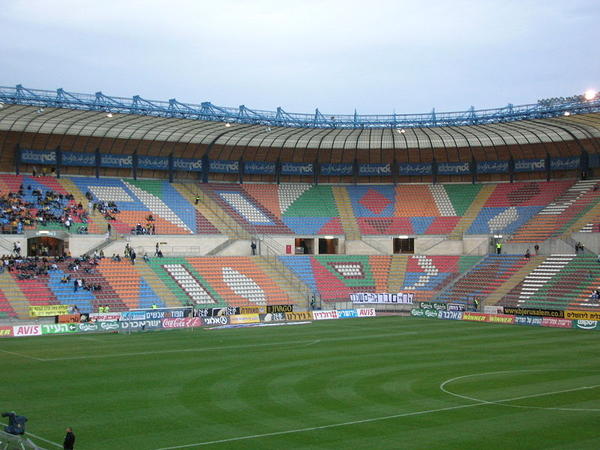 |
| Teddy Stadium |
“The reaction to the Muslim players being here is not racist,” insisted 19-year-old Akeeva, a Beitar fan. “But the club’s existence is under threat. Beitar is a symbol for the whole country.”
Jacob, another fan, agrees, “It’s just a matter of being Arab [by which he means Muslim]. It’s not racism, they just shouldn’t be here. Beitar Jerusalem has always been a clean club, but now it’s being destroyed – many of the other players are thinking of leaving because of the Muslim players being here.”
Akeeva, Jacob and many of the other fans are angry with Mr Gaydamak for bringing in Sadayev and Kadiyev to the club. After they signed the reaction among fans was so extreme that the club’s offices in Jerusalem were burnt down. The pair have been greeted with jeers and whistles every time they step out on to the pitch.
The home club of Sadayev and Kadiyev is no ordinary football team; Terek Grozny is run as the personal project of Chechnya’s leader Ramzan Kadyrov. Although he is no longer officially the club’s president, nobody doubts that he is in charge, while the money man is the oligarch Telman Ismailov, known for his lavish birthday parties in which A-list western pop stars are flown in to sing odes to him.
The unlikely dual transfer came about after a bizarre tour to Chechnya by the entire Beitar squad early this year, which went ahead against the advice of Israeli authorities. There are rumours in the Russian media that Mr Ismailov, a friend of Mr Gaydamak, had an interest in purchasing the struggling club. Rather than travel to see the team in Jerusalem, Mr Ismailov wanted to bring them to Grozny. So it was that the brief tour to the troubled Caucasus republic took place amid extremely high security. After its conclusion – and a friendly match between Terek and Beitar – it was announced that to “strengthen Israeli-Chechen friendship”, two players would be moving to Jerusalem.
“Chechens, like Jews, have a great number of difficult pages in their history and have lived through many tragedies,” said a press release from Mr Kadyrov’s office. “We have a lot in common.”
The 23-year-old Sadayev was seen as a player with some potential, but since his entrance into the Terek team five years ago he has hardly set the Russian league alight – the striker has managed just eight goals in 83 appearances. Dzhabrail Kadiyev, had never started for the Terek first team.
Sadayev said in an interview with Russian media last December, before the Israeli move was on the cards, that if he could play anywhere in the world he would like to try England.
Details of the transfers are murky, and it is unclear whether the players have moved on loan, or permanently. Calls to Terek’s press service went unanswered yesterday. After being substituted after 73 minutes on Sunday, Sadayev received a standing ovation – although by then the boo-boys had largely left. Three minutes later Netanya scored to make it 1-1 and pushed hard until the end.
Whether his performance is enough to win over the crowd remains to be seen, but perhaps he could afford to give his bodyguard the night off.
Ramzan Kadyrov: despot with a taste for social media
Terek Grozny football club is not the only plaything of Chechnya’s pro-Kremlin despot, Ramzan Kadyrov. He also has a collection of wild animals and often posts pictures to his Instagram account of himself cradling a baby leopard, perhaps.
Instagram has become the unlikely medium through which it is best to follow Mr Kadyrov – he posts several times a day, whether on policy or news that he has given his “friend” Gérard Depardieu the gift of a five-room apartment in Grozny.
Over the weekend he stated: “For some people, Instagram might just be entertainment, but for me it’s an additional burden.”
Shaun Walker
Subscribe to:
Posts (Atom)